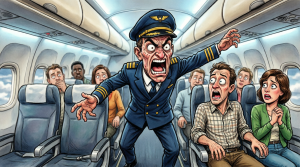
16-year-old Sarah sat in row 9, heading home after visiting her grandfather. When both pilots collapsed at 35,000 ft, panic spread through the cabin. Then the radio crackled with a voice calling for Eagle One. Sarah’s hands trembled. That was her secret code name. Only her grandfather knew it. Sarah Mitchell sat quietly in seat 9A, her backpack tucked under the seat in front of her.
She was 16 years old, wearing jeans and an old aviation club t-shirt from her school. Her brown hair was pulled back in a simple ponytail. She looked like any other teenager on a plane. Nobody would guess that in 2 hours she would be landing this aircraft. The Boeing 737 was half full that Tuesday morning. Flight 2847 from Chicago to Denver was running on time. The weather was perfect. Clear blue skies stretched endlessly outside the window. Sarah watched the clouds below, thinking about her weekend visit with her grandfather.
Her grandfather had been a pilot in the Air Force. He taught Sarah everything about flying. Every summer since she was 10, they spent hours in his basement flight simulator. He made her learn every switch, every button, every procedure. At first, it was just a game, but over 6 years, it became serious training. Sarah could fly a Boeing 737 in the simulator with her eyes closed. She knew the pre-flight checklist by heart. She understood how to read instruments, how to navigate, how to land in bad weather.
Her grandfather was strict. He never let her take shortcuts. He made her practice emergency procedures over and over again. One day, he always said, “This knowledge might save your life or someone else’s.” Sarah smiled, remembering his words. She pulled out her phone and sent him a text. halfway home. Miss you already. Thanks for the awesome weekend. Her grandfather replied quickly. Fly safe, kiddo. Remember what I taught you. Sarah put her phone away and closed her eyes. She was tired.
The weekend had been fun but exhausting. They had flown simulator missions for 12 hours total. Her grandfather had created emergency scenarios, engine failures, hydraulic problems, electrical issues. He made her solve each one. A good pilot expects the unexpected, he told her. “A great pilot is ready for anything.” Sarah drifted off to sleep, her head resting against the window. She had no idea that in 30 minutes everything would change. In the cockpit, Captain James Wilson was having a normal day.
He was 52 years old with 25 years of flying experience. Beside him sat first officer Lisa Chen, 31, with 8 years of experience. They were professionals who had flown together many times. Beautiful day, Lisa said, checking the instruments. Perfect flying weather, Captain Wilson agreed. Should be smooth all the way to Denver. They were cruising at 35,000 ft. Everything was normal. The autopilot was engaged. All systems showed green. It was the kind of flight every pilot hoped for.
Routine, boring, safe. Then Captain Wilson felt it. A sharp pain in his chest. He grabbed his shirt, his face suddenly pale. Jim. Lisa turned to him, alarmed. Are you okay? Captain Wilson tried to speak, but the pain was too intense. His breathing became rapid and shallow. Sweat appeared on his forehead. His hand clutched his chest tighter. “Jim!” Lisa reached for him, but he slumped forward against the controls. The plane dipped slightly. Lisa’s training kicked in immediately. She pulled the captain back from the controls and pressed the autopilot button to stabilize the aircraft.
Then she hit the call button for the cabin crew. Medical emergency in the cockpit. I need help now. In the cabin, flight attendant Maria Santos felt her heart jump. Medical emergency in the cockpit meant one thing. One of the pilots was in trouble. She grabbed the medical kit and rushed forward. Behind her, passengers started noticing something was wrong. The plane had dipped for just a second, but people felt it. Conversation stopped. People looked around nervously. Sarah woke up when the plane dipped.
Her simulator training made her sensitive to aircraft movements. That wasn’t turbulence. That was someone losing control for a moment. She sat up, suddenly alert. Maria entered the cockpit and saw Captain Wilson unconscious in his seat. “Oh no,” she whispered. “Heart attack, I think,” Lisa said, her voice tight with stress. She was flying the plane alone now, trying to stay calm. “Get the AED.” “Now,” Maria worked fast. She opened the captain’s shirt and attached the automatic defibrillator pads to his chest.
The machine analyzed his heart rhythm. Shock advised, the machine said in its calm electronic voice. Clear. Maria pressed the button. Captain Wilson’s body jerked, but he didn’t wake up. Lisa grabbed the radio. Denver center. This is Southwest 2847. We have an emergency. Captain is incapacitated. I need priority handling. The air traffic controller’s voice came back immediately. Southwest 2847. Roger. Squawk 7,700. What is your situation? Captain Wilson is unconscious. Possible heart attack. I am the only pilot. Requesting vectors to nearest airport.
There was a brief pause. The controller was processing this information. Southwest 2847. Nearest airport is Colorado Springs, 40 mi south. Denver is 60 mi northeast. Both have clear weather. I’ll take Colorado Springs. Lisa said it’s closer. Roger. Southwest 2847. Turn right heading 180. Descend and maintain 25,000 ft. Emergency services are being notified. Lisa began the turn. Her hands were steady, but her heart was racing. She had trained for this scenario, but training was different from reality. She was alone now, responsible for 73 passengers and four crew members.
Behind her, Maria continued CPR on Captain Wilson. “He’s not responding,” she said quietly. Lisa didn’t answer. She couldn’t think about that now. She had to focus on flying the plane. Then she felt it. A strange sensation in her head. A dizziness that came from nowhere. No, she thought. Not now. Please, not now. But her body didn’t listen. The dizziness got worse. Her vision started to blur. She had low blood sugar. She hadn’t eaten breakfast. The stress was making it worse.
Maria, Lisa said, her voice weak. I don’t feel good. Maria looked up from the captain and saw Lisa swaying in her seat. What’s wrong? Dizzy. Can’t see properly. I think my blood sugar dropped. Maria’s face went white. Two pilots down. This couldn’t be happening. Can you land? Lisa tried to focus on the instruments, but everything was swimming. I don’t know. Maybe, but if I pass out, she didn’t finish the sentence. Maria understood. If both pilots were unconscious, everyone on this plane would die.
Maria grabbed the radio with shaking hands. Denver Center, this is Southwest 2847. Both pilots are incapacitated. We need help. Immediate help. The controller’s voice changed. The professional calm cracked slightly. Southwest 2847. Say again. Both pilots. Yes. Captain had a heart attack. First officer has low blood sugar and can’t see properly. We need someone to land this plane. Silence. Just for a second. Then the controller spoke again. Faster now. Southwest 2847, standby. We’re checking for any qualified pilots in your passenger list.
In the cabin, passengers knew something was very wrong. The plane was descending. The seat belt sign was on. Flight attendants were rushing around looking scared. A man in row 14 stood up. What’s happening? Why are we descending? Sarah heard the panic in his voice. She looked toward the front of the plane. Through the open cockpit door, she could see Maria talking frantically on the radio. She could see someone slumped in the captain’s seat. Sarah’s grandfather had taught her to recognize emergencies.
This was an emergency. Another flight attendant, Tom, came on the intercom. His voice was trying to sound calm but failing. Ladies and gentlemen, we are experiencing a medical situation with our flight crew. We need to know if there are any certified pilots on board. If you are a pilot, please press your call button immediately. Nobody pressed their call button. 73 passengers looked at each other. Nobody was a pilot. Tom’s voice came back more desperate now. Please, if anyone has any flying experience at all, we need your help.
This is a serious emergency. Still nothing. Sarah’s heart was pounding. She had flying experience. 6 years of simulator training, hundreds of hours, but she wasn’t a real pilot. She was just a kid. The plane lurched slightly. Someone screamed. A baby started crying. Sarah closed her eyes and heard her grandfather’s voice. A great pilot is ready for anything. She pressed her call button. Tom rushed to her row. Yes. Do you have flying experience? Sarah looked up at him.
I’m not a certified pilot, but I’ve trained on Boeing 737 simulators for 6 years. I know this aircraft. I know the procedures. Tom stared at her. She was just a kid. Maybe 16. This was insane. How old are you? 16. But I know what I’m doing. My grandfather was an Air Force pilot. He trained me. I have over 400 hours in simulators. Tom looked at the other passengers. Nobody else had raised their hand. Nobody else had any experience.
It was this teenage girl or nobody. Stay here, he said and ran to the cockpit. He found Maria still working on Captain Wilson. Lisa was barely conscious, her head resting against the side window. There’s a passenger, Tom said. A teenage girl. She says she has simulator training. Boeing 737s. Lisa opened her eyes. How much training? She says 400 hours. 6 years. Lisa closed her eyes again. 400 hours in a simulator. It wasn’t much, but it was something.
And they were out of options. Bring her up. Sarah walked to the front of the plane. Every passenger watched her. Some looked hopeful. Most looked terrified. A girl in jeans and a t-shirt was going to land the plane. This couldn’t be real. When Sarah entered the cockpit, her training took over. She didn’t panic. She assessed the situation. Captain Wilson was unconscious. First Officer Chen was barely holding on. The plane was on autopilot, descending toward Colorado Springs. I’m Sarah Mitchell, she said, her voice steady.
Tell me what I need to do. Lisa opened her eyes and looked at Sarah. The girl was young, but her eyes were calm. That was something. Sit down. Right seat. Sarah slid into the co-pilot seat. Her hands automatically went to the controls. Everything was exactly where it should be, just like the simulator. The yolk felt real under her fingers. The instrument panel showed altitude, speed, heading. She knew every dial, every screen. Okay, Lisa said weekly. First, check your altitude and speed.
Sarah scanned the instruments. Altitude 22,000 ft. Descending. Speed 280 knots. Good. We’re descending at 1500 ft per minute. That’s normal. Keep that rate steady. Sarah’s eyes moved across the panel. Altimeter. Vertical speed indicator. Air speed. Heading. Just like practice. She could do this. The radio crackled. Southwest 2847. This is Denver Center. We have a retired airline captain on standby to assist. His name is Robert Mitchell. He’ll talk you through the landing. Sarah’s heart stopped. Did you say Robert Mitchell?
Affirmative. Captain Robert Mitchell, retired United Airlines. That was her grandfather. Somehow they had found him. Tears filled Sarah’s eyes, but she blinked them away. No time for emotions now. A new voice came over the radio. Familiar, strong, calm. Southwest 2847, this is Captain Mitchell. Who am I talking to? Sarah grabbed the microphone. Her voice cracked slightly. Grandpa, it’s me. It’s Sarah. There was a long pause. Then her grandfather’s voice came back. shocked but steady. Sarah, you’re on that plane.
Yes, I’m in the co-pilot seat. Both pilots are down. Nobody else can fly. Another pause. Sarah could almost hear her grandfather thinking. Then his voice came back. All business now. Okay, Eagle One, you ready to fly? Eagle one. That was his nickname for her. He’d been calling her that since she was 10. Sarah felt her fear start to fade. Her grandfather was with her. Everything would be okay. Ready, Grandpa? Good. First, tell me your current situation. Sarah looked at the instruments.
Altitude 20,000 ft. Speed 270 knots. Autopilot engaged. descending at 1,500 ft per minute. Heading 180. Excellent. You’re doing great. Now, listen carefully. In about 10 minutes, we’re going to start configuring the aircraft for landing. But first, I need you to take a deep breath. Can you do that? Sarah inhaled slowly, deeply. Yes. Good. Now, exhale. Remember what I taught you. The airplane wants to fly. Your job is to guide it. Trust your training. Trust yourself. Lisa, still conscious but weak, looked at Sarah with new respect.
The girl was calm. Focused. Maybe this would work after all. The air traffic controller was clearing all other traffic from the area. Colorado Springs Airport was preparing for an emergency landing. Fire trucks were moving into position. Ambulances were standing by. Everyone knew this was going to be difficult. Sarah’s grandfather stayed on the radio, his voice calm and steady. Southwest 2847, you’re 30 mi from the airport. Turn left heading 160. Descend to 15,000 ft. Sarah reached for the heading knob and dialed in 160.
The plane banked gently left. Then she adjusted the altitude setting. The plane continued its descent. Good. Her grandfather said, “You’re doing perfect. How are you feeling?” “Scared,” Sarah admitted. “But okay. Fear is good. It keeps you sharp, but don’t let it control you. stay focused on the task. In the cabin, passengers were silent. Some were praying, some were crying quietly, others just sat frozen, hands gripping armrests. Tom and Maria moved through the aisles, trying to keep everyone calm.
A man in row eight called Tom over. Is that girl really going to land this plane? Tom nodded. She’s our best option. She’s a child. She’s trained and she’s all we have. The man sat back, his face gray with fear around him. Other passengers were having similar reactions, but there was nothing anyone could do. They were passengers. Their lives were in Sarah’s hands now. Sarah’s grandfather continued guiding her. 20 m from the airport. Descend to 10,000 ft.
slow to 250 knots. Sarah adjusted the altitude and pulled back on the throttle. The engines quieted slightly. The plane slowed. She checked the vertical speed. Still,500 ft per minute. Good. Sarah, in a few minutes, we’re going to start extending flaps and landing gear. Do you remember the procedures? Yes. flaps in stages. Five, then 15, then 30, then full. Landing gear when we’re below 250 knots and 10 mi out. Perfect. You remember everything. Now, I want you to look ahead.
Can you see the airport? Sarah leaned forward and scanned the horizon. There, in the distance, she could see it. Two long gray runways stretching across the flat ground. I see it, Grandpa. Good girl. That’s where we’re going. Nice and easy. Lisa was watching Sarah with amazement. The girl was doing everything right. Her hands were steady on the controls. Her eyes moved efficiently across the instruments. She was 16 years old, but she flew like someone with years of experience.
You’re doing great, Lisa whispered. Really great. Sarah glanced at her and gave a small smile. Then she focused back on the instruments. 15 mi, her grandfather said. Descend to 8,000 ft. Slow to 230 knots. Sarah made the adjustments. The plane was getting lower now. She could see details on the ground, roads, buildings, cars. 10 mi out, her grandfather said. Time to configure for landing. First, extend landing gear. Find the gear lever on your right side. Sarah looked down.
There it was, exactly where it should be. A large lever with a wheel symbol. She took a deep breath and pushed it down. A mechanical sound filled the cockpit, worring. Clunking. Then three green lights appeared on the panel. Three green lights, Sarah reported. Gear down and locked. Beautiful. Now set flaps to five. Sarah moved the flap lever to position five. The plane’s nose dipped slightly as drag increased. She adjusted the trim to compensate. Flaps five, speed 210 knots.
Perfect. You’re a natural, eagle one. Sarah allowed herself a tiny moment of pride. Then she refocused. They weren’t done yet. The hardest part was coming. The air traffic controller’s voice was tense, but professional. Southwest 2847. You’re 8 mi from the runway. Turn left heading 140. Descend to 6,000 ft. Sarah made the turn. The runway was directly ahead now. She could see the white markings clearly. Set flaps 15, her grandfather instructed. Slow to 180 knots. Sarah extended the flaps further and reduced speed.
The plane felt heavier now, more sluggish. That was normal. That was what landing configuration felt like. 5 mi out, the controller said. You’re cleared to land runway 35 right. Wind calm. Sarah’s heart pounded. Cleared to land. This was it. Okay, Sarah. Her grandfather’s voice was calm and strong. Set flaps 30. Slow to 150 knots. Sarah moved the flap lever again. The plane slowed to approach speed. 3 mi out. Set full flaps. Slow to 140 knots. That’s your landing speed.
Sarah extended the flaps fully. The plane settled into its final approach configuration. Speed 140 knots. Altitude 3,000 ft. Runway straight ahead. Now listen carefully, her grandfather said. You’re going to follow the glide slope down. You see the two pink diamonds on your display. Sarah looked at the navigation screen. Two diamond symbols were visible. One was moving down toward a line. I see them. Keep the moving diamond on the line. That’s your correct descent path. If the diamond goes below the line, you’re too high.
If it goes above, you’re too low. Sarah watched the diamond carefully. It drifted slightly above the line. She added a touch of throttle. The diamond moved back to center. “Perfect,” her grandfather said. “You’ve got this.” 2 mi out. The runway was huge now, filling the windscreen. Sarah could see individual lights along its edges. Her hands were sweating, but they were steady. In the cabin, every passenger was silent. Even the babies had stopped crying. 73 people held their breath.
Maria stood in the aisle, her hands clasped in prayer. Tom gripped a seat back, his knuckles white. They were powerless. Everything depended on the teenage girl in the cockpit. One mile, her grandfather said, “You’re looking good, Sarah. Keep it steady.” Sarah’s eyes were locked on the runway. The diamond stayed centered. Altitude 1,000 ft. Speed 140 knots. Everything perfect. When you’re about 50 ft above the ground, her grandfather continued. You’re going to do something called a flare. That means you gently pull back on the yolk.
Just a little. It slows your descent and lets you land smoothly. I’ll tell you when. Okay. Sarah’s voice was barely a whisper. 500 ft. The ground was rushing up at her. She could see details now. grass beside the runway, tire marks on the pavement. 300 ft. Her heart was racing, but her hands stayed steady. 100 ft. 50 ft. Flare now, Sarah. Pull back gently. Sarah pulled the yolk back. The plane’s nose lifted slightly. The descent slowed. The runway was right there, right beneath her.
The main wheels touched down. A soft thump. Then the nose will settled. Another thump. They were on the ground. Brakes. Her grandfather shouted. Top of the rudder pedals. Sarah pressed down hard. The plane began to slow. The engines roared as thrust reversers deployed automatically. The speed dropped rapidly. 80 knots. 60 knots, 40 knots, 20 knots. The plane rolled to a stop halfway down the runway. Sarah sat frozen, her hands still gripping the yolk. They were on the ground.
They were alive. Everyone was alive. The radio exploded with voices. Southwest 2847, you’re down. You did it. Emergency vehicles are approaching. Her grandfather’s voice cut through all the others. Eagle one, I am so proud of you. You just saved 77 lives, including your own. Sarah started to cry. Relief, fear, joy, everything at once. The next few minutes were chaos. Emergency vehicles surrounded the plane. Paramedics rushed aboard. They loaded Captain Wilson onto a stretcher. He was still alive, barely, but alive.
They helped Lisa Chin out next. She was conscious now, her blood sugar stabilized, but weak. Sarah stayed in the cockpit, unable to move. Maria came in and hugged her tight. “You did it! Oh my god, you did it!” When Sarah finally walked into the cabin, every single passenger stood up and applauded. They were crying, laughing, cheering. Some reached out to touch her arm as she passed. Others just stared at her in amazement. The businessman from row 8, the one who had been so skeptical, stopped her.
Tears streamed down his face. “I’m sorry,” he said. “I doubted you. I thought we were dead. Thank you. Thank you for saving my life. Sarah nodded, not trusting herself to speak. Outside, news crews were already gathering. The story was spreading fast. Teenage girl lands commercial jet. Both pilots down. Miracle in Colorado Springs. Sarah was led off the plane and into a private area. Her grandfather was there waiting. When she saw him, she ran into his arms and sobbed.
I was so scared, Grandpa. I know, sweetheart. But you did it. You stayed calm. You remembered everything. You were perfect. Captain Wilson survived. He had emergency heart surgery and made a full recovery. First Officer Chen was treated for low blood sugar and released the next day. Both pilots sent Sarah messages thanking her and calling her a hero. The FAA launched an investigation, but it was just a formality. Everyone agreed Sarah had done the impossible. She had saved 77 lives with skill, courage, and the training her grandfather had given her.
The media went crazy. Sarah’s face was on every news channel. Teen hero lands plane. Miracle in the sky. Granddaughter follows in grandfather’s footsteps. But Sarah didn’t care about fame. She cared about the people she had saved. The 73 passengers who went home to their families, the crew who survived. Captain Wilson, who was alive because she got the plane down in time. 3 months later, Sarah received a letter from the FAA. They were offering her a special program, accelerated flight training.
she could get her commercial pilot license as soon as she turned 18. Multiple airlines were already interested in hiring her when she was old enough. Sarah showed the letter to her grandfather. What do you think I should do? He smiled. I think you should finish high school first. Then we’ll talk about flying. But I want to fly now. I know. But good pilots are patient. Great pilots know when to wait. He paused. Besides, you’ve got plenty of time.
The sky isn’t going anywhere. Sarah nodded. He was right. She was only 16. She had her whole life ahead of her. But she had learned something important that day over Colorado Springs. She had learned that she was capable of more than she ever imagined. She had learned that training mattered. That preparation saved lives. That courage wasn’t the absence of fear, but acting despite it. She had learned that sometimes ordinary people are called to do extraordinary things. And when that moment comes, you don’t run from it.
You step up. You take the controls and you fly. Sarah Mitchell, now 21, sat in the captain’s seat of a regional jet. She had finished high school, completed flight training, and earned her commercial pilot license. She was one of the youngest commercial pilots in the country. Her co-pilot today was a man in his 30s, experienced and professional. He knew Sarah’s story. Everyone in aviation knew her story. Nervous, he asked as they prepared for departure. Sarah smiled a little, but in a good way.
They pushed back from the gate. Sarah taxied to the runway, completed the pre-flight checks, and advanced the throttles. The plane accelerated down the runway and lifted smoothly into the sky. As they climbed through the clouds, Sarah thought about that day 5 years ago. The fear, the pressure, the weight of 77 lives depending on her. She thought about her grandfather’s voice guiding her down. She thought about the moment the wheels touched the runway and everyone lived. That experience had changed her.
It had shown her who she was and who she could become. It had given her purpose and direction. It had turned a hobby into a calling. Now flying wasn’t just something she loved. It was who she was. The radio crackled. Regional 847. Contact departure. Sarah keyed the mic. Regional 847, contacting departure. She smiled. The flight number was 847. The same as that day. Maybe it was coincidence. Maybe it was fate. Either way, it felt right. She leveled off at cruising altitude, engaged the autopilot, and looked out at the endless sky.
clear, blue, beautiful. Her grandfather had been right about everything. The airplane did want to fly. Her job was just to guide it, and she had learned to do that better than she ever dreamed possible. Somewhere below, in row nine of countless planes, other kids sat with their own dreams. Maybe one of them was learning to fly. Maybe one of them would face their own emergency someday. Maybe one of them would save lives because they were prepared. Sarah hoped so.
Because the world needed pilots. It needed people who stayed calm under pressure. People who trained hard. People who were ready when the moment came, people like her grandfather. And now people like her. She was just a kid in row 9 once. But when the pilot called for help, she answered. and that made all the difference. Three years passed. Sarah was now 24 and flying for a major airline. She had been promoted to captain on regional routes faster than anyone in company history.
But success hadn’t changed her. She still remembered where she came from. She still remembered that terrifying day when everything depended on her. One afternoon, Sarah received a call from her grandfather. His voice was weak, different from the strong, confident tone she remembered. Sarah, I need to see you. Can you come visit? She flew to Chicago the next day. When she arrived at his house, she found him sitting in his favorite chair, thinner than before, moving slowly. He was 83 now.
Age was catching up with him. Grandpa, are you okay? Sarah sat beside him, taking his hand. He smiled. That same warm smile from her childhood. I’m fine, sweetheart. Just old. But I wanted to talk to you about something important. He led her down to the basement to the flight simulator where everything had started. The equipment was old now, outdated, but still functional. Sarah felt a wave of nostalgia wash over her. This is where you taught me everything, she said softly.
Yes. And now I want you to teach others. He handed her an envelope. Inside were documents, legal papers. I’m donating this house to create a flight training center for kids who can’t afford expensive pilot schools. Kids who dream of flying but think it’s impossible. Sarah’s eyes filled with tears. Grandpa, this is your home. It’s just a building, but it can become something more. A place where the next generation learns, where they prepare for their moment, just like you did.
He paused, catching his breath. I want you to run it. The Sarah Mitchell Flight Academy. Will you do it? Sarah couldn’t speak. She just nodded and hugged him tight. 6 months later, the academy opened. 15 students enrolled in the first class. Kids from different backgrounds, different circumstances, but all sharing the same dream. Sarah taught them everything her grandfather had taught her. Discipline, focus, respect for the machine, preparation for emergencies. One student stood out, a 13-year-old girl named Emma Rodriguez.
She was quiet, serious, and completely devoted to learning. She reminded Sarah of herself at that age. “Why do you want to fly?” Sarah asked her one day. Emma looked up with determined eyes. “Because my dad died in a plane crash when I was little. Everyone says planes are dangerous, but I want to prove they’re wrong. I want to be the pilot who keeps everyone safe.” Sarah saw herself in that answer. The same passion, the same purpose. Years passed.
The academy grew. Hundreds of students trained there. Many went on to become pilots. Some joined airlines. Others flew private planes. A few joined the military. But all of them carried forward the same principles. Stay calm. Stay prepared. Stay ready. Sarah kept flying, too. She never stopped. But her real joy came from teaching. From seeing young faces light up when they completed their first successful landing in the simulator. From knowing she was creating the next generation of pilots who would be ready when their moment came.
One day, Sarah received an email from Emma Rodriguez. She had just been hired by a major airline. She was 22 years old and beginning her dream career. Thank you for believing in me, Emma wrote. Thank you for showing me that impossible things are possible. I promise to honor everything you taught me. If I ever face an emergency, I’ll be ready, just like you were. Sarah read the email three times. Then she walked down to the simulator room where a new class was starting.
She looked at the young faces staring up at her, hopeful, eager, ready to learn. “Good morning,” Sarah said. “Welcome to the Sarah Mitchell Flight Academy. I’m going to tell you a story. A story about a 16-year-old girl who sat in row nine of an airplane. She was just a passenger, just a kid. But when the impossible happened, she was ready. Do you know why she was ready? The students shook their heads. Because someone taught her. Someone believed in her.
Someone prepared her for a moment she never expected to face. Sarah smiled. And that’s what we’re going to do here. We’re going to prepare you not just to fly planes, but to handle whatever life throws at you. To stay calm when others panic. to act when others freeze, to save lives when it matters most. She paused and looked at each student. You might never face an emergency like I did. I hope you don’t, but if you do, you’ll be ready.
That’s my promise to you.” The students nodded, their eyes shining with determination. Sarah began the lesson. As she taught, she felt her grandfather’s presence. She felt the weight of his legacy and her own. She thought about Captain Wilson alive today because she was prepared. She thought about 73 passengers who went home to their families. She thought about all the future lives that would be saved because of the training happening in this room. Flying wasn’t just about controlling an airplane.
It was about responsibility, about dedication, about being ready for your moment when it came. Sarah had learned that lesson in the hardest way possible. And now she was passing it forward, ensuring that the next generation would be ready, too. Because somewhere out there on some future flight, another impossible situation would happen. Another emergency would occur.