You come to Chicago at eighteen with two shirts, one pair of work boots, and a body built for carrying things other men don’t want to lift.
Back in the little town outside Oaxaca where you were born, the corn never stretched far enough. It filled the field, but not the future. The roof leaked every rainy season. Your mother patched the same shirts until the fabric grew thinner than prayer. Your father’s back curved earlier than it should have from years of work that never paid like it promised. By the time you were old enough to understand money, you already knew the cruelest part of poverty was not hunger. It was repetition.
So you left.
You crossed the border of your old life with a cheap duffel bag and an address written on a folded paper in your pocket, the number of a man from your village who knew somebody in Chicago who knew somebody in construction. The city hit you like a machine the first week. Noise, wind, traffic, towers of glass catching light in ways that made you feel both insignificant and furious. You slept in a cramped room in Little Village with four other laborers, breathing drywall dust and cheap detergent and the sour fatigue of men who worked too hard to dream properly.
You did not have education. You did not have English beyond job words and survival words. You did not have a trade certificate or a polished story or a family name anyone cared about in Illinois.
What you had was endurance.
And for two years, endurance was enough to keep you alive.
You hauled materials. Mixed concrete. Cleaned sites after electricians and plumbers left their messes behind. Ate tacos from a truck three blocks from whatever project you were sweating through that week. Sent money home when you could. Slept with your phone under your pillow because your mother was getting older and your father’s cough was getting worse and no call after midnight ever brought good news.
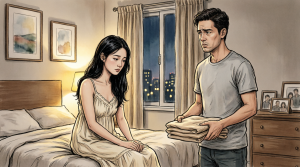
You told yourself you were building toward something, even if you couldn’t yet see its shape.
Then one November afternoon, your supervisor told you the owner wanted to see you.
Not the site manager. Not the foreman. The owner.
Men like Arthur Whitmore usually existed in glimpses. A black SUV at the curb. A polished shoe stepping around mud. A voice from a distance asking why the west side schedule had slipped. He owned half the developments your company touched on the North Side and spoke like every word was part of a negotiation already tilted in his favor. You had seen him maybe four times in two years. He had never once spoken directly to you.
When you walked into his office on the top floor of a building still half-finished, your boots felt too dusty for the carpet.
He didn’t invite you to sit right away. He just looked at you.
You would remember that look later. Not cruel, exactly. Not warm either. Evaluating. Like a man studying a horse he might buy if the legs seemed sound.
Finally he said, “You’re from Mexico.”
“Yes, sir.”
“You don’t drink on site.”
“No, sir.”
“You send money home.”
That startled you enough that your eyes flicked up. He noticed.
“I know things about the men who work for me,” he said. “The useful ones.”
Then he sat and gestured toward the chair across from his desk.
“Sit.”
You sat.
The office smelled like leather, cedar, and the kind of expensive coffee served by machines no laborer ever touched. Through the unfinished glass behind him, the city spread in steel and dirty winter light. Arthur folded his hands.
“I’m going to offer you a way out of the life you’re in,” he said.
Men like him did not offer exits. They offered trades.
You understood that immediately.
Still, you listened.
“My daughter needs a husband,” he said.
For a second, you thought you had misheard him.
“Sir?”
He did not blink. “You heard me.”
You had seen her once, maybe twice. Vivian Whitmore. Forty-five years old. Big enough that people pretended not to stare while staring anyway. The tabloids in grocery store lines loved women like her, rich women whose bodies made them easy targets for public cruelty. The men on site called her things when they thought nobody important could hear. The unmarried daughter. The recluse. The embarrassment. The heiress nobody wanted. You were ashamed now to remember that sometimes you had kept walking instead of telling them to shut up.
Arthur continued in the same calm voice.
“If you marry her, I will put you in charge of managing twelve apartment buildings in Logan Square and Avondale. You’ll get a salary. A small house. A company truck. Legal help for residency. Enough income to bring your parents here if you choose.”
The room went still around you.
That kind of offer does not feel real when you have spent your life counting bus fare.
It feels like a trap shaped like mercy.
You swallowed. “Why me?”
“Because you are disciplined. Because you are not lazy. Because you do not have the habit of talking too much. Because men with better resumes think they are too good for this arrangement, and men with worse instincts would humiliate her.”
Arrangement.
Not marriage. Arrangement.
There it was, clean and ugly between you.
You should have stood up. Maybe a better man would have. A man with more pride, more freedom, more imagination about what his life could still become without being bought into someone else’s family. But poverty does something obscene to the moral imagination. It narrows it until survival starts dressing like destiny.
Arthur watched you absorb the terms.
“You don’t have to love her,” he said. “You do have to treat her with respect.”
That sentence should have comforted you.
Instead it made your stomach turn.
Because somewhere underneath the transaction, buried inside the arrogance of it, was a truth even he seemed to know. His daughter had been hurt enough by this world that basic decency had become a negotiable asset.
“I want one night to think,” you said.
He nodded. “You have until tomorrow morning.”
That night you did not sleep.
The men in your room played cards and argued over soccer highlights on their phones. Someone snored before midnight. A train rattled in the distance. You lay on your mattress and stared at a water stain on the ceiling while your whole future rotated slowly above you like something suspended on a hook.
If you said no, you went back to the site. Back to the dust, the cold, the years passing one cracked knuckle at a time. Maybe you saved enough eventually for a used truck and a studio apartment. Maybe not. Maybe your father died before you got him real medicine. Maybe your mother kept pretending she wasn’t tired because sons far away can only bear so much truth.
If you said yes, you were selling something.
Not your body exactly, though part of that too. Not only your freedom, though that was certainly included. You were selling the illusion that marriage begins in desire or hope. You were accepting a life offered to you by another man’s calculation.
But poor men are not often granted the luxury of clean choices.
By sunrise, you had your answer.
You went back to Arthur’s office at eight sharp and said yes.
He nodded once, as if confirming a delivery window.
“The wedding will be small,” he said. “Three weeks.”
That was it. No congratulations. No false tenderness. Just logistics.
Your friend Diego stared at you that evening like you had announced you were moving to the moon.
“You serious?” he asked.
You sat on overturned buckets behind the site smoking a cigarette you didn’t even want. Wind cut through the alley and turned your fingers stiff.
“Yes.”
He looked at the glowing tip of his own cigarette. “Do you want to?”
You considered lying and decided you were too tired. “I want what comes after.”
Diego let out a low breath. “And what if what comes after is worse?”
You didn’t answer because that was the real question, and the real answer was one poor men learn early. Worse is never a dealbreaker when current life is already grinding you down. Worse is just another flavor of risk.
The wedding took place in a stone church in Oak Park under a sky the color of wet cement.
No family from Mexico came. You could not afford the flights, and even if you could have, how would you explain this without hearing your mother’s silence all the way through the phone? Diego stood beside you in a suit borrowed from his cousin. Arthur stood with the kind of posture money teaches men from birth. A few business associates attended because powerful people like witnesses for their arrangements. There were flowers, white candles, polished wood, and a quartet playing music too elegant for the deal being sealed beneath it.
Then Vivian walked in.
You had expected awkwardness. You had expected pity from the guests and nervous contempt from the men who thought themselves above this spectacle. What you hadn’t expected was dignity.
She wore a simple gown, not one of those glittering excesses rich weddings sometimes use to apologize for deeper ugliness. Her dress was clean-lined, high at the neck, graceful without pretending her body was anything other than what it was. She moved slowly, not because she was ashamed, but because she refused to rush to satisfy anyone’s discomfort. Her face was beautiful in a way people often miss when they have already decided what kind of beauty counts. Large dark eyes. Intelligent mouth. Skin like polished cream under the church lights.
And in those eyes was fear so quiet it almost looked like serenity.
You understood then that she had no illusions about why you were there.
That made it harder.
During the vows, her voice trembled only once. Yours sounded like it belonged to someone farther away. When the priest pronounced you husband and wife, polite applause filled the church. Arthur’s jaw relaxed by half an inch. Diego looked like he might be ill on your behalf.
At the reception in a private room above a restaurant, people drank expensive wine and called you lucky in tones that managed to insult both you and your new wife at the same time. Vivian barely ate. She smiled when spoken to, thanked people for coming, and survived the evening with the controlled endurance of someone who had practiced public humiliation so long it had become an art form.
Much later, after the cake and the speeches and the awful jokes from Arthur’s partners about your “promotion,” you followed her upstairs to the suite her father had reserved in the hotel attached to the restaurant.
The room was larger than the apartment where five laborers shared one bathroom. Larger than your parents’ whole house back home. Heavy curtains. Cream walls. A bed wide enough to lose yourself in. A tray of chocolate-covered strawberries and champagne none of this evening had earned.
Vivian was already sitting on the edge of the bed when you entered.
She had changed out of the gown and into a pale blue nightshirt that fell loosely around her body. Her hair was down now, thick and dark against her shoulders. Without the public armor of the dress and the reception smile, she looked younger and somehow more fragile, though not weak. Fragility and weakness are not the same. You knew that from the women back home who carried water in buckets and still sang.
“Close the door,” she said gently.
You did.
For a moment neither of you spoke.
You had promised yourself you would be decent. That whatever ugliness this marriage contained, you would not add to it by being cruel or crude or visibly disgusted. You had spent days preparing for discomfort, for duty, for the possibility that the bed itself would feel like a transaction stamped in flesh.
Vivian kept her hands folded in her lap.
“You don’t have to force anything tonight,” she said. “Or ever, if we can come to terms. My father has his reasons for wanting appearances. I have mine for wanting peace.”
You stared at her.
She gave a small, humorless smile. “I’m not stupid. And I’m not sentimental.”
The honesty of that hit harder than pity would have.
You stepped closer slowly. “I said yes.”
“Yes,” she replied. “For a house and a truck and a future. I know.”
There was no accusation in it. That made it worse.
You sat beside her on the bed, leaving distance between you. “I will try to be a good husband.”
She looked down at her hands. “That would already make you better than most men who claimed they wanted me.”
You did not know what that meant. Not yet.
The room had gone very quiet. Outside the windows, traffic hummed several floors below. Somewhere in another suite a muffled laugh broke and disappeared. Vivian’s breathing was steady, but you could feel tension in the space around her like a wire pulled too tight.
Then she said, almost casually, “There’s something you should see before you decide what kind of husband you can be.”
She lay back slowly and pulled the blanket over herself, then nodded once toward the edge of it. “Go on.”
This was the moment you had been dreading since Arthur first made the offer. The moment where your bargain would become physical reality. You braced yourself for shame, for revulsion, for your own cowardice, for the possibility that the rest of your life might begin with a flinch you could never take back.
You reached out and lifted the blanket.
And froze.
Not because of anything vulgar. Not because of flesh. Not because of her size.
You froze because both of Vivian’s thighs, her lower abdomen, and the side of her hip were covered in scars.
Some were old, pale and thick, the kind that had healed badly years ago. Some were newer, ridged and angry, crossing each other in cruel ropes of history. On the inside of her left wrist, disappearing under the sleeve, was another cluster. You saw the aftermath of surgeries, yes, but also other damage. Not medical. Not accidental. Damage made by violence, by neglect, by a long war waged against a body that had become an easy target for the world.
The sound that left your mouth was not desire or disgust.
It was shock.
“My God,” you said.
Vivian closed her eyes for one second, as if she had expected another reaction but found this one survivable. “Yes.”
You couldn’t move.
In all the cruel stories the workers told, in all the gossip that floated around her name, no one had ever mentioned this. They had reduced her to weight, to age, to punchline. Not one had spoken of what had happened to her. Of course they hadn’t. That would have made her human, and mockery needs distance to survive.
“What happened?” you asked, your voice low and hoarse.
She opened her eyes and looked straight at the ceiling. “Too many things.”
You waited.
At last she said, “When I was sixteen, I needed emergency abdominal surgery after an untreated infection. My mother was already gone, and my father was building his empire. He sent assistants. Not himself. The doctors saved me, but the incision split twice because I gained weight and no one managed the recovery properly. The other scars came later.”
She touched one lightly. “A trainer my father hired when I was twenty believed humiliation was motivational. He pushed me until I collapsed on a treadmill and tore the skin on the machine when I fell. A doctor he found later tried an experimental procedure because my father thought money should buy miracles. It didn’t. Then came the diets, the injections, the clinics, the private retreats where everyone was polite until they thought I wasn’t listening.”
Every sentence felt like a nail sliding into wood.
You looked at her differently now. Not as the unwanted daughter of a rich man offering you escape. Not even as your wife, exactly. More as a survivor sitting in the center of a narrative everyone else had flattened for convenience.
“And your father?” you asked.
A faint smile crossed her mouth, bitter and intelligent. “He loves me in the way some men love things they consider damaged but still theirs.”
That was when you understood the real bargain.
Arthur had not simply purchased a husband for his daughter. He had arranged for someone stable, manageable, grateful, someone who might keep her calm, quiet, and contained while he preserved the appearance of family order. He had solved a social problem with labor, just as rich men often do.
Vivian turned her head toward you. “You can leave now if you want. My father would be furious, but I would survive it.”
The room seemed to tilt slightly.
All your fear about touching her, sleeping beside her, living inside this transaction suddenly looked childish next to the enormity of what had been done to her in the name of love, treatment, rescue, family reputation. You thought about your mother back home pressing aloe on your childhood cuts with rough, careful hands. You thought about the men on site laughing at Vivian’s name. You thought about Arthur’s cool voice saying you did not have to love her, only respect her.
As if respect were a modest request.
Very slowly, you lowered the blanket back into place.
Then you said the only honest thing you had.
“I’m not leaving.”
Vivian’s eyes widened just a little. “Because of the house?”
“No,” you said.
That answer surprised both of you.
For a long moment she searched your face, as if looking for the hidden clause behind the sentence. When she found none, something in her posture changed. Not relaxed exactly. But less braced for impact.
“You should sleep,” she said quietly.
So you did what no one had prepared you for. You took off your jacket, loosened your tie, and lay down on top of the blanket beside your wife without touching her. The city kept moving beyond the glass. In the dark, after a while, she said, “Thank you,” in a voice so small it almost vanished into the room.
You did not answer because your throat had gone tight in a way you did not understand.
The next morning Arthur invited you both to breakfast in his penthouse.
The table alone probably cost more than your parents’ house. Silver trays. Fresh fruit. Coffee poured by a woman who moved so quietly she might have been part of the architecture. Arthur studied you over the rim of his cup.
“Well?” he said.
Vivian buttered toast with steady hands. She did not look at either of you.
“Well what?” you asked.
Arthur’s gaze sharpened. “Is the arrangement acceptable?”
The old version of you would have said yes immediately. Would have taken the truck keys, the management documents, the new life, and swallowed everything else because poor men know how to survive by not asking questions. But something in the hotel room the night before had changed the weight of your own silence.
“Yes,” you said carefully. “But I want to know the actual job.”
Arthur seemed mildly amused. “You’re in no position to negotiate.”
“Maybe not,” you replied. “But if I’m managing your buildings, I need to know whether you want a husband for your daughter or a servant who signs paperwork.”
Vivian’s knife paused over the toast.
Arthur leaned back.
For a moment you thought you had made a catastrophic mistake. Then, unexpectedly, he smiled.
“There he is,” he said. “I was wondering how long it would take.”
You had no idea what he meant.
The management job, it turned out, was real. Not a title invented to decorate your dependence, but actual responsibility under the supervision of the company’s senior property director. You would learn rent systems, maintenance scheduling, tenant disputes, contractor oversight, and the thousand moving pieces of keeping buildings profitable and habitable. The house in Logan Square was also real. A modest brick two-flat with one unit renovated for you and Vivian, the other occupied by an older Puerto Rican widow named Mrs. Alvarez who had already been told to keep an eye on you.
“Why?” you asked Arthur later when Vivian stepped away. “Why me?”
He looked toward the windows, Chicago spread cold and glittering below. “Because men with class think marrying my daughter is beneath them. Men with ambition often lack loyalty. Men with pity are intolerable. You looked like a man who understood hardship without turning it into performance.”
It was the nearest thing to praise he had probably given anyone in years.
It still didn’t absolve him.
Married life began strangely.
Not with love. Not with desire. Not even with clear resentment. With observation.
Vivian slept on her side of the bed and kept a lamp on until late, reading dense biographies and legal thrillers while you pretended not to watch how gentle her hands were with pages. You learned she had three graduate degrees people never mentioned because the world prefers a woman’s body to her mind when choosing what to mock. She learned you could fix almost anything mechanical and had a habit of waking before dawn even on weekends because poverty teaches the body not to trust abundance.
The house felt too quiet at first.
Too clean. Too spacious. You kept thinking someone would come tell you there had been a mistake. That the bed, the kitchen, the stack of clean towels, the truck parked outside, all of it belonged to another life and you had only wandered into it by accident. Vivian seemed to understand this without your saying it. She didn’t crowd you with questions. Didn’t act grateful. Didn’t act superior. She simply moved through the rooms like a person trying not to scare a stray animal.
At work, things got harder before they got better.
The employees under the property director saw you as the boss’s charity project. The immigrant laborer upgraded by marriage. The guy who must have gotten lucky in some ugly fairy tale they could laugh about over lunch. A few were openly disrespectful until you solved problems faster than they expected and refused to let anyone talk down to maintenance staff because you had been maintenance staff three weeks earlier. Competence, you learned, earns respect slowly and resentment immediately.
At home, Vivian watched you come back tired and dirt-smudged, still carrying yourself like a worker even in clean clothes.
One night, about two months into the marriage, she asked, “Do you hate me for what this gave you?”
The question caught you so off guard that you answered honestly before pride could intervene.
“No.”
She looked up from her book. “That wasn’t the whole question.”
You sat at the kitchen table with a late sandwich in your hands and thought about it. “I hated what I thought this was. Before. The deal. The way your father said it. The way people talk about you.”
“And now?”
“Now I think the ugliest part wasn’t marrying you.” You met her eyes. “It was how easy everyone made it to forget you’re a person.”
Vivian held your gaze so long you had to look away first.
That was the first time she smiled at you without irony.
It happened slowly after that.
Not romance all at once. Life is rarely that theatrical in the moments that matter most. But an easing. A rhythm. Shared coffee in the kitchen. Sarcastic observations during charity dinners Arthur forced you both to attend. Evenings on the back porch when the summer heat sat heavy over the city and Vivian talked about urban policy, architecture, and the books she wanted to write but never believed anyone would publish under her name rather than her father’s.
You began to see all the rooms inside her.
The sharp wit. The ferocious memory. The tenderness with children, especially the ones in tenants’ families who didn’t stare at her body because children often learn cruelty from adults and innocence from somewhere better. The loneliness she carried not like weakness but like weather that had settled into her bones.
And because truth has a nasty sense of timing, that was when you began to love her.
Not all at once. Not with fireworks. More like recognition. Like discovering one day that a language you thought you would always translate now makes sense directly in your blood.
That frightened you more than the wedding had.
Because loving Vivian meant admitting the bargain had changed. It was no longer survival. It was vulnerability. Real marriage, the kind nobody could arrange safely because it asks too much of pride.
Arthur noticed before either of you said anything.
He called you into his office one evening after a tenant hearing and closed the door with that careful soft click powerful men use when they’re about to become dangerous.
“You’re getting ideas,” he said.
You stood very still. “About what?”
“About my daughter.”
That angered you instantly, though you kept your face calm. “She’s my wife.”
Arthur’s eyes went cold. “On paper. Do not confuse gratitude with belonging.”
There it was. The center of him.
He had bought you to stabilize her life, but he did not believe either of you had the right to build something beyond his design. Vivian was to remain his daughter first, dependent orbit second, wife a distant third. You were to remain useful, upwardly mobile, and grateful. Love would complicate the structure because love creates loyalties money cannot fully control.
“I care about her,” you said.
He almost laughed. “You care about what she represents.”
“No,” you said. “I know what that looks like. I’ve lived inside it.”
That landed harder than you intended.
Arthur stood and walked to the window. “My daughter is not your redemption story.”
“Maybe not,” you answered. “But she’s not your project either.”
The silence that followed could have cracked stone.
“You are forgetting where you came from,” he said at last.
The terrible thing was, you weren’t.
You remembered exactly where you came from. Which was why you recognized exploitation even when it wore tailored suits and paternal concern. Poor men do not need lectures on power. We know it when we see it. The rich just prefer to call their version love.
When you told Vivian about the conversation, she did not seem surprised.
“He never planned for us to become allies,” she said.
The word allies did something to you. It felt both smaller and more honest than soulmates. More earned.
“What did he plan?” you asked.
She looked out at the yard where late autumn had stripped the last leaves from the fence line. “Containment. Respectable containment.”
“And if we don’t stay contained?”
Her smile this time had teeth. “Then perhaps we finally become inconvenient.”
The crisis came six months later.
Arthur suffered a minor stroke at a board meeting. Not fatal. Not even disabling in the long term. But enough to expose weakness, and weakness in a business empire attracts predators the way blood attracts sharks. Two senior executives moved quickly, trying to box Vivian out of family voting structures they assumed she barely understood. Arthur, stubborn and half-recovering, responded by trying to centralize control further, which only widened the fractures.
Then the real surprise surfaced.
Vivian already knew the company better than any of them.
She had spent years quietly reading reports no one believed she cared about. Sitting in on calls under the pretense of family obligation. Tracking tax structures, debt exposures, development liabilities, board politics, and labor disputes while the world dismissed her as decorative failure. When the executives made their move, she dismantled them in one meeting so efficiently that one of them actually forgot to breathe for a few seconds.
You watched from the side of the room, technically not important enough to speak, and felt awe rise in you like heat.
Afterward, in the parking garage, you said, “Why did you let them underestimate you for so long?”
She stood beside the black sedan, wind pulling strands of hair loose around her face. “Because when people think you’re harmless, they stop hiding their worst intentions.”
That should have been terrifying.
Instead it was magnificent.
Arthur began leaning on her more after that, though never with full humility. Men like him would rather bleed than admit dependence cleanly. Still, something had changed. Vivian was no longer a problem to be managed. She was now the mind stabilizing the empire he had built. And once she took even partial control, she began changing things.
Tenant protections.
Worker safety reviews.
Real health coverage for site laborers.
Transparent injury reporting.
Scholarship funds for employees’ children.
A formal harassment system that finally punished the kind of foremen who treated immigrant workers like replaceable tools.
You recognized pieces of your old life being repaired in policy language.
One night, after everyone else had left the office, you found her in the conference room with her heels off and files spread around her like battlefield maps.
“You did all this because of the company?” you asked.
She looked up. “Not only.”
“Then why?”
She closed the last file and sat back. “Because I got tired of watching men call cruelty efficiency.”
You loved her so fiercely in that moment it scared you.
So you told her.
Not with grand speech. Not with flowers or some polished line from movies neither of you trusted. You just stood in the fluorescent quiet and said, “I need to tell you something before it grows mean inside me.”
Her eyes stayed on yours.
“I didn’t marry you for love,” you said. “You know that.”
“I do.”
“But I love you now. And I think maybe I have for a while.”
She stared at you for so long you began to feel each second physically.
Then she laughed.
Not at you. In disbelief. In relief so sharp it sounded almost broken.
“You idiot,” she whispered.
Your heart kicked hard against your ribs. “That’s not the response I hoped for.”
She stood slowly. “I’ve been in love with you since the night you saw my scars and looked horrified for me instead of by me.”
Every breath in your body seemed to stop and restart at once.
“You could have said something.”
“So could you,” she replied.
And because life is strange and human beings are often ridiculous even in sacred moments, the first time you kissed her as people who had finally told the truth, you knocked a stack of lease files off the table and both burst out laughing halfway through.
That was how your real marriage began.
Not in a church.
Not in a bargain.
Not under her father’s gaze.
In a fluorescent conference room with policy binders on the floor and two people old enough to know better, honest enough to finally stop pretending.
The months that followed were the happiest you had ever known.
Not perfect. She still had bad pain days from the old injuries. You still carried a migrant’s old instinct to hoard canned food and expect disaster. Arthur remained Arthur, which is to say an intelligent storm in a suit. But love made ordinary things holy in ways poverty and shame had both tried to teach you were impossible.
Shopping together on Saturday mornings.
Falling asleep with a book open on her chest and your hand resting over hers.
Cooking badly together until Mrs. Alvarez came upstairs and rescued the chicken from your shared incompetence.
Taking drives with no destination just because for the first time in your life gasoline and time both belonged to you.
And because happiness always makes the world curious, people began to talk.
At first in whispers. Then in photos. Then in the kind of breathless online language strangers use when they discover a story that unsettles their prejudices. Construction laborer marries reclusive heiress. But the headlines shifted as Vivian took visible control of the company and began speaking at housing conferences, labor panels, and university events. She was brilliant onstage. Calm, surgical, funny in a dry lethal way that made journalists forget how they intended to patronize her.
The same world that once called her unwanted now called her formidable.
It disgusted both of you.
“You notice,” she said one night, scrolling through an article that praised her recent keynote, “that nobody says I got smarter. Only that I became visible in ways they can monetize.”
You took the phone from her and set it aside. “Then let them choke on how visible you become.”
She smiled and leaned into you. “That was almost romantic.”
“Almost?”
“You still talk like a man threatening drywall.”
You laughed. “That’s how men from my village flirt.”
Then Arthur died.
Not dramatically. Not in some late punishment worthy of fiction. A second stroke, bigger than the first, in his library on a Tuesday evening while reading reports alone. By the time the paramedics arrived, the shape of the world had already changed.
Grief is complicated when the dead person was both benefactor and architect of your confinement. Vivian cried hard at the funeral, and you held her through every reception line, every speech, every carefully worded condolence from people already measuring succession. You grieved too, though differently. Arthur had given you a life while also insulting your right to own it. He had made himself impossible to summarize honestly, which is what difficult men often leave as their last burden.
The will reading came a week later.
That was when the final truth arrived.
Arthur had changed the will two years before the wedding.
Everything significant, voting control, the company, the private holdings, the lake house in Wisconsin, the charitable foundation, all of it went to Vivian.
Not because he had no other heirs. There were cousins. Extended blood. Enough grasping hands to fill a ballroom. But because in the end, somewhere beneath his arrogance and manipulations, Arthur had known what he was doing from the beginning. He had chosen you because he believed you would stay. He had arranged the marriage because he did not know how to trust love without engineering it. He had underestimated both of you in the details, but not in the destination.
There was also a letter.
Vivian opened it in private that night at home.
You watched her read it from the other end of the sofa while rain tapped against the windows and the whole house seemed to lean toward the sound of paper turning in her hands. When she finished, she sat very still.
“What did he say?” you asked.
She looked at the letter for another moment before answering.
“That he was wrong about many things.” Her voice thinned. “That he thought security could be arranged, loyalty could be selected, and love could be bribed into place if the structure was strong enough.” She swallowed. “He says he did not know whether I would ever forgive him, but he knew I would outgrow him.”
You let that sit between you.
Then she added, almost incredulous, “He said he saw you looking at me during the wedding like a man who had already realized the room was lying about who mattered in it.”
You laughed softly. “That sounds like him. Insult and insight in the same sentence.”
Vivian folded the letter and placed it on the table. “He left me everything because he finally believed I could carry it.”
“You can.”
She looked at you. “And you?”
It took you a second to understand the question. Then you did.
The old fear still lived in your bones sometimes. That one day someone would remind you this life had started as charity. That no matter how many contracts you negotiated or buildings you managed or years you loved Vivian faithfully, part of the world would still see the laborer who got lucky by marrying up. Poverty brands the imagination. It leaves marks where nobody else can see them.
So you answered carefully.
“I think I’m still learning that a man can enter a house through a bargain and stay because he built a home.”
Tears gathered in her eyes then, though her smile stayed.
“You always wait until I’m vulnerable to say the beautiful thing,” she murmured.
“I learned from the best.”
Years later, people would tell your story badly.
They would say you married rich.
That she saved you.
That you rescued her.
That Arthur orchestrated a masterstroke.
That love bloomed where nobody expected it.
Some of that was true. Most of it was too neat.
The truth was less flattering and far more human.
You said yes because you were poor and frightened and tired of a life built on other men’s deadlines.
Vivian said yes because she wanted peace and no longer believed in romance enough to risk waiting for it.
Arthur made the arrangement because he trusted control more than tenderness and power more than chance.
And yet, out of all that ugliness, something real still grew.
Not because any of you deserved a fairy tale.
Because even broken bargains can become honest if two people stop lying inside them.
Five years after the wedding, you stood beside Vivian at the opening of a new affordable housing project on the South Side. Workers in hard hats moved through the finished lobby. Kids ran across polished concrete floors in brand-new sneakers. Mrs. Alvarez, now honorary queen of your whole block, sat in the front row wearing pearls and judging everyone affectionately. Reporters had come because Vivian Whitmore had become a force in housing policy, and because people still loved the visual drama of her handsome working-class husband standing beside her like a rebuke to every old assumption.
After the speeches, a young laborer approached you.
He was maybe twenty, maybe less, all elbows and hunger, with new city worry still visible in the way he held himself. He glanced at Vivian, then at you, and said awkwardly, “Sir, I heard you used to work sites too.”
“Used to?” you said. “I still do. I just have meetings now.”
He laughed nervously.
Then, quieter, he said, “How did you get out?”
You looked at him. At the callused hands. The cheap boots. The particular exhaustion of men who have not yet admitted how afraid they are that this might be all life gives them. And you thought about telling him the whole story. The bargain. The wedding. The scars. The love. The empire. The humiliation. The grace.
Instead you said, “I didn’t get out. I built a different way through.”
He frowned as if that answer would take time to understand.
Good, you thought. The real ones usually do.
That night, back home, Vivian fell asleep on the couch with her head in your lap while the city glowed outside and the dishwasher hummed in the kitchen. You looked down at the woman the world once mocked as unwanted. The woman whose body had been treated like a public argument. The woman who had survived fathers, doctors, gossip, greed, and pity long enough to become fully herself.
You brushed a strand of hair from her face.
She stirred and opened one eye. “What?”
“Nothing,” you said.
She narrowed that eye. “You’re looking at me like you’re having thoughts.”
“I am.”
“Dangerous ones?”
“The worst kind.”
She smiled without opening her eyes all the way. “Good.”
Then she went back to sleep.
Outside, Chicago kept moving under the dark, full of bargains and ambitions and men who still thought money could arrange the soul into obedience. Inside, in the quiet house that had once been payment and was now simply home, you sat with your wife and understood something that would have sounded impossible to the eighteen-year-old boy who arrived from Oaxaca with cracked hands and no English.
Sometimes you think you are accepting a life because you have nothing left to lose.
Then one night you lift the sheet, see the hidden wounds the world never bothered to mention, and realize the truth is far stranger.
You did have something to lose.
Your blindness.
Your cowardice.
The smaller version of the man you might have remained if survival had been the only story you ever allowed yourself to live.
And by the time you understood that, the woman everyone else called the unwanted daughter had already become the love of your life.
THE END