At 5 am, my sister and her hubby came to my new house. “Pack your things in 48 hours. This house is ours now.” My whole family sided with them. “This house is ours now.” I didn’t argue back, but I prepared. 48 hours later, their lives became a living hell….
At 5:02 that morning, the world I thought I understood was still quiet.
The house hummed with the low, familiar sounds I’d grown up with—the old refrigerator clicking on, the furnace sighing to life, the distant whoosh of a car on wet pavement outside. In the kitchen, a single pendant lamp glowed over the counter, where my mug of coffee waited beside my laptop. Lines of code stared back at me, neat as soldiers, marching toward a solution I’d almost cracked overnight.
I liked mornings like that. They were mine. The rest of the house slept: my father snoring softly down the hall, my mother curled on her side in the room they’d once called the “master suite” before the term fell out of fashion, the empty guest room that still smelled faintly of paint from last year’s touch-up.
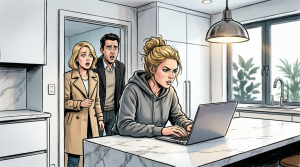
I always woke at five. Not because I had to, but because in that quiet, I could think. At five, nobody needed anything from me. Not my coworkers, not my parents, not the string of obligations that came with being the “reliable” child. I could sit in my leggings and hoodie, hair in a messy bun, and just be a brain attached to fingers, typing logic into existence.
That morning, I was debugging a stubborn asynchronous function that refused to behave. My fingers flew, the rest of me on autopilot. Sip coffee. Scroll. Adjust. I vaguely registered the sound of rain starting, tapping against the kitchen window. It made a dotted pattern on the glass, soft and regular, like another line of code.
I did not register—because why would I?—the sound of a car pulling into the driveway.
I heard the front door open, though. A quick, assertive push, the familiar creak of hinges that had needed oiling for months. Then a sharp, high-heeled cadence on the hardwood hallway outside the kitchen. It didn’t fit with the hour. It didn’t fit with this house.
I paused, fingers hovering over the keyboard.
“Mom?” I called, though I knew she wouldn’t be up. “Dad?”
No answer.
The footsteps came closer. I turned in my chair.
My younger sister, Christina, stepped into the kitchen like she owned it.
She was dressed as if she were about to give a keynote speech—tailored camel coat, slim black trousers, glossy shoulder-length hair blown out in smooth curls that bounced when she moved. Perfect eyeliner, even at five in the morning. Her crossbody designer bag sat on her hip like it had its own security detail.
Behind her, Jonathan followed, closing the front door with a controlled, quiet click. Jonathan always moved like that—precise, calculated, like every motion was a brand decision. His hair was gelled into a neat, immovable wave. The faintest whiff of expensive cologne followed him into the kitchen, cutting through the smell of coffee and toast.
For a moment, my brain refused to reconcile the sight with the time. My cursor blinked on the screen, waiting.
“Michelle,” Christina said, looking around the room with an appraising gaze, like she was standing in a showroom, not the kitchen where we’d eaten cereal as kids. “You’re up.”
“Obviously,” I said, closing my laptop slowly. “It’s five. I’m always up.”
Jonathan checked his watch, as if to verify that time still obeyed him. “Actually,” he said mildly, “it’s 5:06.”
He said it as though it mattered. As though he needed me to know I was already behind schedule.
I looked at them both, the incongruity of their presence settling like a stone in my stomach. Christina hadn’t set foot in the house in years. Literally years. The last time she’d been here was a rushed visit over Christmas, long before pandemics and layoffs and foreclosure threats had rearranged our lives.
“What are you doing here?” I asked, keeping my tone even. “Is something wrong?”
She walked past me, her heels tapping decisively. She touched the back of one of the dining chairs, the edge of the counter, the handle of the refrigerator door as if testing their solidity.
“Actually,” she said, “that’s what we’re here to talk about.”
Jonathan stood just behind her, hands clasped loosely in front of him, the picture of supportive husband. Supportive in that particular way that meant he intended to let her speak while backing her up with carefully-worded statements later.
She took a breath, squared her shoulders, and then said the words that cleaved my life cleanly into Before and After.
“You have forty-eight hours,” she said briskly. “Pack your things and get out. This house belongs to us now.”
For a beat, I honestly thought I’d misheard her. Maybe the early hour distorted her voice. Maybe I’d slipped into some surreal dream, one of those stress dreams where you show up to a math exam naked and holding a toaster.
“Come again?” I said.
She lifted her chin the way she used to when we were kids and she was about to tell on me for some invented offense. “You heard me. Forty-eight hours. We’re moving in. Jonathan and I. Mom and Dad agree it’s the best use of the property. They’ve already signed.”
Jonathan gave a small, practiced smile. “We’ve been discussing this for a while, Michelle. The market is changing. We have an opportunity to turn this place into something that can actually generate value. A proper family home. Christina’s been very clear on the vision. It’s time.”
“That’s right,” Christina added, her eyes sweeping the room again, already rearranging it in her mind. “We’ve been looking at layouts. Maybe open up this wall here, do an island instead of this old table. Take out those hideous curtains—”
I stared at her. “Those hideous curtains you never contributed a cent to,” I said quietly.
She shot me a brief, irritated look, like a fly had landed on her wineglass.
Before she could respond, another voice cut in.
“Michelle.”
My mother stood in the kitchen doorway, robe tied tightly around her, slippers half-crushed at the heel. Her dark hair, now threaded with gray, escaped from a messy clip. She looked smaller than I remembered, or maybe she’d always been that size and I’d only now noticed how much energy she’d been spending trying to fill space.
Her voice was steady, but there was a tremor at the edges of it. “They can make better use of this house,” she said. “You’ve always been… alone. They have a plan.”
The word fell between us, heavy. Plan.
Something inside me didn’t flare. It didn’t explode into righteous fury, as maybe it should have. It froze. Solid. Clear.
“A plan,” I repeated, my voice very calm. “Like the kind where someone else pays off the hundred and fifty thousand dollar mortgage taken out against this house?”
The room went quiet in that specific way that means truth has just entered and kicked over a chair.
Christina’s confidence faltered, minutely, like a light flickering. Jonathan blinked, his mouth tightening for a second before smoothing back into neutrality. My father appeared in the hallway behind my mother and stopped there, his hand on the doorframe, eyes finding an invisible point on the floorboards. He didn’t say anything.
“Michelle,” my mother said sharply, as if I’d just insulted a guest. “This is not the time to bring that up.”
“When is the time?” I asked. “Because I’d love to pencil in ‘being thanked for saving the house’ into my calendar. Unless that slot’s already been taken by ‘getting evicted from it.’”
Jonathan shifted his weight. “This is getting emotional,” he said, with the smooth intolerance of someone who always positioned himself above messy human feelings. “We’re simply talking about allocation of resources. Christina and I are starting a family. We need a place. Your parents are aging. They—”
“They’re right here,” I cut in. “You can say ‘you.’ They’re not an abstract.”
He gave me that patient look he probably used on junior associates. “Of course. My point is, you’re financially independent. You’re thirty, you’re a software engineer, you make good money—”
“Thanks for the biography,” I said. “I was there.”
“You should have your own place by now,” Christina added. “Most people your age do. It’s time to move on. We can’t all just… linger indefinitely.”
The irony of her saying that, having breezed in at dawn after years of absence, was almost funny. Almost.
I remembered, too clearly, the night everything had started. Years earlier. My father’s voice hoarse as he explained how he’d trusted a “friend of a friend” with an investment opportunity that turned out to be a well-packaged scam. How his retirement savings had vanished. How the bank, unimpressed with personal tragedies, had started sniffing around with foreclosure notices.
This house that held every birthday and Christmas and flu recovery and scraped knee was suddenly a line item on some spreadsheet in a lender’s office.
They had come to me then.
“Pay the debt,” my father had said, his eyes wet, his hands twisting in his lap. “Save the house. It’s for the family. For you and Christina. Clear a hundred and fifty thousand in three years or we lose everything.”
I’d postponed buying my own home. I’d skipped vacations I could have easily afforded, said no to impulse purchases, lived frugally in a house that technically didn’t cost me rent but bled me in other ways. Every month, I’d funneled my salary into the mortgage, the repairs, the utilities. I’d bought the new sofa when the old one’s springs gave out, the 65-inch TV that made my father’s eyes light up during football season, the washer and dryer that replaced the ones that finally wheezed their last breath mid-cycle, turning our towels into a sour-smelling heap.
Roof repairs when the shingles cracked. Repainting when the mildew showed. The endless Amazon boxes of small things—new curtains, a better coffeemaker, a toaster that didn’t burn one side and undercook the other.
I had funded the illusion of stability.
And now they were standing in the kitchen telling me I had forty-eight hours to disappear.
I felt something inside me settle into a strange, cold calm. Not numbness. Not exactly. More like the moment before a deployment, when soldiers stop processing the enormity of what’s happening and focus on the next step. The next breath.
I smiled, just barely. “Fine,” I said. “I’ll start preparing.”
Christina exhaled, a tiny puff of relief she probably didn’t realize she’d released. Jonathan’s shoulders relaxed almost imperceptibly. My mother’s eyes darted between us, wary. My father finally looked up, relief and guilt warring in his expression.
They thought it was surrender.
It wasn’t.
It was logistics.
The moment I closed my bedroom door behind me, the operation began.
My room looked just as it had for the last few years—somewhere between a teenager’s refuge and a functional adult’s crash pad. Bookshelves lined one wall, filled with programming manuals, battered paperbacks, and a few framed photos tucked between them. My bed was neatly made, laptop charger wound and clipped at the edge of the desk. On the far wall, the faint pencil marks from my grandfather’s old height chart were still visible, despite repeated paint jobs. He’d refused to let my parents erase them completely.
“History stays,” he’d said when I was nine and my mother tried to roll a fresh coat over my childhood measurements. “This is structural.”
I took a breath, then sat at my desk and opened my laptop again—not to code this time, but to plan.
Portland emergency moving service 24 hours, I typed into the search bar, fingers moving quickly, the mechanical act of it soothing. Names populated the screen—companies with hopeful, energetic titles, promising efficiency and discretion.
I clicked one at random: Green Mountain Movers.
The phone rang twice before a man picked up. His voice was groggy but professional, the way people sound when they’ve had coffee but not enough of it.
“Green Mountain Movers, this is Daniel.”
“Hi, Daniel,” I said. “I need a crew today. Noon, if possible.”
There was a pause. I could almost hear him checking a mental calendar. “Short notice,” he said. “What are we talking, a studio? One bedroom?”
“Single-family house,” I said. “Partial move.”
Another pause, longer. “You know it’s… five in the morning, right?”
“I do.” I looked at the digital clock on my nightstand: 5:14. “Is noon possible?”
He exhaled slowly. “Depends what you mean by ‘partial.’”
I started listing the inventory, my tone going flat and clinical as I went down the mental list. “L-shaped sofa, sectional, gray. Seats five. 65-inch OLED TV mounted on the living room wall. Washer, dryer, both purchased two years ago. Microwave, toaster, coffeemaker, blender. Dining chairs—six of them, upholstered, bought last year. Curtains in the living room and dining room. Area rugs. Some lamps. A few bookcases. I’ll handle my personal things separately.”
His tone shifted. The casual, sleepy cadence sharpened. This wasn’t drama anymore. It was logistics.
“We can do noon,” he said. “Rush fee applies. And we’ll need you to be very clear on what’s going and what’s staying. We don’t do domestic… disputes.”
“That won’t be a problem,” I said. “Everything that’s mine will be clearly labeled.”
“Alright,” he replied. “Text me the address. We’ll be there at twelve on the dot.”
I thanked him and hung up, my heart pounding so hard I could feel it in my fingertips.
For the next few hours, I worked.
If you’d seen me then, moving through the house with a stack of Post-it notes and a folder under my arm, you might have thought I was staging it for an open house. In a way, I was—but not for buyers. I was staging it for extraction.
I pulled open my filing cabinet and took out the folder labeled HOME. Over the years, I’d kept every receipt, every invoice, every email confirming a purchase. Not because I foresaw this exact moment—no one’s paranoia is that accurate—but because I’m the kind of person who documents things. Organized. Logical. The kind of person who wakes at five a.m. to code with coffee.
I spread the papers out on my bed: receipts for the sofa, the TV, the washer and dryer, the set of dining chairs I’d found on sale after spending a week comparing reviews. Printouts of emails about the roof repairs, the repainting, the appliance installs. My name on all of them. My credit card numbers, the last four digits familiar and oddly intimate.
I moved through the house, placing small Post-it notes on everything that fell under the umbrella of “mine.”
Mine on the sofa arm.
Mine on the base of the TV.
Mine on the washer lid, the dryer door.
Mine on the microwave handle, the toaster’s side, the sleek electric kettle Jonathan had once praised as “a decent purchase” in a tone that implied I’d finally done something right.
Mine on the dining chairs, on the living room lamps, on the curtains that softened the harshness of the sunlight in summer.
The house grew a rash of sticky yellow tags, a silent, neon protest.
I left certain things untouched. The dining table, its surface worn but solid, had been my grandfather’s. He’d sanded and refinished it himself before my parents got married, a gift to them and, in his mind, an anchor for the family. That stayed.
The old sideboard in the hallway, its drawers full of mismatched linens and holiday platters, had been my grandmother’s. That stayed too.
But everything else that I’d brought into this house in the last few years—the visible and invisible scaffolding that held my parents’ comfort together—was marked.
At some point around seven, my mother emerged from her room fully dressed, makeup hastily applied. She stopped short when she saw the living room.
“What is this?” she demanded, her eyes darting from Post-it to Post-it. “What are you doing?”
I didn’t look up from the stack of receipts I was sorting at the coffee table. “Labeling the things I paid for,” I said. “So there’s no confusion later.”
Her face tightened. “You’re being petty.”
“Am I?” I held up a receipt, the ink slightly faded. “This is the sofa, Mom. Do you remember when we bought it? The old one had a broken spring that poked Dad in the back every time he sat down. You said you couldn’t afford a new one. I put it on my card. Ten months, zero interest, remember?”
Her gaze flicked to the paper and then away. “We said we’d pay you back.”
“You never did.”
She opened her mouth, closed it, then gestured at the TV. “The television, then. Your father needs that. He loves watching his shows. How is he supposed to—”
“That TV is worth almost two thousand dollars,” I said softly. “That’s ten months of the mortgage payment I made alone when his ‘investment’ went off a cliff. This is not about a man and his shows. This is about values, Mom.”
She flinched at the word, like I’d slapped her.
“Asking me to leave was about values too,” I added. “You made a choice. These are the consequences of that choice.”
Tears sprang to her eyes, angry and quick. “We did it for everyone,” she said. “Christina and Jonathan, they can build a life here. Maybe grandchildren someday. We thought you would understand.”
“They thought,” I said. “You thought. Funny how I wasn’t included in the thinking.”
She stared at me like she didn’t recognize me. Maybe she didn’t. Maybe she was still trying to reconcile the little girl who had once begged to sleep in her bed during thunderstorms with this woman calmly sorting financial paperwork like ammunition.
“Michelle,” she whispered, “you’re going too far.”
I held her gaze. “No,” I said. “For the first time, I’m going exactly as far as you pushed me.”
She left the room without responding.
My father avoided me entirely. I saw him once, in the hallway, hovering by the coat closet like he’d been caught stealing. When our eyes met, he opened his mouth, but whatever words he’d intended evaporated. He shuffled past, his slippers whispering against the floor, and disappeared into the garage.
Christina and Jonathan reappeared around eight, dressed now in more casual clothes—her in jeans and a crisp white blouse, him in a dark polo and chinos. They looked like a couple in a real estate brochure.
Christina took in the Post-its with a frown. “What is all this?” she demanded.
“Labels,” I said. “To make the move efficient.”
“Move?” she repeated, confusion crossing her face.
I met her eyes. “Yes. Mine.”
“You’re not—” She stopped, recalibrating. “You can’t just take everything.”
“I can take everything I bought,” I replied. “Legally, it’s mine. Unless you’d like to go over the receipts with me. I have them all. Color-coded, if that helps.”
Jonathan stepped forward, his tone shifting into lawyer mode. “Now, let’s be reasonable,” he said. “You can’t strip the house bare. Your parents—”
“Are the ones handing it over to you,” I said. “Which is their choice. Just as this is mine.”
He hesitated. I could see the calculations running behind his eyes: Is this bluff? Is she actually going to do it? What’s our exposure?
“Look,” he said finally, spreading his hands in a conciliatory gesture. “We’re trying to keep things amicable. No one wants drama here. If you want to take your bedroom furniture, your personal items, your tech—that’s fine. But gutting the place is—”
“Mine,” I repeated. “Everything with a yellow label leaves at noon. You have until then to take your things out of their path.”
Christina’s eyes flashed. “We’ll see about that,” she said, her voice icy. “Mom! Dad!”
She stomped down the hall in search of allies who, it turned out, were in short supply. No one came back with her.
She returned alone, cheeks flushed. “You’re being vindictive,” she said.
I shrugged. “If you want the house, you can have the shell. That’s what you’ve been treating it as anyway.”
At exactly twelve o’clock, the intercom buzzed.
“Michelle?” The voice crackled through the box. “It’s Daniel, from Green Mountain Movers.”
I walked to the panel, pressed the button, and buzzed them in.
The moving truck looked almost comically large in the driveway, dwarfing my father’s aging sedan. Daniel and his crew stepped out, wearing matching navy t-shirts with the company logo, heavy work gloves tucked into their back pockets.
Daniel himself was in his late thirties, maybe early forties, with the kind of solid build that comes from lifting other people’s lives for a living. He took one look at my expression and didn’t ask any of the questions I could see flickering behind his eyes.
“Afternoon,” he said simply. “You Michelle?”
“I am,” I said. “Thank you for coming.”
He nodded toward the house. “You got everything labeled?”
“Yes.”
He stepped inside, his gaze sliding over the living room. I watched, almost clinically, as his eyes moved from sofa to TV, to the Post-its, to my parents hovering awkwardly by the kitchen doorway.
“Alright, team,” he called over his shoulder. “Everything with a yellow tag. Treat it like glass.”
They moved with calm efficiency. No chatter, no judgment. The sofa went first, its bulk maneuvered through the front door with practiced angles and grunts. Watching it leave, I expected to feel something—sadness, nostalgia, at least a pang. All those imagined family movie nights that never quite materialized, the evenings I’d spent there alone after my parents went to bed, the rare time Christina had sat beside me and actually seemed present.
But I felt… nothing. Or rather, I felt something very specific: closure.
That wasn’t nostalgia leaving the house. It was an invoice fulfilled.
The TV followed, dismounted from the wall with care. One of the movers asked where the box was for it, and I produced it from the garage—of course I’d kept it; of course I knew exactly where it was. The washer and dryer were next, carefully disconnected and wheeled out on dollies. The microwave came down from its perch, the toaster unplugged, the coffeemaker lifted from its spot beside the sink.
Christina watched, aghast.
“You can’t do this,” she muttered, more to herself than to me. “You can’t actually—Mom! Say something!”
My mother sat at the edge of the now-naked dining table, her hands clasped tightly in her lap. She looked as if she’d aged ten years in twelve hours. “She has the receipts,” she said softly. “It’s her right.”
My father said nothing. He stood in the corner, arms crossed, jaw clenched so hard I could see the muscles twitch.
The dining chairs, my carefully chosen modern set, disappeared next. They left the old table standing alone, its mismatched wood stain suddenly more obvious without the distraction of upholstery.
“Table stays?” one mover asked, pausing.
“Yes,” I said. “It was my grandfather’s.”
By two in the afternoon, the house echoed. The curtains were gone, leaving the windows bare and unsoftened. The area rugs had been rolled up and carried out, revealing scuffed hardwood beneath. The hum of the appliances was gone, replaced by a hollow stillness.
The warmth I had financed, the comfort I had curated—all gone.
I photographed the movers’ final receipt with my phone, the paper crisp under my fingers. Documentation mattered. It always had.
“Everything you wanted is loaded,” Daniel said, handing me the original. “We’ll take it to the storage facility address you texted. They’ll be expecting us?”
“Yes,” I said. “Thank you. I’ll meet you there in a bit.”
He nodded once, then glanced back at the house. “Good luck,” he said quietly.
I wasn’t sure which of us he was talking to.
I walked through the house one last time. The living room’s bare walls felt bigger, the nail holes where picture frames had hung now small, accusing eyes. My bedroom, stripped of everything but the built-in closet and the faint height marks on the doorframe, looked like a hotel room between guests.
In the kitchen, the counter was empty, the outlines of the appliances still visible in faint dust lines. The refrigerator remained—an ancient beast my parents had bought before I could walk. It, along with the stove and the dishwasher, had been theirs long before the financial near-collapse. My fingerprints weren’t on those invoices.
On the bare dining table, I placed a single key—the front door key I’d been using for nearly three decades. It looked smaller than I remembered.
I stood there for a moment, listening. No hum of the coffee maker. No murmur of a television. Just the rain tapping on the windows and the faint wheeze of the old refrigerator.
“Michelle,” my mother whispered from the doorway.
I turned.
Her eyes were red-rimmed, mascara smudged. “You don’t have to leave like this,” she said. “We could talk. Work something out.”
“We tried talking,” I said gently. “You talked at me at five this morning. You already made your choice. This is me making mine.”
She flinched as if I’d thrown something. “We’re still your parents,” she said. “We thought you were doing this for the family.”
“I was,” I said. “I just didn’t realize I wasn’t included in your definition of ‘family.’”
She covered her mouth with her hand, shoulders shaking. I felt a flicker of sympathy, but it was distant, as if I were watching someone cry on a screen. I’d spent years feeling guilty on her behalf. It had hollowed me out. There was very little room left for guilt.
“Goodbye, Mom,” I said.
She didn’t answer.
I walked out the front door without looking back.
Forty-eight hours later, my phone exploded.
I’d spent those two days in a strange limbo, shuttling between the storage unit where my possessions now lived in anonymous stacks and the small, temporary apartment I’d rented—a one-bedroom with beige walls and a balcony overlooking a parking lot. It wasn’t much, but it was mine, paid for with money that hadn’t been siphoned off into someone else’s debt.
With the practical chaos handled, my brain had tried to circle back to what had happened, but every time it did, a heavy, exhausted numbness descended. I went through the motions: I answered emails from work, attended Zoom meetings, wrote code. No one on my team knew that in between fixing bugs, I was also uprooting the only home I’d ever known.
Then, on the dot—forty-eight hours after the moment Christina had walked into my kitchen and delivered her ultimatum—my screen lit up with missed calls.
Christina. Mom. Dad. Numbers I didn’t recognize, probably Jonathan’s colleagues or relatives. The voicemail icon grew a little red digit.
I ignored the first few calls. Then, curiosity prying at me, I tapped into the voicemail.
“There’s nothing here,” Christina’s voice cracked through the speaker, pitching high with disbelief. “She took everything. The house is empty. What are we supposed to—how could you do this, Michelle? Call me back. Call me back now.”
Another message from my father followed, his voice resigned and shaky. “Michelle, this… this was too much. You’ve gone too far.”
Too far.
The phrase lodged somewhere deep in my chest and turned slowly, like a piece of glass.
Had I? I had, for once, simply drawn a line at the boundary between my labor and their entitlement and refused to pretend the line didn’t exist.
If that was “too far,” then maybe their map had been upside down all along.
That evening, I sat across from my best friend and attorney, Rebecca, in her glass-walled office downtown. The city sprawled beyond the floor-to-ceiling windows, a grid of lights on wet asphalt. Her office was a study in cool professionalism—dark wood desk, a single potted plant that refused to die, shelves lined with law books and binders labeled with names that weren’t mine.
My receipts, dog-eared and worn, looked almost vulgar spread across her sleek desk. Beside them lay an old photograph of my grandfather, Frank, holding a beer and laughing at some joke I couldn’t remember.
“I don’t want defense,” I said quietly, my fingers tracing the edge of the photograph. “I want offense.”
Rebecca leaned back in her chair, studying me. She was a few years older than me, with sharp eyes and a steady presence, the kind of person you wanted on your side in a storm. We’d met in college—me the logic-driven computer science major, her the philosophy student who loved arguing about ethics late into the night. Somewhere along the way, she’d switched tracks to law school, and I’d gone into software engineering. We’d stayed in each other’s orbits.
“What are you thinking?” she asked.
I looked up at the photograph. My grandfather’s eyes crinkled at the corners, his mouth open mid-laugh. He’d spent countless afternoons in that house, fixing things with stubborn pride, telling us stories about “the old days” which, to my child brain, might as well have been another planet.
He’d died when I was twenty-two. Heart attack. One minute he’d been beating my father soundly at chess in the living room, the next he was clutching his chest and sliding off the chair. The paramedics had come, but they’d been too late.
I remembered, vividly, standing in that same living room as my parents told us there was no will. No instructions. No last wishes in writing. The house, they’d said, would naturally pass to them. “We’ll always take care of it,” my mother had promised, her eyes swollen from crying.
At twenty-two, grief-stricken and naïve, I hadn’t questioned it.
Now, sitting in Rebecca’s office, the suspicion that had been buzzing at the edges of my mind finally settled into words.
“I don’t think the inheritance was clean,” I said. “I think my grandfather left something. And I think my parents hid it.”
Her eyes sharpened as if someone had flipped a switch behind them. “Go on.”
“My grandfather wasn’t careless,” I said. “He planned everything. His garden, his finances, his stupid chess openings. He’d been talking about ‘making things official’ for years before he died. There’s no way he didn’t leave a will. But when I asked, my parents said there wasn’t one. That we just had to ‘trust them.’ And now, after everything with the mortgage, after lying about how bad it was until they were desperate, after letting me pay it off, after trying to evict me from the house I saved, I just… I don’t trust them. Not about anything. Especially not about him.”
Rebecca was already typing, the keys clacking a staccato rhythm. “Give me his full name,” she said. “And the approximate date of death. Hospital, if you know it. County. Anything.”
I gave her everything I remembered, down to the name of the paramedic who’d patted my shoulder as they wheeled his body away. She took it all down. Her jaw was set, the lines of her face hardening.
“Alright,” she said finally. “Leave this with me. If there’s something official, I’ll find it. And if they buried it—figuratively speaking—I’ll dig it up.”
Two days later, she texted me: Come to the office. Now.
I felt my pulse jump as I rode the elevator up, my reflection in the mirrored walls looking oddly composed. On the twenty-first floor, the receptionist waved me through; she’d learned my face over the years, even if my legal issues had so far been blessedly minor.
When I stepped into Rebecca’s office, she didn’t bother with small talk. No jokes about the weather, no quips about her latest impossible client. She just turned her monitor toward me, her expression taut.
“Brace yourself,” she said.
On the screen was a scanned document: slightly yellowed paper, neat type, a seal embossed at the bottom. Across the top, in formal font: LAST WILL AND TESTAMENT OF FRANK HOLMES.
My grandfather’s full name looked unfamiliar in that context, as if someone had dressed him up in a suit too stiff for him.
Rebecca scrolled, skimming past the legal preamble, until she reached a paragraph in the middle. She zoomed in until the words filled the screen.
All real estate, including the residence in suburban Portland, Oregon, shall be bequeathed solely to my beloved granddaughter, Michelle Holmes.
My throat tightened.
I read the sentence once, twice, three times, as if repetition might change it. It didn’t.
“That means…” I began.
“That means the house was legally yours the moment he died,” Rebecca said, her voice steady but vibrating with controlled anger. “Your parents had no right to treat it as theirs. They had no right to tell you there was no will. They had no right to take out a mortgage on a property that was not legally in their names and then ask you to pay it off. And they certainly had no right to try to evict you from a house that was, in fact, yours.”
I stared at the words until they blurred. In my mind, scenes from the last decade rearranged themselves like puzzle pieces suddenly snapping into different slots.
My grandfather, measuring my height against the doorway with a dull pencil, saying, “Someday you’ll be the one to protect this house, you know.”
I’d laughed, thinking he was being sentimental. “Protect it from what? Wolves?”
“From everything,” he’d said. “Houses need guardians. People forget that.”
It hadn’t been a sweet comment. It had been instructions.
Now, looking at his will, I realized he’d tried to give me the tools to fulfill them. And my parents had quietly, deliberately taken those tools away.
I felt something colder than rage settle over me. Rage burns hot; it consumes quickly. This was different. This was clarity. It was the feeling of a lens sharpening into focus.
“Teach them reality,” I said, my voice calm.
Rebecca’s mouth curved into a smile that could cut glass. “With pleasure.”
The next day, a certified letter hit the mailbox at my old house. Two letters, technically; we sent one to my parents and one to Christina and Jonathan at their condo, just in case they tried to claim ignorance.
The first enclosure was a detailed inventory of the items I’d removed, cross-referenced with purchase receipts and timestamps. It asserted my ownership of each item, documented the circumstances of their removal, and firmly warned against any attempt to file false theft reports. It cited Oregon statutes on malicious prosecution and defamation, with references and case law.
The second enclosure was simpler, but heavier.
It laid out, in clean, unambiguous language, that I was the legal owner of the property at [address redacted here, but printed clearly there] by virtue of my grandfather’s will. A copy of the will, duly recorded, was attached.
It informed my parents that their continued occupancy of the property was unauthorized and unlawful. It demanded they vacate within a legally prescribed period. It stated that, effective immediately, damages would accrue daily for unlawful occupancy, calculated at fair market rental value plus additional penalties.
It did not sugarcoat anything.
Rebecca sent them via certified mail, with return receipt requested. She also, at my insistence, emailed scanned copies to all relevant parties. No one could claim they hadn’t received them.
Calls flooded in.
Dozens, then more. Some from my parents, some from Christina, some from numbers I didn’t recognize. I watched them roll in and let them go to voicemail.
Rebecca answered one.
I was sitting on her office couch, knees drawn up, when her phone lit up. She glanced at the screen, then at me. “Your mother,” she said.
“Put it on speaker,” I said.
She did.
“Rebecca,” my mother’s voice screeched immediately, raw with fury. “What is this? What have you done? You—you can’t just—where is Michelle? Put her on the phone. Right now.”
“Good afternoon, Mrs. Holmes,” Rebecca said calmly, as if the woman were asking about a parking validation. “As stated in the letter, all communication should be in writing from this point forward. I’m happy to answer any legal questions you have.”
“I don’t want to talk to you,” my mother snarled. “I want to talk to my daughter. This is some mistake. There was no will. We told her that years ago. Your so-called ‘document’ is—”
“Is a valid will recorded with the county,” Rebecca interrupted. “It’s been verified. I would strongly advise you to retain your own counsel if you plan to contest it. In the meantime, Michelle will not be speaking with you directly. All communication goes through our office. As you also saw in the letter, damages will accrue daily for unlawful occupancy.”
“You ungrateful—” My mother’s voice cracked, breaking off into a choked sob. “After everything we did for you, Michelle! After raising you, after—”
Rebecca pressed the mute button and looked at me. “Do you want to hear the rest?” she asked.
I shook my head.
She ended the call.
“They’ll hire a lawyer,” I said.
“Of course,” she replied. “And then they’ll realize how weak their position is. Still, we’ll be ready.”
They did hire a lawyer. A conservative older man with a silver mustache and a reputation, according to Google, for “aggressive advocacy.” He filed a challenge to the will, claiming my grandfather had not been of sound mind when he drafted it. That he’d been unduly influenced. That he’d “forgotten” he had another grandchild.
“Interesting,” Rebecca said when she read through the filing. “They never seemed too concerned about his mental state when they were cashing birthday checks.”
She built our case methodically, like constructing a bridge.
Medical records showing my grandfather’s cognitive assessments, all within normal limits until his death. Affidavits from friends who played chess with him weekly, describing his sharp mind and sharper tongue. Video from a local senior center’s chess tournament, in which he’d been recorded laughing and trash-talking his opponent with unambiguous lucidity.
She gathered his bank records, showing years of meticulous account management. His taxes, filed on time. His long-standing pattern of doing exactly what he said he would do.
She even tracked down the notary who’d stamped his will. The woman, now retired, remembered him. “Oh, Frank,” she said in her deposition. “He came in with his granddaughter. Made a big fuss about how she was the responsible one. Said he was leaving the house to her so she’d always have someplace safe. It was very sweet, actually.”
I didn’t remember being there. Maybe I’d blocked it out, or maybe my brain had filed that day under “routine errands.” In my early twenties, I’d signed a lot of forms without fully understanding their weight.
When the hearing date came, my stomach felt like a fist.
The courtroom was smaller than I’d expected, more beige than dramatic. No high drama wood paneling, no sweeping balconies. Just rows of wooden benches, a judge’s bench, two tables facing each other like opponents in a chess game.
My parents sat at one table, their lawyer beside them. My mother’s face was pale, lips pressed tight. My father looked even older than he had in my memories of the last few weeks; his hair, once salt-and-pepper, seemed mostly salt now.
Christina sat in the row behind them with Jonathan, dressed in a perfectly tailored blazer and a look of wounded indignation. Jonathan’s expression was carefully neutral, but his eyes darted around, taking everything in.
I sat at the other table with Rebecca, my posture straighter than I felt. She placed a hand briefly on my arm, a grounding touch.
The judge—a woman in her fifties with tired eyes that suggested she’d seen every permutation of family drama—took her seat and called the case.
My parents’ lawyer went first, painting a picture of a confused old man, of a close-knit family blindsided by an “unexpected document.” He implied that I’d taken advantage of my grandfather’s affection, that I’d somehow tricked him into signing away what should have been my parents’ rightful inheritance.
Rebecca didn’t even roll her eyes. She just sat there, pen tapping, waiting her turn.
When it came, she stood and dismantled his narrative one piece at a time.
She submitted the medical records. Played the video of my grandfather at the chess tournament, his laughter filling the courtroom. “Checkmate, you old fox,” he said on the screen, pointing at his opponent’s king. “Age doesn’t mean I can’t think one move ahead.”
She read the notary’s statement into the record. She walked through the timeline: the will drafted and notarized years before his death, the absence of any evidence that he’d been coerced. His documented tendency to see me as the responsible one.
Then she turned, very deliberately, to my parents.
“Mr. and Mrs. Holmes,” she said, “when your father passed, did you inform your daughter that a will existed?”
My mother shifted. “We… we didn’t know.”
“You didn’t know,” Rebecca repeated. “Did you make any effort to find out? Did you contact his attorney? Check with the county? Search his files?”
My mother hesitated. My father swallowed.
“We… we thought there wasn’t one,” my father said. “He never mentioned it.”
“Are you saying he never mentioned wanting to provide for Michelle?” Rebecca asked. “Because we have testimony that he spoke at length about leaving the house to her.”
He faltered. “He… said things. You know how old people are. They talk.”
“And when you took out a mortgage on the property,” she continued, “did you inform the bank that you were not, in fact, the legal owners? That there was a will bequeathing the property to someone else?”
Their lawyer objected to the implication of fraud. The judge sustained, but the point hung there anyway, heavy and toxic.
Rebecca shifted tactics.
“Michelle,” she said, turning to me, her voice softer. “Can you describe your understanding, at the time your grandfather died, of what would happen to the house?”
I took a breath.
“I believed my parents,” I said. “When they told me there was no will. I believed them when they said they would ‘always take care of it.’ When they asked me to help pay the mortgage to save it from foreclosure, I thought I was saving the family home. For all of us. For my grandfather’s memory. I postponed buying my own place. I paid off the entire mortgage. And then, years later, they told me I had forty-eight hours to leave. No conversations. No gratitude. Just an ultimatum.”
My voice wavered only slightly on the last word. I let it. If these people wanted to stay in denial, they could at least be confronted with the emotional cost of their decisions.
The judge’s gaze moved from me to my parents, lingering. She asked a few questions of her own—about timelines, about conversations, about who knew what when. It became increasingly clear that my parents’ ignorance about the will was not so much a matter of innocence as it was of selective blindness.
After closing arguments, the judge recessed for an hour. We filed out into the hallway, where the fluorescent lights and hard benches turned everyone into washed-out versions of themselves.
My mother sat huddled beside my father, whispering furiously. Christina paced, heels clicking, her eyes occasionally darting toward me with a mixture of anger and something like fear.
I stood by a window with Rebecca, watching the rain streak down the glass.
“You’re doing well,” she said quietly. “However this goes, you’ve told the truth.”
“I shouldn’t be here at all,” I said, the absurdity of it washing over me. “We shouldn’t be fighting over something my grandfather was so clear about. He would hate this.”
“Your grandfather also trusted you to protect what was his,” she said. “Sometimes honoring someone’s wishes means fighting the people who are supposed to honor them with you.”
The judge returned sooner than I expected.
We filed back into the courtroom. Everyone sat. The room held its breath.
“In the matter of the estate of Frank Holmes,” the judge began, her voice level, “after reviewing the will, the medical and testimonial evidence, and the arguments presented, it is the court’s determination that Mr. Holmes was of sound mind when he executed his will. The document is valid. The bequest of the property at [address] to his granddaughter, Michelle Holmes, stands.”
My mother made a small choking sound. My father’s shoulders slumped as if someone had cut the strings supporting him.
“The court further finds,” the judge continued, “that the current occupancy of the property by Mr. and Mrs. Holmes is unauthorized. Eviction is granted. They will vacate the premises within thirty days. Damages for unlawful occupancy will be assessed as outlined in Ms. Holmes’s filing, subject to further review if necessary.”
The gavel came down with a soft thud. Just like that, it was done.
Outside the courthouse, the air smelled like wet asphalt and exhaust. I stood on the steps, feeling lightheaded.
“That’s it?” I asked Rebecca. “They just… have to leave?”
“That’s it,” she said. “They could appeal, but they’d be throwing money at a wall. The law is very clear. Frank wanted you to have that house. Now you do.”
“Now I do,” I repeated.
But when I pictured the house, I didn’t see a home anymore. I saw empty rooms, bare walls, echoes of raised voices. I saw my mother’s face as she told me there was no will, my father’s as he asked me to save what he’d recklessly endangered. I saw Christina, standing in the kitchen at five a.m., telling me I had forty-eight hours.
“I don’t want to live there,” I said.
“You don’t have to,” Rebecca replied. “Ownership doesn’t require occupancy. You can rent it. Or…”
“Sell it,” I said.
Her eyebrows lifted, but she nodded. “If that’s what you want, we can make that happen.”
What I wanted was distance. Not just geographical, but emotional and financial. I wanted to untangle my future from the knot of obligations and guilt that house represented.
So we sold it.
The listing agent couldn’t believe how quickly it moved. “Solid bones,” she said, walking through the now mostly empty rooms as we prepared to show them. “Quiet neighborhood. Great yard. With a few cosmetic updates, this place will fly off the market.”
I did not tell her about the invisible cracks in the history. I did not tell her that every corner of the house had been soaked in a kind of emotional corrosion for years.
A young couple bought it—a teacher and a nurse, according to their application. They walked through with shining eyes, talking about where they’d put the crib, the garden they wanted to plant. When they made an offer at asking price, I accepted immediately.
At closing, I signed the papers with a hand that barely shook. The check that landed in my account afterward was large enough to make my breath catch. Years of sacrifice, and theft, and legal battles converted into numbers on a screen.
I moved my furniture out of storage and into a new apartment—bigger, sunnier, with white walls and floor-to-ceiling windows that overlooked the river. Not a house, not yet, but mine. Entirely mine.
I invested a chunk of the sale money into index funds and a few carefully chosen stocks, letting my inner spreadsheet nerd revel in the projections. I paid off the last of my student loans, even though the interest rate was low. I put a portion into a “Future Home” account that felt different now—less like a distant hope, more like a genuine possibility.
As for my parents and Christina, the aftermath rippled through their lives in ways I hadn’t anticipated but also, if I was honest, couldn’t bring myself to grieve.
Christina’s marriage collapsed without the promise of a “free house” hanging in the air.
I heard about it third-hand, through a mutual acquaintance who didn’t realize I was no-contact. Apparently, the fights between her and Jonathan had started almost immediately after the eviction notice. Arguments about money, about whose fault it was that they’d “lost” the house they’d never legally had. About his reputation taking a hit when colleagues learned he’d tried to orchestrate an illegal eviction.
“He said she’d misled him,” the acquaintance reported, eyes wide over her latte. “About the will, about the finances. He wanted no part of it when it blew up. And she… well, Christina never could stand not getting what she wanted.”
They separated within six months. The divorce filings, which I accidentally found online one night when insomnia met morbid curiosity, cited “irreconcilable differences.”
My parents, once fixtures in the neighborhood, fled town when the truth spread.
It was hard to hide something like that in a community where everyone knows everyone’s business. People talk. They talk in grocery store aisles, at PTA meetings, at church socials.
“Oh, did you hear about the Holmeses? Took out a mortgage on their daughter’s house. Lied about the will. Tried to kick her out. Can you imagine?”
Some neighbors sided with them at first; loyalty is a stubborn thing. But paperwork doesn’t lie. As more details emerged—mortgage documents, the will, the timeline—the story shifted. Sympathy turned into discomfort, which turned into avoidance.
My parents sold what they could and moved, according to one of my mother’s distant cousins, to a smaller town in another state. Somewhere cheaper, where no one knew their history. Where they could reinvent themselves as unfortunate victims of a “family misunderstanding” instead of what they had actually been: people who’d treated their daughter like a safety net, then cut her loose as soon as they thought they didn’t need her.
I blocked every number.
Every attempt at contact—calls, texts, emails, even a handwritten letter that arrived one day, my mother’s looping script all over the envelope—went unanswered. I stored the letter in a drawer, unopened. Maybe one day I’ll read it. Maybe I won’t.
No address. No access.
For the first time in my life, there was no direct line connecting my choices to their disappointment.
Months later, I left Portland altogether.
I’d always loved the city’s moss-covered trees and gray skies, the way the rain made everything smell like wet earth. But after everything that had happened, every street seemed to hold a memory. The coffee shop where I’d first told Rebecca I suspected the will existed. The hardware store where my grandfather used to take me to pick out nails “for important projects.” The courthouse, looming over downtown like a monument to both justice and pain.
When a startup in Denver reached out with an offer—project manager, substantial salary bump, interesting work—I said yes. It felt impulsive in the moment, but in hindsight, it was the natural next move.
New city. New job. New life.
Denver was sunnier than I’d expected. Literally. The sky seemed to stretch wider, bluer, the mountains carving a jagged horizon that made Portland’s hills look like gentle suggestions.
I found an apartment in a modern building with a rooftop garden and a gym I pretended I’d use more than I actually did. I unpacked my things slowly, arranging them not the way they’d been in my old house but in ways that felt right for this new space.
The sofa took its place under the living room window. The TV mounted on the wall opposite. The dining chairs clustered around a smaller, lighter table I bought from a local craftsman. My bookshelf went up, filled with programming manuals and novels and a framed photo of my grandfather, positioned not as a shrine but as a quiet anchor.
I hung curtains—different ones, in a soft linen that filtered the sunlight into something gentle. I bought a plant. Then another. When one died, I didn’t berate myself; I just learned which species did better in that corner and moved on.
Work was intense. The startup lived up to the cliché: long hours, fast pivots, jargon-heavy meetings about “scaling” and “runway” and “user acquisition.” But I liked the challenge. As a project manager, I got to do what I’d always done instinctively—organize chaos into timelines and deliverables—only now, people appreciated it. They thanked me for it. They paid me well for it.
I still woke at five a.m., mostly out of habit. Only now, when I sat down at my kitchen counter to drink coffee and check my emails, I did so in a space that no one could threaten to take from me. Every object I saw—the kettle, the mugs, the quirky salt and pepper shakers I’d bought on a whim at a craft fair—belonged to me by purchase, by choice, not as some fragile favor balanced on someone else’s goodwill.
A year after the court case, Rebecca visited.
She flew in for a conference and extended her trip by a weekend. When she arrived at my apartment, suitcase in hand, she stopped just inside the door and looked around.
“This feels like you,” she said, setting her bag down.
I followed her gaze. The living room, with its mix of modern and slightly worn-in furniture. The kitchen, where a small ceramic dish shaped like a fox held my keys. The balcony, where a couple of hardy plants clung to life despite my occasional neglect.
“It does, doesn’t it?” I said.
She walked over to the bookshelf, tracing a finger along the spines. “No law books,” she observed. “Tragic.”
“I was hoping to create a space free of unnecessary tension,” I replied. “I’ll just invite you over to ruin that manually.”
She laughed, then paused at the photograph of my grandfather. “He’d like this place,” she said. “Lots of light. Good view.”
“He’d try to fix something that doesn’t need fixing,” I said. “Probably that kitchen cabinet door that doesn’t quite close all the way.”
She opened and closed it experimentally. It made a soft click, stopping just shy of fully flush. “He’d be right,” she said. “This would drive him nuts.”
We ordered takeout and ate on the balcony, the city stretching out below us. The air was cooler up there; the sounds of traffic floated up muted.
“At any point,” she asked after a while, “did you think about… not pushing it? About just taking your stuff and walking away from the house, the will, everything?”
“Initially?” I said. “Yeah. For about two minutes while I was on hold with the moving company. Part of me thought, ‘Take the furniture. Let them keep the rest. You’re making good money; you can build again.’”
“And?” she prompted.
“And then I thought about my grandfather,” I said. “About how seriously he took responsibility. How furious he would have been if he’d known what they did with his house. How much he trusted me to be the one who didn’t flinch when things got hard.”
I took a sip of my drink, the ice clinking softly. “I realized walking away would have felt like betraying him. Not because of the money, though that mattered. But because of the principle. They lied. Repeatedly. They used me. And they thought they could get away with it because I’m the ‘nice’ one. The ‘logical’ one. The one who forgives.”
“And you decided not to,” she said.
“I decided to stop letting forgiveness be their get-out-of-consequences-free card,” I replied. “I still don’t wish them ill, exactly. I’m not sitting here hoping they trip and fall down a metaphorical flight of stairs. But I’m also not going to keep cushioning their landings. They needed to hit the ground hard enough to notice the impact.”
Rebecca watched me for a moment, then nodded. “You know,” she said, “revenge gets romanticized a lot. People love a good ‘she got them back’ story. But what you did… I wouldn’t even call it revenge.”
“What would you call it?” I asked.
“Alignment,” she said. “You aligned reality with what should have been true all along. You reclaimed what was yours, enforced boundaries, and then let the chips fall where they naturally would. If that feels like revenge to them, that says more about their expectations than about your actions.”
I thought about that later, lying in bed as the city lights blinked outside my window.
I hadn’t been reborn by revenge. I hadn’t emerged from the ashes of my old life as some dramatically new creature, hardened and cynical, swearing never to trust anyone again.
What I had done was quieter, but in its way, more radical.
I had returned to myself.
To the girl who used to sit with her grandfather in the living room, listening to him explain why he always thought three moves ahead in chess. “It’s not about tricking the other player,” he’d say. “It’s about understanding the consequences of your own moves. You think, ‘If I do this, what will that allow? What will it prevent? What will it say about what I value?’”
To the young woman who went into software engineering because she liked puzzles, because she liked the feeling of making something orderly out of chaos. Who kept receipts not because she anticipated betrayal, but because she believed in accountability.
Somewhere along the way, I’d let my family convince me that my value lay in how much I could absorb. How much I could give. How much I could sacrifice for “the greater good”—a phrase that somehow always seemed to benefit everyone else more than it did me.
Taking the house back, legally and financially, and then choosing to sell it on my terms, was not about punishing them. It was about recalibrating my sense of where I ended and they began.
They had taught me, in the harshest possible way, that unconditional loyalty to people who see you as a resource to exploit is not noble. It’s self-erasure.
In the year that followed, small things reminded me of this shift.
The first time I said no to staying late at work because I’d promised myself a quiet evening with a book, and I didn’t immediately drown in guilt.
The first time I turned down a friend’s request to crash on my couch “for a few weeks” while they figured things out, suggesting instead a list of short-term rentals. I helped them research, offered emotional support, but did not offer my home as a solution to a problem they’d created.
The first time a man I’d been casually seeing made a joke about how “it must be nice to have a woman who’s so put-together; you probably make everyone around you better,” and I replied, “It is nice. It’s also not free,” and watched his face as he realized I wasn’t complimenting him.
I still woke at five a.m., most days. I still wrote code with my coffee. I still liked lists and color-coded folders and the satisfaction of crossing tasks off my to-do list.
The difference was that the projects now were mine.
“Upgrade my life,” I sometimes wrote at the top of a page. Then underneath: therapy appointments, investment check-ins, solo hikes on weekends, the name of a new restaurant I wanted to try, a reminder to call Rebecca just to talk, not because I needed her professional expertise.
I thought about my family less as time went on. Not because I’d forgiven them in some grand, cinematic epiphany, but because they simply… faded. Like a program that had once run constantly in the background, draining memory and slowing everything else down, finally being uninstalled.
Every so often, a random memory would surface—a childhood Christmas, my father teaching me to ride a bike, my mother braiding my hair before school—and I’d feel a complicated twinge. Grief for what we could have been if they’d seen me as a daughter instead of a safety net. Relief that I no longer had to contort myself into the shape they wanted.
My grandfather’s voice, though, did not fade.
In my mind, he still stood in that Portland house, pencil in hand, marking my height against the doorway.
“Someday you’ll be the one to protect this house,” he’d said.
I had. Just not in the way any of us had expected.
I hadn’t kept its walls standing forever. I hadn’t ensured it stayed in the family for generations. Instead, I’d protected what the house represented: the idea that the person who shoulders the responsibility, who shows up, who quietly pays the bills and does the work, deserves to be respected. To be consulted. To be honored.
In letting go of the physical structure, I’d preserved something more important: myself.
And as I sat on my Denver balcony years later, watching the sun sink behind the mountains, laptop open to a new project and coffee cooling beside me, I realized that for the first time in my life, the foundation I was building on wasn’t someone else’s. It was mine.
No ultimatums. No forty-eight-hour deadlines.
Just time. And space. And the quiet, steady certainty that I would never again invest my whole heart and bank account into a house where someone could walk in at five a.m. and tell me I didn’t belong.
THE END.

