On the way to a family reunion, my husband went pale and whispered, “Turn the car around. Now.” I was stunned. “Why?” “Just turn around, please.” I trusted him — and it saved us. I never saw my parents the same way again…
My husband went pale so fast I thought he’d swallowed his tongue.
One second we were just another family on the highway—coffee in the cupholder, snack wrappers multiplying like rabbits, the back seat full of half-awake kids and the kind of petty arguments that only children can sustain for hours—and the next second he was staring straight ahead like the windshield had turned into a screen playing our funeral.
“Turn the car around,” he whispered.
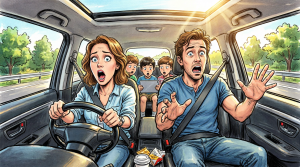
Not a suggestion. Not a question. A command so quiet it barely reached me over the hum of tires, which somehow made it worse. If he’d shouted, I could’ve dismissed it as panic. But my husband doesn’t do panic. He does calm. He does quiet competence. He does tightening a loose cabinet hinge while holding a baby on his hip. He does reading the fine print on our mortgage. He does checking the smoke detector batteries twice a year like his life depends on it.
So when he said it like that—low, urgent, almost pleading—my hands went cold on the steering wheel.
“What?” I asked, automatically smiling the way people do when they want the world to stay normal. “What are you talking about?”
He didn’t blink. His eyes were fixed on the road ahead, but I could feel him seeing something beyond it, something already in motion.
“Please,” he said, and there was a strain in his voice I rarely heard. “Just… turn around. Now.”
I stared at him for a beat too long. Then I looked back at the highway, the signs counting down the miles to the border like a harmless little countdown to potato salad and forced hugs and the reunion photos my mother would post with captions about family being everything.
We were a few minutes out. One last exit before the crossing. After that, it was funnels and lanes and questions and that weird, sterile quiet that settles over your car at a border checkpoint, when even the kids stop talking because something about uniforms makes them behave.
“Why?” I asked again, the word sharper this time. “What’s happening?”
His jaw flexed. He swallowed. “Just… trust me.”
My first instinct was to push. My second instinct was to be offended. I’m the driver because I’m the planner, because I’m the one who reads the hotel reviews and packs the backup socks and knows which kid hates which granola bar. I’m the one who doesn’t like being told to do something without a reason.
But my third instinct—deeper, quieter—was the one that mattered.
This man had held our newborn in an ER chair for six hours without complaining. He had once talked a stranger out of a road-rage fistfight with nothing but a calm voice and an apology that wasn’t even his. He had pulled our oldest out of a rip current like it was just another Tuesday and then thrown up behind the dunes because the adrenaline hit him late.
If he was asking me like this, it wasn’t about control.
It was about survival.
So I flicked on the turn signal and took the last exit before the border.
The ramp curved away from the highway gently, almost politely, as if the road itself was offering me an out. I half expected my husband to tell me I was overreacting, to laugh and say he’d just wanted to see if I’d do it. But he didn’t laugh. The moment we left the main road, his shoulders dropped a fraction. Not relaxed—never relaxed—but like someone had loosened a belt that had been digging into his ribs.
That tiny shift told me everything.
Whatever he thought was about to happen… we’d just dodged the first part of it.
“Okay,” I said, keeping my voice even because the kids were behind us and the last thing I needed was three tiny sirens of anxiety. “We’re off. Now tell me what’s going on.”
He shook his head once. “Just drive.”
“Drive where?”
“I don’t know,” he said, and there was something bleak in that, something almost exhausted. “Anywhere but there.”
In the back seat, our middle child’s cartoon paused, replaced by that suspicious silence kids get when they realize adults are lying.
“Mom?” my seven-year-old called. “Are we going the wrong way?”
“We forgot something,” I said automatically, because lying to your kids is sometimes just parenting triage. “It’s fine.”
“What did we forget?” my ten-year-old asked, already sensing weakness.
“I’ll tell you later.”
Our youngest, five, piped up with the hopeful voice of someone who still believes adults are mostly good. “Is it snacks?”
I didn’t answer.
My husband didn’t speak for a long time.
We drove in silence through a stretch of trees and roadside nothing, the kind of forgotten strip of land that sits between important places. Twenty minutes, maybe more. The kids drifted back into their cartoon. The highway noise faded. My brain, meanwhile, started filling in blanks the way it always does when something doesn’t make sense.
Had he gotten a text? Had he seen a road sign that triggered some memory? Had someone followed us? Was it something about the border itself? Did his passport expire and he was embarrassed? Was he about to confess he’d once committed a crime in Canada in college? My mind threw ridiculous possibilities at the wall because my mind would rather entertain absurdity than face a possibility that felt too heavy to hold.
Then he said, “Take the next turnoff.”
It wasn’t a proper exit. It was a narrow access road with no sign, just a break in the trees and a strip of gravel that looked like it led to nowhere. One of those roads you only notice when you’re lost, or when you’re about to become lost on purpose.
I pulled onto it, tires crunching, and felt like we’d stepped out of our normal life into a secret.
We rolled to a stop beneath a canopy of pines. No houses. No gas station. No other cars. Just trees and the faint sound of wind, and that suffocating awareness that we were alone enough for anything to happen.
My husband unbuckled. “Stay here,” he said.
He got out and walked to the back of the SUV.
“What are you doing?” I called, but my voice came out smaller than I meant it to.
He didn’t answer. He opened the trunk.
From where I sat, I couldn’t see what he saw. I could only hear the rustle of bags shifting, the soft thud of our cooler against the side, the zipper noise, quick and harsh, like tearing fabric.
My hands started sweating. My heartbeat did this weird stuttering thing, fast and heavy, like my body already knew what my brain refused to name.
After a minute, the trunk closed.
He came back to my window and tapped it lightly.
“Can you come out?” he asked.
“Why?”
“I need you to see it.”
He didn’t sound angry. He didn’t sound scared.
He sounded tired.
And very, very sure.
I got out.
The air smelled like sap and dust. The gravel crunched under my shoes in a way that made everything feel louder, more exposed. My husband led me to the back of the car and opened the trunk.
He didn’t speak. He just pointed.
At first, I didn’t understand what I was looking at.
A red duffel bag. The one my dad had handed me that morning with a casual, almost cheerful, “Won’t fit in ours.” It was wedged between our luggage and the kids’ backpacks, innocent-looking, the kind of bag you’d toss into a trunk without thinking.
My husband unzipped it.
Folded back a sweatshirt.
And then my entire body forgot how to breathe.
Inside—wedged between clothes, tucked into what looked like a child’s toiletry kit, sealed in plastic—were packets.
Not one packet.
Several.
Flat, rectangular, wrapped in clear plastic that caught the light in a way that made my stomach drop. There was no label. No prescription bottle. No plausible explanation that wouldn’t involve handcuffs.
It wasn’t fear at first. Fear takes time to arrive. Fear needs permission.
What I felt was something slower and heavier, like the floor of my life giving way in a quiet, unstoppable collapse. Like realizing, in one single instant, that we’d been driving toward a border checkpoint with three kids in the back seat and something illegal in the trunk, and my parents had waved goodbye like they were sending us off on a picnic.
I didn’t touch it. I didn’t need to.
I knew.
I took a step back, my throat tight. “They… put that in our car,” I said, like saying it out loud would make it less real.
My husband nodded once.
“With the kids,” I added, the words ripping out of me.
Another nod.
My eyes stung, but I couldn’t cry. Crying felt too small for what this was. This wasn’t a misunderstanding. This wasn’t family drama. This was criminal. This was our lives on the line.
I looked up at the sky for some reason.
It was still blue. Bright. Calm. Like a normal day.
I hated that. It felt like the universe was mocking me.
“How did you know?” I asked, turning back to him.
He stared at the bag like it could bite. “When they gave us the duffel,” he said slowly, like each word had weight. “Something in their eyes. The way they smiled.”
He shook his head once, almost as if he could shake off the memory. “Like it was already done. Like they were sure it would work.”
He exhaled hard. “I couldn’t stop thinking about it the whole drive. And then… just before the border, it hit me.”
He looked at me then, really looked at me, and there was something painful in his eyes.
“I didn’t know,” he said, “but I knew.”
And somehow that was worse.
Because it meant someone could see the truth in my family’s faces, and I—who’d spent my whole life being the responsible one—had trained myself not to see it. I’d trained myself to accept their smiles as normal, their requests as harmless, their pressure as love.
I walked back to the driver’s seat like I was moving underwater. I sat down and closed the door. My hands shook on the steering wheel, and I stared straight ahead while the heat soaked through the windshield.
The kids’ cartoon laughter floated from the back seat, oblivious.
A normal sound in a suddenly abnormal world.
My phone buzzed on the console, as if on cue.
Mom.
Then Dad.
Then Mom again.
I didn’t answer.
Neither did my husband.
We didn’t need to. We already knew the script.
Where are you? What happened? Are you okay? Where’s the bag?
My husband zipped the duffel closed again before getting back in, hands steady in a way mine weren’t. He didn’t say “Look what they did,” because we both already knew. He didn’t say “We’re calling the police,” because we both knew what that would mean too. He simply buckled his seatbelt and stared forward, as if anchoring us.
I started the car.
We drove for a while—highway, side roads, directionless. The phone kept lighting up every few minutes like a tiny alarm.
Eventually, without speaking it aloud, we turned toward my parents’ house.
It felt almost automatic, like our bodies knew what had to happen even if our minds were still trying to catch up.
The drive back was surreal. The landscape looked the same, but it didn’t feel the same. Trees became witnesses. Road signs became warnings. Every other car felt like a potential threat, not because anyone was following us, but because paranoia is what happens when trust snaps.
We pulled into my parents’ driveway in the middle of the afternoon.
Their porch light was still on from the night before, even though the sun was high. It was such a small detail, but it made me furious. That light was always on when they wanted the house to look welcoming, like a beacon. Like a promise.
My husband got out first and went to the trunk. I followed.
We didn’t talk. Speaking felt dangerous, like it might release something we weren’t ready to hold.
I reached for the fake rock by the porch—a stupid decorative thing my dad bought from a catalog that also sold deer whistles and solar-powered frogs—and flipped it over. The spare key was taped underneath, exactly where it had always been.
Of course it was.
Because my parents never changed. Not really.
We let ourselves in.
The house smelled like old coffee and carpet cleaner. A familiar smell I’d once associated with safety. Now it smelled like a trap.
We carried the red duffel inside and placed it just inside the hallway, like setting down a quiet bomb that didn’t need to explode to ruin everything. We didn’t open it. We didn’t adjust it. We didn’t leave a note. We just set it down where they would see it.
Then we left.
Locked the door behind us.
Got back in the car.
And drove home with our kids still chattering about cartoons and snacks and whether Canada had different candy than the U.S.
By the time we pulled into our own driveway, the adrenaline had started to drain. That’s when the shaking really hit. My hands trembled as I unbuckled my seatbelt. My throat felt sore, like I’d been screaming, even though I hadn’t raised my voice once.
We got the kids inside. We fed them. We smiled too much. We acted normal because our children deserved normal, and because we didn’t know how to explain betrayal without cracking their sense of safety in half.
That night, after they were asleep and the house was finally still, my phone rang again.
Mom.
I stared at it until it stopped.
Then it rang again.
Mom.
I answered on the third try because I wanted it over with, the way you pull off a bandage even when you know it’s stuck to skin.
Her voice was bright, fake, like she was calling to chat about muffins.
“Oh, honey,” she said. “We were so worried. We didn’t know what happened. You just disappeared.”
I didn’t speak.
“Is everything okay?” she asked, the concern perfectly placed, like a line in a play she’d rehearsed.
Still nothing from me.
Then she said it.
“Where’s the bag?”
I felt my entire body go still.
I let silence sit between us for a beat, just long enough for her to hear herself.
Then I said, “We dropped it off at your house.”
A pause.
If you’ve never heard a person’s mask slip over the phone, it’s subtle. It’s not dramatic. It’s a microscopic catch in their breath. A shift in tone that tells you the truth without words.
I heard it.
“If it was that important,” I added softly, “maybe you should’ve taken it yourself.”
Her voice didn’t change much. She was too practiced for that. But it tightened. “What do you mean?”
We both knew what I meant.
I didn’t say “drugs.” I didn’t say “smuggling.” I didn’t say “you tried to ruin my life with my kids in the back seat.”
I didn’t need to.
“Don’t call again,” I said, and my voice surprised me with how calm it was. “We’re not doing this.”
Her breath hitched. “Don’t be dramatic. You always—”
“I’m done,” I said.
And I hung up.
That should’ve been the end.
A line drawn. A door shut. A boundary finally enforced.
But people like my parents don’t respect boundaries. They treat them like dares.
They showed up on a Wednesday.
No warning. No text. Just the doorbell ringing like they were dropping off banana bread instead of guilt.
I knew it was them before I even checked the camera. There’s a certain pressure that comes through a front door when someone believes they’re entitled to you. It’s like static. Like a heaviness in the air.
I opened the door just enough to step outside and then shut it firmly behind me.
My parents stood there in their coats, my mother holding her purse with both hands like a shield, my father with his shoulders squared, trying to look calm. They looked like two people who’d convinced themselves they were reasonable.
My mother gave me a tight, practiced grin. The kind that’s supposed to look warm but doesn’t reach the eyes.
“We wanted to check in,” she said, as if I’d simply missed a brunch invite.
My dad added, “We thought maybe we could clear the air.”
I crossed my arms and waited.
My mother’s smile faltered for a second. She glanced at the closed door behind me, as if calculating whether the kids were within earshot.
Then she said, carefully, “We didn’t know how much you understood.”
There it was. The tell.
They knew.
I knew.
They just didn’t know how far my eyes had finally opened.
I tilted my head. “You mean the bag?”
Neither of them answered, which was answer enough.
“You put it in our trunk,” I said, voice low, “with your grandchildren in the back seat.”
My mother swallowed hard. My father’s jaw tightened.
“It wasn’t going to be a big deal,” my mother said, a little too quickly.
“It wasn’t going to be anything,” my father added, trying to keep his voice even. “Just something to help with the debt.”
“Debt,” I repeated.
My mother’s eyes flashed. “We were desperate,” she said, and then, like a knife turning, she added, “You wouldn’t help.”
There it was again.
The fallback excuse.
The one-size-fits-all defense they’d used my entire life whenever I didn’t do what they wanted.
You wouldn’t help.
Like their betrayal was a natural consequence of my boundaries.
Like risking my life—and my children’s—was just an unfortunate but understandable reaction to my lack of generosity.
I didn’t yell.
I didn’t cry.
I just looked at them and felt something solidify inside me, something unmovable.
“You didn’t just betray me,” I said quietly. “You risked our lives.”
My father shifted his weight.
My mother blinked like she was trying to cry, but couldn’t quite summon tears that didn’t serve her.
“You risked your daughter,” I continued, “your son-in-law, and your grandchildren.”
Silence.
Then my father exhaled and said, like it was supposed to fix it, “We thought it would be fine. People do it all the time.”
That sentence rewired something in me.
People do it all the time.
No remorse. No horror. Just casual rationalization.
I nodded once, slowly, like I was acknowledging a fact in a deposition.
“We’re done,” I said.
My mother’s chin lifted. “Don’t be ridiculous.”
“No,” I said, and my voice turned colder. “Don’t call. Don’t come here. You don’t get to see the kids. This is over.”
My mother opened her mouth, and I could already hear the classic lines forming.
You’ll cool off.
You’re overreacting.
Family is family.
Instead she said, with quiet certainty, “You’ll come around. You always do.”
Like I was a boomerang.
Like I always returned because I belonged to them.
I stared at her for a long moment, and for the first time in my life, I didn’t wonder if she was right.
I walked back inside without another word and locked the door.
Three days later, I went to pick up the kids from school.
It was an ordinary Friday. My mind had started to settle into a rhythm again. Not peace—peace was too big—but stability. We were holding the boundary. We were safe.
I parked in the pickup line, waved at another mom I recognized, and waited.
And waited.
The line moved. Kids poured out. Teachers waved. Parents chatted about weekend plans.
My kids didn’t appear.
At first I thought they were just slow. Maybe one of them had to use the bathroom. Maybe the teacher kept them to talk about homework.
Then I saw their teacher approach with a clipboard and a cheerful expression.
“Oh, they were already picked up,” she said, like she was telling me they’d had a great day.
My blood turned to ice.
“Picked up?” I repeated, my voice thin.
“Yes,” she said. “Your parents said you asked them to.”
The world narrowed to a tunnel.
I don’t remember walking back to my car.
I don’t remember starting the engine.
I remember the sound of it—loud, angry—like my car was outraged on my behalf.
My hands gripped the wheel so hard my fingers hurt. My vision tunneled. My mouth went dry.
I drove to my parents’ house without thinking because there was nowhere else it could be.
Of course it was them.
Inside their house, it looked like a birthday party had detonated.
Balloons. Candy. A whole Lego set that cost more than my grocery budget for the week. Toys strewn across the floor like confetti. My kids were glowing, sugar-high, clutching new things, laughing like this was Disneyland.
My mother stood by the kitchen counter slicing cake.
My father was on the floor building something that beeped.
They looked up when I walked in, and the expressions on their faces were so casual, so pleased with themselves, I felt sick.
This wasn’t love.
This was strategy.
Emotional bribery.
Weaponized affection.
They’d never spoiled the kids like this before. Not like this. Not ever. They’d always been the grandparents who forgot birthdays or gave a single gift with a big speech about how hard they worked to afford it.
But now—now that I’d cut them off—suddenly they were Santa Claus with a debit card.
Because this wasn’t about the kids.
It was about breaking me.
My oldest looked up, face bright. “Mom! Look what Grandma got us!”
My middle child waved a new toy like a flag. “Can we keep it?”
My youngest ran toward me with frosting on his cheek. “Grandpa said we can have cake before dinner!”
I stood there, trying to breathe through rage, trying not to make my kids afraid of the room they were currently enjoying.
My mother smiled, sugary and triumphant. “We just wanted to treat them,” she said. “They’ve been so sad.”
My father nodded. “We’re family,” he added, like that word excused everything.
I looked at my kids and forced my voice to stay calm.
“We’re leaving,” I said.
Immediately, the whining started.
“But why?” my seven-year-old asked, confused.
“Because we are,” I said, keeping it simple.
My mother’s smile tightened. “Oh, honey—”
“No,” I said, louder now, not a shout but a wall. “We’re leaving now.”
My kids didn’t understand. Of course they didn’t. How could they? They were being told yes by people who’d spent their lives saying no, and it felt amazing.
My oldest clutched the Lego box. “Can we keep the toys?” he asked, eyes wide with the fear of losing something new.
I hesitated for one second.
Then I said, “Yes.”
Not because my parents deserved to have their gifts accepted. But because if I took the toys away, my kids would see me as the villain, and I wasn’t giving my parents that win. I wasn’t letting them turn my boundary into my cruelty.
I gathered the kids, herded them toward the door, and didn’t look at my parents again until I was on the porch.
My mother followed us, voice sing-songy and soft, like she was calling after a toddler who’d dropped a mitten.
“They’ll come back to us,” she said. “They always do.”
She said it like a fact.
Like a promise.
Like she still thought she could win.
That night, after the kids were finally asleep—exhausted from sugar and confusion and the emotional whiplash of adults acting strange—I sat on the edge of our bed and looked at my husband.
He looked back at me like he’d been waiting for this sentence since the moment he told me to turn the car around.
“We have to leave,” I said.
He didn’t ask why. He didn’t try to talk me down. He didn’t suggest we wait and see.
He just nodded slowly, like he’d already been halfway to the same conclusion.
I swallowed. “You mentioned North Carolina before,” I said. “Your company has an office there. Your parents live there.”
His eyebrows lifted slightly.
“I wasn’t ready then,” I admitted. “I am now.”
He nodded again. “The transfer is still on the table,” he said quietly.
“Good,” I said, and my voice was steadier than I felt. “Let’s take it.”
No drama. No screaming. No grand speeches.
Just the quiet decision to burn the bridge and never look back.
I didn’t need revenge.
I needed distance.
A clean start somewhere they couldn’t reach us easily, where the school didn’t have their names on file, where the grocery store aisles didn’t contain the risk of running into my mother with her practiced smile.
We moved fast. Not frantic—my husband doesn’t do frantic—but decisive. Boxes. Paperwork. Transfer forms. New lease. New school enrollment. We told very few people. We gave vague explanations.
Job opportunity.
Fresh start.
We didn’t say, My parents tried to use us as drug mules with our children in the car.
Because saying it out loud still sounded like something that happened to other people. People in crime documentaries. People who ignored red flags because they were reckless.
Not people like me.
The responsible one.
A few months later, we were in North Carolina.
The mountains were real in a way my old life hadn’t been. The air smelled like pine and rain and something clean. The kids started school and came home talking about new friends instead of asking why Grandma hadn’t called.
My husband’s parents lived twenty minutes away. Warm. Grounded. Drama-free. The kind of people who brought soup when you were sick without asking what they’d get in return. The kind of people who helped because they wanted to, not because they were keeping score.
We didn’t tell my parents where we went.
We blocked numbers.
We disappeared.
Not in the dramatic “storming off to find yourself” kind of way.
In the we deserve peace kind of way.
One day my phone rang from an unknown number. I let it go to voicemail.
Later, I listened.
A cousin I barely spoke to.
“Hey,” he said, voice uneasy. “Your mom says she doesn’t know where you are. She’s really upset. She said you just cut off contact. I don’t know what’s going on, but… family matters.”
I deleted the message.
Didn’t call back.
Didn’t explain.
Because by then, the only thing I cared about was this: we were safe.
We were free.
We didn’t disappear.
We escaped.
It was about six months later when the last thread of my old life tried to snake its way back in.
New state. New routines. The quiet wasn’t comfortable yet, but it was no longer terrifying. Just… still. And I was starting to realize how much of my life had been built around managing other people’s chaos.
Then I got an email from my sister.
Subject line: EMERGENCY. PLEASE READ.
I stared at it for a long time.
My sister was like my parents, only younger and shinier. The favorite. The one who inherited their charm and their entitlement. She could turn a room warm just long enough to take what she wanted.
I thought about deleting it unread.
I thought about marking it as spam.
Instead, I opened it.
The email was long, frantic, poorly punctuated, like she’d typed it with shaking hands.
The gist was simple.
Our parents had been arrested.
Again.
This time not for being stupid—though that was still part of it—but for doing the exact thing they had almost let us get arrested for.
They’d tried to smuggle something across the border themselves.
No middlemen. No family scapegoats.
Just a trunk full of product and two people in their sixties who still thought rules were suggestions.
They were caught, obviously.
The email ended with a plea: They need help. They need money for a lawyer. This is serious. You have to put the past aside and show up. Your family.
I read that line three times.
Your family.
As if family was a magic word that erased handcuffs and betrayal and the image of my kids eating cake in my parents’ living room while my mother smirked like she’d won.
I hit reply.
All I wrote was:
And I did show up once. I’m not doing it again.
Then I sent it and didn’t think about it for a while. Not because I didn’t care. But because caring was what had trapped me before.
Eventually, word found its way back to me, because it always does. Cousins talk. Family trees have rot, but the roots are deep.
They were charged with possession with intent to distribute and attempting to cross an international border with controlled substances. Enough for intent. Enough for serious consequences. Not enough to make national headlines, but enough to make their lives smaller.
They took a plea deal.
Four years each.
Not life-changing, but not nothing. Enough time to sit with what they’d done—if they were capable of that, which I honestly doubted.
When I heard the sentence, I expected to feel triumph.
I didn’t.
I felt… quiet.
Not empty. Not numb.
Just quiet.
Because the part of me that used to flinch at the idea of second chances had finally learned something: second chances are for people who regret the harm they caused, not for people who regret getting caught.
We have a life here.
It’s not perfect. The kids still fight about invisible lines on the seat cushions. I still buy too many snacks like I’m preparing for the apocalypse. My husband still brakes later than I’d like, and I still complain, because some things don’t change.
But the kids laugh more.
My husband sleeps better.
And I haven’t had to translate guilt into silence in a very long time.
Sometimes I think about that exit ramp before the border—the last chance, the gentle curve of the road offering me an out—and I wonder what would’ve happened if I’d rolled my eyes and kept driving.
I picture the checkpoint. The questions. The officer’s hand gesturing for us to pull aside. The dogs. The search. My kids’ faces, confused and scared. My husband’s expression, controlled but hollow, as our lives cracked open in public.
And then I imagine my parents at home, sipping coffee, waiting for a call, acting shocked, telling everyone it must’ve been a mistake, because they always had a way of wearing innocence like perfume.
That alternate life makes my stomach turn.
So no—when people ask if I went too far cutting them off, I don’t debate it anymore.
If anything, I wish I’d gone far sooner.
Because sometimes the bravest thing you can do isn’t forgiving.
It’s turning the car around before the border, even when your whole life has trained you to keep driving.
THE END.

