My name is Marcus, and in the twelve years I spent studying, I learned that hardship isn’t always the worst kind of pain. Sometimes the deepest wound is the shame other people try to force into your heart.
I was never ashamed of my mother.
But the world kept telling me that I should be.
My mother, Rosa, worked as the restroom janitor at the same school I attended.
Yes — she was the woman pushing a mop and bucket through the hallways, the one who always smelled like soap and disinfectant.
And yes, she was the woman my classmates laughed at… while staring at me with the same cruel smiles.
I was in first grade when it began.
It was my first day of school.
I was excited, proudly wearing the uniform my mother had bought from a thrift store.
But the moment I stepped into the classroom, laughter broke out.
“Hey, that’s the janitor’s kid!”
“Bet he smells like the bathrooms too!”
The whole room burst into laughter.
From that day forward, no one wanted to sit next to me.
Whenever teachers asked us to form groups, I was always the one left standing alone.
At lunch, I sat by myself.
Once, while I was quietly eating, I heard someone whisper loudly enough for everyone to hear:
“No wonder the bathrooms are always clean — the janitor’s son studies here.”
The words stung.
But I said nothing.
I just went home.
When I arrived, my mother was there in the kitchen. Her arms were still damp from washing, and the faint smell of disinfectant followed her.
But she smiled brightly the moment she saw me.
“Marcus, you’re home! I made your favorite. Chicken stew.”
I forced a smile.
“Thanks, Mom.”
I never told her that I had spent the entire lunch break crying because of her.
Year after year, the teasing never stopped.
“Janitor’s kid.”
“Bathroom cleaner.”
“Poor boy.”
Every insult followed me through the halls.
And every time I saw my mother pushing her mop across the school floors while students walked past pretending she didn’t exist, my chest tightened with pain.
Still, she never complained.
Instead, she would tell me gently:
“Son, never feel ashamed of what I do.
Honest work is never dirty.
What’s truly dirty is a heart that judges other people.”
So I endured everything quietly.
I didn’t fight back.
I didn’t argue.
Because deep inside, I believed that one day the truth would speak for itself.
After twelve long years of whispers, laughter, and humiliation, graduation day finally arrived.
The school gymnasium was packed.
Parents filled the seats, dressed in elegant clothes, holding up phones to record the ceremony.
Near the back row, I saw my mother.
She wore a simple blue blouse, her hair neatly combed.
But I could tell she had come straight from work.
There was still soap on her hands, and the faint scent of cleaning solution clung to her clothes.
Yet to me, she looked more beautiful than anyone else in the room.
Then the announcer called my name.
“VALEDICTORIAN — MARCUS RIVERA!”
I stood up and slowly walked toward the stage.
As I passed the rows of students, I heard the whispers again.
“Isn’t that the janitor’s son?”
“Wait… he’s the top student?”
This time, though, I didn’t feel small.
Because now it was my turn to speak.
I stepped up to the microphone.
My hands trembled slightly.
I looked across the room until my eyes found my mother in the back row.
She was crying — but still smiling.
“Good afternoon,” I began.
“I want to thank my teachers, my classmates, and all the parents who came here today.
But more than anyone else, I want to thank someone many of you have laughed at for years — my mother, the woman who cleans the school bathrooms.”
The entire gym fell silent.
Some people shifted uncomfortably in their seats.
“Yes,” I continued, my voice steady now.
“She’s the woman you see every day in the hallways with a mop and bucket.
While you sit in clean classrooms, she’s the one who made them clean.
While you study at your desks, she’s the one bending down to sweep up the mess left behind.”
I paused for a moment and took a deep breath.
“If I’m standing here today with this medal, half of it belongs to her.
Because if my diploma represents honor,
then the broom and soap in my mother’s hands are honorable too — even if some people once called them dirty.”
For a moment, the room remained quiet.
Then I heard soft sniffles.
Some students lowered their heads.
Teachers wiped tears from their eyes.
Even the principal slowly stood up and began clapping.
Soon the entire gymnasium followed.
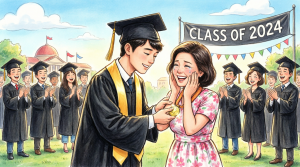
When I stepped down from the stage, I walked straight to my mother.
I removed the medal from around my neck and gently placed it over hers.
“Mom,” I said softly, “this belongs to you.
You’re the real reason my name stands here today.”
She hugged me tightly, tears streaming down her face.
“My son… thank you,” she whispered. “I never thought I’d hear you say you’re proud of me.”
I smiled through my own tears.
“Why would I ever be ashamed of you, Mom?
If it weren’t for you, I might have grown up feeling ashamed of myself.
But you taught me how to stand with dignity.”
Years have passed since that day.
Today, I work as a teacher in the same school where I once graduated.
And whenever I see a child being teased for being poor, I always tell them the same thing:
“There is nothing shameful about being a janitor, a garbage collector, or someone who washes clothes for a living.
What’s shameful is laughing at people who work harder and more honestly than you do.”
My mother still visits the school sometimes.
She still carries her mop and bucket through the hallways.
But now, when students see her, they smile.
No one laughs anymore.
Many of them greet her politely or nod their heads with respect.
And whenever I see her walking down the corridor, I smile and say:
“Mom, you didn’t just clean the school floors.
You cleaned my heart too.”