He was going to be EXECUTED at dawn for a crime he didn’t commit, but a RAT saved his life…
Condemned to die in a dungeon for a crime he did not commit, he shared his last piece of bread with a rat. He never imagined that this little animal held the key to his freedom.
Bruno was a man of wealth, but he possessed the greatest treasure a human being can have. A clear conscience. He worked as a valet in the mansion of the governor, a powerful and stern man who ruled the region with an iron fist. Bruno was known for his unwavering honesty.
He could find a gold coin on the ground and return it without hesitation. However, in a world driven by ambition, honesty often arouses the envy of dark hearts. Gaston, the chief butler, hated Bruno. He hated him because the young man’s integrity highlighted his own corruption. Gaston had been stealing small quantities from the governor’s pantry and wine for months, and he knew that sooner or later Bruno’s attentive eyes would discover it. He decided to strike first.
One afternoon, the governor’s signet ring, a unique piece of gold and rubies, disappeared. Chaos took over the mansion. Gastón, with a performance worthy of a theater, found the ring hidden under the mattress of Bruno’s humble bed. “Here he is, sir,” Gaston shouted with false indignation. “The serpent that he fed in his own house has bitten his hand.” Bruno, paralyzed by shock, could barely stammer his innocence, but the evidence planted was damning.
The governor, red with anger, did not even want to listen. He felt betrayed by the servant he trusted most. “Take him away,” the governor ordered, “let him rot in the tower of oblivion and give him nothing but bread and water until he confesses or dies.” The trial was swift and brutal, if it could be called a trial at all. There were no lawyers or witnesses in favor, only Gastón’s poisonous word against Bruno’s desperate crying. He was sentenced to life in prison.
In the deepest cell of the city’s prison, a place reserved for murderers and traitors, a stone hole from which it was said that no one came out alive. As the guards dragged him through the cobblestone streets toward the prison, the townspeople, who had once greeted Bruno with affection, were now throwing rubbish and spit at him. “Thief!” they shouted hypocrites at him. The pain of injustice was sharper than the chains that tightened on his wrists.
Bruno looked up at the sky for an answer, but saw only heavy gray clouds. Where was divine justice? Why did God allow lies to triumph over truth? Gaston watched from the balcony of the mansion with a smile of satisfaction on his lips, wiping his hands as if he had just finished a dirty but necessary job. Bruno was pushed through the heavy iron gates of the prison and the sound of bolts closing behind him sounded like the end of his life.
The tower of oblivion was not a tower, but a deep, damp, dark basement. Bruno’s cell was a windowless cube of cold stone, where the only light came from a distant torch in the corridor that barely flickered. The air was thick, laden with the smell of mojo, filth, and desperation from hundreds of men who had died there before him. The guard, a brutish man, without a trace of compassion, pushed him inside and closed the gate.
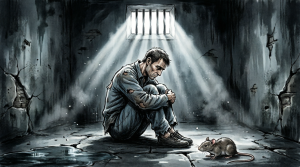
“Make yourself comfortable, thief,” he sneered. “This is your grave. No one will remember you in a week.” Bruno was left alone in the dark. The silence was absolute, broken only by the constant dripping of filtered water somewhere. He slumped down on the rotten straw floor, hugging his knees. The cold penetrated his bones, but the cold in his soul was worse. He had lost his job, his reputation, his freedom, and his future in a single day. Anger, helplessness and fear mixed in his chest forming a knot that prevented him from breathing.
She wept silently, hot tears that were rapidly cooling on her dirty cheeks. He felt completely abandoned by man and by God. Weeks passed in absolute darkness. Hunger turned into a constant pain that weakened his body, but the mental battle was worse. In solitude, doubt attacked him. If God existed, He would not allow this. Bruno, on the verge of despair, whispered in a broken voice, “Lord, if you are there, give me a sign. I don’t ask for a miracle, just to know that I’m not alone in this hell.” But the only response was silence and the dripping of water.
One night, as Bruno looked sadly at the small piece of dry bread that was his dinner, he heard a faint noise near his foot. He stood motionless. A pair of small, bright eyes were watching him from a crack in the stone wall. It was a large, gray rat with dirty fur and a bitten ear. Most of the men would have screamed or tried to kill her. The rats were pests, carriers of disease, the only other inhabitants of that cursed place.
But Bruno, in his infinite solitude, felt something different. He saw in the animal the same hunger and misery that he felt. “You’re hungry too, aren’t you, little one?” whispered Bruno in a hoarse voice. The rat did not run away. He moved his nose smelling the bread. Bruno looked at his food. It was so little, just enough to keep him alive another day. His survival instinct screamed at him to eat everything, but his heart, that kind heart that not even prison had been able to fully harden, took control.
He split the piece of bread in two! Here, he said softly, tossing the smaller half toward the crack. It is little, but it is shared…
Part 2 …
The rat shot out, took the bread and disappeared into the darkness. Bruno ate his part feeling a strange warmth in his chest. For the first time in weeks he had connected with another living being. He did not know that this act of mercy, so small and insignificant in the eyes of the world, had just set in motion the gears of his liberation.
God had heard his prayer and his messenger had no wings, but a tail. From that night on, a sacred routine was established in the darkness of the cell. Every time the guard brought the food, the rat would appear punctually as if it had an internal clock synchronized with Bruno’s hunger. He named her Spark because of the intelligent sparkle in her black eyes. It was no longer just sharing food, it was sharing company. Bruno spoke to her, told her about his life before prison, about Gastón’s injustice, about his fears.
“You’re the only creature that doesn’t judge me here, Spark,” she whispered as the little animal confidently ate crumbs from her hand. Perhaps you are nobler than all the men who walk up there. The rat, in its own way, seemed to hear him. Sometimes he would stay a while longer after lunch, wiping his mustaches, watching him with a curiosity that seemed almost human. However, Bruno’s health was deteriorating rapidly. The moisture from the stone had gotten into his lungs.
He began coughing up blood. Fever visited him at night, causing him delirium, where he saw Gastón laughing and the governor signing his death warrant. He felt like his life was fading like the torch in the hallway, slowly, without anyone caring. Upstairs in the mansion, Gaston’s life was very different, but no less tormented. He had been promoted. He was now in full control of the house, but peace had left him. Guilt is a ghost that does not need chains to imprison.
Gastón had become paranoid. He kept the stolen ring along with other jewels he had stolen over the years in a secret safe, behind a painting in his private room. Every night he would double lock the door, take out the ring and look at it, making sure it was still there. The glitter of gold and ruby that had once given him pleasure now caused him anxiety. If anyone finds him, I’m dead, he thought. I have to sell it, I have to get rid of it.
But the fear of being caught trying to sell such a famous jewel paralyzed him. One afternoon, Gaston felt the unhealthy need to see his victim. He went down to the prison, bribed the guard and stood in front of Bruno’s cell. “Look at you,” Gastón said, covering his nose with a scented handkerchief. “You look like a corpse.” Bruno, trembling with fever, looked up. “You can lock me up, Gaston, but you live in a prison smaller than mine. The prison of your fear.”
Gaston, furious at not seeing Bruno completely broken, knocked on the bars. “Save your words, thief. The governor has decided. In three days at dawn you will be hanged in the public square. Enjoy your last hours.” The news fell on Bruno like a slab of lead. Three days. 72 hours. That was all that was left of his existence. The fear of death, which had been latent, turned into a sharp, cold panic. When Gaston left, Bruno collapsed.
She cried until she had no tears left. He pounded his fists on the ground until they bled. “God cried out in the dark, it’s not fair. I’m going to die for someone else’s greed. Where are you? Why have you forsaken me?” That night Chispa did not come to eat. Bruno left the bread on the ground, but the animal appeared. Loneliness became absolute. Bruno thought that even the rat had abandoned him at the approach of death. He huddled in a corner, trembling, waiting for the end.
“Maybe it’s better that way,” he thought. Death will be a relief from this suffering. But Bruno knew that Spark had not abandoned him. The little rat was on a mission guided by an instinct that was not natural, but divine. The animal had found a way through the ancient pipes and crevices in the foundation, a labyrinth that connected the rottenness of the prison with the luxury of the mansion just above.
The next night, Bruno’s penultimate night, a noise woke him from his feverish sleep.
“Spark,” he whispered in a barely audible voice. The rat was there, but this time it wasn’t coming to look for food. There was something in her mouth, something that shone faintly in the gloom. Spark reached over to Bruno’s hand and dropped the object into his palm. Bruno brought him close to his eyes, squinting them to see in the darkness. His heart skipped a violent beat. It wasn’t a stone or a piece of garbage, it was a button. But not just any button, it was a solid gold button with the emblem of a fleur-de-lis engraved.
Bruno knew that button, he had polished it hundreds of times. It was a button on Gaston’s dress vest, a vest that Gaston jealously guarded in his private room. “Where did you get this?” asked Bruno stunned, looking at the animal. The rat squealed softly and ran towards the crack in the wall. Then she returned as if inviting him to follow her or showing him a path. Bruno’s mind, despite the fever, began to work at full speed. If the rat could go back and forth from Gaston’s room to the cell, it meant there was a direct physical connection and meant something else.
The rat was a forager, attracted to shiny things. A crazy, desperate, and almost impossible idea began to form in the condemned man’s mind. It was a one in a million chance, but it was the only thing I had. Bruno took off his only valuable possession, an old silver medal. He showed it to Spark, whose eyes shone with fascination. “Take it,” Bruno told her, confiding his last hope to an animal. “But bring me what he hides. Bring me the truth.” The rat took the medal with its teeth and disappeared through the dark crack.
Bruno was left alone, praying that the God of small things would guide the steps of his unusual messenger. His life now depended on a rodent. The longest night of Bruno’s life was slowly consumed. Every hour was one more step towards dawn, towards the gallows. Bruno did not sleep. He stood glued to the crack in the wall, his eyes bloodshot from the strain of peering into the darkness, waiting for a miracle that seemed impossible.
“Please, Spark,” he whispered, “come back.” But silence was the only answer. Doubt began to devour him. Had he been a fool? Had he entrusted his life to a dirty animal? Maybe the rat had simply taken the medal to its nest and would never return. Maybe he had fallen into a trap.
Upstairs in the mansion, Gaston slept a restless sleep, drunk on wine and power, unaware that a small shadow was silently moving through his room. The rat, attracted by the familiar smell of evil and the shine of metal, had found the hiding place behind the painting. With her nimble legs and sharp teeth, she had accomplished what no guard could: enter unseen. In the universe of the rat there was no crime or justice, only an exchange: a shiny object, the silver medal, for another shiny object that smelled of Gaston’s fear.
The sound of heavy boots in the stone hallway jolted Bruno out of his trance. They were the guards. The time had come. The sun had not yet risen, but the gray dawn was already sneaking through the cracks. Bruno dropped against the wall, defeated. It was over. Spark had not returned. The bolt of the cell creaked and the door opened with a metallic crash. “Get up, thief,” the guard growled. “The executioner is waiting for you.” Bruno stood up with difficulty, his legs trembling with weakness. He took a step toward the door and then felt something, a sudden weight on his bare foot. He looked down. There was Chispa. The animal panted with its fur bristling as if it had run a marathon and in its mouth it held something heavy and shiny.
The guard approached to grab Bruno. “Wait!” shouted Bruno with a strength he didn’t know he had. He quickly bent down and picked up what the rat had brought. Spark shrieked and ran to hide. Bruno opened his hand. On his dirty palm shone with an unmistakable red and gold light: the governor’s ring. The huge ruby seemed to burn in the darkness of the cell. “God exists,” Bruno whispered, clutching the jewel to his chest.
They dragged him to the prison courtyard where an improvised gallows had been erected. The governor was there dressed in black with a stern expression. Beside him, Gastón smiled anxiously to see the end of his problem. A small group of onlookers had gathered to witness the execution. The executioner put the noose around Bruno’s neck.
“Do you have any final say before you pay for your crime?” the governor said in a cold voice. Gastón took a step forward. “Let’s end this, sir. He doesn’t deserve to talk.”
Bruno raised his head. Despite his rags and filth, he had more dignity at that moment than all the men present. “I’m not a thief, Your Excellency,” Bruno said in a clear voice. “And I have the proof right here.” With a quick movement, despite having his hands tied, he managed to open the fist that he was holding tightly closed. The rising sun struck the ruby of the ring, releasing a flash that momentarily blinded those present.
The governor gasped. Gastón turned white as a piece of paper. “My ring!” she exclaimed, running to Bruno to snatch the jewel from his hand. “How? How is this possible? You’ve been locked up and guarded for weeks. No one has entered or left.”
A deathly silence fell over the courtyard. The logic of the situation was impossible. Bruno could have stolen the ring while he was in the cell. And if he had had it all along, he would have been found in the multiple searches.
“I wasn’t the one who brought him, sir,” Bruno said, staring at Gastón. “He was a messenger of God, a small and humble messenger who can enter where men cannot. If you go now to Gaston’s room, you will find a silver medal of the Virgin, where he hid this ring.”
Gaston began to tremble violently. “He’s lying, it’s witchcraft,” he shouted, but his voice was high-pitched with panic.
“Kill him now!” The governor, who was no fool, saw the terror in his butler’s eyes. “Guards,” he ordered in a thunderous voice, “go to Gaston’s room now and search everything.”
Ten minutes later, the guards returned. The captain of the guard had something small in his hand. “Your Excellency, we found this in the secret safe behind the painting, in Gaston’s room.” The governor took the silver medal, old and worn, identical to the one Bruno always wore. He looked at Gaston.
“The betrayal is evident. You stole my ring, you planted the evidence and you almost had an innocent man hanged.” Gaston fell to his knees weeping and begging, but it was too late. The same guards who were holding Bruno let him go and grabbed Gastón. Justice, though belated, had arrived with divine precision.
The governor approached Bruno and with his own hands removed the rope from his neck. “Forgive me, son,” said the powerful man lowering his head in embarrassment. “I have been blind. I’ll give you your place back. I’ll give you gold. I’ll give you whatever you ask for.”
Bruno rubbed his neck in pain, looked at the small window in the basement where he had been locked up. I knew Spark was down there. “I don’t want gold, sir. I just want my freedom. And that all creatures, no matter how small, be treated with respect. Because God sometimes uses the least to embarrass the bigger.”
Bruno left prison as a free man. He never forgot the rat. It is said that every day he left a piece of fresh bread and cheese near the prison walls. An offering of gratitude for the friend who saved his life.
This story is for you who feel trapped in an unfair situation, for you who believe that there is no way out and that no one sees your suffering. Remember Bruno, sometimes help doesn’t come from where we expect it. Sometimes it does not come from an army or a king, but from the most humble and unexpected.
Don’t look down on small acts of kindness. Sharing your bread when you have little, being kind when you are suffering. Those are the seeds of miracles. Trust. God has messengers everywhere, even in the deepest darkness. Your truth will come out and the chains will break.

