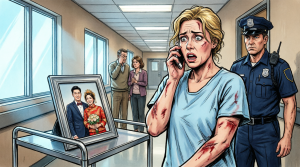
He handed me divorce papers while I was still wearing a hospital bracelet.
The kind that makes you feel less like a person and more like a file number someone forgot to close out, with my name printed in block letters beside a barcode, a date, and a list of allergies pressing against my wrist like a reminder that my body had become a problem for others to manage.
I had been admitted to Westbridge General Hospital in Chicago for complications that started as simple dizziness, and I kept telling myself it was nothing serious while trying to smile through it and avoid becoming a burden.
The dizziness slowly turned into weakness in my legs, then that weakness required constant monitoring, and soon it became hushed conversations outside the curtain where doctors used words they clearly did not want me to hear.
They said things like instability, potential event, and observation, and I lay on the thin mattress staring at the ceiling tiles while trying to keep my breathing steady despite the fear building quietly inside me.
I was exhausted and frightened, yet I still held my life together with trembling hands because I had been conditioned not to inconvenience anyone around me.
That same training existed in my marriage, where I had learned to avoid being dramatic, avoid being needy, and handle everything without asking for help.
I had no idea my husband had been waiting for a moment when I could not even stand on my own.
He walked into my hospital room smiling like he was attending a business meeting, carrying no flowers, offering no concern, and asking nothing about how I felt.
Instead, he held his phone in one hand and wore a smug expression that appeared whenever he believed he had secured a victory.
His name was Bradley Foster, and he loved winning more than anything else in his life.
“Hey,” he said loudly enough for the nurse at the station to glance over, “good news.”
My stomach tightened as he held up a manila envelope like it was some kind of prize he had just earned.
“I filed for divorce,” he announced, then laughed openly, “and I am taking the house and the car.”
The laugh sounded wrong inside the sterile hospital room, echoing against the walls and settling into the silence like something that did not belong there.
He dropped the envelope onto my lap, already signed on his side and carefully highlighted where I was expected to sign as if I were simply another document waiting to be processed.
I stared at the pages while my heart pounded hard enough to echo through the monitor beside me, seeing boxes checked next to house, car, and accounts as if he were casually shopping.
The most shocking part was not that he wanted everything, but that he was completely certain I could not stop him from taking it.
Bradley had no idea how much I earned, because he believed my job was a small side hobby that existed only to keep me occupied and quiet.
He preferred the version of me who paid bills, never argued, and never challenged his assumptions, and I had allowed him to believe that version was real.
I never told him I earned one hundred thirty thousand dollars a year, not out of spite but out of survival and careful planning.
I kept my salary separate, built savings quietly, and watched him spend recklessly as if consequences would never catch up to him.
He leaned closer and lowered his voice like he was offering me a favor, saying, “You cannot afford to fight this, so just sign it.”
I did not cry or beg, and instead I looked up at him and asked softly, “You are leaving me here like this?”
He shrugged casually and replied, “You will be fine because hospitals fix people,” before turning around and walking out without another glance.
The moment he left, I did not panic outwardly, although my hands shook slightly as I pressed the call button and asked the nurse for a charger, a pen, and a moment of privacy.
Then I called the one person Bradley never expected me to have, my attorney, whose name was Patricia Greene.
She answered on the second ring and said, “Tell me everything that happened,” without any greeting or hesitation.
I explained the hospital, the envelope, the highlighted lines, and the way he laughed, laying out the details calmly as if presenting evidence in a case.
Patricia did not react emotionally, and instead she said firmly, “Do not sign anything under any circumstances.”
“I was not going to,” I replied quietly, feeling a sense of control return to me.
“Good,” she said, “because now we build a timeline that will support everything.”
The word timeline steadied me more than comfort ever could, because facts create leverage and leverage creates protection.
She asked about everything I owned, what was in my name, and what documents I had preserved, and I smiled faintly as I answered.
“More than he thinks,” I said, and she responded with quiet confidence that she already understood exactly who I was.
By the time I was discharged from the hospital, Bradley had already moved out of the house without informing me directly.
When I returned home, I found closets half empty, drawers pulled open, and cabinets rearranged as if he had been searching for something important.
He had taken the television, the espresso machine, his clothes, and even his cologne, but he left the mortgage documents untouched in the filing cabinet because he never examined them closely enough.
I stood in the doorway for a long moment, breathing in the silence before turning around and leaving without looking back.
I never slept in that house again after that day.
Weeks later, mutual friends told me Bradley had remarried quickly and extravagantly, throwing a celebration that looked more like a performance than a relationship.
People assumed I was heartbroken, but I felt something entirely different that resembled clarity rather than grief.
Three days after his wedding, at exactly eleven twenty three at night, my phone lit up with his name, and I hesitated before answering.
When I picked up, there was no laughter in his voice, only panic and urgency.
“Please,” he said, his voice cracking, “tell me what you did to everything.”
In the background, I heard a woman crying sharply and anxiously, which I understood must be his new wife.
He spoke quickly, explaining that his cards were not working, the mortgage payment had failed, and the dealership had contacted him about the vehicle.
“You are upset, I understand that,” he said hurriedly, “but my wife is panicking and we cannot be homeless right now.”
I sat in my new apartment, quiet and peaceful, and reminded him calmly, “You left me in a hospital bed without hesitation.”
He dismissed it and replied, “You were not dying, so it was not that serious.”
“But you did not know that at the time,” I said, letting the silence settle.
He grew impatient and said, “Fine, I am sorry, so can we fix this situation now?”
I asked him calmly, “Do you want to know what actually happened here?”
“Yes,” he said urgently, clearly losing control.
“You built your entire plan on the assumption that I could not afford to defend myself,” I explained slowly.
The silence that followed told me everything I needed to know.
Two years earlier, when he pushed to refinance the house and rearrange assets, I had read every document carefully and refused to sign anything that removed protections.
The house title remained solely in my name, protected by a trust clause established long before I married him, which he had mocked at the time.
Now that clause prevented him from selling, borrowing, or claiming the property without triggering a legal review, which happened the moment he filed for divorce.
The joint accounts were frozen due to suspicious withdrawals during my hospitalization, and the car lease remained entirely under my credit and control.
“The letter you received was not revenge,” I said calmly, “it was enforcement of what already existed.”
Behind him, I heard his new wife shouting angrily, “You told me she had nothing at all.”
He lowered his voice and whispered, “If you drop this, I will give you anything you want.”
I remembered the bracelet, the envelope, and the laugh, and I answered without hesitation.
“I already have what I want, and that is my life back.”
Two weeks later, we stood in a courtroom in downtown Chicago for the hearing, and I arrived composed, wearing a navy suit that reflected strength rather than vulnerability.
Bradley sat across from me with his attorney, while his new wife sat behind him looking pale and uncertain.
The judge, a woman with silver hair and sharp focus, reviewed the file before asking, “You filed for divorce while your spouse was hospitalized?”
Bradley attempted to sound confident as he replied, “The marriage was already over, so I did not see a problem.”
“Were you aware of her medical condition at that time,” the judge asked firmly.
He hesitated before admitting that he knew I was hospitalized, which caused the judge to make a note.
Patricia then presented the documentation proving the property was solely in my name and protected under a trust clause that could not be overridden.
She also provided bank statements showing his attempted withdrawals within hours of serving divorce papers, which created visible tension in the room.
When the judge asked him to explain the timing, he claimed he was protecting himself, but he could not explain from what.
Patricia then played a voicemail where he made a threatening statement, and the silence afterward was overwhelming.
The judge ruled in my favor, granting exclusive occupancy of the house, maintaining frozen accounts, and restricting his contact entirely.
When asked about my income, I answered clearly that I earned one hundred thirty thousand dollars annually.
Bradley stared at me in disbelief, realizing for the first time how badly he had miscalculated everything.
Outside the courthouse, he said angrily, “You embarrassed me in there,” and I replied calmly, “You embarrassed yourself in a hospital room.”
Three months later, the divorce finalized according to the law rather than his assumptions, leaving him without the house, the car, or financial control.
I moved into a smaller apartment by choice, furnishing it simply and creating a space that felt peaceful and entirely mine.
Months later, when my phone rang from an unknown number, I let it go to voicemail and never listened to it.
I did not look back, not because of anger, but because I no longer needed to.
