The numbers branded themselves into my mind the instant they flashed across the screen: 4–12–28–35–42, Mega Ball 11.
I was sitting in my basement room—though “room” was generous. It was really a converted storage space with unfinished walls, a camping cot, two plastic bins full of old winter clothes, and a space heater that worked only when it felt inspired. I was watching the lottery draw on a dented, slow-moving laptop with a cracked corner and a sticky keyboard.
When every number matched, I didn’t cheer.
I didn’t shout.
I didn’t even stand up.
I just sat there in the pale blue flicker of the screen while laughter drifted down through the ceiling from upstairs, where my family was hosting dinner guests and pretending, as always, that they were one promotion, one luxury car, one country club conversation away from becoming the people they wanted everyone to think they already were.
Four hundred and fifty million dollars.
After taxes, after taking the lump sum, I’d walk away with something like two hundred and eighty million in cash.
Enough money to buy everything they worshipped and still have more left over than they could imagine.
But I didn’t move. Not yet.
Because the money itself wasn’t the point
The point was what came next.
Three years earlier, on a wet Tuesday morning while the rest of the house still slept under expensive comforters and curated delusions, I drove my rusted 2005 Toyota Corolla across San Diego to the offices of Bennett & Rowe, one of the most expensive law firms in the city. I paid a fifty-thousand-dollar retainer in cash—money I had scraped together over years of overtime, side jobs, and disciplined silence—and I told them exactly what I wanted.
“I need a blind trust,” I said. “Completely anonymous. I want my name buried so deep it would take a team of auditors and a court order to drag it into daylight. And I want every legal protection available to keep me invisible.”
The attorney across from me was a silver-haired woman named Victoria Bennett. Her desk was polished mahogany, her office all leather and books and quiet old money. I was sitting there in my janitor’s uniform, smelling faintly of bleach, floor wax, and stale coffee.
To her credit, she didn’t blink.
“May I ask why the secrecy, Mr. Carter?” she said.
I looked down at my hands, dry and rough from industrial cleaner and paper towels and work no one notices unless you stop doing it.
“Because I need to know whether the people who say they’re family would still treat me like one if they thought I had nothing.”
She studied me for a long moment.
Then she nodded once.
“That,” she said, “is unfortunately a reason I understand.”
Two weeks later, by the time I claimed the prize, I had become a ghost.
The trust had a name—Harbor Crest Holdings. It had directors who weren’t me, a registered agent who wasn’t me, layers of legal insulation that made the money untouchable in any way that could be traced back to Ethan Carter, janitor, basement tenant, disappointment. California released a brief statement saying a resident of San Diego County had claimed the jackpot anonymously. That was all.
And the next morning, I woke at five, put on my blue work shirt, drove to the office, and mopped floors at NorthStar Systems.
Why NorthStar?
Because that’s where my father worked.
Robert Carter was a regional sales manager at NorthStar, fifty-eight years old, perpetually aggrieved, and deeply committed to the theater of success. His entire existence was a performance for a crowd that, in truth, barely cared. He leased luxury cars he couldn’t afford, paid for a country club membership with revolving credit, wore designer watches bought on installment plans, and dropped names in conversation like breadcrumbs leading toward the life he believed he deserved.
My mother, Elaine, was cut from the same fabric, only sharper. She had once, according to old photographs, been beautiful in a soft and unguarded way. But years of chasing status had made her hard around the edges. She evaluated people instantly—by handbag, by neighborhood, by accent, by school district, by whether their shoes looked expensive enough to justify her interest. Her small talk was social warfare dressed in lipstick.
And then there was my younger brother, Tyler. Two years younger. Favorite son. Golden child. The proof, according to my parents, that they had done at least one thing right.
Tyler sold real estate, or at least that was the official version. The real version was messier. He leased a different luxury car every year, wore suits he couldn’t pay for, and flooded social media with carefully staged photos of penthouse listings, rooftop drinks, and captions about “the grind.” What almost nobody knew was that he was drowning—sports betting, online poker, unpaid taxes, shaky deals, forged documents, and the kind of debt that stops being funny the moment the wrong people start asking for it back.
I knew.
I knew because for three years, I watched them all.
And for three years, I saved them.
Quietly. Repeatedly. Completely anonymously.
When my mother maxed out another round of credit cards—and she did, with the reliability of a clock—mysterious electronic payments would appear just before collection notices turned uglier. She thought her luck had turned. Maybe she believed my father had landed a bonus he wasn’t discussing. Maybe she never thought about it at all. That would have been more in character.
When my father’s sales numbers cratered and rumors of “retirement conversations” began circulating at NorthStar, I acted. Through Harbor Crest Holdings, I acquired fifty-one percent of the company. Quietly. Efficiently. No drama. No press. No face attached. I became the majority shareholder, the invisible chairman, the man whose preferences the CEO learned not to question. And one of those preferences was that Robert Carter kept his job.
So he did.
The CEO, Martin Holloway, understood the message perfectly. He didn’t need to know why I wanted it. Only that I did.
And Tyler?
Tyler would have been in prison twice over if I had let consequence do its ordinary work.
The first time, he sold a property using forged authorization papers and ended up crossing a buyer who happened to be an attorney. The lawsuit that followed would have burned his life to the ground. Through a chain of shell companies and carefully arranged settlements, I bought out the claim, buried the case, and made the problem disappear. Tyler celebrated his “good luck” by financing a Rolex he couldn’t afford.
The second time was uglier. He manipulated an elderly couple into a reverse mortgage scheme that wiped out their savings. Their children came after him with lawyers, investigators, and something darker underneath the surface. I stepped in before it became irreversible. I paid full restitution and bought the couple a new house outright through an anonymous charitable entity. Their children dropped the matter.
Tyler told everyone he had “navigated a complicated negotiation.”
I paid for his lies.
I paid for my mother’s delusions.
I paid for my father’s dignity.
And I did it while living in their moldy basement and paying them eight hundred dollars a month in rent for the privilege.
Why?
I asked myself that every night lying on that narrow cot, listening to the house settle above me. Was it love? Some pathetic, leftover hope that one day they would wake up and see me clearly? Or was it pride—some dark need to prove that I could be better than they were while they stepped on me?
Maybe both.
But mostly, I think I wanted proof.
Proof that underneath the vanity, the greed, the social climbing, there might still be something human in them. That maybe, stripped of image and advantage, they could still love a son, a brother, a person, for reasons that had nothing to do with money or status.
So I watched.
And I learned.
At family dinners, I was expected to attend but never welcomed. I sat at the far end of the table, often in the odd chair from the breakfast nook because the “good” dining chairs were reserved for real guests and real sons. They talked over me, around me, through me. Never to me. If Tyler launched into another polished fiction about closing a six-million-dollar deal, everyone leaned in. If I mentioned something ordinary—an annoying coworker, a funny thing I overheard, a long shift—my mother would physically get up in the middle of my sentence and go do something else.
“Ethan,” she once said, already halfway to the kitchen, “we’re trying to enjoy dinner. Nobody wants to hear about cleaning bathrooms.”
My father was worse in subtler ways.
About a year after I started at NorthStar, he saw me there. He was walking a client through the third floor when he spotted me emptying trash bins near the conference rooms. His face moved through shock, recognition, and then raw humiliation so fast it was almost impressive.
That night, he was waiting at the basement door.
“You work at my company?” he hissed. “Do you understand what that looks like? If people connect us—if someone realizes my son is cleaning toilets—do you have any idea how humiliating that is for me?”
“I needed work,” I said.
“Anywhere else would have done!”
It could have. I had two hundred eighty million dollars hidden behind corporate veils and legal firewalls. I could have bought the building, renamed it, and fired everyone who ever looked at me sideways.
Instead I said, “I’ll stay out of sight.”
And I did.
For three years, I became invisible.
I worked the earliest shift, arriving before most office workers got there and leaving before the lobby filled. When I saw my father in a hallway, I disappeared into supply closets or took another staircase. I became a ghost in his workplace, which suited the broader arrangement. I had always been mostly invisible to him anyway.
And then came yesterday.
Their thirtieth wedding anniversary.
My mother had spent months planning it. Rentals, flowers, catering, engraved invitations, a string quartet in the backyard, white roses on every flat surface, crystal glassware, vintage china, imported champagne—the full, expensive pageant of a life curated for other people’s admiration.
I was not invited.
Of course I wasn’t.
The celebration was happening above me, around me, despite me, as if I were some shameful maintenance issue best kept below ground.
But some stupid, still-unbroken part of me wanted to mark the day. To do something simple and sincere. Something that belonged to family rather than theater.
So I baked a cake.
Nothing extravagant. A lemon pound cake using my grandmother’s recipe—the one everyone used to love before loving things became less important than impressing people. I spent the afternoon measuring flour and zesting lemons and trying, absurdly, to get it right.
At seven that evening, I carried it upstairs in a disposable pan.
I was still wearing my work uniform because I didn’t own anything “appropriate” for their party. My clothes smelled faintly of floor cleaner. The kitchen was full of catering staff, polished trays, expensive appetizers.
My father saw me immediately.
His face changed from host to horror in a single second.
“What the hell are you doing here?” He grabbed my elbow and dragged me into the corner. “Look at you. You smell like a restroom. Sterling’s here. Clients are here. Investors are here. Are you trying to humiliate me?”
Sterling.
Except it wasn’t Sterling. At NorthStar it was Holloway.
Martin Holloway, the CEO. The man who reported indirectly to me and didn’t know the janitor standing in the kitchen was the chairman whose instructions he followed.
“I just wanted to congratulate you,” I said, holding up the cake. “It’s Grandma’s recipe. I thought maybe—”
“You thought wrong.”
My mother appeared beside him in a dress that cost more than my monthly rent payment to them. I knew because I had indirectly cleared the card she used to buy it. She took the cake from my hands, turned, and dropped it straight into the trash.
Container and all.
The dull thud it made at the bottom of the bin is still one of the cleanest sounds I have ever heard.
“You are a magnet for failure,” she said. “An anchor around this family’s neck. You’re thirty years old and still mopping floors. Look at your brother. That’s what a real son looks like.”
Tyler was leaning in the doorway with a drink in his hand, smiling like this was entertainment.
“Don’t be too hard on him, Mom,” he said. “Some people are just meant to be background. Somebody has to clean up the mess so the rest of us can shine.”
They laughed.
All three of them.
That was the moment something inside me finally snapped—not violently, not dramatically. More like the final thread of a rope giving way after years of strain.
My father’s voice went flat.
“Pack your things. I’m done. I’m tired of that junk car in the driveway. Tired of worrying someone from work will see you. Tired of being embarrassed by you. Get out.”
I looked at them then. Really looked.
My father, flushed with borrowed authority. My mother, already mentally turning back toward the guests. Tyler, delighted with himself, as always.
Three years of anonymous mercy. Three years of shielding them from the consequences of their own choices. Three years of hoping they might, somehow, still be reachable.
And this was what they thought of me.
“Fine,” I said. “I’ll come back tomorrow for my things. Grandpa’s box is still in the basement.”
There was no box. My grandfather had been dead for years, and anything worth keeping I had already removed. But I needed a reason to return.
“Ten in the morning,” my father said dismissively. “Use the side entrance. And don’t park where anyone can see that car.”
That night, I did not sleep in the Corolla.
I drove to the Ritz-Carlton penthouse I kept under an alias.
Three thousand square feet. Harbor views. Italian furniture. Heated marble floors. A shower with six jets. Bottles in the wine fridge that cost more than my father made in a month.
I poured a glass of Château Margaux and stood at the window looking down at the city.
Tomorrow, I thought, they learn the truth.
And I learn whether truth produces remorse—or just greed in a purer form.
By then, I already knew the answer.
The next morning, I made four calls.
First, Victoria Bennett. “Execute the plan.”
Second, Martin Holloway. “Be at the Carter residence at ten. Bring the termination paperwork.”
Third, the bank holding the hidden third mortgage on my parents’ house—a mortgage they had quietly taken out to pay Tyler’s gambling debts. I had bought that note months before through one of my companies. “Call it due. Three days to vacate.”
Fourth, the Bugatti dealership.
At 9:45, I slid into the driver’s seat of a matte black Bugatti Chiron Super Sport and headed toward the suburbs.
The car announced itself before I ever turned onto their street. Not loud in the cheap, obnoxious way. Loud in the way thunder is loud—deep, expensive, unmistakable.
When I rolled up, my father, mother, Tyler, and Martin Holloway were standing on the lawn talking. My father was mid-story, all animated hands and eager posture. Tyler was checking his phone. My mother was wearing her social smile.
Then the Bugatti stopped at the curb.
The neighborhood went silent.
People came out onto porches. Lawn equipment stopped. A kid on a bike nearly tipped over staring.
Tyler spoke first.
“Oh my God. That’s a Bugatti.”
My father was already moving toward the car, hand outstretched.
“Good morning, sir! Robert Carter, NorthStar Systems. Welcome to the neighborhood. If you need anything—if you’re looking at property around here—my son Tyler’s in real estate…”
I let him talk.
Then the butterfly doors opened.
I stepped out.
Shoes first. Suit second. Sunglasses off. Slow. Deliberate.
He stared at me.
Confusion. Recognition. Refusal. Shock.
“Hi, Dad,” I said. “I came to get my things.”
My mother dropped her glass. Tyler’s phone slipped from his hand into the grass. Holloway’s eyebrows rose the slightest fraction.
“Ethan?” my father said. “What… what is this? Did you steal this? Are you driving for someone?”
He was looking around for the real owner. The actual important person. The one this scene would make sense for.
I walked past him and stopped in front of Martin Holloway.
“Good morning.”
He straightened.
“Good morning, Mr. Chairman,” he said clearly. “I brought the termination papers, as requested.”
Everything stopped.
My father blinked.
“What did he just call you?”
I turned back toward them.
“I’m the majority shareholder of NorthStar,” I said. “The chairman. The one signing off on the decisions that kept you employed these past three years despite your numbers.”
Silence.
“Three years ago I won the lottery. Four hundred and fifty million dollars. After taxes, about two hundred eighty million. I put it behind a blind trust and kept working. I wanted to see who you really were when there was nothing to gain from treating me well.”
I pulled out my phone.
“I paid Mom’s credit cards. Eighteen times. Two hundred forty-seven thousand dollars.”
Another folder.
“I protected your job.”
Another.
“And Tyler—your debts, your lawsuits, the elderly couple you defrauded? That was me too. Every escape hatch, every miracle, every unexplained piece of good fortune. Me.”
Tyler had gone pale.
My mother looked less devastated than calculating, which somehow hurt less than it should have because it was exactly what I expected.
My father lifted a trembling hand. “Son, if we had known—”
“Would it have mattered?” I asked. “Would you have treated me with respect if I’d been poor forever? Would you have loved me in that basement? Or only in this suit?”
No answer.
I handed the foreclosure envelope to my mother.
“You have three days to vacate. The mortgage is due.”
I nodded toward Holloway.
“And Robert, you’re terminated effective immediately.”
Tyler found his voice in a burst.
“You can’t do this. We’re family.”
I laughed once.
“Family? Where was family when you laughed while my cake went in the trash? Where was family when you charged me rent to live in mold? Where was family when you threw me out?”
My father looked like the world had turned against gravity.
“I was trying to make you stronger,” he whispered. “I thought if we were hard on you—”
“You thought wrong.”
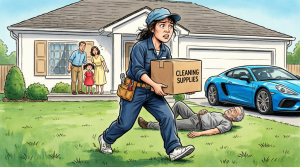
Then he clutched his chest.
For a second I thought it was performance. But the collapse was real—knees buckling, body dropping awkwardly onto the lawn he cared more about than most people.
My mother screamed. Tyler froze.
“Holloway,” I said calmly, “call 911. And when he wakes up, make sure he receives the paperwork.”
“Of course, Mr. Chairman.”
I looked down at my father and felt… nothing dramatic. No triumph. No grief. Just a kind of tired completion, like finishing a task that had been overdue for years.
“What about you, sir?” Holloway asked quietly.
I glanced at the Bugatti.
“I have somewhere better to be.”
I walked back to the car.
My mother was kneeling in the grass, crying, but even then her eyes kept darting to the car, to the suit, to the life she had misjudged and lost access to. Tyler was already on his phone, no doubt building a version of events in which he remained misunderstood and important. My father, unconscious, looked suddenly what he had always been underneath the performance—small, aging, ordinary.
I got in.
The doors closed.
The engine deepened.
And I drove away.
I took the Pacific Coast Highway north. The city fell behind me. The neighborhood vanished. The house, the basement, the role they had written for me—all of it shrank in the mirrors.
At an overlook above the ocean, I pulled over and stood at the railing watching waves slam against the rocks below.
My phone buzzed.
A text from Holloway.
Your father is stable. He received the paperwork. He says he’s sorry and that he loves you.
I read it twice.
Then I deleted it.
Maybe he did love me in whatever stunted, conditional way he was capable of. Maybe they all did.
But love without respect isn’t love that can sustain anything.
Love that requires you to stay small, stay hidden, stay grateful for cruelty because it occasionally comes wrapped in blood ties—that isn’t love worth keeping.
I got back in the Bugatti and kept driving.
The road ahead was wide and open. The ocean stretched blue and indifferent beside me. For the first time in years, maybe in my whole adult life, I felt air reach the deepest parts of my lungs.
Money hadn’t changed who my family was.
It had simply exposed them more clearly.
That was the real lesson.
Money does not create character. It amplifies what was already there.
Their cruelty didn’t begin when I became rich. Their greed didn’t bloom because there was more to want. It had all been there from the beginning, hidden under routine and expectation and the lazy certainty that I would remain available, useful, lesser.
And maybe the hardest lesson was this: blood is not proof of family.
Sometimes the people you grow up with are just that—people you happened to grow up with. DNA can make you related. It cannot make you safe. It cannot make people kind. It cannot force them to see your humanity.
Real family is built on respect.
On tenderness.
On the instinct to protect rather than belittle.
On seeing someone clearly even when they have nothing to offer you.
Everything else is just inheritance of a more ordinary kind.
Somewhere behind me, in a house they could no longer afford, my family was finally learning what I had known for years: that every illusion eventually sends a bill. Every cruelty accrues interest. And one day, even if it takes longer than it should, payment comes due.
I hoped they learned something from it.
I hoped Tyler lost the grin before he lost the rest of himself.
I hoped my mother, stripped of the audience she prized so much, might one day have to meet who she was in silence.
I hoped my father, laid up and unemployed and finally unable to perform competence for anyone, might understand what it cost him to confuse domination with love.
But mostly, I hoped I would never need to know.
Because the point of freedom is not revenge.
It is distance.
It is waking up in a life that belongs to you.
It is no longer measuring your worth by the people least qualified to assign it.
The janitor they mocked.
The basement son they charged rent.
The embarrassment they threw out.
The nobody they never bothered to see.
He had always been worth more than they knew.
And now, finally, he belonged to himself.
