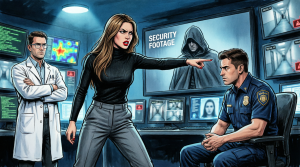
WHEN THE HOSPITAL REPLAYED THE FOOTAGE OF YOUR BABY’S FINAL NIGHT, YOU EXPECTED TO SEE A STRANGER. INSTEAD, THE SCREEN FROZE ON A FACE YOU KNEW, AND THE LIE THAT DESTROYED YOUR LIFE BEGAN TO BLEED IN REVERSE
The detective pressed play, and the room seemed to shrink around you.
The grainy black-and-white footage showed the neonatal intensive care unit exactly as you remembered it: low lights, quiet monitors, nurses moving like ghosts between tiny incubators. You saw yourself first, sitting beside Liam’s bed with your shoulders curled inward, your whole body built around fear. Even on video, grief had a posture. It bent you before it broke you.
Then you watched yourself stand, kiss two fingers, and press them gently to the glass of his incubator before leaving the room because the nurse had told you to go home and rest for an hour. You remembered that moment with brutal clarity. You had hesitated at the door because every cell in your body had screamed not to leave him, but you were exhausted, stitched together by almost no sleep and too much hope.
The timestamp moved forward.
A nurse entered. She checked the monitors, adjusted the blanket, and left. For several seconds, nothing happened except the tiny pulse of machines. Then the door opened again.
A figure stepped inside wearing scrubs, a surgical mask, a cap, and gloves.
At first, there was nothing human about the person on the screen. Just a shape. Just motion. Just hands that moved with sickening calm. The figure glanced over one shoulder, crossed the room, and stopped at Liam’s IV line. One hand held the line steady. The other pulled something from a pocket and injected it directly into the port.
Your heart slammed so hard that pain burst behind your ribs.
“No,” you whispered, though the footage kept moving. “No. No, no, no.”
The figure lingered only a few seconds, then turned as if to leave. But before reaching the door, the person looked up, directly toward the hallway camera. The detective froze the frame and zoomed in.
The room went silent in a way that felt unnatural, like even the air had recoiled.
You saw eyes first. Familiar eyes. Pale green with a downward tilt at the corners. Then the brow. The shape of the cheekbones beneath the mask. A scar near the temple, half-hidden by the cap, one you had seen a hundred times under warm kitchen light and on summer vacations and in wedding photos you had burned after the divorce.
Your mouth went dry.
“It can’t be,” you said, but your voice sounded distant, almost borrowed.
The detective did not answer immediately. He gave you that terrible mercy people offer when truth is about to finish its work. Then he slid a still photograph across the table. It was a recent driver’s license image of Daniel’s second wife, Ava Mercer Carter. Her hair was lighter now, but the eyes were the same. The scar was the same.
Your fingers started to tremble so violently you had to pin one hand beneath your thigh just to stop it.
“Ava?” The name scraped your throat on the way out. “Daniel’s wife?”
Detective Ruiz nodded once. “We believe she was in the hospital the night Liam died using a falsified visitor badge linked to a temporary staffing vendor. That badge was flagged in the audit. At the time, nobody connected it to the infant death because the death had already been coded as genetic.”
You stared at the screen until the pixels blurred together.
Daniel had met Ava only months after Liam died. That was the official story, the one he and everyone else repeated with polished ease. You had heard she was elegant, charitable, impossibly composed. The kind of woman people described as effortless because they never looked closely enough to see the calculation underneath.
But this? This was not calculation. This was murder.
You pressed both palms to your mouth, not because you were about to cry, but because you were afraid something animal and broken might come out of you if you didn’t. For six years, you had carried the sentence Daniel gave you like a stone tied to your spine. Your genes defected. Your body failed. Your child died because something in you was wrong.
And all along, someone had poisoned your son.
“Why would she do that?” you asked finally.
The detectives exchanged a glance that bothered you more than any immediate answer could have.
“That,” Ruiz said carefully, “is what we’re still investigating.”
Dr. Ellis sat across from you with both hands wrapped around a paper cup she was not drinking from. Her eyes were raw, as if she had not slept since the audit exposed the falsified records. When she apologized, it was not the polished apology of an institution. It was the cracked, human kind. The kind that knew it was arriving six years too late to save anyone.
“We found discrepancies in medication logs during a digital migration,” she said. “Someone manually altered the original treatment notes and genetic consult request. The toxicology order was deleted before it could be processed. Then the case was sealed under neonatal complications.”
You looked at her, numb and burning at the same time.
“Someone in your hospital helped cover it up.”
She closed her eyes briefly. “Yes.”
You should have felt vindicated, but grief is a strange country. Truth does not cancel pain. It just gives it sharper edges. Sitting there in that cold room, you realized the past had not been rewritten. It had been robbed, and now the thieves were returning pieces one by one, expecting you to survive the weight of getting them back.
Ruiz handed you a business card. “We’d like you to stay available. Ava is being brought in for questioning. We have enough for probable cause on evidence tampering and unlawful access, but the homicide charge will depend on motive and corroboration.”
“Motive,” you repeated. “She murdered a newborn, and you still need motive?”
His expression did not harden, which made him seem more honest. “We need to prove it in a courtroom, not just in our bones.”
That night, you sat in your apartment in Portland with every light turned on.
The place was small, clean, and carefully ordinary. The books on the shelves. The mug with the chipped handle. The knitted throw your therapist once said looked like proof that comfort could be handmade. For years, you had built your life like a quiet shelter, a place with no sharp corners, no dramatic shadows, nothing that reminded you of the life that collapsed. But now the walls felt temporary, like scenery in a play you had mistaken for home.
At 9:14 p.m., your phone rang.
Daniel.
You stared at his name until the screen nearly went dark. He had not called in almost two years. The last time had been over paperwork involving an old tax discrepancy, and even then his voice had carried the same cool impatience, as if your existence were administrative clutter. You answered because part of you wanted to hear whether guilt changed a man’s breathing.
“Why did the hospital call you?” he asked without greeting.
You stood slowly from the couch. “That’s how you open this conversation?”
“I got a message from someone in legal,” he said. “They said detectives are asking questions about Ava. They won’t tell me anything else.”
Of course. Institutions always told powerful men just enough to make them nervous.
You walked to the window and looked out at the wet Portland street glimmering under the lamps. “They discovered Liam wasn’t sick, Daniel.”
Silence.
Then, softly, “What are you talking about?”
“Someone poisoned him.”
The silence deepened into something you could hear around the edges, something like the sound of a mind rearranging itself too fast. When he spoke again, his voice had changed. Not shattered, exactly. But loosened.
“That’s impossible.”
“They have footage.”
This time he inhaled sharply. You had known him long enough to recognize the tiny sounds he made when he was cornered, though once upon a time you had mistaken them for stress, for ambition, for all the glamorous names cruelty borrows when it wants to survive.
“Who?” he asked.
You almost laughed, but there was no humor in you. “Your wife.”
His denial came so quickly it sounded rehearsed. “No.”
“They have video, Daniel.”
“No,” he said again, louder now, and then you heard it: not outrage, not grief, but fear. “You don’t know Ava. She would never hurt a child.”
The sentence landed so wrong that you pulled the phone away from your ear and stared at it. Never hurt a child. Not she didn’t do this. Not let me see the evidence. Just the blunt instinct to defend her character, as if image still mattered more than Liam’s life.
“Did you ever love him?” you asked.
His breath caught. “What?”
“Did you ever love our son enough to imagine someone besides me could have harmed him?”
There was movement on his end, a door shutting, footsteps, the rustle of panic trying to dress itself as control.
“You need to stop talking to detectives without a lawyer,” he said.
You closed your eyes.
There it was. The true religion of men like Daniel. Not innocence. Not justice. Exposure management.
“You should be careful what you say next,” you told him, each word cold and clean. “Because if there is one atom of truth you’ve been hiding from me, I will pull your entire life apart with my bare hands.”
He hung up.
You barely slept. Every time you closed your eyes, you saw the syringe entering Liam’s IV line. Around 3:00 a.m., you gave up and pulled the old memory box from the back of your closet. You had not opened it in years. Inside were hospital bracelets, condolence cards, a lock of baby hair the nurse had clipped for you before the funeral, and one folded piece of paper you did not remember keeping.
It was a visitor log receipt from the hospital parking garage.
You unfolded it fully and frowned.
The date matched the night Liam died. The timestamp showed your car exiting at 11:18 p.m. But below that, another plate number had been handwritten by the attendant after a machine error. You recognized the last four digits instantly.
Daniel’s old Mercedes.
For a moment, you thought memory was playing tricks on you. Daniel had told you he went home hours before because he had an early investor breakfast. He said he had kissed Liam’s forehead, squeezed your shoulder, and left around 8:00 p.m. You remembered because you had hated him for how easily he walked away from the NICU while you kept vigil like a believer at a failing altar.
But his car was still in the garage after 11:00.
Your pulse turned jagged.
By morning, you were at the police station with the receipt in a plastic sleeve.
Ruiz studied it, then looked up. “Did you know he was there that late?”
“No.”
He called for a records analyst and asked her to pull archived garage surveillance and access logs. While you waited, time stretched into wire. Every ordinary sound in the station seemed obscene. A printer whirring. A coffee machine hissing. A phone ringing somewhere down the hall while your dead child’s last hours were being exhumed from corrupted databases and forgotten hard drives.
An hour later, the analyst returned carrying a tablet.
“We found partial footage from the garage entrance,” she said. “It’s degraded, but usable.”
The video showed Daniel’s Mercedes entering at 10:42 p.m.
You gripped the edge of the desk.
“There’s more,” the analyst added. “A second camera caught a man matching Daniel Carter’s build meeting with an unidentified female in stairwell B at 11:03 p.m. No audio.”
Ruiz turned the tablet toward you.
The footage was dim, but unmistakable. Daniel stood with his back to the camera, coat open, one hand cutting through the air as he argued with a woman in scrubs and a mask pulled down around her neck. Her face was half turned, but you could see enough.
Ava.
Your stomach dropped so fast you thought you might faint.
Onscreen, Daniel grabbed Ava’s wrist. She jerked away. Then she said something sharp, stabbing a finger at his chest. Daniel looked toward the camera, and the frame fuzzed, but not before catching his face in profile. He looked furious. Terrified. Cornered.
The clip ended.
Ruiz did not speak for several seconds. “That changes things.”
You stared at the blank screen. “He knew she was there.”
“We can’t conclude that yet,” he said.
“Yes, you can.” You met his eyes. “He lied about being there. He lied for six years. He defended her last night before he even asked how Liam died. He knew.”
Ruiz leaned back, hands folded. “Then help me understand the marriage. All of it. Anything that felt wrong before Liam died.”
You spent the next three hours telling strangers the story of your collapse.
You told them how Daniel had once been magnetic in the way successful men often are, all precision and confidence and attention so focused it felt like devotion. You told them how, after you got pregnant, that focus shifted. He became colder, restless, increasingly obsessed with legacy, family image, and bloodline. His mother had made poisonous little comments about your side of the family, about ordinary jobs and ordinary genetics and how their name needed to be protected.
You told them about a fundraiser six months before Liam was born, where Daniel introduced you to Ava Mercer.
“She was working event strategy for his foundation,” you said. “Beautiful, composed, almost too polished. She looked at me like she already knew my measurements.”
Ruiz lifted a brow. “You think they were involved before Liam died?”
“I don’t know,” you admitted. “But when Daniel left me, he moved on too fast. Not like a grieving father. Like a man stepping into a life that was already waiting for him.”
By noon, the detectives had Daniel brought in.
You were not in the room for the interview, but through the one-way glass you saw enough. He arrived in a navy suit without a tie, a man attempting grief and inconvenience at the same time. Time had sharpened him rather than softened him. More silver at the temples, harder lines around the mouth, eyes still handsome in the way magazines celebrate and real life regrets.
He sat down, adjusted his cuff, and asked for water before answering a single question.
Ruiz began gently, then narrowed.
Why had Daniel lied about leaving the hospital at 8:00 p.m.?
He said he must have misremembered.
Why did garage footage place him in stairwell B with Ava minutes before Liam’s death?
He said Ava had come by unexpectedly to drop off documents related to a charity event.
At nearly eleven at night. At a hospital.
He said he had forgotten.
Forgotten.
You pressed a fist against your lips so hard you tasted blood.
Then Ruiz showed him the footage of Ava entering the NICU and poisoning Liam’s IV. Daniel’s face did something strange. He did not look shocked first. He looked tired. Like a man watching the inevitable arrive in shoes he recognized.
That was when you knew.
Not suspected. Knew.
He did not see a revelation. He saw confirmation.
Ruiz leaned forward. “Mr. Carter, this is the point where denial becomes a separate crime.”
Daniel swallowed. His lawyer, who had arrived halfway through, put a hand on his forearm and whispered something. Daniel looked down at the table. For a second you thought he might break. Instead he inhaled, gathered himself, and spoke with chilling calm.
“Ava told me she wanted to speak to a nurse about a donation to the NICU,” he said. “She was emotional. She said losing the baby would destroy me.”
The room went still.
Ruiz’s voice sharpened. “Losing the baby?”
Daniel realized too late what he had implied.
His lawyer sat upright. “We’re done here.”
But it was already out.
Losing the baby. Not if the baby died. Not if something happened. The language of a man who had already been standing near the possibility.
A warrant was executed at Ava and Daniel’s house that afternoon.
You did not go home. You sat in a conference room with burnt coffee and listened to pieces of their life being carried back to detectives in evidence bags. Laptops. Hard drives. Old phones. Storage boxes from the attic. Financial records. Maternity clinic invoices. A shredded note reconstructed enough to reveal a single sentence: If this child is yours, everything changes.
When Ruiz returned, his face had the brittle energy of someone holding too much at once.
“We found correspondence between Ava and Daniel dating back nine months before Liam was born,” he said. “The affair began while you were pregnant.”
You laughed once, a dead little sound.
He continued. “There’s also a DNA test order. Not completed, but drafted. Liam was born with blood type inconsistencies that apparently caused tension between them.”
You stared at him. “Are you saying Daniel thought Liam wasn’t his?”
“It appears Ava encouraged that belief.”
The room tilted.
All those years you had replayed Daniel’s accusation, your defective genes killed our baby, and beneath it there had been another poison you never saw. Not just blame. Suspicion. He had let doubt make him cruel before grief ever had the chance.
Ruiz set down a photocopy of an email chain. Ava to Daniel, subject line deleted, body partially recovered: She trapped you. If that child survives, she’ll own you forever. Do what you want with that truth, but I won’t stand beside you while your whole future gets stolen.
You read it twice, then a third time, because horror takes repetition before it becomes real.
“She killed Liam because she wanted Daniel,” you said.
Ruiz hesitated. “Maybe. But there’s more.”
From Ava’s laptop, forensic techs recovered deleted browsing history, including searches for neonatal toxicology, fatal infant dosage thresholds, and inheritance rights for spouses in the event of divorce involving medical negligence. More disturbing still, they found access to Daniel’s private financial spreadsheets.
Ava had not just wanted Daniel.
She had wanted Daniel’s future, protected from scandal, child support, divided assets, and whatever emotional tether a living son might have imposed. Liam was not a baby to her. He was an obstacle with a heartbeat.
When Ava was arrested that evening, the local news caught only the edge of it. A tasteful woman in a cream sweater walked out between officers with her chin high and her face nearly serene. Watching the footage on the station television, you felt a rage so clear it scared you. She did not look haunted. She looked inconvenienced.
“She wants to talk,” Ruiz said.
Your head snapped toward him. “To me?”
“She requested it.”
“No.”
“I think you should hear what she says.”
You almost refused out of principle. Then you thought of six years. Of all the nights you had stood in the shower with the water turned too hot because you believed pain should have a temperature. Of every apology you made to a dead child for a crime you did not commit.
So you said yes.
Ava sat in the interview room with her hands folded in front of her like a woman waiting for a lunch order. Without the makeup and immaculate styling, she looked less polished and somehow more dangerous. Beauty can humanize a monster from far away. Up close, it only gives the damage better lighting.
When you entered, she watched you with mild curiosity, as if measuring whether grief had aged you in ways she found satisfying.
“You look better than I expected,” she said.
You stayed standing. “And you look exactly like the kind of woman who poisons babies.”
A flicker crossed her face, then vanished. “Sit down. You’ll want context.”
“I want one reason not to pray for your suffering.”
Ava gave a small, humorless smile. “That’s the thing about women like you. You always think morality is an asset. Most of the time it’s just a leash.”
You sat because anger needed a place to go and because every part of you wanted to remember her exact expression for the rest of your life.
“Did you kill my son because you thought he wasn’t Daniel’s?” you asked.
She tilted her head. “I killed your son because men like Daniel don’t leave cleanly. They linger where obligation lives. A wife can be discarded. A dead child becomes a tragedy. A living one becomes leverage.”
For a moment you could not breathe.
She continued in that same calm voice, almost reflective. “Daniel was weak. He wanted freedom, but he wanted to think of himself as decent. He kept waiting for fate to do the ugly part for him.”
Your nails bit into your palms. “Did he tell you to do it?”
“No,” she said. “Not in so many words.”
The phrase chilled you more than a confession would have.
“What did he say?”
Ava looked down, almost amused. “He said if the baby wasn’t his, he wouldn’t spend the rest of his life chained to someone else’s mistake.”
You stood so fast the chair legs screeched.
The detective in the corner shifted, ready. But Ava did not flinch. She looked pleased. Not because you were in pain, but because after all these years she still had the power to inflict it.
“He knew you were going to hurt Liam,” you said.
“He knew I was capable of solving problems.” She met your stare without blinking. “And afterward, he knew enough to help the hospital bury it.”
That was the true explosion. Not the affair. Not even the poison. The cover-up.
Your knees weakened, and you grabbed the back of the chair to steady yourself.
“Why?” you whispered. “Why let me believe it was my fault?”
For the first time, something real entered her face. Not remorse. Contempt.
“Because you were convenient,” she said. “And because women like you always accept guilt before you demand proof.”
You left the room before you screamed.
The next weeks turned into a storm with paperwork.
Daniel was arrested two days later for conspiracy, obstruction, and accessory charges tied to record tampering and evidence suppression. A hospital administrator named Charles Wren was also charged after forensic accountants linked him to a series of payments routed through one of Daniel’s shell-linked charitable entities. It turned out grief had been monetized in quiet installments. A donation to the hospital foundation. A consulting contract. A deleted toxicology request. A modified death certificate.
You did not know hatred could become administrative until then. Forms. Warrants. Depositions. Court dates. Public statements drafted in bloodless language while private horror roared beneath each sentence.
News outlets found your story and did what they always do. They took the rawest thing that had ever happened to you and turned it into banners, clips, panels, and headlines. Society papers ran old photos of Daniel and Ava at galas. Business magazines quietly removed him from their “visionary leaders” features. Podcasts discussed narcissism, wealth, and the pathology of image preservation. People online wrote paragraphs about your resilience without knowing resilience is often just the least poetic word for not dying.
You almost disappeared under it.
But then something unexpected happened.
Women began writing to you.
A mother from Ohio whose husband convinced her their stillbirth was punishment for her career ambitions. A teacher from Arizona whose in-laws had forged psychiatric records during a custody battle. A nurse who suspected a cover-up at another hospital and sent you anonymous notes about irregular chart access patterns. Their messages were not all the same, but they carried one terrifying thread: how quickly institutions and families align when a woman is easier to blame than a system is to investigate.
You read them late at night, curled on your couch, feeling your old isolation crack like thin ice.
The preliminary hearing was set for late October.
By then the leaves had started falling in damp copper sheets across Portland, and the city wore that particular American sadness that makes coffee shops look like confessionals. You took the train to the courthouse because you could not bear the thought of driving and arriving alone in a parking garage. Tiny details had become battlegrounds. Elevators. Sterile hallways. The smell of antiseptic. Men in tailored coats speaking gently while hiding knives in their pockets.
Outside the courthouse, reporters called your name.
You kept walking.
Inside, the hallway buzzed with legal assistants, deputies, grieving relatives from unrelated cases, and the strange theater of public justice. You saw Daniel before he saw you. He stood with his lawyer near a drinking fountain, thinner than before, but still determined to wear control like a second skin. When he finally looked up and met your eyes, something in him faltered. Not enough. Not nearly enough. But enough for you to understand he no longer recognized the shape of his own life.
He approached slowly. “Can we talk?”
“No.”
“Please.”
You almost kept walking. Then you thought of every year he let you carry the wrong coffin inside your chest.
So you stopped.
He looked at you with the exhausted ruin of a man who had finally met consequences and found them far less theoretical than he expected. “I didn’t know she would do it,” he said.
The lie was smaller now. More selective. More desperate.
“You knew enough,” you said.
His jaw tightened. “I thought she was bluffing. We argued. I told her to leave. I never imagined she’d actually go near Liam.”
“You let them alter the records.”
His eyes dropped.
“That part,” you said, voice sharpening, “you cannot explain with confusion.”
He rubbed a hand over his mouth. “When the doctor said genetic condition, I thought… I thought maybe it was over. Then Ava told me if there was an investigation, the affair would come out, the paternity doubts would come out, everything would explode. My mother said there was no point tearing apart two families when nothing could bring Liam back.”
You stared at him.
There are moments when a person reveals not only what they did, but the architecture that made it possible. Daniel had not protected the truth because truth cost him status. That was it. No grand madness. No dramatic darkness. Just vanity with a body count.
“You chose your reputation over your son,” you said.
He closed his eyes. “I was a coward.”
“No,” you replied. “Cowardice is too gentle a word for what you are.”
The courtroom hearing opened with procedural motions, arguments over admissibility, and the dry machinery of law trying to hold monstrous facts without spilling them. But when the prosecutors played the NICU footage, the room changed. People shifted in their seats. A bailiff looked down. Even Ava’s attorney seemed to lose his practiced neutrality for a fraction of a second.
Then came the email chain. The payments. The altered records.
Then came the staircase footage of Daniel and Ava meeting minutes before Liam’s death.
And then, unexpectedly, the prosecutor introduced new evidence: a recovered voicemail.
It had been found on an old cloud backup linked to Ava’s deleted phone account. The timestamp placed it forty-three minutes before Liam was poisoned. Daniel’s voice, low and strained, filled the courtroom.
“I can’t do this anymore, Ava. You need to understand that if that baby is mine, everything changes. I won’t live trapped. I won’t. I need this handled. Just handle it.”
The room seemed to stop breathing.
Ava went very still. Daniel’s face emptied.
Handle it.
Not enough for a murder conviction by itself, maybe. Defense attorneys would fight over interpretation, intent, context. But morally, spiritually, humanly, it was a smoking crater.
You felt tears gather, not soft tears, not cleansing tears. These were hot with disbelief at how ordinary evil can sound when it thinks it is speaking privately.
The judge ordered both defendants held pending trial.
Outside, cameras swarmed again. This time you stopped.
Not because you wanted attention, but because silence had already cost too much. The microphones gathered like metal flowers, and flashes popped in the gray afternoon light. You did not prepare a statement. You simply told the truth.
“My son was innocent,” you said. “For six years I lived with a lie that was built to protect people with money, image, and influence. I’m not standing here because justice works quickly. I’m standing here because evidence survived people who tried to kill it. If you are a mother who has been told to blame yourself before anyone checks the facts, hear me clearly. Ask for the records. Ask again. Then ask louder.”
That clip spread everywhere.
The trial began four months later.
Winter had sharpened the city by then. Court mornings tasted like cold iron. You wore the same dark coat most days because it made you feel armored. Your therapist said routines can become lifelines when the body expects catastrophe. So you built tiny ones. Tea before court. Gloves folded in your lap. Three slow breaths before entering the building. Liam’s hospital bracelet in your pocket, hidden but not absent.
The prosecution built its case carefully.
Ava had motive through the affair, financial ambition, and communications showing hostility toward Liam’s existence. Daniel had motive through paternity doubt, reputation anxiety, and deliberate suppression of the truth after the murder. The hospital administrator had facilitated the cover-up for money. Expert witnesses explained the toxic injection, the missing toxicology order, the altered records, and the near impossibility of the original genetic diagnosis once the complete data set was restored.
Then the defense tried to turn you into a weather pattern.
They suggested postpartum trauma had compromised your memory. They questioned your interpretation of Daniel’s coldness. They implied Ava’s statements in the interview room were manipulative, theatrical, unreliable. One attorney even asked whether your longstanding guilt might have influenced how you “reconstructed” the marriage in hindsight.
You looked at him and understood, in one bright ugly flash, that the machinery had not changed at all. It had just changed outfits.
When it was your turn to testify, you walked to the stand feeling Liam beside you in the only way grief allows: not as a ghost, but as a constant pressure on the inside of your ribs.
The prosecutor guided you gently. You described Liam’s birth, the NICU, Daniel’s accusations, the divorce, the years of self-blame, the call from Dr. Ellis, and the moment the footage froze on Ava’s face.
Then the defense stood.
“Mrs. Carter,” Ava’s attorney began smoothly, “isn’t it true that your marriage was already under severe strain before your son’s death?”
“Yes.”
“And isn’t it true that Mr. Carter suspected Liam might not be his?”
You did not flinch. “He did because his mistress planted the idea.”
“But you can’t prove that was false, can you?”
The courtroom went very quiet.
You turned toward the jury, then back to him. “Actually, I can.”
The prosecutor rose slightly, as if to object, then sat when you reached into your bag.
Months earlier, prosecutors had drawn blood from archived heel-prick samples taken from Liam at birth. Combined with Daniel’s court-ordered DNA, the result had come back at 99.9999 percent probability. Daniel was Liam’s biological father.
The report had been admitted into evidence but not yet emphasized in testimony.
You held up the certified copy. “He was Daniel’s son,” you said. “The only thing illegitimate in this case was the excuse.”
A murmur rippled through the courtroom before the judge called for order.
Daniel stared at the table like a man watching his own reflection drown.
That should have been enough. But the trial had one more turn left, one no one expected.
On the twelfth day, Charles Wren, the hospital administrator, took the stand under a plea agreement. Everyone expected him to confirm the bribery, the records, the access changes. He did all that. Then he cleared his throat and said he needed to correct one assumption that had guided the case.
“Ava Mercer was the one who entered the NICU,” he said. “But she was not the only person who tampered with the IV.”
The prosecutor went still. “Explain.”
Wren’s face had the gray look of a man who had finally understood that self-preservation comes with an expiration date. “The toxic dose on the video was real, but it was not enough by itself to guarantee death. Daniel Carter entered the room earlier under family access and disabled a line alarm after a nurse reported the infusion rate was unstable. He told staff the monitor was malfunctioning because he didn’t want anyone investigating the line too closely. Ava administered the poison. Carter created the condition that made it more lethal.”
The courtroom exploded.
Objections. Shouting. The judge pounding for order. Daniel half rising from his seat, face drained of color.
You couldn’t move.
All this time, even at your most furious, some tiny surviving part of you had clung to the possibility that Daniel was a coward, a liar, a collaborator, but not physically part of the act itself. Wren’s testimony took that last shard and crushed it.
The prosecution demanded the security footage supporting the claim. Wren said he had hidden the file in an off-book archival drive years earlier in case he ever needed leverage. His attorney produced it after a frantic recess.
When the video played, you thought your body might simply stop.
Earlier that same night, Daniel entered Liam’s room alone. He approached the IV pole, glanced toward the hallway, and reached behind the pump housing. The angle was poor, but the biomedical engineer later testified that he was disabling the secondary alarm and loosening the line clamp calibration. Small actions. Technical. Plausibly innocent to an untrained eye. Deadly when paired with the toxin Ava later introduced.
It was not a father checking on his child.
It was a man preparing a crime scene.
You do not remember making a sound, but suddenly a victim advocate was beside you, and someone had pressed a tissue into your hand. Across the room Daniel looked up, and for the first time since this nightmare reopened, he seemed stripped of performance. What remained was not powerful. Not composed. Just empty and caught.
You thought of every year you spent believing your body failed Liam.
But no. Two people had looked at your son, tiny and helpless, and converted him into strategy.
By the time closing arguments arrived, the case was no longer about who did what. It was about whether the jury had the nerve to name it fully. The prosecutor did.
“This was not passion. This was not panic. This was not one moment of madness. This was a sequence of choices made by adults who valued status, freedom, and self-interest above the life of a newborn child. Then they recruited an institution to help bury the truth under a diagnosis the mother would be most likely to believe and blame herself for.”
When the defense spoke, the words felt thin, exhausted, already ghosting away.
The verdict came two days later.
You sat in the front row with both hands locked around Liam’s bracelet in your coat pocket. The courtroom smelled faintly of old wood and wet wool. Someone in the back coughed. A reporter dropped a pen. The jury filed in.
On the first count, first-degree murder, Ava Mercer Carter: guilty.
On the second count, first-degree murder as co-conspirator, Daniel Carter: guilty.
On conspiracy, obstruction, evidence tampering: guilty, guilty, guilty.
Charles Wren had already pleaded out, but hearing the others fall one by one felt less like triumph than structural collapse. A building that should have come down years earlier was finally doing what gravity had always intended.
Ava did not cry. Daniel did.
That was the one detail the papers loved. The businessman who remained stone-faced through adultery, fraud, and child murder broke down only after the word guilty landed on his own body. The articles called it dramatic. You called it accurate.
Sentencing came a month later.
You were allowed to give a victim impact statement, though the phrase sounded pathetic next to what had been taken. There is no speech large enough for a child’s missing life. No paragraph that can summarize birthdays never celebrated, teeth never lost, first words never heard, the ordinary miracles that never got their turn. Still, you stood.
You looked first at the judge, then at the two people who had destroyed your family and tried to bury the evidence beneath your grief.
“For years,” you said, “I believed my son died because something inside me was broken. That belief nearly killed me. You built that lie carefully because you knew a grieving mother would rather accuse herself than imagine this level of evil. You counted on my love becoming a weapon against me.”
The courtroom was silent except for the scratch of one reporter’s pen.
“But Liam existed,” you continued. “He was here. He mattered. He was not an inconvenience, an image problem, or a risk factor in somebody’s future. He was a child. My child. And every year you stole from the truth, you did not erase him. You only revealed yourselves.”
When you sat down, your hands were shaking, but not from weakness. Something old and poisonous had finally left your body.
The judge sentenced Ava to life without parole. Daniel received life with additional consecutive terms for conspiracy and obstruction. Wren received fifteen years under the plea agreement. The hospital settled civil claims later for an amount the media described as enormous, though money is a ridiculous language for loss. You used part of it to create Liam’s Lantern, a nonprofit that funds independent medical record reviews for families facing disputed infant deaths and hospital negligence.
That was the part nobody had predicted.
Not the convictions. Not the headlines. The afterlife of the story.
You did not become the woman people on television tried to package. Not the saintly survivor. Not the avenging widow without the widowhood. You became something quieter and harder to market. A woman who learned how systems fail and decided to become expensive for lies. A woman who sat beside strangers in fluorescent waiting rooms and told them what forms to request. A woman who could spot institutional evasion in a single paragraph. A woman who no longer mistook politeness for truth.
A year later, on Liam’s birthday, you visited the coast.
The Oregon sky was pale and wide, the kind of sky that looks unfinished until the sea gives it purpose. You brought no flowers because flowers always felt too temporary. Instead you carried a small lantern etched with his name and set it on a driftwood log above the tide line.
You stood there with your coat buttoned against the wind and let memory arrive without fighting it.
Not the footage. Not the courtroom. Not Ava’s voice or Daniel’s tears. You reached for the older things. The weight of Liam against your chest the day he was born. The shape of his tiny hand around your finger. The way you had once whispered ridiculous promises to him about zoos and bedtime stories and baseball games and school recitals, promises that had nowhere to go but into the dark.
“I know,” you said softly, looking at the water. “I know I found out too late.”
The wind pushed your hair across your face.
“For a long time, I thought being your mother meant failing to save you.” Your voice trembled, but it held. “Now I think maybe it also means telling the truth after they tried to bury it. Maybe it means making sure your life changes something larger than the people who ended it.”
The ocean, unhelpful and endless, said nothing back.
And yet the silence no longer felt empty. It felt witness-like. Vast enough to hold grief without trying to fix it.
When you turned to leave, your phone buzzed in your coat pocket. It was a message from a young mother in Chicago. Her baby’s death had been ruled accidental. Something in the chart felt wrong. Could your organization help review the records?
You looked once more at Liam’s lantern glowing against the gray afternoon, small and stubborn.
Then you typed back.
Yes. Start by requesting the medication logs, badge access records, and all archived versions of the chart. Do not let them give you summaries. Ask for originals.
You hit send and slipped the phone away.
As you walked back toward the parking lot, you realized something that would have sounded impossible in the years after Liam died. Justice had not repaired you. It had not returned your son or undone the nights you spent drowning in undeserved shame. But it had done something else. It had put the blame back where it belonged. And that, in a life built around surviving false burdens, was not a small thing. It was oxygen.
Behind you, the lantern remained lit.
Ahead of you, the path curved up through wet grass toward the road, toward the rest of your life, imperfect and scarred and finally, unmistakably, your own.
And for the first time since the night the hospital called, you did not feel like you were walking out of ruin.
You felt like you were walking out of the lie.
