I gave birth alone — just hours later, my mom texted: “Your sister’s kids need new phones — send $2,000.” I stayed silent. A week later she showed up at my door screaming, “What’s wrong with you?” That was the moment I broke …
I delivered my daughter alone on a dull Thursday afternoon at Hawthorne Military Medical Center, beneath the constant hum of fluorescent lights, while my husband, Ryan, was stationed nearly a thousand miles away on a training assignment he had no authority to leave. There was no cinematic moment, no circle of loved ones gathered around me, no steady hand to hold when the contractions surged so violently that the edges of my vision blurred. It was only me, a rotation of exhausted nurses, and the piercing cry of the baby girl they finally placed against my chest after fourteen relentless hours of labor.
I named her Ava.
For a few fragile minutes, everything felt clean.
Then I reached for my phone.
There were messages from my unit, a quick, professional congratulations from my commanding officer, and a shaky video from Ryan telling me he loved me and hated that he couldn’t be there. Then I opened a text from my mother.
Clara’s kids want new phones for their birthdays. Send me $2,000 tonight before the sale ends.
That was all.
No congratulations. No question about my condition. No acknowledgment that I had just brought a life into the world.
Only a demand, neatly packaged with urgency.
I read it twice, not because it was unclear, but because some part of me still hoped I had misunderstood it. I hadn’t. It was exactly the kind of message my mother, Janet, had sent for years, always framed as family responsibility, always tied to my older sister Clara and whatever crisis had taken over her life that week.
Rent. Car repairs. School supplies.
Holiday gifts. Broken appliances. Overdue bills.
Three children, endless problems, and somehow my bank account was always expected to absorb the impact.
I had been doing it since my first deployment bonus. Back then, I told myself I was helping family survive. What I was really doing was sustaining a pattern everyone else had quietly agreed to normalize.
Lying there with stitches, trembling legs, and a newborn sleeping beside me, I felt something inside me shift—cold, sharp, unmistakably clear.
For the first time, I didn’t respond. I turned my phone face down and focused on Ava’s tiny hand as it opened and closed against the blanket. She had been alive for less than a day, and already I understood something with certainty: if I didn’t end this cycle now, it would become part of her life too.
I went home two days later and still said nothing.
The messages escalated.
First my mother asked if I had seen her text. Then Clara wrote that the kids were “counting on me.” After that came the guilt, layered carefully into familiar phrases. Don’t punish children because you’re overwhelmed.
Family shows up for each other. After everything we’ve been through, this is who you’ve become?
I ignored every message.
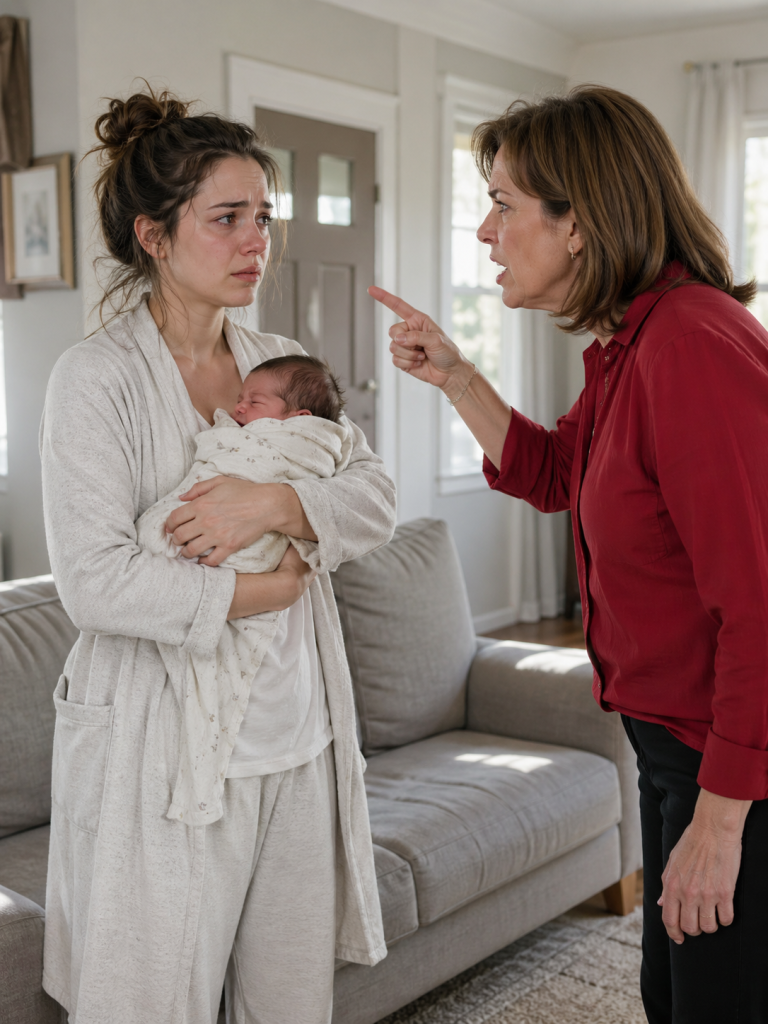
A week after Ava was born, I was standing in the living room, sore and running on almost no sleep, when my front door suddenly flew open.
My mother still had the spare key.
She walked in without knocking, her face set hard, her purse still slung over one shoulder like she had stormed out of a courtroom mid-argument. She didn’t ask about the baby.
She didn’t ask how I was recovering. She pointed directly at me and said, “What is wrong with you?”
Ava startled in her bassinet and began to cry.
And in that moment, something inside me finally broke.
I didn’t shout.
That seemed to surprise both of us.
I picked Ava up before my mother could step closer, holding her protectively against my chest, and told her, as evenly as I could, that she needed to lower her voice or leave my home. Janet stared at me as if I had crossed a line she didn’t believe existed.
Then she launched into the same speech she had repeated throughout my adult life. Clara was overwhelmed. The children were disappointed.
I had always been the reliable one. I had stability, income, and therefore a responsibility to help.
She said all of that while I was still physically recovering, still bleeding, still holding a newborn.
When I told her I wasn’t sending the money—not now, not later—her expression hardened into something sharper. She called me cold.
Said the military had changed me. Accused me of abandoning “real family” in favor of discipline, structure, and pride. Then she stepped closer and lowered her voice.
“You really think your husband is going to protect you from us?”
That word stayed with me.
Us.
Not love.
Not concern. Not family.
Us.
As if I had been standing just outside something I had spent years funding without ever naming.
I told her again to leave.
She refused.
Instead, she demanded the spare key back “when I started acting like a daughter again.” I told her she wouldn’t need it—I was changing the locks. For the first time, she looked genuinely stunned.
And in that moment, I saw the truth clearly: this was never about two thousand dollars. It was about access. About control.
About the certainty that whenever Clara’s life unraveled, I would be pulled in to stabilize it.
My mother slammed the door hard enough to shake the frame on the wall. Ava burst into tears. I locked the door behind her, called a locksmith, and sat on the floor holding my daughter, my hands shaking in a way I couldn’t quite stop.
That should have been the end of it.
It wasn’t.
What followed wasn’t an explosion.
It was erosion.
The messages didn’t stop after that day. They multiplied. Clara sent long paragraphs about how her oldest had cried when he found out I “didn’t care enough.” My mother wrote essays about sacrifice, about everything she had done raising me, about how quickly I had forgotten where I came from.
Then the tone shifted—quieter, sharper, more deliberate. Must be nice to think you’re better than everyone now. Don’t forget who you needed before you had rank and a paycheck.
I didn’t block them.
At the time, I told myself I needed the record.
Something factual, something I could point to if things escalated further. But the truth was harder to admit. Some part of me was still waiting—irrationally—for one message that sounded human.
One sentence that wasn’t a demand, or a guilt tactic, or a reminder of debt I had already paid a hundred times over.
It never came.
Ten days after Ava was born, I was in the kitchen preparing a bottle when everything shifted physically. My vision narrowed without warning. A crushing headache spread behind my eyes, pulsing in time with a heartbeat that suddenly felt too fast and too loud.
My hands shook so badly I almost dropped the bottle. I set Ava carefully into her crib before lowering myself into the nearest chair, pressing my palm against my chest, trying to breathe through something I didn’t understand.
A neighbor—an older woman who had lived on base longer than most—drove me to the hospital.
By the time I reached triage, the nurse’s tone had changed.
Postpartum hypertension. Severe.
Triggered and aggravated by stress.
They admitted me overnight.
When I called Ryan, he didn’t panic. That was always his way. He asked for numbers, medication names, blood pressure readings, discharge estimates.
Within an hour, he had escalated a leave request through his command. By the next morning, he was there—still wearing the same uniform from the day before, his duffel bag slung over one shoulder, his eyes red from lack of sleep and something else beneath it.
He kissed Ava’s forehead first.
Then he checked my chart.
Then he sat down beside me and asked for my phone.

