Your vacation home is perfect for the family reunion — we’re coming next month.
No question mark. No “would that work?” Just a statement, as if I were merely a booking agent for property I happened to own.
Before I even had the chance to reply, my mother called. Her voice carried that bright, artificially casual tone she used when she had already made a decision for me.
“And your sister Melissa’s boys are staying most of the summer,” she added, like she was reminding me to pick up napkins. “You hardly use the place anyway.”
I stood in my kitchen in Charlotte, North Carolina, barefoot on cold tile, holding coffee I no longer wanted. My lake house wasn’t some inherited family cabin. I had purchased it nine months earlier with my own money—$680,000, earned through twelve years of relentless work in medical device sales, two promotions, and the kind of strict budgeting that used to make people laugh at me in my twenties. It sat on Lake Norman, forty minutes north of Charlotte, with a private dock, a coded front gate, and enough quiet that I could hear water hitting the pilings at night.
I bought it because I wanted at least one place in my life that no one could claim.
Unfortunately, my family had a long habit of claiming things. My post-college apartment became “everyone’s crash pad” whenever my parents visited the city. My car was “borrowed” by Melissa for six weeks after her transmission failed. My guest room once turned into my mother’s temporary craft storage because “you live alone, you have space.” Their logic was simple: if I owned something nice and didn’t have a spouse or kids, then it was only partly mine and largely available.
I should have said no right away.
Instead, I said, “Sure.”
There was a brief pause, as if my mother had braced for resistance and didn’t know how to process immediate agreement.
“See?” she said, pleased. “I told your father you’d be reasonable.”
Reasonable. That word lodged in my chest like a splinter.
Over the next three weeks, details trickled in, slowly at first, then like a leak becoming a flood. Not just one weekend. Ten days. Then maybe two weeks. Melissa texted asking if the boys could “leave a few things there” since packing back and forth would be inconvenient. Dad mentioned Uncle Ron might bring his fishing boat. Mom said she had already told my cousins we had enough beds if people brought air mattresses.
We.
That was when I called my property manager, the same retired contractor who handled landscaping and dock upkeep, and asked him to meet me at the lake house the following Saturday.
By Sunday evening, every exterior lock had been replaced. The smart-home entry codes were erased and reissued. The front gate keypad had a new sequence. I updated the Wi-Fi admin password, disabled the old garage remotes, and had my security company revise every camera zone on the property. I even set an alert to notify me the second anyone tried the gate more than three times.
I didn’t tell anyone.
Then, on the first Friday in June, while I was sitting in my Charlotte office finishing quarterly reports, my phone lit up with a motion alert from Lake Norman.
Front gate camera.
Dad’s SUV.
Melissa’s minivan.
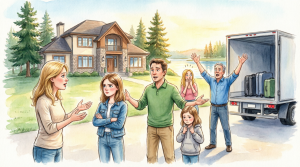
And behind them, unbelievably, a rented U-Haul trailer stacked with plastic bins, bicycles, folding chairs, and enough luggage to suggest they hadn’t come for a reunion.
They had come to settle in.
I opened the live camera feed and nearly laughed in disbelief.
Dad was already out of the SUV, standing at the gate keypad with one hand on his hip like the machine itself had offended him. Melissa’s boys—Tyler, eleven, and Dean, nine—were bouncing around the gravel shoulder in flip-flops, poking each other with pool noodles. My mother stood beside the minivan, dramatically shading her eyes, as if she were the victim of an inconvenient natural disaster. Behind them sat the U-Haul, hitched crookedly, with a blue tarp tied over extra bags and what looked like a portable basketball hoop strapped to the back.
A portable basketball hoop.
For my lake house.
I stepped out of my office and called my father.
He answered on the second ring, already irritated. “What the hell is going on with this gate?”
“I changed the code,” I said.
There was a silence so complete I could hear wind off the lake through his phone.
“You what?”
“I changed the locks too. And the house code. And the garage access.”
Mom’s voice rose in the background. “Put me on speaker.”
Dad did.
“Abigail,” she said, using my full name the way she did when she wanted authority to replace argument, “open the gate. We’ve been driving since six this morning.”
“I know,” I said. “You should have asked before planning a ten-day move-in.”
Melissa grabbed the phone—I could hear the shift. “Oh, come on. Don’t be ridiculous. The kids are standing in ninety-degree heat.”
“Then I suggest you take them somewhere air-conditioned.”
That was when Dad snapped. “You said yes.”
“Yes,” I said. “Then I listened to all of you turn one weekend into an unpaid family compound. So I changed my mind.”
Mom made a sound somewhere between outrage and disbelief. “You can’t leave your family stuck at the gate.”
“I didn’t leave you stuck,” I said. “You drove to private property you don’t own, with a trailer full of plans, without even the courtesy of asking how long was acceptable.”
Melissa cut in, voice sharp. “The boys were counting on this! I told them they’d have the whole summer by the lake.”
“That was reckless of you.”
Through the camera I saw her throw her free hand into the air. Dad turned away and kicked a loose stone. Mom didn’t look embarrassed or reflective—only offended that reality hadn’t rearranged itself around her expectations.
Then came the line I should have anticipated.
“After everything we’ve done for you,” Mom said.
There it was. The family invoice—always vague, always emotionally inflated, always due the moment I set a boundary.
I leaned against the hallway wall outside my office and kept my voice steady. “Buying me school clothes in 2003 does not give you summer rights to a six-hundred-eighty-thousand-dollar property.”
Dad muttered a curse.
Melissa, deciding guilt hadn’t worked, shifted to indignation. “This is exactly why everyone says you act like you’re better than us now.”
“No,” I said. “I act like an adult who knows the difference between generosity and being taken over.”
For a moment, no one spoke. The boys had gone quiet. Through the camera I saw Tyler glancing between the adults with that cautious stillness children get when they realize a promised story may not be true.
Then Dad said, colder now, “Open the gate or I’m calling a locksmith.”
I almost admired the confidence.
“Go ahead,” I said. “You’ll still be standing on the road. And if anyone tries to force entry, the sheriff’s office will get there before a locksmith does, because the property is monitored.”
That landed. I saw it in the way his shoulders shifted.
He knew I wasn’t bluffing.
The argument dragged on for another eight minutes, cycling through every predictable family note—how selfish I was, how humiliating this was, how I had embarrassed the children, how they’d already bought groceries, how Melissa had arranged remote work to stay longer, how Mom had invited half the extended family for a Saturday barbecue. Each new detail only clarified things. They hadn’t misunderstood me. They had simply never believed my ownership outweighed their entitlement.
Finally I said, “There’s a Hampton Inn twelve minutes south in Mooresville. There are also rentals near Troutman if you want lake access. But you are not staying at my house.”
Dad hung up.
Five seconds later, my phone buzzed again. Gate alert. Three wrong codes.
Then four.
Then five.
I texted my property manager, Hank, who lived less than fifteen minutes away on the opposite side of the cove: Family showed up uninvited. Don’t engage unless they try to get onto the property. I may need you as a witness.
He replied within a minute: Understood. Want me to swing by the road entrance?
Yes.
By the time Hank arrived in his dusty Ford pickup, my family was still there. Dad was pacing on the phone. Melissa had opened the U-Haul and was handing out drinks like turning it into a tailgate might somehow make it acceptable. My mother stood at the gate staring into the property like someone wronged by architecture itself.
Hank called me.
“They’re not inside the boundary,” he said. “But they’re making a scene.”
“Tell them what I told you,” I said. “Private property. No access.”
He gave a low whistle. “Your dad doesn’t like that.”
“I know.”
What I didn’t know yet—what changed everything—was that this wasn’t a spontaneous overreach. It was part of a larger plan already in motion, and I was about to see how far they’d gone without telling me.
I found out because my cousin Jenna called at 5:40 p.m., laughing so hard she could barely speak.
“I need to know if this is real,” she said. “Did you actually lock your parents out of the lake house?”
“Yes,” I said.
She exhaled. “Okay. Then I’m not losing it.”
“What do you mean?”
There was a pause, and when she spoke again, the laughter was gone. “Aunt Denise has been telling everyone for two weeks that your place is basically becoming the family summer base. She said Melissa’s boys were already enrolled in a day camp near the lake and that your parents might rotate weekends there.”
I straightened so quickly my laptop nearly slid off the console table. “Enrolled where?”
“Some outdoor camp in Cornelius, I think. She said Melissa wanted them settled by mid-June because she and Brian are ‘figuring some things out.’”
That was the piece none of them had told me.
Melissa hadn’t planned a long visit just for the kids’ fun. Her husband Brian had taken a contract job in Houston for the summer and was living in a short-term apartment there. Melissa had apparently decided that instead of staying in their cramped townhouse in Huntersville, juggling camp schedules, and explaining the situation to the boys, she would move them into my lake house and let our parents rotate in as support.
Using my property as a temporary residence.
Without asking.
The anger I felt then was sharper than anything earlier. Before, they had been opportunistic. Now it was clear they had built logistics around my compliance—schedules, camps, groceries, maybe even mail forwarding if I hadn’t stopped it.
I called Melissa immediately.
She answered on the first ring, sounding brittle and worn, no longer furious enough to pretend innocence. “What now?”
“You enrolled your kids in camp near my house.”
Silence.
Then: “Jenna talks too much.”
“So it’s true.”
She exhaled. “Brian’s in Houston until August. I needed somewhere stable, okay? Mom said you wouldn’t really mind once everyone was there.”
That sentence explained everything. They didn’t need permission. They just needed me cornered by appearances once the kids and luggage were already there.
“You built a summer housing plan around property you don’t own,” I said. “Do you hear how unreasonable that is?”
She sounded tired now, not angry. “You don’t have kids, Abby. You don’t get it.”
“No,” I said. “I get it perfectly. You were desperate, and instead of asking honestly, you let Mom and Dad present your emergency as my obligation.”
She started crying then, which almost reached me until she said, “You could have at least given us this season.”
This season. As if my house were a public resource.
By then, Dad had apparently booked hotel rooms in Mooresville—two rooms, uncomfortable but sufficient for resentment. They stayed there that night and, I later learned, told the boys that Aunt Abby “needed time to calm down.” Mom posted nothing online, which for her was the emotional equivalent of lowered flags.
I drove to the lake house early Saturday morning.
The June light lay clear over Lake Norman, the water barely moving, dock ropes tapping softly against the posts. I walked through every room just to feel it again—the cedar floors, the screened porch, the kitchen with soapstone counters, the upstairs guest room with the sloped ceiling and view of the cove. It was mine. Not out of territorial pride, but because I had built a life disciplined enough to earn it, maintain it, insure it, and protect it from becoming another shared family asset.
At 10:15, my parents arrived alone.
This time there was no U-Haul. Melissa and the boys were still at the hotel, waiting to see if the adults could force a different outcome.
I met Mom and Dad on the gravel turnout outside the gate. Dad looked older than the day before, more worn than angry. Mom still looked offended.
“We should talk in person,” Dad said.
“We are.”
He rubbed his jaw. “Melissa is having a hard summer.”
“Then she should have told me that before loading a trailer.”
Mom folded her arms. “If you had any heart, those boys would already be swimming off that dock.”
I looked at her for a long moment. “If you had any respect, none of you would have shown up assuming access.”
Dad closed his eyes briefly, like someone finally realizing the cost of years of convenience. “What do you want?”
It was the first reasonable question anyone had asked.
So I answered clearly. Melissa and the boys would not stay at the lake house that summer. No one would use the property without my written invitation. No family event would ever be planned there without my approval. If Melissa needed help because her marriage was unstable or because Brian was away, I was willing to contribute money toward a short-term rental for two weeks while she made real plans—not because I owed them the house, but because the boys were innocent. And from now on, if my parents volunteered my time, money, or space, I would automatically say no.
Mom looked horrified. Dad looked like someone absorbing instructions after a crash.
“You’d really let your sister struggle while you keep all this empty?” Mom asked, gesturing toward the house.
“Yes,” I said. “I’d let her deal with reality instead of rewarding manipulation.”
Dad surprised me.
He nodded.
Not warmly, not happily, but once. A real nod. “That’s fair.”
Mom turned on him immediately. “Robert—”
“No,” he said, sharper than I’d heard in years. “This is on us. We assumed.”
The ending wasn’t dramatic in a cinematic way. No one broke down on the gravel. No revelation fixed everything by sunset. Real life is slower, harsher, and far more procedural.
Melissa accepted the two-week rental money after first refusing it on principle and then realizing principles don’t house children near summer camp. Brian returned from Houston in August; by October she had filed for divorce. My parents spent months treating me with cool politeness, as if boundaries were a language they resented learning. But they learned. They never again announced plans for my property. They asked. Sometimes I still said no.
And that first Friday? When they showed up with a U-Haul full of luggage, camp schedules, and a belief in permanent access?
They did what entitled people do when the world finally refuses to bend: they stood at the gate, stunned, discovering that ownership is not the same as availability, and family is not the same as permission.

