Rick Hunt checked his rearview mirror one last time before turning onto Maple Drive. His daughter Emma sat in her booster seat, humming along to a song only she could hear, her small fingers wrapped around the stuffed rabbit she called Mr. Whiskers. She was six years old, gap-toothed, and fully convinced that unicorns lived in the woods behind her grandfather’s house.
“Daddy, will Grandpa Roger make pancakes?” Emma asked, pressing her face against the window.
“Maybe, sweetheart. He usually does on Saturdays.”
Rick hated these drop-offs. Ever since the divorce two years earlier, every interaction with Marsha’s family felt like walking through a minefield. His ex-wife had moved back in with her father after the split, and Rick had agreed to weekend visits to keep things civil. For Emma’s sake, always for Emma’s sake. The custody arrangement had been brutal. Marsha had wanted full custody, painting Rick as an unstable workaholic who couldn’t provide a proper home. Her father, Roger Scott, had funded her legal team, three attorneys who had made Rick’s life hell for eight months. In the end, Rick had gotten joint custody, but barely. Every other weekend, alternating holidays, and Marsha retained primary residence.
Rick had been a crime reporter for the Chicago Tribune for eleven years before the divorce. He had covered everything from gang violence to white-collar fraud, building a reputation for tenacity and thoroughness. But the job’s demands, the late nights, the dangerous neighborhoods, the emotional toll, had eroded his marriage. Marsha had accused him of loving the work more than his family. Maybe she had been right. Maybe he had been chasing stories when he should have been chasing his daughter around the backyard. After the divorce, Rick had left the Tribune. The breaking point came when he missed Emma’s fifth birthday because he was covering a double homicide in Englewood. He had walked into an empty apartment that night, a store-bought cake melting on the counter, and realized he had become the absent father he had always sworn he would never be. Now he freelanced, wrote occasional investigative pieces for online publications, and spent his weekends with Emma. The money was tighter, but he could control his schedule. He could be present.
Roger Scott’s house loomed ahead, a sprawling Colonial with white columns and a manicured lawn that screamed old money. Roger had made his fortune in pharmaceuticals, though Rick had never quite understood the details.
“Import, export,” Roger had once said vaguely. “Business consulting.”
The kind of answer men gave when they didn’t want questions. Rick pulled into the circular driveway, the gravel crunching under his tires. Something felt off immediately. Usually Marsha would be standing on the porch, arms crossed, ready to reclaim her daughter with minimal conversation. Today the porch was empty. The house looked dark despite the morning sun.
“Daddy, why aren’t we getting out?”
“Just a second, bug.”
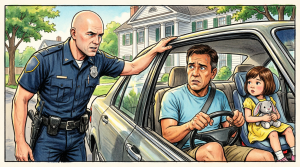
Then Rick saw him. A figure emerged from behind one of the columns, a man in a sheriff’s uniform moving with purpose. Sheriff Donald Mallister. Rick recognized him from a story he had covered years ago, a corruption investigation in Porter County. Mallister had been one of the clean cops, one of the few who had testified against his own department. The sheriff walked directly to Rick’s driver-side window and bent down. His face was weathered, late fifties, with the kind of hard lines that came from seeing too much, but his eyes were urgent, almost desperate. Rick rolled down the window.
“Sheriff Mallister? What—”
“Don’t let her out of the car,” Mallister whispered, his voice barely audible. He glanced back at the house, then back at Rick. “Pretend your engine won’t start.”
Rick felt his stomach drop.
“What? I don’t understand.”
“Please.” Mallister’s voice turned cold, clipped. “There’s no time to explain. Turn the key like you’re trying to start the car, but don’t let her out. Do you understand me?”
Rick looked at Emma in the rearview mirror. She was still humming, oblivious. Every instinct screamed at him to drive away, but something in Mallister’s expression made him hesitate. This wasn’t a joke. This wasn’t a mistake.
“Okay,” Rick said quietly. “Okay.”
Mallister straightened and walked toward the house, his hand resting on his service weapon. Rick turned the key in the ignition, letting the engine turn over and die. He did it again and again. Emma stopped humming.
“Daddy, what’s wrong with the car?”
“I’m not sure, sweetie. Give me a minute.”
Through the windshield, Rick watched Mallister climb the porch steps and knock on the front door. No answer. The sheriff tried the handle. Locked. He knocked again, harder this time, then spoke into his radio. Rick’s phone buzzed. A text from an unknown number lit the screen.
Stay in the vehicle. Help is coming. Do not approach the house.
“What the hell is going on?” Rick muttered.
Twenty minutes felt like twenty hours. Emma grew restless, asking questions Rick couldn’t answer. He kept trying the ignition, kept scanning the house for any sign of movement. More squad cars arrived, silent, no sirens. Officers took positions around the property, moving with tactical precision. Then Mallister returned to Rick’s window, and his expression had changed. The urgency was gone, replaced by something darker. Sadness, anger, relief.
“Mr. Hunt, I need you to drive away now. Take your daughter home. I’ll call you in one hour.”
“Sheriff, what’s happening? Where’s Marsha? Where’s Roger?”
Mallister glanced back at Emma, then leaned closer.
“Your daughter was never supposed to leave this house today. Now go. Please.”
Rick’s blood ran cold. He started the car. It turned over fine. Of course it did. He backed out of the driveway while Emma waved at the police officers as they passed, thinking it was all some kind of game. Rick kept his hands steady on the wheel, but his mind was racing. Your daughter was never supposed to leave this house today.
The hour that followed was agony. Rick took Emma to a diner three miles away, ordered her chocolate chip pancakes, and watched her color on the paper placemats while his coffee grew cold. His phone finally rang at 10:47 a.m.
“Mr. Hunt. This is Sheriff Mallister. Are you somewhere private?”
“I’m with Emma. What’s going on?”
“Can you take her somewhere safe? A friend’s house? Your parents?”
Rick’s parents lived in Arizona, retired and blissfully unaware of the chaos in his life. But his best friend Tony Davidson lived twenty minutes away.
“Yes. I can do that.”
“Do it now. Then meet me at the station alone.”
Rick dropped Emma at Tony’s house, told him it was an emergency, and promised he would explain later. Tony’s wife, Jessica, bless her, immediately swept Emma into the kitchen to bake cookies. Tony pulled Rick aside.
“You look like hell. What’s wrong?”
“I don’t know yet. I’ll call you.”
The drive to the sheriff’s station was a blur. Rick’s hand was shaking by the time he walked through the doors. Mallister was waiting in a small conference room along with a woman in a dark suit who introduced herself as Detective Lauren Robbins from the state police.
“Mr. Hunt, please sit down,” Robbins said. Her voice was professional but not unkind.
Rick sat. “Someone tell me what the hell is going on. Where’s my ex-wife? Where’s Roger Scott?”
Mallister and Robbins exchanged glances. Finally, Mallister spoke.
“We arrested Roger Scott and Marsha Hunt approximately forty minutes ago. They’re being charged with conspiracy to commit kidnapping and attempted murder.”
The words hung in the air like smoke. Rick felt his vision narrow, his hearing go fuzzy.
“What?”
“Roger Scott has been under investigation for six months,” Robbins said, sliding a file across the table. “He’s been running an illegal prescription drug distribution network. Fentanyl, oxycodone, benzodiazepines, all diverted from legitimate pharmaceutical suppliers and sold through a network of corrupt doctors and dealers across three states.”
Rick opened the file with numb hands. Photos. Surveillance logs. Financial records.
“And Marsha, your ex-wife, has been helping him launder money through a series of shell companies,” Robbins continued. “We have records going back eighteen months.”
Eighteen months. That was before the divorce had even been finalized. While Rick had been fighting for custody, Marsha had been helping her father run a drug empire.
“But Emma,” Rick said, his voice breaking. “Why Emma?”
Mallister leaned forward.
“Three weeks ago, we received a tip from an informant, someone inside Roger’s organization. They told us Roger was planning something involving your daughter. We didn’t have specifics, just that it was happening today during the custody exchange. We’ve been watching the house for the past seventy-two hours.”
“This morning,” Robbins added, “we intercepted communications between Roger and a man named Brett Huff. Huff is an enforcer, Mr. Hunt. He has a record. Assault. Armed robbery. Roger hired him to make it look like a kidnapping gone wrong. They were going to take Emma from the house, kill her, and dump her body to make it look like a random abduction.”
Rick’s world tilted. He gripped the edge of the table, fighting the urge to vomit.
“Why? Why would they do this?”
“Because Emma saw something she wasn’t supposed to see.”
The memory hit Rick like a freight train. Two months earlier, Emma had come home from a weekend visit and told him about the medicine room in Grandpa Roger’s basement. She had gotten lost looking for the bathroom, wandered into a room full of boxes and bottles. Roger had found her, been furious, and told her never to go down there again. Emma had been shaken up for days. Rick had mentioned it to Marsha during a tense phone call. She had brushed it off, said Emma was making things up, that there was no special room. Rick had let it drop, focused on other battles.
“I let it drop,” Rick whispered. “She told me about the room, and I didn’t push it.”
“You couldn’t have known,” Mallister said. “But Roger knew Emma had seen the operation. He knew she was young, that she’d talk, that eventually someone would ask the right questions. So he decided to eliminate the risk.”
“And Marsha agreed to this?” Rick asked, his voice hollow. “She agreed to kill her own daughter?”
Robbins pulled out another document.
“Your ex-wife stands to inherit everything when Roger dies. His estate is worth approximately forty million dollars, but there’s a trust fund set up for Emma. Five million, accessible when she turns eighteen. If Emma dies before then, that money reverts to Marsha. We believe that was part of her motivation.”
Rick’s grief morphed into rage, cold and crystallizing.
“Where are they now?”
“County lockup. They’ll be arraigned Monday morning.”
“And Brett Huff?”
“We picked him up an hour ago. He was waiting at a warehouse in Gary, expecting Roger’s call. We found a van, zip ties, plastic sheeting. He was ready.”
Rick stood, his legs unsteady.
“I need to see her. I need to see Emma.”
Mallister stood too.
“We’ll need a formal statement from you, but it can wait until Monday. Take care of your daughter, Mr. Hunt. We’ll take care of the rest.”
But as Rick walked out of the station into the harsh afternoon sun, he knew the sheriff was wrong. They wouldn’t take care of the rest. The legal system would grind forward, sure. Arraignments, trials, plea deals. Maybe Roger and Marsha would go to prison. Maybe they would get life sentences. Maybe. But that wasn’t enough. Rick had spent eleven years documenting how criminals operated, how they thought, what they feared. He had interviewed murderers, con artists, drug dealers, corrupt politicians. He knew their world. He knew their rules, and he knew how to destroy them.
By the time Rick picked up Emma from Tony’s house, he had made his decision. Emma ran to him, cookie crumbs on her face, Mr. Whiskers clutched under one arm.
“Daddy, we made chocolate chip cookies and regular chip cookies. Miss Jessica said I could bring some home.”
Rick knelt and pulled her into his arms, breathing in the scent of her shampoo.
“That sounds wonderful, bug.”
“Why were there so many police cars at Grandpa’s house?”
“Grandpa Roger wasn’t feeling well. The police were helping him.”
“Is Mommy okay?”
Rick’s jaw tightened.
“Mommy’s with Grandpa. They’re going to be gone for a while.”
Emma pulled back and studied his face with those wide, innocent eyes.
“Are you sad, Daddy?”
“No, sweetheart. I’m not sad.”
He kissed her forehead.
“I’m glad I have you.”
That night, after Emma was asleep, Rick sat in his small home office and opened his laptop. The investigative journalist in him had never really died. It had just been hibernating, waiting for the right story. And this was the story of his life. He started with Roger Scott. Public records. Business filings. Property deeds. Roger had built his empire carefully, hiding behind legitimate pharmaceutical consulting businesses. But Rick knew how to read between the lines. He pulled corporate registrations, cross-referenced board members, mapped out the network of shell companies Robbins had mentioned. Then he moved to Marsha. His ex-wife had always been good with numbers. She had worked as an accountant before Emma was born. Now Rick saw how she had used those skills, creating false invoices, manipulating books, making dirty money look clean.
The paper trail was hidden, but it existed. Rick just needed to follow it. By three in the morning, he had a list of names. Associates. Distributors. Corrupt doctors who had been writing prescriptions. Some were already on the police radar, but others were not. Rick recognized a few prominent members of the community, people who thought they were untouchable. They weren’t. He picked up his phone and called an old contact, a private investigator named Isaac Hoover, who owed him a favor. The phone rang four times before a gruff voice answered.
“Rick, it’s three in the goddamn morning.”
“I need your help, Isaac, and I need you not to ask questions.”
There was a pause.
“What kind of help?”
“The kind that doesn’t involve cops. The kind where we find things that maybe shouldn’t be found.”
Another pause. Longer this time.
“When do we start?”
“Tomorrow. I’ll send you addresses.”
Rick hung up and returned to his laptop. The rage was still there, burning in his chest, but now it had direction, purpose. Roger and Marsha had tried to kill Emma to protect their empire and their money. Now Rick was going to burn that empire to the ground, piece by piece, until there was nothing left but ash and regret. And he was going to make sure they watched it happen.
The arraignment Monday morning was a media circus. Roger Scott, pharmaceutical consultant and pillar of the community, arrested on drug charges. The story was everywhere. Rick sat in the back of the courtroom watching as Roger and Marsha were led in wearing orange jumpsuits. Marsha’s eyes found his, and for a moment Rick saw something flicker across her face. Shame. Regret. It didn’t matter. Both pleaded not guilty. Roger’s attorney, a slick corporate lawyer named Clark Joyce, argued for bail, citing Roger’s community ties and lack of flight risk. The prosecutor countered with the severity of the charges. The judge set bail at two million dollars each. Roger posted bail within an hour. The family fortune ran deep. Marsha, however, remained in custody. Roger didn’t post her bail. Interesting.
Rick followed Roger from the courthouse, keeping his distance. The old man climbed into a black Mercedes driven by a man Rick didn’t recognize. Rick snapped photos, noted the license plate, and texted it to Isaac. The response came back twenty minutes later. Driver is Kevin Baird. Works for Sentinel Security Services. Legitimate company, but they do private protection for high-risk clients. Roger had hired personal security. Smart, but not smart enough. Over the next week, Rick conducted surveillance like he was working a story, except this time the stakes were personal. He documented Roger’s movements, meetings with his legal team, trips to the bank, and a private dinner with two men Isaac identified as Scott McBride and Henry Oliver, both distributors in Roger’s network. Rick also started making calls. He had spent years building relationships with sources in law enforcement, healthcare, and finance. Now he cashed in those relationships, gathering information the police couldn’t or wouldn’t share.
He learned that Roger’s operation had distributed pills worth tens of millions over the past three years. He learned about the doctors who had been writing fake prescriptions. Dr. Eric Bowman in Indianapolis. Dr. Steve Payne in Fort Wayne. He learned about the overdoses, the deaths, the families destroyed, and he documented everything. But Rick wasn’t interested in just helping the prosecution. He wanted something more permanent, more devastating. He wanted to destroy Roger’s credibility, his reputation, his legacy. Prison was one thing. Public humiliation was another.
Rick reached out to an old colleague from the Tribune, an editor named Pat Burgess, who now ran a major investigative news site. They met at a coffee shop in Hyde Park.
“I heard about what happened,” Pat said, stirring sugar into his coffee. “I’m sorry, Rick. That’s… Jesus. I can’t imagine.”
“I need your help publishing something.”
Pat raised an eyebrow.
“What kind of something?”
“An exposé. Everything about Roger Scott’s operation. The money laundering, the distribution network, the doctors involved. I have documents, photos, recorded conversations. I want it public.”
“The police are building a case.”
“This is different. This is about making sure everyone knows who Roger Scott really is. Making sure his name is poison.”
Pat studied him carefully.
“This is personal.”
“Damn right it’s personal. He tried to murder my daughter.”
“I’ll need to verify everything. We can’t publish without corroboration.”
“I have corroboration. More than you’ll need.”
Pat nodded slowly…
“All right. Send me what you have. But, Rick, this is going to blow up. You understand that? Once this is out there, there’s no taking it back.”
“Good.”
Rick spent the next two weeks writing. Not just an article, a comprehensive takedown. He detailed Roger’s pharmaceutical operation, the network of corrupt doctors, the shell companies, the money laundering. He included interviews with families of overdose victims, medical experts explaining how prescription drug diversion worked, financial analysts showing how Roger had hidden his profits. And he included the plot to kill Emma, the communications between Roger and Brett Huff, the timeline, the motive. Pat published the series on a Wednesday morning: eight thousand words across three articles, supported by hundreds of documents. The response was immediate and devastating. National news picked it up within hours. Roger’s business partners issued statements distancing themselves. The pharmaceutical industry issued condemnations. Two of the corrupt doctors, Bowman and Payne, were arrested by the DEA that same afternoon. Roger’s attorney held a press conference denying everything, claiming Rick’s reporting was biased and vindictive. But the evidence was overwhelming. By Friday, three more doctors had been arrested, two distributors had turned themselves in, and Roger’s assets were frozen pending a federal investigation.
Rick watched it all from his apartment, Emma playing with blocks in the living room, oblivious to the firestorm her father had unleashed. He felt no satisfaction, only a cold determination. This was just the beginning.
The weekend brought an unexpected visitor. Sheriff Mallister showed up at Rick’s door Saturday morning, his expression unreadable.
“Mr. Hunt, can we talk?”
Rick let him in, checking first to make sure Emma was occupied with her cartoons. They sat in the kitchen, the sheriff’s large frame making the small space feel cramped.
“Hell of a story you published,” Mallister said.
“Just reporting the facts.”
“The federal prosecutor is pissed. You released information that could compromise their case.”
“Everything I published was from my own investigation. Nothing came from police sources.”
Mallister smiled, but it didn’t reach his eyes.
“You’re walking a fine line, Hunt. I respect what you’re trying to do, but you need to be careful. Roger Scott still has resources. Still has friends.”
“Is that a warning?”
“It’s advice from someone who doesn’t want to see you or your daughter get hurt.”
Rick leaned back in his chair.
“What else?”
“Brett Huff agreed to testify against Roger in exchange for a reduced sentence. That changes things. The prosecutor now has a clear path to proving the conspiracy charge.”
“And Marsha?”
“She’s still in custody. She’s trying to cut a deal, but the prosecutor isn’t interested. She was going to let her own daughter die, Hunt. No judge is going to go easy on her.”
Rick felt a dark satisfaction at that.
“Good.”
Mallister stood to leave, then paused at the door.
“One more thing. Roger’s security has been increased. Kevin Baird isn’t his only protection anymore. If you’re planning something else, be smart about it.”
After Mallister left, Rick sat alone in the kitchen thinking. The public exposure had been phase one. But Roger was still free on bail, still living in his mansion, still protected by money and lawyers. The man who had tried to kill Emma was sleeping in a comfortable bed while Marsha, complicit but not the mastermind, sat in a cell. That wasn’t justice. That was just the system grinding forward. Rick needed something more.
He called Isaac Hoover.
“I need surveillance on Roger’s house twenty-four seven. I want to know everyone who comes and goes.”
“That’s a lot of manpower.”
“I’ll pay whatever it costs.”
“Rick, what are you planning?”
“Just give me the surveillance.”
Isaac was silent for a moment.
“You know I can’t be involved in anything illegal.”
“I know. This is just information gathering. That’s all.”
“All right. I’ll have someone on it by tonight.”
The surveillance revealed interesting patterns. Roger’s mansion was indeed well protected. Kevin Baird and three other security guards rotated shifts, monitoring cameras and patrolling the grounds. But Roger himself was venturing out regularly despite his attorney’s advice to stay low: meetings with his remaining business associates, dinners at expensive restaurants, a visit to his country club. The man was either arrogant or desperate to maintain appearances, probably both. Rick also noticed that Roger was visiting someone regularly, a woman living in a condo in Oak Park. Isaac’s research identified her as Cindy Cahill, thirty-four, Roger’s former administrative assistant. The visits always lasted exactly ninety minutes and always happened between two and five in the afternoon. Rick suspected she was more than a former assistant. He suspected she knew things, things that might be useful.
On a Thursday afternoon, Rick followed Roger to the condo building and waited until the old man left. Then he approached the building and pressed the buzzer for Cahill’s unit.
“Hello?” Her voice was cautious.
“Miss Cahill, my name is Rick Hunt. I’m a journalist. I’d like to talk to you about Roger Scott.”
A long pause.
“I have nothing to say.”
“I’m not here to hurt you. I just need information.”
“I said I have nothing to say. Leave me alone.”
The intercom clicked off. Rick stood on the sidewalk considering his options. He could push harder, could show up again, could make her uncomfortable. But that wasn’t his style. There had to be another way. He spent that evening digging into Cindy Cahill’s background. She had worked for Roger for six years, managed his calendar, handled his correspondence. Then, two months earlier, she had quit, right around the time the police investigation was heating up. No new employment since then. Living off savings, maybe, or off payments from Roger to keep quiet. Rick found her social media profiles, photos of her at charity events with Roger, professional headshots, vacation pictures. Nothing particularly revealing. But then he noticed something. In several photos she was wearing a necklace with a distinctive pendant, a stylized letter C with tiny diamonds. Expensive. Personal. Roger had bought it for her. Rick was sure of it.
He dug deeper and found credit-card receipts. Roger had purchased the necklace from an upscale jeweler in downtown Chicago eighteen months earlier. The price: twelve thousand dollars. Roger was having an affair with Cindy Cahill. And if Rick knew that, he could use it.
The next day, Rick sent Cindy Cahill an email from an anonymous account. The subject line read: Roger’s secrets won’t protect you.
The body of the email was simple. You know what he did. You know what he planned to do to my daughter. The police are closing in, and when they connect the dots, you’ll be charged as an accessory. Roger won’t protect you. He didn’t even post bail for his own daughter. You’re not special to him. You’re just another liability. But you can protect yourself. You can tell the truth. You can cooperate. Think about it.
Rick didn’t sign the email. He didn’t need to. Cindy would know who sent it.
Two days later, Rick received a response from a different anonymous account. Meet me. Grant Park. Saturday noon. Near the fountain. Come alone.
Rick showed up early, scanning the area for any sign of Roger’s security. He didn’t see anyone obvious, but he stayed alert. At noon exactly, Cindy Cahill approached, wearing sunglasses and a hooded jacket despite the warm day. She looked nervous, constantly glancing over her shoulder.
“This was a mistake,” she said immediately. “I shouldn’t be here.”
“But you are. That tells me you want to talk.”
“What do you want from me?”
“The truth. What do you know about Roger’s operation?”
“I don’t know anything about drugs or distribution or any of that. I just managed his schedule.”
“But you knew something was wrong.”
She looked away.
“I knew he had meetings with people who seemed off. Men who didn’t look like business associates. I knew he kept a room in the basement that I wasn’t allowed to enter. I knew he was making a lot of money from sources I didn’t understand.”
“And you didn’t ask questions.”
“He paid me well not to ask questions.”
Rick softened his tone.
“Cindy. Roger tried to kill my daughter. She’s six years old. She’s innocent, and he was going to have her murdered to protect his business. You understand that, right?”
Cindy’s face crumpled.
“I didn’t know about that. I swear I didn’t know.”
“But you suspected he was capable of it.”
She nodded, tears streaming down her face.
“He’s not a good man. I thought I could change him, or that it didn’t matter, or… I don’t know. I was stupid.”
“Help me. Tell the police what you know.”
“If I testify, he’ll destroy me. He knows things about me, things I’ve done for him. Financial irregularities. Falsified documents. If I testify, he’ll make sure I go down too.”
Rick pulled out his phone and showed her the photo of the necklace.
“He bought you this. He’s been having an affair with you for at least eighteen months, probably longer. His wife died three years ago, so it’s not technically adultery, but it shows a pattern. He manipulated you, paid you for your silence, used you. You don’t owe him anything.”
Cindy stared at the photo, her expression hardening.
“What do you want me to do?”
“I want you to meet with Detective Lauren Robbins from the state police. Tell her everything. Roger’s meetings, his associates, the room in the basement, everything you remember. In exchange, I’ll make sure the prosecutor knows you cooperated.”
“And if Roger finds out?”
“He will find out. But by then you’ll be under police protection, and he’ll have bigger problems.”
Cindy wiped her eyes and took a deep breath.
“Okay. Set up the meeting.”
Rick called Detective Robbins that evening. She agreed to meet with Cindy on Monday morning with full immunity for any minor crimes in exchange for testimony. By Tuesday, Cindy Cahill had provided a detailed statement: seventy pages of names, dates, locations, transactions. The federal prosecutor called it the missing piece. Roger’s attorney tried to discredit her, claiming she was a scorned lover seeking revenge. But her testimony was corroborated by documents, surveillance footage, and other witnesses. The walls were closing in, and Rick wasn’t done yet.
He had been saving the final piece for last, the one that would hurt Roger more than prison, more than public exposure, more than losing his fortune. He was going to attack Roger’s legacy, the thing the old man cared about most. Roger Scott had always fancied himself a philanthropist. Over the years, he had donated millions to hospitals, universities, and medical research foundations. His name was on buildings, scholarship programs, plaques. He had cultivated an image of benevolence, of a man who had built a fortune and then given back to the community. But all of that money had come from drug distribution, from pills that had killed people, destroyed families, ruined lives. Rick was going to make sure every institution that had accepted Roger’s money knew the truth.
He started with Northwestern University, where Roger had endowed a chair in pharmaceutical research. Rick sent a detailed letter to the university president with copies of all the evidence from his investigation. He explained that the Scott endowment, worth ten million dollars, had been funded through illegal drug trafficking. He suggested the university might want to rename the position or return the donation. Then he did the same with Rush University Medical Center, where Roger had funded a pediatric cancer wing. The irony was not lost on Rick. Roger had used money from selling drugs to build a wing for sick children, then tried to kill a healthy child to protect that money. He contacted the Chicago Museum of Science and Industry, where Roger was a board member. He contacted the Lincoln Park Conservatory, where Roger had funded a garden renovation. He contacted every charity, every foundation, every institution that had ever taken Roger Scott’s money. And he told them all the same thing: this money is tainted. This man tried to murder his own granddaughter. Your association with him is a liability.
The response was swift. Within a week, three universities announced they were renaming endowments and launching reviews of past donations. The museum asked Roger to resign from its board. Two charities announced they were returning donations and removing Roger’s name from their buildings. The Chicago Tribune, Rick’s old paper, ran a story about philanthropists with dirty money, featuring Roger as the prime example. Roger’s legacy was being erased in real time.
But Rick had one more card to play, and this one was personal. Through his surveillance, he had learned that Roger visited his late wife’s grave every Sunday morning at Oakwood Cemetery. It was the one moment when the old man was alone, the one moment he dropped the facade and showed genuine emotion. Rick had seen the surveillance footage: Roger kneeling at the grave, his shoulders shaking, his head bowed. Roger’s wife, Margaret Scott, had died of cancer three years earlier. By all accounts, she had been a good woman, unaware of her husband’s criminal activities. Emma had been too young to remember her grandmother, but Rick had met Margaret a few times during the marriage. She had been kind, gracious, the sort of person who made you feel welcome in her home. Rick wondered what Margaret would think if she knew what her husband had become, what he had tried to do to their granddaughter.
On a Sunday morning, Rick arrived at Oakwood Cemetery at seven a.m., two hours before Roger’s usual visit. He walked to Margaret’s grave, a simple headstone with her name, dates, and the inscription Beloved Wife and Mother. Rick sat on a nearby bench and waited. Roger arrived at 9:15, driven by Kevin Baird. The security guard stayed with the car while Roger walked to the grave carrying fresh flowers. The old man knelt, placed the flowers carefully, and began speaking in a low voice. Rick approached quietly.
“Hello, Roger.”
Roger’s head snapped up, his face going pale.
“What are you doing here?”
“I wanted to talk to you alone.”
Roger stood, his eyes darting toward the car. Kevin Baird was watching, but he didn’t move. Rick had positioned himself so that from the car it looked like a normal conversation.
“You’ve destroyed everything,” Roger said, his voice shaking with rage. “My reputation. My business. My legacy. Are you satisfied?”
“Not even close.”
“Emma would have been taken care of. I would have made sure—”
“You were going to kill her. Don’t rewrite history now.”
Roger’s facade cracked.
“She saw things she shouldn’t have seen. She was a liability. In business, you eliminate liabilities.”
“She’s a six-year-old child. Your granddaughter.”
Roger’s lip curled.
“She has your stubbornness. Your inability to let things go. Just like you’re proving right now.”
Rick stepped closer.
“I want you to know something, Roger. When you go to prison, and you will go to prison, I’m going to make sure Emma forgets you existed. I’m going to make sure she grows up never knowing her grandfather was a monster. You’ll die alone in a cell, and nobody will remember you except as a cautionary tale.”
Roger’s face contorted with fury.
“You self-righteous—”
“And one more thing. I’m going to visit Margaret’s grave regularly. I’m going to bring Emma here, and I’m going to tell her stories about her grandmother. Good stories. True stories. Emma will know Margaret as a loving woman. But you? You’ll be erased like you never existed.”
Roger lunged forward, his hands reaching for Rick’s throat. But Rick was younger, faster, and ready. He sidestepped, letting Roger’s momentum carry him forward. The old man stumbled, nearly fell, and by the time he regained his balance, Kevin Baird was running across the grass.
“We’re leaving,” Rick said calmly, backing away. “But remember what I said, Roger. You’re already dead. You just don’t know it yet.”
The trial began in September, four months after the arrest. The prosecution had built an overwhelming case: testimony from Brett Huff, financial records, surveillance footage, and Cindy Cahill’s detailed account of Roger’s operation. The jury deliberated for less than six hours. Guilty on all counts. Roger Scott was sentenced to thirty-five years in federal prison. At seventy-two years old, it was effectively a life sentence. Marsha received twenty years for conspiracy and money laundering. Brett Huff got twelve years for his role in the conspiracy, reduced from life because of his cooperation. The corrupt doctors were sentenced separately. Dr. Bowman got fifteen years. Dr. Payne got eighteen. The distributors, Scott McBride and Henry Oliver, both received similar sentences.
Rick sat in the courtroom and watched them all taken away in handcuffs. He felt no joy, no triumph, just a hollow relief that it was over. Almost over. One month after the sentencing, Rick received a letter from Marsha. It had been forwarded through her attorney. He debated throwing it away unopened, but curiosity got the better of him.
Rick, I don’t expect you to forgive me. I don’t expect you to even read this, but I need to say some things. I was weak. I was greedy. I convinced myself that my father’s business was just business, that the people buying the pills knew what they were doing, that it wasn’t our responsibility. I convinced myself that securing Emma’s future, even if it meant something horrible, was justified. I was wrong. So completely, irredeemably wrong. My father destroyed everything. He destroyed our marriage. He destroyed our family. He destroyed lives I’ll never know about. And I helped him. I’ll spend the rest of my life in prison knowing that I almost let him kill our daughter. Emma is better off without me. I know that. Please don’t tell her about me. Not unless she asks. Let her grow up thinking her mother died or disappeared or anything but the truth. She deserves better than to know her mother was a monster. I’m sorry isn’t enough. Nothing I can say is enough. But I’m sorry anyway. Marsha.
Rick folded the letter and put it in a drawer. He would keep it. Maybe someday, when Emma was older, when she had questions, he would show her. Let her make her own judgments. But not now. Now Emma was a happy kid who loved her stuffed rabbit and believed in unicorns and didn’t need to know about the darkness that had almost consumed her.
Life gradually returned to something approaching normal. Rick continued freelancing and wrote another major investigative piece about pharmaceutical industry corruption that won him a Polk Award. Tony and Jessica Davidson became Emma’s unofficial godparents, their daughter befriending Emma at school. Sheriff Mallister checked in occasionally, always with an excuse about following up on the case, but really just making sure Rick and Emma were okay. And Rick visited Margaret’s grave once a month, usually alone, but sometimes with Emma. He told her about her grandmother, how Margaret had been kind, how she had volunteered at animal shelters, how she had made the best apple pie. Emma listened with wide eyes, absorbing these stories of a woman she had never really known.
On one of those visits, Emma asked the question Rick had been dreading.
“Daddy, where’s Grandpa Roger?”
They were standing by the grave, Emma holding a small bouquet of wildflowers she had picked from the field behind their apartment. Rick knelt beside her.
“Grandpa Roger had to go away, bug. He made some bad choices, and now he’s somewhere else.”
“Is he coming back?”
“No. He’s not coming back.”
Emma thought about that, her small face serious.
“Did he do something really bad?”
Rick chose his words carefully.
“Yes. He hurt people. He was going to hurt you.”
“Why?”
“Because sometimes adults make terrible decisions. Because sometimes people choose money and power over the people they’re supposed to love.”
Emma looked at the flowers in her hand, then placed them carefully at the base of Margaret’s headstone.
“I’m glad he’s gone then.”
“Me too, sweetheart. Me too.”
They stood there for a while, the September wind rustling through the cemetery trees. Rick thought about the past year, the terror, the rage, the systematic dismantling of Roger Scott’s empire. He thought about the articles he had written, the testimony he had given, the phone calls and meetings and late nights researching. He thought about justice and revenge, and whether there was really any difference between the two. In the end, it didn’t matter. Emma was safe. The people who had tried to harm her were in prison. The world knew the truth about Roger Scott. That was enough.
As they walked back to the car, Emma slipped her small hand into Rick’s.
“Daddy?”
“Yeah, bug?”
“I love you.”
Rick squeezed her hand gently, a genuine smile crossing his face for the first time in what felt like forever.
“I love you too. More than anything in the world.”
And he meant it. Emma was his world, his reason for fighting, his reason for surviving, his reason for everything. Roger and Marsha had tried to take that away, had tried to reduce his daughter to a casualty in their criminal empire, but they had failed.
Rick Hunt had been a crime reporter for eleven years. He had covered murders, betrayals, and human cruelty in every form. He had thought he had seen the worst of humanity. But nothing had prepared him for the moment when he realized his own family wanted his daughter dead. That moment had changed him. It had stripped away his objectivity, his professional distance, his belief that the system would always work. But it had also revealed something else: a capacity for focused determination, for strategic thinking, for taking down monsters in ways the legal system never could.
Roger Scott would spend the rest of his life in prison, his reputation destroyed, his legacy erased. Every institution that had once honored him now condemned him. Every business associate had distanced themselves. His name had become synonymous with corruption and greed. And Marsha would spend the next two decades behind bars, living with the knowledge that she had betrayed her own daughter for money. No plea deal. No early parole. No redemption. The corrupt doctors who had enabled Roger’s empire had lost their licenses and their freedom. The distributors who had profited from addiction were scattered across various federal prisons. Brett Huff, the enforcer who had been ready to murder a six-year-old, was locked away where he could never hurt anyone again.
Rick had dismantled them all piece by piece using the tools of his trade: research, investigation, media exposure, and strategic leaks. He had turned their own systems against them, used their greed and arrogance as weapons. And he had done it all while the legal system ground forward, ensuring that his revenge and justice moved in parallel. It had been exhausting. It had been consuming. But it had been necessary.
As Rick drove Emma home that evening, listening to her chatter about school and friends and a unicorn book she was reading, he felt something he hadn’t felt in months.
Peace.
Not complete peace. The trauma of what had almost happened would never fully fade. But enough peace to move forward, to build a life, to be the father Emma needed. He had won not because of the prison sentences or the news coverage or the public humiliation of his enemies. He had won because Emma was still alive, still innocent, still his daughter. She was safe, loved, and free to be a kid. That was the only victory that mattered.
And as for Roger Scott, rotting in a federal prison cell, stripped of his fortune and his legacy, knowing he had lost everything while the granddaughter he had tried to kill thrived, that was just a bonus.
Rick Hunt had once been a reporter who documented other people’s stories. Now he had lived through one of his own, a story of betrayal and revenge, of justice and determination. It wasn’t the story he had wanted, but it was the story he had needed. It had tested him, broken him, and ultimately made him stronger. And in the end, he had protected the one person who mattered most. Emma was safe. Emma was happy. And that was enough.