I’m 28, an architect, and the adopted daughter of Ethan Richardson — the man Boston business magazines love to call “the self-made king of the skyline.” I grew up watching my parents build Richardson Holdings from my mother’s tiny home office.
Mom, Caitlyn, was the quiet brain behind the empire. Her family’s connections opened doors. Her spreadsheets kept the lights on. Ethan got the magazine covers. She got the late nights and the stress. When she died of cancer when I was 13, she left behind more than memories.
She left 15% of Richardson Holdings — around $75 million today — and a $2 million trust in my name. She also left Ethan in charge as executor, which turned out to be her only mistake. Six months after her funeral, he married Michelle — former Miss Massachusetts, professional social climber, and mother of one perfect golden boy: Nathan. Ethan adopted him on day one. The family photos came down. The furniture changed.
My mother’s office became “Michelle’s design studio.” From then on, the hierarchy was carved in stone. Nathan got Harvard Business School and an $80,000 check. I got into MIT Architecture and a folder of loan applications.
Nathan’s 21st birthday? Yacht party with a custom DJ and a society-page spread. Mine? A family dinner where Michelle forgot to order cake. Every time I achieved something, Ethan reminded me where I stood.
When I won the Emerging Architect Award, I forwarded him the email like a hopeful kid. His reply came back in two minutes: “Congratulations. Don’t forget you’re not a real Richardson. Managing expectations will serve you better than awards.” I printed that email. Actually, I printed everything. Every dismissal, every “charity case” comment, every document showing how Mom’s shares were supposed to be mine. “Paper is proof,” my mother used to say. “People rewrite history. Documents don’t.” The real war started when I turned 28.
In Mom’s will, I get control of my $2 million trust at 30 — unless Ethan finds “just cause” to deny it. The 15% stake in the company is supposed to transfer automatically, but he’s been fighting it in probate court for years, arguing Mom “wasn’t of sound mind” when she signed it. Never mind that she updated it before she got sick.
My small architecture firm is three months from bankruptcy. Ten employees need their paychecks. I need that inheritance just to keep the lights on. So when Michelle slid papers across her marble island last month and said, “Sign your shares over to Nathan. For family harmony. Your mother would want blood family controlling the business,” something in me finally snapped.
That night, I opened my mom’s safety deposit box. Inside was a letter in her handwriting and a name: “Find Dr. Sarah Coleman at Geneche Labs. Ask her about Project Genesis.” Twenty-four hours later, I was sitting in a genetics lab in Back Bay while a Harvard-trained scientist quietly slid DNA results across the table and said, “Your mother was right.
The test is conclusive. Nathan is not Ethan’s son.” Zero percent match. Ninety-nine point nine seven percent match… with Ethan’s brother, Daniel. The golden heir who calls me “not real family” is actually my adoptive father’s nephew. The boy Ethan has been shoving in my face for 24 years as proof that blood matters more than love? Not his blood at all.
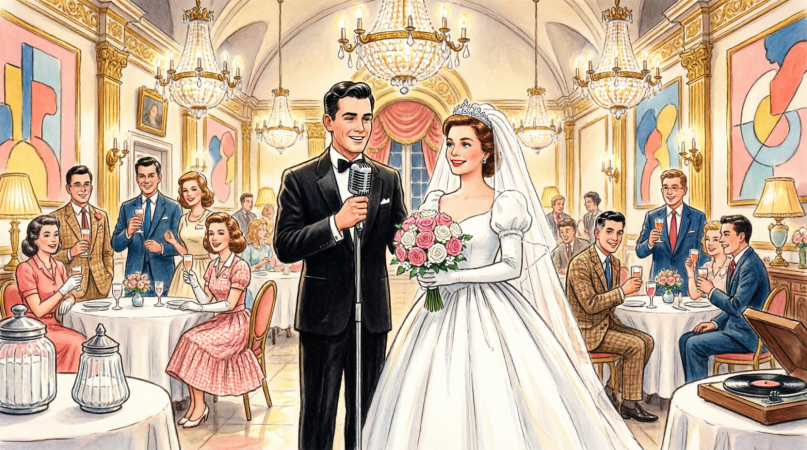
I put the notarized DNA report in a white envelope and slipped it into my silver clutch on my wedding day, right next to my lipstick. Just in case. So when Ethan stood up in the Four Seasons ballroom tonight — in front of the mayor, a senator, three judges, and 500 of Boston’s richest people — and announced I was adopted, not “real” family, and that he was cutting me off from my trust and Mom’s shares…
When he looked straight at me and said, “She’s not my real daughter anyway,” and waited for the room to laugh with him… I adjusted my veil, walked to the mic, felt 500 eyes on my back, and smiled. “Since we’re sharing DNA secrets, Ethan,” I said, pulling out the envelope, “should we tell everyone who Nathan really belongs to?” If you’re still reading, tell me what city you’re in — and if you want to hear what happened when I read those results out loud and watched Boston’s golden family implode in real time,
.then let me tell you exactly how the silence sounded.
It wasn’t the polite quiet of a speech ending. It was the heavy, suffocating vacuum of five hundred people realizing they were witnessing a murder—not of flesh, but of reputation. The clinking of silverware stopped. The waiter pouring wine froze mid-pour, the bottle tilted dangerously over a senator’s glass.
Ethan’s smile didn’t fade; it shattered. His eyes widened, darting from the envelope in my hand to Michelle, who had gone so pale she looked like a marble statue come to life. Nathan, standing near the head table with a champagne flute halfway to his mouth, lowered it slowly. He looked confused, the way a person looks when the ground beneath them suddenly turns to water.
I didn’t scream. I didn’t cry. I’m an architect. I deal in load-bearing walls and structural integrity. And I had just learned that the foundation of the Richardson empire was rotten all the way down.
“This envelope,” I said, my voice amplified by the speakers until it bounced off the crystal chandeliers, “contains a notarized DNA test conducted by Geneche Labs. It compares Ethan Richardson’s genetic markers with those of his son, Nathan.”
I paused. I let the words hang there. I saw Ethan’s hand twitch toward the mic stand, like he wanted to rip it out of the floor, but he knew he couldn’t. Not with the mayor sitting at table four. Not with the press in the back.
“The result,” I continued, calm as a blueprint, “is zero percent probability of paternity.”
A gasp rippled through the room like a wave. Michelle made a sound—a sharp, choked intake of breath—and dropped her clutch. It hit the floor with a loud clatter that echoed in the silence.
“But since we’re talking about bloodlines,” I said, turning slightly to look at the table where Ethan’s younger brother, Daniel, was sitting. Daniel, who had always been overly friendly with Michelle. Daniel, who had been conspicuously absent from family photos for the last year. “The test also identified the biological father. With ninety-nine point nine percent certainty.”
I locked eyes with Daniel. He was staring at his plate, his knuckles white around his fork.
“Nathan isn’t Ethan’s son,” I said. “He’s Daniel’s.”
The room exploded.
It wasn’t applause. It was chaos. Chairs scraped against the floor. People stood up. Phones came out—five hundred cameras recording the moment the Richardson dynasty imploded. Michelle grabbed Nathan’s arm, her nails digging into his suit jacket, and hissed something I couldn’t hear over the din. Nathan pulled away, looking at Ethan, then at Daniel, then back at me. He looked lost. The golden boy had just been stripped of his gilt.
Ethan finally found his voice. He lunged for the mic, but I stepped back, handing it to the emcee who was standing in the wings, trembling.
“This is a lie!” Ethan shouted, his voice cracking. “She’s bitter! She’s adopted! She’s trying to steal—”
“Paper is proof, Ethan,” I said softly, into the mic I still held. “Mom taught me that. People rewrite history. Documents don’t.”
I placed the envelope on the podium. I didn’t throw it. I didn’t slam it. I just set it down, like placing the final brick on a wall I had built myself.
“My lawyer,” I said, nodding toward the back of the room where Mr. Henderson, the senior partner of the firm that had handled my mother’s estate, stood up. “Has copies for the board of directors. And for the press.”
I stepped away from the mic. I adjusted my veil. I looked at my husband, David, who was standing near the front row. He wasn’t smiling. He looked proud. He had known what I was planning. He had helped me draft the speech.
“I believe,” I said to the room, “that the wedding reception is still scheduled to continue. Please enjoy the cake. It’s chocolate. My mother’s favorite.”
I walked off the stage. I didn’t look at Ethan. I didn’t look at Michelle. I walked straight to my husband, took his hand, and led him out the side door into the cool Boston night.
Behind us, the ballroom was a war zone. I could hear shouting through the heavy doors. Ethan was yelling at Daniel. Michelle was crying. Nathan was demanding answers. The empire was eating itself.
The next morning, the headlines were inevitable.
RICHARDSON HEIR NOT BIOLOGICAL SON. BILLIONAIRE HUMILIATED AT DAUGHTER’S WEDDING. BOARD OF DIRECTORS CALLS EMERGENCY MEETING.
Richardson Holdings stock dropped twelve percent by noon. By the end of the week, Ethan had stepped down as CEO. The board couldn’t handle the liability, the scandal, the instability. He was given a golden parachute, of course. He’s still rich. But he’s not powerful. And in Boston, power is the only currency that matters.
Michelle filed for divorce within the month. She took a settlement, but she lost the social standing she’d climbed twenty years to achieve. She’s still seen at charity galas, but the invitations are quieter now. The front row is empty.
Nathan tried to sue me for defamation. His case was dismissed before it reached a judge. The DNA test was ironclad. He eventually left the city. Last I heard, he’s working in finance in London. He changed his last name.
As for me?
The probate court ruled in my favor three months later. The “just cause” clause Ethan had tried to invoke was voided due to his own misconduct and breach of fiduciary duty. I received the $2 million trust. I received the 15% stake in Richardson Holdings.
I didn’t sell the shares. I kept them. I took my seat on the board. I’m not the CEO. I don’t want to be. But I have a vote. And I use it to steer the company toward projects that matter—affordable housing, sustainable design, community centers. Things my mother would have loved.
My architecture firm didn’t go bankrupt. We paid our employees. We took on three new projects. We’re thriving.
But the money isn’t the victory. The victory is the quiet.
I went to visit my mother’s grave last week. It’s a small plot in a cemetery outside the city. Quiet. Green. No cameras. No headlines.
I placed a single blue orchid on the headstone. Her favorite.
“You were right, Mom,” I said to the stone. “Paper is proof.”
I sat there for a while. I told her about the wedding. About the mic. About the way Ethan’s face looked when the truth came out. I didn’t feel guilty. I didn’t feel vindictive. I just felt… clear.
She had spent her life building something for me. Not just the money. The spine. The courage. The knowledge that I didn’t need their permission to exist.
I stood up and brushed the dirt off my knees. David was waiting by the car. He didn’t ask what I said to her. He just opened the door.
“Ready to go?” he asked.
“Yeah,” I said. “I’m ready.”
We drove back to the city. The skyline rose up ahead of us, glass and steel catching the sunset. My father had built those towers. He thought they were his name carved in stone.
But he was wrong.
Buildings don’t belong to the men who fund them. They belong to the people who design them. To the people who inhabit them. To the people who keep them standing when the ground shakes.
I looked out the window. I thought about the envelope in my clutch. I thought about the silence in the ballroom.
Family isn’t blood. It’s loyalty. It’s showing up. It’s protecting the people who can’t protect themselves.
Ethan chose power over people. He chose a lie over a daughter. And now he has nothing but a quiet house and a name that people whisper with pity.
I have a husband who loves me. A firm that respects me. A legacy that is mine.
And I have the truth.
As we merged onto the highway, my phone buzzed. A text from an unknown number.
You destroyed us.
I looked at it. I thought about deleting it. I thought about blocking it.
Instead, I typed one reply.
I didn’t destroy anything. I just exposed what was already broken.
I put the phone away. I turned up the radio. David reached over and took my hand. His grip was warm. Solid. Real.
We drove into the city, toward the lights, toward the future, toward the life I had built with my own two hands.
And for the first time in my life, I didn’t look back.