My 9-Year-Old Son Was Rushed To The Hospital From His Friend’s House. When I Arrived, There Were Police Officers Who Said, “It’s Better If You Don’t Go In Right Now.” “Why?” I Asked. The Officer Replied, “You’ll Find Out Soon.” 10 Minutes Later, My Husband Came Out Strangely Smiling With Relief…
“You shouldn’t go in there right now.”
When the police officer said that, I stopped so suddenly my purse slid off my shoulder and hit my hip. The automatic doors behind me kept opening and closing with little sighing sounds, letting in gusts of humid summer air from the parking lot. Inside the hospital lobby, everything smelled like antiseptic, burnt coffee, and floor cleaner. A television mounted in the corner was showing a cooking segment with the sound off. Somewhere down the hall, a child was crying.
None of it felt real.
But to explain why that sentence hit me like a slap, I have to go back to that morning, before the hospital, before the police tape across the end of the pediatric hallway, before my life split into a Before and an After.
My name is Jennifer Carter. I’m thirty-eight years old, and I’ve worked as an accountant for fifteen years. I like clean spreadsheets, labeled folders, and numbers that behave. My husband, Mark, works in sales. Our son, Ethan, is nine. We had a brick two-story house in a quiet subdivision with trimmed hedges, decent schools, and neighbors who waved when they got the mail. For a long time, I thought that meant we were safe.
Then life did what life does. It exposed the weak places.
Five years earlier, Mark had made a bad decision at work—nothing criminal, just a stupid, expensive mistake that cost him his biggest account and knocked his income down hard. He had gone from being the high-energy, confident man who could sell anything to a quieter, tighter version of himself. His laugh got shorter. His patience got thinner. He started checking my pay stubs the way some people check storm warnings.
At the same time, my career took off. I landed a long-term corporate client, then another. My income climbed to around a hundred and fifty thousand a year. Mark’s settled much lower than that, and though I told him over and over that it didn’t matter, I could see in his face that it mattered to him very much.
“We’re a team,” I had told him one night in our kitchen while the dishwasher hummed and a pan soaked in the sink.
He had smiled, but it was the kind of smile that never reached the eyes. “Sure.”
That was Mark these last few years. “Sure.” “Fine.” “Don’t worry about it.” Little polite phrases laid over something darker.
Still, we kept going. People do. You make dinner. You help with homework. You mow the lawn and pay the electric bill and convince yourself that routine is the same thing as stability.
That morning started like any other warm Saturday in June. The sun came through the kitchen windows too bright and too early. Ethan sat at the table in mismatched pajamas, spooning cereal into his mouth while reading the back of the box like it contained state secrets.
“Mom,” he said, “can I go to Tyler’s house later?”
I was rinsing blueberries in the sink. “What time?”
“After lunch. He got a new soccer game and said I can try it.”
I looked at him. He had Mark’s dark hair and my chin, and when he smiled, it still felt to me like the cleanest thing in the world. “You can go. Be home by five.”
He grinned. “Okay.”
Tyler lived five minutes away, in the beige house with white shutters on the next block over. His mother, Lisa Miller, had moved into the neighborhood two years earlier with her husband David and Tyler. She was the kind of woman people described as warm. She brought zucchini bread to new neighbors, remembered birthdays, wore soft cardigans even in air conditioning, and somehow always smelled faintly like vanilla lotion. She and I had become close in the casual suburban way women sometimes do—coffee in each other’s kitchens, texts about school schedules, borrowing sugar, complaining about the price of groceries.
I had trusted her.
At noon, Mark said he needed to “run out for a while.” He said it while putting on his watch in the hallway mirror.
“Work thing?” I asked.
“Sort of.”
I noticed then that he had changed his shirt. Not the faded polo he wore around the house, but a navy button-down that actually fit him well. I also noticed the extra spray of cologne, sharp and woody, the expensive one he only used for client dinners.
That should have meant something to me. It didn’t. Not then.
PART 2
At two o’clock, Ethan ran out the front door with his sneakers half untied and his phone in his pocket. We had given it to him mostly for school and emergencies, and because all the other parents seemed to be doing it. He turned at the sidewalk and waved.
“I’m going, Mom!”
“Have fun!”
The air outside smelled like cut grass and hot concrete. Cicadas screamed in the maple trees. I watched him jog down the sidewalk, skinny legs pumping, and then I went back inside to finish reconciling a client expense report I had promised myself I would not touch on a Saturday.
At 4:02 p.m., my phone rang.
The number on the screen was from County Memorial Hospital.
Something cold moved through me before I even answered.
“This is Jennifer Carter.”
“Mrs. Carter?” The nurse’s voice was brisk, but there was an urgency under it. “Your son Ethan has been brought into the emergency department. Apparently he fell down the stairs at a friend’s house. We need you to come right away.”
I gripped the edge of my desk. “Is he conscious?”
A pause. Papers rustling. “He was unconscious when he arrived. Please come as soon as possible.”
The rest of the conversation blurred. I remember saying, “I’m on my way.” I remember dropping my keys once because my hands wouldn’t work properly. I remember backing out of the driveway too fast and almost clipping the mailbox.
The drive to the hospital was only twelve minutes, but every red light felt hostile. Every slow-moving SUV in front of me felt personal. My mouth was dry, my chest hurt, and all I could think was Ethan at the bottom of a staircase, Ethan’s head hitting wood, Ethan alone and scared.
By the time I got to County Memorial, I was breathing like I had run there.
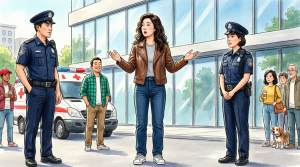
I made it through the ER doors, gave my name, got directed upstairs, and nearly ran into the police officer standing near the pediatric wing.
He was tall, maybe mid-forties, with a buzz cut and a patient face. One hand rested near his belt. Behind him, at the far end of the hall, I could see nurses moving around a room with the curtain half drawn.
“That’s my son,” I said. “I need to get in there.”
He stepped slightly to the side but did not let me pass. “Ma’am, you shouldn’t go in right now.”
I stared at him. “What does that mean?”
“It means we need a few minutes.”
My fear spiked into anger. “My child is in there.”
“I understand that.”
“No, you don’t.” My voice came out too loud. A nurse at the station glanced up. “He fell at a friend’s house. It was an accident. Why are the police here?”
The officer lowered his voice. “When a child is seriously injured at someone else’s home, we have to ask questions. It’s standard. We need to confirm there was no negligence, abuse, or criminal conduct involved.”
I felt like I had stepped onto ice that was thinner than it looked. “Criminal conduct? You think someone hurt him?”
“We’re investigating the circumstances.”
I opened my mouth to argue again, then saw movement near the room.
Mark stepped out.
For one irrational second, relief flooded me so hard my knees weakened. Then I saw his face.
PART 3
Mark didn’t look like a man whose child had just been rushed into the hospital unconscious. His shoulders were relaxed, his breathing steady—almost… relieved. That was the word that hit me hardest. Relief. It didn’t belong here, not in this hallway filled with fear and fluorescent lights. I searched his face for panic, for grief, for anything that matched the storm inside me. But instead, he gave me a small, strange smile. “He’s going to be okay,” he said. And somehow, that made everything feel worse.
“What happened?” I asked, my voice trembling despite my effort to steady it. “They said he fell.” Mark nodded quickly, too quickly. “Yeah. Stairs. Just a bad fall.” His eyes flicked toward the officer and then away again. It was subtle, but I saw it. I’ve spent years reading numbers for inconsistencies—people aren’t that different. Something wasn’t adding up. “Then why are the police here?” I pressed. Mark hesitated, and in that pause, my stomach dropped.
Before he could answer, the officer stepped forward. “Ma’am, we’re going to need to ask you a few questions.” His tone was calm, practiced. “About your son, your husband, and your relationship with the Millers.” The Millers. Lisa. A sudden, sharp image flashed in my mind—Mark adjusting his shirt that morning, the cologne, the vague “work thing.” My heart began to pound harder, not from fear this time, but from something colder. Something that felt dangerously close to understanding.
“I need to see my son,” I said, more firmly now. The officer studied me for a moment, then nodded. “You can go in. But prepare yourself.” That was all he said. No comfort. No reassurance. Just that. My hand shook as I pushed past the curtain. Ethan lay small and pale against the white sheets, a bandage wrapped around his head, machines beeping softly around him. But it wasn’t the injuries that made my breath catch.
It was what he whispered when I leaned close.
“Mom… I didn’t fall.”
Everything inside me went silent.
I pulled back just enough to look at his face. His eyes fluttered open, unfocused but desperate. “Tyler’s dad… and Dad… they were yelling.” His voice was weak, broken between breaths. “I was on the stairs… they didn’t see me… and then—” He winced, tears slipping from the corners of his eyes. “Mom, they pushed each other… and I fell.”
The world didn’t shatter. It collapsed inward.
When I stepped back out into the hallway, I wasn’t the same person who had run in. Mark looked at me, searching, but I saw him clearly now—every forced smile, every “sure,” every quiet resentment I had ignored. “What did he say?” he asked carefully. I held his gaze, steady and unblinking. “He told me the truth.”
The officer moved beside me, already understanding.
Mark’s face changed then. Not relief. Not anymore.

