My four-year-old son called me at work, crying so hard I could barely understand him. “Daddy… Mommy’s boyfriend hit me with a baseball bat. He said if I cry again, he’ll hurt me more…” Then I heard a grown man shouting in the background, and before I could say another word, the line went dead.
The call came right in the middle of a budget meeting, under those cold fluorescent lights that make everything feel numb and unreal. Numbers were glowing on the conference room screen, coworkers arguing over percentages like nothing in the world was about to fall apart. I ignored the first call out of habit, trained to stay professional, trained to believe real emergencies would announce themselves again and again.
Then my phone buzzed a second time.
That was when dread hit me.
Tyler knew better than to call during work unless something was seriously wrong. I pushed my chair back so hard it crashed into the wall and hurried out into the hallway, already feeling my pulse pound in my throat.
“Daddy.” His little voice was thin, trembling, broken by sobs. “Daddy, please come home.”
My body went cold. “Tyler, what happened? Where’s Mommy?”
There was a pause, just enough to make panic spread through me. Then he whispered, “She’s not here.”
And after that, the words spilled out in a rush, frantic and mangled by crying.
“Brad hit me with a baseball bat. Daddy, my arm hurts so bad. He said if I cry, he’ll hurt me more.”
Then I heard a man’s voice roar somewhere near him. “Who are you calling? Give me that phone, you little—”
The line cut off.
For one suspended second, everything around me felt unreal, like the hallway had dropped underwater. Then terror slammed into me all at once. My hands shook so violently I nearly dropped my keys. I was twenty minutes away, stuck in downtown traffic, while my four-year-old son was trapped inside that house with a man capable of hurting a child.
I ran for the elevator, fumbling with my phone, my suit jacket flying open as my breathing turned ragged. I didn’t stop to think. I called my brother Jackson.
He picked up on the first ring. “What’s going on?”
“Tyler just called me,” I said, barely able to get the words out. “Jessica’s boyfriend hit him with a baseball bat. I’m still twenty minutes away.”
There was only the briefest silence before Jackson’s entire tone changed. It turned hard, sharp, dangerous. “Where are you?”
I told him.
“I’m closer,” he said. “Fifteen minutes from your place. Just say the word.”
“Go,” I said. “I’m calling the police.”
“I’m already moving.”
The elevator felt impossibly slow. By the time I hit the parking garage, I was sprinting, dress shoes striking the concrete, tie half-yanked loose like I couldn’t breathe. I called 911 while running, but the operator’s calm questions only made me feel more helpless. Yes, my son was in danger. Yes, an adult man was threatening him. No, I could not stay calm. My brother was already on the way.
Traffic through downtown crawled like a nightmare. Every red light felt personal. Every second felt stolen from my son. I leaned on the horn, cut around slower cars, and pushed through the city in a blur of panic and fury.
Then Jackson called again.
“I’m two blocks away,” he said. I could hear the engine, the rush in his breathing, the urgency in every word.
“Go,” I told him. “Just go.”
I kept the line open as I drove.
Jackson had once been a champion in the regional MMA circuit before a shoulder injury ended everything, but the fighter in him had never really disappeared. Especially when it came to family. He had always been the one person I knew would never hesitate when someone crossed a line like this.
“I’m at the house,” he said. “Truck’s in the driveway. Brad Walton, right? That’s the name on the plate.”
“That’s him,” I said, gripping the steering wheel so hard my knuckles ached. “Jessica’s been with him six months. Let him move in after three. I told her something was off, but she said I was jealous. Controlling. Dramatic.”
Our divorce had been bitter in all the quiet ways that last the longest. Jessica got primary custody because the court decided Tyler needed his mother more. I obeyed every condition, paid everything on time, kept my mouth shut for my son’s sake.
And somehow this was where it had led.
“Front door’s locked,” Jackson said.
A second later I heard him moving fast, then the violent crash of wood breaking apart. “Back door’s open now. I’m inside.”
My heart pounded so hard it hurt.
“Tyler!” Jackson shouted, his voice filling the house. “It’s Uncle Jackson!”
From somewhere upstairs came a tiny, frightened answer. “Uncle Jackson… I’m up here.”
“Stay where you are, buddy. I’m coming.”
Then another voice cut through the phone, male and thick with anger. “Who the hell are you? You can’t just break in here. I’m calling the cops.”
“Do it,” Jackson said, already taking the stairs. “Tell them what you did to a four-year-old.”
“That little brat deserved it,” the man snapped. “Wouldn’t stop crying. Kept screaming for his daddy.”
What came next was sickeningly clear even through the phone — the brutal crack of a punch landing, followed by a startled scream.
Then Tyler’s voice, much closer now. “Uncle Jackson!”
And Jackson, suddenly gentle again, said, “I’ve got you, buddy. Let me see your arm.”…
PART 2
By the time I pulled into the driveway, police lights were already flashing against the house like a warning I should have seen months ago. My car hadn’t even stopped moving before I threw the door open and ran. The front door hung crooked, splintered from where Jackson had forced his way in. Inside, everything smelled wrong—like sweat, fear, and something broken beyond repair.
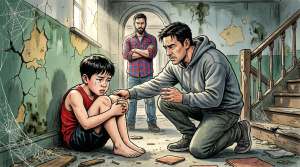
I found Tyler wrapped in Jackson’s arms on the living room couch. My son’s face was streaked with tears, his small body trembling uncontrollably. His arm… God. It was swollen at an angle no arm should ever bend.
“Daddy…” he whispered when he saw me.
That one word shattered something inside me.
I dropped to my knees in front of him, afraid to touch him too hard, afraid to hurt him more. “I’m here, buddy. I’m here now.” My voice didn’t sound like mine. It sounded thin. Useless. Late.
Behind me, officers were dragging Brad Walton out in handcuffs. He was still shouting, still angry, like he was the victim in all of this.
“It wasn’t even that hard!” he barked. “Kid wouldn’t stop crying!”
Jackson stepped forward like a storm about to break again, but one of the officers held him back. “Not now,” the cop warned.
Brad turned his head just enough to look at me—and smirked.
That smirk stayed with me longer than anything else.
At the hospital, they confirmed what I already knew the second I saw Tyler’s arm.
Fractured.
Clean break.
They said he was lucky.
Lucky.
I sat beside his bed long after they put a cast on him, long after the sedatives finally calmed his sobbing. His fingers curled weakly around mine, like he was afraid I might disappear if he let go.
“I called you, Daddy,” he murmured, half-asleep.
“I know,” I whispered, pressing my forehead against his. “And I should’ve answered the first time.”
That guilt? It didn’t fade. It settled in.
Permanent.
PART 3
Jessica showed up two hours later.
Disheveled. Breathless. Defensive before she even spoke.
“What happened?” she demanded, like she hadn’t left our four-year-old alone with a man I had warned her about over and over again.
I stood up slowly.
“You left him,” I said. My voice was quiet, but it carried something sharp enough to cut. “You left him alone with someone who broke his arm.”
Her eyes flicked to Tyler, then away. “Brad said it was an accident—”
“Don’t,” I said.
Just one word. But it stopped her.
For the first time since I’d known her, Jessica looked unsure.
That was the moment everything shifted.
I didn’t argue. I didn’t yell. I didn’t beg.
I acted.
By morning, I had filed for emergency custody.
By afternoon, I had photos, medical reports, witness statements—including Jackson’s—and the police report that documented every word Brad had said, including the part where he claimed my son “deserved it.”
And then… I waited.
Three days later, we stood in court.
Brad sat there in a borrowed suit, suddenly quiet, suddenly small without his anger to hide behind. Jessica sat beside him, pale, shaken, finally realizing this wasn’t something she could talk her way out of.
When the judge asked what happened, I didn’t speak first.
I let the evidence speak.
The photos.
The recordings.
The officer’s testimony.
And then… Tyler’s voice.
A short clip from the 911 recording. Just enough.
“Daddy… my arm hurts…”
The courtroom went silent.
Not polite silence.
Heavy silence.
The kind that changes outcomes.
When the judge looked up again, his expression had hardened into something final.
“Emergency custody is granted to the father, effective immediately.”
Jessica broke then. Not loudly. Not dramatically. Just… collapsed in on herself like something hollow.
Brad didn’t say a word.
Not this time.
That night, I carried Tyler into my apartment, his small body resting carefully against my chest, his cast secured, his breathing soft and steady.
“You’re safe now,” I whispered.
He nodded sleepily against my shoulder.
For the first time since that phone call… I believed it.
And as I closed the door behind us, I made myself one promise I would never break again:
No call from my son would ever go unanswered.
Not ever.
They Tried to Erase Me From My Own Home—But What I Did Next Made Them Wish I Had Stayed Silent 012

“Get out of my kitchen right now!” my daughter-in-law screamed—inside the house I bought, the kitchen I’d built, the life I’d paid for. My son clapped like it was entertainment. I said nothing… until a message buzzed in my pocket: he had tried to steal my house using fake documents. I went silent. That night, they celebrated my “defeat.” One week later, in front of their entire family… I destroyed everything they thought they owned….
“Get out of my kitchen right now!”
Diana’s scream echoed through the entire house like a whip.
My hands were shaking as I held the wooden spoon I had used for thirty years. She was there in my kitchen, using my pots, my ingredients, cooking for her entire family as if she owned the place.
And the worst part hadn’t even happened yet.
My son Chris ran into the kitchen. Instead of defending me, instead of reminding his wife that this was his mother’s house, he started clapping. Yes, clapping, like he was at a show.
“That’s right, honey. Finally, someone put her in—”
But he didn’t have time to finish the sentence because in that moment, something inside me broke.
Or maybe it finally woke up.
Let me back up a bit so you understand how I got to that moment of absolute humiliation.
My name is Martha. I’m sixty-three years old, and for the last five years I have lived a silent hell in my own home.
When Chris introduced me to Diana six years ago, I thought my son had finally found someone who would make him happy. She was young, thirty-two, pretty, with that kind of beauty that comes with a lot of self-confidence. Too much confidence, I’d say now.
At our first dinner, she barely spoke to me. She only talked to Chris, constantly touching his arm, laughing loudly at his jokes that weren’t even funny, ignoring me as if I were part of the furniture.
But I kept quiet.
Like a good mother, I wanted my son to be happy. I swallowed the discomfort, the feeling of being invisible at my own table.
Give her time, I told myself. She’s nervous. It’s normal.
How naive I was.
The wedding was five years ago. An expensive ceremony that I helped pay for, even though Diana told everyone her parents funded the whole thing. I remember at the reception they sat me at a table in the back, far from the main table, next to distant cousins I didn’t even know.
Meanwhile, Diana shined in her ivory dress, and Chris looked at her like she was the only person in the world.
I didn’t exist.
I cried in my hotel room that night, but I dried my tears quickly.
It’s their day, I repeated to myself. This isn’t about you, Martha.
After the wedding, they moved into a small apartment. They lasted exactly eight months.
Eight months before Chris showed up at my door with a suitcase and that awkward smile he always had when he needed something.
“Mom, it’s temporary,” he said. “Just until our financial situation improves. Diana is looking for a better job, and I’m waiting for a promotion.”
I had a three-bedroom house too big for just me since I was widowed.
“Of course, son,” I said. “This will always be your home.”
If I had known that temporary would become a five-year nightmare, I would have locked the door right then.
The first few months were tolerable. Diana worked at an expensive clothing boutique downtown. She left early and came home late. I barely saw her. Chris worked at a tech company, always glued to his computer, always stressed.
I continued with my normal routine. I cooked. I cleaned. I took care of my house just like I always had.
But little by little, things started to change.
First, it was small comments.
“Martha, could you wash my clothes too? I just get so tired from work.”
“Martha, you use too much salt in the food.”
“Martha, that’s not how you cook.”
“Martha, don’t you think it’s time to update the living room furniture? It looks so old.”
I endured it. I swallowed my pride and endured it because I didn’t want to create conflict. Because I loved my son and wanted his marriage to work. Because I had been taught that a good mother always sacrifices, always gives, and always puts her family first.
But Diana wasn’t my family, even if she carried my late husband’s last name.
Diana was a stranger who every day made me feel more like a stranger in my own home.
Six months after moving in, she quit her job at the boutique.
“I’m exhausted,” she told Chris. “I need a break.”
That break has now lasted four and a half years.
Four and a half years of watching her lie on my sofa watching television while I cleaned around her as if I were a maid.
And Chris, my son, the boy I raised alone after his father died in that accident when he was only twelve—he just supported her in everything.
“Mom, Diana is going through a tough time,” he would tell me. “She needs time to find herself.”
Find herself.
While I cooked, cleaned, washed her clothes, and she didn’t even say good morning to me.
The respect completely evaporated.
She started giving me orders.
“Martha, I want chicken for dinner tonight.”
“Martha, my family is coming this weekend. I need you to clean the house. Really clean it.”
“Martha, don’t use that detergent. It ruins my clothes.”
My clothes. My house. As if I were the guest and she were the owner.
But that day, Diana’s birthday exactly one week ago, was different. It was the day everything changed, even if they didn’t know it yet.
It was a Saturday morning, and I was in the kitchen making my breakfast, just coffee and some toast. Nothing elaborate.
I heard the front door open and the loud voices of Diana and her mother, Betty, coming in loaded with grocery bags.
“Today, I’m going to show my family that I’m the best cook!” Diana yelled excitedly.
Betty laughed.
“My girl, you’ve always been talented in the kitchen, not like some others.”
And she looked at me.
She looked at me with that contempt I already knew so well.
They burst into the kitchen like a tornado. Diana started pulling bags out onto my table, throwing packages of meat, vegetables, bottles of wine.
“I’m going to make my famous stew,” she announced while I just stood there, my coffee cup in hand, invisible.
Betty opened my refrigerator without asking permission, pulling out my ingredients, my things.
“There’s an onion here. Perfect,” she said. “And look, she has good spices.”
My spices. The ones I had collected for years. Some brought back from trips, others gifts from my sister Doris.
I tried to speak.
“Excuse me. I was—”
But Diana cut me off with that tone you use when speaking to an annoying child.

PART 2
PART 3

