My name is Grace Meyers. I’m thirty-six years old. Twenty years ago, my parents kicked me out of the house for getting pregnant in tenth grade. Sixteen years old. November rain. One suitcase. My mother pointing at the door, telling me I was dead to them. That same night, they signed papers erasing me from the family. Me and any child I might ever have. I kept those papers. I kept everything. For two decades, I was invisible. They told everyone I’d moved abroad, built their spotless reputation on the grave of the daughter they threw away. Then last week, they showed up at my door—desperate, smiling, demanding to meet their grandson, a grandson they’d bragged about for months to two hundred of their most powerful friends. They offered me a quarter million dollars. They had no idea that the grandson they’d been promising everyone didn’t exist, and what they found instead would tear apart everything they’d spent fifty years building.
Portland, Oregon. November 2004. I was sixteen, a sophomore at St. Catherine’s Academy, and the youngest child of Richard and Diane Meyers. On paper, we were the perfect family. My father owned a successful real estate law practice downtown, Meyers and Associates, established in 1987. My mother had been president of the parent-teacher association for four consecutive years. We sat in the front pew at Grace Fellowship Church every Sunday, dressed in coordinated outfits my mother selected each Saturday night.
But every family has its hierarchy, and I learned mine early. Nathan, my older brother, was twenty-two and in his third year of dental school. He was the pride of the family, the son who would carry on the Meyers name. Carolyn, twenty, was studying to become a teacher, the beautiful daughter who never questioned anything. And then there was me. I was what my mother once called “the surprise,” born when she was thirty-four, six years after she thought she was done having children. I don’t think she ever forgave me for disrupting her plans.
The signs were subtle, but constant. Family photos displayed prominently in the living room somehow never included my school portraits. Dinner conversations revolved around Nathan’s clinical rotations or Carolyn’s student-teaching placement. When I mentioned making the honor roll, my father would nod and say, “That’s nice, Grace,” before turning back to Nathan. I learned to make myself small, to not ask for too much, to not need too much.
My father had a saying he repeated at every family gathering. Reputation takes twenty years to build and five minutes to destroy. I didn’t understand then how prophetic those words would become, or that I would be the five minutes he feared.
I met Marcus Webb at the public library downtown. It sounds unremarkable, but for me the library was sanctuary, a place where no one compared me to my siblings or reminded me of expectations I could never meet. I went there three afternoons a week, ostensibly to study, really just to breathe. Marcus attended Jefferson High, the public school my parents would never acknowledge existed. He was seventeen, worked part-time at his uncle’s auto repair shop, and had the kindest eyes I’d ever seen. He found me crying in the biography section one October afternoon after my mother had forgotten to pick me up from school for the third time that month.
“Hey,” he said, sliding into the seat across from me. “You okay?”
No one had asked me that in a very long time. We dated secretly for two months. He was gentle and patient and made me feel like I mattered, like I was someone worth remembering.
I’ll never forget staring at that pregnancy test in the bathroom of a gas station three miles from my school. Two pink lines. My hands wouldn’t stop shaking. When I told Marcus, he didn’t run. He didn’t make excuses. He held my hands and said:
“We’ll figure this out together, Grace. You’re not alone.”
I wanted to believe him. Part of me did. But I knew my parents. I knew what mattered to them. And I knew that when I told them, their first question wouldn’t be, “Are you okay?” It would be, “What will people think?”
I decided to tell them at Sunday dinner. I didn’t know it would be the last meal I ever ate in that house. The roast beef was overcooked. I remember that detail because I was staring at it, trying to find the courage to speak, while my father complained about a property dispute and my mother calculated which families would attend the church Christmas gala.
“I have something to tell you.”
The table went quiet. Four faces turned toward me. My parents. Nathan, home for the weekend. Carolyn, visiting from college. I was eight weeks pregnant, and I couldn’t hide it much longer.
“I’m pregnant.”
My mother’s fork clattered against her plate. My father didn’t move.
“Who is the father?” His voice was ice. “Is it someone from St. Catherine’s? Someone we know?”
“His name is Marcus Webb. He goes to Jefferson High. He works at—”
“The public school.”
My mother’s face had gone pale.
“You’ve been seeing a boy from the public school?”
“He’s a good person, Mom. He comes from a good family.”
My father cut in.
“What does his father do?”
“He lives with his uncle. He works at an auto shop.”
The silence that followed lasted exactly eleven seconds. I counted. Then my father stood.
“You will not keep it.”
“Richard,” my mother started.
“She will not destroy everything we’ve built.”
He looked at me like I was a stranger, like I was something that needed to be removed.
“If you keep that baby, you are no longer part of this family.”
By 9:15 that night, I was standing on the front porch with one suitcase, rain soaking through my sweater. My mother had opened the door and pointed outside. Not my father. My mother. Nathan and Carolyn watched from the upstairs window. Neither of them came down.
I called Marcus from a pay phone at the gas station on Mulberry Street. My hands were shaking so badly I could barely dial. He picked up on the second ring.
“Grace, what’s wrong?”
“They kicked me out.”
Twenty minutes later, his uncle’s truck pulled up to the gas station. Marcus jumped out before it fully stopped, wrapped me in his jacket, and held me while I sobbed against his chest.
“I’ve got you,” he said. “I’ve got you.”
We didn’t have a plan. We had three hundred dollars between us, a truck with questionable brakes, and nowhere to go. That’s when Margaret Torres saved my life. She was our neighbor, three houses down from the Meyers residence, sixty-two years old, a retired schoolteacher, the only person on our street who didn’t treat my father like he owned the neighborhood. She’d seen me standing in the rain from her window. She’d watched long enough to understand.
“You can stay with me,” she said when I knocked on her door at nearly ten that night. “As long as you need.”
Two weeks. That’s how long we stayed in Mrs. Torres’s guest room before Marcus found us a studio apartment in Seattle. Four hundred twenty-five dollars a month, above a laundromat that smelled like bleach and secondhand hope.
My parents had their lawyer draw up papers the night they threw me out. I know because my father mailed me a copy three days later, certified mail, signature required, like I was a business transaction. The document stated that Grace Elizabeth Meyers forfeited all inheritance rights and the Meyers family bore no legal or moral obligation to her or any child born to her. I kept that paper. I’ve kept it for twenty years.
Lily Grace Meyers Webb was born on July 6, 2005, at Harborview Medical Center in Seattle. Seven pounds, four ounces. Ten fingers, ten toes. Her father’s brown eyes and my stubborn chin. She came into the world screaming, and I thought, Good. Scream. Make them hear you. Don’t ever let anyone make you small.
The first five years were a blur of survival. Marcus worked double shifts at a repair shop in Ballard while I finished my GED, then started community college classes, two at a time, whatever I could manage around Lily’s schedule. We lived on ramen noodles and free bread from the day-old bin at the bakery down the street. I learned to sew patches onto patches to make a dollar stretch until it begged for mercy.
I sent my parents a birth announcement when Lily was born. No response. I sent a photo on her first birthday. Silence. By her second birthday, I stopped trying.
Marcus and I never got married. We kept saying we would someday, when we had money for a real wedding, when life calmed down. Someday kept getting pushed back. Then on March 15, 2010, a delivery truck ran a red light on Aurora Avenue. Marcus was driving home from a night shift. The police officer who came to my door said he died on impact. He was twenty-six years old. Lily was four.
The life insurance policy Marcus had through work paid out twelve thousand dollars. That was it. Twelve thousand dollars for twenty-six years of a good man’s life. I was twenty-two years old, a single mother with a four-year-old daughter, twelve thousand dollars, and absolutely no one to call.
I could have given up then. I didn’t.
I’d started doing small interior design projects while Marcus was alive, decorating apartments for neighbors who couldn’t afford professionals, staging homes for real estate agents willing to take a chance on a young mother with no credentials. I had an eye for it, people said. A gift for making small spaces feel like home. After Marcus died, I threw myself into that work like my life depended on it, because it did.
In 2012, I met Eleanor Vance at a design workshop at Seattle Central College. She was fifty-two, recently retired as creative director of a major design firm, and looking for a project. For reasons I still don’t fully understand, she chose me.
“You have talent,” she said after reviewing my portfolio. “Raw, unpolished, but real. Let me help you shape it.”
In 2014, with Eleanor’s mentorship and a fifty-thousand-dollar SBA loan that took me three attempts to secure, I founded Hearth & Home Interiors. Our first office was a converted closet in a shared workspace.
By 2018, we had eight employees and revenue of $1.2 million.
By 2022, Seattle Met magazine ran a feature story on me: From Teen Mom to Design CEO: Grace Meyers’s Story. The journalist spent three days interviewing me about my journey—the pregnancy at sixteen, being cut off from my family, losing Marcus, building a business from nothing. I told her everything except my parents’ names. Not to protect them. To protect Lily from anyone who might try to connect her to people who never wanted her to exist.
By 2024, Hearth & Home had twenty-two employees, $4.2 million in annual revenue, and a corner office overlooking Capitol Hill. My daughter was nineteen, a sophomore at the University of Washington, majoring in psychology. She was brilliant and fierce and everything I had hoped she would become.
Twenty years. No contact from the Meyers family until last week.
I had just gotten home from a client meeting, a tech executive renovating her Mercer Island waterfront property, a contract worth eight hundred thousand dollars. My mind was still running through fabric samples and lighting options when I turned onto my street and saw the car: a black Mercedes-Benz S-Class, Oregon plates.
My heart stopped.
I parked in my driveway and sat there for a full minute, gripping the steering wheel, watching two figures standing at my front door. The man had gray hair now, stooped shoulders. The woman still held herself with that rigid posture, that constant vigilance against anything that might disturb her carefully constructed world.
Richard and Diane Meyers. My parents.
I hadn’t seen them in twenty years.
I considered driving away, going to a hotel, calling Lily, pretending this wasn’t happening. But I was thirty-six years old. I owned a company. I had built a life without them. I would not run.
I got out of my car and walked toward them. My father spoke first.
“Grace, you look…”
He paused, scanning me. My designer coat. My leather bag. My house.
“Well.”
“What are you doing here?”
My mother stepped forward. Her face had more lines now. Her hair was a careful shade of ash blonde that didn’t quite match her age.
“We know about your son, Grace. We know you have a son.”
I stared at her.
“We’d like to meet him,” my father added. “We’d like to reconnect as a family.”
The absurdity of it nearly made me laugh. Twenty years of silence. Twenty years of pretending I didn’t exist. And now they were standing on my porch asking to meet a grandson they’d never bothered to know. A grandson who didn’t exist.
I let them into my house. I still don’t know why. Maybe I needed to hear what twenty years of silence had led to.
My father sat in my living room like he was evaluating a property for purchase, assessing the hardwood floors, the custom built-in shelves, the original artwork on the walls. My mother perched on the edge of my sofa, hands folded, spine straight.
“Your anniversary,” I said. “That’s why you’re here.”
“Fifty years.” My father almost smiled. “November fifteenth. We’re hosting a celebration at the Heathman Hotel. Two hundred guests. The mayor will be there, Pastor Harrison, the Rotary Club board.”
“What does that have to do with me?”
My mother exchanged a glance with my father.
“There have been questions, Grace. About you. About what happened twenty years ago.”
“People talk,” my father added. “Some people remember that we had a third child. They’ve asked where you are. What happened to you? We’ve always said you moved away, went abroad. But lately, questions have become more persistent.”
“So you need me to make an appearance. Show everyone that the Meyers family is whole and happy.”
“We need your son.” My mother’s voice was firm. “We’ve told people about him, about our grandson. He should be there representing the next generation of the Meyers family.”
The room went very still.
“Who told you I have a son?”
“We read that article.” My father waved his hand dismissively. “The magazine piece. It mentioned your child, your successful business. You’ve done better than we expected.”
Better than we expected. As if I’d been graded. As if my entire life was a test I might have failed.
“And if I refuse?”
My father’s jaw tightened.
“Let’s not make this difficult, Grace.”
He reached into his leather briefcase and withdrew a blank check. The sight of it made my stomach turn.
“We’re prepared to compensate you,” he said, placing it on my coffee table. “Two hundred fifty thousand dollars. You bring your son to the party, stay for three hours, take some family photos, then you can return to your life.”
I looked at the check, then at my mother, who was nodding as if this were the most reasonable proposition in the world.
“Two hundred fifty thousand dollars?” I repeated. “Is that what twenty years of silence costs?”
“We’re also prepared to reinstate you in the family trust.” My mother leaned forward, her voice dropping to a conspiratorial whisper. “The combined estate is valued at 3.8 million. You would have an equal share with Nathan and Carolyn.”
I thought about that studio apartment above the laundromat. The nights I’d worked double shifts while Lily slept in a playpen behind the counter of a coffee shop because I couldn’t afford child care. The years I’d spent building something from nothing while they sat in their Portland mansion pretending I’d never existed.
“And if I say no?”
My father’s expression hardened.
“We would prefer not to involve your son directly, Grace, but if necessary, we can reach out to him ourselves. Explain the situation. Help him understand his family history.”
It was a threat, subtle but unmistakable.
“You want to contact my child,” I said slowly, “and tell them your version of what happened.”
“We want to be a family again.” My mother spread her hands, the picture of reasonableness. “Isn’t that what you’ve always wanted?”
I was about to answer when I heard footsteps on the stairs, and everything changed.
“Mom? Is everything okay? I heard voices.”
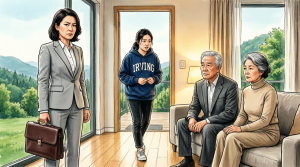
Lily stopped at the bottom of the stairs, her psychology textbook still in her hand. She was wearing sweatpants and a University of Washington hoodie, her dark hair pulled into a messy ponytail. She looked exactly like what she was, a nineteen-year-old college student who’d been studying in her room.
My mother rose to her feet, her face cycling through confusion, calculation, and something close to horror.
“Who is this?”
“This is Lily.” I stood, positioning myself slightly between my daughter and my parents. “My daughter. Your granddaughter.”
“Daughter?” My father’s voice cracked. “But we were told—the article said—”
“The article said child. You assumed the rest.”
Lily’s gaze moved from me to the strangers in our living room. Understanding dawned in her eyes.
“These are them? The grandparents who threw you out when you were pregnant with me?”
My mother flinched.
“That’s not—it was more complicated then.”
“Which part was complicated?” Lily crossed her arms. “The part where you kicked a sixteen-year-old out in the rain, or the part where you spent twenty years pretending she didn’t exist?”
“Young lady,” my father started.
“I’m not your young lady. I’m the grandchild you never wanted to meet. The one you tried to make disappear.”
Lily’s voice was steady, but I could see her hands trembling.
“I know everything. Mom never hid it from me. I know about the letter. I know about the inheritance papers. I know you told your friends she went abroad.”
My parents sat in stunned silence.
Lily looked at me.
“They came here for a grandson, didn’t they? Someone they could show off.”
“Yes.”
She turned back to them with a cold smile.
“Surprise.”
My father recovered faster than my mother. I watched him recalibrate, the lawyer in him assessing this new variable.
“A granddaughter,” he said carefully. “That… that works. We can adjust the narrative. Lily can come to the party as—”
“As what?” Lily cut in. “The secret granddaughter you’ve been hiding for nineteen years? The daughter of the teen mom you threw away?”
“We could say you were studying abroad.” My mother’s voice was pleading now. “Recently returned. A surprise reunion.”
“I was born in Seattle. I’ve never left the country. I’m a sophomore at UW.”
Lily laughed, but there was no humor in it.
“Do you even hear yourselves? You want me to lie to two hundred people about my entire existence?”
“The party is November fifteenth.” My father checked his watch as if time was the only variable that mattered. “Ten days from now. We need an answer by the tenth.”
I stood.
“I think you should leave.”
“Grace—”
“I’ll consider what you’ve said, but not tonight. Not with Lily here.”
My mother rose, gathering her handbag. At the door, she turned back.
“This is an opportunity to heal, Grace, to put the past behind us. Don’t let old wounds cost you your future.”
I watched them walk to their Mercedes, watched my father help my mother into the passenger seat the same way he had a thousand times before, as if this were any ordinary evening. When the car disappeared around the corner, Lily spoke.
“You’re not actually considering this, are you?”………………………..
I looked at my daughter, this fierce, brilliant young woman I had raised alone, the person Richard and Diane Meyers had tried to erase from existence before she was even born.
“No,” I said. “But I’m not done with them yet.”
Before we continue, let me ask you something. Have you ever stood where I stood that night, facing people who abandoned you only to return when they needed something? I’d love to know what you would have done in my position. Drop a comment below. And if you want to see how this all unfolds, hit that subscribe button, because what happened next—even I didn’t see it coming.
That night, after Lily went to bed, I pulled a fireproof lockbox from the back of my closet. I hadn’t opened it in years. Inside were the documents of my erasure. The notarized letter of disinheritance, dated November 14, 2004, signed by Richard Allen Meyers and Diane Elizabeth Meyers, witnessed by a notary named Harold Brennan. I remembered the day my father mailed it to me, certified mail, requiring my signature, as if he wanted to make sure I knew exactly how thorough he’d been.
The document was three pages, legal language designed to be airtight, ensuring that Grace Elizabeth Meyers hereby forfeits all claims to the Meyers family estate, and that the family bears no legal or moral obligation to the aforementioned party or any dependents thereof. Any dependents thereof. Lily, reduced to three words in a legal document, erased before she took her first breath.
I photographed each page with my phone, uploaded them to my cloud storage, made backup copies.
“Mom?”
I looked up. Lily was standing in my doorway, arms wrapped around herself.
“I couldn’t sleep either.”
She sat beside me on the bed, looking at the documents spread across my comforter.
“Is that the letter?”
“Yes.”
She picked up the first page, reading slowly. When she finished, her eyes were bright with tears she refused to let fall.
“They really did it,” she whispered. “They really just cut you out like you were nothing.”
“They did.”
“What are you going to do with these?”
I looked at my daughter, at the evidence of twenty years of calculated cruelty laid out before us.
“I don’t know yet,” I admitted. “But whatever I do, they won’t be able to pretend anymore.”
Lily nodded slowly.
“I might have an idea.”
The next morning, I made a call I hadn’t made in over a year. Margaret Torres answered on the third ring.
“Grace, is that you, sweetheart?”
“Mrs. Torres? I hope I’m not calling too early.”
“At my age, early is relative. What’s wrong? You sound like you’ve got weight on your shoulders.”
I told her about my parents’ visit, about the grandson they’d invented, the anniversary party, the $250,000. When I finished, the line was quiet for a long moment.
“Those people,” she finally said. “Twenty years, and they haven’t changed one bit.”
“Mrs. Torres, I need to ask you something. That night, November 14, 2004…”
“I remember it like it was yesterday.” Her voice hardened. “I watched from my window. Saw you standing in the rain. That little suitcase at your feet. Watched your parents’ car drive away. I should have come out sooner. I’ve regretted that every day since.”
“Do you still have your security camera footage from back then?”
A pause.
“You know, I never delete anything. Old teacher’s habit. Document everything. Let me check my files.”
Twenty minutes later, my phone buzzed with an email. A grainy but unmistakable image. A sixteen-year-old girl standing on a porch in the rain. 9:17 p.m., November 14, 2004. The timestamp was visible in the corner. The address—my parents’ house—was partially visible in the frame.
“That’s you,” Mrs. Torres said when I called her back. “That’s the night they threw you away.”
“Would you be willing to verify this officially if needed?”
“Honey, I’ve been waiting twenty years for someone to ask.” Her voice was fierce. “Whatever you need, I’m there.”
I thanked her and hung up.
Two pieces of evidence. Two witnesses. Now I needed a plan.
I spent that evening rereading my own story. The Seattle Met article was still available online, shared more than twelve thousand times since it was published in March 2022. The journalist, Rebecca Huang, had titled it From Teen Mom to Design CEO: Grace Meyers’s Story. Twenty-five hundred words about loss, resilience, and building something from the ruins of everything you thought you knew.
I had been careful in that interview. I had told the truth, but not the whole truth. I mentioned being estranged from my family without naming names or cities. I talked about becoming a mother at seventeen without identifying the parents who’d cast me out. Not to protect them. To protect Lily from strangers making connections, asking questions, dredging up pain that didn’t belong to them.
Now I scrolled through the comments. Thousands of them.
This woman is incredible.
Imagine being thrown away by your own family and still becoming this successful.
I went through something similar. This story gives me hope.
Someone should make a movie about her life.
One comment caught my eye, posted just two weeks earlier. Does anyone know if she’s related to the Meyers family in Portland? The law firm people? Someone in my church mentioned it and now I’m curious.
So that was how my parents found out.
My phone rang. Eleanor Vance.
“Grace, I heard through the grapevine that your parents materialized after two decades of radio silence.”
I laughed despite myself.
“News travels fast.”
“This is Seattle. Everything travels fast.” Her voice softened. “What do you need?”
“I don’t know yet. Advice, maybe. Perspective.”
“What I know,” Eleanor said, “is that you’ve spent twenty years proving who you are without them. Don’t let three hours at their party undo that.”
She was right. But I was already thinking bigger than three hours.
The next afternoon, my phone showed an Oregon area code I didn’t recognize. I almost let it go to voicemail.
“Grace, it’s Nathan.”
I hadn’t heard my brother’s voice in twenty years. It was deeper now, weathered, the voice of a man in his forties instead of the twenty-two-year-old who had watched from an upstairs window while I stood in the rain.
“Nathan.”
“I know. I know I have no right to call. I know you have no reason to talk to me.” He exhaled shakily. “But I need you to know some things before… before whatever happens next.”
“Then talk.”
“The grandson story. The whole thing about you having a son—that came from Mom. She read the Seattle Met article two years ago, but didn’t read it carefully. Just saw a child and successful business and constructed this whole narrative about you having a boy who was some kind of entrepreneur. She invented a grandson. She told her church friends, her Rotary friends, built an entire story about this brilliant young man continuing the Meyers legacy.”
Nathan’s voice cracked.
“Dad went along with it. They’ve been dining out on your imaginary son for months.”
I closed my eyes. Even now, even after everything, my parents’ capacity for delusion still stunned me.
“Why are you telling me this?”
“Because I was a coward. Grace, twenty years ago, I should have come downstairs. I should have said something. I should have…”
He stopped, breathing hard.
“Carolyn and I have talked about it for years. We were wrong. We’ve always been wrong. And now… now I want to make it right. Whatever that looks like.”
Nathan paused.
“The anniversary party. Carolyn and I will be there. If you decide to come, you won’t be alone.”
I didn’t know what to say to that.
Nathan talked for another hour. He told me about the unwritten rules of being a Meyers child, the expectations, the constant performance, the way our parents wielded approval like a weapon, granting it to those who complied and withdrawing it from anyone who stepped out of line.
“Carolyn has two kids,” he said, “eight and eleven. She’s terrified of them growing up the way we did—walking on eggshells, never knowing if they’re good enough.”
“Why didn’t you ever reach out in twenty years?”
Long pause.
“I almost did five years ago. I had your number, found it through the business website, dialed it at least a dozen times.” His voice dropped. “And every time I hung up before it connected because I knew that if I talked to you, I’d have to admit what I let happen. And I wasn’t ready.”
“What changed?”
“Seeing them show up at your door demanding a grandson that doesn’t exist. Watching them try to buy you like you’re a prop for their anniversary photo.” Nathan exhaled. “It made me realize if I don’t say something now, I never will. And I’ll spend the rest of my life knowing I failed you twice.”
I thought about the brother I remembered. The one who played board games with me when our parents were at their charity galas. The one who taught me to ride a bike in the backyard.
“There’s something you should know,” Nathan added. “The anniversary party. There’s going to be a family moment that gets livestreamed on the church Facebook page. Pastor Harrison’s idea. A show of unity for the congregation.”
A livestream. Two hundred witnesses in person. And who knew how many more watching online.
“Thank you for telling me, Nathan.”
“What are you going to do?”
“I’m not sure yet, but I’m starting to see it clearly.”
The next morning, my father called directly this time. No preamble.
“Grace, we’re running out of time. The party is in one week. Two hundred fifty thousand dollars, full reinstatement in the family trust. Final offer.”
“I’ve been talking to Nathan.”
Silence.
“He told me about the grandson story you’ve been telling people. The one you made up based on an article you didn’t bother to read carefully.”
“That’s not—we may have embellished slightly.”
“You invented an entire person. You’ve been telling your friends about your successful grandson for months. A grandson that doesn’t exist.”
“Grace,” my father said, his voice hardening, “I don’t appreciate your tone after everything we’re offering.”
“What exactly are you offering?” I kept my voice calm, steady. “Money to make me perform for your friends? A spot in a trust you used to erase me? You’re not offering me anything. You’re trying to buy your way out of a lie you created.”
“You have no right to judge us.” Now he was angry. “You’re the one who destroyed this family. You’re the one who brought shame.”
“I was sixteen years old. I was pregnant and scared and I needed my parents.” My grip tightened on the phone. “And you threw me out like garbage and spent twenty years pretending I died.”
“If you don’t come to this party, Grace, you will never have another opportunity to be part of this family.”
“You said that twenty years ago. And you know what? I built a better life without you than I ever would have had with you.”
“We’ll see about that.”
He hung up.
I sat in my office, heart pounding, mind racing. One week. Two hundred guests. One livestream. It was time to stop letting them control the narrative.
That evening, I sat at my dining table with Lily and Eleanor.
“They want a performance,” Eleanor said, swirling her wine. “They want you to show up, smile for the cameras, validate twenty years of lies.”
“They want to use you,” Lily added. “The same way they’ve always used you, as something to manage, not someone to love.”
I looked at both of them—my mentor, my daughter, the family I’d built for myself.
“I’m going to that party.”
Lily’s head snapped up.
“Mom—”
“Not to give them what they want. To give myself what I need.”
I pulled out my phone, showing them the photos of the disinheritance letter, Mrs. Torres’s security footage, the Seattle Met article.
“They’ve spent twenty years controlling my story, telling people I went abroad, inventing a grandson, making me disappear.”
“And you want to undisappear,” Eleanor said slowly.
“I want to tell the truth in front of everyone who matters to them. On their stage. At their party. During their precious livestream.”
I took a breath.
“Not to humiliate them. But to stop letting them pretend I don’t exist.”
“I’m coming with you.” Lily’s voice was firm. “They need to see who I really am, not their imaginary grandson. Me.”
I reached for her hand.
“Are you sure? This could be—”
“I’ve spent my whole life knowing that my grandparents chose their reputation over my mother, and by extension over me. I’m sure.”
I called Nathan that night.
“Your offer to stand with me—does it still hold?”
“Carolyn and I talked. We’re ready.”
“Then I need you to do something. Don’t warn Mom and Dad. Don’t tell them I’m coming. Can you do that?”
“Yes.”
“Good.”
I looked out at the Seattle skyline, at the life I’d built from nothing.
“Because in one week, we’re going to show them what family actually means.”
The Crystal Ballroom at the Heathman Hotel was everything my parents would have chosen. Chandeliers dripping crystal. White tablecloths starched to precision. Flower arrangements that probably cost more than my first month’s rent in Seattle. Two hundred guests in formal attire, clutching champagne flutes, making small talk about golf handicaps and investment portfolios.
I stood in the entrance with Lily beside me. She wore a navy-blue dress, simple and elegant. I had chosen black, professional, understated, impossible to ignore.
“You okay?” she whispered.
“I’m about to crash my parents’ fiftieth anniversary party to tell two hundred people they’ve been lying for twenty years.” I squeezed her hand. “I’m terrified.”
“That’s not what I asked.”
I looked at her, this incredible young woman who had grown up knowing her grandparents had tried to erase her, who had built her own strength from that knowledge instead of letting it break her.
“Yeah,” I said. “I’m okay.”
We walked in.
The room was arranged around a raised platform at the far end where my parents would give their speeches. A camera crew was setting up the livestream for Grace Fellowship Church. I could see the Facebook Live indicator already blinking.
And there they were. Richard and Diane Meyers, standing on that stage surrounded by well-wishers. My mother in champagne-colored silk. My father in a tailored navy suit. Both of them glowing with the confidence of people who believed they had won.
They hadn’t noticed us yet. The room was too crowded, the attention too focused on them. But heads were starting to turn.
Someone near the door whispered:
“Is that…?”
“Someone else?” another voice said. “The daughter from the article?”
The whispers spread like ripples in water. And then my mother looked up.
My father had just begun his speech.
“Fifty years of marriage has taught me that family is everything. Diane and I have built our lives around that principle. Our children, our community, our faith—”
His voice carried across the ballroom, amplified by the microphone, captured by the livestream camera. On the small monitor near the stage, I could see the Facebook Live comment section already scrolling.
Beautiful couple.
God bless the Meyers family.
What an inspiration.
My mother saw me first. Her champagne smile froze. I watched her hand tighten on my father’s arm. He followed her gaze, stopped mid-sentence. The room began to notice, heads turning, whispers building.
Someone near the back said loudly enough to carry:
“That’s her from the magazine. The design CEO.”
Someone else added:
“That’s Richard’s daughter. I thought she was in Europe.”
My father recovered first.
“As I was saying, family has always—”
I started walking toward the stage.
The crowd parted. Not dramatically—this wasn’t a movie—but people stepped aside, sensing something was about to happen. Lily walked beside me, her chin high, her steps steady. Nathan appeared at the edge of the crowd, Carolyn beside him. They didn’t try to stop me. They just watched.
“Grace,” my father said through the speakers, strained now, “what a surprise. We weren’t expecting—”
I climbed the three steps to the platform. The livestream camera tracked my movement. I could feel two hundred pairs of eyes on me, plus however many were watching online.
I took the microphone from his hand before he could react.
“Hello, Dad.”
Then I turned to the crowd……………………………………..
I paused.
“The one they told you went to Europe twenty years ago.”
The silence in that ballroom was absolute.
“I didn’t go to Europe,” I continued. “On November 14, 2004, twenty years ago tomorrow, my parents discovered I was pregnant at sixteen. That same night, they threw me out of their house. They had their lawyer draft papers disowning me. They told me I was dead to them.”
Someone gasped. The livestream comments were exploding. I could see them scrolling faster than anyone could read.
“They told everyone I’d gone abroad. For twenty years, they pretended I didn’t exist.”
I reached into my bag and pulled out the notarized letter.
“This is the document my father mailed me three days after throwing me out. It states that I forfeit all inheritance rights and that the Meyers family has no obligation to me or, I quote, ‘any dependents thereof.’”
I held it up to the camera, close enough to read.
“Those dependents? That’s my daughter Lily.”
I gestured to where she stood at the edge of the stage.
“Your granddaughter, whom you’ve never met. The grandson you’ve been telling your friends about for months doesn’t exist. You invented him based on a magazine article you didn’t read carefully.”
My father grabbed for the microphone.
“Grace, this isn’t the place—”
“When is the place, Dad?” I held the mic out of his reach. “When is the right time to tell the truth? You came to my house last week offering me two hundred fifty thousand dollars to parade a fictional grandson at this party. Two hundred fifty thousand dollars to make your lie look real.”
I turned to the crowd, to the camera, to the two hundred witnesses and the thousands watching online.
“I didn’t come here for money. I came here because I’m done being erased.”
Pastor Harrison stepped forward.
“Richard, is this true?”
My father couldn’t answer.
My mother started crying. I had only seen Diane Meyers cry once in my entire childhood—at her own mother’s funeral. Now tears streamed down her face, ruining the careful makeup she had spent hours perfecting.
“Richard,” Pastor Harrison said, his voice firm, “I asked you a question. Is what your daughter is saying true?”
The room held its breath.
My father looked at the crowd: the mayor, the Rotary Club board members, the church elders who had respected him for decades. I watched him calculate, search for an angle, try to find words that would spin this into something acceptable.
He couldn’t find them.
“It was a difficult time,” he finally said. “We made decisions that—”
“You threw me out because I was pregnant.” My voice stayed calm. “Because your reputation mattered more than your child.”
Nathan stepped onto the stage, then Carolyn. They stood beside me, not touching, but present.
“She’s telling the truth,” Nathan said, his voice carrying through the room. “Carolyn and I were there that night. We watched from the window while our parents put our sixteen-year-old sister out in the rain. We never said anything. That was our failure.”
The whispers became a roar. I could see people pulling out phones, texting, recording. The mayor, Harold Simmons, was already moving toward the exit.
“Mrs. Torres,” I said, pointing to a gray-haired woman in the back row who had flown in from Portland that morning. “Our neighbor from twenty years ago. She saw everything. She has photos. Timestamps.”
Margaret Torres stood, her chin lifted.
“I watched that child stand in the rain for ten minutes before she walked away. I gave her a place to sleep. The Meyers family never once asked where she went.”
The livestream comments exploded.
This is insane.
Those poor girls.
Someone call the news.
Can you imagine standing where my parents stood in that moment? Everything they had built, fifty years of reputation, the respect of their community, the image they’d polished so carefully—crumbling in three minutes of truth.
Hit that like button if you think they deserved it, and keep watching, because what happened next surprised even me.
I handed the microphone back to my father. He took it reflexively, like a man in shock.
“I didn’t come here to destroy you,” I said quietly enough that only those on stage could hear. “I came here to stop being invisible.”
Then I turned back to the crowd and raised my voice.
“I’m not asking for your pity. I don’t need it. Twenty years ago, I was thrown out with nothing. Today, I own a design company in Seattle with twenty-two employees and over four million dollars in annual revenue. My daughter is a sophomore at the University of Washington. We built our lives without the Meyers family’s help.”
I looked directly at the camera.
“I’m not here for revenge. I’m here because my parents tried to buy my silence last week. Two hundred fifty thousand dollars to pretend their lies were true. I’m here because they deserve to face the consequences of what they did. Not in private. In front of the community they value more than their own children.”
Lily climbed onto the stage and took my hand.
“I’m Lily,” she said into the microphone. “The granddaughter they never wanted. I’m nineteen years old. I’ve known my whole life that my grandparents chose their reputation over my mother, and by extension over me.”
She looked at Richard and Diane.
“You could have known me. You could have watched me grow up. You could have been at my birthday parties, my school plays, my high school graduation.”
Her voice cracked.
“You chose not to. And now you don’t get to pretend that was ever our fault.”
Lily handed back the microphone and walked off the stage. I followed her.
Behind us, the crystal ballroom erupted into chaos.
At the ballroom door, I turned back one last time.
“One more thing.”
My voice cut through the noise.
“I’m not going to sue you. I’m not going to contest the will or demand money. The disinheritance papers you signed twenty years ago, I’m keeping them as a reminder of who you really are, not as a weapon.”
Richard looked up, something like confusion crossing his face. He had expected a battle, a lawsuit, demands.
“But understand this. If you ever spread lies about me or my daughter again, if you ever try to contact Lily without her consent or spin some new story about us for your friends, I will make every document I have public. I have the disinheritance letter. I have timestamped photos. I have witnesses.”
I nodded toward Mrs. Torres.
“And now I have two hundred witnesses to this conversation.”
Eleanor Vance appeared at my elbow.
“Ready?”
“Yes.”
As we walked through the doors, I heard Pastor Harrison’s voice behind us.
“Richard, Diane, I think we need to talk privately tonight.”
Lily squeezed my hand as we stepped into the November evening. The air was cold and clean, and for the first time in twenty years, I felt like I could breathe.
“Mom.”
Her voice was small.
“Did we do the right thing?”
I thought about sixteen-year-old Grace standing in the rain with a suitcase and a baby she hadn’t planned for. I thought about all the years of building, surviving, fighting to become someone worth being.
“We told the truth,” I said. “We set a boundary. We let them face the consequences of their own choices.”
I pulled her into a hug.
“That’s not revenge. That’s justice.”
“What happens now?”
I looked up at the night sky.
“Now we go home.”
The fallout began within hours. By midnight, the livestream clip had been shared 847 times. By morning, that number had tripled. Someone titled it Woman Exposes Parents’ 20-Year Lie at Their Anniversary Party and uploaded it to YouTube, where it accumulated forty thousand views in the first twenty-four hours.
Forty-seven guests left the party within thirty minutes of my departure. I learned this from Nathan, who called me Sunday morning with a full report.
“Mayor Simmons walked out without saying goodbye to Dad. Mrs. Patterson from the church board followed him. The Hendersons—you remember them? They own the chain of auto dealerships. They actually apologized to me on their way out. Apologized for never asking where you were, for just accepting the story.”
Sunday afternoon, a short item appeared in the Portland Herald. Local Attorney’s Anniversary Gala Ends in Family Revelation. The article was carefully neutral. The comment section was not.
I went to church with these people. I had no idea.
Richard Meyers drew up my will. What kind of man throws out his own child?
Anyone who watched that livestream will never see that family the same way again.
By Monday, Richard had resigned his position as elder at Grace Fellowship Church. “For personal reasons,” the church bulletin stated, but everyone knew. By Wednesday, the Rotary Club board announced they would be reviewing membership criteria at their next meeting. Richard’s name was specifically mentioned.
And through it all, I was in Seattle answering emails from potential clients. Seven new inquiries came in that week, people who had seen the Seattle Met article two years ago and had just connected it to the viral video. Some fallout destroys. Others clarify. Mine did both.
The following Thursday, a reporter from Seattle Met called. Rebecca Huang, the same journalist who had written my profile two years earlier.
“Grace, I don’t know if you’ve seen, but your video is everywhere. We’d love to do a follow-up piece. The CEO Who Confronted Her Past. What do you think?”
I thought about it.
“Let me get back to you.”
“Of course. Just know the response has been overwhelming. People are connecting with your story. A lot of them have similar experiences.”
She wasn’t wrong. My company’s general inbox was flooded with messages, not about design, about family, about being cut off, about spending years feeling invisible and finally finding the courage to speak.
Your video made me call my brother for the first time in twelve years.
I’m a teen mom too. You gave me hope.
Thank you for showing that success is the best response to people who tried to destroy you.
That Saturday, Nathan and Carolyn came to Seattle for the first time in twenty years. We sat in my living room, the same room where our parents had tried to buy my silence two weeks earlier, and talked for six hours. Nathan told me about the years of guilt. Carolyn cried when she met Lily for the first time. Their children, my niece and nephew, ages eight and eleven, played in my backyard while the adults tried to rebuild something from the wreckage.
“I’m sorry,” Nathan said. “I know it’s not enough. I know sorry doesn’t cover twenty years.”
“No,” I agreed. “It doesn’t. But it’s a start.”
Lily watched from the doorway, this young woman who had grown up without extended family, finally seeing what it might look like to have one. Imperfect. Complicated. But real.
One week after the party, my phone rang with an Oregon number. My mother.
“Grace.”
Her voice was smaller than I’d ever heard it.
“I’m not calling to apologize. I don’t… I don’t know how to apologize for what we did.”
“Then why are you calling?”
Long silence.
“I watched the video. The livestream. I’ve watched it eleven times.” Another pause. “I keep looking at your face when you’re talking, trying to see my daughter. The one I… the one I put out in the rain.”
I said nothing.
“Your father is…” She trailed off. “He’s not doing well. The church, the Rotary, his colleagues. Everyone is looking at him differently now. He doesn’t know how to handle it.”
“I didn’t do this to punish him. Or you.”
“I know. I know that now.”
Her voice cracked.
“You did it because you had to stop pretending. You did it because we gave you no other choice.”
“Why did you call, Mom?”
The longest silence yet.
“Because I wanted to hear your voice. Because I haven’t heard it in twenty years, and I realized I might never hear it again.” She was crying now. “Because my granddaughter stood on that stage and told two hundred people she’d spent her whole life knowing we didn’t want her. And I couldn’t breathe.”
I closed my eyes.
“I’m not ready to forgive you,” I said. “I might never be. But I’m not going to hang up on you either.”
“That’s more than I deserve.”
“Yes,” I said. “It is.”
We stayed on the line for another minute, not speaking. Then she said goodbye. She didn’t ask for another chance. She didn’t demand anything. Maybe that was progress. Or maybe it was just the first step of a very long road.
Thanksgiving 2024. My dining table, the one I’d bought three years ago from an estate sale and refinished myself, seated twelve. It had never been this full. Lily sat at my right hand. Eleanor Vance at my left. Mrs. Torres, who had flown up from Portland again, was teaching my nephew how to fold napkins into swans. Nathan carved the turkey while his wife set out side dishes. Carolyn’s daughters were arguing about who got to light the candles.
My parents weren’t there. We hadn’t reached that point. Maybe we never would.
But looking around that table, I realized something. I had spent twenty years mourning a family that had never really wanted me. Now I was surrounded by people who had chosen to be here, who wanted to know me. Not a version of me. Not a prop for their image. Me.
Lily stood to make a toast.
“I wrote something for Mom.”
She pulled out a folded paper.
“When I was little, I used to ask why I didn’t have grandparents like the other kids. Mom always told me the truth, that they’d made a choice, and that choice wasn’t about me. It took me years to really understand that.”
She looked at me.
“But I understand now. And I know that everything I have, everything I am, is because you never let their choice define us.”
She raised her glass.
“To the family we build, not the one we’re born into.”
Everyone drank.
Later, after the dishes were cleared and the guests were scattered through my house drinking coffee, I stood at the kitchen window. Lily appeared beside me.
“You okay?”
I looked at my daughter, at this life I had assembled from the ruins of everything I thought I’d lost.
“Yeah,” I said. “I really am.”
If you’re still listening, let me leave you with this. Twenty years ago, I was a scared sixteen-year-old standing in the rain, watching my parents’ taillights disappear down the street. I thought my life was over. I thought I had nothing left.
I was wrong.
I had Marcus, for as long as I could have him. I had Mrs. Torres, who opened her door when she didn’t have to. I had Eleanor, who saw potential in a young mother with nothing but determination. I had Lily, who grew up knowing the truth and chose to be fierce instead of bitter. And eventually, I had myself, the version of me who stopped asking for permission to exist.
If you’re in a situation where your family makes you feel like you need to shrink yourself to be acceptable, like your worth depends on their approval, I understand. I’ve been there.
But here’s what I know now. You don’t need their validation to know your value. Setting boundaries isn’t revenge. It’s survival. And sometimes the family you build is stronger than the one you were born into.
My parents still haven’t apologized. Not really. Richard has barely spoken since the party. Diane calls occasionally, and I answer when I can. Nathan and Carolyn are trying. We’re all trying. But I’m not waiting for them to change. I’m living my life. The one I built. The one I earned. The one that belongs entirely to me.
That’s not a happy ending. It’s a real one. And real endings, they don’t need applause. They just need truth.
The end.

