Rain in the Pacific Northwest doesn’t fall—it needles. It turns streetlights into halos and car windows into mirrors, and if you’re driving down I-5 at night, it can make you feel like the whole state of Washington is watching you blink and deciding whether you deserve mercy.
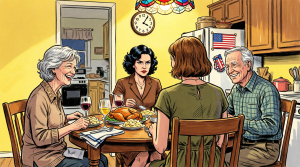
That’s what it felt like the Sunday my sister lifted her wine glass at our parents’ dining table in Tacoma and turned me into the evening’s entertainment.
“Clear as daylight,” Brooke announced, swirling her Cabernet like she was hosting a reality show reunion. Her lipstick was perfect, her nails were fresh, and her smile had that bright influencer polish—beautiful until you looked close enough to see the cruelty in the seams.
Then she tilted her head, all faux curiosity, and asked loudly enough for the whole table to hear, “So where’s your husband and kids, Grace?”
She paused just long enough for my mother to inhale, for my father’s eyes to flick toward me, for the air to tighten.
“Oh,” Brooke added, blinking innocently. “Right. You don’t have any.”
The laughter that followed wasn’t loud. It didn’t need to be. It was the kind that slips under your skin and stays there, humming. My mother laughed like it was harmless teasing. My father chuckled like Brooke had delivered a clever line. Even the clink of forks sounded like applause.
I froze with my fork halfway to my mouth, roasted chicken steam rising between us like a curtain trying to hide what was happening. I tasted nothing. I heard everything.
I’d spent years paying their bills. Years wiring money into their house like IV fluids, keeping the lights on, the mortgage from collapsing, my mother’s prescriptions filled, Brooke’s “emergencies” solved. And in return, at their table, in their warm yellow dining room light, I was still the punchline.
Something inside me didn’t shatter loudly. It snapped clean.
I set my fork down carefully. The tines hit the plate with a small sound that felt like a bell.
Brooke’s eyes glinted, expecting me to laugh along, to shrink, to take my usual place at the edge of the photo.
Instead, I looked straight at her.
And in a voice so calm it startled even me, I said, “Where’s your money, Brooke?”
Her smile faltered. My mother’s laugh died in her throat.
“Oh,” I continued, the words smooth as glass. “Right. I’ve been supporting you. Until today.”
The room went silent so abruptly it felt like someone had yanked the power cord out of the wall. My mother’s hand froze midair. My father’s posture stiffened like he’d been caught doing something he couldn’t explain. Brooke blinked like her brain couldn’t process the idea that the quiet daughter had just spoken in a language she recognized.
That silence didn’t end the night.
It started everything that came after.
My name is Grace Whitaker. I’m thirty-two. I live in Seattle’s Capitol Hill, in a clean apartment that smells like lemon cleaner and coffee and the faint perfume of a life I’m always too tired to fully enjoy. I’m a UX researcher, which means I spend my days studying how people behave when they think no one is watching—what they click, what they ignore, what they choose when they’re afraid.
If you asked strangers what my life looks like, they’d say: stable job, good salary, quiet mornings, a woman who has it together.
What they wouldn’t see is where half my paycheck goes.
It disappears into the same black hole it has vanished into for years: my family.
My mother, Linda, used to be a nurse until heart surgery pushed her into early retirement. My father, Thomas, taught economics back when he still believed in systems and fairness. Then he slid into “consulting,” which is a polite word for waiting for calls that never come while telling everyone he’s on the verge of something big.
And Brooke—four years younger than me, bright and charming and endlessly adored—calls herself a fashion influencer. Which is true, I guess, if the thing she influences most is my bank balance.
Rent. Credit cards. “Car repairs.” “Just one more month.” “A brand didn’t pay me on time.” Her messages always started with the same sugar-coated hook.
Hey sis. Can you help me just this once?
I used to tell myself this is what good daughters do. They keep the family upright. They don’t let a house fall into foreclosure. They don’t let their parents drown. They don’t let their younger sister learn the hard way, because isn’t love supposed to make things easier?
What I didn’t understand—what I refused to understand—was that my family didn’t see my help as love.
They saw it as my role.
Every Sunday, I drove down to Tacoma, an hour south if traffic behaved, longer if the rain turned drivers into idiots, which it often did. I’d leave Seattle’s skyline—glass and gray and ambition—and head toward my childhood street where the porch light still flickered and the paint still peeled along the window frames.
Inside, the house smelled the same: coffee and old wood polish and a faint medicine-cabinet sharpness that made my chest tighten every time.
The walls were covered in photos. Brooke in a white dress at her high school pageant, smiling like she’d been born for spotlight. My father shaking hands with some important-looking man, both of them grinning like money had just made a promise. My mother in a hospital uniform, proud and exhausted.
There wasn’t a single photo of me alone.
In the family pictures I existed like background furniture—standing at the edge, half-cropped, the reliable one who showed up late because she had to finish work first. The one holding a casserole dish or a stack of plates. The one smiling politely like she didn’t notice.
I never complained. I brought wine. I helped clean up. I asked about their week.
They talked about Brooke’s latest partnership. They talked about my father’s “potential client.” They talked about the cost of prescriptions. They talked about how hard things were.
And then, inevitably, my mother would glance at my face with that practiced softness and say, “Sweetheart… we’re just a little short this month.”
My father would add, “Just until the next check comes in.”
Brooke would sit on her phone, scrolling, pretending not to listen while she waited for the money to arrive like room service.
Every time, I paid.
Some nights on the drive back to Seattle, I told myself: Families are messy. Families are imperfect. They need each other. That’s normal.
Other nights I gripped the steering wheel so hard my knuckles ached, and the truth rose in my throat like bitter coffee:
It wasn’t love that kept me paying.
It was guilt—the kind they raised me on.
That’s why I didn’t see last Sunday coming. I expected the usual: tension hidden under polite smiles, small talk over mashed potatoes, Brooke’s little digs, my mother smoothing everything over like she could press a warm hand to the cracks and make them disappear.
But that night, the air felt different—thick with something sharp, waiting. The kind of tension that makes the silverware sound too loud.
The table looked the same. Roast chicken in the center. Basket of rolls. Wine glasses catching the amber light. But warmth felt wrong—stretched thin, like a smile held too long.
My mother talked about Brooke’s latest fashion event, how she’d been invited to a designer party in downtown Seattle. My father added something about “great exposure” and how proud we should be.
I smiled and said the right words because I’d practiced that smile for years.
But inside my chest, something tightened.
Exposure didn’t pay rent.
Pride didn’t erase the thousands I’d wired to keep Brooke’s credit score alive.
Brooke leaned back in her chair, scrolling her phone like the rest of us were background noise to her main character life. Then she laughed—sharp, dismissive—and pierced the little bubble of politeness we’d been pretending was family.
“You know, Grace,” she said, “you should come to one of those events. Maybe you’d finally meet someone.”
She looked up with that grin that never reached her eyes.
“Where’s your husband and kids anyway?” she asked again, louder, like she wanted the words to hit the walls and bounce back.
“Oh, right,” she said. “You don’t have any.”
For a heartbeat, no one moved.
Then my mother laughed. Soft and high-pitched. The laugh she used to smooth things over.
But this time it carried something else.
Agreement.
My father chuckled too, shaking his head like Brooke was a naughty puppy doing a trick.
“Don’t tease your sister,” he said lightly.
But there was a smirk tugging at the corner of his mouth.
I felt my world narrow into tiny sharp details: roasted garlic, ticking wall clock, the clink of silverware against ceramic.
I’d worked holidays. Skipped vacations. Paid their debts. Carried their stress like a second job.
And this was what they saw when they looked at me: not a daughter, not a woman, not a person.
Someone incomplete.
A woman defined by what she didn’t have.
Brooke swirled her wine, her eyes glittering. “I mean, you’re doing fine, right? That tech job of yours. What is it you do again—screens and surveys?”
She tilted her head with a sugary cruelty that made my stomach turn. “I just think you’d be happier if you had a life outside spreadsheets.”
The heat rose from my neck to my ears. My hand tightened around my spoon.
For years, I’d let it slide. The jokes. The digs. The quiet expectations. Because I told myself they didn’t mean it. Or because I was afraid of what would happen if I stopped being useful.
But something broke in that moment—something small, and irreversible.
That’s when I set my spoon down and asked Brooke where her money was.
That’s when I said I was done.
And that’s when the house—my childhood house, the one I’d saved like a fool—went so quiet it felt like it was holding its breath.
Brooke blinked, stunned, like she’d never imagined I could speak back.
“Excuse me?” she said, voice brittle.
“You heard me,” I replied. “I’m done.”
For the first time in years, no one interrupted me. The only sound was the clock ticking on the wall, and my own pulse thudding slow and steady like a drum.
When I drove back to Seattle that night, the silence in my car felt heavier than their stares.
The road stretched ahead in wet black ribbons, headlights reflecting off puddles like broken glass. My reflection in the window looked unfamiliar—calm on the surface, eyes too clear.
I didn’t cry. I didn’t replay their laughter.
I thought about every transfer, every bill, every sacrifice that had built their comfort while shrinking mine.
By the time I pulled into my Capitol Hill parking spot, I knew I couldn’t go back to pretending.
Inside my apartment, I kicked off my shoes and went straight to my desk.
There, in the corner, was the stack of envelopes and receipts I’d never had the courage to total. I’d always told myself it was better not to know. Better to keep it vague. Better to keep hope alive that it wasn’t that bad.
That night, I wanted the truth to hurt me into clarity.
I opened my laptop and pulled up my bank account.
Line after line. Year after year.
Money for Brooke’s tuition. Money for my father’s mortgage. Money for my mother’s medications. Money for “emergencies.” Money for “just one more month.”
Over $80,000 in seven years.
My chest tightened like someone had cinched a belt around my ribs.
I worked in fintech—building tools to help people manage money—while my own finances had been bleeding out quietly, obediently, for the benefit of people who laughed at me over chicken and mashed potatoes.
I stared at the recurring transfer I’d set up for my parents.
The screen asked, politely, like it didn’t understand it was holding my life in its hands:
Are you sure you want to cancel this transfer?
I clicked Yes.
One click.
But it felt like cutting a cord that had been wrapped around my throat for years.
I leaned back and exhaled. For the first time in forever, the breath felt like it belonged to me.
The next morning, my phone started buzzing before I’d even finished coffee.
Mom first: Sweetheart, did something happen? The mortgage payment didn’t go through.
Then Dad: You forgot the house transfer.
Then Brooke, casual as always: Hey, can you Venmo me? Rent’s due.
I read every message. Every guilt-laced word. Every assumption that I would fix it.
Then I set my phone face down on the counter and let it vibrate itself tired.
By evening there were voicemails.
Mom’s voice trembling. Dad’s voice angry. Brooke’s voice half accusing, half begging.
By the end of the week, the calls turned desperate. They stopped pretending this was confusion and started calling it betrayal.
You can’t do this to your family.
You owe us after all we’ve done.
You’re being dramatic.
I didn’t respond.
Instead, I started saving everything.
The messages. The bank logs. The receipts.
Not out of spite—out of instinct. A quiet voice in my head whispered that people who treat you like a wallet don’t accept “no” like normal people do. They look for ways around it. They look for loopholes.
Then the text came that confirmed my instinct.
Come home Sunday. We need to talk.
No greeting. No question.
Just an order.
I stared at the glowing screen until it dimmed. My pulse slowed instead of speeding up.
If this was a war they wanted, I was done pretending I didn’t know how to fight.
Fine, I whispered to myself.
Let’s talk.
Sunday came gray and cold, classic Washington weather that makes everything look honest because nothing is bright enough to hide in. The drive down to Tacoma felt different this time.
No guilt.
No rehearsed polite answers.
Just a steady, deliberate calm.
I parked in front of the house I’d spent years saving from foreclosure. The porch light still flickered. The paint still peeled. The curtains still hung in the windows like tired eyelids.
Nothing had changed.
And yet, everything had.
When I stepped inside, the air hit me—coffee, tension, something metallic beneath it, like fear hiding under a smile.
My mother was setting the table, moving too briskly, not meeting my eyes.
My father sat at the head of the table like a judge, hands clasped.
Brooke leaned against the counter scrolling her phone, pretending not to care.
“Grace,” my mother said without looking up, voice clipped. “We can’t live like this.”
I hung my coat over the chair slowly. “I know,” I said. “I’ve known for seven years.”
My father’s tone was sharp. “Don’t start. This family depends on you. You’ve always helped. Why stop now?”
I met his eyes. “Because it’s not help if it’s expected. That’s obligation.”
My mother dropped the napkin she was folding like the word had slapped her. “You’re being cruel.”
“No,” I said quietly. “I’m being honest.”
Brooke snorted without looking up. “Wow. Someone found her backbone. Congrats, sis.”
I turned toward her, and the calm in me held steady.
“You mock me for not having a husband or kids,” I said, “but you’ve lived off me like I’m your second parent.”
Brooke’s head jerked up. “Excuse me?”
My mother jumped in, flustered. “Enough, both of you. Brooke—”
But Brooke was already sharpening her expression into something vicious. “You can’t expect me to be as… responsible as you,” she said, with a smirk. “Some of us have lives.”
My laugh came out dry. “That’s exactly the problem. You never expected her to be.”
My father slammed his hand on the table. The sound cracked through the room like ice breaking.
“Watch your tone,” he snapped. “We’re your parents. Show some respect.”
I didn’t move. I didn’t flinch. “Respect is earned,” I said. “Not demanded.”
For a moment, the room held its breath again.
Then Brooke stepped forward, voice dripping venom. “You think you’re so much better because you make a little money. Please. Without us, you’d have no one.”
I took a breath. Slow. Controlled.
“That’s the difference,” I said. “You need people to define you. I don’t.”
Her face twisted. “You’re pathetic. You’ll die alone with your spreadsheets.”
I smiled faintly, because for the first time her cruelty couldn’t hook into me. “Maybe. But at least I’ll be debt-free.”
My mother gasped like I’d cursed. My father muttered something under his breath.
Brooke stormed toward me, her voice rising. “You selfish—”
I reached into my bag and pulled out the thick folder.
The sound of it hitting the table was so solid it cut her sentence in half.
“What’s that?” my father demanded, eyes narrowing.
“Records,” I said. “Every payment I’ve made for this family since I started working. Over eighty-four thousand dollars.”
My mother’s face tightened.
I flipped the folder open and slid the pages across the table like evidence in a courtroom: dates, amounts, account notes, screenshots.
Tuition. Mortgage. Credit cards. Repairs. Furniture. Medications. Even the “new couch” my father was sitting on like a king.
Brooke rolled her eyes, but her fingers twitched. “You’re keeping score now?”
“No,” I said evenly. “I’m keeping proof.”
My mother’s voice shook. “Grace… that’s not necessary.”
“It is,” I said, and my voice sharpened, because we were past polite now. “Because what happened after last Sunday wasn’t just a misunderstanding.”
My father frowned. “What are you talking about?”
I slid one more sheet toward him.
A printed notice from a lender. A document with a signature that looked like mine—almost.
But it wasn’t mine.
His eyes dropped to the page.
The color drained from his face so fast it was like watching someone’s mask fall off in real time.
“This,” I said quietly, “is the home equity loan you took out using my name.”
My mother’s hand flew to her chest. Brooke froze, eyes darting between us like a trapped animal.
My father’s mouth opened. Closed. Opened again.
“That’s ridiculous,” he said, but his voice had no force behind it.
“Really?” I asked. “Because the bank disagrees.”
I placed another document on top—an official-looking stamped page from the lender’s fraud department confirming an investigation was underway.
Forgery. Identity misuse. Financial fraud. Call it whatever you want. The bottom line was simple:
They crossed a line no family ever should.
Brooke whispered, “You called the bank.”
“I didn’t just call,” I said. “I hired a lawyer.”
My mother’s face twisted like she’d tasted betrayal. “You brought in an outsider? Against your own family?”
I looked at her steadily. “You stopped being ‘family’ when you used me like a wallet.”
My father leaned forward, voice low. “You think you can threaten us?”
I didn’t blink. “Not a threat,” I said. “A timeline.”
I set my palms on the table, leaning in just enough to make sure they understood I wasn’t the same person who’d driven down every Sunday with wine and guilt.
“You have thirty days to remove my name from every account and reverse every unauthorized obligation,” I said. “If you don’t, my lawyer files.”
The room went dead silent.
Even Brooke couldn’t find a joke fast enough.
My mother’s tears began then—soft and practiced at first, like she was reaching for the script that had always worked.
“Sweetheart… we only did it to protect the house,” she whispered. “You know your father’s been struggling…”
I watched her carefully. The tears didn’t move me the way they used to. Not because I’d become heartless. Because I’d finally become awake.
“You thought I’d clean it up again,” I said. “You didn’t think. You counted.”
My father’s face hardened into anger, but it looked weaker now, like a suit that didn’t fit.
“We’re your parents,” he snapped.
“And I was your insurance policy,” I replied. “Not anymore.”
Brooke sank into a chair, eyes glassy, voice small for the first time. “You’re ruining us.”
I gathered the folder back into my arms.
“No,” I said. “I’m saving myself.”
As I turned toward the door, my mother’s voice cracked behind me. “Grace, please. We can fix this together.”
I paused at the doorway and looked back at the dining room—the same room where they’d laughed at me like I was disposable.
“I spent years fixing things you broke,” I said quietly. “This time, you fix it yourselves.”
Outside, the sky was the color of steel. The cold air bit my cheeks clean. Through the window, I could still see them—Mom crying, Dad pacing, Brooke staring blankly at the table like she’d finally realized the money had always had a face.
For once, I didn’t feel guilty.
I felt free.
And then—because life loves to prove a point—two weeks later my lawyer called with a voice that made my stomach drop in a different way.
“Grace,” she said, “the bank confirmed the signature isn’t yours. Your liability is being cleared.”
My knees went weak. Years of pressure dissolved in one breath.
“So… it’s over?” I asked, barely able to get the words out.
“Legally,” she said, “yes.”
Then her voice softened.
“Emotionally… that’s up to you.”
That night I stood by my apartment window in Seattle, watching city lights shimmer on wet streets, thinking about everything I’d poured into people who still found ways to humiliate me.
I poured a glass of wine—not to celebrate them, not to mourn them—just to mark the moment I chose myself.
But the story didn’t end with a phone call and a cleared liability.
Because the kind of family that will sign your name without permission doesn’t stop when the bank says no.
They get creative.
And the next thing they did wasn’t just desperate.
It was personal.
The Tacoma house showed up in my feed the way bad news always does now—quietly, between things that used to matter.
A sponsored post for ergonomic desk chairs. A friend’s engagement photos in Pike Place Market. A weather alert about heavy rain moving across Puget Sound.
Then: a real estate listing.
“Charming family home in a quiet neighborhood,” the caption said, with a bright, hopeful font that made me want to laugh. The photos were too cheerful, too wide-angle. The peeling porch looked like “character.” The flickering light looked like “ambience.” The dining room—our dining room—looked staged, emptied of the tension that had lived there for years.
My thumb hovered over the screen.
I wasn’t angry. Not in the hot way. It was colder than that. I felt the inevitability of gravity.
When you build a life on someone else’s sacrifices, it always collapses eventually. Not with fireworks. With paperwork.
An hour later, my mother’s message arrived.
One last dinner before we leave the house. Please come.
The word “please” sat there like a peace offering, like she hadn’t spent seven years teaching me that “please” meant “do it or you’ll feel guilty forever.”
I stared at the text until the screen dimmed. I told myself I didn’t need to go. I told myself closure wasn’t something you got from people who treated you like a resource. I told myself Seattle was an hour north for a reason.
And still—some old version of me, the reliable one in the half-cropped photos—reached for her keys.
I hated that part of myself. I also understood her. She wasn’t weak. She was trained.
The drive down felt like passing through layers of memory. I-5 slick with rain, gray sky pressed low. Trucks throwing mist like smoke. Exit signs glowing green—Federal Way, Fife, Tacoma—like a countdown to a place I’d outgrown but couldn’t fully leave.
When I pulled up to the house, the first thing I noticed was how bare it looked.
No car in the driveway. No porch chair. No seasonal wreath. The windows stared back at me like blank eyes. Even the porch light had stopped pretending; it didn’t flicker anymore. It just didn’t turn on.
Inside, the smell was wrong.
No roast chicken. No warm butter. No coffee.
Just dust. Cardboard. The faint sourness of stress.
Boxes were stacked in the hallway, labeled in my mother’s neat handwriting: KITCHEN, LINENS, DAD’S BOOKS. The living room was stripped, the walls pale where frames used to hang. The spots where Brooke’s pageant photo and my father’s handshake photo had been were clean rectangles, as if the house itself had been editing history.
My mother appeared from the kitchen, wiping her hands on a towel that looked too new, too unused.
“Grace,” she said softly, and her eyes darted over my face like she was checking whether I’d brought money in my purse instead of just myself.
My father stood near the dining room doorway, shoulders hunched. He looked older than I remembered from two weeks ago. Not older in years—older in certainty. Like someone had finally realized the world wouldn’t bend for him just because he demanded it.
Brooke was at the counter with her phone face down for once. That alone made my stomach tighten. Brooke never put her phone down unless she was planning something.
“Hi,” I said, and my voice sounded too calm in the empty house. Like a stranger testing acoustics.
Dinner was… minimal. Store-bought rotisserie chicken in a plastic container. Bagged salad. Rolls that tasted like cardboard. My mother set it out as if she wanted the scene to look familiar, but the room refused. The table felt too big without the usual clutter of denial.
We ate in silence for the first ten minutes.
Not peaceful silence. Not thoughtful silence.
The kind of silence that’s waiting for someone to speak first so it knows where to strike.
My mother cleared her throat. “It’s been… hard,” she said, voice trembling on cue. “The bank, the calls… your father’s been under so much pressure.”
I kept chewing. I didn’t respond. I wasn’t going to help her build the bridge back to her favorite story: we’re victims, Grace saves us, everything goes back to normal.
My father set down his fork with a clink that felt intentional. “We didn’t raise you to abandon your family,” he said, and there it was—his version of “hello.”
I looked at him steadily. “You didn’t raise me,” I said. “You used me.”
My mother’s eyes flashed with pain. Real or performed, I couldn’t tell anymore. “Grace,” she whispered, like my name was a warning.
Brooke laughed softly, one quick breath of amusement, like she’d been bored waiting for the tension to start. “Wow,” she said. “Still dramatic.”
I swallowed. Set my napkin down. “Why am I here?” I asked, because I wasn’t going to dance around it.
My father exchanged a glance with my mother that was too practiced. My stomach tightened further.
My mother reached under the table and pulled out an envelope.
Thick. White. Official-looking.
She slid it toward me like a gift.
“We just need you to sign something,” she said quickly, like speed could make it harmless. “It’s… paperwork. For the sale. Just to make everything smooth.”
I didn’t touch it. I didn’t even look down at it yet.
“Why would I need to sign anything?” I asked.
My father’s jaw tightened. “Because your name is on things,” he said, like it was my fault. “We’re trying to fix it.”
“You mean you’re trying to make sure the sale goes through,” I said.
My mother’s smile flickered. “We just want to move forward.”
The words sounded like a slogan. Like something she’d rehearsed in the mirror.
Brooke leaned her elbows on the table, suddenly attentive. “Come on, Grace,” she said, voice coated in fake sweetness. “Be helpful one last time. For old times’ sake.”
Old times. Like my exhaustion was nostalgia.
I finally looked down at the envelope.
At the top of the first page: a title in bold.
Authorization and Release.
My eyes moved lower, scanning fast.
Power of attorney language. Temporary, they’d say. Limited, they’d insist. Just to handle the house, they’d promise.
But it wasn’t just the house.
It referenced accounts. Obligations. Financial authority. The kind of broad, slippery wording that could swallow a person whole.
My pulse stayed steady only because I’d been here before.
I looked up. “No.”
The word dropped into the room like a stone.
My mother’s expression cracked. “Grace, please—”
“No,” I repeated.
My father’s voice sharpened. “You’re being unreasonable.”
“Unreasonable,” I echoed, smiling faintly. “You forged my name on a loan. You emptied your home and put it online like it’s a fresh start. And now you want me to sign something that gives you legal authority over me.”
My mother’s eyes filled with tears. “We would never—”
“Stop,” I said quietly, and the single syllable cut through her performance like a blade.
Brooke’s chair scraped back slightly. “You always think everyone’s out to get you,” she snapped. “You’re not special.”
I leaned forward just enough to make sure they heard me.
“I’m not paranoid,” I said. “I’m educated.”
My father’s face reddened. “After everything we’ve done for you—”
I laughed once, short and humorless. “What exactly did you do for me? Because I have receipts, and none of them show you supporting me.”
Brooke’s lips curled. “You’re really going to keep throwing money in our faces?”
“I’m going to keep telling the truth,” I said. “Because the truth is the only thing that stops you from rewriting reality.”
My mother reached for my hand. I pulled mine back before she could touch it.
Her eyes narrowed for a split second—anger slipping through the “sad mom” mask—then she softened again.
“Sweetheart,” she pleaded, “if the house sale doesn’t go through, we’ll have nowhere to go.”
I held her gaze. “Then you should have thought about that before you signed my name.”
My father stood up abruptly, pushing his chair back hard enough to jolt the table. “So that’s it?” he snapped. “You’re going to watch us lose everything?”
I stood too, slowly. “I’m going to watch you live with your choices,” I said.
Brooke scoffed. “You’re acting like you’re some hero.”
“No,” I replied. “I’m acting like someone who finally learned what you are.”
And that’s when the night crossed from tense into dangerous—not physically, not with drama you’d see in a movie, but with something colder: strategy.
My father’s voice dropped. “You should be careful,” he said. “You think you’re safe up there in Seattle, acting all high and mighty. You forget who knows you.”
There it was. The threat hidden in “family.”
My mother dabbed at her eyes. “We don’t want this to get ugly,” she whispered.
Brooke’s smile returned, bright and mean. “Yeah,” she said. “It would be a shame if people started hearing things.”
My stomach didn’t drop. It settled. Heavy and clear.
“Things like what?” I asked.
Brooke tilted her head, pretending innocence. “Oh, you know,” she said lightly. “That you’re unstable. That you’ve been stressed. That you’re… not doing well.”
My father sat back down slowly, like he was taking his position at the head of the table again. “You work in a field where reputation matters,” he said, voice calmer now. “It would be unfortunate if your employer had concerns.”
My pulse stayed steady, but my hands went cold.
They were going to smear me.
Not because they believed it. Because it worked. Because people love an explanation that makes someone else the problem.
My mother’s voice softened. “We just want you to cooperate. Sign, and we can all move on.”
I looked at the envelope again, then back at them.
“You’re trying to scare me into signing away control,” I said quietly.
Brooke shrugged. “Call it whatever you want.”
I picked up my bag. “I’m leaving.”
My mother’s voice rose, panic sharpening it. “Grace—don’t do this.”
“I’m not doing anything,” I said, stepping toward the doorway. “I’m refusing.”
As I walked down the hallway, I could feel their eyes on my back like hands. I paused in the living room where the walls were bare and the floor was scuffed where furniture used to be.
I turned.
“Listen carefully,” I said, because I wanted the words to be clean and unforgettable. “If any of you contacts my workplace, my landlord, my friends, or anyone connected to my life with lies, my lawyer won’t send another warning. She’ll file everything.”
My father’s mouth tightened. “You can’t prove what we say.”
I smiled faintly. “Try me.”
I walked out into the cold and didn’t look back.
The rain had stopped, but the air was sharp, the kind that makes you feel awake whether you want to or not. I sat in my car for a moment with both hands on the wheel, breathing, letting the adrenaline drain.
Then my phone buzzed.
A notification from LinkedIn.
Someone had viewed my profile.
Brooke.
Of course.
I drove back to Seattle with my jaw clenched and my mind moving fast. By the time I reached Capitol Hill, I’d already drafted an email to my lawyer, detailing the envelope, the pressure, the threat.
I told myself it was enough.
I told myself boundaries were strong when they were clear.
I underestimated how far people will go when their comfort is threatened.
Two days later, my manager messaged me: “Can you hop on a quick call?”
The words were polite. The timing wasn’t.
I joined the video call and saw HR already there, faces carefully neutral.
My manager’s eyes looked apologetic in the way people’s eyes do when they’re about to ask you to prove you’re not something you never were.
“Grace,” HR began gently, “we received a message expressing concern about your wellbeing.”
My stomach went cold.
“A message from who?” I asked, though I already knew.
HR hesitated. “A family member,” she said. “They didn’t provide a lot of specifics, but they implied you’ve been under significant stress and may be… struggling.”
Brooke didn’t have to say much. She just had to plant the seed.
I kept my face calm, but my voice sharpened. “This is retaliation,” I said. “Because I stopped financially supporting them.”
My manager leaned forward. “We believe you,” she said quickly, but the addition of “believe” was its own crack in the foundation. “We just have to follow protocol. Can you… provide something that confirms you’re okay? Like a note from your primary care physician?”
There it was.
The modern version of being put on trial—quiet, corporate, framed as “care.”
I didn’t argue. I didn’t plead. I didn’t cry.
“I can,” I said. “And I will.”
The call ended with careful smiles. I stared at my laptop screen afterward, hands resting on the desk, feeling the old rage rise.
Not hot this time.
Icy.
Because this wasn’t just about money anymore.
They were trying to control the story of me.
That afternoon, another notification arrived.
A credit monitoring alert.
New inquiry.
My breath caught.
I opened it and saw the lender name.
An auto loan company.
My heart thudded once, hard.
I called them immediately and gave my information. The representative’s voice was bright and bored, the way people sound when they don’t realize they’re holding a grenade.
“Yes,” she said after a pause, “we received an application in your name.”
“I did not apply,” I said, voice flat.
More typing. “It lists an address in Tacoma,” she said.
Of course it did.
I hung up and called my lawyer.
This time her voice wasn’t gentle. It was steel.
“They’re escalating,” she said. “We’re going to respond accordingly.”
By evening, my inbox held copies of cease-and-desist letters drafted with clean, terrifying language. Notifications were prepared for institutions. Documentation packets were assembled—screenshots, timestamps, the LinkedIn view, the HR call summary I’d written immediately after it happened.
Because that’s the difference between who I used to be and who I was becoming:
I didn’t just react anymore.
I documented.
Three days later, Brooke posted a story—carefully vague, dripping with implication.
“Some people forget where they come from,” she wrote over a selfie, eyes shiny like she’d practiced in the mirror. “Pray for my family. Hard times.”
She didn’t name me. She didn’t need to. Our mutuals knew. Her followers didn’t have to know the truth; they just had to feel the vibe.
My mother started calling again—soft at first, then frantic.
“Grace, why are you doing this to us?” she sobbed. “We’re being attacked. People are judging us. Brooke’s partnerships—”
I laughed once, bitter. “You mean consequences?”
My father left a voicemail that was pure rage disguised as righteousness.
“You’re destroying your own family,” he said. “One day you’ll regret this when you have no one.”
He didn’t say, We’re sorry.
He didn’t say, We crossed a line.
He said what they always say when the person they’ve used finally refuses:
You’re the problem.
I forwarded everything to my lawyer and then did something I’d never done in my life.
I told the truth—quietly, strategically, to the people who mattered.
I emailed HR with a short, factual statement: “A family member is engaging in a harassment campaign after I refused further financial support. My legal counsel is involved. I can provide documentation if needed.”
I didn’t write a novel. I didn’t sound emotional. I made it boring.
Because boring is credible.
Then I went to my doctor, got the note, and handed it over without ceremony.
My manager called me afterward. “I’m sorry,” she said, voice tight with anger on my behalf. “This shouldn’t have happened.”
I thanked her. But inside, I noted the lesson: even good workplaces can be shaken by a well-placed lie.
That night, my lawyer called.
“Grace,” she said, “your father’s lender is cooperating. The attempt on the auto loan is flagged. We have enough now to file for a protective order and pursue civil action.”
A protective order.
The phrase made my throat tighten because it sounded too dramatic for my life—like something that belonged to other people.
But then I remembered the envelope on the table. The threat in my father’s voice. Brooke’s smile when she said it would be a shame if people started hearing things.
This was my life now, whether I wanted it or not.
“Do it,” I said.
The next week moved fast in that surreal way legal things do—emails, forms, signatures, meetings that feel like they happen behind glass. My lawyer filed. Notices went out. Financial institutions flagged my name. My credit was locked down so tight it felt like a vault.
And then—because the universe has a twisted sense of timing—I got a message from my mother.
One line.
We’re sorry.
I stared at it for a long time.
Not because it moved me.
Because I recognized it for what it was.
Not remorse.
A reset button.
The kind you press when the old method stops working.
I didn’t reply.
Two days later, the house in Tacoma sold.
I saw it online. “Pending” turned into “Sold” in a neat little update, like a game status.
That night, Brooke posted a photo of herself in front of a “new beginnings” sign at some trendy café, holding a latte and smiling like her life was inspiring instead of imploding.
My mother didn’t post. My father didn’t either.
They went quiet.
And for a moment—just a moment—I wondered if it was finally over.
Then a plain envelope arrived in my Seattle mailbox with no return address.
Inside was a photocopy of a childhood photo.
The four of us. My mother smiling. My father’s arm around her. Brooke in the center. And me—at the edge, half-cropped, holding a plate.
On the back, in Brooke’s handwriting, one sentence:
You’ll always be the one left out.
My hands went cold. Not because it scared me.
Because it revealed the truth underneath everything.
This was never about money.
Money was just the leash.
This was about power. About keeping me in my place. About punishing me for stepping out of the role they assigned me.
I stared at the photo, then set it down on my kitchen counter like evidence.
And I felt something in me settle into the final shape of resolve.
If they wanted to keep playing games, fine.
But I was done being a character in Brooke’s story.
I was going to become the author of my own.
And the next move I made would make it impossible for them to ever use my name again—on a loan, in a rumor, or at a dinner table.