My parents kicked me out at 18 with a backpack. At 27, I walked into my grandfather’s will reading—and watched them smile when the lawyer said, “$3.5 million… to Oliver.” Mom chirped, “We’ll manage it for you.” I said nothing. A week later, the bank called: someone impersonated my “representative.” Then they filed to declare me incompetent. In court, my lawyer opened Grandpa’s notebook—and my mother went white when the judge read the next line…
My name is Oliver. I’m 27 years old. And if you had told me 10 years ago that I’d one day inherit my grandfather’s entire estate worth a jaw-dropping $3.5 million, I would have laughed in disbelief. Back then, I didn’t even know if I’d make it through the week, let alone to a point in life where I’d be sitting in a lawyer’s office with my aranged parents staring at me like vultures circling their prey. The irony of it all is that these are the same parents who cut me off at 18, threw me out with nothing but a backpack, and told me I wasn’t their responsibility anymore. Yet, here we are with them suddenly reappearing at the will reading as though the past decade hadn’t happened.
Growing up, my family was complicated. My mom and dad weren’t poor by any means. We lived in a nice enough suburban home. My dad worked as a regional manager for a logistics company, and my mom was a part-time teacher who liked to act like she ran the entire neighborhood. But they had one fatal flaw. Appearances were everything. My older sister, Claire, was the golden child. Straight ace student, cheerleader, the one who never caused them trouble. She could do no wrong. I, on the other hand, was painted as the disappointment. I wasn’t rebellious. Not really. I just didn’t fit their mold. I liked art more than football, books more than cars, and I had this stubborn streak that meant I questioned things they expected me to just accept. That to them was unforgivable.
The cracks really started showing when I was a teenager. Anytime money was involved, it became a weapon. Clare got a brand new car for her 17th birthday while I was told to be grateful for handme-downs. She got her college tuition fully covered while I was told if I wanted to go, I’d better figure it out myself. And when I tried to push back, asking why things weren’t equal, I got lectures about being a man and earning my place. My mom would roll her eyes and say things like, “Over, you’ve always been too sensitive. You expect the world to hand you things.” My dad would mutter about how I’d never make it without them.
I’ll never forget one night at dinner when my father leaned across the table, looked me dead in the eye, and said, “If you’re still under our roof by 18, you’re a failure.” I laughed then because what else could I do? But inside I was crushed. When my 18th birthday came, they didn’t just kick me out, they staged it like a performance. They sat me down, told me they were cutting me off financially, and said, “It’s time for you to learn the value of hard work. They gave me no money, no support, not even a safety net.” I walked out of that house with a backpack, two changes of clothes, and a part-time job that barely paid enough for groceries. That night, I slept in the backseat of my car. Meanwhile, Clare was posting Instagram photos from her sorority house, smiling with a shiny new MacBook and a credit card from dad.
The only person who didn’t abandon me was my grandfather. He was my dad’s father, and he’d always been different from the rest of them. Where my parents saw weakness, he saw potential. Where they mocked me for being quiet, he said, “Ol, that’s because you think before you speak.” He didn’t care that I wasn’t the athlete or the golden child. He saw me for who I was. He’d invite me over for weekends, feed me, let me crash on his couch when things got bad. I never told him the full extent of what my parents had done. But he wasn’t stupid. He saw the tension. He saw how I flinched when my dad’s name came up. And over the years, he became more of a father to me than my actual dad ever was.
Fast forward nearly a decade. I’d built a modest life for myself. It wasn’t glamorous. I worked long hours, saved where I could, and kept my distance from my family. Clare would occasionally send me smug texts about her vacations or her new house just to remind me I was still beneath her. My parents, silence, unless, of course, they needed something. Then suddenly, I’d get a call with my mom’s syrupy voice: “Oliver, honey, how are you doing?” I knew better than to fall for it. I always kept my answers short. I wasn’t going to be their backup plan.
And then came the phone call I’d both dreaded and expected. My grandfather had passed away. It gutted me. Even though he’d been sick for a while, I’d convinced myself he’d pull through. Losing him felt like losing the only real family I’d ever had. When the lawyer called and told me I was expected at the will reading, I assumed I’d get maybe a watch or a letter, something sentimental. I didn’t think for a second that I’d be the one inheriting everything.
When I walked into that oak panled office, I froze. Sitting there dressed like they were heading to a gala where my parents and Clare. My mom’s smile was wide. My dad’s hand rested smuggly on his knee. And Clare gave me this once over like she was measuring how much I was worth now. I wanted to turn around and leave, but I forced myself into a seat. The air felt thick with her fake sweetness. My mom leaned over and whispered, “Don’t worry, Oliver. We’ll make sure the estate is taken care of properly.” My dad added, “Yeah, of course. We’ll manage it for you.” They were already counting the money in their heads. I could see it in their eyes. They thought I was still that powerless kid they’d kicked to the curb.
But then the lawyer cleared his throat, shuffled the papers, and said the words that made my heart pound. “Per the wishes of the late Mr. Harold Montgomery, his entire estate, valued at approximately $3.5 million, is hereby left to his grandson, Oliver Montgomery.” I swear time stopped. I looked up and for a split second I thought I saw my grandfather’s smirk in my mind like he’d been planning this moment all along. My parents smiles froze in place. Clare’s jaw actually dropped. And then the lawyer turned the page and said, “There are additional stipulations you’ll want to hear,” and that’s where things took a turn none of us were prepared for….
PART 2
PART 3
The courtroom felt colder than it should have been, like the air itself knew something ugly was about to surface. I sat at the defense table, hands steady on the surface, even though ten years of anger and disbelief churned underneath. Across from me, my parents looked composed—too composed. My mother dabbed at invisible tears, playing the part she’d perfected. My father sat upright, confident. Claire wouldn’t meet my eyes. They really believed they had already won.
The accusation hung in the air like smoke: mentally unfit. They’d filed documents, forged authority, even tried to slip into my finances through a “representative” I never appointed. If my lawyer hadn’t caught it early, they might have succeeded. That was the worst part—not just that they tried, but how easily they thought they could erase me again. Reduce me to that eighteen-year-old kid with a backpack and nowhere to go.
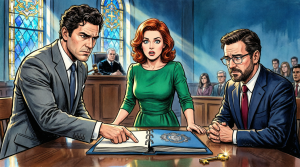
Then my lawyer stood, calm and precise. “Your Honor, we’d like to introduce Exhibit D—Mr. Harold Montgomery’s personal notebook.” A small, worn leather book was placed into the judge’s hands. My mother shifted for the first time. I saw it—the flicker. Recognition. Fear. She knew exactly what that notebook was. She’d seen Grandpa write in it for years. What she didn’t know… was what he had written about them.
The judge adjusted his glasses and read silently for a moment. Then, out loud, he spoke: “If my family ever attempts to control, coerce, or declare Oliver unfit to gain access to my estate, it will serve as proof that they are acting in bad faith. In such a case, I request the court deny them any involvement—and formally investigate their conduct.”
My mother went white. Not pale—white. Like every drop of certainty had drained out of her at once.
But it didn’t stop there. The judge turned another page. “Oliver has already survived without them. He does not need saving. He needs protection—from the very people who failed him.”
The silence that followed wasn’t empty. It was heavy. Crushing. My father’s composure cracked first. His jaw tightened, his fingers curled. Claire looked like she wanted to disappear into the floor. And for the first time in my life, I wasn’t the one shrinking in that room.
The ruling came swiftly after that. Their petition was denied. The court flagged their filings for fraud review. My so-called “incompetence” had just exposed theirs. As the gavel struck, I felt something I hadn’t expected—relief, yes, but also something quieter. Closure. Not because I had beaten them. But because my grandfather had seen me clearly… long before I ever learned to see myself that way.
They tried to approach me outside the courtroom. My mother reached for my arm again, softer this time, her voice trembling. “Oliver, we were just trying to help…”
I stepped back before she could touch me.
“No,” I said, steady and certain. “You were trying to take.”
I walked out of that building alone—just like I had ten years ago.
Only this time, I wasn’t leaving with a backpack.
I was leaving with everything they said I’d never have… and the one thing they could never take from me again—myself.