The first time I saw my husband again, he was carrying a sack of cement across one of my construction sites, and for three full seconds I forgot how to breathe.
The morning had started like any other morning in the life I had spent years building—sharp, scheduled, controlled. My assistant had gone over the agenda in the car, the project manager had called twice before nine, and by the time I stepped out onto the packed dirt at the edge of the site, I was already thinking in numbers. Cost overruns. Delivery delays. Labor coverage. Completion targets. The apartment complex on the east side was one of our largest developments that year, a steel-and-glass statement meant to prove that Whitmore Holdings could keep expanding no matter what the market was doing, no matter what competitors whispered, no matter how many magazines had decided I was too young, too female, or too polished to run a company founded by men who still wore their arrogance like cufflinks.
I was good at my job. Better than most people ever expected me to be.
Business magazines called me precise. Investors called me disciplined. Reporters called me brilliant when they wanted my quote and cold when they didn’t get it. There was a time when those words mattered to me. Then there was marriage. Then there was motherhood. Then there was the night my husband disappeared and left behind papers that claimed he wanted to end our life together.
After that, very little written about me by strangers managed to land where it used to.
The site manager was talking as we walked, his voice half-swallowed by the metallic sounds of the place—scaffolding rattling, engines idling, men shouting measurements to one another over the grind of machinery. The air tasted of dust and steel. My white hard hat felt slightly too tight against my temples. I nodded at the appropriate moments while he explained progress and praised the crew and told me we were two weeks ahead of schedule, which under ordinary circumstances would have pleased me.
But there had been no ordinary circumstances in my life for six months.
Even then, even on a morning like that one, with a dozen concrete problems waiting to be solved and a company large enough to consume thought if I let it, part of my mind was always searching. Every crowd became a scan. Every unfamiliar face made something in me pause. Every man with dark hair and broad shoulders seen from behind made my pulse misfire for one humiliating second before reason reasserted itself.
I had trained myself not to hope and failed at it every day.
We turned past a partially framed wing where workers were unloading materials. Men in reflective vests moved through the haze of dust with practiced rhythm. A pallet jack squealed. Someone dropped a length of pipe, and the sound rang like struck iron.
Then my eyes caught on one figure, and the whole world snapped out of sequence.
He was twenty yards away, maybe less.
A man in worn work pants and a gray shirt darkened by sweat was lifting a heavy bag of cement onto his shoulder. His hair was longer than I remembered, curling slightly at the nape because it needed cutting. There was dust on his arms, dust in the crease of his neck, dust across one cheek. He looked leaner. Harder. As if the months I had lost him had planed something essential from him and left only the part that knew how to endure.
But it was him.
Even at a distance.
Even in dirt.
Even stripped of every context in which I had last known him.
Julian.
My husband, who had vanished in the middle of the night.
My husband, who had left signed divorce papers on our table and taken our daughter.
My husband, whose silence had followed me through six months of waking and sleeping and functioning and breaking in ways nobody else ever saw.
I stopped walking so abruptly that the site manager took two more steps before he realized I wasn’t beside him anymore.
“Miss Whitmore?”
I didn’t answer.
I was already moving.
My heels sank into the dirt, useless, wrong for that ground, but I hardly felt it. I crossed between stacks of lumber, ignored the startled look from a foreman who tried to guide me around an open trench, barely heard the manager calling after me. All I could hear was the blood in my ears and the single impossible truth beating through it.
It’s him. It’s him. It’s him.
Julian adjusted the weight on his shoulder and turned slightly, maybe sensing movement, maybe feeling the stare before he understood where it came from.
Our eyes met.
The bag slipped from his hands and hit the ground with a thud that sent a puff of powder into the air.
For a heartbeat we only stared at each other.
In that heartbeat I saw everything at once—the shape of his face I knew better than my own, the hollowness around his eyes, the shock that went through him like current, the fact that he had recognized me instantly and had not expected to.
Then the six months inside me detonated.
I crossed the last few feet between us, and before thought caught up with pain, my hand rose and struck his face.
The sound cracked across the site louder than it should have.
Nearby workers stopped.
The site manager went silent.
The whole unfinished building seemed to pause around us.
Julian did not flinch away. He did not grab my wrist. He did not even lift a hand to his cheek. He just stood there and looked at me with a face that seemed both older and more familiar than I could bear.
“Why?” I demanded.
My voice shook. My chest felt like glass under pressure.
“Why did you do this?”
No answer.
That silence—after months of silence—poured gasoline on everything.
“You disappeared,” I said, louder now, not caring that everyone was watching. “You took Lily. You left divorce papers on our table like seven years was a contract you could end with a signature. Do you have any idea what you did to me?”
“Clara—”
“No.” I stepped closer. “No. You don’t get to say my name like that. You do not get to vanish for six months and then look at me as if I’m the one who owes you calm.”
His throat moved. He glanced once at the workers around us, then back at me.
“Not here,” he said quietly.
The restraint in him—God, even then, even with dust on his face and humiliation burning through mine, he was still the man who wanted to protect the room from our pain.
“Here,” I said. “You answer me here.”
He held my gaze for a long second.
Then he said the first thing that made my anger falter.
“Your father came to see me the night before I left.”
It was such an absurd sentence, so disconnected from the version of events I had been dragging through my mind for months, that for a second I honestly thought I had misheard him.
“My father?”
Julian nodded once.
“He didn’t come alone.”
The noise of the site fell away, not literally, but in the way the mind edits the world when one sentence has already changed everything.
I looked at him more carefully then. Really looked.
His jaw was tighter than usual. There was a scar near his left temple I didn’t recognize. His hands, always capable, always strong, were no longer just the hands of a man who fixed little things around the house because he liked knowing how things worked. They were cut, roughened, scraped raw in places, the hands of someone who had spent months taking whatever labor kept him hidden and paid.
A terrible unease opened inside me.
“What are you talking about?” I asked.
Julian breathed in slowly, like a man bracing against impact.
“He brought two men with him,” he said. “Big men. Not bodyguards in suits. The kind who don’t wear ties because they want you to know they’re not there to negotiate.”
I stared.
“And he told me,” Julian continued, each word quieter than the last, “that if I didn’t disappear from your life, he would make sure our daughter never saw another birthday.”
The sentence did not land all at once.
Parts of it hit me separately.
Disappear.
Daughter.
Never saw another birthday.
Then the meaning assembled and went through me like ice water.
My mouth opened, but no sound came out.
Julian kept looking at me. Not pleading. Not performing. Just telling me the truth with the exhausted steadiness of someone who had spent too long carrying it alone.
“He called me a stain on the Whitmore name,” he said. “He said I was embarrassing his empire. He said I’d had my little fantasy of belonging to your world and it was over.”
I couldn’t breathe properly.
“No,” I whispered.
He gave the smallest shake of his head, not disagreement, just pain.
“He wanted you to marry his best friend’s son. He said the papers were already prepared. All I had to do was sign them, leave quietly, and never contact you again.”
My father had said those words to me once, in a different form, over dinner with crystal glasses and candlelight.
You still have time to fix this mistake.
At the time, I had thought he was being cruel in the familiar, cold-blooded way powerful men are cruel when they believe their daughters are extensions of corporate strategy. I had thought he was insulting my husband because Julian came from modest beginnings, because he wore simple clothes and fixed his own sink and never once pretended to be dazzled by money. I had not understood that my father’s disapproval had already evolved into planning.
“If I refused,” Julian said, and for the first time his voice broke, “he said Lily would disappear. Not me. Lily.”
I closed my eyes.
The sun was hot on my hard hat. Somewhere to my left, a forklift beeped in reverse. Dust moved in the air between us like smoke.
When I opened my eyes again, he was still there.
Still real.
Still thin.
Still watching my face with the kind of caution people wear when they know the truth might save them or destroy them depending on how it is heard.
“You just left?” I asked.
It came out weak. Not accusation anymore. More like a child asking how the world could possibly be as cruel as it suddenly appeared.
Julian nodded.
“I took Lily to my sister’s that same night. I told her enough to keep her quiet, not enough to put her in danger. Then I signed the papers, left them where you would find them, and disappeared before dawn.”
His eyes were red-rimmed, but he was not crying. Julian had never been a dramatic man. If anything, he felt too deeply and showed too little, which was one of the reasons I had trusted him. He did not manufacture emotion. He lived inside it until there was no room left for performance.
“I thought if I stayed,” he said, “your father would make good on the threat. I thought if I told you, you would confront him, and then he would know I talked. I thought if I vanished and made you hate me, at least you and Lily would still be alive.”
The world shifted then.
Not with sound. Not with motion. Just inside me, all at once, like a building whose load-bearing walls have been quietly moved in the night. Every memory from the past six months began to rearrange itself. My father arriving the morning after with those calm eyes and that impatient sigh. His insistence that I sign. The way he called Julian a beggar with the relaxed certainty of a man who thought contempt itself was argument enough. The way he had watched me disintegrate over weeks and months and never once looked surprised by the depth of it.
He had known.
Of course he had known.
He had orchestrated the wound and then stood at my shoulder offering advice on how to survive it.
I looked at Julian again and suddenly all the anger I had dragged to the construction site curdled into something colder and infinitely more dangerous.
“Where is Lily?” I asked.
His expression changed at once.
“She’s safe.”
“That’s not what I asked.”
“With my sister.”
“Where?”
He hesitated.
“Julian.”
“She’s in Bloomington,” he said softly. “With Eva.”
Relief was so violent it nearly doubled me over.
My daughter was alive.
My daughter was safe.
My daughter had not been gone because her father stopped loving me or because I had failed to keep my family together or because money had finally shown Julian the distance between our worlds. She had been hidden because my father had threatened to kill her.
I pressed both hands against my face.
For one humiliating second I thought I might collapse right there in the mud and dust and half-built luxury I had spent years helping my father sell to people as a future.
Julian took half a step forward.
“Clara—”
I lowered my hands.
“No.”
He stopped.
I inhaled once, hard.
“I need to know everything. Every word. Every detail. What time he came. Which men he brought. What car. What he touched. What he said about Lily. What he said about me.”
The site manager was still standing a cautious distance away, pretending not to hear but obviously hearing every word. Workers had started moving again, though slower now, all of them pretending to focus on concrete and steel while their attention bent toward us.
Julian glanced around.
“There’s a break trailer near the north gate,” he said. “It’s empty this time of day.”
I nodded once.
We went there like strangers.
Not because we were strangers. Because after six months of being broken in different places, we no longer knew what the first movement back toward each other was supposed to look like.
Inside the trailer, it smelled of stale coffee, damp insulation, and men’s lunches left too long in plastic coolers. There were two folding chairs, a narrow table scarred by knives and pens, and a small window looking out toward stacked rebar and open sky.
I closed the door behind us and took off the hard hat.
My hands were shaking now, which annoyed me.
I had spent my whole life learning how not to visibly fracture in rooms built to test me. Boardrooms. Courtrooms. Negotiations. Interviews. Crisis meetings after market crashes. My father’s dining table. I did not shake. I did not lose my voice. I did not cry where anyone could measure the depth of it and use it later.
But there, in that ugly trailer beside one of my own projects, in front of the man I had loved and hated and grieved and found again within the same hour, my hands wouldn’t stop.
Julian noticed.
He always noticed.
Quietly, he took a bottle of water from the table, opened it, and set it near me. Not touching me. Not assuming touch still belonged to us. Just making sure there was water.
That small gesture nearly undid me more than the confession.
I sat down.
“So tell me,” I said.
He did.
He told me my father had arrived at our house a little after ten on the night I’d worked late with investors. He told me the security staff had let him in because of course they had—Whitmore men were never refused at Whitmore gates. He told me the two men with him never sat, never smiled, never removed their coats. He told me my father walked through our living room as though inspecting a hotel suite he regretted financing, glanced at Lily’s toys on the carpet, at our framed photographs, at the hand-painted ornaments Lily and Julian had made together the week before, and then said, “This little experiment has gone on long enough.”
Julian had thought, at first, that the old man had simply come to insult him in private. My father had never openly humiliated him in front of me. That would have risked making me choose sides too early. He preferred the slow poison of implication and contempt by a thousand small cuts.
But that night, according to Julian, subtlety disappeared.
“He sat in your chair,” Julian said. “The one by the fireplace. He crossed one leg over the other and looked at me like he was deciding whether I qualified as furniture.”
I shut my eyes again because I knew the chair. Deep blue upholstery. My favorite place to read on Sunday mornings. The chair Julian had bought me for my thirty-second birthday because he said every woman who built companies deserved one place in the house where the world could not ask her for anything.
“He said you had embarrassed him long enough. That I had embarrassed him. That he was done pretending this marriage was survivable.”
Julian looked down at his hands before continuing.
“I asked him to leave.”
My throat tightened.
He smiled without humor.
“He seemed almost amused by that.”
He told me my father had then placed the divorce papers on our coffee table like a man laying down a menu. No shouting. No dramatic threats. Just precision. Sign. Leave. Never contact Clara again. Never come near the house. Never challenge the narrative. And if you do, the child goes missing first and you follow.
“Those were his words?”
Julian nodded.
“I remember them because he said them so calmly. That’s what made it real.”
I believed him. Not because I wanted to. Because I knew that calm. I knew the cadence my father used when he was most serious, the one that frightened board members and silenced grown men twice his size. He was never loud when he meant harm. Volume was for people who needed witnesses. My father preferred inevitability.
“Why didn’t you call the police?”
Julian’s expression changed at the question. Not defensive. Sad.
“Your father funds half the campaigns in this county, Clara. He golfs with judges. He built half the buildings their offices sit in. If I’d called the police and he’d already decided Lily was leverage, what exactly do you think would have happened next?”
The answer arrived before I could stop it.
Nothing good.
Nothing safe.
Nothing that would have allowed me to sleep if I’d chosen it for the wrong reason.
“I took Lily to Eva’s after midnight,” he said. “I didn’t tell her everything. Just that we needed to disappear for a while and that if anyone from your family asked questions, she knew nothing. I left before dawn. I changed phones twice in the first week. I took day labor jobs, moved from site to site, stayed where cash got me quiet and paperwork didn’t.”
His mouth tightened.
“I came here because I knew your company cycled labor through outside subcontractors. I knew if I kept my head down, no one would look too closely at a dusty face in a hard hat.”
I stared at him.
“All this time you were on one of my sites.”
“Not this one,” he said. “Not until four months ago. Before that I was north. Then two weeks in Joliet. Then here.”
“And you never thought I might come by?”
“I prayed you wouldn’t.”
That answer hurt more than it should have, which was how I knew it was honest.
“Because you didn’t want to see me?”
“No,” he said immediately. “Because I did.”
For a moment neither of us moved.
The trailer seemed too small for the amount of ruined time between us.
“I thought you stopped loving me,” I said finally.
Julian looked at me as if the sentence itself wounded him.
“Clara.”
“I need you to hear it. I need you to know what these six months were. Because if we pretend the intention excuses the damage, then we’re lying again, just in a different direction.” My voice trembled but did not break. “I thought you stopped loving me. I thought our daughter was gone because her father decided I wasn’t worth a conversation. I thought I had married the only man in my world who didn’t measure me in status, and then I woke up one morning with signed papers and an empty house.”
He stood very still.
Then, quietly: “I know.”
“No,” I said. “You know what you chose. That’s different.”
He took that. Didn’t defend himself. Didn’t rush to say he had no choice, even if in some ways he hadn’t. That restraint made me trust him more than any denial would have.
“I’m sorry,” he said. “For all of it. For every hour you thought that. For every hour Lily asked when she could call you and I had to tell her not yet.”
My chest clenched.
“She asked?”
“Every day.”
I turned my face away.
When I looked back, I asked the only question left that mattered before anything else.
“Can I see her?”
Something in him finally softened. Not all the way. The months had carved too much for that. But enough.
“Yes,” he said. “If you still want to.”
I laughed through tears then. One sharp impossible sound.
“If I still want to?”
He bowed his head slightly, ashamed of the sentence the moment it left him.
“I deserve that.”
“Yes,” I said. “You do.”
But I stood up anyway.
“We’re going to Bloomington.”
He stared. “Now?”
“Yes. Right now.”
“Clara, your father—”
“Doesn’t get another hour of my ignorance.”
The drive south felt unreal.
I had my assistant clear my afternoon under the pretense of an investor emergency, then I got into Julian’s truck because he refused to let me summon a company car or driver and I, after one brief glance at the dents in the passenger-side door and the cracked dashboard, understood why. He did not trust anything connected to the Whitmore machine. At that moment, neither did I.
The truck smelled faintly of sawdust, coffee, and worn denim. There was a child’s hair tie in the cup holder. A coloring book on the back seat. The sight of those two things alone made my throat ache.
For the first forty minutes, we hardly spoke.
The city thinned. Concrete widened into road, road into winter fields and bare trees and low gray sky. I watched the landscape unspool while my mind performed violent revisions. Every conversation with my father over the past six months changed shape. Every time he’d told me to be practical. Every time he’d called Julian a weak man. Every time he’d implied I was humiliating myself by continuing to search. He hadn’t merely known Julian hadn’t abandoned us.
He had counted on me suffering in exactly that confusion.
“Does Lily know who I am?” I asked suddenly, the question ridiculous and necessary both.
Julian looked over sharply. “Of course she does.”
“She’s five.”
“She talks about you every day.”
That should have comforted me. Instead it hurt like a rib being set.
“What did you tell her?”
“The truth that a child can carry,” he said after a moment. “That Mommy loved her. That Mommy didn’t leave. That bad grown-up things happened and we had to be careful until we could fix them.”
I looked down at my hands.
“She was angry,” he added. “Sometimes. She thought if she got good enough or quiet enough we’d go home faster.”
My head snapped toward him. “She thought that?”
He nodded, gripping the wheel tighter. “She’s your daughter, Clara. She thinks solutions are earned.”
I had to turn toward the window then because the alternative was breaking apart in the passenger seat.
An hour later, I called my head of legal and told her I needed every gate log, visitor record, and security archive connected to my residence from the six-month period surrounding Julian’s disappearance. I did not explain. She was too competent to ask in the wrong tone. Then I called my chief of operations and instructed him to pause discretionary approval authority on two of my father’s standing development channels pending my review. He sounded startled. I didn’t care. Then I called my father’s office.
His assistant answered.
“Is he available?”
“Your father is in a meeting.”
“Then interrupt it.”
A pause.
“May I say what this is regarding?”
“Yes. Tell him his daughter found her husband.”
The silence on the other end lasted just long enough to tell me that sentence had landed where it needed to.
“He’s unavailable,” the assistant said at last, but her voice had changed. Tighter. Less sure.
“Noted,” I replied, and hung up.
Julian’s sister lived in a white two-story house on a quiet Bloomington street lined with bare maples and identical mailboxes. The winter light had gone watery by the time we pulled up. A bicycle lay on its side in one yard. Someone two doors down had half-removed Christmas decorations, so a string of lights still blinked weakly around a front hedge as if refusing to admit the holiday had already failed.
Julian killed the engine.
Neither of us moved immediately.
“What if she’s angry with me?” I asked.
He turned in his seat, and there it was again—that look that used to anchor me in every room, the one that said he saw through everything I said and still found the fear underneath worth answering gently.
“She’s five,” he said. “She missed her mother.”
Then he added, very quietly, “So did I.”
That was the first time either of us let the sentence stand between us without argument.
Eva opened the door before we even reached it.
She looked like Julian—same dark eyes, same steady face, same tendency to hold herself like someone who did not waste movement on drama. I had always liked her, which made seeing the caution in her expression almost as painful as seeing Julian on the site.
She looked at me once, hard.
Then she opened the door wider and said, “She’s in the den.”
I don’t remember crossing the hall.
I remember the rug.
The smell of cinnamon and crayons.
The low lamp by the couch.
And then Lily.
She was sitting cross-legged on the floor in pink socks and a yellow sweater, building a tower out of wooden blocks. Her hair had grown longer. She had one side tucked behind her ear the way I used to fix it when she fell asleep in the car. For one impossible second she did not look up, and I saw not the child in front of me but all the mornings and baths and storybooks and sticky fingers and sleepy questions I had lost.
Then she lifted her head.
Her eyes found my face.
The block in her hand fell.
“Mommy?”
There are griefs that make no sound. This wasn’t one of them.
I dropped to my knees.
She hit me like a thrown little body, arms hard around my neck, sobbing before I could even gather her fully in. I held her so tightly she squeaked and then clung tighter, and all the practiced control in me disintegrated at once. I cried into her hair. She cried against my shoulder. Somewhere behind us I heard Eva leave the room and the soft weight of Julian not following.
“I knew you’d come,” Lily said into my neck between gasping breaths. “I knew you would. Daddy said we had to wait. I waited so much.”
I pulled back just enough to look at her face.
“I am so sorry,” I whispered. “Baby, I am so, so sorry.”
She touched my cheek as if confirming I was physical.
“Are we going home now?”
Children ask the most devastating questions in the plainest language.
I kissed her forehead.
“We’re going somewhere safe,” I said.
“Will you stay?”
“Yes.”
I did not say forever because adults lie with forever when they are frightened. I said yes because yes was the truest thing available.
That night I slept on Eva’s couch with Lily curled against me under a blanket covered in faded stars. Julian slept in the guest room at Eva’s insistence and my silence. There was too much between us for easy decisions and too much truth now for false ones. In the dark, Lily’s breathing slowly deepened against my chest. Every time she stirred, one hand reached instinctively for me to make sure I was still there.
I did not close my eyes for a long time.
The next morning, while Lily colored at the kitchen table and Eva made toast, I started dismantling my father.
Not emotionally. Structurally.
That was the advantage of being his daughter. He had taught me how power actually moved in the world long before he realized I might one day use the lesson against him.
I already knew where to look.
First, security.
My head of legal had the initial records by seven-thirty. Gate access logs showed my father’s car entering my house the night before Julian left. Two additional vehicles entered under courtesy override. Camera feeds from the living room had been corrupted for exactly forty-two minutes that same night. The corruption had been tagged by a subcontracted security technician whose invoices, when cross-checked, tied back to a firm my father’s office used for “private residential discretion.”
Second, staff.
My house manager, a woman who had worked for me for four years and quietly detested my father, answered when I called and said she had been waiting for me to ask. She remembered the men. She remembered being told by my father to take the kitchen staff upstairs and not come down until he left. She remembered hearing Lily cry once and Julian’s voice telling someone, calmly but not calmly enough, to stop touching the child. She remembered my father leaving with his coat unbuttoned and his face absolutely composed.
Third, money.
I had a team of forensic accountants by noon pulling internal records from two shell entities tied to my father’s discretionary accounts. One of those entities had made recurring payments to a “consulting firm” run by one of the men visible in the gate camera stills. The same entity had also financed private investigators over the previous six months, which explained why Julian had needed to keep moving and why two strangers had once lingered too long outside one of our Chicago offices asking questions that did not concern business.
Fourth, motive.
This one was almost insultingly easy. My father had been in active negotiations with his best friend’s family over a merger structure that required, among other optics, a personal alliance robust enough to please several legacy investors. He wanted me attached to the other family, not just professionally but socially, publicly, matrimonially if possible. There were emails about “stabilizing future leadership perception” and one particularly revolting note in which his best friend described me as “wasted on sentiment.” My father had not even bothered to hide his intentions particularly well. Men like him rarely do when everyone around them has spent years calling ambition wisdom.
By that evening, I had enough.
Not for criminal conviction perhaps—not yet, not without dragging Lily through horrors I refused to risk—but enough for truth. Enough for leverage. Enough to tear the varnish off my father’s public face in the one place it would wound him most: in front of people whose respect he had spent decades curating.
As if the universe had gotten tired of subtlety, the opportunity arrived almost immediately.
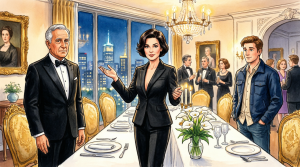
My father was hosting one of his periodic gatherings at the mansion the following weekend. Family, business allies, old friends, donors, polished sons, polished wives, the whole gallery of people who believed power was a thing you demonstrated through food and architecture and strategic intimacy. Under ordinary circumstances, I would have attended because I always attended, because being absent from Whitmore events produced as much commentary as being present, and I had long ago learned to conserve energy by disappointing people in fewer rooms rather than more.
This time, I asked my assistant for the guest list.
My father’s best friend would be there.
His son would be there.
Several board members would be there.
Two investors central to the pending merger would be there.
Perfect.
Julian didn’t like the plan.
That is too soft a sentence for what passed over his face when I told him.
“No,” he said immediately. “Absolutely not.”
We were in Eva’s backyard while Lily played with chalk on the cracked patio pretending the concrete squares were islands. The winter sun had come out in a weak pale sheet that gave everything the look of a memory.
“No?” I repeated.
“No,” he said again. “You are not going back into that house to provoke him. Not after what I told you.”
“I’m not provoking him. I’m exposing him.”
“That’s semantics.”
“It’s strategy.”
He scrubbed a hand over his face.
“Clara, your father doesn’t lose control cleanly.”
I stepped closer, lowering my voice so Lily couldn’t hear the iron entering it.
“And if I do nothing? If I take Lily and disappear with you and leave him his story? He keeps his name. He keeps his leverage. He keeps calling you what he wants and telling people you ran because you were weak and I was foolish. He keeps arranging my future as if he still owns it. No.”
Julian looked past me at our daughter, who had drawn a crooked yellow sun in the corner of an island and was narrating to herself under her breath.
“I’m not trying to protect my pride,” I said. “I’m trying to make sure he cannot come after us again while the world still thinks he’s a benevolent king with a difficult daughter.”
That got through.
He still hated it. I could see that. But he understood.
“What do you need from me?” he asked at last.
I breathed out slowly.
“Nothing in the room. You stay away from the house.”
His jaw tightened.
“I hate that.”
“I know.”
“And after?”
“After,” I said, “I come back out the front door. And then we decide what home means now.”
For a long moment, neither of us said anything.
Then Julian nodded once.
“All right.”
On the night of the gathering, I dressed for war.
Not in black. Black would have been too easy, too mournful, too readily interpreted as emotional. I wore ivory silk and a narrow gold bracelet and heels sharp enough to sound like decisions on marble. I pinned my hair back in the style my mother used to say made me look severe, which was exactly what I wanted. Around my finger I wore the diamond ring my father had given me on my thirtieth birthday—the one he liked to call a symbol of legacy, as if diamonds could stand in for permission.
In my clutch were copies.
Gate logs.
Invoices.
Still images.
Emails.
A printed statement from my house manager.
One voicemail transcription from a private investigator paid by my father’s shell firm describing “continued observation of the laborer spouse” who had “relocated again.”
I didn’t intend to read all of it. The point wasn’t to litigate in the drawing room. The point was to make denial expensive.
The mansion gleamed when I arrived.
It always had. Stone facade, iron gates, windows bright with old money and newer insecurity. I had grown up in those rooms. Learned to walk on those floors. Learned to lower my voice in hallways where executives slept over after dinners and learned by fifteen which paintings were original and which were reproductions my father pretended not to know were fake because they photographed well. It was the kind of house guests entered already prepared to be impressed by, which made it ideal for a man like my father.
Inside, everything was perfect.
Champagne in cut crystal.
A string quartet in the west salon.
Servers with silver trays.
My aunts in silk.
My father’s friends laughing too loudly.
And near the center of the room, beside my father, stood the man he had once suggested I should marry. Tall, polished, vacant in all the ways legacy men often are. The sort of person who had never had to become interesting because money had done the work of making people look at him.
When I entered, heads turned.
My father saw me and smiled with visible relief.
For a moment—one extraordinary, obscene moment—I realized he thought he had won. He thought six months of pressure and lies and grief had finally broken me down into submission. He thought my appearance at his gathering meant acceptance. Return. The prodigal daughter reentering the house with enough exhaustion in her bones to resume her place in the narrative.
“Clara,” he said, crossing toward me. “There you are.”
His voice was warm. Public. Perfect.
He kissed the air near my cheek.
“You look better,” he murmured as if offering fatherly praise. “I assume you’ve finally accepted reality.”
I did not answer.
Instead I let him lead me inward, let the room shift to include me, let his confidence deepen as guests gathered closer. This was his stage. That mattered. Men like my father only understand humiliation if it occurs under their own lighting.
He raised a glass.
“I was just telling everyone,” he said to the room, “that my daughter will soon be making a decision that strengthens our family’s future.”
The best friend smiled.
His son smiled.
My mother, standing a little behind and to the side, looked confused enough that I knew my father had not told her the specific performance planned for the evening. Good. That meant what happened next would be truly live, and my father always lost more composure when he couldn’t manage the rehearsals.
“Actually,” I said, “I have something to say too.”
The room quieted at once.
My father’s fingers tightened around his glass, but he kept the smile.
“Of course.”
I looked around.
Every face was turned toward me.
Business partners.
Relatives.
Friends who had watched me grow up.
Women who had pretended concern during my six months of private hell and then gone home to speculate over wine.
Men who called my father visionary and ruthless and meant both as compliments.
Perfect.
“For six months,” I said, “my father told me my husband left because he wanted money.”
The air in the room shifted.
Subtle first. The way expensive rooms shift when guests sense something unplanned and become hungrier for it.
My father stepped toward me.
“Clara—”
“For six months,” I repeated, louder now, “he called the father of my child a beggar. He told me I had embarrassed myself by loving him. He told me to sign divorce papers and stop humiliating the family.”
My mother had gone pale.
My father’s smile finally disappeared.
“That’s enough,” he said in a tone meant to end things.
But I had spent my whole life listening to that tone. It no longer worked on me.
“Do you know what really happened?” I asked the room.
No one moved.
I turned to my father.
“You threatened him.”
Whispers started at once.
Small. Sharp. Alive.
He looked at me with naked fury now.
“That is a lie.”
“You went to my house the night before he disappeared. Security logs place your car there. Two other vehicles entered on your authority. Camera feed was corrupted for forty-two minutes. Staff were ordered upstairs. One of your contracted investigators continued tracking my husband after he left. I have the invoices. I have the gate records. I have the witness statement.”
Each sentence stripped another layer from him.
His best friend lowered his glass.
One board member actually took a step back.
The polished son beside my father had gone so still he looked decorative.
“You told Julian,” I said, and my voice was steady now, beautifully steady, “that if he did not disappear from my life, our daughter would never see another birthday.”
Gasps this time.
Not whispers.
My father’s face changed. Not to guilt. I would have recognized guilt. This was anger at losing control of the room.
“I did what was necessary,” he snapped. “You were destroying yourself for a man who would never elevate you.”
There it was.
Not denial.
Justification.
Sometimes the most revealing thing a powerful man can do is assume his logic will still protect him after the secret gets sunlight.
I stared at him.
“You destroyed my marriage,” I said. “You made me believe the man I loved abandoned me. You made my daughter hide for six months. And you call that necessary?”
He looked around the room as if seeking allies.
“What I call it,” he said, voice hard, “is best for the family.”
“No,” I replied. “What you call best for the family is whatever keeps you in charge of it.”
The words hung there.
I could almost feel the room reordering itself around the possibility that the thing they had always admired in him—his certainty—had never been wisdom at all. Only entitlement made large by money.
Then I reached up, slid the ring from my finger, and placed it on the table beside his glass.
The sound it made was tiny.
It echoed anyway.
“You can keep your empire,” I said.
My father stared at the ring as if it were some incomprehensible insult.
“Clara,” my mother whispered.
I looked at her then, really looked, and saw a woman who had spent decades surviving by not asking which cruelty her comfort required. I loved her. That was the tragedy. Love does not vanish simply because clarity arrives. It just stops pretending clarity is optional.
Then I turned back to my father.
“I choose my family.”
His voice rose, not in grief, but in outrage.
“If you walk out now, don’t expect to come back.”
I almost laughed.
At thirty-five years old, a billionaire in my own right, the operational head of half the company he bragged about in interviews, and he still thought in terms of permission. Enter. Leave. Return. As if the house and everything attached to it remained a kingdom with one gatekeeper.
I paused only long enough to answer him.
“My family isn’t in this house.”
Then I walked.
No one stopped me.
Not my mother.
Not a cousin.
Not a board member.
Not the polished son.
Not even my father, because public humiliation had finally done what private pleading never could: it had frozen him inside the ruins of his own authority.
Outside the gates, a car waited.
Julian stood beside it.
He had changed clothes. Clean jeans, dark coat, hair cut shorter now. But the tiredness around his eyes remained, and when he saw me coming through the open gates, something inside his face tensed as if he had spent the entire evening imagining every possible outcome except the one where I came back to him whole.
I crossed the last few feet between us and stopped.
He searched my face.
“Well?” he asked softly.
“Are you ready to go home?” I said.
He blinked.
“Home?”
I smiled then, not because anything was simple, but because for the first time in months the word no longer belonged to architecture or inheritance or the threat of gates closing behind me.
“Wherever we go together,” I said.
For a second he just looked at me.
Then he nodded.
We got into the car and drove away from the mansion, from the empire, from the man who thought power mattered more than family and would therefore never understand why he had already lost.
But that wasn’t the end.
Real endings rarely happen at the moment the door closes. They happen in the days after, when consequences arrive and people must decide whether truth is something they will carry or merely survive.
The company reacted first.
Not morally. Corporations almost never do anything morally first. They reacted structurally. Once the allegations were public enough to become risk and private enough to include documents, board counsel got interested. My father’s friends stopped calling him visionary and started calling him complicated. Legal requested internal reviews of discretionary security expenditures. The merger discussions with his best friend’s family halted “pending reputational clarification,” which was elegant language for we are not tying ourselves to a man whose daughter just accused him of terrorizing a child and there might be paper.
I did not go back to the main office the next day.
I worked from one of our smaller downtown spaces with glass walls and no family portraits. My inbox filled with concern, outrage, denial, support, veiled threats, and two resignation letters from senior staff who had clearly known more than they’d ever intended to know. My father called thirteen times. I did not answer. My mother called five. I answered once.
She was crying.
“I didn’t know he would go that far,” she said.
The sentence sat between us like broken glass.
Not I didn’t know.
Not I’m sorry.
Not tell me where my granddaughter is so I can hold her.
I didn’t know he would go that far.
Meaning, of course, she had known he would go some distance.
“I believe you,” I said at last.
It was the most merciful truth I could offer. I believed she had not known about the direct threat to Lily. I did not believe she had been blind to my father’s campaign against Julian. There is a difference between innocence and selective vision, and my mother had lived in that difference so long she no longer felt its edges.
“I want to see you,” she whispered.
“Not yet.”
Then I hung up before either of us could make uglier sounds.
Julian and I did not repair ourselves in a single night or even a single week.
That part matters.
Stories like mine are always in danger of becoming too clean once the villain is named. But naming the villain does not automatically heal what terror and silence have damaged. Julian had left me to save us. That was true. I had lived six months inside the belief that he had abandoned me. That was also true. Both facts occupied the same marriage now. They had to be reckoned with separately.
For a while, we lived in a rented house outside the city under a trust my father’s attorneys could not easily touch. Lily adjusted faster than either of us deserved. Children often do. She slept between us the first two nights. After that, she insisted on sleeping in her own room because, in her words, “I’m not a baby, I’m just recovering.” Julian laughed when she said it. I did too, and the sound almost startled us both.
We built small things first.
Breakfast at the same table.
School enrollment under a name my father’s circle would not immediately scan.
Walks to the park without checking every car twice.
One evening on the floor putting together a wooden dollhouse Julian bought secondhand because Lily had fallen in love with it despite one missing shutter.
There were harder things too.
The first time I woke from a dream convinced Julian was gone again and found him sitting on the porch unable to sleep because he was watching headlights pass on the road.
The first time Lily asked if Grandpa was the bad man and I had to answer without poisoning her bloodline.
The first time Julian touched my arm in passing and both of us went still because ordinary contact had become loaded with everything we had lost.
We spoke more honestly than we ever had before.
Pain requires that if it’s going to do anything useful.
One night after Lily was asleep, I asked him the question I had been avoiding because the answer frightened me more than any boardroom scandal.
“If he hadn’t threatened Lily,” I said, “would you ever have left?”
Julian did not hesitate.
“No.”
“You’re certain.”
“Yes.”
I believed him.
Then he asked his own question.
“If I had told you the truth that night, would you have gone to him immediately?”
I stared at the dark yard beyond the porch.
“Yes.”
He nodded once, as if confirming something he had always known.
“And that,” he said quietly, “is why I was afraid.”
He was right, of course. I would have gone to my father full of fury and righteous disbelief, and my father would have seen the knowledge in my face before I spoke a word. After that, anything might have happened.
Knowing that did not undo the wound.
But it gave shape to it.
Weeks passed. Then months.
My father lost more than the merger. Three board members requested he step back from executive oversight during “family-related governance review,” which was almost funny given how relentlessly he had tried to fuse governance with blood. His best friend’s family publicly distanced themselves. The polished son married someone else within the year, a woman from old money whose greatest talent seemed to be looking unstartled in photographs.
I did not take over the company the way everyone expected.
That surprised the press, the board, and my father most of all.
I stepped away.
Not because I couldn’t have won. I could have. Between my equity, my performance record, and the way the board needed clean optics after the scandal, I could have kept the whole machine and become exactly the kind of empire-builder my father had always claimed I should be. But standing in that boardroom weeks after finding Julian at the site, listening to men in expensive suits discuss my family as “brand volatility,” I realized something with a clarity so sharp it was almost peaceful.
I did not want to spend the rest of my life proving I could rule a kingdom built by a man who thought love was weakness.
So I sold a controlling portion of my operational stake, kept enough wealth to remain free forever, and walked.
The papers called it shocking.
The board called it unfortunate.
My father called it emotional sabotage according to one email later forwarded to me by an appalled counsel who had finally grown a conscience.
I called it leaving.
Julian didn’t ask me to. That matters too. He never once told me to abandon anything. If anything, he was afraid I would one day resent him for what the choice cost. But it was not his cost. It was mine, and I paid it willingly because for the first time in my adult life the choice was not between love and ambition. It was between someone else’s architecture of power and my own idea of a life.
I chose the life.
The first time my mother saw Lily again, it was in a public garden with ducks and too many benches and enough open space that no one could spring anything on anyone else.
She cried before she reached us.
Lily, after studying her for a long second, walked forward and said, very seriously, “You scared my daddy.”
It was the kind of sentence only a child could say with perfect moral geometry.
My mother sank onto the bench and covered her mouth.
“I know,” she whispered.
Then she cried properly, not elegantly. Not like a woman preserving status. Like a grandmother who had finally understood the price of choosing not to see.
I let them have a relationship, but on my terms.
No mansion.
No unsupervised holidays.
No family mythology without correction.
No photographs posted for public sentiment.
My father never saw Lily again while I was there.
He asked twice through lawyers and once through my mother. Each time the answer was no.
I do not say that with pride.
I say it with accuracy.
Some doors should not be reopened simply because the person on the other side remembers your childhood name.
A year after the confrontation, Julian and I were standing in the kitchen of the house we eventually bought together—a smaller house, by choice, near a lake far from the city and farther from my father’s orbit. Lily was asleep upstairs with three stuffed animals, one sock missing, and her school drawing of our family taped crookedly beside her bed. The counters were cluttered. A pan soaked in the sink. A lamp in the corner needed rewiring because Julian had insisted he could do it himself and I had insisted he was absolutely not allowed to electrocute himself for nostalgia.
He was making tea.
I was leaning against the counter watching him.
He looked up.
“What?”
“Nothing,” I said.
He smiled a little.
“That look means something.”
I considered lying and decided against it.
“I was just thinking,” I said, “that my father called you a beggar.”
Julian snorted softly. “I remember.”
I shook my head.
“He spent so much of his life convinced money was the final measure of worth. He could build towers, buy influence, host rooms full of people who wanted his approval, and still he never once understood the difference between possession and value.”
Julian handed me a mug.
“And?”
I took it, warm against my palms.
“And the man he called worthless was the only one who ever gave up everything to keep me and our daughter alive.”
He looked at me then in that direct, quiet way that had undone me the first time and still did.
“I never wanted you to lose your family,” he said.
I thought of the mansion.
The boardroom.
The ring on the table.
My mother crying in the garden.
My father’s voice telling me love didn’t build empires.
Then I thought of Lily upstairs.
The lake outside.
This kitchen.
The way Julian always remembered to put a spoon beside my tea because I preferred honey to sugar and never once forgot that fact even after six months of exile.
“I didn’t lose my family,” I said.
He waited.
“I found it.”
And that was the truth.
Not a dramatic truth. Not a cinematic one.
Just the simple, difficult truth that the family I was born into had confused blood with ownership and control with care, while the man they mocked as beneath us had understood something far richer from the beginning: that love is not status, and safety is not power, and a home built on fear is only ever a well-decorated prison.
My father had called Julian a beggar because he had nothing my family could measure.
No empire.
No pedigree.
No strategic advantage.
He had only loyalty.
Only courage.
Only the willingness to vanish into hardship rather than watch a child become leverage.
And in the end, those were the only currencies that mattered.

