The first time my parents ever looked small to me, they were standing under the soft glow of recessed lights in their brand‑new home theater wing. Red velvet seats cascaded down in perfect rows. The screen was as wide as the wall where the climate‑controlled glass cases had once stood.
Popcorn butter and fresh paint hung in the air, a cheap, oily stand‑in for leather‑bound pages and peppermint tea. Great‑Grandmother Catherine stood beside me, leaning lightly on her cane. At eighty‑two, she was barely five‑foot‑two in sensible black flats, but in that moment she felt like the tallest thing in the room.
My mother, Angela, hovered near the front with a champagne flute. My father, Brandon, was in the center, basking in the glow of their friends and donors from Fairfield County, all of them packed into a theater that had been built with money that didn’t belong to them. Brandon lifted his glass, ready to make his speech about legacy and family and ‘the next generation.’
Catherine beat him to it.
‘You really did sell the collection,’ she said, her voice clear enough to cut through the soundtrack humming softly from the hidden speakers. Conversation died in ripples. The laughter, the small‑talk about internships and lake houses and country club renovations, all went flat.
I watched my parents’ faces turn toward her like sunflowers tracking the wrong sun. Angela tried for a laugh. ‘Mom, can we not do this right now?’ she said, fingers tightening around the stem of her glass.
Catherine’s gaze never left my father. ‘The collection,’ she said, taking a step forward so the cane clicked sharply against the new slate floor, ‘was never yours.’
Brandon’s smile wobbled, then collapsed entirely. By the time she spoke those four quiet words, the damage had already been done.
This theater was their monument. It was also Exhibit A. —
My name is Olivia Henderson.
I am thirty‑one years old, an archivist by trade, a single mother by circumstance, and for most of my life I was the invisible one in a very visible family. If you have ever been the responsible child in a house full of main characters, you already know my role. I was the one who bought my sweaters on clearance at Target so my ten‑year‑old daughter Anna could attend a private Montessori school in Stamford.
The one who spent weekends scanning brittle letters into digital archives while my younger sister Kayla filmed outfit‑of‑the‑day reels in perfect natural light. I kept the engine running so everyone else could pretend the car propelled itself. The house at the center of everything is a colonial estate in Fairfield County, Connecticut, the kind they like to put on glossy magazine covers.
White columns, black shutters, a long gravel drive lined with maples that explode red every October. Technically, people call it Henderson House. On paper, it is something much more complicated.
To the state, it is a registered cultural landmark tied to a heritage trust. To my parents, it was their ticket into a social circle that liked historic plaques and charitable brunches. To Great‑Grandmother Catherine, it was the thing she had poured her life and her savings into preserving.
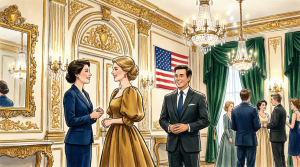
To me, it used to be just ‘the house.’
Then my parents sold my daughter’s future for $165,000 and poured it into a movie screen. It started on a Tuesday afternoon that smelled wrong. If you’ve ever walked into a room that has been quietly betrayed, you know what I mean.
The Henderson library had always smelled the same: old paper, lemon oil on the wood, and peppermint tea. Catherine drank that tea every afternoon at three, like clockwork, sitting in the same leather armchair while Anna curled up cross‑legged at her feet with a book. That day, when Anna and I walked through the side entrance, the air was sharp and chemical.
The hall that led to the library was taped off with blue painter’s tape. Plastic sheeting hung from the doorframe like a cheap shower curtain. ‘Grandma?’ Anna’s voice was small but steady.
I pushed the plastic aside. The temperature was wrong first. The room had always been cool, the steady hum of the climate‑control system a kind of heartbeat.
Now it was warm and still. The humming was gone. So were the shelves.
The wall where the first editions had once stood was bare down to the studs. Drywall dust powdered the floor. A contractor in a paint‑splattered T‑shirt was standing on a ladder, installing recessed lighting where the glass cases used to be.
For a second, my mind refused to process the scene. I actually blinked, expecting the cases to snap back into place like some kind of museum illusion. ‘Excuse me,’ I managed.
‘What is this?’
The contractor glanced down, clearly annoyed to be interrupted. ‘Theater wing,’ he said. ‘You must be Kayla’s sister.
We’re on a tight timeline, so I can’t really chat.’
Anna walked past me like she was sleepwalking. Her sneaker left a footprint in the dust where Catherine’s Persian rug had been. She stopped in front of the empty wall and reached out as if the books might still be there, invisible, waiting.
‘Where are the cases?’ she asked me, not looking away from the studs. I couldn’t answer, because I already knew. Every year, when I filed the compliance paperwork for the Henderson historical designation, I itemized the same list: architectural features, original fixtures, and the Catherine First Edition Collection.
I knew the insurance value by heart. I knew the clause that said the collection had to remain stored in a climate‑controlled, secured room on the estate. I also knew my parents’ relationship with money.
I found them in the kitchen, of course. Angela was at the marble island with a stack of swatch books, a glass of chilled white wine, and a clipboard. Brandon was leaning over the architectural plans, his readers halfway down his nose.
‘You gutted the library,’ I said. My voice didn’t sound like mine. It sounded like someone reading a line from a deposition.
Angela blinked up at me as if I’d interrupted a tasting menu. ‘Oh, Olivia,’ she said, that half‑sigh she always used when she thought I was being dramatic. ‘Let’s not use words like gutted.
We’re renovating.’
‘Where are the cases?’ I asked. Brandon straightened, the plans crackling under his hands. ‘It’s all being repurposed,’ he said.
‘The collection was just… sitting there. No one but Catherine and Anna ever went in that room. This is going to be a space the whole family can enjoy.’
My stomach dropped.
The collection was. ‘You sold them,’ I said. I didn’t inflect it as a question.
Angela’s eyes flicked to Brandon, then back to me. ‘We spoke with a very reputable private collector,’ she said. ‘He offered one hundred and sixty‑five thousand dollars.
For some dusty old books. Honestly, Liv, it was a blessing.’
I heard the number and saw it as a ledger line, not as a windfall. $165,000.
The approximate value of Anna’s college fund if we continued saving the way I had planned. The cost of a down payment on a modest house somewhere I could actually afford on my salary. A number that had just evaporated into surround sound speakers and luxury recliners.
‘You didn’t have the right,’ I said quietly. Brandon gave a short, incredulous laugh. ‘Excuse me?
We are the owners of this property. We’ve poured money into this place for decades. The taxes alone—’
‘Which I reduce by thirty‑five thousand dollars a year,’ I cut in.
‘By spending my nights filing your preservation reports and compliance audits. I know exactly how much you’ve poured into this place. I also know exactly how much you’ve taken out.’
Angela’s shoulders stiffened.
‘Olivia, don’t make a scene in front of your daughter.’
Anna was standing in the doorway now, dust on her shoes, hands clenched at her sides. She didn’t look at me. She looked at them.
‘Great‑Grandma said the books had to stay with us,’ she said to my parents. ‘She said they were ours to keep safe.’
Angela’s smile reappeared, brittle and bright. ‘Oh, sweetheart,’ she cooed, stepping toward Anna with her hands out.
‘You’re ten. You can read any of those stories on an iPad. We can get you digital copies, and they’ll be so much easier—’
‘No,’ Anna said.
It was just one syllable, but it had weight. She took a step back from her grandmother’s reaching hands and moved closer to me, pressing her shoulder against my side. I looked at her face.
No tears. No trembling lip. Just a flat, stunned sort of understanding.
Something inside me that had spent three decades bending finally snapped. I didn’t scream. I didn’t slam a cabinet door or throw a wine glass at the gleaming subway tile.
All of that would have implied I still believed they could be better than this. That somewhere, buried under their entitlement and vanity, there was a version of them who would be horrified by what they’d done. I no longer believed in that version.
I turned to my daughter. ‘Get your things,’ I told her. ‘We’re leaving.’
The smell of sawdust followed us down the hall and out the side door.
It clung to my sweater, threaded through my hair. I could still remember when that scent had been peppermint and paper. Memory has a way of turning into evidence when you least expect it.
We climbed into my aging Subaru in the driveway between a Range Rover and a gleaming German SUV that probably cost twice my annual salary. I started the engine, more out of muscle memory than intent, and sat there with my hands on the wheel. Anna buckled herself in without being asked.
She stared out the windshield at the house, at the white columns and the black shutters and the small brass plaque that declared the property a protected landmark. ‘Are they gone forever?’ she asked finally. I knew she meant the books, not my parents.
I swallowed. ‘I don’t know yet,’ I said honestly. ‘But I know this isn’t over.’
She nodded once, as if that was enough for now, and went back to watching the front door.
I didn’t feel like a mother then. I felt like an auditor. I reached into the back seat for my laptop bag and slid the device out, balancing it on the center console.
My fingers moved through the motions without hesitation. Password. Two‑factor authentication.
Portal access. For years, my parents had treated my work as a quirk. ‘Our Olivia, the little archivist,’ my father would say at parties, laughing like my master’s degree in archival science was an adorable hobby rather than the thing that kept his tax bill artificially low.
They thought the Henderson Landmark Tax Exemption was part of the house, like the columns or the original hardwood floors. They forgot it was contingent on annual documentation filed by one very real, very tired person. Me.
I navigated to the state’s historical preservation portal, the one I had bookmarked and visited more often than my own online banking. The Henderson estate was right there at the top of my dashboard: ACTIVE. COMPLIANT.
A line of small text beneath it listed the key protected elements: colonial façade, original staircase, east‑wing library, and the Catherine First Edition Collection. I stared at the words ‘east‑wing library’ until they blurred. Then I did what I’d always done.
I told the truth. I opened a new compliance report and selected ‘Report Material Change.’ In the field that asked for a description, I typed: ‘Removal of climate‑controlled library fixtures and relocation of protected first edition collection off‑site without prior approval.’
I attached the latest photographs from my last inspection, the ones with the shelves fully loaded, glass cases sealed, temperature gauges glowing a steady sixty‑five degrees. I took my phone, snapped a single photo of the gutted room through the plastic sheeting, and attached that too.
Picture, caption, date. That was all it took. I checked the box that read ‘Non‑compliant.
Recommend review of exemption.’
Then I hit submit. The portal updated in less than a minute. ACTIVE shifted to UNDER REVIEW.
I didn’t do it out of spite. I did it because the library was gone. The exemption was built on the existence of that room and that collection.
Without them, the tax break was a lie. My parents had burned the furniture and expected the house to stay warm on imaginary fire. If they wanted to treat family assets like their personal slush fund, they could shoulder the full cost of that choice.
The second tab I opened was my banking app. A month earlier, Angela had called with one of her bright, brittle ideas. ‘Sweetheart, since you’re so good with online things, could you just handle the catering deposit for Kayla’s theater reveal party?’ she’d said.
‘It’s only twelve thousand. We’ll settle up later. Think of it as your contribution to the kids’ happiness.’
I had paid it because that’s what I did.
I patched the holes and told myself it was love. Staring at the transaction now, it looked less like love and more like an overdraft on my compassion. I selected the charge, hit ‘Request Stop Payment,’ and confirmed.
A small spinning wheel, a progress bar, and then the words: TRANSACTION CANCELED. The power shift was almost painfully quiet. No fireworks.
No dramatic music. Just a line of text confirming that, for once, I had chosen my child over my parents’ image. Beside me, Anna said, ‘They really sold them.’
I closed the laptop, the click of it sounding louder than it should have.
‘Yes,’ I said. ‘They did.’
Anna nodded. She didn’t cry.
She didn’t ask why. That was when I realized my daughter had already learned the lesson it had taken me three decades to understand: some people will always choose their comfort over your existence. Your job is to stop handing them the tools.
If you grow up in a family where love is rationed, you learn to survive by needing less. My role in the Henderson house had been defined long before I was old enough to name it. Kayla, two years younger, was the ‘delicate one.’ She had allergies and stage fright and a talent for looking beautiful in photographs.
Angela wrapped herself around Kayla’s schedule like ivy: dance recitals, dermatologist appointments, brand collaborations once the followers rolled in. Brandon’s world revolved around his business contacts and the estate. He liked dropping ‘heritage trust’ into conversations at the club, enjoyed the way people responded to words like legacy and stewardship.
That left me. ‘Olivia’s our independent one,’ they would say with a fond little shrug. ‘She’s low‑maintenance.’
What they meant was: she costs us nothing, because she gives us everything.
I was the kid who remembered to send the mortgage payment when my father forgot to schedule it. The teenager who learned how to navigate the property tax portal because no one else had the patience. The twenty‑something who sat with Catherine in the library as she catalogued each volume by hand, learning the smell and weight of history while everyone else was in the pool.
By the time I finished my graduate program, the state’s preservation officer knew me by first name. I was the contact of record for the Henderson House. Every year, I submitted the documentation that saved my parents thirty‑five thousand dollars in taxes.
I told myself that made me part of the legacy. Really, it just made me easy to ignore. My phone lit up five minutes after we pulled out of the driveway.
MOM. I watched the call go to voicemail. It lit up again.
Then again. Six calls in ten minutes. On the seventh, I answered.
‘Olivia, thank God,’ Angela said, exhaling dramatically. ‘What on earth is going on? You storm out with Anna like we’ve committed some crime.’
I watched the trees blur past on the Merritt Parkway as I drove, one eye on the road, one on the rearview mirror where Anna’s reflection sat very still.
‘You sold my daughter’s collection,’ I said. ‘You destroyed a registered library to build a theater.’
Angela laughed. Actually laughed.
‘You are being overly sensitive,’ she said, slipping into that country‑club voice that turned everything into a charity committee debate. ‘Those books are just paper, Liv. Anna can read digital copies on an iPad.
You of all people should appreciate how accessible technology has made things.’
‘Those books are part of a cultural heritage trust,’ I said. ‘They’re not yours to liquidate.’
‘Oh, please,’ she snapped. ‘Your great‑grandmother signed a stack of papers twenty‑two years ago.
She barely understood what she was doing. Your father and I have carried this place on our backs. We’re allowed to enjoy it.’
I thought of Catherine in the library, teaching Anna to handle first editions with clean, dry hands.
I thought of the peppermint tea, the way she would whisper, ‘We are keepers, not owners, darling.’
She had understood exactly what she was doing. ‘I filed a change report with the state,’ I said. ‘The exemption is under review.’
There was a beat of silence on the line.
When Angela spoke again, the gloss had cracked. ‘You did what?’ she hissed. ‘I told them the truth,’ I said.
‘The protected library doesn’t exist anymore. The collection is gone. The tax break was tied to both.’
Behind her, I could hear the low murmur of Brandon’s voice, the faint clatter of dishes, the distant whine of a saw in the half‑built theater.
‘Olivia, you need to call them back and fix this,’ she said. ‘Do you have any idea what will happen to us if—’
‘Yes,’ I said, and ended the call. My phone vibrated almost immediately with new notifications.
I ignored them until one flashed across the top of the screen that wasn’t from my parents. Kayla had posted a new Instagram reel. Signal in our little apartment in Stamford is spotty in the afternoons, but the reel loaded just fine.
Kayla twirled in the center of the gutted library, her blond hair catching the light from the new can fixtures they’d installed where the old brass lamps used to be. Blue painter’s tape on the floor framed her like a stage. The caption read: ‘Clearing out the dust to make room for the stars,’ followed by three sparkle emojis and a cluster of hashtags about luxury living, family first, and home theater goals.
The sawdust floating through the air looked like glitter in her chosen filter. In the corner of the frame, if you paused at the right second, you could see a contractor wheeling out one of the old climate‑control units. Evidence.
I locked my phone and set it face down. They weren’t sorry. They weren’t even conflicted.
To them, the liquidation of Anna’s inheritance was nothing more than content. That night, after I put Anna to bed with a library book from the public branch because her own shelves at home suddenly felt too empty, I opened my laptop again. Not for my parents this time.
For the collection. I started with an email to an old colleague at the state university’s rare books department. Marcus and I had spent a summer together cataloguing a donated collection of abolitionist pamphlets.
His brain retained statutes the way mine remembered call numbers. Subject line: ‘Catherine Collection – urgent irregularities.’
I laid out the facts in clean, chronological lines. The original deed Catherine had signed, placing the first edition collection into a registered cultural heritage trust twenty‑two years earlier.
The way that deed intertwined the collection with the estate’s legal standing. The requirement that the books remain on‑site, in a protected environment, accessible for scholarly use by appointment. I attached scans of the trust documents and my most recent compliance report.
I described, in neutral professional language, the gutted library and the contractor’s confirmation of a home theater renovation. I mentioned the sale to a private collector for one hundred and sixty‑five thousand dollars, as reported by my parents. I did not call it theft.
I didn’t have to. Less than an hour later, my phone rang. ‘Olivia,’ Marcus said without preamble, his voice tight.
‘Tell me I’m misunderstanding this email.’
‘I wish you were,’ I said. He exhaled. I could hear pages flipping on his end, the low murmur of voices in the background at the university office.
‘Alright,’ he said. ‘Here’s the situation. If the collection is indeed part of a registered cultural heritage trust, and your parents sold it without going through the proper channels, we’re not talking about a family spat.
We’re talking about a breach of trust, possibly a federal heritage felony depending on the interstate commerce involved.’
My spine went cold. ‘What happens now?’ I asked. ‘First, we verify,’ he said.
‘I’ll pull the trust registration in the morning and cross‑check your documents. If everything lines up the way I think it will, the university is obligated to notify the state’s heritage council. They, in turn, notify the Attorney General’s office.
There will be an investigation. A notice of non‑compliance at minimum. Potential criminal charges at maximum.’
I thought of Angela’s laugh when she called the books ‘dusty old paper.’ I thought of Brandon holding court at the club, bragging about the renovations.
I thought of Kayla twirling in the ruins of the library for likes. Marcus’s voice softened. ‘I’m sorry, Liv.
I know this is your family.’
‘It’s a trust,’ I said quietly. ‘And they broke it.’
There was a pause. ‘You know this could affect the estate itself,’ he said.
‘Depending on how the documents are structured, a breach of the collection clause could trigger a review of their right to occupy the property.’
I looked at the peeling paint on our apartment ceiling, at the stack of bills on my dining table held together with a binder clip. ‘I know,’ I said. ‘Catherine warned them.
They didn’t listen.’
Marcus made a humming sound. ‘She always did play the long game,’ he said. ‘I’ll call you tomorrow after I’ve talked to legal.’
After we hung up, I sat in the quiet kitchen for a long time.
For thirty‑one years, my survival strategy in that family had been simple: be useful, be quiet, and maybe they’ll let you stay. In that moment, stirring sugar into a mug of peppermint tea in my tiny Stamford kitchen, I realized I didn’t want to stay anymore. I wanted to see what happened when the record reflected the truth.
The next morning, I sent exactly one message to the Henderson family group chat. It was short. Clinical.
Written in the same tone I used when corresponding with state archivists. I have initiated a full inventory review of the Catherine Heritage Trust, I typed. Any missing assets must be accounted for within forty‑eight hours.
I attached a PDF of the original trust summary. The read receipts popped up one by one. Angela: READ.
Brandon: READ. Kayla: READ. The typing bubble appeared beneath Angela’s name, then disappeared.
Appeared again, vanished again. Nothing came through. Instead, half an hour later, I received a different kind of notification.
You’re invited: Grand Reveal of the Henderson Home Theater. The digital invitation was black with gold foil accents, the kind you can buy from a template service and customize with names and times. Saturday, 7:00 p.m.
Dress code: cocktail chic. At the bottom, in a smaller script font, there was a note: Please be adult enough to attend, for the sake of the family image. – Mom
Family image.
I stared at the invitation long enough for my coffee to go cold. Brandon and Angela were planning a party with stolen funds while the state quietly opened a file with their names on it. I clicked ‘Accept.’
If the house was finally going to tell the truth, I wanted to be in the front row.
When Catherine found out, she didn’t cry. She was recovering in a rehab facility in New Haven after a bout of pneumonia, her white hair pulled back in a simple twist, a wool blanket over her knees. The window behind her looked out over a strip of lawn and a parking lot lined with sedans, a far cry from the maples and stone walls of Henderson House.
I brought her peppermint tea in a paper cup. Habit. ‘Well?’ she asked, after I finished explaining the renovations, the sale, the trust documents, Marcus’s reaction, the impending audit.
Her hands were thin but steady as she wrapped them around the cup. Her knuckles were as familiar to me as the spines of the books she loved. ‘I’m so sorry,’ I said.
‘I should have seen it coming.’
She studied me for a long moment, pale blue eyes sharp. ‘You were busy surviving,’ she said. ‘That was your job when you were a child.
It’s not your job anymore.’
I told her the number. One hundred and sixty‑five thousand. Catherine gave a soft snort.
‘Brandon always did have cheap taste hiding under expensive habits,’ she said. ‘He sold a century for a theater wing.’
‘It was Anna’s name on the deed,’ I reminded her. ‘You gifted the collection to her.’
‘I did more than that,’ she said.
She asked me to pull her purse from the drawer of the bedside table. Inside, wrapped in a folded linen handkerchief, was a photocopy of the trust deed. She had scrawled notes in the margins in her spidery handwriting.
‘Look at paragraph seven,’ she said. I read the clause slowly. In the event that the appointed trustees remove or attempt to remove the Catherine First Edition Collection from its designated location without approval of the heritage council, the trustees’ right of occupancy shall be subject to immediate review and potential dissolution.
‘I told your father, more than once, that the library was not his living room,’ Catherine said. ‘He treated it like an inconvenience that came with the plaque on the front lawn. I needed him to understand there were conditions to his comfort.’
My throat tightened.
‘You built a trap.’
‘I built a boundary,’ she corrected. ‘A boundary they never believed would have consequences.’
For the first time since stepping into the gutted library, I felt something uncoil in my chest. Catherine lifted her gaze to mine, eyes bright.
‘Olivia,’ she said, ‘the collection was never theirs.’
The words sank into me like a stone into deep water, sending out quiet ripples. The collection was never theirs. ‘Come Saturday,’ she added, settling back against her pillows, ‘I would very much like to attend this little premiere of theirs.’
I smiled for real then, the first genuine smile I’d felt in days.
‘Alright,’ I said. ‘We’ll get you there.’
Marcus called on Friday afternoon. ‘We pulled the trust,’ he said.
‘Everything matches your documentation. The university’s legal counsel has looped in the heritage council and the AG’s office. There will be a formal notice served.
Sixty days to restore the collection or repay the full one hundred and sixty‑five thousand plus penalties.’
‘Can they restore it?’ I asked. ‘If the buyer cooperates,’ he said. ‘He’s already bragging in a private forum about an off‑market acquisition, so he’s not exactly subtle.
Once he realizes he’s holding stolen property, my guess is he’ll hand it over rather than risk charges.’
I thought of the empty wall, of Anna’s hand hovering over what used to be there. ‘And the house?’ I asked. ‘On review,’ Marcus said.
‘The trust language gives the council authority to dissolve your parents’ right to occupy if they find a material breach. It’s not automatic, but…’
‘But theater wings built on top of gutted libraries don’t look great,’ I finished. He made a low sound of agreement.
‘Olivia, this is going to get messy,’ he said gently. ‘It’s already messy,’ I replied. ‘At least now the mess is on paper.’
The Henderson estate glowed on Saturday night like it knew it was on borrowed time.
Every window was lit, the long driveway filled with SUVs and sedans from Greenwich, Westport, and beyond. The autumn air was crisp, the maples along the drive just beginning to turn. The brass landmark plaque at the gate caught the headlights and flashed.
I parked at the far end of the gravel, away from the valet stand. Anna held Catherine’s arm on one side; I supported her on the other. Catherine wore a simple navy dress and a string of pearls, the same ones she’d worn at the ceremony when the trust was signed.
Inside, the foyer was full of people and the kind of laughter that comes from too much champagne and not enough self‑awareness. Servers in black carried trays of crab cakes and mini lobster rolls. A jazz trio played near the sweeping staircase.
‘Looks like a movie set,’ Anna murmured. ‘That’s the idea,’ I said. Angela intercepted us near the entrance to the new wing.
Her dress was champagne silk, her hair perfectly blown out, her smile just a little too bright. ‘Olivia,’ she said, air‑kissing the space near my cheek. ‘Catherine, you look wonderful.
We’re so glad you could make it.’
Catherine’s gaze moved slowly from Angela’s dress to the velvet rope that had been strung across the theater entrance like the door of a VIP lounge. ‘You’ve always loved a performance, Angela,’ she said mildly. My mother’s smile tightened.
‘Let’s just have a nice evening, shall we?’ she said through her teeth. We joined the small crowd filing into the theater. The room was all dark walls and plush seats, the air heavy with new carpet and expensive leather.
My parents had turned a place of quiet into a place that demanded noise. Brandon stood at the front in a tailored navy suit, a glass of champagne in hand. Behind him, the screen glowed with a looping slideshow of family photos: Kayla in designer swimsuits at the Cape, group shots on ski trips, Angela hosting charity luncheons in the garden.
There were almost no pictures of the library. ‘Friends,’ Brandon boomed, spreading his arms. ‘Thank you all for being here to celebrate with us.
This new theater wing represents our commitment to the next generation. A place where the Henderson family can gather, watch films, and enjoy the fruits of our hard work—’
Catherine tapped her cane once against the floor. The sound cut clean through his speech.
‘Brandon,’ she said. He faltered, turning toward her with a half‑annoyed, half‑placating smile. ‘Mom, we’ll do a proper toast in a minute.
Why don’t you—’
‘Why don’t we start with the cost of this little project?’ she interrupted. Murmurs rippled through the room. People loved numbers.
They just preferred them in the context of net worths and fundraising totals rather than breach‑of‑trust penalties. Brandon’s knuckles whitened around the stem of his glass. ‘We don’t need to discuss finances in front of our guests,’ he said.
Catherine took a step forward. The big screen behind her flicked to a photo of Anna and her in the library, taken last Christmas, before I’d realized anyone else had been in the room. Anna sat on the floor with a book in her lap.
Catherine’s hand rested on a shelf of gold‑leafed spines. ‘Because the finances are so simple, dear,’ Catherine said. ‘You sold a protected collection for one hundred and sixty‑five thousand dollars to build a theater in a house you do not own.’
The room froze.
‘Excuse me?’ one of Brandon’s golf partners said under his breath. Angela laughed too loudly. ‘Mother, really, this is not the time for your dramatic stories,’ she said.
‘The collection was—’
‘Never yours,’ Catherine finished. Silence landed like a dropped curtain. I could see it now, the moment my parents’ self‑image separated from reality.
Angela’s hand trembled. Brandon’s eyes darted over the crowd, searching for someone to laugh it off with him, to turn this into a charming anecdote about overzealous paperwork. No one volunteered.
The double doors at the back of the theater opened. A man in a dark suit stepped in, followed by a woman carrying a slim leather portfolio. Marcus was right behind them, wearing his usual slightly rumpled blazer and an expression I recognized from faculty meetings: polite, but unyielding.
‘Brandon and Angela Henderson?’ the man in the suit asked. Brandon’s voice wobbled. ‘Yes?’ he said.
The man approached, offering the envelope the way a waiter offers a check. ‘On behalf of the State Heritage Council and the Office of the Attorney General,’ he said, loud enough for the front rows to hear, ‘this is formal notice of a breach of the Catherine Heritage Trust. You have sixty days to restore the Catherine First Edition Collection to its designated location or provide full restitution of one hundred and sixty‑five thousand dollars plus applicable penalties and interest.
Failure to comply may result in criminal charges and review of your right to occupy this property.’
Someone in the back gasped. Angela took a step back, hand flying to her chest. ‘This is ridiculous,’ she said, voice shrill.
‘We are the owners of this estate. We have sacrificed—’
‘You are tenants of a life estate contingent on your stewardship,’ Catherine said calmly. ‘You were given rooms to live in and a plaque to polish.
In return, you were supposed to protect what was entrusted to you.’
Kayla, standing near the aisle in a sequined dress, had gone pale. Her phone screen glowed in her hand. Notifications were popping up faster than she could clear them.
Her latest reel had started to circulate, but not the way she’d imagined. Someone had screen‑recorded it and added a caption: ‘Influencer’s family sells protected rare book collection to build home theater.’ Local news outlets loved a story that combined old money, scandal, and Instagram. The comments were brutal.
‘Is this a joke?’ someone whispered. ‘Is that the library?’ another guest asked, pointing at the frozen frame on the theater screen, where a photo of the gutted room had appeared. Brandon’s shoulders slumped.
For the first time in my life, he looked smaller than the house. ‘Mom,’ he said to Catherine, voice cracking. ‘We didn’t think—’
‘That’s right,’ she said, eyes steady.
‘You didn’t.’
The party ended not with a toast but with a stampede. Guests who had been more than happy to drink vintage champagne in a stolen theater suddenly remembered prior commitments. Realtors slipped out first.
Then the club friends with delicate reputations. One by one, they murmured excuses, promised to ‘catch up soon,’ and disappeared into the cool Connecticut night. Within half an hour, the only people left in the theater were family and a few stunned staff.
Kayla stood in the corner, staring down at her phone as her follower count ticked backward. Comments flooded her latest posts: thief, fraud, unfollow. Brand partners that once sent her PR packages were quietly archiving their collaborations.
‘People are being so cruel,’ she whispered, eyes shiny. I almost felt bad for her. Almost.
‘You built a platform on the illusion of a lifestyle you didn’t own,’ I said softly. ‘The truth was always going to feel like bullying.’
Brandon tried to argue with the heritage officials, talking about improvements and property values and how the theater would ‘enhance the guest experience.’ The attorney listened politely, then pointed to the clause in the trust that Catherine had circled for me the day before. ‘Improving your comfort with stolen assets is not stewardship, Mr.
Henderson,’ he said. ‘It is exactly what this language was designed to prevent.’
Angela cycled through stages of denial like she was trying on clothes. Outrage, wounded dignity, brittle self‑pity.
None of them fit anymore. ‘We did this for the family,’ she insisted at one point, eyes glassy. ‘For the grandchildren.
We wanted a space where we could all be together.’
Anna, standing beside me in her simple navy dress, squeezed my hand. ‘We already had one,’ she said quietly, her eyes flicking toward the invisible outline of the library beneath the theater. The next sixty days moved fast.
The private collector, faced with the possibility of charges and a lawsuit, returned the first edition collection in full. He claimed he’d been misled, that he hadn’t known the books were part of a registered trust. Marcus didn’t bother arguing with him.
The important thing was that the heavy crates reappeared at the estate under the watchful eyes of both the heritage council and the university. Every volume was inspected, catalogued, and re‑shelved according to Catherine’s original system. Anna hovered nearby during each visit, hands clasped behind her back, asking questions in a small, serious voice that made even the gruffest archivist soften.
The theater didn’t survive. Under supervision, contractors dismantled the plush seats and took down the oversized screen. The acoustic panels came off the walls.
The scented candles Angela had picked out to make the space ‘smell like a boutique cinema’ went into trash bags. Slowly, the room began to resemble its old self again. We stripped away the velvet drapes and brought in the mahogany shelves Catherine had commissioned decades ago from a local craftsman.
The climate‑control units were reinstalled, humming softly back to life. The air cooled, and with it came the faint, unmistakable scent of old paper and peppermint tea. In the end, the heritage council restored the estate’s landmark status—but not my parents’ place inside it.
The review of their right to occupy did exactly what the clause allowed. Catherine’s trusteeship was reaffirmed. As the only descendant who had not participated in the breach and who had, in fact, initiated the corrective action, I was added as co‑trustee and future primary steward.
Angela and Brandon received a different letter. They were granted thirty days to vacate. They sold the Range Rover first.
Then the smaller Mercedes SUV they had bought for Kayla ‘for safety.’ Country club memberships were quietly canceled. Vacations were refunded. The home theater that was supposed to be the crown jewel of their social life had turned into a cautionary tale, and no one wanted to be associated with it.
They moved into a two‑bedroom apartment complex near the interstate, the kind with beige carpeting and a shared laundry room. There was no brass plaque by the entrance. No maples lining the driveway.
No velvet ropes. For the first time in their adult lives, my parents lived in a place they actually owned. The day we moved our boxes into Henderson House, the silence felt different.
It wasn’t heavy anymore. It didn’t press down on my lungs the way it had when I was a kid, trying to take up as little space as possible in my own home. The air was cooler, the hum of the climate‑control system a steady reassurance in the background.
Anna carried her own box into the library, the one labeled ANNA – BOOKS in her careful block letters. She set it down gently near the restored shelves. ‘Can I unpack them here?’ she asked.
‘All of them,’ I said. She grinned, the first full, unguarded grin I’d seen from her in weeks. We spent that afternoon arranging her small collection among the giants.
Her favorite middle‑grade mysteries tucked beside nineteenth‑century novels, her dog‑eared fantasy paperbacks sharing space with leather‑bound histories. Catherine watched from her armchair, cane resting at her side, a mug of peppermint tea steaming on the small table next to her. ‘It suits her,’ Catherine murmured.
‘It was always supposed to be hers,’ I said. Later, after Anna went upstairs to get ready for bed, I sat at the old oak desk in the corner of the library. It had been Brandon’s once, a place where he pretended to review investment portfolios while I did the actual paperwork at the kitchen table.
Now it was mine. My phone buzzed on the blotter. The Henderson family group chat icon blinked, full of unread messages.
Apologies that weren’t apologies. Guilt‑trips disguised as concern. Requests to ‘talk this out like adults for the sake of the family.’
For thirty‑one years, I would have read every one of them, searching for a scrap of the validation I’d been starving for.
I didn’t open a single message. I tapped and held the thread until the options popped up. Delete.
Block. I hit confirm. For the first time in my life, there was no noise.
Just the quiet tick of the old clock on the wall, the soft whir of the climate‑control system, and the rustle of pages as Anna turned them in her armchair. The scent of peppermint tea wrapped around us like a promise. If you’re still here, listening to this, maybe some of this feels uncomfortably familiar.
Maybe you’re the one who remembers everyone’s birthdays but no one remembers yours. The one who stays late to fix the messes, who signs the forms, who pays the deposits labeled as ‘your contribution.’ Maybe you’ve spent years telling yourself that being low‑maintenance is the same thing as being loved. It isn’t.
You weren’t invisible because you lacked value. You were invisible because someone decided your usefulness was more important than your humanity. My parents sold one hundred and sixty‑five thousand dollars’ worth of history to build a theater.
They treated my daughter’s inheritance like a line item in their renovation budget. They called me dramatic when I said it was wrong. In the end, I didn’t raise my voice.
I didn’t break a single glass. I filed a report. I made a phone call.
I let the record show what had always been true: the collection was never theirs. The house was never a reward. It was a responsibility.
People like Angela and Brandon build their lives on rented status. They confuse living in a landmark with being landmarks themselves. But when the tax breaks vanish and the plaques come down, what’s left is who they are without the props.
Sometimes, the most radical thing you can do is stop being useful to people who are hurting you. Sometimes, justice looks less like revenge and more like restoration. Tonight, as I sit at this desk with the last of the sunset filtering through the old panes of glass, Anna is curled in the leather armchair, her legs tucked under her, a restored first edition open in her lap.
Catherine sleeps lightly across from her, a book resting against her chest, her cane leaning against the chair arm like a sentry. The house finally feels like it knows who it’s for. It isn’t a backdrop for social media posts or a monument to an empty wallet.
It’s a sanctuary for the keepers of stories. My parents burned their furniture for warmth. We rebuilt the fire in the hearth.
So tell me, from wherever you’re watching or reading this: do you think Catherine went too far… or not nearly far enough? Drop your thoughts, and if you’ve ever been the invisible one in your own family, tell me what finally made you stop playing along. There are more stories like this.
And if you stay, I promise you this much: in every one of them, the truth gets the last word. What I didn’t expect, when I first told this story out loud, was how many people would quietly answer back. The night I uploaded the video, the house was already dark.
Anna was asleep upstairs, a small pool of lamplight spilling across her comforter where she’d fallen asleep reading. Catherine had gone to bed an hour earlier, insisting she didn’t need anyone to hover. The only sounds were the tick of the hallway clock and the soft hiss of the climate system.
I sat at the old oak desk with my laptop open, the progress bar inching across the screen as the file processed. My own face stared back at me from the thumbnail: hair pulled back, eyes steady, the library behind me like a witness. My finger hovered over the Publish button longer than I care to admit.
There’s a particular kind of fear that comes with telling the truth about people who still share your last name. It isn’t the fear of being sued or disowned. It’s the fear of finally losing the right to pretend things were better than they were.
I clicked anyway. An hour later, the first comments started to appear. A woman from Ohio wrote, “My parents cashed out my college fund to pay for my brother’s rehab and swore it was ‘for the family.’ I didn’t find out until I was signing my student loan paperwork.
I still don’t know how to forgive them.”
A man in Texas said, “I grew up doing my dad’s books for his construction company when I was fourteen. He didn’t file taxes for three years. Guess who they came after?
Spoiler: not him.”
Someone else simply wrote, “I was the useful one too. Thank you.”
Every ding of a new notification felt like another brick knocked out of a wall I’d thought was mine alone. Have you ever watched strangers on the internet finish sentences you were sure only lived in your own head?
By midnight, the video had more views than anything I’d ever posted in my life. The comment section read like a support group no one had ever been invited to join but everyone desperately needed. I scrolled until the words blurred and finally closed the laptop.
For the first time, my story didn’t feel like a burden I was carrying alone. It felt like a mirror I was holding up, and other people were recognizing themselves in it. A week later, an envelope arrived at the apartment complex where my parents now lived.
I only know this because my father called, his number popping up on my phone while I stood in line at the grocery store watching a conveyor belt covered in apples, milk, and cereal. I let it ring out the first time. On the second call, I stepped out of line and answered.
“Olivia,” Brandon said. He sounded tired in a way I’d never heard before, the edges of his voice frayed. “We got your… video.”
Of course they had.
Fairfield County might pride itself on privacy, but gossip travels faster than any algorithm. I leaned against the cool glass of the freezer case, the hum of the compressor filling the silence. “I didn’t send it to you,” I said.
“I know you didn’t,” he said quickly. “People did. Friends.
Colleagues. The heritage people. They all have opinions now.” He gave a short, humorless laugh.
“Apparently I’m trending.”
There was a time when that would have sent me into a panic, scrambling to repair his reputation, to smooth things over before anyone important saw the cracks. Now, I just waited. “What do you want, Dad?” I asked.
He inhaled sharply, like he wasn’t used to me setting the terms of the conversation. “We’re trying to get back on our feet,” he said. “Your mother isn’t… handling all this very well.
The apartment is small. The neighbors are loud. The bank accounts are…” He trailed off.
Empty, I supplied silently. “We were wondering if there was any way you could talk to the university. Or the council.
Tell them we’re sorry. That it was a mistake. Maybe they’d… reconsider the occupancy review.
Let us move back.”
There it was again. The old assumption that my usefulness was a lever they could pull whenever they needed to move the world an inch in their favor. I stared at a display of cereal boxes, the bright cartoon mascots grinning back at me.
“Dad,” I said slowly, “what exactly would you like me to say to them?”
“That we raised you,” he said quickly. “That we kept that place going for decades. That we made one bad decision—”
“One hundred and sixty-five thousand dollars isn’t a bad decision,” I cut in.
“It’s a choice. You didn’t trip and fall into a private sale. You sat down, you signed papers, you cashed the check.”
He was quiet for a moment.
“You’re really going to let them take everything from us?” he asked. There was genuine bewilderment in his voice, like he couldn’t fathom a version of our relationship where I wasn’t the safety net. “I didn’t take anything from you,” I said.
“You gave back what was never yours.”
“That house is all we have,” he insisted. “No,” I said. “It’s all you ever wanted anyone to see.”
There was a beat of silence, heavy and unfamiliar.
Have you ever realized mid-conversation that the script you’ve been reading from your whole life doesn’t fit you anymore? “I hope you figure out who you are without it,” I added. “For your sake.
But I’m not going to help you pretend this didn’t happen.”
“Olivia,” he said, and in that one word I heard twenty years of expectation packed into three syllables. “I have to go,” I said. “Anna’s waiting for dinner.”
I hung up.
My hands were trembling when I pushed my cart back into line. Not from guilt. From the unfamiliar sensation of choosing not to fix something I didn’t break.
That was a boundary. It didn’t come with fireworks. Just a quiet exhale and the realization that the world didn’t end when I said no.
Anna watched the video too. I’d debated whether to let her. Part of me wanted to shield her from the comments, from the reality of just how many people had opinions about her family’s worst moments.
But she was ten, and smart, and already more observant than I’d been at twice her age. One evening, she padded into the library in her socks, a graphic novel tucked under her arm. “Mom?” she asked.
“Can I see what everyone’s talking about?”
We settled into the leather armchair together, my laptop balanced across our knees. I hit play. It was strange, watching myself speak with her pressed against my side.
Stranger still to see the library from the angle of the camera: the shelves, the soft lamplight, Catherine’s cane visible in the background like a punctuation mark. Anna watched in silence until the end. When my on-screen self asked, “Do you think Catherine went too far or not far enough?” she glanced up at me.
“I think she did exactly what she had to,” Anna said. “She warned them. They didn’t listen.”
Her certainty was almost startling.
“What about you?” I asked. “Do you think I went too far?”
She frowned, considering. “You told the truth,” she said finally.
“You fixed what they broke. And you didn’t yell.”
“That part’s important?” I asked, smiling a little. She shrugged, her expression thoughtful in a way that made her look older than ten.
“When adults yell, everyone just gets scared and then pretends it didn’t happen later,” she said. “When you send emails and call lawyers, things actually change.”
Her words landed with a weight I didn’t expect. Have you ever heard your child describe your strength in a way no one else in your family ever has?
I closed the laptop. “Hey,” I said gently, “if you ever feel like I’m not listening to you, or like I’m choosing something over you the way they chose the theater, I want you to tell me. Loudly, if you have to.
Okay?”
Anna nodded seriously. “I don’t think you will,” she said. “But okay.”
That was another boundary, I realized.
Not just what I wouldn’t tolerate from my parents, but what I refused to recreate with my own child. Months passed. The story drifted through its inevitable internet life cycle: initial wave of outrage, think pieces about heritage and privilege, a brief appearance on a morning show panel where three hosts debated whether what I’d done to my parents was “justice or cruelty.”
I didn’t watch that segment.
Marcus texted me a screenshot of the chyron and added, “For the record, my vote is justice.”
Kayla’s influencer career never quite recovered. Brands that had once lined up to put their products in her hands quietly stopped calling. A few tried to pivot, reaching out to see if she’d be interested in “sharing her journey of growth and accountability,” but Kayla didn’t seem ready to turn her humiliation into content.
We weren’t in contact, but the internet has a way of showing you your relatives whether you’re looking for them or not. Every few weeks, one of her posts would drift onto my For You page, the likes a fraction of what they used to be. In one, she was sitting in a cramped kitchen that definitely wasn’t Henderson House, talking about “starting over in a smaller space.” She never mentioned why.
I scrolled past. There’s a difference between watching someone face consequences and watching them heal. One is your business for as long as they’re hurting you.
The other is not. Catherine, for her part, seemed to grow stronger the longer she was back in the house. She took to holding informal “office hours” in the library on Sunday afternoons.
Former students, local historians, the occasional curious neighbor would drop by to ask questions about a particular volume or to see the infamous collection that had nearly cost the Hendersons their name. Anna loved those afternoons. She’d sit at Catherine’s feet again, just like before, but this time she wasn’t the only one.
Sometimes there’d be a kid from the middle school down the road, or a teenager writing a paper, or a retiree who’d always wondered what the inside of the landmark house looked like. Watching them, I realized something. They weren’t just preserving books.
They were building a new kind of family. One that wasn’t based on blood or last names or who got invited to which gala. It was based on shared respect for something bigger than any of us.
If you’ve ever had to walk away from the people who raised you, you know the loneliness that comes afterward. The question that keeps you up at night is simple and brutal: if not them, then who? Most days now, when that question flickers across my mind, I look around the library and have an answer.
The last time I saw my parents in person, it was by accident. Anna and I were at a strip mall off I-95, picking up takeout from a Thai place we liked. The air smelled like fried food and car exhaust.
The parking lot was a patchwork of minivans and sedans. As we walked back to the car, bags swinging from my hands, I saw Angela and Brandon coming out of the big-box discount store two doors down. They both looked… smaller.
Brandon’s shoulders were rounded. Angela’s hair, always perfectly styled, was pulled back into a simple ponytail. They each carried a single reusable shopping bag.
For a second, we just stared at each other across the asphalt. Angela recovered first. “Olivia,” she said, her voice softer than I remembered.
“Anna.”
Anna stepped closer to me. I felt her hand find mine. “Hi,” I said.
Brandon cleared his throat. “How are you?” he asked. “We’re okay,” I said.
“You?”
He looked around the parking lot, at the cracked pavement, the flickering neon sign of the laundromat at the far end. “We’re… managing,” he said. Angela’s eyes flicked to the takeout bags in my hands.
“That used to be your father’s favorite place,” she said, nodding toward the Thai restaurant. “He always ordered too much.”
Brandon gave a small, rueful smile. “It’s just the two of us now,” he said.
“Hard to justify three curries for no reason.”
Once, that comment would have made me rush in with an invitation. Come over. Let’s have dinner together, like nothing ever happened.
Instead, I just nodded. “I’m glad you have each other,” I said. Angela’s gaze flicked to Anna.
“We miss you,” she said, her voice catching. Anna squeezed my hand. “I miss the library how it used to be,” she said quietly.
“Before.”
The word hung between us like a verdict. Angela opened her mouth, closed it again. Whatever excuse or justification she’d been about to offer died on her tongue.
“I’m sorry,” she said instead. It was the first time I’d ever heard those words from her. Not I’m sorry you feel that way.
Not I’m sorry this blew up. Just I’m sorry. It landed in my chest like a small, warm stone.
Forgiveness is not a light switch. It’s not a single decision you make in a parking lot between the discount store and the Thai place. It’s a series of choices, some you’re not ready for yet.
In that moment, I chose something small and manageable. “Thank you for saying that,” I said. We stood there for a beat, four people on cracked asphalt, carrying different versions of the same history.
“I hope you’re both taking care of yourselves,” I added. Brandon nodded. “We’re trying,” he said.
We said goodbye and walked in opposite directions. In the car, Anna was quiet. “Are you okay?” I asked as I pulled out of the parking lot.
She thought about it. “I’m… sad,” she said. “But I’m also glad they can’t hurt the library anymore.”
“That’s allowed,” I said.
“Both of those things at once.”
She leaned her forehead against the window, watching the strip mall recede in the side mirror. “Do you think we’ll ever have Christmas with them again?” she asked. I could have given her a tidy answer.
Maybe. Probably not. Someday.
Instead, I told her the truth. “I don’t know,” I said. “But if we do, it’ll be because it’s actually good for us.
Not because we feel obligated. That’s our line now.”
She nodded slowly. “That’s a good line,” she said.
So here we are, back in the library, you and I. You know the shape of the story now: the sale, the theater, the audit, the legal notice, the quiet restoration. You know how my parents lost a house and how my daughter got her sanctuary back.
If you’ve made it this far, I want to ask you something. Which moment hit you the hardest? Was it the first time Anna stepped into the gutted library, leaving footprints in the dust where the rug used to be?
Was it Catherine standing in front of a room full of people and saying, “The collection was never yours” while the theater lights dimmed around her? Was it the envelope delivered in the middle of the party, giving my parents sixty days to undo what they’d done? Was it the crates of books returning one by one, the scent of old paper filling the room as the shelves came back to life?
Or was it something quieter—the moment I deleted the family group chat, or the way Anna said, “You told the truth,” like that was enough? I’m genuinely curious. Because the moment that hits you often says something about where you are in your own story.
Maybe you’re still in the gutted library phase, just realizing what was taken from you. Maybe you’re standing in the metaphorical theater, ready to say the one sentence that changes everything. Maybe you’re on the other side, in a smaller apartment or a new city, learning who you are without the house, the job, the role you thought defined you.
Wherever you are, I hope you’ll tell someone. Even if that someone is a stranger on the internet. And if you feel like sharing with me, I’d love to know: what was the first real boundary you ever set with your family?
Was it refusing to co-sign a loan? Saying no to unpaid childcare? Moving out?
Blocking a number? Sitting in a therapist’s office and finally saying, “This happened”? Drop it in the comments if you’re reading this on Facebook or watching on your phone in a parked car outside somebody else’s house.
Not because I need the story for views. Because somewhere out there, another “useful kid” is scrolling, wondering if they’re allowed to stop being useful. Sometimes all it takes is seeing that someone else drew a line and survived.
Sometimes all it takes is hearing that the collection—the part of you that was never for sale—was never theirs to begin with.

