My Daughter Passed Away 7 Years Ago. I Sent Her Husband $40,000 Every Year—Until My Grandchild Gave Me a Warning…
My Daughter Died 7 Years Ago. I Sent Her Husband $40,000 Every Year—Until My Grandchild Warned Me…
My daughter died seven years ago—or so I believed. Every January, I sent her husband $40,000, money I earned running a small grocery store with aching hands and through sleepless nights. I did it for my granddaughter, for my wife—who died of grief believing our daughter was gone—and for the daughter I thought I had already buried
Then, one quiet afternoon at the park, my seven-year-old granddaughter grabbed my sleeve and whispered, “Grandpa, please stop sending him money.”
“Grandpa, come to the house and see.”
I did exactly what she said, and what I saw there nearly stopped my heart.
The Routine of a Broken Family
I’m Steven Harper, 68 years old, and for the past seven years, I’ve been doing my best to hold what’s left of my family together. That means every other Saturday I take my granddaughter, Ivy, to Riverside Park for ice cream—chocolate chip for me, strawberry swirl for her. It’s our routine. It has been since her mother died.
Willow was my daughter, my only child. Seven years ago, she died in a car accident on Route 9. The vehicle went off the road and caught fire. They said the body was too badly burned for an open casket. We cremated what was left. Six months later, my wife, Gloria, died too. The doctors called it a heart attack, but I knew the truth: she died of a broken heart. Losing Willow killed her just as surely as that accident did.
So now it’s just me, Ivy, and her father, Brad, my son-in-law. Brad is raising Ivy alone, and I help out. I’ve sent $40,000 a year, every January, for the past seven years. It’s what Willow would have wanted. It’s what family does.
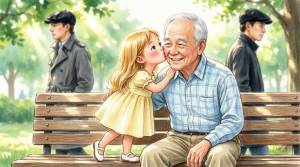
That September afternoon at the park seemed normal enough. Ivy sat beside me on our usual bench, telling me about her spelling test. She’d gotten an A. I told her I was proud. She smiled that same smile Willow used to have, and for a moment, everything felt okay.
Then she stopped smiling.
“Grandpa.” Her voice dropped to a whisper. She glanced over her shoulder toward the playground, then leaned in close. “Please stop sending money. The money to Daddy.”
I blinked. “What?”
Her little hand gripped my sleeve, and I saw something in her eyes I’d never seen before: fear. “Please stop. There’s something you need to see. Just watch him, Grandpa. Watch Daddy. You’ll see.”
She pulled away suddenly, hopping off the bench. “I have to go. He’ll be mad if we’re late.”
The Seeds of Suspicion
The drive to Brad’s house was silent. Ivy stared out the window, clutching her backpack like a life preserver. Brad’s house is a modest two-story on Maple Street. I’d helped him with the down payment four years ago—another check I’d written without thinking twice.
He was waiting on the front steps when we pulled up. “You’re late,” he said flatly.
Ivy hurried inside without saying goodbye. I stood on the sidewalk, watching through the window as she sat at the dining room table. Brad walked right past her, phone pressed to his ear, not even glancing her way. Something twisted in my gut.
“Brad,” I called out. “Is everything okay with Ivy?”
He shrugged. “She’s fine. Kids get moody.” He paused, then added, “Hey, any chance you could send next year’s payment early? Got some expenses coming up. House stuff.”
“Next year’s payment?” It was only September. “Forget it. January is fine.”
The door closed. I sat in my car, hands gripping the steering wheel. Watch him, Ivy had said. $40,000 a year. $280,000 over seven years. That was a lot of money for a man who barely said thank you.
I drove home as the sun set. The house was quiet. Willow’s urn was sitting on my mantle; I’d kept it there for seven years because I couldn’t let go. I lay awake that night staring at the ceiling. What did Ivy mean?
The night they told me Willow was dead, I didn’t believe them. It was 3:00 a.m. on March 15, 2017. Two officers stood on my porch. They said she hit a tree on Route 9 and the car engulfed in flames. Brad had identified her from dental records.
After Gloria died six months later, the Harper Family Market became my anchor. I kept my promise to Willow to take care of Ivy. But Brad never sent updates. No pictures, no dinner invitations. Just a quick “Thanks” via text every January.
A Familiar Face in the Coffee Aisle
On Tuesday morning at the market, a woman walked in at 9:15. She wasn’t a regular. She was in her mid-30s with dark hair and a leather jacket. She bought a bag of ground coffee and a jar of cinnamon.
As she passed the register, something tugged at my memory. “Ma’am,” I called. “Have we met?”
She didn’t look up. “I don’t think so.” She pushed through the door and left.
Twenty minutes later, I stepped outside to bring in the sign. I saw her across the street beside a silver sedan. She wasn’t alone. Brad was with her. They were talking, laughing. She touched his arm, and they both got into the car and drove away.
Coffee and cinnamon. The combination unsettled me. I called my old friend Roger Stevens, a retired detective. “Need to talk,” I messaged. He was there in twenty minutes.
I told him everything—Ivy’s warning, the money, and the woman. Roger’s face was serious. “Seven-year-olds don’t say things like that unless something is wrong,” he said. “We start simple. I’ve still got some equipment. We’ll park down the street from Brad’s place and watch.”
The Empty Truth
Before meeting Roger the next morning, I looked at my own records: $280,000 total. And I had nothing to show for it. No thank-you notes, no receipts.
I stood in the living room, staring at that brass urn. The woman at the store had bought coffee and cinnamon. Why did that stick in my head? I lifted the urn from the mantle. It felt cold. “Forgive me, Willow,” I whispered, and I twisted the lid.
The lid came off too easily. Inside was a clear plastic bag. I opened it and let the contents run through my fingers. It wasn’t ash. It was coarse and grainy. I smelled it.
Coffee. And underneath it, the sweet, spicy scent of cinnamon.
The kitchen tilted. I dumped the bag onto the table. It was kitchen scraps. A joke. My wife had died of a broken heart believing her daughter’s ashes were in this box, and it was a bag of Starbucks and baking spices.
The rage was suffocating. If the urn was fake, the funeral was fake. If the funeral was fake… was the body?
I called Roger. “The urn is fake. It’s coffee and cinnamon.”
The Warehouse on East Industrial
We began surveillance. Brad’s routine was clockwork: leave at 7:45, home at 6:00. The woman in the silver sedan visited every other afternoon. She had a key.
On the fourth morning, Brad left at 10:00 a.m. We followed him to a brick warehouse, Building 447, in the industrial district. He went inside for 45 minutes and then left.
The next day, Roger came to my house with his laptop. “I need you to sit down,” he said. He had accessed traffic camera footage from near the warehouse. He zoomed in on a woman walking toward the side entrance.
I leaned closer to the screen. The tilt of the head, the shape of the nose… even with darker hair and an older face, it was unmistakable.
“97% match,” Roger said softly. “Steven, that’s Willow.”
My daughter was alive. For seven years, I had talked to an empty grave while my daughter was a mile away. But Roger reminded me of what we heard through the warehouse walls during our scout: crying and pleading. “She’s being held there,” Roger said. “And Brad is the one keeping her.”
The Confrontation
We went to the warehouse that night. It was cold and industrial. In a back corner, past piles of debris, was a makeshift home: a twin bed, a hot plate, and photos taped to the wall. Every photo was of Ivy.
Willow was sitting on the bed. When the door creaked, she looked up. She was gaunt, with dark circles under her eyes and small white scars on her arms.
“Dad,” she whispered.
I wanted to scream, but Roger kept me steady. Willow broke down. She told us a story of a fight seven years ago with her friend, Natalie. She said Natalie had fallen, hit her head, and died. Brad had convinced her it was an accident but told her she’d go to prison. He told her she had to disappear to protect Ivy.
“Brad staged the accident,” she sobbed. “He said if I stayed hidden, Ivy would be safe. He brought me food and photos. I didn’t know about the money, Dad. I swear.”
Roger pulled out his phone. “Willa, I ran Natalie Hughes’s name. This photo was taken three days ago at a coffee shop.”
Natalie was alive. The “death” was a lie. The “accident” was a scam. Brad and Natalie had been together for ten years. They used Willow’s guilt to imprison her while they lived off my $40,000 a year. And now, they were planning to flee to the Cayman Islands with the remaining $60,000.
The Sting
We coordinated with Detective Kevin Walsh. We fitted Willow with a wire. She went back to the warehouse to wait for Brad and Natalie.
Roger and I sat in the car, listening through earpieces. Brad and Natalie arrived, sounding cheerful. They talked about their flight the next day. Willow confronted them.
“I know Natalie is alive,” she said, her voice stronger than I’d ever heard it.
Brad didn’t even deny it. “We needed the money,” he said casually. “Your father never questioned it. It was just business.”
Natalie laughed about the urn. “Coffee and cinnamon. He kept that thing for seven years.”
But then, the tone shifted. Brad realized Willow was a liability. “We can’t risk her talking,” Natalie hissed.
I heard the sound of a struggle. “Let go of me!” Willow cried.
That was the signal. I didn’t wait for the police. I threw open the warehouse door.
“Get away from my daughter!” I roared.
The warehouse swarmed with officers. Brad tried to run but was tackled by Walsh. Natalie stood still, her expression blank.
“Brad Wallace, Natalie Hughes, you’re under arrest,” Walsh announced. “We recorded everything.”
Restoration
The trial lasted two weeks. The jury heard the wire recordings and saw the coffee-filled urn. Brad was sentenced to 15 years; Natalie got 12. Even the cousin at the morg who provided the “remains” got 5 years.
The money mattered less than the healing. It took time, but Ivy and Willow began to rebuild. At first, it was just an hour at a time. Then, Ivy asked Willow to teach her how to braid hair.
Healing isn’t a straight line, but it’s happening. Every Sunday, we visit Gloria’s grave. We tell her Willow is home.
I spent seven years paying for a lie, mourning a daughter who was alive but imprisoned. I wanted revenge, but I found something better: redemption.
Anger is easy. Forgiveness is hard. But healing? Healing is worth every second.
If this story touched you, I’d love to hear your thoughts. Have you ever had to fight for the truth in your own family? Drop a comment below.