Part 1
Mason’s voice hit me before the warm air did.
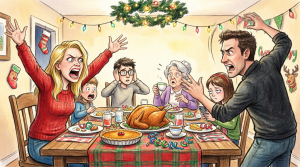
“Where were you? Seriously—where the hell were you?” He stood at the edge of the dining room like he owned the oxygen, jaw tight, eyes flicking past me to the clock on the wall. “My family’s been sitting here for an hour. Hungry. And the table’s still not set.”
I didn’t flinch. Not because I was brave, but because I’d run out of places inside me that still reacted.
Snow slid off my coat in slow drips, pattering onto the hardwood by the entryway. The pine garland over the banister smelled like sap and cinnamon oil, and the whole house carried that slightly scorched sweetness from the candles his mom insisted on lighting every year—vanilla something, too strong, like someone trying to cover up a different smell.
At the table, his family sat in their Sunday-best Christmas outfits, stiff-backed and careful-eyed. His dad had a napkin folded into a perfect triangle on his lap. His sister Paige stared down at her phone like it was the most fascinating thing in the world. His mom looked straight at me but not really at me, the way people look at a dent in their car they don’t want to talk about.
Nobody moved. Nobody told him to stop.
In my right hand, I still held my keys. They were so cold they burned. My left hand was buried in my coat pocket, fingers curled around something flat and rigid, edges sharp enough to remind me it was real.
Mason took a step closer, lowering his voice the way he did when he wanted it to sound like he was being reasonable. “It’s Christmas. You couldn’t just… be here? Like you promised?”
“I’m here,” I said.
He laughed once, humorless, and threw a look over his shoulder toward the dining room like I was the punchline. “You call this here?”
Behind him, the chandelier glowed too bright, bouncing off the polished table like an interrogation lamp. In the center sat his mom’s big ceramic Santa, smiling like a liar. A covered serving dish waited beside it, lid fogged with heat. Something buttery and meaty leaked into the air—ham, probably. Or turkey. Mason liked to pretend it didn’t matter because he “wasn’t picky,” but he always knew exactly what he wanted.
And he always wanted me to do it.
I could have said a hundred things. I could have said: I worked until midnight last night because the clinic was short-staffed and the ER was packed with people who didn’t have families to nag them about place settings. I could have said: you invited them for three o’clock even though I asked for five. I could have said: you have hands, you have a brain, and I’ve watched you set up a grill with the precision of a NASA engineer, so don’t act helpless now.
Instead, I took off my boots slowly. One. Two. I lined them up on the mat the way I always did because Mason liked things “clean.” My wet socks squeaked faintly on the floor.
His mom cleared her throat, soft, performative. “Harper, honey… we just didn’t know where you went.”
The word honey felt like a sticky trap.
“I had something to do,” I said, and kept my voice even. My throat tasted like cold air and old coffee.
Mason’s eyes narrowed. “Something to do,” he repeated, like he couldn’t believe the audacity of me having a life outside his schedule. “On Christmas Day.”
I started unbuttoning my coat. My fingers were clumsy, stiff from the cold and from the way my pulse had decided to settle into a slow, steady beat. Calm didn’t always mean peace. Sometimes it meant you’d already decided what you were going to burn down.
The last button popped free, and the air in the house felt too warm, too dry. I could hear the furnace kicking on and off, a faint metallic sigh in the vents. Somewhere in the kitchen, a timer beeped impatiently, and no one moved to turn it off.
Mason snapped his fingers once, sharp. “Well? Are you going to start setting the table or stand there making us all wait more?”
Paige’s head lifted just enough for her to peek at me over the rim of her phone. Her eyes flicked to my coat pocket. Just the smallest movement, like she’d seen it too.
I stepped past Mason without touching him. The space between us felt electric, not with chemistry, but with danger. His cologne—cedar and pepper—hit me, and beneath it, something else. A sweet floral that didn’t belong in our house.
Laundry detergent? A hand lotion? A perfume?
A memory flashed: Mason in our bedroom a few weeks ago, tugging his shirt over his head, the fabric catching the light just right so I saw a faint smear on the collar, pale pink, like lipstick blotted too hard. I’d asked what it was. He’d said, “Probably your makeup,” and kissed my forehead like I was adorable for noticing.
I wasn’t adorable anymore.
In the kitchen, the counters were already crowded with dishes and foil and Mason’s mom’s casserole carriers. The sink was full of cloudy water and utensils, like someone had started cleaning and given up halfway. The air smelled like roasted garlic and rosemary, and under it, that over-sweet vanilla candle trying to fight for control.
I grabbed a stack of plates from the cabinet. My hands moved automatically—plate, plate, plate—because my body remembered how to be useful even when my mind was elsewhere. I set them down on the counter and reached for the silverware drawer.
Mason followed me, of course. He always did, like my existence was a show he’d paid to see. He leaned against the doorway, arms crossed, watching.
“You know,” he said, casual and cruel, “my mom offered to handle dinner this year. But I told her you’d want to do it. You love this stuff.”
I snorted before I could stop myself.
He blinked, offended. “What?”
“Nothing,” I said, and pulled out forks. The metal was cold against my fingertips, the tines catching the kitchen light like little teeth.
Mason pushed off the doorway and came closer. “Harper. Don’t do that. Don’t get an attitude in front of them.”
“In front of them,” I repeated softly, and something inside me shifted. Like a lock clicking.
He didn’t hear it. Mason never heard the important sounds until it was too late.
From the dining room, his mom called, “Mason, sweetheart, is everything okay?”
“Fine,” he called back, smiling with his voice. Then he turned to me and dropped the smile. “Just… hurry up.”
I carried the forks into the dining room and started placing them beside the plates already set out. Except—halfway down the table—I stopped.
Because there was an extra place setting.
Not just extra like “we forgot to put one away.” Extra like it had been planned. A plate, a folded napkin, a wine glass polished so clean it caught the chandelier and threw it back in tiny sparks.
And in front of it, a name card.
White cardstock, simple black marker. Block letters.
SAVANNAH.
The room seemed to tilt. The noise of everyone’s breathing suddenly got loud. My skin prickled under my sweater like the cold had followed me inside.
Mason noticed my pause and frowned. “What now?”
I didn’t answer right away. I stared at that name like it might move, like it might explain itself if I looked hard enough.
Because I hadn’t written it. And nobody in his family was named Savannah.
My stomach dropped with a slow, ugly certainty as I lifted my eyes to Mason’s face and saw the flicker of panic he tried to hide—so who exactly was coming to Christmas dinner?
Part 2
I forced my hands to keep moving.
Fork down. Knife down. Smile on. Breathe in through my nose like the air didn’t taste like warning.
“Harper?” Mason’s mom leaned forward slightly, her pearl earrings swinging with the motion. “Sweetheart, are we expecting someone?”
Mason answered too fast. “It’s nobody.”
That was funny, because people with “nobody” don’t get a name card.
I kept my gaze on the table as I adjusted the napkin at Savannah’s seat, making it look casual. My fingertips brushed the paper, and I felt a faint indentation where someone had pressed hard with the marker. Like they’d written the name with emphasis. Like they were proud of it.
Mason stepped behind me, close enough that his breath warmed the back of my neck. “Don’t make this a thing,” he murmured, low.
I straightened slowly and turned, my face neutral. “Who’s Savannah?”
His eyes flicked toward his family. Then back to me. “It’s for a client.”
I almost laughed again. Mason’s “clients” were usually just guys from his dad’s construction circle who wanted discounts and favors and to drink beer in our garage while pretending the world was simple.
“A client,” I said.
“Yes,” he snapped, and his jaw worked like he was chewing on a lie. “Paige invited her. It’s business. She’s stopping by. Don’t—Harper, don’t do your weird suspicious thing right now.”
Paige’s head jerked up. “Wait, what?” She looked genuinely confused, eyes widening. “I didn’t—”
Mason shot her a look so sharp she shut her mouth mid-word. Her cheeks flushed a deep, blotchy red, and she stared down at her lap.
So Paige hadn’t invited her.
I filed that away with everything else I’d been filing away for months: the late-night “work calls” in the garage, the sudden new password on our shared laptop, the way Mason had started grabbing the mail before I could. The way he’d gotten weird about me touching his wallet, like I might steal something from him, when he was the one who’d been quietly siphoning pieces of my life.
His mom clasped her hands like she was praying. “Well, I don’t care if the Pope is coming, I’m starving,” she said with a brittle laugh. “Let’s eat.”
Chairs scraped. Plates clinked. The family shifted into performance mode—holiday voices, polite laughter, the kind of normal that makes you feel crazy for seeing what’s underneath.
Mason pulled out his chair at the head of the table, the king returning to his throne. He waited until everyone was seated before he sat, like he wanted the moment to land.
I stayed standing.
“Harper,” Mason said through a smile. “Sit.”
“I forgot the gravy,” I lied. “And the rolls.”
His mom’s eyes widened. “Oh Lord, not the rolls.”
“I’ll get them,” I said, already turning away. My heart thudded once, slow and heavy, the way it did when I was about to open a door I couldn’t close again.
In the kitchen, the timer was still beeping, insistent and bright. I hit it off and opened the oven, heat blasting my face. The smell of browned butter and yeast hit me, and for a second I was back in my childhood kitchen, my mom humming, flour dusting her hands. That memory always came with a sting now, sharp as the cold edge of grief.
Mason’s mom had told everyone my mother’s death “made Harper fragile.” Mason used that word too, whenever I didn’t immediately fold myself into the shape he wanted.
Fragile people don’t survive what I’d been surviving.
I set the rolls in a basket and reached into the fridge for the gravy boat. As I leaned down, I noticed a manila folder tucked behind the milk, shoved back like someone had hidden it fast. The corner was bent, and a strip of tape ran across it like a cheap seal.
My name was written on the tab.
HARPER LANE.
My stomach tightened.
The fridge hummed, low and steady. The candle on the counter flickered like it was holding its breath.
I pulled the folder out, careful, like it might bite. It was thicker than it should’ve been, stuffed with papers that smelled faintly like toner and stale air-conditioned offices.
Footsteps behind me.
I slid the folder onto the counter and turned just as Mason walked in, his smile already arranged. “Everything okay?” he asked, too loud for the kitchen.
I held up the gravy boat. “Just grabbing this.”
His gaze dropped to the folder. The smile didn’t change, but something in his eyes did—tightened, sharpened.
“That’s nothing,” he said quickly, reaching for it.
I put my hand on it first. “Why is this in the fridge?”
He blinked, and for a second he looked genuinely thrown off, like his script had skipped a page. Then he chuckled. “My mom put it there. She’s always shoving stuff in random places.”
From the dining room, his mom called, “Mason, did you tell Harper we’re doing gifts after dinner?”
“So it wasn’t her,” I said softly.
Mason’s throat bobbed. “Harper…”
I flipped the folder open.
The first page was a loan application with our address at the top. The next was a printed copy of my driver’s license—front and back—perfectly scanned. Then a bank form with my Social Security number typed out in neat little boxes.
My skin went cold.
Mason reached for the papers, but I slid them back, scanning faster now, my eyes snapping from line to line. There were signatures—mine, apparently—looped and familiar at a glance.
Except they weren’t.
They were too neat. Too careful. Like someone tracing me.
At the bottom of the stack was a loan agreement with my name printed twice. One signature line was blank.
The other wasn’t.
A perfect copy of my handwriting sat there in blue ink, my name written like I’d signed it without hesitation.
My fingers went numb as the blood rushed in my ears. I lifted my eyes to Mason’s face and watched him realize I could see it too.
Someone had already signed for me.
So what else had they taken while I was busy being the “good” wife?
Part 3
I walked back into the dining room carrying the rolls and gravy like my hands weren’t shaking.
The table smelled like warm ham glaze and sharp cranberry sauce, sweet and acidic. Mason’s dad had already carved a thick slab of meat and was chewing like he wanted to get the whole meal over with. Paige picked at her food, eyes darting from Mason to me like she was watching a tennis match she didn’t understand.
Mason stood when I came in, too polite, too eager. He took the gravy boat from my hands like he was rescuing me from myself.
“There we go,” he said, bright. “Now we can finally eat.”
I slid into my chair halfway down the table, close enough to hear everything but not close enough to be trapped at the head. My chair legs scraped the floor, loud in the sudden silence.
Mason sat, then leaned back and raised his glass. “To family,” he said.
“To family,” his mom echoed.
The word landed wrong in my chest.
We ate. Or rather, they ate and I moved food around my plate like an actress miming appetite. The lights above us made the silverware gleam and the wine look like blood. Mason told stories—safe, practiced stories—about work, about “crazy customers,” about how he “doesn’t know what he’d do without Harper keeping him organized.”
His mom laughed on cue.
I watched his hands. The way he held his fork. The way his ring glinted when he gestured. The way his thumb kept rubbing the edge of his napkin, over and over, like he was sanding down a rough spot.
He was nervous.
Mason wasn’t nervous about dinner. He wasn’t nervous about his family.
He was nervous about me.
Halfway through the meal, Mason’s dad cleared his throat. “So,” he said, wiping his mouth with his napkin, “Mason tells me you’ve been doing real well at the clinic.”
“Busy,” I said.
“That’s good,” his dad said, nodding like he’d just approved of my existence. Then he reached under his plate and pulled out a thin stack of papers.
My heart punched once against my ribs.
He slid them across the table toward me. “We just need your signature on something real quick. Nothing major. Just helping the family out.”
Mason’s mom smiled like she’d been waiting for this. “It’s such a blessing, Harper. You’re so responsible. Such good credit.”
There it was. The real reason I’d been invited to be humiliated, fed, and smiled at.
Mason placed a pen on top of the papers with a gentle tap, like he was setting down a weapon.
“Just sign,” he said softly, eyes locked on mine. “Then we can do gifts.”
My fingers touched the edge of the document. The paper felt thicker than normal printer paper—official. The top line had my name typed out, and beneath it, a paragraph of dense legal wording that made my vision blur.
I didn’t read it. I didn’t have to.
I’d already seen the version in the fridge with my forged signature.
Mason’s foot nudged mine under the table, a warning disguised as intimacy. “Harper,” he murmured. “Don’t do this in front of them.”
Don’t do what?
Don’t refuse? Don’t ask questions? Don’t stop being useful?
I looked up and met his gaze. His eyes were that familiar hazel that used to feel warm and safe. Now they looked like glass—pretty, hard, and easy to cut yourself on.
I smiled.
It surprised him. His shoulders loosened a fraction, like he’d won.
“Sure,” I said, and his mom actually sighed in relief. “But I want to do gifts first.”
Mason blinked. “What?”
“I want to do gifts first,” I repeated, still smiling. I reached for my water, took a slow sip, and let the cold slide down my throat like a reset. “It’s Christmas. Let’s not make it all about paperwork.”
His dad frowned. Mason’s mom’s smile twitched.
“We always do gifts after dinner,” she said.
“New tradition,” I said lightly. “Just this year.”
Mason’s jaw tightened. His hand flattened over the papers like he was trying to pin them down. “Harper,” he said, voice low, “stop.”
Paige suddenly pushed her chair back hard enough that it squealed. “I need air,” she blurted, and stood.
Mason snapped, “Sit down.”
Paige flinched like he’d slapped her. Her eyes flashed, not at Mason—at me. Then she grabbed her napkin, crumpled it in her fist, and walked out toward the hallway.
The room held its breath.
Mason’s mom forced a laugh. “She’s so dramatic.”
But Mason wasn’t watching Paige. He was watching me, measuring.
I stood slowly, picking up my wine glass like I was calm enough to enjoy it. “I’ll check on her,” I said.
Mason’s hand shot out and grabbed my wrist under the table, fingers tight. His nails bit into my skin.
I leaned in, close enough that I could smell that sweet floral on him again. “Let go,” I whispered, my smile still in place.
His eyes flicked to his family. He released me like I’d burned him.
In the hallway, the air was cooler, quieter. I found Paige in the guest bathroom, perched on the edge of the bathtub with her head in her hands. The light above the mirror buzzed faintly, and I could hear the faint echo of laughter from the dining room like a TV show playing in another house.
Paige looked up when I entered. Her mascara was smudged at the corner of one eye.
“Don’t sign anything,” she said, voice shaking. “He’s… he’s desperate.”
My mouth went dry. “What do you mean?”
Paige swallowed hard. “Just—don’t.” She stood and pushed past me, then paused long enough to press something into my palm: a folded scrap of paper, damp from her sweat.
On it, in rushed handwriting, were four words.
He’s not his name.
Before I could ask what that meant, the doorbell rang.
A clean, bright chime that cut through the house like a knife.
Down the hall, I heard Mason’s chair scrape back. Heard his mother’s voice jump too high: “Oh! That must be—”
I walked toward the front door on legs that felt too light. Through the frosted glass, a woman’s silhouette shifted. Snow clung to the shoulders of her coat. The porch light made her outline glow.
Then I heard her voice, clear and familiar in the way it didn’t belong here.
“Mason?” she called, saying his name like a secret she’d kept too long.
My heart thudded once, heavy and final—who was Savannah to him, and why was she here now?
Part 4
Mason opened the door with a smile that looked stapled on.
“Savannah,” he said, too cheerful. “You made it.”
The woman on the porch wasn’t what my brain had pictured when it saw that place card. She wasn’t twenty-two in sparkly heels and a red dress. She was mid-thirties maybe, hair pulled into a low bun under a knit hat, cheeks pink from the cold. Her coat was plain, dark green, the kind you buy because you need it, not because it’s cute.
In one hand, she held a slim leather folder. In the other, a small bakery box dusted with snow.
Her eyes moved past Mason and landed on me. They were sharp, assessing, the eyes of someone who’d spent a lot of time watching people lie.
“Hi,” she said to me, then back to Mason. “We need to talk.”
Mason laughed, low. “About the loan? We can do that next week.”
Savannah’s mouth didn’t move into a smile. “No. We need to talk now.”
Mason tried to block the doorway with his body. “This is family dinner.”
Savannah took one step closer, and I saw it then—what she was wearing clipped to her belt, half-hidden by her coat.
A badge.
My stomach dropped in a different way this time—less shock, more grim recognition. Of course.
Of course he’d brought someone official into this.
“Harper,” Mason said, turning his head toward me without taking his eyes off Savannah. His voice turned sweet, the way it did when he wanted me to play along. “Can you—”
“I’m Savannah Rios,” she said, cutting through him. “Fraud investigations.”
Behind her, down the walkway, two uniformed officers stood near the steps. Their breath puffed white in the cold. One of them had a hand resting near his belt, casual but ready.
Mason’s face shifted. The smile cracked.
Savannah held up the leather folder. “I spoke to you on the phone last week. You told me you’d come into the branch.”
Mason blinked fast. “I don’t know what you’re talking about.”
“You do,” she said. “And I’m done doing this in circles.” She glanced at the dining room where Mason’s mom and dad had risen from their seats, hovering like birds that sensed a storm.
“What is this?” his mom demanded. “Who are you?”
Savannah stepped inside, wiping her boots on the mat like she belonged here. “Ma’am, I’m sorry to show up like this, but we have reason to believe Mason—” she paused, eyes flicking to Paige’s note in my pocket like she somehow knew it existed, “—the man you know as Mason has been using stolen identities to secure loans and move money through accounts tied to this address.”
The room went dead quiet.
The only sound was the faint Christmas music still playing from the living room speaker—some cheerful jingle about mistletoe that suddenly felt obscene.
Mason’s dad’s face went purple. “That’s insane,” he barked. “Our son—”
Savannah opened the folder and pulled out a sheet of paper, holding it up. “This is a loan agreement signed in Harper Lane’s name.”
All eyes turned to me.
Mason’s mom looked at me like I’d set the tree on fire. “Harper,” she whispered. “What did you do?”
I laughed once—small, breathy, not amused. “Me?”
Mason stepped toward me fast, palm out, like he could physically shut me up. “Harper, don’t—”
Savannah held up a hand. “Mrs. Lane, we’d like to ask you a few questions.”
Mason jumped in, voice rising. “She has nothing to do with this. This is a misunderstanding. You can’t just barge into my house—”
One of the officers stepped inside, calm as stone. “Sir, we can. We have a warrant.”
The word warrant sucked the air out of the room.
Mason’s mom made a choking sound. His dad’s hand clenched into a fist on the back of his chair.
Mason’s eyes snapped to me, and in them I finally saw it—real fear, stripped of charm.
He mouthed, Harper.
Like I was supposed to save him.
I reached into my coat pocket, the one I’d kept on the back of my chair like an excuse, and pulled out what my fingers had been holding all night. A small red envelope. Not festive red—deep, almost blood red, the kind you use when you want something to look like a gift but feel like a threat.
I walked past Mason and set it on the table in front of Savannah.
The paper made a soft slap against the wood, louder than it should’ve been.
Savannah’s gaze flicked up to mine. “Is that what I think it is?”
I nodded. “Everything I could get. Copies. Photos. Screenshots. Dates. Names I didn’t understand until recently.”
Mason lunged for the envelope.
The officer caught his wrist and twisted just enough to stop him. Mason hissed, teeth flashing.
Paige made a small, broken sound. “Oh my God,” she whispered.
Mason’s mom whirled on me, face twisted with rage. “You brought the police here? On Christmas?”
I looked at her, really looked. At the lines around her mouth from years of disapproval. At the way she’d watched Mason speak to me like I was furniture and called it “marriage.” At the way she’d just tried to blame me for his crimes.
“You invited me to sign my life away,” I said quietly. “On Christmas.”
Savannah opened the envelope and began pulling out what I’d packed inside: printed bank statements, a list of account numbers, copies of the forged signatures, and one flash drive taped to a note with my handwriting.
Mason’s breath came fast now. “Harper, please. We can fix this.”
Fix it. Like it was a crooked picture frame.
The officers moved past the dining room toward the stairs. Savannah spoke into her phone, giving a calm update, and I caught fragments: multiple identities, false documentation, interstate.
Mason’s dad tried to follow the officers. “You can’t go upstairs,” he yelled. “That’s private!”
An officer didn’t even turn around. “Sir, step back.”
Mason’s mom sank into a chair like her bones gave up. Her hand flew to her chest, fingers trembling.
I felt… nothing. Not victory. Not joy.
Just the clean, sharp edge of reality: this was who he was.
A crash upstairs—drawer pulled out, something dropped. Then heavy footsteps.
Savannah turned her head toward the staircase as the officers came back down. One of them carried a small black safe, the kind you keep passports and jewelry in.
Mason’s face went white. “No,” he croaked.
The officer set the safe on the dining table right beside the ceramic Santa. Savannah entered a code she must’ve already had, and the lock clicked open with a quiet, decisive sound.
Inside were stacks of cash, a passport, and a handful of IDs with different names.
And then Savannah’s fingers paused on something small and familiar.
She lifted it carefully.
A gold ring.
My mother’s ring.
The one I’d thought I’d lost the year she died, the one I’d torn the house apart searching for, the one Mason had held me while I cried and promised we’d find it together.
The gold caught the Christmas lights and threw them back in my face.
I stood there, frozen, the room swaying around me as Savannah held it up like evidence.
I’d been hunting his lies for months—but why had he kept the one thing that mattered most to me?
Part 5
I left before anyone could figure out what to say.
Not because I was running. Because I didn’t want Mason’s last memory of me to be his version—crying, begging, breaking. I wanted it to be the truth: me walking out like I finally remembered I had legs.
Outside, the cold slapped my cheeks raw. The snow had thickened into soft, steady flakes, blurring the streetlights into glowing halos. My breath came out in visible bursts, and for a second I just stood on the porch, listening.
Inside, I could still hear muffled shouting—Mason’s dad demanding answers, his mom sobbing, Mason’s voice sharp and frantic like a cornered animal. The officers’ voices stayed calm, like they’d seen this play a hundred times.
I walked to my car with my keys clenched so tight the metal bit into my palm.
The engine coughed, then caught. Warm air slowly crawled from the vents, smelling faintly like dust and old peppermint gum. I stared through the windshield at the house, at the soft glow of the Christmas tree in the living room window.
For years, that tree had been a symbol of “us.” Our tradition. Our life.
Now it looked like a staged set in a play where the actors had finally started telling the truth.
My phone buzzed.
A text from Savannah: Don’t leave town. We’ll need your statement tomorrow.
I stared at the words until they blurred.
Then another buzz.
Paige: I’m sorry. I didn’t know how to tell you.
I didn’t answer.
I drove.
Not far—just to the far edge of town where the roads were quieter and the houses didn’t look like they were judging you. I pulled into the parking lot of a small, cheap motel with a flickering sign and a lobby that smelled like bleach and burnt coffee. It wasn’t glamorous. It wasn’t romantic.
It was mine, for the night.
In the room, the heater rattled like it was full of coins. The bedspread was patterned with faded flowers that had seen better decades. I sat on the edge of the mattress, still wearing my sweater, and finally let my shoulders drop.
My fingers were shaking now that I wasn’t performing.
I opened my purse and pulled out the small folded note Paige had given me. He’s not his name.
I thought about the safe. The passports. The IDs.
I thought about the ring.
I stared at the motel’s thin curtains and tried to breathe like the air wasn’t full of betrayal.
Morning came too fast.
By nine, I was sitting in a beige interview room at the station with a Styrofoam cup of coffee that tasted like cardboard. Savannah sat across from me, hair still pulled back, eyes still sharp, but her voice softer now.
“You did the right thing,” she said, like she’d seen too many people hesitate until it was too late.
I didn’t know how to respond to praise. I only knew how to survive.
Savannah slid a file toward me. “We found more,” she said.
My stomach tightened. “More like… what?”
“A storage locker,” she said. “In his—” she paused, “in the name he used for the lease. We recovered a key from his wallet when he was booked.”
My skin prickled. “He has a storage locker?”
Savannah nodded. “Unit’s under your county. We can’t open it without the right paperwork, but…” She tapped the file. “We also found a receipt for a hotel reservation. Tonight.”
My throat went tight. “A hotel.”
Savannah watched me carefully. “Do you know who he was meeting?”
I thought of the place card.
Savannah.
The name that had sat at my table like a ghost.
“I don’t know,” I said, and it was the truth. Or at least the truth I could admit out loud.
Savannah pushed a photo across the table.
It was a grainy printout from a security camera. Mason—Mason or whoever he really was—stood at a bank counter with a woman beside him. Her hair was dark. Her smile was bright. She leaned into him like she belonged.
The angle caught her profile and made her look almost familiar in a way that made my skin crawl.
“She’s not me,” I said quickly, like I needed the universe to hear it.
Savannah’s voice stayed even. “We don’t know who she is yet. But we will.”
After the statement, I drove to the storage facility with Savannah’s card in my pocket and a pressure in my chest that didn’t feel like panic anymore. It felt like momentum.
The storage place was a long row of metal doors under a gray sky. The air smelled like wet concrete and gasoline. A bored man in a neon vest led me down the row, keys jangling, and stopped at Unit 17.
“Police said you could look,” he said, scratching his neck. “Just don’t—like—break anything.”
I slid the key into the lock. My hands were steady again.
The door screeched open, metal on metal, and cold air rolled out.
Inside were suitcases stacked neatly. A duffel bag. A couple of plastic bins labeled in black marker.
And on top of the nearest suitcase sat a small wrapped box.
Silver paper. Red ribbon.
My name written on the tag.
HARPER.
My breath caught.
I stepped inside and picked it up, the ribbon rough under my fingertips. The box was heavier than it looked.
I set it down on a plastic bin and peeled back the tape.
Inside wasn’t jewelry.
It was a bundle of documents and a hotel keycard stamped in clean, black letters: ROOM 612.
Under it sat the printed receipt Savannah mentioned.
Tonight. 8:00 PM. Two guests.
My throat tightened until swallowing hurt.
What was waiting in that room—and why did it feel like the worst betrayal hadn’t even happened yet?
Part 6
The hotel was one of those sleek places downtown that smelled like citrus cleaner and money.
I parked across the street and sat in my car for a full minute, watching people drift in and out of the revolving doors. Couples in nice coats. A guy wheeling a suitcase. A woman laughing into her phone like the world had never hurt her.
My hands rested on the steering wheel, and I could feel my pulse in my palms.
Savannah had told me not to confront anyone alone. She’d told me to let them handle it. She’d told me the kind of people who live behind fake names don’t suddenly turn honest when cornered.
But I wasn’t walking into this blind. Not anymore.
I texted Savannah: I’m at the hotel. Room 612 keycard. If this is stupid, tell me now.
Her reply came fast: Wait in the lobby. I’m sending an officer in plain clothes. Do not go up alone.
I sat there, staring at that message until my breathing slowed. Then I stepped out into the cold and walked toward the doors, my boots clicking against the sidewalk like a countdown.
Inside, the lobby was warm and bright, all glass and polished stone. A Christmas tree taller than my living room stood near the bar, covered in gold ornaments that caught the light and made it sparkle like a lie that cost too much.
I took a seat in a corner chair with a view of the elevators. I kept my coat on. I kept my purse in my lap like armor.
Every few minutes, the elevator doors opened and closed, swallowing people and spitting them back out.
At 7:52, a woman walked in wearing a cream-colored coat with a fur-trimmed hood. She paused at the front desk, smiled at the clerk, and glanced around the lobby like she was looking for someone.
My stomach tightened—until I recognized her.
Not a stranger.
Not a mystery woman from a grainy photo.
My sister, Dana.
My older sister who’d hugged me at my mother’s funeral. Who’d told me Mason “seemed solid.” Who’d borrowed small amounts of money over the years and always paid it back late with a joke and a shrug. Who’d been quiet when Mason started talking over me at family gatherings, like she didn’t want to get involved.
Dana walked toward the elevators like she belonged there.
I stood before I could talk myself out of it.
My legs felt disconnected, like they belonged to someone else, but they carried me across the lobby anyway. The air smelled like pine from the tree and espresso from the bar and my own fear, metallic and sharp.
“Dana,” I said.
She froze.
Her shoulders lifted like she’d been caught in the headlights, then she turned slowly, forcing a smile. “Harper! Oh my God—what are you doing here?”
The way she said it—too bright, too casual—made something inside me go very still.
“I could ask you the same thing,” I said.
Dana’s eyes darted to the elevators. Then back to me. “I’m… meeting someone.”
“In Room 612?” My voice sounded calm even though my hands were trembling.
Her smile faltered. “What?”
I pulled the keycard from my pocket and held it up. “This room. Tonight. Two guests.”
Dana’s face drained of color so fast it was almost impressive.
For a second, she didn’t speak. She just stared at the keycard like it was a gun.
Then she exhaled sharply and grabbed my wrist, pulling me toward a quieter corner near a fake plant and a wall of framed abstract art.
“Not here,” she hissed. “Not in public.”
My pulse hammered. “How long?”
Dana’s eyes filled, but her expression didn’t soften. It hardened. Defensive. Angry. Like I’d inconvenienced her by catching her.
“Harper,” she whispered, voice tight, “you don’t understand. I was trying to—”
“To what?” I cut in. “Help him? Help yourself? Help me by lying to my face?”
Dana flinched. “It wasn’t like that.”
I laughed, low and shaking. “Then explain to me why my sister is checking into a hotel room my husband reserved under a fake name.”
Dana’s lips parted, and for a split second I saw the truth hovering there. Then she looked away, swallowing it back down.
“I needed money,” she said finally, flat. “Mom’s medical bills, after she got sick, I—”
“Mom died three years ago,” I said, and the words came out like ice.
Dana’s eyes snapped back to mine. Tears welled, real this time. “Okay, fine. I needed money for me. Is that what you want to hear?”
I stared at her, and the grief that hit me wasn’t even about Mason anymore. It was about the way betrayal multiplies when it comes from someone who shared your childhood.
“Did you give him my information?” I asked, voice low.
Dana’s silence answered before her mouth did.
My chest tightened so hard I thought I might actually fold in half. “You gave him my Social Security number.”
Dana’s chin trembled. “He said he just needed it for… paperwork. He said you agreed.”
I shook my head slowly, like I was watching something collapse in slow motion. “You didn’t even ask me.”
Dana’s voice rose, frantic. “Harper, I swear, I didn’t know he was doing fraud or whatever—he’s charming, okay? He makes everything sound normal—”
“Stop,” I said, sharp enough that she went quiet. I leaned in, close, and felt the heat of my anger like a fever. “Don’t defend him. Not now. Not ever.”
Dana’s eyes squeezed shut, and she whispered, “Please. Don’t ruin me.”
I stepped back. The words landed like a final insult.
Ruin you.
Like she hadn’t helped ruin me.
Behind us, the elevator doors opened. A man stepped out—mid-forties, plain black jacket, no holiday cheer in his face. He walked straight toward us with the calm focus of someone doing a job.
Savannah’s plain-clothes officer.
He glanced at me, then at Dana, and I watched Dana realize in real time that this wasn’t just a sister fight. This was consequences.
Dana’s breath hitched. “Harper—”
I looked at her, at the familiar shape of her face that suddenly felt like a stranger wearing my sister’s skin.
“I’m not saving you,” I said quietly. “Not this time.”
Dana’s shoulders sagged as the officer spoke to her, voice low, professional. Her eyes stayed on me like I was the one holding the cuffs.
Maybe I was.
Later, when I was alone again—really alone—I sat in my motel room with my coat still on and stared at my bare left hand where my wedding ring used to be. I’d slipped it off at the storage unit without ceremony and left it in the bottom of a bin like a discarded screw.
Mason would spin stories in court. Dana would cry and blame the world. Mason’s mom would call me heartless.
Let them.
I’d already spent too long being the person who made everything easier for everyone else.
A week later, I signed a lease on a small apartment across town. The first night, I ate takeout straight from the container on the floor because I didn’t own a table yet—and I didn’t feel ashamed. The silence felt clean. The air smelled like fresh paint and freedom.
On Christmas morning the next year, I made coffee and watched snow fall outside my own window, quiet as a promise. No yelling. No performance. No name cards for strangers.
My phone buzzed with a text from a number I’d saved months ago but hadn’t dared to use much: Dinner’s ready if you want company.
I smiled despite myself, warmth spreading in my chest like the first sip of coffee—could I finally learn what Christmas feels like when it belongs to me?
Part 7
The text sat on my screen like a dare.
Dinner’s ready if you want company.
I stared at it until the letters stopped looking like words and started looking like light—warm, human, possible. Outside my window, snow fell straight down, quiet as lint. The city was muted, like someone had turned the volume down on the whole world.
My thumb hovered over the keyboard.
I hadn’t been alone this past year, not technically. I’d had Savannah’s clipped check-ins, my lawyer’s emails that read like cold soup, coworkers who brought me muffins and didn’t ask too many questions. But company—the kind that asks nothing from you except your presence—still felt like a language I’d forgotten.
I typed: What did you make?
The reply came fast.
Roast chicken. Lemon. Garlic. I burned the first one. This one is redeemable. Come up if you want. No pressure.
No pressure. Two words that didn’t belong to Mason’s world.
I pulled on a clean sweater that smelled faintly like detergent and the lavender sachet I’d shoved in my dresser out of desperation. The mirror over my sink showed a face that still startled me sometimes—same cheekbones, same eyes, but different posture. Like my body had learned it didn’t have to brace for impact every time a door opened.
The hallway outside my apartment smelled like someone’s fried onions and old carpet. I locked my door twice out of habit, then made myself unlock it once because I refused to be the kind of person who checks locks like a prayer.
His door—Unit 3B—was two floors down. I’d met Jordan three months ago when I couldn’t get the laundry room machine to take my quarters. He’d offered me a fistful of coins without making it weird, like it was the most normal thing in the world to help a stranger.
He wasn’t handsome in a magazine way. He was tall and slightly awkward, with hair that never seemed to pick a direction. He wore soft flannel shirts and always smelled faintly like coffee. The first time he’d seen the bruise-yellow shadow on my wrist from where Mason had grabbed me that Christmas, he hadn’t asked questions. He’d just held the door longer and said, “If you ever need someone to walk you to your car, I’m around.”
That had been enough.
When Jordan opened his door, warm air and roasted chicken rolled out, rich and sharp with lemon. His apartment was small but lived-in: a stack of books on the coffee table, a half-assembled shelf against the wall, a Christmas movie paused on the TV like he’d started watching it and then decided silence was better.
“Hey,” he said, and his smile was cautious, like he didn’t want to scare me off.
“Hey,” I said back, and surprised myself by stepping inside.
A pot simmered on the stove. Something buttery hissed in a pan. The lights were dim, not theatrical, just gentle. A little paper snowflake was taped crookedly to his window, the kind kids make in school, which told me he’d either stolen it from a niece or he’d tried to make one himself and failed charmingly.
“You cooked,” I said.
“I attempted,” he corrected. “Sit. If you want wine, I have red and also a white that tastes like regret.”
I laughed. It came out rusty, like a hinge moving for the first time in a while. Jordan looked relieved, like that sound had been the whole point.
We ate at his tiny table, knees almost touching because there wasn’t room not to. The chicken was good—crispy skin, bright lemon, salt in the right places. The potatoes were a little overdone, edges dark. Jordan watched me try one and winced.
“They’re… committed,” I said diplomatically.
He groaned. “I knew it.”
“They’re fine,” I added, and meant it. Fine tasted incredible when no one was yelling.
For a while we talked about nothing: bad movies, the weird neighbor who played saxophone at midnight, how snow made the city look cleaner than it was. My shoulders loosened without my permission. My fork stopped clinking against my plate like my hand wasn’t shaking anymore.
Then my phone buzzed on the table.
Unknown number.
I didn’t pick it up. The screen lit my face for a second, an old reflex flaring—danger, surprise, something you didn’t schedule.
Jordan didn’t ask. He just kept chewing and let me decide.
The buzzing stopped. A voicemail icon appeared.
My appetite vanished.
I excused myself to the bathroom, shut the door, and listened with the volume low, like the voice might crawl out of the speaker and grab me.
A woman spoke, her voice thin and fast. “Harper? I’m sorry—this is going to sound insane. My name is Tessa. I… I think we were married to the same man.”
The room tilted.
I pressed my hand against the sink. The porcelain was cold enough to anchor me.
Tessa kept talking. “Not Mason. That’s not his name. I saw the news about the arrest, and the photo… I recognized him. I don’t know what you know, but I have paperwork. I have proof. Please call me back before he convinces everyone you’re lying.”
I ended the message and stared at my own reflection.
My eyes looked flat, like a lake right before a storm.
I went back out, and Jordan was stacking plates, moving quietly, giving me space without leaving me alone.
“Everything okay?” he asked gently.
I opened my mouth, then closed it. How do you explain that the man who broke you might have broken you in bulk, mass-produced like a scam?
“I got a weird call,” I said finally.
Jordan nodded once. “Do you want to leave?”
I realized he meant it literally—do you want to get out of here, out of your skin, out of the moment. Not do you want to run. Do you want help.
“No,” I said, surprising myself. “I want to call her back.”
Jordan washed his hands at the sink, then leaned against the counter like he was bracing for impact with me. “Do it here,” he said. “If that’s okay. You don’t have to do it alone.”
I dialed the number before my courage could evaporate.
It rang twice.
“Harper?” Tessa answered, breathless, like she’d been waiting with the phone glued to her ear.
“Yes,” I said, and my voice came out steadier than I felt. “Tell me everything.”
Silence, then a shaky exhale. “Okay,” she said. “But you’re not going to like it.”
My stomach clenched as I listened to her first sentence, and somewhere deep in my chest, a new kind of dread uncoiled—how many lives had he been living right beside mine, and how many more names was I about to learn?
Part 8
We met two days later in a diner off the highway that smelled like bacon grease and burnt coffee.
It was the kind of place where the vinyl booths squeaked when you slid in, and the menus were sticky no matter how often they wiped them down. A little plastic jukebox sat at each table, blinking uselessly. Outside, the snow had melted into gray slush that cars dragged into the parking lot in dirty ribbons.
I chose a booth with my back to the wall, facing the door. Old habits don’t die; they just get quieter.
Tessa walked in wearing a puffy black coat and a knitted scarf wrapped too tight around her neck. She looked younger than I expected—late twenties, maybe. She scanned the room like she was looking for an exit before she looked for me.
When our eyes met, she froze. Not because she didn’t recognize me, but because she did.
She slid into the booth across from me and set a folder on the table between us like it was evidence and an apology.
For a second we just stared at each other. Two women who’d been pulled into the same trap from different angles.
“You look like you sleep,” Tessa said finally, like it was an accusation and a compliment at the same time.
“I do now,” I said.
Her laugh cracked in half. “Must be nice.”
A waitress poured us coffee without asking. The steam rose, bitter and thin. Tessa’s hands trembled around the mug.
“I’ll start with the simple part,” she said, and her voice steadied as she talked, like facts were the only safe thing to hold. “His name with me was Eric Dawson. We got married in Vegas. It sounds so stupid when I say it out loud.”
“It doesn’t,” I said automatically, because I knew how easy it was to think you were making a choice when really you were being steered.
Tessa pulled the first document from the folder and slid it toward me.
A marriage certificate. Her name in print. His name beside it.
Eric Dawson.
The date was four years ago.
My throat tightened. I’d been married to “Mason” for three.
Which meant…
“He overlapped,” I whispered.
Tessa’s eyes glistened. “Yes.”
The diner noise went muffled around me. Plates clattered far away. Someone laughed near the counter. A kid whined about pancakes. Normal life, happening inches away from two women comparing wreckage.
“I didn’t find out because I was smart,” Tessa said quickly, like she needed me to know she wasn’t proud. “I found out because he disappeared. One day he was there, and the next day his number was disconnected. The apartment lease was under my name. The credit cards were under my name. And then the bank called and asked why I was applying for a business loan in another state.”
Her words hit like cold rain.
I stared at the certificate until the letters blurred. I could almost hear Mason—Eric—whatever he was—laughing softly as he poured me wine, kissed my forehead, told me I was overthinking.
“Did you report him?” I asked.
Tessa’s mouth tightened. “I tried. They treated me like I was embarrassed about an affair. Like I was making it up. Then I got served for debt I didn’t even recognize.” She swallowed hard. “I had to move back in with my mom. I work two jobs now. I’m still paying off… him.”
My fingers curled around my coffee cup so hard the heat hurt. Anger rose, hot and clean, and for once it didn’t have nowhere to go.
“What do you want from me?” I asked gently. Not because I didn’t want to help. Because I needed to understand the shape of what we were about to do.
Tessa lifted her gaze. “I want him to stop. I want him to actually pay for it, not just plead down and vanish again. And I want…” She hesitated, then said it like it tasted bitter. “I want someone to believe me.”
I nodded once. “I believe you.”
Tessa’s eyes filled and she looked away fast, wiping at her cheek like she hated herself for being human.
We sat there, trading pieces of him like trading cards: the phrases he used, the way he talked about “investment opportunities,” the way he got irritated when we asked about money but acted wounded if we didn’t trust him. The little tells—his left thumb rubbing his napkin, his habit of turning his phone face down like it was sleeping.
The more we compared, the more the pattern sharpened.
He chose women with stable jobs and soft hearts.
He chose women who were the “responsible one” in their families.
He chose women with grief he could exploit—dead parents, strained siblings, a hunger to build something safe.
I felt sick.
It hadn’t been random. It had been targeted.
When the waitress came back, Tessa didn’t touch her food. She just slid one more page across the table.
A photocopy of an ID.
Not Mason. Not Eric.
A third name.
And under it, a mugshot-style photo of him with shorter hair, older-looking, eyes colder.
Beneath the picture was a line of text that made my scalp prickle:
WANTED: MULTIPLE STATES.
Tessa leaned forward, voice low. “He’s been doing this longer than us,” she said. “He’s not just a liar. He’s… organized.”
My phone buzzed on the table, making both of us flinch.
This time the number wasn’t unknown.
Savannah.
I answered with a dry mouth. “Hello?”
Savannah’s voice was brisk. “Harper, are you somewhere you can talk?”
I glanced at Tessa, then at the diner door like it might suddenly swing open with him standing there smiling. “Yes.”
“We got confirmation on his identity,” Savannah said. “And he’s asking for you. He wants a private meeting before arraignment.”
My skin went cold.
“Why?” I asked.
Savannah paused, and in that pause I heard something I didn’t like: caution.
“Because he says there’s something you don’t know,” she said. “Something he thinks you’ll trade for.”
I stared at Tessa’s folder, at the names, the dates, the evidence stacked like bricks, and felt my stomach drop—what could he possibly still be holding over me, and why did it feel like he’d planned this conversation from the start?
Part 9
The jail visitation room smelled like disinfectant and old sweat, like someone had tried to clean despair and failed.
The chairs were bolted to the floor. A vending machine hummed in the corner, filled with snacks that looked too bright to be real. The overhead lights were harsh and flat, turning everyone the same color: tired.
Savannah sat beside me, posture straight, a file on her lap. A uniformed guard watched from the wall like we were animals in a zoo.
“Remember,” Savannah murmured without looking at me, “you don’t owe him anything. He’s going to try to steer the conversation. Don’t let him.”
I nodded, but my throat was tight.
The door buzzed, and he walked in.
He’d shaved. His hair was cut short. The orange jumpsuit made him look smaller than he’d ever looked in my kitchen, towering and loud. But his eyes were the same.
Hazel, clear, calculating.
He sat across from us with a slow smile that made my stomach twist. “Harper,” he said, like we were meeting for coffee.
I didn’t answer.
He looked at Savannah and tilted his head. “Agent Rios. You look tired.”
Savannah didn’t blink. “This isn’t a social call.”
He shrugged, then leaned forward toward me. “You look… better,” he said softly. “Less stressed. Guess you got what you wanted.”
My fingers tightened around the strap of my purse. Inside it, my hands were shaking, but my face stayed calm. I’d learned how to do that from him. Funny how survival steals tricks from predators.
“You asked to see me,” I said. “Talk.”
His smile thinned. “Straight to business. That’s my Harper.”
I flinched internally at the possessive tone. My Harper. Like I was a product he’d once owned.
Savannah slid a paper across the table. “You’re facing multiple counts,” she said. “Wire fraud. Identity theft. Forgery. This meeting is not going to change that.”
He didn’t look at the paper. His gaze stayed on me. “I’m not here to negotiate with you,” he said to Savannah. “I’m here to give Harper information.”
Savannah’s jaw tightened. “Anything you say will be documented.”
He lifted his hands like surrender. “Great. Document this.” He turned back to me, voice lowering. “Your sister didn’t just ‘make a mistake.’”
My stomach dropped anyway. Even when you expect a knife, it still cuts.
“What are you talking about?” I asked, and hated that my voice changed.
He watched that tiny crack with satisfaction. “Dana came to me,” he said. “Not the other way around.”
I stared at him, trying to map truth and lie through the familiar maze of his tone.
He continued, casual. “She had your information. She had access. She wanted money and she wanted it fast. She said you wouldn’t notice.”
My mouth went dry. I remembered Dana borrowing my laptop years ago, asking for a printer, rummaging through my desk like it was nothing. I remembered brushing it off because she was my sister.
He leaned closer. “You think I’m the villain,” he said softly. “And sure, I’m not a saint. But your sister? She sold you.”
Savannah’s pen scratched across paper, steady.
I forced air into my lungs. “Why are you telling me this?”
He smiled like I’d asked the exact question he wanted. “Because I can prove it.”
He reached into his jumpsuit pocket and slid a folded piece of paper across the table. The guard watched but didn’t stop him.
Savannah opened it first, eyes scanning fast. Her expression didn’t change, but her shoulders tightened.
She turned the paper toward me.
It was a photocopy of a handwritten note.
Dana’s handwriting—rounded, familiar—across the top: Harper’s SSN / DOB / License #.
Underneath, a sentence:
Use this. She won’t fight if you keep her ring.
My stomach lurched like I’d been punched.
I heard a sound and realized it came from me—small, broken, embarrassed.
He watched me swallow it down.
“See?” he whispered. “Not all betrayal comes from strangers.”
I stared at the paper until the ink swam. My mother’s ring. He’d kept it because Dana told him to. Like it was a leash.
My hands went cold.
Savannah’s voice cut in. “This isn’t going to help your case.”
He shrugged. “I’m not helping my case. I’m helping Harper understand her life.”
I looked up slowly. “You stole the ring,” I said, voice low. “You stole it years ago.”
He didn’t deny it. He just smiled like I’d finally caught up. “I kept it safe,” he said. “You’d have lost it.”
Rage flared so hot my vision narrowed. For a second I pictured standing up, tipping the bolted chair, lunging across the table.
But I stayed still.
“That ring wasn’t yours,” I said. “Neither was my name. Neither was my home. Neither was my marriage.”
His smile faltered—just a twitch. He didn’t like when I spoke like I saw him clearly.
He recovered fast. “If you want it back,” he said, voice soft, “there’s another storage unit.”
Savannah’s head lifted. “We already cleared—”
“Not that one,” he said, eyes locked on mine. “The one under your mother’s maiden name.”
My throat went tight. “What?”
He leaned in, and his voice turned intimate, like a secret between lovers. “Your mother had something,” he whispered. “Something she left behind. Dana knows. I know. You don’t.”
Savannah’s gaze sharpened. “What is it?”
He ignored her. He spoke only to me. “Meet with your sister,” he said. “Get her to tell you. Or don’t. But if you don’t, you’ll never know what she really did before your mom died.”
My skin prickled. The air in the room felt thinner.
He leaned back, satisfied, like he’d dropped a match in dry grass. “Merry Christmas, Harper,” he said quietly.
The guard stood, signaling the meeting was over.
I rose on legs that felt too light, the paper still burning in my mind, Savannah’s hand hovering near my elbow like she wasn’t sure if I’d collapse or run.
As we walked out, my phone buzzed again in my pocket. A new message from Dana lit my screen like a bruise:
Can we talk? Please. It’s important.
My stomach clenched with a new, colder fear—what was buried under my mother’s name, and what had my sister done to keep it hidden?
Part 10
Dana chose a coffee shop near the hospital, like she thought proximity to my old life would soften me.
The place smelled like espresso and scorched milk. The windows were fogged from too many bodies and wet coats. A barista called out names in a bored monotone, and Christmas music played too loud, trying to force cheer into the air.
Dana sat at a small table by the window with a paper cup in both hands, fingers white around it. She looked thinner than the last time I’d seen her, hair pulled into a messy knot, eyes red-rimmed like she’d been crying for days or sleeping for years.
When she saw me, her face crumpled with relief that made my stomach turn.
“Harper,” she breathed.
I didn’t sit. I stayed standing, coat still on, my purse strap wrapped around my wrist like an anchor.
Dana gestured to the chair. “Please.”
I sat only because I didn’t want a scene. Not because I wanted closeness.
Her voice shook. “I’m sorry.”
I stared at her coffee cup. The lid was stained with a drip of foam, dried and tan. Such a normal detail for such an ugly moment.
“I saw the note,” I said.
Dana’s face drained. “What note?”
“The one you wrote,” I said, voice steady. “With my Social Security number. The part about my ring.”
Her mouth opened, then closed. Her eyes flicked toward the door like she was looking for an escape hatch.
I leaned forward slightly. “Don’t lie,” I said quietly. “I’m done with lies.”
Dana swallowed hard. “Okay,” she whispered. “Okay. I wrote it.”
I waited. Let the silence squeeze the rest out of her.
Her voice cracked. “I didn’t think he would… become all of that. I thought he was just… hustling. Like everyone does.”
“Like everyone does,” I repeated, and the words tasted like rust.
Dana flinched. “I needed money. I was behind. I was drowning.”
“And you decided I was your life raft,” I said.
Tears spilled down her cheeks. She wiped them away angrily, like she hated herself for leaking. “He told me you were fine,” she said. “He told me you had savings. He told me you’d never notice because you were too busy being… perfect.”
The word perfect made my jaw tighten. Mason used to call me that when he wanted something. A compliment that was actually a leash.
“Why the ring?” I asked.
Dana’s eyes dropped to her hands. “It was leverage,” she whispered. “He said if you got suspicious, you’d calm down if the ring showed up. Like a… peace offering.”
My stomach turned. “You knew how much it meant to me.”
Dana’s shoulders shook. “I know. I know. I hate myself.”
I sat back, feeling something inside me go very still. Not numb—clear. Like a fog lifting.
“Tell me about the storage unit,” I said.
Dana’s head snapped up. “What?”
“The one under Mom’s maiden name,” I said. “What’s in it?”
Dana froze. Her breathing turned shallow.
So it was real.
I watched her struggle, watched the guilt and fear wrestle behind her eyes. Finally she whispered, “Mom didn’t trust me.”
The sentence landed like a slap.
Dana rushed on, words tumbling. “She loved me, but she didn’t trust me. She had this… lockbox. After she got sick, she kept saying she wanted to make sure you were taken care of. She said you were the one who would… do something with your life, not waste it.”
My throat tightened, grief rising like a tide. “What did she leave?”
Dana’s voice was barely audible. “An account. Not huge-huge, but enough. And a letter. She put everything under her maiden name so Dad wouldn’t… complicate things. She asked me to help her set it up because she couldn’t drive anymore.”
“And you never told me,” I said.
Dana squeezed her eyes shut. “I was going to,” she whispered. “I swear I was. But then she died and I panicked. I thought… I thought if you got it, you’d leave me behind. And I was already behind, Harp. I was already losing.”
I stared at her, and the worst part wasn’t even the money.
It was that she’d looked at my grief and saw an opportunity.
My phone buzzed. Savannah: We can escort you to the unit. Your call.
I stood slowly. My chair legs scraped the tile.
Dana looked up, desperate. “Harper, please. I can fix this. I can give you the key. I can testify. I can—”
I pulled my purse strap off my wrist and held it like a boundary. “You don’t get to fix it,” I said, calm as stone. “You don’t get to be the hero in the story where you were the knife.”
Dana sobbed. “I’m your sister.”
I looked at her for a long second, feeling the old instinct to comfort, to smooth, to make everything less sharp for everyone else.
Then I let that instinct die.
“No,” I said quietly. “You were.”
I walked out into the cold.
Two hours later, I stood in front of a storage unit door with Savannah and an officer, the metal cold enough to sting my fingertips. The air smelled like wet asphalt and old cardboard. Savannah handed me a key in an evidence bag.
“This came from the safe,” she said. “We logged it.”
I slid the key into the lock. Turned. Heard the click.
The door rolled up with a metallic groan, and a rush of stale air washed out—dust, fabric, time.
Inside was a small stack of boxes, neatly labeled in my mother’s handwriting.
KITCHEN.
PHOTOS.
HARPER.
My throat tightened so hard it hurt.
On top of the boxes sat a weathered tin lockbox, the kind you’d keep in the back of a closet. My hands shook as I lifted it. The metal was cool, familiar, like something that had waited patiently to be found.
Savannah stood back, giving me space.
I opened it.
Inside was a folded letter in my mother’s handwriting, the ink slightly faded, and a small velvet pouch. I pulled the pouch open and found her ring—my ring—placed carefully inside like a promise returned.
My breath hitched, loud in the quiet unit.
I unfolded the letter with trembling fingers. The paper smelled faintly like her house—old books, lavender, the ghost of her perfume.
I read the first line and my vision blurred:
Harper, if you’re reading this, it means you finally chose yourself.
My knees threatened to give out. I pressed the letter to my chest, feeling the hard edge of the ring through the pouch, and let the grief come in a clean, sharp wave—not drowning this time, just moving through.
Savannah’s voice was gentle. “You okay?”
I nodded, unable to speak.
That night, back in my apartment, I cooked for the first time in months. Not to prove anything. Not to perform. Just because I wanted the smell of garlic in my own kitchen. I played music low. I let the water run hot over my hands. I moved slowly, like I had nowhere else to be.
When Jordan knocked, I opened the door without checking the peephole twice.
He held up a small grocery bag. “I brought dessert,” he said. “And… I brought extra forks in case yours are weird.”
I laughed, real this time.
We ate on my floor because I still didn’t own a table. The pasta was slightly too salty. The dessert was perfect. Jordan didn’t ask about court or Dana or Mason’s real name. He just told me a story about burning his first chicken and setting off the smoke alarm, and I listened like the world could be simple again in small pockets.
Later, after he left, I sat alone with my mother’s letter. I slipped the ring onto a chain and hung it around my neck, letting it rest against my skin where I could feel its weight.
My phone buzzed one last time that night.
A message from Mason’s mother: Can you find it in your heart to forgive? We’re family.
I stared at the words until my chest stopped tightening, then I deleted the message and set the phone face down.
Outside, snow started falling again, soft and clean, covering the city in a fresh layer like the world believed in new starts.
I touched the ring at my throat and breathed in the quiet—was this what freedom finally felt like when it stopped asking permission?
THE END!

