THE NIGHT MY FATHER THREW ME INTO A DENVER BLIZZARD, HE SAID I’D NEVER CARRY THE HARPER NAME AGAIN—TWELVE YEARS LATER, I WALKED INTO MY BROTHER’S WEDDING OWNING THE ONE THING THAT COULD DESTROY THEM
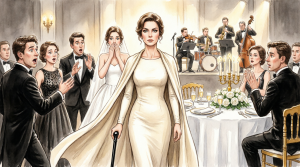
The first thing my brother did when he saw me at his wedding was forget how to breathe.
I watched it happen from two feet away.
One second Mason Harper was standing in the center of the Crawford Hotel ballroom foyer with his arm looped possessively around Avery Langford’s waist, laughing for the photographer, looking rich and polished and invincible in midnight-blue velvet. The next, his face went blank so completely it was like someone had pulled a plug behind his eyes.
The laugh died in his throat.
His hand fell from Avery’s waist.
His mouth opened.
No sound came out.
I stopped in front of him and let the silence stretch long enough for him to understand that no, he wasn’t imagining me, and no, I had not come back weak.
I had come back finished.
“Congratulations, Mason,” I said softly.
My voice didn’t tremble. That alone would have shocked him once.
His stare flicked over me in pieces, like he couldn’t take in the whole picture at once. The dress first. Then my face. Then the logo embroidered in white silk thread over my heart—so subtle it was almost invisible unless the light hit it exactly right.
It hit it exactly right.
I saw the instant he recognized it.
Not just me.
What I had become.
Avery turned to him, smiling in that practiced bridal way people do when they think a moment is still under control. “Mason? Do you know her?”
He still couldn’t speak.
Then my mother saw me.
Laura Harper had been gliding across the marble floor holding two champagne flutes, diamonds flashing at her wrists and fingers, silver heels clicking like the woman she’d spent thirty years teaching herself to become. For a second she looked almost beautiful in that brittle, lacquered old-money way.
Then the glasses slipped out of her hands.
They hit the floor hard.
Crystal exploded across the marble.
Champagne splashed over her shoes.
The sharp crash cut through the string quartet and every conversation in the room like a gunshot.
That was how I announced my return to Denver.
Not with a speech.
Not with anger.
With my mother dropping both hands full of celebration because she’d just seen the daughter she helped erase walk back into the room wearing a dress worth more than her conscience.
Every head turned.
My father stepped out from behind her and froze so completely he looked carved there. Richard Harper had aged in the way powerful men always think they won’t—expensively, carefully, but unmistakably. His hair was thinner and silvered now. The jaw that used to tighten like a locked gate had softened into the loose heaviness of too much scotch and too little sleep. But the eyes were the same.
Cold. Assessing. Proud enough to confuse cruelty with discipline.
Only right then they weren’t cold.
They were terrified.
He looked at me the way men look at a fire they thought they had stamped out years ago, only to discover it had gone underground and spent all that time learning where the foundations were weakest.
I did not move.
I stood in the middle of that silence with my shoulders back, my chin level, my white silk dress falling in one clean line to my ankles, and I let them look.
Because twelve years earlier, my father had pushed me out into a Denver blizzard with one suitcase, eight hundred dollars, and a sentence meant to follow me forever.
I don’t want you carrying my name anymore.
That night, as I stood in my brother’s wedding reception and watched his future collapse behind his eyes, I almost smiled.
Not because I am cruel.
Because some debts take twelve years to mature.
Three nights before my high school graduation, I was on my knees in the upstairs hallway yanking open the cabinet where my mother kept every document no one was allowed to lose. Insurance forms. Tax folders. Christmas card lists. Return labels. Half the family’s life compressed into accordion files and plastic bins.
I was looking for the stupid packet with my cap-and-gown order forms because the school office had called that morning and said if I didn’t bring them in by Friday, I’d be walking at graduation in borrowed robes like a last-minute transfer student.
I had one arm inside the cabinet and my shoulder pressed against the door when I heard my father’s voice drift out of his office.
The door was cracked open.
Not wide enough to invite interruption. Just open enough that it always meant he felt safe.
He was on speakerphone. I knew that because I could hear the faint echo underneath his words. I recognized the voice on the other end instantly too.
Mr. Caldwell.
The old-money investor who still held twenty-two percent of Harper Fashions and treated my father like a temporary steward of something that would always really belong to richer men.
Dad had a special tone for people like Caldwell. A smooth, quiet, almost intimate voice he never used on family because he didn’t believe anyone under his roof was worth persuasion. We got instructions. Men like Caldwell got charm.
“This is Richard Harper,” he said. “Look, Caldwell, Trinity’s dyslexia is worse than we thought. Severe. She still stutters under pressure. And next to Mason…” He paused, and I can still hear the little sigh he gave there, the one meant to sound regretful. “She just doesn’t photograph well. We can’t have the public face of the brand tied to that. We’ll handle it quietly after graduation. Clean break.”
For a second I didn’t understand what I was hearing.
Not because the words were unclear.
Because some part of me still believed there had to be a boundary even my father wouldn’t cross in front of strangers.
I was wrong.
I stood up too fast and hit my elbow on the cabinet frame. The pain barely registered. My hand was wrapped so tightly around the folder I’d finally found that the cardboard bent.
That was when I noticed Mason.
He was leaning against the wall just outside Dad’s office, half in shadow, arms folded like he’d been there long enough to get comfortable.
He was thirteen then. Already taller than me. Already carrying himself with that loose, lazy confidence boys wear when they know the entire house bends toward them. He’d heard everything. Every word. And he was enjoying it.
He looked straight at me and mouthed slowly, clearly, so there would be no possibility I could misread his lips.
Ugly disabled idiot.
Then he laughed.
Not loudly. He didn’t need to. Just one quiet, cutting little laugh like we were sharing the funniest joke in the world.
To this day, that laugh is worse in my memory than the insult.
The office door opened.
Dad stepped out, closed it behind him, and finally noticed me standing there with the bent folder in my hand and my brother’s laughter still hanging in the air between us.
His face didn’t change.
That was the part that damaged something in me I never got back. He didn’t flinch, didn’t try to explain, didn’t even look embarrassed that I had heard him discussing my speech and dyslexia like a defective product line that had to be withdrawn before launch.
“You heard enough,” he said.
I stared at him.
He looked at the folder in my hand, then back at my face, and said, as evenly as if he were announcing a meeting time, “I’m not saying it twice. I don’t want you carrying the Harper name anymore. One hour. Pack and leave.”
I remember everything after that with obscene clarity.
The banister under my mother’s hand when she appeared at the top of the stairs in her silk robe. Her eyes already swollen, as if she had been crying before I even got there. Or maybe that was just the lighting. With my mother, grief and performance often wore the same face.
She opened her mouth.
Closed it.
Opened it again.
Nothing came out.
It never did when money was on the table.
When it came to my father, silence was the shape of her loyalty.
Mason stayed where he was, arms still crossed, watching the scene like he had front-row seats to a show he’d been waiting all season to see. I walked past him and had to turn sideways so my shoulder wouldn’t touch his.
Upstairs, my room looked exactly the way it had looked that morning and exactly the way it would never look again. The pale blue walls my mother had insisted were more flattering than the green I wanted. My desk covered in sketchbooks and school papers. The mirror over the dresser with a crack in the corner where Mason had once thrown a baseball indoors and blamed me for not moving. My black suitcase in the closet, the same one I’d had since middle school.
I packed with the mechanical focus people mistake for calm.
Jeans. Hoodies. Underwear. Socks. My two decent dresses. My laptop, already old and half unreliable. My sketchbooks. Every dollar I had saved from babysitting and hemming neighbors’ pants and selling little designs online to girls at school who wanted custom dance-team warm-up jackets.
I couldn’t find my boots.
That detail matters because it’s the kind of ridiculous, stupid thing your brain grabs when the real thing is too large to hold. My father is throwing me out. My mother is doing nothing. My brother is enjoying it. But all I could think while I yanked clothes into the suitcase was Where are my boots?
I never found them.
I dragged the suitcase down the stairs in sneakers. The wheels rattled against every step loud enough for the whole house to hear.
Dad was waiting by the front door.
He had already taken my house key off the ring and placed it on the entry table like a dead insect.
Mom was standing ten feet away, arms wrapped around herself, eyes shining and useless.
Mason had moved to the living room archway for a better view.
I stopped in front of Dad.
“What do I tell people?” I asked.
Even now, I hate that those were the words that came out. Not Why are you doing this? Not How could you? Not Don’t. Something smaller. Practical. Embarrassingly hopeful in its own way.
What do I tell people?
Dad opened the door.
“Tell them whatever you want.”
Snow blew sideways into the entryway. The cold hit my face before I crossed the threshold.
Then he added, “Just don’t tell them you’re a Harper.”
I stepped outside.
It was twenty-two below with windchill. Snow hit my cheeks like thrown gravel. I had one glove in my pocket and no boots and a suitcase my fingers could barely feel the handle of before I was halfway down the front walk.
The door closed behind me with a soft click.
Not even a slam.
That somehow made it worse.
A slam would have admitted feeling.
The click said the decision had been settled long before I heard it.
I made it halfway down the driveway before my phone buzzed in my coat pocket.
Unknown Boulder number.
I answered with my teeth already chattering. “Hello?”
“Trinity, it’s Grandma Eleanor.”
I stopped breathing for a second.
She didn’t ask if it was true. Didn’t ask where I was. Didn’t even say hello properly.
“Don’t you dare get on a bus tonight,” she said. “Drive to Boulder. I’m leaving the porch light on and the garage open. You come straight here.”
That was the moment I broke.
Not when Dad threw me out. Not when Mason laughed. Not when Mom stood there and let it happen.
When I heard my grandmother’s voice telling me where the light would be.
I somehow got into the old Subaru Dad had bought me two years earlier because he couldn’t be bothered to drive me to school anymore. It was ten years old even then, dull blue, always smelling faintly of gas in winter, but it was registered in my name because he didn’t think I would ever need leverage against him and never imagined I might someday know how to use paperwork better than he did.
I drove to Boulder through a blizzard that should have had me in a ditch.
The wipers could barely keep up. The roads were slick and half vanished under the snow. More than once the tires lost traction and the whole car slid just enough to let fear sink its teeth in properly. I kept both hands locked on the wheel and stared at the red blur of taillights ahead like they were instructions from God.
I remember thinking, over and over, This would actually be easier if I died.
Not because I wanted to.
Because then at least there would be a shape to the ending.
When I pulled into Grandma Eleanor’s driveway forty minutes later, she was already standing in the doorway.
She was eighty-one. Tiny. Wrapped in a robe over one of her old quilted nightgowns. Her hair was pinned badly because she had clearly done it in a hurry. The porch light behind her turned the falling snow gold.
She opened both arms before I even shut the car door.
I walked into them still half frozen.
She did not ask a single question that night.
She pulled me inside, sat me on the couch, wrapped me in the same faded afghan she had covered me with when I was five and sick with the flu, and put a mug of cocoa in my hands as if the world had not just split in half.
Only when I could feel my fingers again did she touch my cheek and say, “You’re safe tonight.”
I stayed three days.
On the fourth morning, she made coffee, waited until I had taken the first sip, and slid a thick roll of bills across the kitchen table.
Eight hundred dollars. Rubber-banded. Mixed twenties and fifties.
“Everything I can spare without Richard noticing,” she said. “And before you open your mouth, we are not arguing about you staying.”
I tried anyway.
“Grandma—”
She lifted one hand and stopped me cold.
“You listen to me. The night he threw you out, Richard called me himself. He made it crystal clear that if I took you in permanently or spoke up publicly, he’d have me in assisted living by the next morning. Doctors. Lawyers. The whole show.”
I stared at her.
She held my gaze without blinking.
“He still controls the trust I live on,” she said. “One phone call and this house is gone. My accounts are frozen, and I’m drugged up in some facility where they won’t even let me have real coffee. I am not giving that bastard the excuse he wants.”
Her voice did not shake.
That was what made it sink in properly.
At eighteen, you still think injustice will look dramatic when it arrives. You expect screaming, maybe slaps, maybe obvious villainy. Not paperwork. Not legal leverage. Not a son threatening to institutionalize his elderly mother because she chose compassion over brand image.
“Then what do I do?” I whispered.
She pushed the money closer.
“You go south,” she said. “Austin. Your cousin Lan has a friend with a room to rent. It’s not pretty, but it’s cheap. I already called. You get on the bus this afternoon, and every month I send what I can from the account Richard doesn’t know about. That’s how we win.”
I looked at the money, then back at her.
“Win?”
She gave me the smallest, fiercest smile I have ever seen on another human being.
“By living long enough to watch them choke on what they threw away.”
Three hours later I was on a Greyhound heading south with eight hundred dollars, one suitcase, my laptop, and the exact weight of my old life shrinking in the window.
The first six years in Austin were not inspiring.
People love stories about reinvention because they want the middle part to be montage. A train station. A cheap apartment. A few gritty shots of hard work. Then success, preferably with a killer soundtrack.
What actually happened was uglier and slower.
I worked breakfast shifts at a diner on East Cesar Chavez where the coffee was terrible and the customers believed eye contact with waitresses counted as intimacy. I cleaned office buildings at night with a woman named Nia who taught me how to stretch my wrists after scrubbing too many sinks. I did deliveries in a borrowed hatchback until it died in a grocery store parking lot and I cried over the repair bill like someone had handed me news of a death.
I rented a room in a two-bedroom apartment with one window that looked directly at a brick wall and a ceiling fan that made a grinding noise every third rotation. The mattress sagged in the middle. The shower water went lukewarm after seven minutes. Some months I barely cleared enough after rent to buy groceries without calculating down to the cent.
On the counter in that apartment, I kept a glass jar labeled Grandma.
The first Tuesday of every month, a plain white envelope arrived. Sometimes three hundred dollars. Sometimes five. Never more. Always a note in her sharp, slanted handwriting.
You’re smarter than all of them put together.
Or:
I saw a woman in the market wearing the ugliest dress I’ve ever seen. You could do better blindfolded.
Or:
I’m still alive and still meaner than your father. Keep going.
That money paid for speech therapy at a free clinic run by graduate students who looked barely older than I was and treated my stutter like a solvable engineering problem rather than evidence of defect. Twice a week I sat in a fluorescent room practicing breath pacing and pacing phrases and the slow humiliating discipline of retraining panic.
By the fifth year, the stutter only came when I was exhausted, furious, or suddenly forced to speak in front of men who smelled like money.
The dyslexia never vanished, of course. That wasn’t how it worked. I learned what I had needed all along: accommodations, systems, patience, software, strategy, and the radical relief of no one acting like my brain was an embarrassment. I used text-to-speech programs. Color-coded pattern notes. Dictation software. Recording memos to myself instead of pretending I could brute-force my way through certain tasks just because shame had taught me to hide.
Design classes were online, one painful semester at a time.
Pattern making on a laptop balanced on a cardboard box because I couldn’t afford a proper desk. Fabric theory watched at 1.5 speed after midnight. Draping tutorials paused and rewound so many times I started hearing the instructors in my sleep. My first sketches were awful. Not because I lacked talent. Because skill is a brutal teacher and talent is just the nerve to stay in the room long enough to disappoint yourself repeatedly.
So I disappointed myself.
Then I did it again.
Then I got better.
I learned to cut clean lines. To respect grain and movement. To understand what a body wants from fabric instead of treating clothing like a hanging concept sketch. I learned how a collar changes a woman’s posture. How invisible pockets can make a garment feel like freedom. How some clothes ask women to apologize for taking up space and others quietly dare them not to.
That became the beginning of everything.
My first real pieces were not glamorous.
A wrap dress made from deadstock denim. A cropped linen blazer with hidden interior seams because I was obsessed with structure then. A silk scarf dyed in my kitchen sink until my cheap apartment smelled like wet minerals for three days. I opened an Etsy shop under the name T. Harper Designs because I still couldn’t decide whether keeping the name was rebellion or weakness.
Twelve sales in the first month.
I remember every one of them.
The woman in Phoenix who messaged me to say the denim wrap dress was the first thing she’d put on in years that made her feel beautiful and comfortable at the same time. The teacher in Dallas who ordered the scarf in rust and then came back for navy. The older woman in Sacramento who sent me a mirror selfie in the blazer and wrote, I feel expensive in this.
Grandma Eleanor bought the very first scarf.
Then mailed me a photograph of herself wearing it to the farmers market with sunglasses on and her chin tipped up like she was daring someone to ask where it came from.
I still have that photo framed in my office.
Orders grew slowly. Then steadily. I dropped the cleaning gigs first. Then the diner shifts. Then deliveries. I moved from the brick-wall apartment into a studio with real light. Bought a proper cutting table secondhand from a tailor going out of business. Hired a seamstress for overflow work. Then two.
In 2021, a local investor sat down with me for coffee, asked to see my numbers, asked better questions than anyone in my life had ever asked me about design, labor, sustainability, and margin, and wrote a fifty-thousand-dollar check before the coffee got cold.
I walked back to my car that day and laughed until I cried.
Not because of the money.
Because someone with power had finally looked at what I built and thought more.
By 2023, revenue crossed seven figures.
By then the company had a real name.
Everline.
Not after me. After the line every woman crosses when she stops shrinking for other people.
We moved into a proper studio. Hired a production manager. Shifted entirely to sustainable fabrics and ethical manufacturing. Built our own small line of adaptive details into pieces without advertising them as pity or novelty—magnetic closures disguised as sculptural buttons, soft seams in unexpected places, elegant structures that didn’t punish bodies for living in them.
The industry noticed.
Then it started circling.
There were profiles. Features. Panels. Investors who said “authenticity” too often. Competitors who pretended not to know my name while assigning interns to track our customer growth. By 2025, we had twenty-two employees, a waitlist, and numbers that would have made my father spill his scotch.
All while I kept the Harper connection buried deep.
Not because I was ashamed of myself.
Because I wanted the reveal to arrive with teeth.
Grandma Eleanor’s letters never stopped.
The handwriting grew shakier over the years. The notes shorter. The edges of the envelopes softer. But the message never changed.
Keep going.
Don’t look back too soon.
When you’re ready to return, you tell me first. I want to be alive to see their faces.
I kept every single letter in a fireproof box alongside the original eight hundred dollars she gave me. I never spent that money. Not one bill. It stayed rubber-banded exactly as she slid it across the table in Boulder, because some things stop being cash and become witness.
By early 2025, I was finally ready.
Not because I was done hurting.
Because the hurt no longer owned the direction of my life.
The invitation arrived in April.
Heavy cream cardstock with gold edging. Mason Harper and Avery Langford. Black tie requested. The Crawford Hotel in Denver.
I stood in the hallway of my East Austin apartment holding that envelope for a long time while the kettle whistled in the kitchen and the whole place smelled faintly of garment steam and cedar hangers.
No personal note, of course.
No apology.
No explanation for how they got my address after twelve years of silence.
Just an invitation so expensive it practically announced itself in a different tax bracket.
I laughed when I realized what it meant.
They wanted optics.
Old-money mergers disguised as love stories are still mergers. Avery Langford wasn’t just a bride. She was an alliance. Her father, Douglas Langford, had spent the last two years trying to acquire Everline or crush it, depending on which quarter he was having. He had no idea the woman haunting his market reports was also the daughter Richard Harper had thrown away.
That invitation wasn’t about me as family.
It was about the version of me they assumed still existed—small, hidden, easily managed, maybe even pathetic enough to feel grateful for a card stock olive branch.
I booked the earliest non-stop flight before the kettle finished boiling.
Then I called Grandma.
It was after ten in Boulder, but she picked up on the second ring.
The oxygen tube was more visible than the last time we’d talked. Her face thinner too. But her eyes were still pure flint.
“I’m coming home for my brother’s wedding,” I said in Vietnamese.
It was the language we used only when things were serious enough to deserve the truth stripped of decoration. Her late husband, my grandfather, had taught me when I was little. Dad never bothered learning more than a few greetings. He said it wasn’t useful. That alone should have told me everything.
Grandma looked at me for several seconds.
Then the corner of her mouth lifted.
“Then come back like a real Harper,” she rasped. “Don’t make me ashamed in front of our ancestors.”
I laughed, actually laughed, in a way I hadn’t in days.
“I wouldn’t dare.”
She nodded once, satisfied, and hung up without saying goodbye.
That was her way.
I packed the next morning.
Not one item in my suitcase came from another brand.
The long white cashmere coat I had cut and sewn the previous winter when I was obsessed with mountain light and clean silhouettes. A dove-gray silk blouse. Cream trousers with invisible pockets and perfect drape. Boots dyed to match the exact color of snow at sunset on stone. Jewelry so minimal it looked like intention rather than decoration.
And the dress.
I made that dress with my own hands.
White silk cut on the bias, seamless from a distance, liquid in movement, impossible to read fully until it caught light. Over the heart, embroidered in white on white, was the Everline logo. Subtle enough to miss if you didn’t matter. Fatal if you did.
I left the packed suitcase by the door for two weeks like a promise to myself.
On the morning of the flight, I wore the white coat over a black cashmere turtleneck and jeans, put on oversized sunglasses even though it was barely dawn, and walked through the Austin airport like someone who had already survived the only thing there was to fear.
The Uber driver from DIA to downtown Denver glanced at me in the mirror and asked, “Headed to a photo shoot or something? You look like one of those fashion influencers my wife watches.”
I met his eyes in the rearview and smiled.
“Something like that.”
The city looked smaller than I remembered and more dangerous in the way all childhood places do when you return with adult eyes. Cherry Creek still gleamed. The mountains still framed everything like God showing off. The air still smelled thinner, sharper, as if altitude had opinions.
I checked into the hotel under my own name.
Not T. Harper.
Not a pseudonym.
Trinity Harper.
The woman at the desk looked at the reservation, looked back at me, and smiled with professional brightness.
“Welcome back to Denver, Ms. Harper.”
Something in me went still at that.
Welcome back.
No one had said words like that to me in twelve years.
Saturday night, I stepped out of the elevator on the mezzanine level and paused just long enough for the dress to settle properly around my ankles.
The hallway opened toward the grand staircase. Music drifted up. Conversation. Crystal. Laughter polished thin by old money.
I placed one hand lightly on the banister and walked down.
Every step was deliberate.
Not slow. Not theatrical. Controlled.
The white silk moved like water around me. The hotel lights caught the embroidery over my heart and then released it. A security guard at the velvet rope took one look at the dress, my posture, the absence of hesitation in my stride, and lifted the rope without asking my name.
That almost made me laugh.
Twelve years earlier, I had been too disposable to keep in my own father’s house.
Now strangers assumed I belonged wherever I chose to stand.
The foyer was full. Crystal chandeliers. Champagne towers. Men in tuxedos discussing money as if that were a personality. Women in gowns selected to suggest effortless wealth after deliberate suffering. Mason in the middle. Avery bright beside him.
I crossed the room like I had every right to be there.
When Mason saw me, his whole body betrayed him.
Then came my mother’s shattered glasses. My father’s silence. The room freezing.
That should have been enough.
It wasn’t.
Because standing a few yards away, deep in conversation with two investors and a smile built for acquisitions, was Douglas Langford.
His gaze flicked over at the crash. Landed on me. Dropped to the white-on-white embroidery over my heart. Narrowed.
He took a step closer.
Then another.
When recognition hit him, it was almost physical.
He mouthed the words first.
“No way.”
Then, louder, with everyone still staring, “Everline.”
He looked from the logo to my face and back again.
“You’re the Harper behind Everline.”
It wasn’t a question.
I met his eyes and did not answer.
I didn’t need to.
The dress was the answer. The silence was the answer. The fact that Richard Harper looked like his pulse might stop was the answer.
Behind Langford, Dad finally found his voice.
“Trinity,” he said. Hoarse. “How?”
I ignored him.
I slid my phone out of the hidden pocket in the dress, typed one sentence to Grandma Eleanor—Inside. Don’t worry.—and sent it.
Then I looked back at my family and let them stand there under the weight of what they had just realized.
Twelve years of silence.
Twelve years of work.
Twelve years of becoming someone they could neither claim nor dismiss.
Now they saw.
And once people like my father see the cost of their own arrogance standing in front of them in silk, they never really recover.
Avery excused herself about fifteen minutes later.
She did it beautifully, of course. A tight smile. One hand on Mason’s sleeve. “I just need the restroom.”
If I hadn’t been watching for it, I might have missed how pale she had gone.
I knew exactly where she was going because I had already set the next part in motion.
Her father’s recognition had been useful. Her uncertainty would be decisive.
I waited exactly one minute before taking the private elevator to the fifteenth floor.
The marble restroom hallway was empty except for the soft hum of hotel air and the distant sound of a reception still trying to convince itself nothing had happened. I leaned against the wall outside the women’s restroom and checked my phone.
One new message.
Ryan Keller: Sent.
Ryan Keller had been my closest friend in high school until leaving the Harpers became politically expensive and he drifted into the part of life where people who know the truth still choose careers over loyalty. But time had improved him. Or guilt had. Maybe both. He was a corporate litigation lawyer in Denver now, and when I called him two months earlier and said, “I need you to deliver a file at precisely the right moment to precisely the right person,” he had only asked one question.
“Is this about your brother?”
“Yes.”
“Then I’m in.”
I had given him two things.
The audio clip of my father speaking to Caldwell twelve years earlier—a recording Ryan had quietly recovered from an old archived litigation backup during a case involving Harper Fashions years later and recognized only because he remembered that night from the stories no one was supposed to know. And the notarized disinheritance letter Dad signed the week after throwing me out, formally severing me from every trust, succession, and public mention connected to the family brand.
Not because I wanted pity.
Because truth lands harder when it arrives documented.
The restroom stall door banged open.
Avery stepped out pale as paper, phone in one trembling hand, mascara smudged at one corner like she’d rubbed her face too hard.
She saw me and stopped.
I did not move.
For a few seconds the only sound was her breathing.
“You’re her,” she whispered at last. “The one they said didn’t exist.”
I gave the smallest nod.
Her eyes dropped to my dress again, to the logo, then back to my face. The realization seemed to strike her in waves.
“Your company,” she said. “My father has been trying to acquire or destroy Everline for two years. He talks about you in board meetings. He calls you that Austin upstart.” Her voice broke on the last word. “He had no idea it was you.”
“No,” I said. “He didn’t.”
She backed into the marble counter as if she needed something solid behind her.
“Mason never told me he had a sister.”
“Now you know why.”
She looked down at her phone again, where my father’s recorded voice was still visible on the screen beside the pdf of the disinheritance letter. Then back up at me.
“He said you were dyslexic,” she whispered. “Like it was a stain.”
I almost laughed, but there was no humor in it.
“He said worse than that.”
Her mouth tightened.
It was not easy sympathy on her face. That would have insulted me. It was something better—humiliation by proxy, the horror of realizing you were about to marry into a family so invested in image that they had buried their own daughter to protect a brand and never imagined the buried thing might come back richer.
I pushed off the wall and took one step toward her.
“Tell Mason the wedding can go on,” I said. “Or not. That part is up to you.”
Then I walked past her.
Before the elevator doors opened, I called Grandma.
She answered on the first ring.
“Everything’s going well,” I said. “Go to sleep.”
She laughed that rough, smoker’s laugh I loved more than almost anything in this world.
“Good night, my girl.”
I hung up.
By Monday morning, the city had done what cities like Denver do best when scandal and money meet in daylight.
It fed.
At nine o’clock sharp, Douglas Langford stepped into the ballroom of the Brown Palace Hotel flanked by publicists and lawyers and announced the immediate termination of Langford Capital’s one-hundred-twenty-million-dollar strategic investment in Harper Fashions.
He did not smile.
He did not name me.
He did not need to.
“Material omissions regarding family risk and corporate governance,” he said.
The phrase was dry enough to sound administrative. In markets, that’s more dangerous than outrage. Outrage can be spun. Bureaucratic distrust gets priced in immediately.
By 9:12, Harper Fashion stock was down twenty-eight percent.
By 9:27, it had dropped forty-eight.
Trading was halted twice before lunch.
What Langford knew—and what my father had hidden from everyone betting on his company’s future—was not just that the founder of one of the most aggressive sustainable competitors in the western market was his disowned daughter.
It was that he had concealed both the existence of that daughter and the circumstances of her removal from the family while courting investment, brand expansion, and merger-adjacent alliances. In private equity, men pretend morality doesn’t matter. What they mean is morality doesn’t matter until it becomes risk. Then it matters more than blood.
The banks moved in before noon.
Harper’s factories in Commerce City, Longmont, and Aurora had been operating under debt structures my father assumed he could smooth over with Langford money and future projections. Once the investment vanished and the family-governance questions surfaced, covenants triggered. Loans defaulted. Operations froze.
Three armored trucks.
A dozen security guards.
Yellow tape at the loading docks.
Machines stopped mid-stitch.
Workers escorted out carrying paper envelopes with final checks.
It would have been tragic if Richard Harper had ever actually cared about the people who kept his business alive. Instead, it was just the market finally translating his arrogance into a language he could not intimidate.
By eleven-thirty, the first shareholder lawsuit landed on his desk.
Fraud. Concealment. Material misrepresentation.
More followed before closing bell.
Mason never made it to Aspen for his honeymoon.
He was at the private terminal at Centennial Airport with luggage already loaded and his boarding pass in hand when Avery arrived wearing sunglasses, a trench coat, no makeup, and no ring.
She handed the engagement ring back in a velvet pouch.
“I’m not getting on that plane,” she said.
Mason laughed at first because men like Mason always confuse disbelief with power.
“Avery, come on. Whatever she told you—”
“She didn’t tell me anything.” Avery’s voice went cold enough to cut glass. “She showed me. Your father’s own words. Your family’s lies. My father just lost one hundred and twenty million dollars because of your name. We are done.”
Then she turned and walked away.
The pilots closed the jet door.
Mason stood on the tarmac holding the ring while the plane taxied out without him.
I wish I could say I watched it in person. I didn’t. Ryan Keller called me from the airport parking lot laughing so hard he could barely finish the story. I sat in my hotel room in a robe, drinking coffee, staring out at Union Station, and let his words paint the image for me.
Sometimes hearing a downfall is better than seeing it. Your imagination knows where to place the knife.
Back in Cherry Creek, my parents’ house became exactly what that kind of marriage becomes when the money stops disguising the rot.
A war zone.
Mom screaming at Dad in the kitchen.
Dad drinking in his study before noon.
Financial statements thrown like shrapnel across marble counters.
You said it was handled.
You said she’d never come back.
You said no one would find out.
Neighbors pretending not to hear through windows that had heard everything for years.
By midafternoon, two divorce attorneys had stepped into the house.
One for Laura.
One already retained by Richard.
Papers laid out on the same island where my mother used to arrange flawless Christmas charcuterie boards as if fig placement could count as love.
She signed first.
Of course she did.
My mother had always loved security more than truth. Once the first vanished, the second became cheap enough to mention.
Dad, I later learned, didn’t even read his copy.
At 4:02 that afternoon, he locked himself in his study with a bottle of Macallan and dialed the one number he swore he would never call again.
Grandma Eleanor answered on the fourth ring.
He said her name like an appeal.
She cut him off before he finished the sentence.
“Don’t.”
Just that.
I found out the rest from her later, in her living room in Boulder, while late sunlight turned the edges of everything gold.
“He wanted me to talk to you,” she said, stirring sugar into tea she wasn’t supposed to drink anymore. “Wanted me to tell you the family had suffered enough. That there had been misunderstandings. That your brother’s future was being ruined over old pain.” She snorted. “As if the pain were the offense.”
“What did you say?”
She looked over at me, eyes bright and mean and deeply alive.
“I told him if he ever called me about your forgiveness again, I would live long enough to enjoy his funeral out of sheer spite.”
I laughed so suddenly I almost spilled my cup.
Then I leaned over and kissed her hair.
She patted my hand once like she had not just delivered the cleanest verdict of the entire saga.
But the story wasn’t over.
Not for me.
Because destruction is satisfying for about five minutes before you have to decide what kind of person you want to be in the empty space after.
I had not come back to Denver just to watch them burn.
I had come back to reclaim something.
Not their approval.
Not their house.
Not even their company.
My name.
See, Richard Harper thought the sentence he threw at me in that hallway would define the rest of my life.
I don’t want you carrying my name anymore.
He thought the name belonged to him.
That was his deepest mistake.
Names do not belong to the people who wield them like weapons. They belong to the people who survive them.
Three days after the market collapse, I sat in a conference room with my legal team, my CFO, two acquisition advisors, and a stack of documents connected to the bankruptcy positioning around Harper Fashions.
My team looked a little stunned when I told them what I wanted.
“I’m not buying the company,” I said. “I don’t want the debt. I don’t want the chaos. And I don’t want my people dragged into their culture.”
“Then what do you want?” my CFO asked.
I slid the file across the table.
“The archives. The pattern library. The historic atelier building if it can be separated from the rest. And first position on the equipment lots once liquidation starts.”
He stared at me.
“Why?”
“Because the women in those workrooms did not throw me into a blizzard,” I said. “And because I’m not letting my father’s vanity turn three generations of craftsmanship into scrap.”
There was a long silence after that.
Then Jillian—who had flown in because by then she had become half litigator, half guardian angel—smiled and said, “That’s the nicest revenge I’ve ever seen.”
It wasn’t nice.
It was precise.
Two months later, through bankruptcy proceedings and asset separation and enough paperwork to choke a courthouse, Everline acquired the Harper atelier building, its original pattern archives dating back to my grandfather’s era, and a substantial portion of the equipment inventory from the shuttered facilities.
I did not keep the old name.
On the new brass plaque outside the restored building, we engraved three words.
Eleanor House Atelier.
When I told Grandma, she cried for the first time in front of me in twelve years.
Only for a minute.
Then she wiped her face and said, “Good. It was a stupid name before.”
We hired back as many displaced workers as we could reasonably absorb. Not out of charity. Out of respect. Good seamstresses are not replaceable, and women who had spent years surviving under Harper management knew things about discipline, finish, and speed that most startups spend a decade trying to learn.
The first day Eleanor House opened under Everline management, I stood in the center of the workroom while sunlight poured through industrial windows and watched women set up machines, pin muslin, unwrap shears, and claim stations.
No one applauded.
No one made a speech.
They just got to work.
It was one of the most beautiful things I have ever seen.
Word spread, of course.
Denver loves a comeback almost as much as it loves a scandal, and what I had done satisfied both instincts. The daughter cast out by the local fashion dynasty returns, topples the family deal, rescues the archives, reopens the atelier under her grandmother’s name. By then the press was doing half my storytelling for me.
I kept interviews minimal.
I would not let them turn my life into a redemption fable that erased the years it took to get there.
Still, one line from a magazine profile made me keep the clipping.
When asked why she chose not to restore the Harper name, Trinity Harper smiled and said, “Because I already did.”
Mason called me once.
It was late July. I was in the Austin studio reviewing fall samples when my phone buzzed with a Denver number I didn’t recognize but immediately knew.
I answered because curiosity is an old weakness.
He didn’t say hello.
“You think you’ve won?”
His voice sounded wrong. Smaller. Worn thin by sleeplessness and the shock of no longer being the safest child in the room.
I leaned back in my chair.
“I think you called me,” I said.
He exhaled sharply. “You ruined everything.”
“No,” I said. “You ruined it when you became the kind of man who could hide his sister like a stain and still ask another woman to marry him.”
“You came there to destroy us.”
“I came there so you would have to look at me.”
That silence on the line felt different from the ones twelve years ago.
Back then silence meant he had power.
Now it meant he didn’t know what to say without admitting too much.
Finally he muttered, “You always were dramatic.”
I smiled without humor.
“And you always were a coward.”
Then I hung up.
My mother never called.
She sent letters instead.
Three over the course of six months. Cream paper. Controlled handwriting. Never once saying I’m sorry. Plenty of phrases like family tragedy, private pain, unfortunate misunderstandings, and your father made difficult decisions under pressure.
I burned the first one unopened after the salutation.
Read the second out of morbid curiosity and regretted it.
By the third I had learned.
Some people write not to tell the truth, but to build a softer version of themselves in your head.
I stopped offering her that construction site.
Dad did try once. Not with letters. In person.
He came to Boulder in October.
Grandma Eleanor was in her recliner with a blanket over her legs and an oxygen tank humming softly beside her when the front doorbell rang and I looked through the sidelight and saw my father on the porch holding a hat in both hands like he was auditioning for humility.
“Absolutely not,” Grandma called from the living room before I even spoke. “If you let him in, I’m haunting you while I’m still alive.”
I laughed despite myself and opened the door just enough to step outside and pull it nearly shut behind me.
The air had that dry autumn bite unique to Colorado. Dad looked older again. Diminished. There is nothing more exhausting to powerful men than irrelevance.
“I won’t take much of your time,” he said.
“Then don’t.”
His jaw shifted. He still hated resistance. That had not changed.
“I made mistakes,” he said at last.
There it was. Not an apology. A managerial summary.
I waited.
He looked down at the hat in his hands.
“What happened with Caldwell… with the board… the pressure then…” He took a breath. “You were never supposed to find out that way.”
I stared at him.
Twelve years. A blizzard. A disinheritance letter. Silence. Smears. Legal threats. And this man had come to my grandmother’s porch to tell me the problem was my method of discovery.
“You threw me out in sneakers,” I said.
He flinched.
Good.
“You let Mason say whatever he wanted. You let Mom stand there and say nothing. You tried to erase me from the family, from the business, from your own story. Then when that wasn’t enough, you told investors I was too damaged to exist in public. And now you’re standing here talking about pressure.”
“Trinity—”
“No.” My voice sharpened, and for one flicker of a second the old stutter pressed against the edge of my throat, not from weakness but from fury. I breathed once and it passed. “You do not get to come here for a cleaner ending than the one you gave me.”
His face sagged in a way I had never seen before.
“I was trying to protect the company.”
I looked at him and felt, at last, absolutely nothing that resembled fear.
“And I was your daughter.”
He closed his eyes.
When he opened them, there was water in them.
If I had been younger, that would have undone me.
At thirty, with a company of my own and my grandmother breathing behind the door and my brother stripped of every illusion that had once made him cruel, all it did was make me tired.
“I’m not forgiving you because you finally understand loss,” I said. “I lived with it first.”
Then I stepped back and closed the door.
Grandma Eleanor didn’t ask what he said.
She just handed me a cigarette from the silver case she still kept in the drawer even though her doctors would have had an aneurysm if they knew. I didn’t smoke. She knew that. But the gesture meant, Sit down. Recover. You did well.
So I sat.
And for the first time since I was eighteen, I felt like the girl he threw out had finally fully come home.
Grandma died the following spring.
Peacefully. In her own bed. In Boulder. With me on one side, a nurse on the other, and the house she refused to lose still around her.
A week before, when she could still speak in short bursts, I read her the article about Eleanor House Atelier’s first major collection under the Everline umbrella. She listened with her eyes closed and one hand over mine.
When I got to the part describing the line as “a rebirth of legacy craftsmanship under the direction of one of the most formidable designers in American fashion,” she squeezed my fingers and whispered, “Damn right.”
At her funeral, there were more people than my father expected.
Former neighbors. Old church women. Two seamstresses from the earliest Harper days who remembered when she used to hand-finish collars in the back room while pregnant. Lan flew in. So did half my Austin team. Jillian came. Ryan Keller stood in the back looking like guilt had finally matured into loyalty.
My father and mother both attended.
Mason did too.
No one approached me.
That was wise.
After the service, as people filtered toward the cemetery path, I stayed by the casket a moment longer. There was a white silk scarf folded inside near her hand—the very first one I ever sold, the one she wore to the farmers market.
I touched the edge of it and smiled.
“You were right,” I whispered. “They choked.”
Then I walked out into sunlight.
If you want a perfect ending, I can’t give you one.
Families like mine do not wrap themselves back up neatly.
There was no final scene where my mother collapsed into remorse and begged forgiveness. No courtroom speech where my father admitted everything in public. No cinematic moment where Mason apologized in tears and became a better man.
Real damage is rarely that tidy.
What I got was better.
I got truth with consequences.
I got a life so full and deliberate that their version of me could not survive contact with it.
I got workers rehired. Archives saved. My grandmother’s name carved into brass where my father once assumed his own would last forever.
I got to keep Harper on my passport, on my business profile, on magazine covers, on lease agreements, on tax forms, on contracts, on the building my father no longer entered, on the scholarship documents Emma—one of the first students funded through the Eleanor House apprenticeship program—signed two years later when she came to study garment engineering in our summer design lab.
That last part still makes me smile.
Because yes, we named one of the scholarships after my grandmother.
And yes, we reserved it every year for students who had been told some version of what I had been told: that their brains, their speech, their bodies, their pace, their difference made them unsuitable for beautiful things.
We were very selective.
Not because they had to prove themselves worthy.
Because I wanted women who had already survived the lie.
Sometimes reporters still ask me if revenge was worth it.
That question always irritates me a little because it assumes what I did was about vengeance alone. Vengeance is hot. Fast. Satisfying. Then empty.
What I wanted was restoration.
Restoration of truth.
Restoration of craft.
Restoration of my own name.
What happened to my father and brother was not some dramatic curse I laid on them. It was the delayed bill for years of arrogance finally reaching the right address. All I did was stop intercepting the mail.
And if you ask whether they ever forgot me, the answer is no.
How could they?
Every time an investor asked what happened to Harper Fashions.
Every time a magazine profile mentioned Everline founder Trinity Harper.
Every time someone in Denver drove past Eleanor House Atelier and saw the women working under clean bright light in a building that used to belong to a man who thought his daughter was too damaged to represent beauty.
Every time Mason had to explain why Avery Langford married someone else two years later and why his own name now sounded less like legacy and more like a cautionary tale.
Every time my father signed anything and saw the surname he once tried to strip from me flourishing everywhere he had wanted it silenced.
No, they never forgot.
That was the point.
The night my father threw me out, he thought he was ending my story.
What he really did was remove himself from the version that would have made him proud.
Twelve years later, when I walked into that wedding reception in a dress I made with my own hands and watched the room freeze around me, I finally understood something that would have saved me years of grief if I’d known it sooner:
Being discarded by the wrong people is sometimes the first honest gift your life receives.
They called me ugly.
They called me broken.
They called me unfit for the family name.
Now my name is on paychecks, mentorships, labels, articles, contracts, scholarships, and a building full of women making beautiful things in spite of men who once thought beauty belonged only to them.
That is how the story ended for them.
That is how it began for me.

