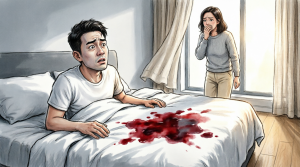
I still remember that business trip to Miami like it was a nightmare I couldn’t wake up from.
If anyone ever asked me when I felt my heart drop straight into an abyss, I would tell them without hesitation it was that morning when I saw the red stain on the bed sheet.
Everything had started so normally, and my ex wife Rachel Adams and I had been divorced for almost three years without betrayal or screaming, only distance and exhaustion slowly tearing us apart.
We signed the papers without tears or drama, and after that I stayed in Chicago working for a construction firm while she moved to Florida and built a career in resort management.
We never spoke again until that night in Miami when I stepped into a quiet bar after work and saw her standing there like a memory that refused to stay buried.
“Daniel?” she said softly, and I smiled awkwardly because I felt like I had walked into a past life I had no right to revisit.
We talked at the same table, and the tension slowly faded into something familiar as we shared memories, laughter, and the strange comfort of time softening old wounds.
By midnight she asked where I was staying, and when I told her, she looked at me quietly before saying, “Do you want to take a walk by the beach?”
The ocean was calm, the air warm, and the distance between us disappeared with every step until the silence between us turned into something we both understood without words.
That night she came back to my hotel, and neither of us pretended it meant more than a fragile moment between two people who once loved each other deeply.
The next morning I woke up late, and sunlight filled the room while Rachel stood by the window wearing my white shirt, looking so familiar that it almost hurt to breathe.
Then I got out of bed and froze when I saw the red stain on the sheet, not large but enough to make my entire body go cold.
I stared at it in silence, and nothing about that moment made sense.
I looked up at her, and she turned, following my gaze, and the softness on her face disappeared instantly.
“It is nothing,” she said quickly, but her voice carried a tension I remembered too well.
“That does not look like nothing,” I replied, and she folded her arms like she was holding herself together.
“It is just an old medical issue,” she said, avoiding my eyes.
“What kind of issue,” I asked, stepping closer, but she stiffened, and I stopped.
“I am fine,” she insisted, though it sounded rehearsed rather than true.
I remembered the years we struggled with the idea of having children, the tests, the silence, and the slow collapse of hope that we never fully talked about.
“Rachel, tell me the truth,” I said quietly.
She closed her eyes for a second and then said, “Irregular bleeding, that is all for now.”
I knew it was not all, but she dressed quickly and left, saying she had to get back to work, leaving me with questions that would not settle.
Over the next few days I tried to focus on work, but the image of that morning kept returning, and when I texted her, she replied briefly that she was fine and told me not to worry.
A month later, everything changed.
It was late at night in Chicago when my phone rang, and her name appeared on the screen, making my pulse spike before I even answered.
“Daniel, I need to see you,” she said, her voice tight with something deeper than fear.
We met at a small café near my apartment, and when she sat down, I noticed how tired she looked, thinner and worn in a way that made my chest tighten.
“I am pregnant,” she said, and the world around us seemed to disappear.
I tried to process the timing, the night in Miami, and everything we had lost years ago, and nothing about it felt simple.
“How far along,” I asked carefully.
“About six weeks,” she answered, and I knew the timeline matched, even if it felt unreal.
She explained that she had been seeing a specialist for months due to health issues, including surgery and warnings that her chances of having children were limited.
“The pregnancy is high risk,” she said, her voice shaking slightly, “and the bleeding that morning could have meant anything.”
I realized then that she had been carrying this alone, and something inside me refused to let that continue.
“Do you want me involved,” I asked, needing to hear it clearly.
“Yes,” she said, and for the first time that night, there was relief in her eyes.
From that moment, everything shifted.
I began traveling to Florida regularly, meeting her doctor, attending appointments, and learning more about her condition than I ever had during our marriage.
We rebuilt something slowly, not through romance at first, but through presence, honesty, and the willingness to stay when things were uncertain.
One night she found me reading medical notes in her kitchen and said softly, “You do not have to control everything to keep me safe.”
“I know,” I admitted, even though I clearly did not.
“I am scared too,” she said, and that honesty broke something open between us.
We kissed again that night, not with urgency but with care, as if we were both afraid of rushing into something we had already lost once.
By the end of the first trimester, things seemed stable, and for the first time, I allowed myself to imagine a future we once thought impossible.
Then everything fell apart.
At thirteen weeks she called me in panic, telling me there was heavy bleeding and that she was on her way to the hospital, and by the time I arrived, I already knew.
The pregnancy was gone.
I sat beside her as she stared at the ceiling, her face pale and empty, and when she whispered, “I am sorry,” something inside me broke.
“You do not apologize for this,” I told her firmly, holding her hand as she finally cried.
The days that followed were filled with quiet grief, hospital visits, and the painful reality that her health would need serious attention moving forward.
Instead of drifting apart, we stayed close, and one night she asked me to lie beside her because she did not want to be alone.
That night, with nothing but silence and shared pain, became the real beginning of something new between us.
We started talking honestly about everything we had avoided before, including how our marriage failed not from lack of love but from fear and silence.
Months later, while sorting through old documents, she found a sealed medical report from the final year of our marriage.
When we opened it, we discovered that my fertility issues had improved back then, and that we might have had a chance at having a child if we had followed up.
The realization was devastating, because it meant we had walked away at the very moment hope had been possible.
“We were not strangers,” I said quietly.
“No,” she replied, “we just kept missing each other.”
Over time, her health stabilized, and we built a new relationship based on honesty rather than assumptions, learning to ask instead of avoid and to stay instead of withdraw.
One afternoon, I asked her to have dinner with me, and as we sat together, I told her the truth.
“I do not want to do this halfway again,” I said.
She looked at me carefully and said, “You scared me back then, because loving you felt like being managed instead of understood.”
“I know,” I admitted, “but I am trying to change that.”
She studied me for a long moment before saying softly, “I still love you, but I need to trust you again.”
“Then I will earn it,” I replied.
A year later, we stood in a quiet park in Boston, and I asked her to marry me again, not with a grand gesture, but with the simple truth of everything we had learned.
“Yes,” she said through tears, and this time it felt real in a way it never had before.
Years later, when I think about that morning in Miami, I still remember the fear, the confusion, and the red stain that started it all.
But the most important truth I discovered was not about the pregnancy or the past.
It was that love fails not because it is weak, but because people are afraid to be honest while they still have time.
And sometimes, if you are lucky enough, life gives you a second chance to do it right.

