A mother donated blood for 7 years after losing her son. What she never imagined was that the same hospital had been keeping him hidden in a secret room. When she discovered the truth… nothing was ever the same again.
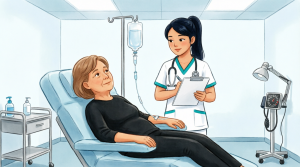
For seven years, María González arrived punctually at the hospital’s blood bank.
Always on the first Tuesday of every month.
Always at eight in the morning.
The nurses already knew her.
“Back again, Mrs. María?” one of them would joke while preparing the bed. “At this rate, we’re going to put your photo at the entrance of the hospital.”
María would smile shyly.
“It’s nothing special,” she would reply.
But no one knew the real reason she kept coming.
Everyone believed she was simply a generous woman who wanted to help.
The truth was much more painful.
María donated blood because it was the only thing she felt she could still do for her son.
Her son Alejandro.
The same son who, according to official documents, had died seven years earlier.
Everything happened one stormy afternoon.
A truck.
A crash on the highway.
An ambulance that arrived too late.
That’s what they told her.
When María arrived at the hospital, a doctor with a tired voice led her into a small room.
“Mrs. González… we did everything we could.”
María could barely breathe.
“I want to see him,” she said.
The doctor shook his head.
“The accident was very severe… your son is unrecognizable. It’s better if you remember him the way he was.”
María felt her world collapse.
She signed papers without reading them.
Three days later, she buried a closed coffin.
She never saw the body.
She never said goodbye.
Only a wooden box being lowered into the damp earth of the cemetery.
The months that followed were a silent hell.
The house was empty.
Too empty.
Alejandro’s room stayed exactly the same.
His backpack on the chair.
His sneakers under the bed.
His notebooks open on the desk.
Every night, María entered that room.
She sat on the bed.
And talked to herself.
“Today it was very hot, son.”
“Today I cooked rice the way you liked it.”
Sometimes she left the door slightly open, as if Alejandro might come home late.
But the dead do not return.
Life, however, kept moving forward.
The bills kept coming.
The rent too.
María returned to work sewing clothes in a small workshop in downtown Monterrey. She spent hours at an old sewing machine repairing pants and stitching school uniforms.
One morning she heard something on the workshop radio.
An announcement from the hospital.
“We need blood donors. A single donation can save lives.”
María didn’t know why, but she felt an immediate impulse.
Maybe guilt.
Maybe love.
Maybe simply the need to feel she could still do something good.
That same week, she went to the hospital.
“Blood type?” the nurse asked.
“AB negative.”
The nurse raised her eyebrows in surprise.
“That’s extremely rare.”
María didn’t understand the importance of that sentence.
She simply sat on the bed and extended her arm.
The needle entered slowly.
The blood began filling the bag.
María closed her eyes.
And for the first time since her son’s death, she felt something close to peace.
After that first donation, the hospital started calling her more and more.
“Mrs. María, we need your blood type.”
“Mrs. María, there’s an urgent patient.”
“Mrs. María, could you come tomorrow?”
Over time, María became a special donor.
Always compatible.
Always needed.
One doctor even told her once:
“Your blood is like gold.”
María smiled.
But she felt a chill she couldn’t explain.
After each donation, weeks later, she would receive a message from the hospital:
“The transfusion was successful.”
They never mentioned the patient’s name.
They never explained anything more.
María didn’t ask.
Maybe because she was afraid of the answer.
So seven years passed.
Seven years walking through the same white hallway.
Seven years watching her blood fill the same bags.
Until one morning everything changed.
That day, the hospital was quieter than usual.
A new nurse was working at the reception.
“Please wait a moment,” she said while searching something on the computer.
María sat in the waiting room.
Next to her was an old metal filing cabinet.
One of the drawers was not fully closed.
A folder stuck out a few inches.
María had no intention of touching it.
But something inside her pushed her.
An intuition that had been asleep for years.
She slowly stood up.
Looked around.
No one was watching.
She opened the drawer.
Yellow folders.
Medical records.
Names.
She flipped through one.
Then another.
And then she saw it.
Alejandro González.
The air vanished from her lungs.
María froze.
She read it again.
Alejandro González.
Age: 19
Blood type: AB negative
Status: Chronic patient — periodic transfusions
María’s hands began to tremble.
“It must be another Alejandro,” she whispered.
But it wasn’t.
The admission date.
Seven years earlier.
The same day as the “accident.”
The same day she buried that coffin.
María’s heart was beating so hard she thought she might faint.
She didn’t scream.
She didn’t cry.
She didn’t make a scene.
She took out her phone.
Photographed every page.
Then carefully closed the folder.
She returned to her seat.
When the nurse called her, María walked to the bed as usual.
She sat down.
Extended her arm.
The needle entered her skin.
Blood began to flow.
But this time María did not close her eyes.
She looked at the transparent tube.
She watched her blood slowly travel into the bag.
And for the first time she understood something terrible.
For seven years…
She had been keeping someone alive.
And now she knew who it was.
But what María still didn’t know…
was why her son was still locked inside that hospital.
For seven years…
María believed her son was buried underground.
But that file proved something impossible.
Alejandro González was not dead.
He was registered as a living patient inside the hospital.
And if that was true…
then someone had been lying for seven years.
But the most terrifying question still had no answer:
Why did they want to keep her son alive… in secret?
PART 2…
As the needle withdrew from her arm, María didn’t feel the usual lightheadedness; she felt a cold, sharp clarity. She thanked the nurse, walked out of the donation room, and instead of heading toward the exit, she turned toward the hospital’s restricted administrative wing.
Using the floor plan she had glimpsed on the office wall, María found the room number listed in the hidden file: Room 702-B. It wasn’t in the main wards. It was located in the “Private Research Wing,” a floor funded by a mysterious pharmaceutical foundation.
María slipped past a security guard distracted by a phone call and reached the heavy, windowless door of 702-B. Her heart hammered against her ribs like a trapped bird. She pushed the door open.
The room was filled with the rhythmic hum of high-tech monitors. In the center of the bed lay a young man. He was thin, his skin pale, but his features were unmistakable.
“Alejandro,” she whispered.
His eyes fluttered open. They were cloudy, but as they focused on María, a spark of recognition ignited. “Mama?” his voice was a dry rasp, barely audible.
Before she could reach him, a firm hand gripped her shoulder. She spun around to find the same doctor who, seven years ago, told her her son was dead. Dr. Varga looked pale, his composure shattering.
“Mrs. González, you shouldn’t be here,” he hissed, trying to steer her out.
“You buried an empty coffin!” María roared, her grief turning into a tectonic rage. “You stole my son! Why?”
Dr. Varga cornered her in the hallway, his voice trembling. “Your son didn’t die in that crash, María. But he was brain-dead… or so we thought. Then we tested his blood. His AB-Negative mutation contains a rare protein—a universal recovery agent. His body produces a ‘fountain of youth’ for rare blood diseases.”
He looked at her with a mix of guilt and scientific obsession. “A billionaire board member of this hospital needed that blood to stay alive. We couldn’t let Alejandro die. We kept him in a medically induced coma, using your monthly donations to keep his own system from crashing during the extraction process. You weren’t just saving ‘patients,’ María. You were the only thing keeping your son’s heart beating while they drained him.“
María didn’t call the police immediately. She knew the hospital’s power. Instead, she used the photos of the files she had taken. She sent them to her nephew, a journalist, with a simple message: “If I don’t walk out of here with Alejandro in ten minutes, go live.”
She walked back into the room and sat by Alejandro. She realized that for seven years, their blood had been a bridge. Every drop she gave went straight into the veins of the boy she loved. They were never truly separated.
The scandal rocked the country. The “Golden Blood” case led to the arrest of Dr. Varga and the hospital’s elite donors. Alejandro, freed from the induced coma and the constant extractions, began a grueling road to recovery. His brain hadn’t been dead; it had been suppressed.
Two years later, María sat in a garden in a small house far from Monterrey. Alejandro sat next to her in a wheelchair, his color returning, his hand holding hers. He couldn’t speak perfectly yet, but he looked at the sunset with eyes that were fully alive.
María no longer goes to the hospital on the first Tuesday of the month. Instead, she spends that time in the garden. She realized that while the hospital used her blood for greed, her love had used that same blood to refuse to let go.
“The doctors said his blood was gold,” María told a reporter later. “But they were wrong. His life was the treasure. I didn’t just donate blood for seven years… I fought a silent war for his soul. And finally, my son is home.”