When I finished, he leaned back.
“You have a case,” he said.
I sat very still.
“Defamation. Potential emotional damages. Loss of educational opportunity is harder to quantify but not impossible to frame, especially if we can establish the effect on scholarships and your forced withdrawal. The fact that the allegation was knowingly false from the beginning matters enormously.”
I looked at the legal pad in front of him, where my life had been transformed into bullet points and possible claims.
“What does it get me?” I asked.
He studied me.
“Justice,” he said. “Maybe. Money, probably. Public vindication, certainly, if we win. But it won’t give you your twenties back.”
“I know.”
He nodded once. “Then the question is whether you want judgment or peace.”
I thought about the years I had spent choosing peace by absence and how little it had healed.
“I want the truth to cost her,” I said.
That was enough for him.
I moved into the lake house while everything began.
Calling it a house at that point was generous. It was more like a beautiful memory rotting in place. The shutters sagged. The porch rails were loose. Ivy had claimed one entire side. Inside, the air smelled like mildew and old wood and abandonment. But beneath the neglect, I could still see the bones of what it had been. The big windows facing the water. The fieldstone fireplace. The wide plank floors my grandfather had refinished himself. I stood in the silence of that first afternoon with the key in my hand and thought: If I stay here long enough, maybe I can learn what it means that he left me this.
Renovating it became a kind of ritual.
Mornings I met with Crowley, gave statements, signed documents, reviewed strategy. Afternoons I worked on the cottage myself. Tore out warped boards. Reset trim. Patched plaster. Sanded cabinets. Rebuilt the porch steps. It was the one thing that steadied me—wood, tools, sequence, repair. If I couldn’t unbreak the past, I could at least make this place sound again.
One afternoon at the hardware store, I saw Sophia.
I knew her instantly despite the fifteen years. Some faces stay rooted in the body no matter how old they get. Her hair was shorter. There were faint lines around her eyes. A wedding ring flashed on her left hand as she rang up a customer, but the posture was the same—graceful, slightly guarded, as if she had always expected the world to ask something difficult of her.
When she looked up and recognized me, all the color left her face.
“Nathaniel.”
I should have felt triumph. Or anger. What I felt was a dull ache so old it had worn smooth.
“Sophia.”
She stepped around the counter before I could stop her.
“I’m so sorry,” she said immediately. “I was nineteen. I was scared. I didn’t know what to believe. I should have stood by you. I should have—”
I set my paint samples on the counter and slid my cash forward.
“I loved you,” I said.
The sentence shut her up.
It wasn’t theatrical. I didn’t mean it as punishment. I meant it as fact, one laid down between us too late to matter and too true not to say.
Her eyes filled.
“I know.”
“No,” I said quietly. “I don’t think you did.”
Then I took my receipt and walked out.
That night, I told my story publicly.
I sat at the old desk in the study overlooking the lake, the room lit only by a brass lamp and my laptop screen, and wrote everything. The accusation. The exile. The years of work and silence. The DNA results. The hospital revelation. The cost. I did not make it neat. I did not make it charitable. I wrote it the way wounds actually feel—ragged, humiliating, repetitive, impossible to summarize cleanly.
Then I posted it.
By morning it had exploded.
Old classmates shared it. People I hadn’t seen in years commented apologies. Teachers reached out with awkward condolences. A few local pages picked it up. Then regional ones. My inbox filled with strangers saying versions of the same thing: I’m sorry. You didn’t deserve this. We should have known.
It was surreal, infuriating, and faintly satisfying all at once.
James commented publicly.
I’m sorry, Dan. I should have been there. I should have told you about Dad. I don’t expect forgiveness.
I stared at his name for a long time before closing the laptop.
That evening he came to the lake house.
The sunset behind him turned the water copper and gold. He looked older than his years. Remorse had weight; I could see it on him.
“Can we talk?” he asked.
“What’s left?”
He flinched.
“A lot, probably. But I’ll start with this. I was a coward. I believed what was easier to believe because everyone else did. I let them lead and I hid behind being younger. Then later…” He looked down. “Later, it was shame. Every year I waited made it harder.”
“You didn’t tell me Dad died.”
His face crumpled. “I know.”
“I found out on Facebook.”
“I know.”
“Do you understand how unforgivable that is?”
“I don’t know if I can understand it from your side,” he said. “But I know I did something unforgivable.”
That answer was honest enough to hurt.
“I hated you most for that,” I told him.
He nodded, tears running openly now. “I know.”
I wanted to slam the door in his face. I wanted to hit him. I wanted, absurdly, to ask him why he hadn’t chased me down that first night all those years ago, why he hadn’t met me at the edge of town and said I don’t know what’s true but you’re my brother and I’m coming with you until we find out.
Instead I said, “You’re fifteen years too late.”
Then I went inside and shut the door.
The lawsuit moved quickly after that.
Small towns love scandal, but they love legal scandal even more. Depositions became gossip before they were even completed. People speculated at diners, in church parking lots, at gas pumps. Everyone suddenly had a memory, an opinion, a theory. Some insisted they had always suspected Khloe. Others defended their old behavior as ignorance, youth, concern for family. None of it interested me.
What mattered was this: under oath, facts harden.
Khloe first tried partial truths. Confusion. Pressure. Fear. Then contradictions piled up. Medical timelines. Messages. Witnesses. And finally, cornered, she admitted what she had known from the beginning.
She had never believed I was the father.
Not for one second.
When I heard those words in deposition, I had to look away from her because the urge to lunge across the table was so immediate it frightened me.
The actual father, as rumor had eventually suggested, was a former gym teacher who had quietly left town years earlier. He denied involvement at first, then confirmed it when legal exposure became impossible to avoid. By then it barely mattered. My life had not been destroyed by the identity of the father. It had been destroyed by the fact that Khloe chose me as the lie.
Maybe because I was available. Maybe because she knew the family would believe anything ugly enough if it explained her fear. Maybe because somewhere in her she understood exactly how little certainty protected me in that house.
The trial was packed.
Every seat in the courthouse filled with the same kind of people who had once watched me in hallways, once whispered my name like contamination, once looked away because looking directly might have required judgment. I sat at the plaintiff’s table in a suit that fit too well for a man who still occasionally felt nineteen inside, and listened as lawyers rearranged my worst years into arguments.
They called me plaintiff.
They called her defendant.
They spoke about damages and reputational harm and measurable loss. They displayed old scholarship letters, my withdrawal papers, employment records from the years after, expert testimony about trauma, defamation, social consequences. They showed the jury how a lie can become infrastructure. How once enough people believe a thing, the accused person starts paying rent inside it every day.
For two weeks, the town watched.
Khloe never met my eyes.
Alex sat through part of it and then stopped coming. Word was he had already filed for divorce and was pursuing custody. I did not ask for details. Max remained mostly out of the public eye, thank God.
On the final day, when the jury returned, the whole room seemed to stop breathing.
“In the matter of Hayes versus Hayes,” the judge said, “the jury finds in favor of the plaintiff, Nathaniel Hayes.”
The words entered my body slowly, like warmth reaching numb hands.
The damages award was significant. More money than I had imagined a local court would assess, though money was never what made my chest tighten. What nearly undid me was the next part.
The judge ordered Khloe to issue a public apology acknowledging the lie and its consequences.
She stood with a paper in trembling hands and read aloud to a room full of people who had once taken her tears as proof.
“I falsely accused my cousin Nathaniel Hayes of fathering my child,” she said. “I knew he was not the father. My lie caused him to lose his home, his education, his family, and years of his life. I am responsible for that harm.”
Her voice cracked on the last line.
No one comforted her.
No one applauded either.
The silence was heavier than either.
When court adjourned, I walked out into spring sunlight so bright it almost hurt. The air smelled of cut grass and hot pavement. My mother and James were waiting on the steps.
She moved toward me immediately.
“Nathaniel—”
I stopped and looked at her.
“You threw me out,” I said.
Her face collapsed.
“I know.”
“I was nineteen. I begged you to believe me.”
Tears spilled down her cheeks.
“I know.”
“You let me go.”
“We thought—”
“You thought I was guilty. And because you thought that, you made me disposable.”
She covered her mouth and sobbed.
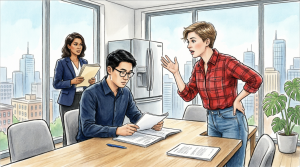
I felt no satisfaction in it. That’s something no one tells you about vindication—it does not always feel like triumph. Sometimes it feels like finally being allowed to name the shape of the wound in front of the people who inflicted it, and realizing they cannot bear to look at it any more than you could.
James stepped forward then.
“I should have been your brother,” he said.
“Yes.”
“I should have come after you.”
“Yes.”
“I should have told you about Dad.”
I looked at him until he dropped his eyes.
“Yes.”
He was crying now too.
I had imagined this kind of scene for years—some version of it, anyway. In every fantasy, I thought the release would be immediate, volcanic. Instead I felt only tired. Tired beyond anger. Tired in the marrow.
“You were not there,” I said. “And nothing you say now changes that.”
Then I walked past them.
Khloe’s life unraveled quickly after the verdict.
Alex pursued full custody and got it after a brutal hearing in which her credibility had already been publicly demolished. Her job at a local firm evaporated. Friends stopped calling. People in town, who had once embraced her because she fit their preferred story, now crossed streets to avoid her. She became, in the ugly small-town way, both villain and spectacle.
I did not enjoy that as much as I expected either.
Watching someone collapse under deserved consequence is not the same as getting your life back.
Max’s surgery was successful.
A few weeks later, I went to the hospital to see him.
He looked impossibly small in the bed, skin pale, hands thin around an action figure he was moving weakly across the blanket. He knew who I was in the vague way children know family scandals without understanding them.
“Hi,” he said.
“Hey, Max.”
I sat in the chair beside him.
He studied me with solemn curiosity.
“My dad says you’re good.”
I almost laughed at the simplicity of it.
“I try to be.”
He thought about that.
Then he held up the action figure to show me how its arm moved.
We spent ten minutes talking about superheroes and nothing else. And in those ten minutes I felt something unclench that all the legal victories in the world had not touched. The child had not chosen any of this. He deserved at least one adult in the story who understood the difference between anger and cruelty.
After the trial, I made a decision that surprised everyone, including me.
I moved my company home.
Not entirely at first. Expansion, officially. A second office. New trucks. New crews. New contracts in the county where I had once been run out. People said it was poetic. Or bold. Or vindictive. The truth was simpler: the lake house had become more than a piece of inherited guilt. It had become the first place in my hometown where I could breathe.
Restoring it taught me something I had not expected.
A structure can be badly damaged and still worth saving. But only if you are honest about what is rotten, what is load-bearing, and what must be cut out completely before anything sound can replace it.
That turned out to be true of family too.
My mother calls often now.
Sometimes I answer. Sometimes I let it ring and call back two days later. We speak carefully. Politely at first, then with small bursts of actual warmth that surprise us both. She asks real questions now—not performative ones, not diagnostic ones, but genuine ones. How did you learn to do that ceiling detail? Do you still sketch houses when no one’s paying you? What do you do when you can’t sleep?
My father’s absence hangs between us all the time. It will forever. Some losses do not heal; they become geography. But sometimes, when I’m sitting on the porch of the lake house at dusk and she’s on the phone telling me about a recipe she ruined or a memory of me at ten years old catching frogs at the lake, I can almost feel the shape of something trying to regrow.
James is more patient.
He doesn’t push. He texts every now and then—an article about building permits, a picture of the old truck he finally sold, a simple happy birthday. Once he showed up at a charity fundraiser my company sponsored and asked if I wanted coffee. We drank it in silence for a while before he said, “I still think about that night all the time.”
“So do I,” I told him.
“I don’t know if I’ll ever stop being sorry.”
“You probably won’t.”
He nodded. “Okay.”
That, I’ve learned, is as close to honest as some relationships ever get. And sometimes honest is enough to keep going.
I also started therapy.
The first session, I nearly walked out.
The office smelled like lavender and old books. The therapist had kind eyes, which I distrusted immediately. She asked me why I had come, and for ten full seconds I couldn’t answer because the truthful response—Because a lie turned me into a ghost and now that the lie is dead I don’t know what to do with the body it left behind—felt too dramatic to say out loud.
So I said, “My family believes me now.”
She waited.
“And?”
“And I’m still furious.”
That was the first honest thing I said in therapy, and maybe still the truest.
Healing, it turns out, is not becoming softer. Not always. Sometimes it is learning how to stop carrying rage in ways that cut into your own hands. Sometimes it is allowing grief to exist without constantly disguising it as productivity. Sometimes it is admitting that vindication is not the same thing as restoration and never will be.
There are nights I still dream of the living room.
There are mornings I wake in the lake house and for one disorienting second think I’m nineteen again, about to be thrown out.
Then I hear the quiet lap of water against the dock. I see the new porch rail I installed with my own hands. I smell coffee in the kitchen. I remember that the house is mine.
That matters.
My company thrives here now. We expanded faster than even I expected. People like hiring the man who came back after fifteen years and rebuilt himself in public. They call it inspiring. Redemptive. The sort of story local business magazines eat alive. I let them print the cleaned-up version because I’ve learned not every truth has to be dragged into daylight to remain true.
Sometimes I drive past my old family home.
I have not gone inside.
Not once.
I don’t know if I ever will.
Some things are too saturated with memory to enter without becoming someone else again.
But I do stop sometimes at the end of the street, engine idling, and look at the place where my life broke open. Then I drive away and return to the lake house, to the company I built, to the crews who rely on me, to the porch where evening gathers across the water, and I think about the strange, brutal arc of everything that happened.
For years I believed what I wanted most was revenge.
Then I got justice and discovered it was only one piece.
For years I believed what I needed was for the truth to come out.
Then it did, and I learned that truth does not walk around sewing old wounds shut.
For years I believed family was blood, or duty, or the people whose names matched yours.
Now I think family is anyone who, when given the chance to discard you, doesn’t.
That list is shorter than it used to be.
But it is truer.
Sometimes, late at night, I sit in my father’s old chair in the study and wonder what would have happened if he had lived long enough to board that plane. If he had knocked on my door. If I had opened it. If he had stood there with whatever apology or explanation he had spent years assembling and looked at the man I became because he failed the boy I was.
Would I have forgiven him?
I still don’t know.
What I know is this: he left me the lake house. The place where, before any of this, I learned that structures could be beautiful and strong at once. The place where the water still catches sunset like molten copper and the wind through the trees sounds almost like a voice saying keep going.
Maybe that was his apology.
Not enough. Never enough. But real.
And maybe my life now—messy, scarred, imperfect, hard-won—is the answer to everyone who once thought one lie could define me forever.
I am not the boy who was thrown out.
I am not the accusation.
I am not the silence that followed.
I am Nathaniel Hayes.
A builder.
A man who learned too young how quickly trust can be weaponized and still, somehow, kept building anyway.
A son who was failed.
A brother who was abandoned.
A cousin who was lied about.
A survivor, though I used to hate that word.
And if there is any justice deeper than courtrooms and verdicts and public apologies, maybe it lives there—in the fact that after everything, I am still here.
Not whole in the innocent way I once was. That version of me is gone forever.
But standing.
Still standing.
And some days, especially when the lake is still and the porch lights come on against the dark and the house creaks softly around me like it has finally accepted my weight, that feels like enough