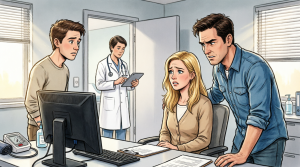
Part 3
I didn’t sleep. I sat in my recliner with the living room lamp on low, listening for footsteps, staring at my own hands like they belonged to someone older.
Morning came gray and wet. Rain tapped the windows in a steady, impatient rhythm. Nora drifted into the kitchen in her slippers, blinking at the light like it was too loud. Caleb was already up, dressed, making eggs with the easy confidence of a man who’d decided the kitchen was his office.
“I’m heading out,” he announced. “Meeting downtown. I’ll be back by dinner.”
My pulse jumped. A window. Time without him.
“Okay,” I said, keeping my voice level.
He kissed Nora’s cheek. “Mom, take it easy today. Drink your tea.”
She nodded obediently, like he’d set her schedule with a remote.
When the front door closed, I stood still for three seconds, just listening. His car started. The tires hissed on wet pavement. Then silence.
I turned to Nora. “Sweetheart, can I see behind your ear?”
She frowned, lifting a hand. “Why?”
“I just want to make sure it’s not irritating your skin.”
She let me. Her hair was soft, warm from sleep. I brushed it back gently and saw the patch clearly—a small oval, flesh-colored, stuck to her skin like a secret. The edges were clean, like it had been applied carefully.
I didn’t rip it off. Not yet. I didn’t know what it was. I didn’t know what taking it off might do. All I knew was that Caleb had put it there without telling me, and Dr. Klein had whispered like she was afraid.
Goal, I told myself. Simple. Find out what it is. Find out what’s in the dispenser. Find out what “baseline” means.
Conflict showed up almost immediately: Nora reached for her mug on the counter. The travel mug. Caleb’s mug. The one with the flip-top latch.
“Don’t,” I said too quickly.
She froze, eyes widening. “Don’t what?”
I softened my tone. “Let me make you fresh tea. That one’s been sitting.”
She stared at me like I was speaking a different language. “Caleb made it.”
“I know. I’ll make another. Just—humor me.”
Her mouth tightened, the way it used to when she thought I was being stubborn. “Tom, you’re acting strange.”
That stung because it was true, and because it was the same accusation Caleb used like a leash.
“I’m fine,” I lied. “Go sit down.”
She shuffled to the table, and I poured the tea down the sink. The smell rose sharp—mint and bitterness—and for a second I thought of hospital corridors, antiseptic and closed doors.
The gray dispenser sat on the counter like a little robot. It had a lock and a display: Good morning, Nora! Time for your pack.
My fingers hovered over it. I tried the latch. Locked. I tried again, harder. Locked.
Caleb’s voice replayed in my head: Dad gets mixed up with the bottles.
I opened drawers until I found the instruction manual Caleb had left in a junk drawer, tucked under rubber bands and dead batteries. In tiny print, it mentioned a “caregiver override” code.
I tried our anniversary. Our address. Caleb’s birthday. Nothing.
My eyes landed on a sticky note on the fridge—Caleb’s handwriting. It listed reminders like a boss talking to an employee.
April 12th. Nora’s birthday.
My throat tightened as I typed it in.
The dispenser clicked open.
Inside were compartments with little paper cups. Each cup held pills—different colors, different shapes—like candy nobody should want. I lifted one cup and shook it lightly. The pills tapped together, tiny hard sounds.
I didn’t know what I was looking at. I wasn’t a pharmacist. I was a retired HVAC guy who spent his life fixing other people’s broken air.
But one pill caught my eye because it wasn’t stamped like the others. No clear marking. No familiar look. Just a flat, pale oval that seemed… wrong.
I slid it into a plastic bag and pocketed it, hands sweating.
Then I did the hardest thing: I put everything back exactly as it was.
Nora watched me from the table. “Are you mad at Caleb?” she asked.
I forced a smile. “No.”
She looked down at her hands. “He says you get angry when you’re tired.”
My stomach turned. “He says that?”
She nodded, small. “He says I shouldn’t upset you.”
I sat across from her, rainlight gray on the tabletop. “Nora, do you feel safe?”
She blinked slowly, like the question was heavy. “With Caleb?”
“Yes.”
Her face softened automatically. “He’s my boy.”
I reached across the table and covered her hand with mine. It felt fragile. “And with me?”
She looked at me for a long time, then nodded. “You’re Tom.”
As if that settled it. As if my name was the only proof she needed.
By noon, I was driving to a strip mall pharmacy on the other side of town. Not ours—too close, too familiar. I walked in with the small bag in my pocket, heart hammering like I was carrying a stolen diamond.
The pharmacist on duty was a woman with silver hair pulled into a tight bun and reading glasses on a chain. Her name tag said: MARIA.
“I have a question,” I said, voice low. “Hypothetically.”
Her eyes lifted. “Hypothetically is my favorite kind.”
I slid the bag across the counter, shielding it with my hand. “What is this?”
Maria picked up the pill with tweezers, turned it under the light. The overhead fluorescents made it look even paler.
She didn’t answer right away. Her mouth tightened.
“That’s not something you should find in a home organizer,” she said finally.
My blood went cold. “What is it?”
She hesitated, then lowered her voice. “It’s a sedative class medication. Prescription only. And it’s… not usually given to someone your wife’s age unless there’s a very specific reason.”
My throat felt too small. “What kind of reason?”
Maria studied my face, and I saw a shift in her eyes—professional caution turning into human concern.
“Who’s prescribing it?” she asked.
“I don’t know,” I admitted. “My son… manages her meds.”
Maria’s gaze sharpened. “Does her doctor know she’s taking it?”
“I don’t think so.”
She exhaled slowly, like she was trying not to say something she’d regret. “Listen. I can’t tell you more without the prescription record. But I can tell you this: if someone is giving her something like this without proper oversight, it can absolutely cause confusion, memory problems, balance issues.”
I heard Dr. Klein’s whisper again, and it felt like a hand closing around my spine.
“Is it reversible?” I asked, voice breaking.
Maria’s expression softened. “Sometimes. If the cause is medication-related, stopping the exposure can help. But you need a doctor involved. Immediately.”
I nodded, throat burning. “Thank you.”
As I turned to leave, my phone buzzed.
A text from Caleb: Running late. How’s Mom?
My fingers hovered over the screen, and for a second I couldn’t remember how to act normal.
Fine, I typed. Quiet day.
Then I sat in my truck in the rain and stared at the pharmacy receipt Maria had printed—just a generic note about “medication identification consultation,” nothing incriminating, nothing I could wave like a flag.
I needed more. Proof. A record. Something that wouldn’t evaporate if Caleb smiled at the right person.
When I pulled into our driveway, Nora was standing at the living room window, watching the street like she was waiting for someone to return.
I walked inside, and she turned toward me.
“Tom,” she said clearly, without hesitation. “You were gone a long time.”
My heart stopped.
It was the first time in months she’d said my name like she meant it—like she remembered it belonged to me.
Hope surged so fast it hurt. And right behind that hope, rage rose cold and steady.
Because if she was coming back already…
What had Caleb been doing to keep her gone?
Part 4
Saturday morning smelled like bacon and rain-soaked earth.
I stood in the kitchen with my sleeves rolled up, frying bacon the way Nora used to—slow, patient, letting the edges curl just right. The sound of it popping felt like proof of life. Nora sat at the table with a mug of coffee I made myself, watching me with a puzzled, almost amused expression.
“You’re cooking,” she said.
“I can cook,” I replied.
She smiled faintly. “You usually burn things.”
“That’s slander.”
Her laugh came out sharper than it had in months. Real. I turned my head quickly so she wouldn’t see my eyes going wet.
Caleb had left Friday night for what he called “a weekend retreat.” He’d said it like it was nothing—like he didn’t run our house like a command center. He’d packed a small duffel, taken his laptop, kissed Nora’s forehead, and reminded me three times not to touch the dispenser.
“Don’t get creative,” he’d warned lightly.
I smiled back, the way you smile at someone holding a knife you can’t yet grab.
The moment his car disappeared, I made my move.
Not dramatic. Not heroic. Just careful, trembling practicality.
I didn’t rip the patch off Nora’s ear in a panic. I called Dr. Klein’s office first, got routed to an on-call nurse, and explained in a voice that shook. The nurse told me to remove it and bring it in, to save it in a plastic bag. She told me to monitor Nora’s breathing, her balance, her heart rate. She told me to call 911 if anything felt wrong.
So I peeled it off gently. Nora winced.
“What was that?” she asked.
“Nothing important,” I lied, even as my hands shook.
Then I opened the dispenser with the override code and replaced the suspicious pills with plain vitamins—same shape as close as I could find, bought at a grocery store at midnight like some desperate thief. I left the legitimate ones alone. I didn’t want to harm her. I just wanted to stop the fog.
Goal: give her one weekend without whatever Caleb had been slipping into her life.
Conflict: my own fear. What if I was wrong? What if I made her worse? What if Caleb came back early?
Information: within twelve hours, Nora started asking questions.
Not perfect questions. Not fully oriented. But questions that had weight.
“Why is Caleb always so tired?” she asked while I folded laundry. “He sleeps like he’s running from something.”
I froze with a towel in my hands. “Does he?”
She nodded slowly. “He has that look. Like when someone’s hiding a bad grade from their parents.”
I swallowed hard. “Do you remember signing anything recently?”
She frowned, eyes narrowing. “Paperwork?”
“Yes.”
She stared at the kitchen counter for a long moment, then shook her head. “I remember Caleb putting a pen in my hand. I remember him saying, ‘Just sign, Mom, it’s for your safety.’” Her voice tightened. “I remember the pen felt heavy.”
My chest tightened so hard I had to sit down.
By Sunday afternoon, she made tea without asking where the kettle was. She found her own reading glasses on the windowsill. She looked at a photo of our grandkids and named two of them correctly.
And then she looked at me, eyes suddenly sharp with something like anger.
“Tom,” she said, voice low, “why did I think you were… mean?”
The question hit me like a slap.
“I never thought that,” I said quickly.
She shook her head. “I did. In my head. Like a story somebody told me. Like… you were the problem.”
My throat burned. “Who told you that?”
She stared down at her hands. “Caleb. He said you’d get mad. He said I should listen to him because you were… unreliable.”
Emotional reversal hit hard: relief that she was returning, followed by grief so sharp it tasted like metal.
Because Caleb hadn’t just been fogging her brain.
He’d been rewriting her trust.
That night, as Nora slept, I sat at the kitchen table with the removed patch in a bag, the suspicious pill in another, and Dr. Klein’s nurse’s instructions written on a scrap of paper.
I heard a car outside.
Headlights swept across the living room walls.
My stomach dropped.
The engine shut off.
A door opened. Closed.
Footsteps on the porch.
The front door handle turned.
Caleb walked in, wet from rain, duffel over his shoulder.
Two days early.
He stopped when he saw Nora’s half-finished crossword on the table, filled in with neat handwriting.
He stared at it like it was a dead animal.
Then he looked at me.
“What did you do?” he asked softly.
“I made breakfast,” I said, keeping my voice calm.
His eyes flicked to the gray dispenser. “Did you open it?”
“No,” I lied.
He stepped closer, breathing controlled, expression polite. “Dad. Don’t play games.”
Nora’s voice came from the hallway. “Caleb?”
She appeared in her robe, hair messy, eyes clearer than he’d seen in months.
Caleb’s smile snapped into place. “Hey, Mom. I missed you.”
Nora stared at him for a long moment. “You came back early.”
“I wanted to check on you.”
She glanced at me, then back at him. “I feel… better.”
Caleb’s face didn’t change, but something behind his eyes tightened. “That’s great.”
He moved toward the dispenser like it was muscle memory.
I stepped in front of him.
Conflict landed in the space between us like a dropped weight.
“Move,” he said quietly.
“No.”
His nostrils flared. “Dad, you don’t understand what you’re messing with.”
Nora’s voice cut in, sharper. “What is happening?”
Caleb turned to her, smile returning. “Nothing, Mom. Go back to bed.”
Nora didn’t move. “Don’t talk to me like I’m a child.”
Caleb’s smile faltered. Just a crack.
I reached into my pocket and pulled out the plastic bag with the patch. I held it up like a tiny, ugly flag.
“What is this?” I asked.
Caleb’s eyes widened—just for a flash—then narrowed. “You went through her things.”
“You put it on her.”
“It was for nausea.”
Nora touched behind her ear, confused. “You did?”
Caleb’s voice stayed smooth. “Yes. It helps. You get sick.”
“I do?” Nora asked, and the doubt in her voice made my heart ache.
I pulled out the second bag—the pale oval pill.
“I had this checked,” I said. “It’s not a vitamin.”
Caleb’s face went still. “Who did you talk to?”
“Doesn’t matter.”
“It matters,” he snapped, then caught himself, smoothing his tone instantly. “Dad. Give me the bags.”
Nora stepped closer to me, eyes darting between us. “Caleb,” she whispered, “what have you been giving me?”
Caleb’s jaw tightened. For a second he looked like a man in a corner.
Then his phone buzzed.
He glanced down, and I saw the screen light up with a single name: Tessa.
His thumb hovered. He didn’t answer. He just looked at me, voice low.
“You really want to do this in front of her?” he said.
Before I could respond, my own phone buzzed—an unknown number.
One message.
Stop digging, or you’ll both go back to sleep.
My skin went cold. Caleb watched my face and smiled slightly, like he could tell something had shifted.
And in that moment, I realized Caleb wasn’t the only one playing this game—so who was pulling the other end of the string?…………………
CLICK HERE READ FINAL PART 👉– I Took My Wife To A Neurologist. The Doctor Whispered: “Keep Her Away From Your Son.”

