The People Who Show Up Tired Are the Ones Holding Us Together
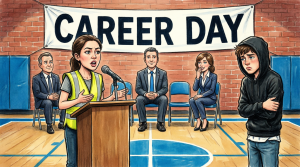
They laughed when the truck driver grabbed the microphone—until one skinny boy stood up shaking and called her the bravest parent in the room.
“Ma’am, the guest speakers are supposed to wait by the curtain.”
The volunteer smiled when she said it, but her eyes had already gone to my boots.
Mud on the soles.
Reflective jacket over a plain black shirt.
Hair tied back with a red gas-station scrunchie.
Around me stood people who looked like they belonged in brochures.
A dentist with perfect teeth.
A financial advisor with shiny cuff links.
A woman from a private clinic carrying a slideshow about “future success.”
And then there was me.
My name is Linda Brooks.
I’m forty-six, I drive an eighteen-wheeler, and I’ve raised two kids mostly through voicemail, highway coffee, and the promise that I would always come back.
My daughter, Emma, begged me to do this.
“Please, Mom,” she said the night before. “They need to hear from somebody real.”
I almost told her no.
Not because I was scared of talking.
Because I was scared of being looked at the way people look at folks like me when they think we don’t notice.
Like we’re useful, but not impressive.
Necessary, but not admirable.
The gym was full by the time they called Career Week to order.
Kids sat cross-legged on the floor.
Parents lined the folding chairs in the back.
The speakers went one by one.
A lawyer talked about discipline.
A consultant talked about leadership.
A software manager talked about innovation and opportunity.
Nobody was rude.
But I saw the drifting eyes.
The polite claps.
The kind of attention people give when they’re waiting for something better.
Then I heard a whisper behind me.
“A truck driver?” a mother muttered. “That’s what they brought in?”
The woman beside her gave a small laugh.
I felt it in my chest the way you feel a pothole through the steering column.
Hard.
Sharp.
Familiar.
Then they called my name.
I walked to the microphone hearing my work boots hit the hardwood.
I had no slides.
No handouts.
No letters after my name.
Just two hands that had gripped a steering wheel through black ice, sleet, exhaustion, and too many lonely nights to count.
I looked at the kids first.
Not the parents.
Not the teachers.
The kids.
And I told them the truth.
“I don’t save lives in an operating room,” I said. “I don’t argue cases in court. I don’t wear heels to work or sit behind a polished desk.”
A few adults smiled at that.
Then I kept going.
“But when the country got scared and the roads went quiet, I was still out there.”
The gym changed.
Not loud.
Not dramatic.
Just still.
“I hauled baby formula when parents were panicking. I hauled canned soup when shelves were stripped. I hauled the kind of medicine people wait on in small towns where there’s one pharmacy, one clinic, and no room for delay.”
Now nobody was moving.
“I missed birthdays. I missed school plays. One Christmas Eve, I ate crackers in my cab behind a dark loading dock because my trailer had to be at a distribution center before dawn. If I turned around and went home, somebody else’s kids woke up to less.”
I saw Emma in the second row.
Her chin was trembling, but she was smiling.
I swallowed and kept my voice steady.
“Last winter, I got trapped in a storm so bad I couldn’t see past my own hood. Two nights in the cab. Engine running low. Phone battery dropping. Forty thousand pounds of refrigerated food behind me. I could’ve walked away and saved myself the fear. But then all I could think was this: somewhere, an older man living alone was waiting on that delivery. Somewhere, a mother was counting dollars in a grocery aisle. Somewhere, somebody was praying the shelves wouldn’t be empty again.”
The financial advisor stopped looking at his watch.
The clinic woman lowered her tablet.
A boy in the back raised his hand.
He looked about thirteen.
Too thin.
Freckles across his nose.
Gray hoodie hanging off his shoulders like it belonged to somebody older.
“Can I ask something?” he said.
“You sure can.”
He didn’t smile.
“Do you ever regret not doing something more?” he asked. “Like college. Or… something bigger?”
You could feel the adults tense up.
Like they wanted to rescue me from the question.
I didn’t need rescuing.
I rested both hands on the sides of the podium.
“Son,” I said, “when people are cold, hungry, sick, or scared, they don’t ask whether help arrived from a corner office or a loading dock.”
Nobody breathed.
“They ask whether it showed up.”
The silence got deeper.
“So no,” I said. “I don’t regret honest work. I don’t regret feeding my family with it. And I sure don’t regret helping keep other families standing when life got hard.”
That should have been the end.
I thought it was.
Then I heard a chair scrape.
The skinny boy in the hoodie stood up so fast he nearly knocked it over.
His face had gone red.
His voice shook on the first word.
“My dad drives nights,” he said. “People joke that he just sits there and turns a wheel.”
His lips trembled.
“He sleeps during the day on our couch because he gave me his room after my mom left. He pays for my little sister’s inhalers. He misses almost everything. And he still says sorry like he’s the one letting us down.”
Nobody in that gym was looking at anything except that boy.
He wiped his face with his sleeve and pushed through the rest.
“So maybe people like you don’t wear suits. Maybe you don’t make fancy speeches. But my dad is the reason we eat. He’s the reason we still got lights on. He’s the reason I get to be here.”
His voice cracked completely then.
“He’s my hero. And I think you are too.”
I have spoken in truck yards.
At weigh stations.
Across greasy diner counters at two in the morning.
But nothing in my life ever hit me like that.
Not because he called me a hero.
Because I knew exactly what kind of shame he was carrying for a father who had done nothing wrong except work the kind of job people depend on and still look down on.
A teacher in the front row started crying.
One of the mothers who had whispered earlier stared at her lap.
A man in a tie began clapping.
Then another.
Then the whole gym.
Not polite clapping.
Real clapping.
The kind that sounds like people realizing something about themselves a little too late.
I looked at those kids and said the only thing that mattered.
“This country does not run on applause,” I told them. “It runs on people who show up tired.”
I pointed toward the bleachers.
“The drivers. The welders. The nursing aides. The mechanics. The janitors. The warehouse crews. The lineworkers. The people who miss dinner so somebody else can have one.”
I paused.
“So when you think about your future, don’t ask what sounds impressive. Ask what is honest. Ask what is needed. Ask what lets you sleep at night knowing you carried your part.”
Nobody whispered after that.
When it was over, kids lined up to talk to me.
Not about trucks, mostly.
About dignity.
About their dads.
About their moms.
About work they were proud of but had been taught to hide.
And when Emma reached me, she wrapped her arms around my waist and said, “I told you they needed somebody real.”
I held her for a long time.
Because the truth is, people don’t just get lonely in empty houses.
They get lonely in full rooms too.
Especially when the world keeps telling them their sacrifice counts only when there’s a crisis.
But that morning, in a school gym with scuffed floors and folding chairs, a room full of people finally remembered something they should have known all along:
The hands that keep a country alive do not always look important.
They just keep showing up anyway.
PART 2
The applause had barely died when the fight over what I said began.
Not out loud at first.
Not in the gym.
In the smiles that didn’t quite hold.
In the little nods people give when they’re being polite with their mouths and angry with their thoughts.
I was still standing near the folding chairs with Emma’s arms around my waist when I saw Principal Dawes glance toward the back doors.
Two mothers had stopped there.
One of them was the woman who had whispered about me before I spoke.
She was talking fast now.
Tight jaw.
Crossed arms.
The kind of body language that says, I am not done with this.
Emma felt me stiffen.
She stepped back and looked up at me.
“What?”
“Nothing,” I lied.
She followed my eyes and saw them too.
Then she did that thing kids do when they’re not kids anymore.
She squared her shoulders.
“Let them talk.”
I should have listened to her.
But when you’ve spent enough years walking into rooms where people have already made up their minds about you, you get good at hearing trouble before it starts making noise.
Kids were still lined up.
A few of them wanted to ask about trucks.
Most didn’t.
One girl with braces said her mother cleans offices at night and always hides it when school forms ask what parents do for work.
A boy in a baseball cap said his uncle fixes heating units and people call him “just a repair guy,” even though everybody panics when the heat goes out.
One quiet little girl with pink shoelaces said her grandmother folds laundry at a nursing home and comes home smelling like bleach and peppermint lotion.
“She says not to tell people because it sounds sad,” the girl whispered.
I crouched down so we were eye level.
“It doesn’t sound sad to me,” I said.
“It sounds like she’s helping people.”
The girl looked like somebody had loosened a knot in her chest.
That nearly undid me more than the applause had.
Then the skinny boy in the gray hoodie came over.
Closer up, he looked even younger.
Thirteen, maybe.
Fourteen at the most.
Freckles.
Sharp collarbones.
A face that had learned to stay brave too early.
“Ma’am,” he said.
“You can call me Linda.”
He nodded once.
“Mason.”
He held his hand out like a grown man.
I shook it.
His palm was cold.
“That was for my dad,” he said.
“I figured.”
He looked down at his sneakers.
“They laugh at him sometimes.”
“Who does?”
He shrugged, which usually means too many people to name.
“People.”
He swallowed.
“He says it doesn’t matter. But sometimes when he thinks I’m asleep, he sits on the edge of the couch and just stares at the floor.”
I did not know Ray Hale.
Not yet.
But I knew that stare.
I had seen it in the mirror at truck-stop bathrooms at three in the morning.
In warehouse windows.
In my own dark kitchen when bills were lined up like accusations and the house was quiet enough to hear the refrigerator hum.
Mason pulled a folded piece of paper from his pocket.
It was bent soft from being opened and closed too many times.
“My English teacher made us write about our hero last month,” he said. “I wrote about him.”
He hesitated.
“Can I give it to you?”
I blinked.
“Why me?”
“Because I think maybe you’d understand it right.”
He handed it over and walked away before I could answer.
I didn’t open it there.
I couldn’t.
Something in the way he let go of that page felt too personal to unfold in a crowd.
When the last few kids drifted off, Principal Dawes came over with the careful smile of a man trying to manage twelve feelings at once.
“Ms. Brooks,” he said, “that was… memorable.”
I almost laughed.
Memorable is what people say when they mean powerful and inconvenient at the same time.
“Thank you.”
He cleared his throat.
“A number of parents were very moved.”
I waited.
“And a few are concerned.”
There it was.
Emma crossed her arms.
“Concerned about what?” she asked.
He glanced at her, then back at me.
“They feel some students may have received the wrong message.”
I could feel the heat rise up my neck.
“What message was that?”
He shifted on his feet.
“That success is optional. That ambition is somehow less honorable than sacrifice.”
Emma made a noise that sounded like disbelief and disgust had met in the middle.
I kept my voice level.
“I did not tell one child not to dream bigger.”
“No, of course not.”
“But?”
“But some heard it as… anti-college.”
I looked around the gym.
At the scuffed floor.
The folding chairs.
The banners peeling at the edges.
The place where people had just clapped for the workers they depend on and gone right back to grading those workers by how polished they looked.
“Funny,” I said. “I talked for less than ten minutes and somehow folks still heard exactly what they came in here wanting to hear.”
Principal Dawes rubbed the bridge of his nose.
“I’m only letting you know there may be follow-up.”
“I haul frozen food, Principal. Follow-up doesn’t scare me.”
That surprised a smile out of him.
A tired one.
The real kind.
“Understood.”
Emma took my hand as we walked out.
The hallway smelled like floor wax and cafeteria pizza.
The walls were lined with college pennants.
Not one poster for apprenticeships.
Not one for logistics.
Not one for electrical training or diesel repair or nursing aide certification or anything else that keeps a place running while everybody else is talking about potential.
Emma saw me looking.
“Yeah,” she said quietly. “I know.”
Outside, the sky had turned that washed-out gray you get before rain.
Parents were gathering their kids.
Engines turned over.
Back doors slammed.
And standing near a silver sedan was the woman who had whispered about me.
She was dressed like the weather should have asked permission before touching her.
Neat coat.
Soft leather purse.
Hair that did not move, even in wind.
Beside her stood the woman from the private clinic.
Tablet tucked under one arm.
They looked over when Emma and I came down the steps.
The whispering mother smiled first.
That kind of smile.
Smooth.
Thin.
Not friendly.
“Ms. Brooks,” she said. “That was certainly emotional.”
I nodded once.
“I’ve been accused of worse.”
She gave a small laugh, like I was supposed to enjoy being handled.
“I only hope the children understood that hardship should not be romanticized.”
Emma started to speak.
I squeezed her hand.
Not yet.
The clinic woman stepped in.
“No one doubts the value of labor. But at this age, children are impressionable. It is important that they aim beyond survival.”
I looked at both of them.
The first woman’s nails were pale pink and perfect.
The second wore a bracelet that probably cost more than my monthly electric bill.
And neither one had heard a word I’d said.
Or maybe they had.
Maybe that was the problem.
“I didn’t romanticize hardship,” I said.
“I told the truth about it.”
The whispering mother tilted her head.
“Truth can still lower a ceiling.”
That one landed.
Because it was the kind of sentence people use when they want to sound wise while saying something cruel.
Emma stepped in before I could answer.
“My mom didn’t lower anything,” she said.
Her voice was steady.
“She just didn’t pretend some people matter less because their jobs come with steel-toe boots.”
The clinic woman’s face changed first.
Just a flicker.
Surprise that a child had said the impolite part out loud.
The other mother’s smile thinned even more.
“I can see where her confidence comes from,” she said.
Emma smiled back.
“Good.”
Then she pulled me toward the parking lot before I said something that would’ve made her principal’s afternoon harder.
We sat in my truck for a minute with the doors closed and neither of us moving.
Emma let out a long breath.
“I hate that woman.”
“Don’t hate her.”
“Why not?”
“Because hate is too much work, and I’ve already got a route tomorrow.”
That got a laugh out of her.
Small, but real.
Then she looked over at me, and all the heat went out of her face.
“You okay?”
I stared through the windshield at the school doors.
At the stream of people coming and going.
At Mason walking to an older pickup with his backpack hanging low.
At a broad-shouldered man in a work jacket climbing out of the driver’s side.
His face was drawn with exhaustion.
Even from that distance, I could see it.
Mason ran to him.
Not like kids run to men they are scared of.
Like kids run to the place they know is still standing.
The man hugged him hard with one arm.
Then he looked toward the school.
Toward me.
He didn’t wave.
Just put a hand over his heart once.
Then he got back in the truck.
I felt that in places I don’t have names for.
“I’m okay,” I said.
Which was almost true.
By the time I got home, the clip was everywhere.
Not everywhere in the world.
Just everywhere that can make your own little town feel too small.
Some teacher had posted a short video from the gym.
Then a parent shared it.
Then someone else clipped the line about people who show up tired.
And by dinner, my phone looked like it had caught fire.
Messages from old classmates I hadn’t heard from in twenty years.
Texts from drivers I knew by first name and truck stop coffee orders.
Voicemails from cousins.
One from my brother, who once told me truck driving was no life for a woman and now sounded like he was trying to cry and hide it at the same time.
Then the comments started.
Some of them were kind enough to make your throat close.
My dad worked nights my whole childhood. Thank you for saying this.
My sister cleans rooms at a motel and my son came home saying he finally felt proud of her.
I needed my teenager to hear every word.
But kindness never travels alone for long.
The other comments came right behind it.
This is how small towns keep kids stuck.
Nobody should be applauding struggle.
Why invite a driver when students need role models for advancement?
Working hard is honorable. Settling is not.
That last one got under my skin.
Settling.
As if life only counts when it gets shinier.
As if holding the line for your family is the same as giving up on them.
Emma stood at the kitchen counter eating cereal straight from the box and reading over my shoulder.
“Don’t,” I said.
“Don’t what?”
“Don’t feed the wolves.”
“I wasn’t going to.”
She paused.
“I was going to memorize names.”
I looked at her.
She shrugged.
“Kidding.”
Then, after a beat:
“Mostly.”
I took the phone away and set it face down.
The kitchen felt too small.
The bills on the counter looked sharper than usual.
The overhead light buzzed faintly.
A truck rumbled past out on the county road.
“I’m sorry,” Emma said.
“For what?”
“For asking you to do it.”
That turned me so fast my chair scraped.
“No.”
I pointed a finger at her.
“No, ma’am. Don’t you put this on yourself.”
She stared at the cereal box.
“I just thought…”
“I know what you thought.”
I softened my voice.
“You thought maybe one room full of people could remember that human worth is not a dress code.”
She looked up.
I let out a breath.
“And maybe they did. Some of them.”
She slid into the chair across from me.
The same chair where she used to do homework while I reheated canned soup and tried not to calculate miles in my head.
“Ms. Bell called today,” she said.
“The counselor?”
She nodded.
“She wants to meet tomorrow.”
“About?”
Emma took too long to answer.
That is one of the first signs you learn as a mother.
The pause before the truth.
“The Mercer scholarship.”
That name I recognized.
Arthur and Claire Mercer.
Money all over town.
Their family funded playgrounds, gala dinners, quiet plaques on brick walls, and the kind of donations that get announced from podiums by people who think generosity and control are cousins.
Claire Mercer.
The whispering mother.
Of course.
“How much?”
Emma named a number so big it made the room go still.
Not rich-people big.
Not life-is-easy big.
But enough to turn my stomach for reasons that had nothing to do with money and everything to do with what money can ask in return.
“Emma.”
“I know.”
“Do you?”
She nodded.
“It’s a full ride to Halston Ridge.”
A private college with ivy on its brochures and students who looked like they had never had to check a bank balance before buying shampoo.
I had seen the pamphlet.
Thick paper.
Smiling faces.
A campus green so perfectly manicured it looked fake.
“You want it?”
She looked at her hands.
“That’s not a simple question.”
“No,” I said. “It usually isn’t.”
We sat there a second.
Then she said the thing I should have known was living under everything.
“If I got a scholarship like that, you could stop taking the long winter runs.”
I looked away first.
That’s the truth.
Not because I was ashamed.
Because she had reached right into the fear I keep locked down and spoken it in my own kitchen.
There are mothers who protect their children with soft words.
There are mothers who protect them with money.
I had protected mine mostly by leaving.
Leaving before dawn.
Leaving for routes.
Leaving casseroles in the fridge and notes on the microwave and birthday presents wrapped early because I wasn’t sure where I’d be when candles got lit.
And every single mile of it had been for this exact reason.
So my daughter would one day have choices that did not taste like sacrifice.
I swallowed hard.
“You do not pick a future because you’re trying to rescue me from mine.”
Her eyes went wet.
“What if I want both?”
I had no answer fast enough for that.
The next morning I was back on the road before sunrise.
That’s the thing about working people.
The world can be arguing about your value online, and your trailer still needs to be at the distribution yard by nine.
I had a refrigerated load headed north.
Eggs, produce, boxed milk, a whole trailer full of ordinary things that become very important the minute they don’t arrive.
The highway was still blue-black when I merged on.
Coffee in the cup holder.
Dashboard lights low.
The radio off.
I like to start in silence.
It reminds me who I am before everybody else’s noise gets in.
The phone buzzed at my first red light off the county road.
I ignored it.
Buzzed again at the truck entrance to the interstate.
Ignored that too.
By the time I stopped for fuel two hours later, there were six missed calls.
Three from Emma.
One from Principal Dawes.
One from a number I didn’t know.
One from Mr. Ortega, the shop teacher.
I called Emma first.
She picked up on the first ring.
“Mom.”
“You okay?”
“Yeah.”
She sounded too fast.
Too bright.
The way people sound when they are trying to outrun the tremble in themselves.
“What happened?”
“There’s a meeting tonight.”
“With who?”
“The school board. Some parents. A few faculty. The Mercers.”
I leaned against the side of my cab and watched diesel shimmer on wet pavement.
“For what?”
She went quiet.
Then:
“They were already planning to convert the auto shop and logistics room.”
I stood up straighter.
“Convert them into what?”
“A leadership lab.”
I shut my eyes.
Of course it had a name like that.
“What does that mean?”
“It means they want to tear out the lifts, clear out the engine bays, get rid of the freight simulator, and build some presentation space with glass walls and media stations and college branding.”
The fuel pump clicked hard into the tank.
I barely heard it.
“The logistics room too?”
“Yeah.”
That room mattered to me more than I knew until that moment.
It was where students learned routing, supply chains, inventory systems, commercial safety basics.
Not truck driving exactly.
But the bones of how goods move.
The bones of how shelves stay stocked and clinics get supplies and towns keep breathing.
“When were they going to tell people?”
Emma laughed once without humor.
“Probably right after they got the big donation approved.”
I rubbed a hand over my mouth.
“And this has what to do with me?”
“Mom.”
I heard her exhale.
“Your speech blew it open.”
That hit harder than I expected.
Not because I was proud.
Because I understood immediately what that meant.
Kids had gone home asking questions.
Parents had talked.
Maybe some of them had looked for the first time at what the school was celebrating and what it was quietly erasing.
Mr. Ortega came on the line next.
His voice had sawdust in it.
Warm and worn.
“Linda.”
“Morning.”
“Hell of a morning.”
“What’s going on?”
He didn’t waste my time.
“The board thinks the school needs a more ‘aspirational image.’”
I laughed so sharply it came out mean.
“Aspirational to who?”
“To people who write checks.”
That at least was honest.
He kept going.
“I’ve got twenty-three kids in that program this term. Eight of them are the first in their families to pass any certification test for anything. Five already have apprenticeships lined up after graduation. One girl rebuilt a transmission with hands so small she has to use both palms to push the breaker bar.”
He paused.
“And half the reason Mason Hale still comes to school every day is because he can breathe in my shop.”
That made me still.
“What do you mean?”
“I mean some kids don’t sit well in rooms where every right answer has to come from a screen. Put a torque wrench in their hand, and they remember they’re capable.”
I looked out across the fuel island.
At men in reflective vests.
At a woman in a flatbed climbing down off her rig and stretching her back.
At a line of trucks that would all be somewhere else by sundown, leaving behind nothing but tire tracks and a little less empty space on store shelves.
“When’s the meeting?”
“Six.”
“I’ll be back by five-thirty if traffic behaves.”
“And if it doesn’t?”
“Then the town will have one more reason to remember why logistics matters.”
That got a tired laugh out of him.
“All right, Linda.”
Then his voice changed.
“If you come, be ready. This won’t just be about classes.”
“I know.”
It was about what a child is taught to admire.
What a school displays.
What it apologizes for.
What kind of future it photographs.
And what kind it quietly shoves through the side door.
I drove the rest of the route with all that riding shotgun.
At mile marker 84, I thought about Emma at nine, asleep on the couch with a library book open on her chest because I had missed story night at school again.
At mile marker 112, I thought about the first time a cashier had asked her what her mother did and she said, “She drives a truck,” and then looked around like she was waiting to see whether that answer made us poor in public.
At mile marker 138, I thought about how hard it is to raise a child inside a system that loves workers most when they are invisible.
By the time I backed into the last dock, my jaw was aching from how long I had been clenching it.
On the drive back south, Emma called again.
“Ms. Bell wants to meet before the board meeting,” she said.
“You going?”
“I already did.”
I gripped the wheel.
“And?”
Emma was quiet long enough for me to hear my turn signal clicking.
“She said the Mercer scholarship committee is watching all this closely.”
There it was.
Not a threat.
Not in words that clean.
But close enough to smell.
“What exactly did she say?”
“She said opportunities can be fragile. And families should think carefully before turning complicated situations into public conflict.”
I laughed once.
Not because it was funny.
Because sometimes the truth gets so ugly it circles around into almost comedy.
“They’re worried about me.”
“They’re worried about optics.”
That was my girl.
Straight through the paint.
I kept my eyes on the road.
“Emma.”
“Yeah?”
“If the price of money is that you have to stand there while somebody tells kids like Mason their future doesn’t photograph well enough, then that money is expensive in ways nobody puts on paper.”
I expected her to agree.
I expected her to be fierce and quick and sure.
Instead I got silence.
Then a voice so small it took me back ten years.
“I know.”
A beat.
“But being broke is expensive too.”
I almost pulled over.
Because she was right.
And there are some truths so blunt they take the air right out of your chest.
By the time I got home, I had forty-seven minutes to shower, change, and get to the school.
Emma met me in the driveway.
She was wearing jeans, boots, and the same determined face she had worn in the gym.
No makeup.
No performance.
Just my daughter looking like she had decided not to be moved by anything smaller than truth.
“You eat?”
“Half a sandwich.”
“You?”
She lifted one shoulder.
“That’s not an answer.”
“It’s the best one I got.”
We drove to the school in my pickup because neither of us had the patience for formality.
The lot was already filling up.
Not with gala people.
With real people.
A lineman still in work pants.
A woman in scrubs and compression socks.
Three mechanics from the county garage.
A man with drywall dust on his boots.
Two warehouse women in reflective jackets.
And there, climbing out of an older pickup with a dented tailgate, was Mason’s father.
Ray Hale.
He looked exactly like I thought he would.
Broad hands.
Face worn by night shifts.
Posture of a man who carried tired like an extra layer of clothing.
Mason got out on the passenger side.
So did a little girl with an inhaler clipped to a pink pouch on her belt.
Lucy, I guessed.
Ray saw me.
For a second he looked like he might turn around and leave.
Instead he walked over.
Not fast.
Not dramatic.
Just deliberate.
“Ms. Brooks.”
“Linda.”
He nodded.
“Ray.”
His handshake was careful, like he was trying not to crush my fingers.
“I wanted to say thank you in person.”
“You don’t owe me that.”
“Yes,” he said. “I do.”
Mason stood half behind him, hands in his hoodie pocket.
Lucy leaned against her father’s leg and studied me like I might be on television.
Ray looked toward the school doors.
“I almost didn’t come.”
“Why?”
He huffed out a breath.
“Because folks like me spend a lot of years getting trained to be grateful when people speak for us and quiet when they speak over us.”
That was one of the best sentences I heard all week.
I told him so.
He gave a tired half smile.
“Don’t make too much of it. I’m usually not that poetic.”
Lucy tugged his sleeve.
“Daddy, is she the truck lady?”
He looked down.
“Yeah, baby.”
She nodded solemnly.
“I like trucks.”
“That makes two of us.”
She considered that.
Then held up her inhaler pouch.
“My daddy pays for my breathing medicine.”
Ray’s face did something then.
Not big.
Not public.
Just a tiny break at the corner of the mouth and eyes.
The look of a man who has been trying to keep his children from noticing the cost of staying afloat, and discovers they noticed anyway.
“I bet he does,” I said softly.
Inside, the board room was too small for the crowd.
So they moved us into the library.
Rows of chairs.
Fluorescent lights.
Books along the walls with titles about ambition and leadership and almost nothing about labor unless it came attached to history.
Arthur and Claire Mercer were already there.
He was silver-haired and handsome in the carefully assembled way wealth can buy.
She was poised, polished, and wearing the same expression she had worn outside the gym.
Concern dressed as civility.
Ms. Bell sat near them.
So did the clinic woman.
Several teachers stood in a cluster near the back.
Mr. Ortega was easy to spot.
Grease still under one thumbnail.
Tie loosened.
Face set like he was braced for impact.
Principal Dawes opened the meeting.
He used phrases like “program realignment” and “evolving student needs” and “future-facing educational identity.”
All of which meant exactly what I thought they meant.
They wanted to tear out the classes that taught kids how to keep the world working and replace them with rooms that looked better in fundraising brochures.
Then Claire Mercer stood.
Her voice was smooth and practiced.
She talked about preparing students for a competitive century.
About leadership, innovation, exposure, excellence.
She said no path was being “disrespected,” but schools have a duty to lift children toward “their highest possibilities.”
There are sentences that sound noble until you ask who gets to define highest.
Arthur Mercer took his turn next.
He surprised me.
He didn’t sound arrogant.
He sounded like a man with an old wound that had turned into a worldview.
“My father worked with his hands every day of his life,” he said.
“He came home broken. Shoulders gone by fifty. Back gone by fifty-five. He loved us. He provided. But if someone had opened a different door for him sooner, he would have walked through it.”
He looked around the room.
“I do not look down on labor. I am here because I respect what it costs. And I do not want these children to inherit pain just because we are sentimental about grit.”
Now that was smarter.
Harder to dismiss.
Because buried inside it was real love.
Misguided in places, maybe.
But real.
A murmur moved through the room.
Some heads nodded.
Ray’s jaw tightened.
Mr. Ortega stared at the floor.
Emma looked at me.
This was the heart of it.
Not bad people versus good people.
Not workers versus dreamers.
Fear versus respect.
The fear that honoring labor means chaining children to hardship.
The disrespect that comes when you honor only the exits.
Public comments opened.
A man in a pressed sweater got up first and said students should not be encouraged to “normalize limitation.”
A nursing aide in the second row stood after him and said limitation was not learning a skill, limitation was having only one version of dignity sold to your children.
A mother whose son loved computers said she wanted more tech investment but did not understand why that required removing the shop.
A retired welder said schools used to teach boys and girls how to build things, fix things, carry things, and now they teach them how to make slide decks about things.
That got a few laughs.
Then Ms. Bell stood.
And I knew trouble was coming because people who work in guidance often learn how to make pressure sound like concern.
She said students deserve broad horizons.
She said first-generation college candidates especially need visible support.
She said narratives around noble sacrifice can sometimes unintentionally discourage academic risk.
Then she turned toward Emma.
Just a glance.
Barely there.
But enough.
Enough for every mother in that room to know exactly where the blade had been laid.
I stood.
Nobody called my name.
Nobody had to.
“I’ll keep this plain,” I said.
That got the room quiet faster than any microphone check.
“I am not against college.”
I looked right at the Mercers.
“I am against contempt.”
Then I turned to everybody else.
“I am against the kind of thinking that pats working people on the head in a crisis and talks down to them in a budget meeting.”
No one moved.
I kept going.
“If a child wants to become a surgeon, good. Teach them chemistry. If a child wants to study literature, good. Hand them books until their arms get tired. If a child wants to learn diesel systems, logistics, respiratory care, welding, linework, machining, heavy equipment, or anything else that keeps the lights on and the shelves full and the roads open, good. Teach them that too.”
Now you could feel the room tipping.
Not into agreement exactly.
Into honesty.
“Because the lie is not that college matters,” I said.
“The lie is that only certain futures deserve fluorescent lighting and school pride.”
I saw Claire Mercer’s expression tighten.
Arthur Mercer watched me without blinking.
I let myself look at the rows of faces.
At Mason.
At Lucy swinging her feet in the chair.
At Emma with her hands folded so tightly her knuckles were white.
“Mr. Mercer is right about something,” I said.
“Pain should not be inherited.”
That surprised people.
They heard it.
I made sure they did.
“No child should be trapped in suffering because the adults around them romanticized struggle. No daughter should think bad knees and missed meals are the price of moral worth. No son should be told that breaking down quietly is noble just because his father did.”
Ray lowered his eyes.
I felt mine sting.
“But there is a difference,” I said, “between opening more doors and padlocking the ones working families already know how to walk through.”
That landed.
I knew it did.
Because the room went still the way a road goes still right before weather breaks.
Arthur Mercer leaned forward.
“Ms. Brooks.”
“Linda.”
He gave the smallest nod.
“Linda. If you and I agree that hardship should not be destiny, then why defend programs that often lead directly into hard labor?”
I answered before the last word finished leaving his mouth.
“Because choice is not the enemy.”
I stepped away from the chair row so people could see me clearly.
“Because a school that offers only one kind of prestige is not expanding horizons. It is ranking human beings.”
I turned toward the back wall where college pennants had been brought in for display from the counseling office.
“Some kids will leave for campuses with stone buildings and green lawns. Good for them. Some kids will stay local, work, certify, apprentice, support families, and build their lives without a framed degree on the wall. Good for them too.”
I looked back at Arthur.
“The question is whether your money is here to widen the road or repaint only one lane.”
A few people clapped.
Then stopped, embarrassed by themselves.
Claire Mercer rose before the sound could spread.
“I think that is unfair.”
I faced her.
“Is it?”
She held my gaze.
“Our family is trying to bring resources this school has lacked for years.”
“I believe that.”
“We are not dismantling dignity.”
“No,” I said. “You’re just organizing it by zip code and aesthetics.”
That got a sharp inhale from somewhere behind me.
Claire’s cheeks colored.
Arthur Mercer touched her wrist.
Not to silence her.
To steady the room.
He looked at Principal Dawes.
“Perhaps,” he said carefully, “there is a misunderstanding about intent.”
Mr. Ortega stood then.
No notes.
No polish.
Just a teacher who had finally decided he was done speaking softly.
“Intent doesn’t rebuild a transmission,” he said.
“Intent doesn’t keep a senior boy from dropping out when the only class he feels competent in gets turned into a branding room.”
He held up a folder.
“I have job placements. Apprenticeship agreements. certification pass rates. attendance improvement data. mental health referrals that stabilized because some kids finally found a place where they could succeed with their hands.”
He set the folder on the table with a hard thump.
“If your future lab is so valuable, put it somewhere else. Don’t bulldoze the one space in this building where certain kids stopped feeling stupid.”
That one drew real clapping.
Not polite.
Not contained.
Claire Mercer sat down.
Arthur did not.
He looked older now.
Not weaker.
Just less protected by his own certainty.
Then, because life does not believe in subtlety when pressure is highest, Principal Dawes cleared his throat and said there was one more matter the Mercer family wished to address regarding scholarship investment.
I felt Emma go rigid beside me.
Claire stood again.
This time her voice had some steel in it.
“The Mercer Promise scholarship,” she said, “was created for students who embody excellence, resilience, and upward vision.”
Every hair on my neck lifted.
“After recent events,” she continued, “it seems important to clarify that our scholarship supports students who intend to step boldly into expanded opportunity.”
Not one person in that room missed the message.
Not one.
It was ugly not because it was explicit.
Because it was dressed up enough to be denied later.
Emma stood before I could grab her hand.
For one terrible second I thought she was going to start shaking.
She didn’t.
She looked calm.
That was worse.
Because calm means decided.
“I’m Emma Brooks,” she said.
As if anyone in the room did not know.
Claire Mercer offered a measured smile.
“Of course, dear.”
Emma ignored it.
I had never loved her more.
“I appreciate being considered for your scholarship.”
Her voice carried clean.
No wobble.
No teenage apology in it at all.
“But if expanded opportunity means I have to stand by while people talk about working families like we’re a sad before-picture, then I’m not your student.”
The room didn’t just go quiet.
It listened.
That is different.
She kept going.
“My mom did not raise me to think escape is the only form of success.”
I felt tears hit hot under my eyes.
She didn’t look at me.
She looked straight ahead.
“I applied to colleges,” she said. “And I also applied to the state logistics and emergency supply program.”
Now the murmurs started.
People turned.
Ms. Bell blinked hard.
Emma went on.
“Because I grew up watching one woman with cracked hands keep promises to people she would never meet. I watched her miss school plays to make sure strangers had food on shelves and medicine in towns she would never live in. And somewhere in all that, I learned something most of this room is still arguing about.”
She finally looked at the Mercers.
“Helping people and impressing people are not always the same thing.”
That one hit like thunder.
Claire Mercer went still as marble.
Arthur Mercer lowered his head a fraction.
Emma drew a breath.
“I’m not ashamed that my future might be local. I’m not ashamed if I work while I learn. I’m not ashamed if I choose a path that’s useful before it’s glamorous.”
Her eyes found Mason.
Then Ray.
Then Mr. Ortega.
Then me.
“But I would be ashamed to take money that asks me to nod along while another kid’s dream gets called smaller because it comes with grease under the fingernails.”
For a second nobody clapped.
Nobody moved.
They were too busy feeling what had just happened.
Then Lucy Hale started.
Tiny hands.
Sharp little claps.
Mason joined her.
Then Ray.
Then the lineman.
Then the nursing aide.
Then the mechanics.
Then half the room was on its feet before the rest realized what they were doing.
I did not stand.
I couldn’t.
My knees had gone weak.
I just sat there and cried the quiet kind.
The kind working mothers get used to.
The kind that happens when something you feared all your life turns inside out and becomes pride so big it hurts.
When the applause eased, Arthur Mercer asked for the microphone.
This time nobody gave it to him because of money.
They gave it because even the room wanted to know who he was going to be next.
He stood there a moment before speaking.
“My father,” he said slowly, “used to come home and sit in his work boots at the edge of the bed for ten minutes before showering. My mother said it was because if he bent too quickly, his back would lock.”
He looked at Ray.
At me.
At Mr. Ortega.
“I built my whole life trying to make sure pain did not pass down.”
He swallowed.
“And somewhere along the way, I may have confused protecting children from hardship with protecting them from labor itself.”
Claire turned toward him, stunned.
He kept going.
“That is my error.”
Now the room was holding its breath again.
He looked at Principal Dawes.
“If our gift cannot support both college pathways and skilled trade infrastructure, then it needs to be rewritten.”
Claire whispered his name.
Not loud.
But hurt.
Not because he had betrayed truth.
Because he had stepped out from the story they had been telling themselves together.
He faced her then, in front of everyone.
And what he said next was not polished enough for a brochure, which is probably why I believed it.
“Claire, excellence does not only wear blazers.”
Nobody in that room forgot that line.
She sat very still.
For one second I thought she might walk out.
Instead she drew in a slow breath and looked around the library.
At the workers.
At the kids.
At the posters on the wall.
At Emma, still standing.
Then she did something I respected more than any donation speech.
She let herself be wrong in public.
Not theatrically.
Not with tears and redemption music.
Just plainly.
“I don’t know how to talk about this without sounding defensive,” she said.
“So I’ll try not to.”
The room waited.
“My father was a roofer. He fell twice before I was sixteen.”
That changed the air again.
Not because pain cancels harm.
But because it explains shape.
“I spent my whole adult life believing that if I could push enough children toward polished futures, I was doing something merciful.”
She looked at me.
“Perhaps I have been using polish as a synonym for safety.”
I nodded once.
That was enough.
She let out a breath.
“I still want students to have options beyond physical wear and economic precarity.”
“So do I,” I said.
And for the first time all night, it didn’t sound like a fight.
It sounded like the beginning of one honest sentence.
Mr. Ortega raised a hand.
“Then fund both.”
That actually drew laughter.
Relief laughter.
The kind that comes when somebody finally says the obvious thing everybody else was stepping around.
Arthur Mercer smiled first.
A real one this time.
“Fair.”
The board meeting ran another hour.
Numbers got discussed.
Room allocations.
Matching funds.
Insurance.
Equipment upgrades.
Local business partnerships.
A state grant no one had bothered applying for because nobody thought donors liked dirty budgets.
Workers in the room offered what workers always offer first when systems fail.
Time.
Skill.
Bodies.
One mechanic said he’d help refurbish the training bays on Saturdays.
The lineman said he knew a retired electrician who would donate conduit work.
A warehouse supervisor offered pallets, shelving, transport racks.
A woman in scrubs said the clinic supply office had old training inventory software nobody used anymore.
Ray Hale, who had barely spoken all night, lifted a hand from the back.
“If the logistics room stays,” he said, “I’ll come teach one evening a month. Routing, compliance basics, whatever those kids need. Free.”
Mason looked at him like somebody had lit him from inside.
I will carry that face to my grave.
By the end, the board agreed to delay any demolition vote, preserve the auto shop and logistics room, and work with the Mercers on an expanded plan instead of a replacement plan.
Not perfect.
Not magical.
But real.
And real is the only thing that ever changed my life.
When we finally walked outside, the air was cold enough to bite.
People gathered in little knots under the parking lot lights.
Talking.
Exhaling.
Not because everything was fixed.
Because something had been named properly at last.
Emma came down the steps beside me.
I touched her shoulder.
“You applied to the state logistics program?”
She smiled without looking up.
“Three months ago.”
“Three months?”
“I was waiting until I knew if I wanted it for me or just because it felt familiar.”
“And?”
She looked at me then.
“I want to build better supply systems for small towns. Emergency routes. medical delivery chains. food access. The invisible stuff everybody notices only when it breaks.”
I laughed through what was left of my crying.
“That sounds exactly like trucking’s smarter cousin.”
“That’s rude.”
“It’s also true.”
She leaned into my side.
“I still applied other places.”
“Good.”
“But I needed at least one dream that felt like mine.”
That sentence made me think about how many children get handed dreams already translated into somebody else’s language.
I kissed the top of her head.
“You don’t ever have to apologize for choosing useful.”
Ray came over before we got to the truck.
Mason and Lucy were with him.
Lucy was half asleep standing up.
Ray shoved his hands in his jacket pockets.
“I’m not good with speeches.”
“That makes two of us on weekdays.”
He smiled.
Then got serious.
“When my son stood up this morning, I wanted to crawl under the damn bleachers.”
I waited.
“Not because I wasn’t proud.”
His voice roughened.
“Because I realized he’d been carrying my shame for me. And I never gave him that shame on purpose. I just… kept saying sorry for being tired. Sorry for missing things. Sorry for smelling like diesel. Sorry for falling asleep during cartoons.”
Mason looked down.
Ray put a hand on the back of his neck.
“I thought I was teaching him humility.”
He blinked hard.
“Turns out I was teaching him my own embarrassment.”
I thought about every time I had said sorry to Emma for the route, the delay, the missed dinner, the missed recital, the tiredness, the secondhand furniture, the old truck, the cheap Christmas, the practical birthday present.
How apology can curdle into inheritance if you are not careful.
Ray looked at Emma.
“Your mama did a hell of a thing.”
Emma shook her head.
“No. She did.”
And pointed at him.
That almost wrecked him.
You could see it.
He looked away fast.
Workers get real tender around praise.
Like it might burn.
“Come on, kids,” he muttered.
But before he turned, Mason reached into his hoodie again and handed me another folded paper.
“What’s this one?”
“I changed the ending.”
He smiled this time.
Just a little.
“For my hero essay.”
After they left, I opened both papers in the truck under the dome light.
The first one was about his dad.
Misspelled in places.
Creased.
Written like a boy trying to make the world see what he already knew.
My hero drives at night so me and Lucy can sleep.
He always looks tired but he still jokes in the morning.
He says sorry a lot even when the thing he’s sorry for is work.
He knows which medicine costs more and buys it anyway.
He eats standing up sometimes because he falls asleep if he sits.
He lets me have the bedroom because he says growing boys need space.
I think that means dads should have space too.
The second paper was one extra paragraph tacked on at the end.
Today a truck driver came to school and said the country runs on people who show up tired.
I think maybe brave is when you’re tired and kind at the same time.
That sentence sat with me all the way home.
The next month moved like weather.
Fast in places.
Stuck in others.
The internet argued until it found something newer to argue about.
But in town, things kept happening.
Not shiny things.
Useful things.
Mr. Ortega’s students stayed after school and inventoried every tool in the auto bay.
The county garage donated two old training engines.
A local fabrication shop sent over steel tables with one leg shorter than the other because perfection is expensive and leveling shims are cheap.
Arthur Mercer came in a suit the first Saturday workday, looked around at fifty people already hauling sheetrock and conduit and shelving, went back to his car, and returned in old jeans.
That earned him more respect than his check had.
Claire Mercer showed up later with coffee and breakfast trays and none of the brittle certainty she had worn in the library.
At one point she stood beside a nursing aide who was painting a wall and asked how to cut a clean edge around a light switch.
I saw the nursing aide hand her a brush and say, “Slow and humble.”
Which felt about right for everybody.
Ray Hale came every weekend.
So did Mason.
Lucy mostly sat on a stool with coloring books and informed everyone where they were doing it wrong.
Emma helped Mr. Ortega redesign the logistics room.
Not to make it prettier.
To make it truer.
Routing boards.
Emergency distribution maps.
Inventory software stations.
Wall photos of warehouses, truck yards, mechanics, dispatchers, clinic stockrooms, utility crews, kitchen staff, and every other job kids are taught to overlook until the world gets shaky.
Above the whiteboard, she painted a line in block letters.
NOT ALL ESSENTIAL WORK LOOKS IMPRESSIVE FROM FAR AWAY.
Mr. Ortega wanted to add punctuation.
Emma told him no.
“Punctuation looks too finished,” she said.
Fair enough.
One Saturday, Arthur Mercer was carrying boxed stools into the new collaboration room when he paused near me.
I was helping bolt down a training rig.
He set the box aside.
“My father would have liked you,” he said.
“Would he?”
“He respected people who didn’t flinch.”
I tightened the bolt once more before answering.
“He might’ve liked me better before I embarrassed you in public.”
Arthur smiled.
“You did not embarrass me.”
He looked around at the workers, students, and fresh paint.
“You interrupted me.”
I stood up.
“That usually feels like embarrassment to people with money.”
He laughed.
There was some wear in it now.
That made it better.
“I deserved that.”
Then he sobered.
“For what it’s worth, Emma turned down the scholarship formally in writing.”
“I know.”
“We revised it.”
I waited.
“It’s now open to any student pursuing either a four-year degree, two-year program, certification track, or apprenticeship.”
I stared at him.
“You changed the scholarship.”
“We changed our definition of advancement.”
That one I respected.
Because changing language is easy.
Changing where the money flows is confession.
“Thank you,” I said.
He nodded.
Then added, almost awkwardly:
“She taught us something.”
I looked across the room where Emma was arguing with a shelf bracket and winning.
“Yeah,” I said.
“She tends to.”
The room opening happened six weeks later.
No ribbon-cutting circus.
No string quartet.
No fancy desserts.
Just coffee in giant cardboard boxes, folding chairs, and a crowd too big for the hallway.
The auto shop stayed an auto shop.
Cleaner, brighter, upgraded.
The logistics room doubled in size and got renamed by student vote.
Not after a donor.
Not after a slogan.
They called it The Show-Up Room.
Principal Dawes tried to talk them into something more official.
He lost.
Good.
Mason got up at the opening and showed a routing simulation he had built for emergency inhaler distribution during storm closures.
Lucy sat in the front row kicking her feet and announcing, “That’s my brother,” every time anybody clapped.
Ray stood in back with both hands shoved in his pockets like he still did not fully know what to do with being seen kindly.
Claire Mercer spoke briefly.
She did not use the words aspiration or excellence once.
Instead she said, “There are many kinds of future, and schools should have enough respect to prepare students for more than one.”
That was growth.
Plain and unfancy.
The best kind.
Then Principal Dawes asked if I would say a few words.
I nearly laughed.
I had become dangerous and useful, apparently.
So I stepped up.
No slides.
No notes.
Same as before.
I looked at the kids first.
Same as before too.
Only this time, the room had engine grease in one corner and computer screens in the other, and somehow that felt more like a school than anything I had seen in years.
“I’m going to keep this short,” I said.
That got a laugh because nobody believed me anymore.
“I spent a lot of years thinking respect was something you earned privately and lived without publicly.”
I let that sit.
“Then I found out something. If you stay quiet long enough while people sort human beings into impressive and unimpressive, eventually your children start using the same ruler on themselves.”
Emma looked down when I said that.
Not in shame.
Recognition.
I went on.
“So let me say this where every student in this room can hear it.”
I pointed to the auto bays.
“To the students who learn by taking things apart and putting them back together, you are not less.”
I pointed to the logistics screens.
“To the students who want to move supplies, design routes, fix broken systems, track shortages, keep towns ready for storms and shortages and long bad weeks, you are not less.”
I pointed toward the counseling office down the hall.
“To the ones who want universities and dorm rooms and degrees with Latin words on the wall, you are not more.”
The room went very still.
“Just different.”
That settled over them clean.
“Your job is not to become the kind of person strangers clap for fastest. Your job is to become the kind of person other people can lean on when life gets heavy.”
I thought about all the tired faces I had ever seen.
Warehouse docks.
Truck stops.
School libraries.
Kitchen tables.
The edge of my own bed.
“And if you can do that,” I said, “you are doing bigger work than most people know how to measure.”
When it was over, the kids swarmed the room instead of me.
Which was exactly right.
Mason dragged Ray over to show him the route board.
Lucy found Emma and attached herself to her leg like a barnacle.
Arthur Mercer was helping stack extra chairs.
Claire Mercer was laughing with the nursing aide over paint on her sleeve.
Mr. Ortega stood in the middle of the shop floor with his hands on his hips and the face of a man trying very hard not to cry in front of teenagers.
Emma came over once the noise thinned.
She slipped her arm through mine.
“You know,” she said, “you still missed a lot of school plays.”
I looked at her.
“Wow. Tough crowd.”
She grinned.
“I’m making a point.”
“What point?”
“That maybe showing up late and tired still counts as showing up.”
That one went right through me.
We stood there for a moment and watched the room.
Kids at screens.
Kids at tool benches.
Parents talking across lines they had lived inside for years.
A school that looked a little less like a brochure and a little more like a promise.
“I used to think,” Emma said quietly, “that the goal was to make sure nobody ever had to live like us.”
I waited.
“Now I think the goal is to make sure nobody ever has to feel ashamed if they do.”
I kissed her temple.
“That’s a better goal.”
Outside, trucks moved along the county road beyond the parking lot.
You could hear them if you listened.
That low steady thunder.
Supplies going somewhere.
Somebody’s dinner.
Somebody’s medicine.
Somebody’s paycheck.
Somebody’s life staying stitched together by people who probably wouldn’t make the front page of anything.
And I thought about the gym.
About the applause.
About the whispering.
About the board room and the scholarship and the way one honest sentence can crack open a whole polished lie.
I had walked into that school thinking the hardest part would be speaking.
It wasn’t.
The hardest part was refusing to let other people define dignity so narrowly that our own children started shrinking to fit it.
That was the fight.
Still is.
Because this country has a habit of praising essential people right after disaster and forgetting them right after dinner.
It loves convenience.
It loves polished success.
It loves the finished product.
But the truth lives farther back than that.
In loading docks.
In tool belts.
In stockrooms.
In janitor closets.
In delivery routes.
In line trucks.
In lunch coolers.
In tired parents sitting on the edge of a couch wondering whether their kids know they did their best.
They know.
At least, they can.
If we stop teaching them to confuse shine with worth.
That night, long after the room opening ended and the last chair was folded and stacked, Emma and I sat on the tailgate in the school parking lot.
The air had gone soft.
Summer thinking about arriving.
The lights inside the building clicked off one by one.
She rested her head on my shoulder the way she used to when she was small enough to carry from truck to house asleep.
“Mom?”
“Yeah?”
“You still have that first hero essay?”
I touched my jacket pocket.
I had it folded there.
Worn soft already.
“Yep.”
“Keep it.”
“Planning to.”
She nodded.
Then, after a little while:
“I’m proud of you.”
I looked out at the dark school windows because sometimes direct eye contact is too much when the truth comes gentle.
“I’m proud of you too.”
“For what?”
“For not taking easy money with strings.”
She snorted.
“Nothing about that was easy.”
“No.”
I smiled.
“It was just right.”
We sat there listening to the road.
And I thought maybe that was the thing people get wrong when they talk about brave.
They think brave is loud.
Flashy.
Certain.
They think it comes with speeches and applause and the kind of music they use in movies right before the credits roll.
But most of the brave I have known looked different.
It looked like a father sleeping on a couch so his son could have a room.
It looked like a teenage girl refusing to let strangers turn her future into a before-and-after ad.
It looked like a teacher fighting for the one classroom where certain kids remembered they were smart.
It looked like wealthy people admitting polish is not the same as wisdom.
It looked like workers showing up on Saturdays with drills and paint trays and sore backs to build a room none of them would personally profit from.
It looked like people staying in the argument long enough to tell the truth better.
That is the kind of brave I trust.
The tired kind.
The useful kind.
The kind that does not need a spotlight to keep going.
And maybe that is the lesson Part 2 was always headed toward, even back in that gym before I knew the fight was only beginning:
A country is not held together by the people who look the most impressive in the brochure.
It is held together by the people who refuse to look away from one another’s worth.
And when those people finally stand up—
not polished,
not perfect,
not finished—
the whole room changes.

