Reality was not simple.
Mark hired a lawyer named Daniel Klein, the kind of man who smiled with his mouth, not his eyes. Mine was a tired woman recommended by Lauren’s cousin who mostly handled wills and minor car accidents.
From the first email, I could feel the imbalance.
Mark’s side moved fast. They produced spreadsheets, bank statements, investments I’d forgotten we even had. Stock options, bonuses, restricted shares. They filed motion after motion. My inbox filled with phrases like “community property,” “spousal support,” and “valuation of earning capacity.”
Then Mark called me one night.
“Em, we don’t have to make this ugly,” he said. His voice was soft, familiar. “We can settle. I’ll give you the condo in Echo Park, you keep your 401(k), and we call it even. No alimony either way.”
“The condo has no equity,” I said. “We’re underwater.”
“That’s the market,” he replied. “I’ll take the house and the debt on it. I’m being generous here.”
Generous.
My attorney told me his offer was “lopsided, but not outrageous.” She warned me that if we pushed, we’d rack up fees I couldn’t afford. Mark had already frozen our joint account “for clarity” and switched his paycheck to a separate bank.
I remembered his words in the hotel: I’m not going to let you blow up my life without consequences.
I turned him down.
After that, things got worse.
Suddenly, emails I’d written months earlier—complaining about my job, about feeling “overwhelmed” and “numb”—were printed, highlighted, attached to declarations about my “emotional instability.” Screenshots of late-night texts to Lauren about drinking too much wine and “not wanting to wake up for Monday” became “concerning statements suggesting depressive tendencies.”
He wasn’t just dividing assets. He was rewriting our history.
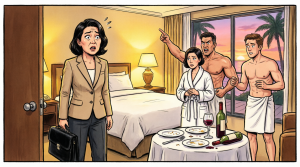
He claimed I’d checked out of the marriage years ago. That I’d refused therapy. That I’d “isolated” us from friends, made him walk on eggshells. There were no kids to fight over, but there was spousal support, and there was reputation. In his version, I was the moody, unreliable wife sabotaging his career with “public outbursts”—like showing up to his hotel uninvited and confronting “clients” in a “compromising and embarrassing situation.”
My lawyer asked, “Do you have proof of the affair? Photos? Messages?”
“No,” I said. “Just what I saw.”
And what I saw, apparently, was no match for what Mark could spin.
I thought about reaching out to Tessa, but when I searched her on LinkedIn, her profile was gone. Mark’s company website, however, had a new press release: “Collins Promoted to Account Director After Landmark Client Win.”
The Palm Springs client.
The one he’d been “entertaining.”
Months blurred into court dates and mediation sessions. I watched Mark sit at the opposite table in suit and tie, posture perfect, answering questions in measured tones. He talked about the stress of his job, his “desire to support” me through my “periods of low mood.” He acknowledged “crossed boundaries” without ever admitting to specific acts.
By the time paperwork was signed, I was exhausted, ten pounds lighter, and several thousand dollars in debt to my attorney.
I didn’t get the house. I didn’t get alimony. We split our savings after his lawyer argued successfully that a portion of his recent bonuses were “separate property” tied to his personal performance.
On the last day, outside the courthouse, he caught up to me on the steps.
“Hey,” he said.
I turned, hugging my thin folder of final documents to my chest. “What.”
He looked annoyingly fresh. New watch. New suit. The faint smell of that expensive cologne.
“I wired your share this morning,” he said. “You should see it in your account by tomorrow.”
“Great,” I said. “Anything else?”
For a moment, he just studied me. Not cruel. Not kind. Just assessing, the way he’d look at a pitch deck.
“I never wanted it to get this bad,” he said. “You made some choices, I made some choices. This is where we ended up.”
“You cheated on me,” I said. “Then you punished me for leaving.”
His jaw tightened. “You ambushed me in my hotel room in front of clients and colleagues. You threatened my career. I defended myself. That’s how I see it.”
We stood there in the California sun, strangers wearing the ghosts of people who used to share a bed.
“Are you still seeing her?” I asked suddenly. I didn’t even know why I cared, but the question slipped out.
His mouth twitched. “That’s not your business anymore.”
Which was as good as a yes.
For a second, images flashed in my head: his new promotion, the bigger office, the nicer dinners. Maybe Tessa on his arm at some rooftop bar, laughing at his stories, believing she was special. The world wouldn’t punish him. It would reward him.
Something inside me settled.
“Then I hope she surprises you someday,” I said quietly. “I hope she opens a door you forgot to lock.”
He held my gaze, then nodded once like we’d concluded a meeting.
“Goodbye, Emily.”
He walked away, phone already in his hand, talking before he reached the bottom of the steps.
I went the other direction.
Life didn’t magically rebuild itself. I picked up extra freelance work. I sold the engagement ring to cover part of my legal bill. On weekends, I took long drives out to nowhere, just to remember there was a world that existed beyond conference rooms and courtrooms.
Sometimes, late at night, I’d think about Palm Springs. The way my body had frozen at that sound behind the door. If I’d turned around then, walked away, maybe I’d still be in our house, pretending not to notice the lies. Playing my role.
Instead, I opened the door.
I didn’t win. Not in any way that looked good on paper.
But the one thing Mark couldn’t spin, couldn’t file a motion against, was this: when I looked in the mirror in that cheap apartment with the parking lot view, I recognized the woman staring back at me.
She wasn’t stuck in his story anymore.
He got the promotion, the house, probably the girl.
I got my life back, stripped down and smaller than before—but undeniably mine.
And no one had to write “Dinner for three” on a receipt to tell me that was enough.