“Victoria is just trying to protect our family’s harmony,” he went on. I could practically hear the phrases he’d absorbed from her, parroting them without even realizing. “Banning you from the beach house—well, maybe she overreacted, but you know how tense things have been. Maybe it’s better if you just… give everyone some space.”
“By banning me from my own family’s beach house?” I asked quietly. “The house Mom’s parents built? The house she put in a trust?”
He hesitated. There was a faint clink, like he’d set a glass down. “She told me you were being difficult about the property. That you didn’t care about it anymore, that you never visited. She said she was just trying to… simplify things.”
Simplify. That was one way to describe rewriting history.
I looked down at the trust documents spread across my desk, at Mom’s signature in blue ink. I remembered her warning that Victoria would try to twist things if she could. Mom had been many things—a gardener, a storyteller, someone who could make an entire room feel warm just by walking into it—but naïve wasn’t one of them.
“Don’t worry, Dad,” I said, and I felt something settle inside of me, a quiet resolve snapping into place. “I won’t cause any problems.”
“Good,” he sighed, relief already flooding his voice. “That’s all I—”
“I’ll handle this my way,” I added.
He didn’t know what that meant. Victoria didn’t either. But Mom would have.
After we hung up, I sat there for a long moment, the weight of the envelope solid in my lap, like a physical representation of something much bigger: trust, legacy, and the promise I’d silently made at my mother’s funeral, standing barefoot in the sand outside the beach house with the ocean pounding its grief into the shore.
I opened my laptop, pulled up a flight booking page, and typed in my destination: coastal Massachusetts.
My fingers moved over the keys with surprising steadiness. Morning flight. One checked bag. Return flight left open-ended.
Confirm.
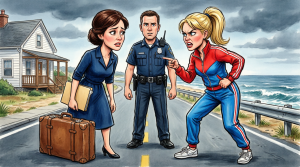
It was time to go home.
But first, there were calls to make.
An hour later, I sat at my kitchen table, a mug of lukewarm tea forgotten at my elbow, while I scribbled notes on a legal pad as I spoke with Margaret.
“We have everything we need,” she said, her voice calm and crisp on the line. I could picture her—steel-gray bob, wire-rim glasses, the kind of woman whose very presence made people sit up straighter. She’d been my mom’s lawyer, but also her friend; I remembered her bringing fresh-baked banana bread to the hospital, slipping me twenty-dollar bills for snacks when she thought Mom wasn’t looking.
“The trust was executed cleanly and with full capacity,” she continued. “Your father knew exactly what he was signing at the time. The beach house has been separate from his other assets since your mother’s passing. It is not marital property. Legally, it belongs to you and only you.”
“But Victoria says he transferred it,” I said, even though I knew the answer.
“Legally,” Margaret repeated, “he cannot transfer what he doesn’t own. Whatever paperwork he signed with her is invalid where the beach house is concerned. At best, she’s confused. At worst…” I could hear the faint clack of keyboard keys on her end. “At worst, she deliberately misled him.”
We walked through every step—who I should talk to, what to bring, what to say and, more importantly, what not to say. She’d already contacted the local authorities and sent them copies of the trust and deed.
“The local police have been notified,” Margaret said. “Officer Martinez is expecting you. He has copies of the documents and understands that you are the legal owner. If there’s any trouble, he’ll assist.”
I pictured Victoria’s face when a uniformed officer calmly informed her she’d banned the wrong person from the property. A tiny flare of satisfaction warmed my chest.
One more thing,” Margaret added. “I’ve documented all of Victoria’s attempts to access the trust over the years. The judge will be very interested if this ever goes to court.”
A memory surfaced: Victoria hovering near Mom’s desk after the funeral, her fingers brushing the locked drawer with my mother’s files. Or the time she’d asked an oddly casual question over dinner: “So, Alexandra, what ever happened with that old beach property paperwork? Your mother always hated dealing with that stuff.” I’d shrugged and said something noncommittal, watching her eyes narrow thoughtfully.
It hadn’t been paranoia. Mom had seen it. Margaret had seen it. I just hadn’t wanted to see it as clearly.
We wrapped up the call, and I walked to my living room window. Outside, the sky had shifted from fiery orange to deep purple, city lights sparkling like a second constellation below. Somewhere out there, people were going about their lives, unaware that in one small apartment, a battle line had been quietly drawn over a house by the sea.
My phone buzzed again.
Victoria.
I’m having your mother’s roses removed from the garden tomorrow, her text said. Time to let go of the past.
For a moment, I couldn’t breathe.
I could see the roses clearly: deep crimson, planted along the front path, dancing in the sea breeze. Mom had cared for those bushes like they were old friends. She’d talked to them while she pruned, humming under her breath, fingers stained green. She’d given cuttings to neighbors, saying, “So a little piece of our home can bloom at yours.”
Time to let go of the past.
I didn’t reply. There was nothing I could say that would matter to her. She wasn’t trying to inform me. She was trying to hurt me. To mark the house as hers by tearing out one of the last tangible pieces of Mom.
Instead, I set my phone aside and went to my bedroom.
I packed.
I packed jeans and sweaters and the old navy-blue hoodie Mom had once stolen from my closet, worn all weekend at the beach house, and then reluctantly returned after we’d argued playfully about “ownership.” I packed the manila envelope with the trust documents and the deed, tucking them carefully between two thick hardcover books. I slid a worn photo of Mom and me on the beach—me about seven years old, hair in tangled braids, her in a floppy hat—into the inside pocket of my bag.
As I zipped the suitcase closed, Mom’s voice popped into my mind again, from that last summer we’d spent together at the house.
“Sometimes, sweetheart,” she’d said, as we’d sat on the porch watching the sun slip beneath the horizon, turning the water molten gold, “the best revenge is simply standing your ground and letting others realize how badly they’ve underestimated you.”
I hadn’t fully understood it then.
I did now.
Tomorrow, Victoria would learn exactly what that meant.
The early morning fog in coastal Massachusetts didn’t roll—it wrapped. It moved like something alive, winding around telephone poles and dunes, blurring streetlights into hesitant halos. As my Uber wound its way along the familiar coastal road, I pressed my forehead against the cool window and inhaled deeply, almost able to smell the ocean through the glass.
The landscape shifted from town to sea. One moment there were clapboard houses and weathered storefronts; the next, the horizon opened up, and there it was: a sheet of gray-green water, restless and infinite.
Then, through the thickening mist, I saw it.
The house.
My heart twisted.
From a distance, it looked both completely unchanged and deeply wrong at the same time. The wraparound porch was still there, hugging the front and side of the house like a protective arm. The weathered shingles, once a proud gray, looked freshly painted, losing some of their charm in the glossy uniformity. The white railing had been replaced with something sleeker, more modern, and utterly out of place.
The car pulled into the crushed-shell driveway that crunched under the tires.
And parked right smack where Mom’s old garden shed used to be—where she’d kept bags of soil, chipped terracotta pots, and a radio permanently tuned to classic rock—was a bright red Mercedes.
Of course.
New security cameras peered from the corners of the house like watchful, judging eyes. A large NO TRESPASSING sign was hammered into the ground not far from the driveway entrance. It was glossy and new, with bold red letters that clashed horribly with the soft, muted tones of sand and sea grass surrounding it.
Perfect, I thought.
Before I could even open the car door, the front door flew open and Victoria stormed out, the fog swirling dramatically around her as if even nature had been enlisted in her theatrics.
She was wearing designer workout gear, all sleek black and neon accents, her blond hair pulled back into a tight ponytail that didn’t dare move in the breeze. The outfit looked like it belonged in some elite city gym, not on the front steps of a weather-beaten beach house that had seen more fishing nets and sandy feet than yoga mats.
Behind her, Lily emerged, phone in hand, camera aimed straight at me.
Of course she was filming.
“I told you you’re not welcome here!” Victoria shrieked as she marched down the shell-lined path toward the car, her sneakers crunching dramatically. “Get back in that car and leave, Alexandra. Right now. I’m calling the police.”
“Please do,” I replied, opening my door calmly.
The ocean air hit me like a drug—salt and damp and the faint smell of seaweed. My lungs expanded like they hadn’t in months. I stepped out, the shells grinding beneath my boots, and pulled my suitcase from the trunk.
“In fact,” I added, straightening and meeting her furious gaze coolly, “I already called them myself. They should be here any minute.”
For a second, she faltered. It was quick—just a hitch in her step, a flicker in her eyes—but I saw it. Then her face tightened, her lips pressing into a razor-thin line.
“You entitled little…………..

