I ALWAYS KNEW MY SISTER HATED ME, BUT AT MY OWN BIRTHDAY DINNER SHE SLID A DNA TEST ACROSS THE TABLE, LOOKED ME DEAD IN THE EYE, AND LAUGHED, “MAYBE THIS WILL EXPLAIN WHY YOU’RE ANOTHER MAN’S MISTAKE.”
Naomi slid the gift box across the table with two fingers, as if she were offering me something fragile instead of trying to split my life open.
It was wrapped in silver paper that caught the chandelier light and threw it back in hard little flashes. The bow was too neat. Naomi had never been a neat person unless she was staging something. She smiled as the box stopped in front of my plate, and even before I touched it, I knew this was not a birthday gift. It was theater. A prop. Something chosen for the effect it would have once the room went quiet.
“Go on,” she said sweetly. “Open it.”
My mother, seated at the head of the table with a wineglass in one hand, made a small sound that almost rose into a word.
“Naomi,” she murmured.
But my sister didn’t look at her. She was watching me.
Watching the way my fingers moved to the edge of the wrapping paper. Watching the way I hesitated. Waiting, almost vibrating, for the moment when I would finally understand that the dinner she had insisted would be “small and nice and just family” had never been about my birthday at all.
I peeled back the paper.
Inside was a DNA testing kit.
For one strange second, my brain refused to identify it. It was just a white box with clean lettering and a plastic tray inside, absurdly clinical against my mother’s polished mahogany table. Then the meaning arrived all at once, and I felt the blood leave my face so fast I had to grip the box to steady myself.
Naomi leaned back in her chair and laughed.
“Maybe this will explain why you’re another man’s mistake,” she said, loud enough that every fork in the room stopped halfway to someone’s mouth.
The silence that followed was a living thing.
My mother flinched. Actually flinched. Her hand jerked against the stem of her wineglass hard enough to slosh red across the white tablecloth. But she didn’t tell Naomi to stop. She didn’t say, That’s enough. She didn’t look at me and say, This is cruel and I’m sorry and your sister has gone too far.
She just stared at the table like she was watching something inevitable happen.
That was what frightened me most.
Not Naomi’s words. Not even the humiliation of hearing them spoken in the old dining room with its silver candlesticks and inherited china and all the careful beauty of a family that cared far more about appearances than warmth.
It was the fear in my mother’s eyes.
Fear doesn’t appear when someone tells a ridiculous lie. Fear appears when someone says the quiet part out loud.
I sat there with the DNA kit in my hands and understood, with a certainty that made my stomach drop, that Naomi had not invented this to humiliate me.
She had weaponized something that was already true.
Most people imagine family as a place you fall back into. Soft. Familiar. Safe. Mine had always felt like a house with polished floors in winter—beautiful from the outside, cold enough to make your bones ache the second you stepped in.
Growing up in the Ellington house in Denver, I learned early how to shrink.
I was the child who did her homework without being asked. The child who cleaned up after herself, who learned the household rhythm so well I could predict when my mother would sigh before she actually did. I knew which floorboards in the upstairs hallway creaked loudest and how to step around them if I wanted to move unseen. I learned to keep my voice low because my sister’s was always high enough for both of us.
Naomi was two years older and born with the kind of energy that other people sometimes mistake for magnetism. She had loud laughter, theatrical hurt feelings, a talent for telling stories that made even ordinary moments sound cinematic. She could walk into a room and make every head turn without earning any of the attention she got. It simply seemed to belong to her.
My mother adored that about her.
Naomi would bring home a B and my mother would say she was “well-rounded.” Naomi would quit ballet, then soccer, then choir, and my mother would smile indulgently and say she was “finding herself.” Naomi once crashed the family car into the mailbox at seventeen and cried so convincingly about feeling “so much pressure” that my mother ended up comforting her like she’d been the injured party.
Meanwhile, I brought home straight A’s and my mother would blink as though I had stepped out from behind wallpaper.
“That’s nice, Grace,” she’d say. “Can you help set the table?”
I do not say this to make her sound monstrous. Monsters are simpler than mothers. My mother was beautiful, controlled, socially graceful, and deeply invested in the image of being a devoted parent. People loved her. Our neighbors admired her. Teachers said she was elegant. She sat on committees and remembered birthdays and sent handwritten notes when someone was sick.
But inside the house, attention was a resource she rationed, and Naomi was always the preferred investment.
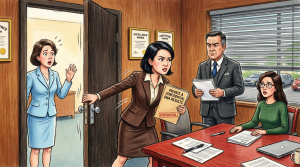
I spent most of my childhood trying to become unobtrusive enough that my needs wouldn’t inconvenience anyone.
My father was different. Not warm, exactly. Not openly affectionate. James Ellington was a man of silences and good suits and long pauses before speaking. He had the kind of presence that filled a room without ever raising his voice. In a family of performers, he was the one person who felt almost solid.
He never competed with Naomi for volume. He never snapped at me for taking up space. He did something stranger, and at the time I mistook it for safety: he saw me quietly.
A hand settling on my shoulder when I was too nervous before a school competition to eat breakfast. A proud nod at my college graduation. A soft, almost embarrassed, “You did good, Gracie,” when I landed my first analyst job. The way he’d leave the porch light on if I got home late from high school events, as if some old-fashioned part of him needed the gesture to exist even if he never named the care behind it.
My father was not an openly loving man.
He was, however, the only person in that house who ever made me feel visible without making me pay for it.
That was why his death pulled me back.
Austin had become a kind city for me. Not loud, not performative—just steady. I was thirty-five and lived in an apartment full of soft neutral colors, clean lines, and the kind of quiet I had spent years teaching my body to trust. I worked as a financial analyst for a midsize firm and liked the predictability of numbers, the relief of a world where discrepancies mattered and truth could still be documented. My mornings were orderly. My evenings were mine. If loneliness visited, it did so politely.
Then my father died in late winter, and the center of gravity in my life shifted.
The funeral dragged me back to Denver, back to the old house with its lemon polish and inherited furniture and rooms that seemed permanently chilled no matter how high the heat ran. Naomi performed grief beautifully—sharp black dress, perfect makeup, tears that arrived exactly when people were watching. My mother looked genuinely shattered, but even in mourning she never quite knew how to stand near me. She leaned toward Naomi, not me. She let me carry dishes and answer the door and disappear into practical tasks while everyone else wept.
I told myself it didn’t matter. Funerals reveal people, but they don’t change them.
What changed things was what came after.
Three months later, my mother called and insisted we have a birthday dinner at the old house.
Her voice over the phone had been too bright, too careful, as if she were performing normalcy for both of us. I remember standing in my Austin kitchen with my hand around a coffee mug and thinking, She sounds like someone reciting lines.
“Just us,” she said. “Small. Intimate. We haven’t really had a proper chance to sit down since the funeral.”
I almost said no.
But grief does strange things to hope. It softens your defenses, not because you trust more, but because part of you becomes so tired of distance that you want to believe one decent evening might still be possible. Also, and this is harder to admit, I missed my father so fiercely that being in his house again felt like a way to stand near the place where his presence had once settled.
So I went.
The old house looked exactly as I remembered when I pulled up: white stone, black shutters, trimmed hedges, everything symmetrical and expensive and curiously lifeless. It was the kind of home that photographs beautifully for holiday cards. The kind that impresses delivery drivers and neighbors. The kind with a foyer designed to create the illusion that what waits inside must be equally grand.
The second I stepped through the front door, I smelled lemon polish and old books.
For a moment I stood still and let memory move around me. That house had once held every version of me—the child who read by flashlight under the covers, the teenager who stayed too long in the shower because it was the only locked door, the young woman who learned to leave before she could be told she didn’t belong.
Naomi was already at the kitchen table when I came in. She looked tanned, glossy, curated, as though she had recently come back from somewhere with beachside cocktails and an audience. A stack of resort brochures sat beside her. She looked up just long enough to let me know she had seen me, then went back to flipping pages.
“Grace,” she said, like she was acknowledging a delivery.
My mother emerged from the pantry carrying a bottle of wine. Her smile appeared too quickly, as if it had been resting somewhere offstage until she heard my footsteps.
“There you are,” she said. “Traffic?”
“No worse than usual.”
She nodded as if that answer completed something important.
She had laid out dinner more carefully than the occasion required. Linen napkins. Good plates. Candles. A cake from the grocery store, still in the plastic container, sat near the edge of the counter like an afterthought. The whole room was wrong in tiny ways. Too arranged. Too stiff. Naomi’s mood too buoyant. My mother’s too strained. The sort of unease that doesn’t announce itself but settles in your spine anyway.
I tried, stupidly, to make normal conversation.
I asked after the house. After the garden. After a cousin I vaguely remembered had moved to Seattle. My mother answered politely. Naomi interrupted often. When I mentioned my job, the room seemed to absorb the sentence and move on like it had never been spoken.
At one point I asked, gently, whether there had been any movement on my father’s estate.
I wasn’t asking greedily. I wasn’t even asking about money, not really. My father had always been meticulous. There had to be paperwork, instructions, something. I wanted to know if his accounts had been settled, if there were charitable donations to be handled, if the house would be sold. Practical questions. The kind he would have respected.
My mother froze.
It was brief—only a flicker—but I saw it. Her fingers tightened around her glass. Her smile went flat.
“We’re just not ready yet,” she said.
Her eyes moved to Naomi.
Naomi smirked.
That look, more than the words, stayed with me.
Because it wasn’t just smugness. It was ownership. She knew something I didn’t, and for reasons I couldn’t yet name, she was enjoying my ignorance.
Dinner itself unfolded like a play where everyone had seen the script but me.
Naomi talked constantly. Her job, her husband, the kitchen remodel she wanted in some French farmhouse style she’d seen online, the friend who’d embarrassed herself on vacation, the hotel in Napa with the impossible waiting list. My mother laughed at all the right moments. The candles burned lower. The wine level in my mother’s glass never seemed to drop because she kept refilling it before she had finished. She needed her hands occupied.
When Naomi did address me, it was with the practiced sweetness people use when they want an audience to hear the knife before they feel it.
“So, Grace,” she said at one point, “still at that same firm in Austin?”
Before I could answer, she launched into another story about herself.
It wasn’t a question. It was a reminder. You are scenery. Return to your assigned place.
By the time my mother rose to get the cake, the air in the room felt electrically wrong. Naomi sat back in her chair, eyes gleaming with anticipation. My mother whispered her name once—softly, like someone trying to stop a train with a thread.
Then Naomi reached for the silver-wrapped box.
And we were back at the moment where everything split.
After the DNA kit.
After the line about “another man’s mistake.”
After the terrible, ringing silence.
I set the box down very carefully.
No one spoke. The refrigerator hummed. The candles flickered. The grandfather clock in the hallway ticked with obscene steadiness, as if time had no respect for humiliation.
I looked at my mother first.
She still wouldn’t meet my eyes.
“Is this supposed to be funny?” I asked.
Naomi shrugged. “I thought honesty would be a nice change.”
My mother’s head snapped up at that. “Naomi.”
Again, just my sister’s name. Not Stop. Not That’s enough. Not Apologize to your sister right now.
I stared at my mother until the truth of that landed too.
She wasn’t protecting me because she couldn’t.
She was failing to protect me because she was implicated in whatever this was.
I stood.
The chair legs scraped softly against the floor.
“I’m going upstairs,” I said.
No one stopped me.
That may have been the cruelest part. If Naomi had followed, I could have fought. If my mother had cried, I could have hardened. But I walked out of the dining room to the old staircase and climbed it alone while the house held its breath around me.
My childhood bedroom still wore the pale blue paint I had picked at fifteen because it reminded me of winter sky. The furniture was the same. The curtains, the bookshelf, even the small dent in the closet door from when Naomi had once slammed it too hard during a fight and no one had ever fixed it.
I closed the door and stood in the middle of the room listening to my own breathing.
Then I began opening drawers.
I’m not sure I knew what I was looking for. Proof, maybe. Something physical to anchor the feeling that had just taken hold of me. I moved boxes from the closet shelf, knelt on the floor, dug through old notebooks, high school yearbooks, dried-out pens, a scarf I’d forgotten I owned.
At the back of the closet, half-hidden behind a bin of winter decorations, I found an envelope.
Dust had gathered around it, but not on it. The cardboard shelf was cleaner in a thin crescent where it had recently been moved.
My skin went cold.
Inside was a photograph.
My mother looked younger in it, softer. She was standing outside—some park, maybe, or the edge of a church lawn—and holding a baby I recognized only because I knew the shape of my own infant face from family albums. Beside her stood a man I had never seen before.
He wasn’t my father.
I knew that instantly and irrationally, before I’d even had time to study him. He was taller than James had been, thinner, with a crooked half-smile and a windblown look that made him seem less anchored to the world. One hand was resting lightly at my mother’s back, not the way friends stand in photographs but the way people do when they once believed they had the right to touch each other without asking.
On the back of the photo, in my mother’s handwriting, were two words.
Forgive me.
I sat on the floor with the envelope in my lap and realized, with slow-growing horror, that Naomi had not given me a DNA kit because she wanted to create pain.
She had given it to me because she believed the pain would serve her.
I took pictures of the photograph, the handwriting, the envelope itself. Then I looked at the DNA kit box again.
She had wanted me to use it.
Fine.
The next morning, before I even drove back to my hotel, I swabbed my cheek, sealed the sample, and mailed it.
Not because Naomi wanted an explosion. Because I wanted a name for the fault line I had spent my whole life standing on.
The five weeks that followed were strange in a way only suspense can make time strange. Nothing happened, and yet everything in my mind rearranged itself. I went back to Austin. I went to work. I reviewed quarterly projections and tax adjustments and variance reports. I smiled in meetings. I answered emails. I bought groceries. I watered the basil on my windowsill. I slept badly.
Every now and then a memory would surface, and I would look at it differently.
Why had my mother always seemed to study my face in certain lights, almost with dread?
Why had Naomi’s cruelty toward me felt less like sibling rivalry and more like territorial rage?
Why had my father, in his quiet way, always seemed to watch me with something heavier than ordinary affection? Something like sorrow, or guilt, or guardianship?
At work, I’d find myself staring at a spreadsheet while thinking about the photo. About the way my mother’s hand had curved around my infant body. About the unfamiliar man’s smile. About the words forgive me written in the handwriting that used to sign my school permission slips.
When the email finally came, it was on a Tuesday afternoon.
I was at my desk, halfway through revising a report for a client who loved adding new assumptions after the analysis was already done. The office air conditioner hummed softly overhead. Someone was laughing near the break room. A Teams notification blinked in the corner of my screen. My phone buzzed once beside my keyboard.
DNA Results Available.
I stared at the notification without opening it.
Then I did.
I expected shock to come first.
It didn’t.
What came first was recognition. As if my body had always known and was simply waiting for language to catch up.
No biological relationship detected with the Ellington family.
I read it three times.
Then further down:
Possible lineage match: Hartman.
The name meant nothing to me.
And yet it changed everything.
I didn’t cry. Not then.
I sat back in my chair and let the knowledge move through me, cold and clean. I was not, in fact, imagining the distance. I had not invented the sense of being a guest in my own childhood. It had not been oversensitivity or insecurity or some flaw in me that made home feel conditional.
I had spent thirty-five years sensing a truth no one would confirm.
Now a stranger’s name in a database had done it in one line.
I took a screenshot.
I opened the family group chat—one that had become mostly inactive after the funeral, aside from Naomi occasionally sending photos of vacations or my mother forwarding holiday recipes no one asked for.
I sent the screenshot and typed:
Does anyone want to explain this?
My phone buzzed almost instantly.
My mother was calling.
I let it ring twice before answering.
She was crying before I said hello, but the sound of it struck me as wrong. Not grief. Not remorse. Panic.
“Grace, sweetheart, please,” she said. “Please delete that. You don’t understand. This is complicated. Things happened a long time ago. We moved past them—”
“We?” I repeated.
She made a desperate sound. “Please. Please don’t put this in writing. We need to talk privately.”
“Talk about what?”
But she wouldn’t answer directly. She never apologized. Not for the dinner. Not for the lie. Not for the years. She just kept circling the same frightened plea: delete the message, stop asking questions, don’t make it worse.
Worse for whom, she never said.
When I hung up, my phone buzzed again.
This time it was Naomi.
Just four words.
Well, now you know.
No emoji. No elaboration. Just satisfaction.
I stared at the text until it blurred.
Then I called her.
She answered on the third ring, already annoyed, like my need for explanation was inconveniencing her.
“Why?” I asked. “Why do this? Why now?”
Her silence was brief and deliberate, the pause of someone arranging a smile before speaking.
“Because I’ve kept this family secret for twenty years,” she said. “Because Mom owed me. Because you’ve played victim long enough. And now the right people will finally get what they deserve.”
I gripped the phone harder.
“What does that even mean?”
But the line had already gone dead.
I sat on my couch in the fading afternoon light and repeated her words in my head until they felt less like a threat and more like evidence.
The right people will finally get what they deserve.
She wasn’t just lashing out.
She was positioning something.
The next day, I started asking quiet questions.
You’d be surprised how much people will tell you if you call gently enough and don’t sound accusatory. An old neighbor who remembered my parents when they first moved into the Ellington house. A family friend who’d seen Naomi around downtown with a man who turned out to be an estate attorney. A former colleague of my father’s who mentioned, with careful vagueness, that there had been “some tension” in the last year about inheritance planning.
Piece by piece, a picture emerged.
Naomi had been busy for months.
Meeting with estate lawyers.
Asking hypothetical questions about legitimacy, blood relation, and whether “informal family arrangements” could affect inheritance.
Dropping hints to extended relatives that “major changes” were coming after my father’s estate was settled.
Talking about the family house as if it were already hers.
The more I learned, the colder I felt.
This wasn’t about exposing a secret to hurt me.
It was about erasing me in time to redirect a fortune.
That was when I called Sarah Ang.
Sarah came recommended through a partner at my firm who had used her for a fiercely ugly trust dispute a few years earlier. She was known for handling complicated inheritance cases with the kind of intelligence that made richer, louder attorneys underestimate her until it was too late.
Her office in Austin overlooked the river. She wore charcoal gray, minimal jewelry, and the expression of a woman who had heard everything before but still respected how much it cost you to say it.
I brought her everything.
The DNA results. The photo. Screenshots of Naomi’s text. Notes from the calls I had made. A list of people Naomi had likely met. Dates. Names. Half-remembered remarks from my mother around the funeral.
Sarah listened without interrupting. When she did ask questions, they were precise and surgical.
“Your father’s official will has not been read?”
“No.”
“Any trust documents you’ve seen?”
“None.”
“Did your father know you took the DNA test?”
“I don’t think so. He’d already passed.”
She looked at the photograph for a long moment, then at Naomi’s text message.
Finally she said, “Your instincts are correct. This isn’t just resentment. Someone is building a case to erase you.”
The sentence settled over me like a seal on a document. Not comfort. Confirmation.
“Can they?” I asked.
Sarah leaned back slightly. “Legally? Not if your father named you in the will. Not if he recognized you as his child. Biology matters less in estate law than people assume—especially if there’s intentional inclusion. But if there’s money involved and someone believes there’s an angle, they’ll try.”
“And if they already tried?”
Her gaze sharpened.
“Then we make sure they regret it.”
Three days later, Mr. Dalton called.
Harold Dalton had been my parents’ attorney for so long he existed in my memory almost like a piece of family furniture—always somewhere in the background of summer barbecues and holiday parties, arriving late in wool coats, bringing expensive wine, speaking to my father in lowered tones about trusts and tax strategies. I had never spoken to him for more than five minutes at a time.
Now his voice came through my phone formal and unusually grave.
“Grace,” he said, “your father left instructions for a will reading under specific circumstances. Those circumstances have now been met.”
My spine went cold.
“What circumstances?”
A pause.
“I think it’s best we discuss that in person,” he said. “I need you in Denver this week. And I would recommend you bring counsel.”
I glanced at Sarah, who was already reaching for her calendar across the desk.
“Understood,” I said.
Before hanging up, Dalton added, “Grace… you should prepare yourself. Your father anticipated complications.”
The morning of the will reading, Denver looked carved out of steel.
The sky was colorless. The air had that dry, high-altitude bite that never quite leaves the city, no matter how many years you spend away. Sarah and I arrived early at the downtown tower where Mr. Dalton’s firm occupied the top floor. Floor-to-ceiling windows. Dark wood conference table. The kind of office designed to make wealth feel inevitable and truth feel expensive.
We took seats near the windows.
“Observe everything,” Sarah murmured as she set down her legal pad. “Speak only when necessary. Let them reveal themselves.”
I nodded.
My mother arrived next.
She looked like someone who had been dragged through several bad nights and not allowed to sleep at the end of any of them. Her hair was pinned back too quickly. She wore a navy dress I’d seen her wear to charity events and funerals, as though she only owned one outfit for public suffering. She clutched her purse with both hands and sat at the far end of the table without greeting me.
She did not look at me.
The air around her was made of dread.
Naomi entered ten minutes later in cream-colored tailoring and confidence so polished it bordered on arrogance. She had brought her own attorney, a sleek man whose face I recognized from billboards advertising “aggressive representation” in estate disputes. Naomi’s lipstick was perfect. Her smile when she saw me was slow and cruel.
“Grace,” she said, as if acknowledging an employee who had arrived late.
She truly believed she had already won.
Mr. Dalton came in last carrying a thick folder and a thinner stack of envelopes. He moved slowly, deliberately, the way old men do when they understand the importance of making a room wait for them.
He took his seat at the head of the table, rested one hand on the folder, and looked at each of us in turn.
“Before we begin,” he said, “I want the record to reflect that James Ellington left explicit instructions for how this reading should proceed. He anticipated the possibility of disputes. Everything I am about to share was prepared with full knowledge of circumstances that some of you may find surprising.”
Something passed across Naomi’s face then. Not fear exactly. But a flicker. The first crack in her certainty.
Dalton opened the folder.
He began to read.
“I, James Robert Ellington, being of sound mind and full legal capacity, declare this to be my final will and testament…”
The room settled into attentive stillness.
Then he reached the relevant section and read, in the same calm voice, “I leave seventy percent of my estate, including the family home, investment accounts, and associated assets, to my daughter, Grace Ellington.”
Silence hit like impact.
Naomi was on her feet before Dalton had even set the page down.
“She is not his daughter,” she snapped. “We have DNA proof. She has no legal claim to—”
Dalton raised one hand.
“Please sit down,” he said. “There is more.”
Naomi remained standing half a second too long, then dropped back into her chair with a violent rustle of fabric.
Dalton turned the page.
“I have known since Grace was two years old that she is not my biological child. I chose to raise her anyway. I choose now to leave her my legacy because she alone has proven worthy of it. This decision requires no further validation.”
The world narrowed to the sound of paper moving in Dalton’s hands.
My mother closed her eyes.
Naomi’s face drained of color so quickly it made her makeup look theatrical, masklike.
I sat absolutely still because if I moved, even slightly, I thought I might shatter.
Two years old.
He had known since I was two.
And yet he stayed. Raised me. Signed my school forms. Held my hand crossing streets. Stood at my graduation in a navy suit pretending not to cry.
Something in my chest hurt with new edges.
Not because he wasn’t my biological father.
Because he knew. And I had spent my entire life interpreting his quietness as distance when maybe part of it had always been something heavier. Some private burden. Some arrangement he carried mostly alone.
Dalton continued.
“Eight months before his death, Mr. Ellington retained a private investigator to document any attempts to manipulate or interfere with his estate. The investigator gathered substantial evidence.”
He placed a stack of documents on the table.
Even from where I sat, I could see the neat tabs dividing sections.
Payments. Withdrawal records. Consultation notes. Email printouts.
Naomi’s attorney straightened in his chair. “We were not informed of any investigatory material.”
“You were not required to be,” Dalton said coolly.
He lifted the first set of documents.
“These records demonstrate unauthorized withdrawals totaling fifty thousand dollars from accounts reserved for medical and household administration during Mr. Ellington’s illness. They also document consultations with three separate estate lawyers regarding the legal standing of a non-biological child, discussions about amending inheritance distribution, and the purchase of a DNA test mailed to Naomi Ellington’s home address before being gift wrapped.”
Naomi’s mouth opened.
“That’s ridiculous,” she said. “That was a joke.”
No one answered immediately. Sarah didn’t even glance at me. She just began writing something slowly on her pad.
Dalton picked up a final sheet—cream paper, folded once.
“Mr. Ellington requested that I read this aloud.”
He unfolded it.
“Naomi,” he read, “I know what you’ve been planning. I watched you pressure your mother. I watched you mistake greed for cleverness and cruelty for power. I hoped you would choose differently. These consequences are your own doing.”
A sound came out of Naomi that didn’t quite belong to speech. Half gasp, half protest. Her attorney leaned toward her sharply and whispered, with barely controlled urgency, “Do not contest this. There’s a no-contest clause. You will lose everything.”
But Naomi was beyond listening.
“This is fraud,” she said, voice rising. “Grace manipulated him. She tricked a dying man—”
Sarah stood.
She didn’t raise her voice. She didn’t need to.
“The will explicitly acknowledges Grace’s parentage,” she said, “and documents Mr. Ellington’s reasoning. Any contest would be frivolous and would trigger the no-contest clause immediately. That includes acceleration of outstanding loans and repayment obligations, currently estimated at approximately two hundred thousand dollars.”
The silence after that was different.
Not shock this time.
Calculation.
Naomi’s head whipped toward Dalton. “That’s not a loan,” she said. “He gave me that money.”
“Not according to the estate records,” Dalton replied. “It is documented as an advance against discretionary inheritance, recoverable upon contest or interference.”
My mother finally spoke.
“Naomi,” she whispered.
Just that. Her name. But this time it sounded like grief, not performance.
Naomi didn’t look at her.
“This should be mine,” she said instead, turning toward me with something close to hate burning through the panic. “All of it. I’m the real daughter. I’m the one who stayed.”
I rose more slowly than she had.
My voice, when it came, surprised me with how calm it sounded.
“You didn’t stay, Naomi,” I said. “You controlled. You hovered. You treated loyalty like a weapon. You built your whole life on a secret you thought would make you important.”
She stared at me with eyes that had gone wild and glossy.
Before she could answer, Dalton said, “There is one more item.”
He reached for a smaller envelope.
“This is for Grace.”
I took it with hands that barely felt attached to me and slid my finger under the seal.
Inside was one sheet of paper. My father’s handwriting. Slanted, controlled, unmistakable.
Grace,
You spent your life believing you were invisible. You were not. I saw your strength, your kindness, your integrity, and the grace with which you bore things no child should have had to bear. You were my daughter not by blood, but by choice, and I leave you my legacy with absolute certainty that you will honor it better than anyone else in this room. If you are reading this, then the truth has finally been weaponized against you. I am sorry I did not stop it sooner. I thought protecting you meant silence. I was wrong. Let this be the one thing I do without hesitation. I choose you openly now.
The room disappeared.
I could hear nothing for a few seconds except my own breathing.
When I looked up, Naomi had finally understood the full shape of what had happened.
This wasn’t my triumph.
It was her defeat, meticulously designed by the man she had underestimated most.
The hearing ended in fragments after that.
Naomi left first, her attorney half-pulling her out before she could say something irreparable. My mother stayed seated until the room was almost empty, staring at her hands as if they no longer belonged to her. Dalton spoke quietly with Sarah about next steps. Papers were signed. Copies exchanged. Deadlines established.
I moved through it all in a state that wasn’t numbness exactly. More like delayed impact. As though some part of me knew I would fall apart later and had courteously set the collapse for a more private hour.
It came in the hotel room that night.
I sat on the edge of the bed still in my coat, still holding my father’s letter, and cried so hard I could barely breathe.
Not because I had “won.”
Because he had known.
Because he had loved me.
Because he had also failed me in ways that no inheritance could erase.
Both things were true, and grief makes room for contradictions no courtroom ever can.
The legal fallout moved faster than Naomi expected.
Her attorney withdrew the next morning after reviewing the investigator’s file in full. She found another lawyer, tried to contest anyway, and watched the judge dismiss the challenge almost immediately. The no-contest clause held. Her remaining inheritance vanished. The two hundred thousand in prior “advances” became personal debt owed back to the estate. The fifty thousand in unauthorized withdrawals remained separately actionable.
For the first time in my life, Naomi looked small.
Not changed. Not humbled. Just cornered by consequences she had always assumed were for other people.
My mother came to see me a week later in Austin.
I almost didn’t let her in.
But curiosity has always been one of my flaws, and some truths are too old and sharp to leave outside on the porch.
She sat on my couch with both hands folded in her lap and told me everything.
About the man in the photograph.
Daniel Hartman, she said. A man she had loved before James. They had broken apart badly, then drifted back into each other for one disastrous stretch during the first years of her marriage. She got pregnant. Daniel wanted her to leave James. She didn’t. She chose safety, reputation, structure. She chose the life that looked correct from the outside.
James found out when I was nearly two.
He had suspected before, she said. I had Daniel’s mouth. Daniel’s ears. Daniel’s blood type.
I listened without interrupting.
She cried while she spoke, but her tears did not move me the way they might once have. Because even in confession she centered herself—her fear, her guilt, her impossible choices, her shame. She talked about how hard it had been to live with the lie. How Naomi overheard the truth as a teenager and used it like a knife ever since. How James had insisted that I remain his daughter legally and privately, how he refused divorce because he “would not punish a child for adult sins.”
When she said that, something inside me twisted.
Punish a child.
Because that was exactly what had happened anyway. Just slowly. Indirectly. Elegantly enough that no one had to name it.
“I want to make things right,” my mother whispered when she finished.
I looked at her.
She still had the same beautiful hands. The same careful voice. The same ability to sound sincere at moments when sincerity cost her the least.
“I believe you want that,” I said.
Hope flickered across her face.
Then I continued.
“But making things right starts with letting me live a life that is not built around your secrets.”
The hope went out.
That, more than anger ever could have, seemed to wound her.
Good, a colder part of me thought. Some truths deserve to leave scars.
In the months after, Sarah helped me settle the estate.
We did it quietly.
Accounts were transferred. Property evaluated. Tax issues resolved. Naomi’s debts documented. The house in Denver—beautiful, expensive, full of ghosts—was the hardest part. I walked through it one last time before deciding. The walls held too much silence. Too many meals where my voice vanished. Too many birthdays where Naomi got the center and I got the leftovers.
I sold it.
I did not keep the dining table. I did not keep the chandelier. I took only what mattered: my father’s letters, a set of old books with his penciled notes in the margins, one landscape painting from his study, and the photograph with forgive me on the back—not because I had forgiven, but because truth belongs with the person who survived it.
Then I left Denver behind.
I chose Oregon because no one in my family had ever mentioned wanting to go there. Which sounds like a joke, but it wasn’t. I wanted distance so complete it had weather in it. I wanted rain and fir trees and a coastline that made people feel small in the right way. I wanted a place that had nothing to do with old money, old lies, old dining rooms.
I found a house outside Portland with a long porch, pale wood floors, and windows that let in the kind of gray light that feels soft instead of bleak. I arranged my life there carefully. Not lavishly. Just honestly. I kept my job remotely for a while, then shifted into a consulting role that let me choose my time. I learned to garden badly. I bought mugs I actually liked instead of the ones that looked correct. I painted one room the green of deep moss because no one was there to tell me it was “too much.”
Sometimes I still think about my father.
Not with uncomplicated tenderness. He doesn’t get that. Love doesn’t erase omission. He knew the truth and still allowed me to grow up in a house where I was made to feel peripheral. He may have believed his quiet loyalty was enough. It wasn’t. He may have believed protecting me meant preserving the illusion. It didn’t.
And yet.
He chose me in the one place where choice could no longer be taken back.
That matters too.
The first winter in Oregon, I framed his letter and kept it in a drawer instead of on a wall. I wasn’t ready to make a relic out of a man who had loved me and failed me in the same breath. Some relationships remain too complicated for display.
As for Naomi, I stopped following the details after the first year. I heard enough through Sarah to know the broad shape of things. Debt. Legal restrictions. A downsized house. The kind of anger that curdles when it can no longer find a useful target. I did not gloat. I did not check public records for sport. Naomi had spent too many years living in my mind rent-free. Consequences could have her. I wanted space.
My mother wrote twice after I moved.
The first letter was long and apologetic and full of phrases like if only and I hope someday. I read it once and filed it away. The second was shorter. She said she had started therapy. She said she was learning to live with the choices she made. She said my father had left more than money behind—he had left her the knowledge that she had failed the wrong child.
I didn’t answer either letter.
Silence, used correctly, can be an act of mercy. Not all conversations deserve resurrection.
Some endings aren’t loud.
They aren’t courtroom victories or slammed doors or speeches that make everyone in the room finally understand what they did to you.
Sometimes they are quieter than that.
Sometimes they are the decision not to explain anymore.
Not to argue your right to exist. Not to absorb someone else’s shame as if it were proof of your own inadequacy. Not to keep returning to the same table hoping the people sitting there will someday act like family.
Now, when rain taps at my Oregon windows and I make coffee in the morning, I think about that silver box on the table and the way Naomi smiled when she pushed it toward me.
She thought she was handing me humiliation.
What she actually handed me was the end of confusion.
And there is a strange peace in finally knowing which pain is yours to heal and which was never yours to carry.
Sometimes freedom doesn’t arrive as joy.
Sometimes it arrives as clarity.
And that is enough to build a life on.

