“Only $300?” My dad scoffed while opening my gift. “Lena covers mom’s entire life — $4,700 monthly, minimum.” I whispered, “Those auto-payments came from my backup account.” Then my sister tossed a folder across the table: “We voted. You need to move out by friday.” That night, I revoked all access, notified the landlord, and froze the rent split. By morning, they found out — an envelope marked “confidential”
“Only three hundred?”
My dad didn’t even try to hide the sneer. He held the envelope between two fingers like it was something damp he’d picked up off the sidewalk, the kind of thing that might stain him if he touched it too long. The wrapping paper lay in torn, curling strips on the tablecloth, glittery and cheerful, like it had walked into the wrong house.
He peeled the edge back slowly, theatrically, like the moment deserved suspense.
And then he laughed.
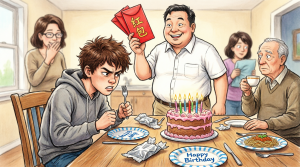
Not the warm kind. Not the kind that meant, oh, you shouldn’t have. This was a bark of disbelief, the kind that meant, you actually thought this was acceptable?
“Only three hundred,” he repeated, louder this time, so everyone could hear. Like the number itself was an insult he needed witnesses for. “That’s what you brought?”
The dining room was too bright. My mother had insisted on turning on every overhead light as if illumination could make the atmosphere clean. The table was set with her “good” plates, the ones she only pulled out when she wanted the house to look like a normal family lived in it. Napkins folded neatly. Glasses aligned. A cake that smelled like too much butter and too much effort.
My sister Lena sat straight-backed at the far end of the table, hair perfect, blouse crisp, lips glossy. She watched my father with a tiny, knowing smile, like she’d predicted this scene and was pleased to see her forecast come true.
My brother Tim was already halfway through his second helping of something, chewing lazily, eyes half on his phone. A cousin I barely recognized—one of the ones who drifted in and out depending on who was paying for groceries—kept eating, unfazed, as if being present for cruelty was just another Tuesday.
My hand tightened around the edge of my chair. I felt the old instinct rise up—explain, justify, soften. Make it easier for them to swallow.
But something in me stayed still.
The envelope he was holding wasn’t the only gift. It wasn’t even the real gift. The real gift was the silence I’d been giving them for years, the soft, endless permission. The real gift was the way I’d trained myself to accept being talked down to in exchange for being allowed to exist in the room.
And I was tired.
I’d saved for that cash gift anyway. I’d pulled it out of an account I rarely touched, an account I’d built like a bunker—my backup, my emergency, my if everything collapses fund. I’d told myself it wasn’t a big deal, that it was just money, that he was my father, that birthdays mattered to him in the same way gratitude mattered to him: as a performance.
“Lena covers Mom’s entire life,” he said abruptly, turning the envelope over as if the paper might reveal a hidden punchline. “Four thousand seven hundred dollars. Monthly minimum.”
He said it like it was a scoreboard.
He said it like it meant she loved my mother more than I did.
My mother stirred her tea. She didn’t look at me. She didn’t look at him either. She was an expert at keeping her face neutral while fires grew around her, an Olympic-level competitor in pretending things weren’t happening. Her spoon clinked softly against the ceramic cup again and again, a small, steady sound that made me want to scream.
I opened my mouth, then closed it.
My father leaned back and lifted the envelope higher, presenting it to the table like evidence in a courtroom. “So what’s this supposed to be?” he asked. “A snack? A tip? Is this how you say thank you for raising you?”
My stomach went cold. I could feel heat crawl up my neck anyway, that humiliating flush that always came when I was being scolded in front of an audience. The old version of me would have laughed awkwardly, would have tried to turn it into a joke. Would have said, I’m sorry, I’ll do better next time.
Instead, I heard myself whisper, barely audible even to me, “Those auto payments came from my backup account.”
He didn’t hear me. Or he pretended not to. His voice rose again, booming with the confidence of a man who never feared consequences.
“Three hundred dollars,” he said. “Unbelievable. Your sister understands what family means.”
Lena’s smile deepened, just a fraction, and I saw the shape of the trap before it sprung. Her eyes flicked to my mother. My mother’s spoon kept circling.
And then Lena stood.
She moved slowly, smoothly, like she’d rehearsed the motion in a mirror. She reached down beside her chair and lifted a folder—thick, stiff, the kind you bring to meetings where people’s lives are decided.
She tossed it across the table.
It slid on the tablecloth and landed with a sharp slap, stopping right in front of me.
The room went quiet in the way it only goes quiet when a group of people are waiting to see if you’ll bleed.
“We voted,” Lena said, voice sweet and official, like she was reading a memo to employees. “You need to move out by Friday.”
I blinked.
I looked around the table for someone—anyone—to react, to say what the hell, to laugh and reveal it as a sick joke.
No one flinched.
My father’s mouth twitched with satisfaction. Tim made a low chuckle like he’d just heard a punchline. My mother’s gaze drifted to the table, to her tea, to anywhere but my face.
Even the cousin kept chewing.
I stared at the folder. The label on the tab was printed neatly. They’d taken time with it. They’d planned this. They’d sat somewhere—maybe even in this room—discussing my presence like it was a stain they could remove.
My mouth tasted metallic.
“You’re serious,” I said, though it wasn’t a question. My voice came out calm, which surprised me, because inside I felt like glass about to shatter.
Lena shrugged, the smallest lift of her shoulders. “We need space,” she said, parroting my mother’s favorite word. “You know how tense everything’s been.”
“Tense,” I repeated softly.
My father tapped the envelope against his palm. “You’re an adult,” he said. “Time you act like one.”
I almost laughed. It would’ve been the funniest thing I’d heard all year if it hadn’t been my life.
Because the thing they either didn’t know—or thought I’d never say out loud—was that I was already acting like one. I’d been acting like one since I was a teenager. I’d been acting like one every time I paid a bill they pretended didn’t exist. Every time I wired money to “fix” their emergencies. Every time I stood in line at a bank while my friends went out, because my parents needed help “just this once.”
I swallowed. I looked at my mother, searching her face for even a crack.
She didn’t give me one.
So I nodded, once, like a man accepting a business proposal.
“Friday,” I said.
Lena’s eyes flashed with triumph. My father leaned back like he’d just won something.
My mother’s spoon kept circling.
I sat through the rest of the dinner like my body was present but my spirit had stepped outside. The conversation rolled on without me, touching on Lena’s “sacrifices,” on how hard things were for my parents, on how ungrateful people were these days. I didn’t argue. I didn’t defend myself. I didn’t explain the $300 wasn’t “only.” That it was hours of work and restraint, pulled out of a secret place I’d built for survival.
I watched them talk.
And I listened.
Because there’s a moment, sometimes, when you realize you’ve been trying to be loved by people who have never, ever planned to love you. They’ve only planned to use you, and your effort has just made the using easier.
By the time I left the table, my hands were steady.
That night, I did not pack.
That night, I revoked access.
It was almost clinical. Like cutting wires in a bomb.
First, I opened my banking app. The screen glowed in the dark of my room, the only light in the house that didn’t feel hostile. I went to connected accounts and auto payments, the long list of things I’d set up over the years because it had been “simpler” if it all came from one place.
Mom’s health insurance premium. Dad’s gym membership. Lena’s cloud storage. Tim’s “family plan” subscriptions. Utilities. Rent. Wi-Fi. A dozen little charges that added up to my life being slowly siphoned away.
I tapped each one and canceled.
Cancel. Confirm. Cancel. Confirm.
Then I opened the section that listed shared users.
There were five.
I removed them one by one. Each tap felt like a door locking.
A message popped up: Are you sure you want to revoke access?
I stared at it for a long moment.
Then I pressed Yes.
Next, I opened the rent portal. The apartment—the one they were trying to evict me from—was in my name. The lease was mine. The landlord knew me. The payment account was mine. The “split” they referenced so casually, the one Lena claimed she contributed to? It existed mostly in conversation, like a myth they repeated until it sounded like truth.
I froze the split.
Then I drafted an email to the landlord. Not emotional. Not dramatic. Just facts. A notification that no lease reassignment was authorized, no payment changes were approved, and any requests claiming otherwise should be verified directly with me.
Then, I changed the passwords to everything.
Wi-Fi. Utilities. Rent portal. Streaming accounts. Even the stupid smart thermostat app my dad insisted on controlling like it made him king of the house.
I didn’t slam doors. I didn’t cry. I didn’t scream.
I just removed the oxygen from the fire.
Before I lay down, I went to the kitchen.
On the counter, beneath the bright overhead light, I placed an envelope.
On the front, in clean, deliberate letters, I wrote:
CONFIDENTIAL.
Under it, I added a small handwritten note.
You built a lie on my silence. Now you can pay the bill.
Then I went back to my room and slept like someone who had finally stopped negotiating with a disease.
By morning, the house was chaos.
I heard it through the walls first—my father’s voice, loud and sharp, the sound of drawers being yanked open, cabinet doors slamming. Lena’s voice too, high and offended, like the world had committed a crime by not staying in order.
I stayed in bed for a few extra minutes, listening, letting myself savor the unfamiliar feeling of not rushing to fix it.
My phone buzzed once. Then again. Then it started buzzing like an angry insect trapped in a jar.
Family group chat.
Texts from my mother. A missed call from Lena. Another from my father. Tim sent a single message: what the hell did you do?
I didn’t respond.
Eventually, I got up and walked out into the hallway.
My father was in the living room with his phone in his hand, stabbing at the screen like he could force it to obey him. The Wi-Fi wasn’t working. The streaming service wasn’t loading. His gym app probably refused to log in. His bank account likely didn’t recognize the auto withdrawal schedule he’d grown used to ignoring.
Lena stood by the kitchen counter, staring at the CONFIDENTIAL envelope like it was a live grenade.
Mom hovered near the sink, hands wringing the dish towel she’d been clutching, eyes darting between them.
When my father saw me, his face turned the color it always turned when he realized he wasn’t in control—red, blotchy, furious.
“What did you do?” he snapped.
I looked at him calmly. “I revoked access,” I said.
He scoffed, as if I’d just mispronounced a word.
“You can’t do that,” he said automatically, because that was always the response when I did anything that interrupted their comfort. You can’t do that. Like I was an appliance that wasn’t allowed to unplug itself.
“I already did,” I said.
Lena’s eyes narrowed. “This is petty,” she said, voice trembling with outrage. “You’re throwing a tantrum.”
I glanced at the envelope. “Open it,” I said.
My father reached for it. His fingers were thick, impatient, not used to handling anything delicate. He tore it open without reading the label, and a stack of papers slid out onto the counter.
He frowned as he skimmed the first page.
Then his frown deepened.
Then his mouth tightened.
“What is this?” he demanded, but the question sounded weaker now, more uncertain.
“It’s the ledger,” I said. “The one I kept for myself, because I knew someday you’d pretend you didn’t know.”
Lena leaned forward and grabbed a page, scanning it quickly. Her face shifted. Her eyes flicked away. Then she forced a laugh that didn’t reach her throat.
“This is insane,” she said. “You’re… you’re making this up.”
I looked at her. “Those auto payments,” I said softly, “came from my backup account.”
My father’s eyes flashed. “We’re family,” he snapped, like it was an answer to everything.
“No,” I said. “You’re users.”
The word landed heavy in the room.
My mother made a small sound, like a hurt breath. I didn’t look at her. If I looked at her, I might crack.
Lena slammed the papers back down. “You’re overreacting,” she said. “We were joking about you moving out. You always do this. You always make everything into some dramatic—”
“By Friday,” I repeated, matching her tone from last night. “Was that the joke?”
She hesitated, just long enough.
My father stepped closer. “You’re not going to embarrass us,” he said lowly. “You’re not going to—”
“Embarrass you?” I echoed, and for the first time something like amusement touched my voice. “You’re embarrassed because the bill got redirected back to you.”
Tim wandered in, squinting at the papers. “Wait,” he said, scratching his head. “Is this… rent payments?”
“I paid the rent,” I said.
Tim laughed, a confused sound. “No, I mean, sure, sometimes, but—”
“All the time,” I said. “Since March last year.”
Lena shot him a look like shut up.
“Stop lying,” Lena snapped at me. “You’ve been living here rent-free for years.”
I blinked slowly. “Lie number one,” I said. “The apartment’s in my name.”
My father froze.
My mother’s hands tightened around the towel.
Tim’s eyes widened a little, like a kid realizing the magician’s trick had an explanation he’d never bothered to consider.
“I cover rent,” I continued, voice steady. “Utilities. Wi-Fi. Insurance. The gas bill. I’ve been covering it because Lena lost her job.”
Lena’s chin lifted. “Because of toxic energy,” she said sharply, as if the phrase itself proved her innocence.
Translation: she screamed at her manager and got written up again.
I didn’t say it out loud. I didn’t have to.
I pulled out my phone and opened my banking app. The numbers glowed on the screen.
“Eleven thousand two hundred,” I said. “That’s what you owe me, Lena.”
Her eyes flared. “That’s not—”
“And that’s not counting the Amazon orders,” I added. “The Dyson Airwrap. The hair supplements. The weighted blanket for your ‘emotional recovery.’”
Tim let out a low whistle.
Lena’s mouth opened, then closed. For a second she looked young, caught, exposed.
Then she recovered, snapping back into her favorite role: victim.
“This is harassment,” she said, voice trembling now, eyes glossing over on command. “You’re attacking me in front of everyone.”
“No,” I said softly. “I’m telling the truth in front of everyone.”
My father turned on my mother, as if she could fix it. “Say something,” he barked. “Tell him he can’t—”
My mother stared at the papers, face pale.
And I realized something then, something I’d avoided acknowledging for years.
She’d always known.
Maybe not every detail. Maybe not every number. But she’d always known enough.
She’d let it happen because it was easier than standing up to him, because it kept the household running, because if I was the one paying, she didn’t have to face what kind of man she’d married—or what kind of mother she’d become.
The group chat exploded before noon.
I didn’t read it immediately. I let it stew, let it pile up like dirty laundry.
When I finally opened it, the messages were a fever dream of confusion, outrage, and manufactured pity.
What’s going on?
Why isn’t the Wi-Fi working?
Your father is stressed.
You need to calm down.
Then the guilt messages came.
My mother’s voicemail arrived first.
Her voice was syrupy, soft, the voice she used when she wanted something.
“Sweetheart,” she said, stretching the word like it could erase everything. “We didn’t mean for it to sound like an eviction. You just need space. You know how your father is when he’s stressed. He doesn’t mean half of what he says.”
I deleted it without answering.
Then Lena called. I watched her name flash on my screen and felt nothing.
When I didn’t pick up, she left a message. She was crying—real or performed, I couldn’t tell anymore.
“We were joking,” she sniffed. “Okay? You always overreact. It’s not even your place. You’ve been living there rent-free for years.”
Lie number one, recycled.
Then the smear campaign began.
It started subtle, like a drip.
A black-and-white photo appeared on Lena’s Facebook—her face turned toward a window, eyes sad, captioned: Sometimes the people you trust the most are the ones who teach you what betrayal means.
Within minutes, relatives I barely knew started commenting.
Stay strong, honey.
We’re here for you.
Some people forget what family is.
My father posted a cropped screenshot of one of my texts—just a line that read: Not my problem.
No context. No thread. No mention of what I’d been responding to.
He captioned it: This is what he said to his mother after everything she’s done.
It didn’t matter that the real conversation had been about Lena asking for $800 “for therapy” after spending $300 on a hoodie the same day. It didn’t matter that my mother’s “everything she’s done” included rerouting insurance payments through my account and helping Lena try to take my lease.
People love a villain when it’s convenient.
The family group chat lit up with voices I hadn’t heard in years.
A mother’s love is unconditional. Why isn’t yours?
He used to be such a sweet boy. What happened?
Disgusting.
Aunt Beth posted: Money changes people.
No one asked me what happened.
Not one message said, Hey, I’m hearing things—what’s your side?
Because in my family, my side had never been valuable. I wasn’t a person to them. I was a resource.
I didn’t argue.
I didn’t defend myself in the group chat. I didn’t plead my case with people who’d already decided the verdict.
Instead, I started digging.
That afternoon, while the house was still spiraling, I went to my room and pulled out an old external hard drive I’d noticed weeks earlier. It belonged to Lena. She used to plug it into my computer back when she was trying to be a freelancer, back when she still pretended she had a plan.
“I never delete anything,” she used to say, flipping her hair like the sentence made her wise. “I archive my truth.”
Turns out she archived too much.
I plugged the drive into my laptop. It hummed softly, waking up, and a folder tree popped onto my screen.
There it was: a folder labeled rent_2022.
Inside, a PDF ledger.
My heart beat a little faster as I clicked.
The document opened, clean and organized, and I felt an eerie chill because it looked like something a finance department would produce—except the “department” was my sister, and the “business” was stealing from me.
January: auto pay transfer $450. Say it’s Spotify.
April: mortgage top off. He won’t notice. Came from reserve.
May: got a med bill. Just use backup debit. He never checks.
It went on and on, month after month, written casually, like she was documenting a diet or tracking workouts. Like siphoning money from me was just a habit she was proud of maintaining.
My jaw clenched so hard my teeth ached.
Then I saw another folder.
Recordings.
I clicked it.
The first audio file played, and Lena’s voice filled my room—bright, rehearsed.
“Dad,” she said, practicing, “he said he’s cutting you off. Said you’re a leech. I recorded it. Want me to send it?”
My skin crawled.
I clicked another.
This one had strange distortions, a robotic edge under the sound.
Lena again, but lower, altered.
“I don’t care if she dies.”
My stomach dropped.
I knew that sentence. I knew it because it wasn’t real.
The real message I’d said, months ago, exhausted and fed up, was: “I don’t care if she lies again. I’m done.”
But Lena had chopped my voicemail, stitched pieces together with some voice-mod app, crafted it into something monstrous.
She was building a narrative.
And she was good at it.
I kept clicking, listening, watching the pattern unfold.
She had files of herself practicing lines, rehearsing crying, rehearsing anger, rehearsing the exact phrases she knew would trigger people’s sympathy.
She had drafts of texts she never sent, written like scripts.
She had screenshots labeled “family bait.”
It wasn’t just theft.
It was strategy.
And it explained everything.
It explained why my father sounded so confident last night, why Lena tossed that folder like she was a judge. They weren’t improvising. They were executing.
A memory hit me so hard I had to close my eyes.
I was nineteen again, standing behind a counter at a diner, taking orders under flickering fluorescent lights. My father called during my break.
“The fridge broke,” he said. “We can’t afford a new one.”
I’d wired $800 that same day.
I’d canceled my textbook purchase to do it. I remember staring at my online cart afterward, deleting the books one by one because I couldn’t justify spending money on my education when my family didn’t have a fridge.
He texted later: Appreciate it. You’re finally stepping up.
Not thank you.
Not we’ll pay you back.
Just finally stepping up.
A week later, my mother posted photos of new patio furniture.
Family barbecue season ready! the caption read.
I remember sitting on my dorm bed eating dry pasta with no sauce, wondering if I was crazy.
I wasn’t crazy.
I was being harvested.
Thursday morning, I called the landlord.
He answered with a wary, confused tone, like he’d already been warned about me.
“Hi,” I said, keeping my voice polite. “This is about my lease. I want to confirm no reassignment is being processed.”
There was a pause. “Oh,” he said slowly. “Your sister told me you were moving to Seattle. Said she’d be taking over payments.”
My heart went cold again, but it was a steadier cold now, the kind that comes with clarity.
“She said that?” I asked.
“Yes,” he said. “She sounded… certain.”
“She lied,” I said simply. “The lease is mine. I’m not moving. No reassignment is authorized. I’m emailing you documentation.”
I sent him everything: receipts, payment history, utility accounts, screenshots of texts, even an old voice memo where my mother had said, casually, as if it was a compliment: “He always covers the rent. Lena can’t handle those things.”
Within an hour, the landlord replied that no changes would be made without my written approval.
Lease reassignment canceled.
My father’s retaliation came like clockwork.
He posted on his timeline: You give them everything and they still spit in your face. #FamilyDoesntQuit.
Then he texted me directly.
You’re playing with fire. We made you who you are.
I stared at that sentence for a long time, because it was almost true.
They had made me.
They had made me someone who watched every penny. Someone who flinched when phones rang. Someone who couldn’t enjoy a meal without doing math in his head. Someone who felt guilty when he rested.
They had made me someone who learned to survive them.
I decided then I would stop surviving.
I would start ending.
That same day, as if the universe wanted to underline the point, I got an alert from my credit monitoring app.
A loan account flagged for review.
My chest tightened. I opened it, and the details popped up like a punch.
A $15,000 personal loan from 2022.
Co-signer: me.
My social security number.
My name.
My signature—except it wasn’t my signature. It was a sloppy imitation, like someone had traced it from an old document.
I remembered confronting my father back then, the way he’d acted offended that I’d even asked.
“It was a mistake,” he’d said. “They must’ve mixed up paperwork.”
I’d wanted so badly to believe him. I’d told myself he was embarrassed, that he’d fix it, that he’d pay it off. I’d let it slide with the condition that he’d handle it.
He hadn’t.
Now the interest was eating him alive, and the account had been flagged.
I called a lawyer friend I hadn’t spoken to in months. I explained everything, my voice flat with shock.
He went quiet.
Then he said, “This is fraud.”
“Yes,” I said. “I know.”
“Do you want to press it?” he asked.
I looked at my phone, at the endless messages from family calling me cruel, unstable, dramatic.
I thought about my father scoffing at my gift like my effort was a joke.
I thought about Lena practicing fake tears into audio files.
I thought about my mother stirring tea while they voted to evict me.
“I want it documented,” I said. “I want it frozen. I want them to understand I’m not bluffing.”
We filed fraud documents. We attached an affidavit. We sent it to the loan company.
The account froze.
That night, I compiled everything.
Every rent payment.
Every utility bill.
Every “emergency.”
Every transfer.
Every stolen subscription.
Every fake audio file.
Every email.
Every screenshot.
I made a spreadsheet titled: FAMILY EXPENSES PAID 2018–2024.
The total was over $71,000.
When the number finalized, I stared at it until my eyes burned.
Seventy-one thousand dollars.
That was not help.
That was not love.
That was a slow robbery, disguised as family.
I zipped everything into a folder on my desktop.
I named it the same thing as the envelope I’d left on the counter:
CONFIDENTIAL — THE LEDGER.
Then I printed it.
Two copies.
One delivered to my father’s office.
One dropped in my mother’s mailbox.
No dramatic letter. No threats.
Just truth.
If they wanted war, I was finally armed.
The next call I took was from my mother.
Not a text. Not a voicemail. An actual call, which meant she was either scared or desperate.
I let it ring twice, three times, then answered.
“Hello,” I said.
She exhaled like she’d been holding her breath for hours. “Can we meet?” she asked.
There was a softness in her voice, a nostalgia she hoped would work on me. “Somewhere… neutral.”
A memory flashed: her hand in my hair when I was little, her voice calling me champ after school competitions, the way she used to brag about me to neighbors before Lena became her golden child and Tim became her excuse.
“Where?” I asked.
“The café,” she said. “The one on Maple. The old one.”
The old one.
Where she used to take me for cinnamon rolls after debate tournaments, back when she still looked at me like I mattered.
“Fine,” I said. “Tomorrow.”
The café smelled the same, thirteen years later.
Cinnamon. Burnt espresso. Old wood. The clink of a spoon against ceramic, somewhere behind the counter, like a ghost of my mother’s tea.
I sat in the far corner booth facing the door. I chose the seat with the best view, because some part of me still expected an ambush. Still expected my family to turn any meeting into a trap.
When my mother walked in, she moved slowly. Cautiously. Her purse hugged to her chest like armor.
She looked older than last week. Older than I’d ever admitted.
When she spotted me, she paused.
Her face flickered—guilt, regret, calculation.
Then she walked over and slid into the booth across from me.
“You picked this place,” I said, not accusing, just stating.
“It was your favorite,” she said.
I didn’t answer.
She reached for the sugar packets, fiddling with them like she could build a bridge out of paper.
“I didn’t know about everything,” she began.
I let her talk. I let her settle into her script.
“The loan,” she continued, eyes glossy. “The recordings… that was Lena’s idea. Your father… he just didn’t want to burden you.”
I looked at her. “You helped them steal from me,” I said calmly.
Her mouth tightened.
“You wrote emails,” I said. “You called the landlord. You let them use my name for insurance, for credit, for taxes.”
She blinked rapidly.
“We didn’t think it was a big deal,” she whispered.
“One dollar,” I said, then paused. “Seventy-one thousand. Three hundred eighty-four.”
Her face went pale.
“That’s the total,” I said. “Rent. Bills. Lena’s vet visits. Your prescriptions. Dad’s back taxes. I have a ledger.”
I slid the folder across the table.
CONFIDENTIAL — THE LEDGER.
The same one I’d delivered to Dad.
“You’re lying,” she whispered, but her voice didn’t carry conviction. It carried fear.
I opened the folder to page three and pointed.
“This email,” I said. “That’s yours. To the insurance company. You added my debit card on file. Remember? You said your card wasn’t working.”
Her hands trembled. Just enough to notice.
She stared at the page as if the ink might rearrange itself into a different story.
Then I pulled out a tiny flash drive and set it on the table between us.
“This has Lena’s audio montages,” I said. “You should hear what your daughter created. And what your husband approved.”
My mother’s breath hitched.
“You think this is revenge?” she asked softly, the way people ask when they’re trying to shame you into silence again.
“This isn’t revenge,” I said. “This is closure.”
She tried to speak.
I lifted my hand. “No,” I said. “I let you talk for thirty years. Now you listen.”
Her mouth closed.
“You sat at that table,” I said, voice steady, “and voted to evict me from the apartment I paid for. You told the landlord I was unstable. You watched them post lies about me online while you quietly rerouted payments I made from my emergency fund.”
“We were drowning,” she whispered.
“No,” I snapped, the first real crack in my calm. “You were comfortable. You were thriving on my name, my credit, my silence.”
I leaned forward, lowering my voice so it was only for her. “I’m done being silent.”
She shook her head slowly, eyes wet. “You don’t understand what your father’s been going through,” she said, as if his pain was a universal pardon. “He… he lost his pride. He couldn’t provide anymore.”
“So he took mine instead,” I said.
She flinched.
“Tell me,” I continued. “When you sent that group text—when you wrote that I snapped and threatened you—did you think I wouldn’t find the screenshots?”
Her eyes widened, just slightly.
“Lena labeled them ‘family bait’ on her backup drive,” I said. “I’ve seen everything.”
My mother swallowed. Her hands gripped the sugar packets until they crumpled.
“You still think this ends with me forgiving you?” I asked.
She stared at me, tears slipping now.
“But this isn’t a movie, Mom,” I said quietly. “There’s no slow piano and teary hug at the end.”
I pulled out one last envelope, sealed, clean.
“This is a formal withdrawal of all financial support,” I said. “Effective immediately. Rent, insurance, cell plans, car loan, groceries—everything.”
Her eyes darted to the envelope like it was a death sentence.
“You wouldn’t,” she whispered.
It wasn’t a threat.
It was a plea.
“I already did,” I said.
I stood.
The booth creaked softly. The café noises continued—espresso machine hiss, a barista laughing with a customer—like the world didn’t care about our family drama at all.
I looked down at her.
This woman who once packed my lunches and kissed my forehead and called me her smart boy.
This woman who had become a quiet accomplice.
“You told people I turned my back on family,” I said. “But I didn’t. I turned my back on users.”
“Please,” she whispered, voice breaking. “If we lose the apartment, we have nowhere else to go.”
I felt something twist in my chest. Not guilt—something older, sadder.
“That’s not my problem anymore,” I said.
And then, because I couldn’t resist the final cut, I leaned in close and spoke softly, almost kindly.
“This coffee is on me,” I said. “Everything else—never again.”
I walked out.
I didn’t look back.
By the time I stepped into the daylight, my anger had burned down into something cleaner.
Done.
Done being their invisible provider.
Done holding shame that wasn’t mine.
Done carrying a family that voted me out like I was a virus when I’d been the vaccine all along.
That night, in my new apartment—the one none of them had ever seen—I set up my phone on a shelf and recorded a video.
No music. No edits. No dramatic lighting.
Just me, sitting at my kitchen table with a mug of coffee and a stack of papers beside me.
CONFIDENTIAL — THE LEDGER.
I looked into the camera and felt my throat tighten with a weird mix of fear and relief.
“Some of you may have heard things about me lately,” I began. “That I abandoned my family. That I turned my back on them. That I snapped.”
I paused.
“This isn’t a story about betrayal,” I said. “This is a spreadsheet.”
Then I walked through it.
Page by page.
Every rent payment.
Every transfer.
Every fake emergency.
Every dollar rerouted through guilt.
I showed receipts. I showed screenshots. I played short clips—blurred names, but recognizable voices. My sister practicing lies. My father bragging about using my account.
“He doesn’t even read the statements,” Lena’s voice said in one recording, laughing. “That’s the beauty.”
When I got to the end, I looked at the camera and felt my voice soften.
“If you’re watching this and wondering if I’m doing this to shame them,” I said, “I’m not. I’m doing it to free myself. And maybe someone else who’s been made to feel like a wallet in a family photo.”
I posted the video at 9:00 p.m.
By midnight, it had forty-eight thousand views.
By morning, it had over six hundred thousand.
My inbox turned into a flood.
Strangers. Survivors. People writing things like:
You just described my childhood.
I thought I was crazy. Thank you for making me feel sane.
Therapists reshared it.
A podcast host messaged me.
A journalist asked if I wanted to do an interview.
A lawyer offered help going after fraudulent accounts.
Then came a message from Jake—Lena’s ex.
What you did lit a match, he wrote. She’s burning everything trying to put it out.
Meanwhile, my family’s messages shifted from anger to panic.
Dad’s voicemail: “You think you look strong, but this is pathetic.”
Lena’s text: “Please take it down. I’m losing everything.”
Mom’s email: “You proved your point. Can we stop this?”
It wasn’t about a point anymore.
It was about reality.
A week later, I launched a website.
Clean. Minimal.
A digital shelter for people like me—people used by the ones closest to them.
It wasn’t a nonprofit yet, but it was a start.
I posted tools I wished I’d had:
Steps to freeze shared accounts.
Sample letters to landlords.
A guide titled: HOW TO EXIT A FAMILY WITH RECEIPTS.
At the bottom, I added a donation link.
Not for me.
For a foundation that supports adults recovering from family-based financial abuse.
Within seventy-two hours, over fourteen thousand dollars was raised.
Someone designed merch.
T-shirts that said: BLOOD IS NOT EQUAL TO DEBT.
Mugs: CONFIDENTIAL — THE LEDGER.
Hoodies: I’M NOT YOUR ATM.
Then came the part that made me laugh out loud in my empty apartment.
My father posted a video.
Grainy. Filmed from his car, like the setting made it more believable.
He tried to explain “his side.”
He said I was always difficult.
He claimed I was unstable.
He said the video was doctored.
He said Lena was “going through something.”
It had four likes.
All bots.
The top comment read: “You taught him everything he knows—especially how to walk away.”
A few days later, I drove back to the house.
Not to go inside.
Just to stand across the street at dusk and look at it like it was a place I’d escaped from.
The lights were off.
No music. No laughter. No staged dinners.
The garden was overgrown. Trash bins overflowing.
The house looked like it was trying to forget itself.
I walked up to the mailbox and slipped in one last envelope.
Inside was a photocopy of the withdrawal form—signed, notarized.
And one sentence, scribbled in red ink.
I stopped paying for your silence. Start living with the noise.
I left town that weekend.
New city.
New keys.
New number with an area code no one in that house would ever know.
In my new place, the first thing I did wasn’t unpack clothes.
It was purge.
I opened my contacts list and started deleting.
Mother. Father. Lena. Tim. Claire. Uncle Jim. Aunt Beth. Cousins whose faces I barely remembered.
Scroll. Tap. Delete.
Then socials.
Facebook: unfriend, unfollow, block.
WhatsApp: leave group, delete chat.
Shared calendar invites: decline permanently.
The point wasn’t to be dramatic.
The point was to seal the door.
Then I went through my apps.
Mobile banking showed six remaining auto payments still tied to my name—little ghosts of my old life.
Mom’s insurance. Dad’s gym. Lena’s cloud storage.
Tim’s Spotify family plan.
A suspicious $8/month charge labeled “utility help fund.”
That one made me laugh because it was mine from three years ago, still being charged, still ignored.
I canceled all of it.
Then I rearranged my apartment like I was rearranging my mind.
New sheets—white, clean, no memories.
New plates.
New towels.
A new diffuser scent—citrus and rosemary.
No cinnamon. No reminders of her kitchen.
I moved my bed by the window.
Flipped my desk to face the wall so I wouldn’t stare at the door like I expected someone to burst through it.
I changed the locks even though I knew no one had keys.
Trauma isn’t logical. It’s muscle memory.
That night, I sat at my kitchen table alone.
Coffee. Quiet. My phone face down.
It was my birthday.
I realized it halfway through the evening when I saw the date on a receipt in my email.
No calls.
No fake “happy birthday” posts.
No guilt texts from my mother.
No passive-aggressive quotes from Lena.
Just one notification from PayPal: a $15 refund from a canceled family subscription.
I stared at it, then laughed softly.
Of course.
Even on my birthday, the universe sent me a receipt.
I bought myself a cake.
Pistachio.
No frosting.
Exactly how I like it.
I poured a glass of wine.
Lit one candle.
And sat on the floor, back against the couch, feeling the kind of quiet that used to terrify me.
When you grow up in noise—arguments, accusations, constant need—silence feels like danger at first.
But then, slowly, it becomes something else.
Detox.
Breathing room.
I took a bite of cake and closed my eyes.
I whispered, “To me,” because no one else was going to say it, and because I deserved to hear it anyway.
To me—for surviving.
For paying attention.
For finally choosing myself even when it hurt.
For finally becoming unavailable.
Later, as I washed my plate, I caught my reflection in the dark window—my face lit by my kitchen light, eyes clear in a way they hadn’t been in years.
I thought about the boy I used to be—the quiet kid reading books, the one who learned early that being useful was the safest way to be loved.
I thought about how I’d mistaken their dependence for affection.
I thought about the way my father had scoffed at three hundred dollars, as if money was the only language worth speaking, and as if he wasn’t fluent in taking.
I realized something then that felt both heartbreaking and freeing:
They weren’t going to miss me.
Not in the way I once wanted.
They were going to miss the version of me that said yes.
They were going to miss the automatic payments.
They were going to miss the backup account.
They were going to miss having someone to blame when the lights went out.
And that was fine.
Because the version of me they missed wasn’t me.
It was a function.
A service.
A living credit card with a pulse.
And I was done performing.
Weeks passed, and the noise online slowly faded into a low hum. My video stopped trending. My inbox calmed down. The world moved on to the next scandal, the next hero, the next villain.
But my life didn’t go back.
My life moved forward.
I got up in the mornings without checking my phone for emergencies.
I ate meals without calculating how much I could spare.
I slept without dreaming of angry voices behind doors.
Every now and then, a message would slip through—an unknown number, a cousin creating a new account to reach me, a friend of my mother’s trying to guilt me with words like “forgiveness” and “family” and “God.”
I blocked them.
Not with anger.
With peace.
One afternoon, months later, I walked into a bookstore and stood in front of a shelf of journals. I picked one up—blank pages, clean cover—and held it like it was something sacred.
When I paid, the cashier smiled and said, “New beginning?”
I almost said yes.
But what I felt was deeper than that.
It wasn’t the rush of starting over.
It was the relief of stopping something that had been killing me quietly.
Back home, I opened the journal and wrote the first line.
Not for them.
Not for the internet.
For me.
I wrote:
I am not a villain.
I am not a victim.
I am finally unavailable.
Then I turned the page and began telling the rest of the story—the parts no one saw in a viral video.
The nights I cried silently in my room so no one would accuse me of being dramatic.
The way my stomach dropped every time my phone rang.
The time I bought my father a gift I couldn’t afford and watched him criticize it, then still felt guilty for not doing more.
The time I realized my mother’s love had conditions, and I’d been meeting them with money.
The moment at the table when Lena said, “We voted,” like my existence was a policy decision.
The moment I whispered, “Those auto payments came from my backup account,” and knew, with absolute clarity, that the backup account wasn’t the only thing I needed to protect.
I needed to protect myself.
As I wrote, the memories didn’t vanish—but they changed shape.
They became something I held, not something that held me.
And when I finished the journal’s first chapter—not a chapter I labeled, not one I announced, just a section of pages filled with truth—I closed it and placed it on my shelf.
Next to my coffee mug.
Next to the printed ledger.
Next to the quiet.
I sat down at my desk and looked at the framed print someone had sent me after my video went viral.
It read: NOT A VILLAIN, NOT A VICTIM, JUST FINALLY UNAVAILABLE.
I smiled.
Not because I was proud of the chaos, or the exposure, or the war.
But because I owed them nothing now.
Not rent.
Not apologies.
Not explanations.
Not even goodbye.
And for the first time in years, when my phone buzzed, my body didn’t brace for impact.
It was just a notification from my bank.
A simple message.
Your balance is available.
I opened it and stared at the number.
Not because it made me feel powerful.
But because it was mine.
My money.
My name.
My life.
No siphons.
No secret transfers.
No family “needs” draining me dry.
Just me.
Breathing.
Living.
Finally, quietly, whole.
That night, I turned off the lights in my apartment and stood by the window, looking out at a city that didn’t know me yet, a city that didn’t have a script for who I was supposed to be.
In the dark glass, my reflection looked back—older, steadier, not smiling like a man who’d won, but like a man who’d stopped losing.
Somewhere far away, in a house full of unpaid bills and broken narratives, my father was probably still telling people I was ungrateful.
Lena was probably still posting quotes about betrayal.
My mother was probably still stirring tea and pretending nothing was wrong while the ceiling burned.
But I wasn’t there anymore.
I had stepped out of the story they wrote for me.
I had taken my receipts and walked away.
And in the quiet that followed, I finally understood something no one in that family had ever taught me:
You don’t owe anyone your life just because they share your blood.
You owe yourself your freedom.
So I whispered it once into the darkness, a vow and a farewell all at once.
“Never again.”
THE END.