MY DAD CALLED THE COPS ON ME FOR “STEALING” AND WRECKING HIS BRAND-NEW $80,000 CAMARO—AND WHEN DISPATCH RADIOED THAT IT WAS WRAPPED AROUND A POLE WITH NO DRIVER ON SCENE, HE POINTED AT ME LIKE HE’D BEEN WAITING HIS WHOLE LIFE TO WATCH ME GET CUFFED. I WAS STANDING ON OUR PORCH IN HANDCUFFS WHILE MY OWN FATHER BEGGED THE OFFICER TO “PRESS CHARGES TO THE FULL EXTENT”… UNTIL I REMEMBERED THE ONE THING HE’D COMPLETELY FORGOTTEN ABOUT THAT CAR: THE 4K DASH CAM I INSTALLED WITH CLOUD BACKUP. I TOLD THE OFFICER TO PULL THE FOOTAGE RIGHT THERE, ON THE SPOT—AND MY DAD’S CONFIDENCE DRAINED OUT OF HIS FACE SO FAST IT WAS LIKE SOMEONE PULLED A PLUG. THE OFFICER HIT PLAY, TURNED THE VOLUME UP… AND THE FIRST VOICE THAT FILLED THE SPEAKERS MADE MY STOMACH DROP—BECAUSE IT DEFINITELY WASN’T MINE…
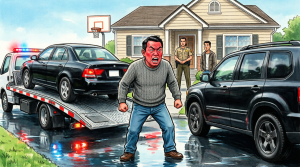
The pounding on my bedroom door didn’t sound like knocking.
It sounded like an accusation.
Bam. Bam. Bam.
I lurched upright so fast my neck cracked, disoriented, the room still dark except for the faint blue glow of my phone on the nightstand. For a second I thought it was a dream—one of those half-awake moments where your brain tries to stitch the world together from scraps.
Then the pounding came again, harder, shaking the cheap hollow door in its frame.
“Jason!” my father’s voice bellowed. “Open this door. Open it right now!”
I blinked at my phone. 3:15 a.m.
My body was heavy with sleep and the long shift I’d worked at the shop, but adrenaline yanked me upright anyway. I threw the blanket off, stumbled across the carpet, and opened the door.
My father didn’t wait for it to swing all the way.
He shoved past me into my room like he owned the air.
He was in his bathrobe, but he looked like he’d run a mile. His face was slick with sweat, cheeks flushed red, eyes wild. The smell hit me a beat later—sharp alcohol and something sour underneath it, like he’d been drinking hard enough that his body was trying to reject it.
“You ungrateful little thief,” he snarled, spinning on me. “What did you do?”
I stood there, still half-asleep, trying to decode what he was saying. My heart started thudding anyway, because my father didn’t come into my room at three in the morning unless the world was about to become a problem.
“What are you talking about?” I asked, rubbing my eyes.
“The car,” he shouted, voice cracking with outrage. “My Camaro. It’s gone.”
For a second, my brain misfired. Gone meant stolen. Gone meant someone had broken into the house. Gone meant the security gate had failed. Gone meant—
My stomach dropped.
“Gone?” I repeated. “Did someone steal it?”
He stepped closer until he was in my space, breath hot with whiskey. “Don’t play dumb with me,” he hissed. “The keys are gone from the hook. You’re the only one here. You took it for a joy ride, didn’t you? Where is it? Did you scratch it?”
I stared at him, awake now in the worst way. “Dad, I’ve been asleep since ten. I didn’t touch your car.”
“Liar!” he screamed, and spit flew. “You’ve been jealous since the day I bought it.”
Jealous.
The word was almost funny, except nothing about his face was funny. His eyes weren’t just angry—they were hunting, like he’d decided on a story and he was going to force the world to match it.
“I don’t want to drive your car,” I said, voice steadier than I felt. “I work on cars all day. I don’t need—”
He cut me off with a harsh laugh. “Right. The grease monkey with the moral compass. Spare me.” He jabbed a finger toward my chest. “I’m calling the police. I’m not protecting you this time. You steal my car, you pay the price.”
He pulled his phone out and dialed 911 while I stood there in my own doorway feeling like the floor had tilted. I heard the operator answer. I heard my father’s voice shift—smooth, practiced, the voice he used when he wanted to be believed.
“This is Robert Reynolds,” he said. “My son stole my $80,000 vehicle. I want officers here now.”
Eighty thousand. He said it like the number made the crime more real. Like the price tag mattered more than the fact he was accusing his own kid.
“Dad,” I said, trying again, “hang up. Let’s check outside. Maybe you parked it somewhere else.”
He whirled on me. “I parked it in the garage,” he roared. “And now the garage door is open and the car is gone.”
He gave the operator our address, the gated community, the house with the trimmed hedges and the stone archway—everything that screamed respectability. Then he ended the call and looked at me with a kind of grim satisfaction, like he’d just made the winning move in a game I didn’t realize we were playing.
I could feel my pulse in my throat.
My father had always loved two things more than anything else: the way people looked at him, and the things that made people look at him.
Cars were his favorite kind of attention.
He didn’t just drive them. He wore them. He let them announce him long before he stepped out.
And for the last three months, he’d been wearing that Camaro like it was proof he was still powerful, still admired, still the man he wanted everyone to believe he was.
My name is Jason Reynolds. I was twenty-two then, a mechanic by trade, grease under my fingernails most days because engines don’t care about image. I still lived at home—not because I was mooching, but because I was saving up for a down payment on my own place. I paid rent. I bought my own food. I kept to myself as much as you can in a house where your father treats every hallway like his stage.
My father, Robert, was a successful real estate agent in our town, the kind whose face was on bus benches and billboards. Perfect suit, perfect teeth, perfect watch, perfect handshake. People loved him because he made them feel like they were part of something glossy and exclusive. They didn’t see what it cost the people who lived behind that smile.
My mother, Linda, saw it. She’d been seeing it for years.
She was quiet, soft-spoken, the kind of woman who learned to keep the peace by making herself smaller. She walked on eggshells around my father’s ego, smoothing things over before they could explode, apologizing for things that weren’t her fault because it was easier than watching him get louder.
I grew up watching that dynamic and learning one lesson early:
In our house, my father’s version of reality was the only version allowed.
That’s why the Camaro mattered so much.
Three months before that night, my father went through what I called his super midlife crisis.
He came home one Friday evening like he was carrying a secret. He didn’t even take off his shoes before he started talking.
“You’re not going to believe what I did today,” he said, voice bright with self-satisfaction.
My mom looked up from the kitchen sink. I was at the table with my laptop, checking invoices from the shop, half-listening. My father loved to announce purchases like they were achievements.
“What did you do?” my mom asked carefully.
He jingled keys in his hand. Not house keys. Not normal keys. Something heavier.
“I bought a ZL1,” he said, as if those letters were a magic spell.
I glanced up despite myself. “A Camaro ZL1?”
He smiled like he’d been waiting for me to speak the language. “Brand new. Black on black. Six hundred fifty horsepower.”
My mom’s face tightened. “Robert—”
“Don’t start,” he warned immediately, smile still on but eyes already sharpening. “I earned it.”
That was always his justification. Earned. As if anything he wanted automatically counted as deserved because he wanted it badly enough.
The next morning, he pulled into the driveway with a sound that didn’t belong in our quiet gated community—a low, aggressive rumble that made the windows vibrate. The car looked like a stealth bomber on wheels, black paint so glossy it swallowed light. The hood had vents like gills. The tires were thick and wide and expensive.
He parked it in the garage and immediately turned the garage into a shrine.
I’m not exaggerating. He literally bought velvet ropes—the kind you see in museums—and placed them around the Camaro so no one would “brush against the paint.” He wiped it down with a microfiber cloth every night like it was a ritual. He bought special soap. Special wax. Special gloves. He’d stand back afterward, arms crossed, admiring his reflection in it like the car was a mirror showing him who he wanted to be.
He made rules.
No eating in it. No drinking in it. No touching it with “dirty hands.”
And specifically, loudly, repeatedly:
“Jason is never allowed to touch it.”
He’d say it like it was a joke to anyone who visited. “I can’t let him near it,” he’d laugh. “He’d probably change the oil with a shovel.”
Then he’d look at me and smirk.
I didn’t care about driving it. I drove fast cars at the shop sometimes. I got my thrill from diagnosing a problem and fixing it, not from flexing horsepower on a suburban street. Honestly, the Camaro made me nervous—not because I wanted it, but because my father was a terrible driver.
Aggressive, impatient, the kind of man who believed the rules of the road didn’t apply to him because he was important. He cut people off. He tailgated. He treated yellow lights like personal dares.
And with six hundred fifty horsepower under his foot?
I was worried he was going to kill himself.
That worry—quiet, practical, the kind mechanics have because we see how fragile machines and bodies are—was why I did what I did next.
Two weeks after he bought the car, I bought him a dash cam.
Not a cheap one. A high-end 4K system that recorded front, rear, and interior cabin. GPS tracking. Speed overlay. Cloud backup. It was the kind of camera you buy when you’re serious about protecting yourself.
I told myself it was a peace offering. A way to show him I wasn’t against his joy, even if his joy made the whole house tense.
The truth is I also wanted proof.
Proof of what he did behind the wheel, because I had this sick feeling one day someone would get hurt and he would claim it wasn’t his fault.
I gave it to him at the kitchen counter like a normal gift.
“Dad,” I said, keeping my tone light, “with a car this expensive, you need protection. People drive crazy. This will prove it wasn’t your fault if someone hits you.”
He scoffed. “I don’t need a camera. I’m an excellent driver.”
My mom glanced at me, a flicker of gratitude in her eyes. She didn’t say anything. She never did when it came to my father’s ego. But I could see she wanted him protected too, even if she wouldn’t admit she feared him.
My father turned the box over like it was insulting his intelligence. Then he shoved it toward me.
“Fine,” he said. “Install it. Just don’t scratch the dashboard.”
I installed it perfectly.
I hid the wires so you couldn’t see them. I mounted the front camera clean, tucked the rear camera neatly, tested the interior lens. I linked it to the cloud. I made sure it would upload automatically. I showed him the app, how to pull footage, how to save clips.
He looked at it for five seconds, got bored, and walked away.
He forgot about it completely.
He assumed it was just a gadget that sat there.
He didn’t realize it was always watching.
That was the part that would save me.
And destroy him.
Fast forward to last Saturday.
It was humid for December, one of those weird nights where the air feels thick and wrong, like the weather is holding something back. My mom was out of town visiting her sister for the weekend—one of the few times she ever left the house without my father. I remember helping her load her overnight bag in the car earlier that day and seeing that small, guilty relief on her face. Like being away from him for two days felt like breathing.
“Call me if you need anything,” she’d whispered when my father wasn’t looking.
“I’m fine, Mom,” I’d said, but my voice had been tight. I always felt uneasy when she left me alone with him. Not because I thought he’d hit me. He didn’t need to. He had other ways of hurting.
That night I worked a long shift at the shop. I was exhausted—hands sore, back tight, brain fried from a stubborn transmission issue that had eaten half my day. I got home around nine, ate something quick, went to my room, put on headphones, played a little video game to shut my mind off, and fell asleep.
I didn’t hear my father come home.
I didn’t hear the garage door.
I didn’t hear anything until the pounding on my door at 3:15.
And after he called the cops, after he accused me with that wild certainty, everything moved fast.
Twenty minutes later, the front yard was lit up with blue and red lights.
Two police cruisers pulled in. A third vehicle arrived a minute later—a tow truck, but not for us. It rolled slowly down the street like it already knew it was headed toward something dead.
My father opened the front door like he’d been waiting for an audience.
Officer Miller stepped onto the porch first. Big guy, serious face, posture that said he’d seen plenty of late-night family mess and had no patience for theatrics. Another officer followed, younger, hand near his belt. Their flashlights swept the porch, the foyer, my father’s face.
“Mr. Reynolds?” Officer Miller asked.
“Yes,” my father said, immediately putting on his victim mask. It was almost impressive how fast he could switch. His voice softened, eyes widened, shoulders slumped slightly like a grieving man.
“Officer, thank you for coming. I’m devastated.” He gestured toward me as if I were a stranger he’d found in his house. “My son—he has a problem. He took my new Camaro while I was sleeping. I just want my car back.”
Officer Miller’s gaze moved to me. “Is this your son?”
“Yes,” my father said quickly. “He’s a mechanic. He knows how to hotwire cars. Or he just stole the keys. He’s been jealous of that car since I bought it.”
Jealous again.
I stepped forward. “Officer, I didn’t take the car. I’ve been asleep.”
Officer Miller studied me, then looked past me into the house—quiet, expensive, staged. Gated community. Real estate agent father. Mechanic son. Late-night theft claim. The story wrote itself in ways that didn’t favor me.
“Sir,” Officer Miller said to me, “step out onto the porch, please.”
I walked out. The air outside was damp and cold, smelling like wet grass and exhaust from the idling cruisers. I could see neighbors’ porch lights flicking on up and down the street, curtains shifting. In a gated community, nothing travels faster than suspicion.
“I didn’t take the car,” I repeated, louder now, because I could already feel my father’s narrative trying to wrap around my neck.
Just then, a radio call crackled on Officer Miller’s shoulder mic.
It was loud enough for all of us to hear.
“Dispatch to Unit 4. We found the vehicle matching the description. Black Camaro ZL1. It’s wrapped around a utility pole on Oak Street. Total loss. No driver on scene.”
My father sucked in a dramatic breath and pressed his hand to his mouth as if he were witnessing tragedy on live television.
“Oh my God,” he gasped. “He wrecked it.” He whipped toward me, face twisting into rage. “He wrecked my dream car.”
He pointed at me, shaking, and screamed loud enough that my neighbor across the street opened his front door wider.
“You destroyed it, you useless, jealous waste of space!”
“I didn’t drive it!” I shouted back, adrenaline surging, fear turning hot. “I was in bed!”
“Save it for the judge,” my father spat.
Then he turned to Officer Miller with icy certainty.
“I want to press charges,” he said. “Full extent. Grand theft auto. Destruction of property. Reckless driving. Everything. I want him arrested. Maybe prison will straighten him out.”
Prison.
The word landed like a hammer.
Officer Miller looked at me, suspicion heavy in his eyes. “Son,” he said, “if you were driving, you need to tell us. Leaving the scene of an accident is a felony. If you were drunk, it’s worse.”
“I wasn’t driving,” I said, voice tight. “Check the car for prints. Check the seat position. I’m six-two. My dad is five-eight. The seat would be—”
“He probably moved the seat!” my father snapped. “Officer, look at him. He’s lying. He’s always been a liar.”
I could feel the trap closing. I could see it in Officer Miller’s posture—how he shifted, how his gaze hardened. To him, this looked like the classic situation: angry father, irresponsible kid, expensive car destroyed. The father had a reputation. The son had grease under his nails. The world loves clean stories.
“Turn around,” Officer Miller said to me. “Hands behind your back. I’m detaining you while we investigate.”
The handcuffs clicked onto my wrists.
Cold metal. Tight. Final.
My stomach lurched.
My father crossed his arms and watched with grim satisfaction. He wasn’t sad about the car anymore. He was happy he was winning.
“That’s right,” he said, almost smiling. “Take him away.”
And then—like a spark in a dark room—it hit me.
The dash cam.
My father had forgotten about it. He never checked the app. He never used it. But I had it on my phone. I’d installed it. I’d linked it. And because I’m the kind of mechanic who double-checks his work, I knew it was uploading.
“Officer!” I shouted, voice cutting through the night. “Wait—there’s a camera in that car.”
Officer Miller paused mid-motion.
“What?” he said.
“I installed a dash cam in that Camaro three weeks ago,” I said fast, words tumbling. “It records interior and exterior. It uploads to the cloud. I have the app on my phone. It will show you exactly who was driving.”
My father’s face drained of color so fast it was almost comical.
In the flashing blue lights, I watched his confidence evaporate like it had never existed.
“There’s no camera,” he stammered. “He’s making it up. He’s stalling.”
“It’s on my phone,” I said. “My phone is in my pocket. Please, officer. Look at the footage. If it shows me driving, take me to jail. But you have to look.”
Officer Miller looked at my father, who was now sweating. Then he looked back at me.
“Okay,” he said slowly. “I’ll look.”
He uncuffed one wrist so I could reach into my pocket. My hands were shaking—not from fear exactly, but from adrenaline and the sick awareness that this was the only thing between me and my father’s lie becoming my life.
I pulled my phone out with stiff fingers. Opened the app. The loading circle spun.
Come on.
Come on.
It connected to the cloud. A file popped up from tonight.
Timestamp: 2:30 a.m.
My throat tightened.
“Here,” I said, handing the phone over with my one free hand.
My father took a step forward, eyes wild, like he wanted to snatch it. Officer Miller’s head snapped up.
“Stay back, sir,” he warned.
Officer Miller pressed play and turned the volume up.
The video started from the interior camera, pointed into the cabin.
The first thing we heard was laughter.
Not my voice.
My father’s voice.
“Woo! Stick to the floor, baby!” he hollered.
The image was clear enough you could see the shine of sweat on his face.
He was in the driver’s seat.
And he wasn’t alone.
In the passenger seat was a woman, hair loose, cheeks flushed, holding a red Solo cup like she was at a party.
It wasn’t my mother.
I recognized her immediately because our town isn’t big and my father’s business circle is a small, shiny pond.
Mrs. Henderson.
The wife of my father’s business partner.
She laughed, leaning toward him. “Robert, slow down!”
“This car can handle it,” my father slurred. His eyes were glassy. His jaw moved too loosely, words thick. “This isn’t some little—” he glanced at the dash, grinning, “this is power.”
Mrs. Henderson giggled, spilling her drink on the expensive leather seats. “Oh my God, you’re going to kill us.”
Officer Miller’s head lifted slowly from the phone.
He looked at my father.
“Is that you, sir?” he asked, voice suddenly colder.
My father didn’t answer.
He stood frozen, face blank, like his brain had short-circuited.
The video kept playing.
The car was swerving. You could see the GPS overlay. Speed: 85 mph.
In a 35.
Mrs. Henderson screamed suddenly. “Watch out!”
There was a loud thump.
The car jerked violently.
“What was that?” she shrieked. “Robert—what was that?”
“You hit something!” she cried, voice rising into panic. “Robert, you hit—oh my God, you hit that dog walker!”
My blood turned to ice.
I hadn’t known. I hadn’t even imagined—when dispatch said utility pole, I pictured metal and glass and ego. I didn’t picture a person.
My father’s voice in the video snapped, angry and scared. “Shut up!”
“You have to stop!” Mrs. Henderson screamed. “You have to stop right now!”
“I can’t stop!” my father yelled back, and the words came out slurred but clear enough to be unmistakable. “I’ve been drinking! I’ll lose my license!”
Mrs. Henderson sobbed. “Robert—please!”
The car took a sharp turn. Tires screamed. The camera shook. My father’s hands—visible on the steering wheel—jerked too hard.
Then the massive crunch.
Airbags deployed, exploding into the cabin like white clouds. The audio went muffled for a second. Then coughing. Swearing.
My father shoved the airbag away. “We gotta go,” he said, breathless. “We gotta go. Run.”
Mrs. Henderson was crying, frantic. “You can’t leave! You can’t—”
“I’ll report it stolen,” my father said, voice hard with decision. “I’ll blame Jason. He’s home.”
My stomach dropped so violently I felt nauseous.
“You can’t blame your son!” Mrs. Henderson sobbed. “Robert, that’s—”
“He’s a loser,” my father snapped, vicious. “Nobody will believe him.”
The video showed them scrambling out of the wreckage. The camera angle shifted as doors opened. You could see flickering streetlights, hear distant barking dogs, hear my father’s heavy breathing.
“Run to your house through the woods,” he told her. “I’ll run home. I’ll call it in.”
Then the recording ended.
For a long moment, the porch was silent except for the distant hum of cruiser engines and the faint crackle of the radio.
Officer Miller stared at the phone.
Then he looked at me.
Then he reached into his pocket, pulled out the key, and unlocked my cuffs.
The metal fell away from my wrists with a click that sounded like justice.
“I’m sorry,” Officer Miller said, and he meant it.
Then he turned toward my father.
My father was trembling now, his lips moving but no sound coming out. He looked like a man who had been caught mid-performance and forgotten his lines.
“Mr. Reynolds,” Officer Miller said, voice hard, “turn around and place your hands behind your back.”
“Wait,” my father squeaked, voice suddenly small. “It—it was a deep fake. He edited it. That’s AI!”
“Save it,” Officer Miller said, grabbing his wrist and spinning him around with practiced force. He slapped cuffs on him tight.
“Robert Reynolds,” Officer Miller said, “you are under arrest for driving under the influence, reckless driving, leaving the scene of an accident with injury, and filing a false police report.”
“Injury?” my father repeated, voice shaking. The word seemed to hit him harder than the DUI.
Officer Miller’s eyes were cold. “We got a report of a pedestrian hit on Oak Street five minutes before the crash,” he said. “He’s in critical condition. That makes this felony hit-and-run. You’re looking at serious time.”
My father started crying.
Not the fake, controlled crying he’d done earlier when he wanted sympathy.
This was ugly crying—jaw loose, breath hitching, face collapsing.
“Jason!” he shouted as the officers walked him toward the cruiser. “Jason, tell them! Tell them you let me drive! Don’t let them take me—I’m your father!”
I stood on the porch with my arms crossed, wrists still red from the cuffs. My whole body felt like it was vibrating, not from fear now, but from the sheer adrenaline of watching the truth cut through his lies in real time.
I looked him dead in the eye.
“You said it yourself,” I said, loud enough for the neighbors to hear as they watched from windows and porches. “I’m just a loser. Nobody will believe me.”
His sob turned into a sound that was half rage, half despair.
They shoved him into the back of the cruiser. The door slammed shut.
And with that, a piece of metal and glass finally did what I couldn’t do for twenty-two years.
It exposed him.
Because the truth about my father was this: he didn’t love cars because he loved machines.
He loved cars because they made people look at him.
They made him feel like a king.
And the moment that car turned against him—capturing his drunken voice, his mistress’s panic, his plan to blame his own son—the king had no clothes.
The aftermath didn’t unfold like a movie where everything resolves in a neat montage. It was messier. Slower. More painful in the ways that matter.
My mother came home the next morning.
I was sitting at the kitchen table when I heard the front door open. She walked in with her overnight bag still on her shoulder, cheeks flushed from the cold. For a second, she smiled like she expected normal—like she’d left for two days and returned to the same careful routine.
Then she saw the police business card on the counter. She saw my face. She saw the way the house felt—too quiet, too heavy.
“Jason?” she whispered.
I stood up slowly. My wrists still ached. My throat felt raw from adrenaline.
“Mom,” I said, and my voice cracked.
She dropped her bag. “Where’s your father?” she asked, and the question itself sounded like dread.
I didn’t answer with words. I just picked up my phone, opened the dash cam file, and handed it to her.
She looked at me, confusion flickering. “What is this?”
“It’s… evidence,” I said quietly. “Just watch.”
She sat down at the table like her legs gave out, and she pressed play.
I watched her face while the video rolled, because I couldn’t watch the video again. I’d already heard my father call me a loser with a stranger’s laughter in the background. I’d already heard him say he’d blame me. I didn’t need to hear it again.
My mother’s expression changed in stages. Confusion first. Then disbelief. Then horror.
When Mrs. Henderson appeared in the passenger seat, my mother’s lips parted but no sound came out. When my father’s voice slurred “baby,” I saw something in her eyes shatter, like glass cracking.
And when he said, “I’ll blame Jason,” my mother made a sound that wasn’t a sob and wasn’t a scream—something raw, guttural, like her body was rejecting the reality.
She pressed a hand to her mouth, eyes wide and wet. The video ended.
The kitchen was silent.
My mother stared at the phone for a long moment like she didn’t recognize the world anymore.
Then she looked up at me.
“I’m so sorry,” she whispered.
It wasn’t a dramatic apology. It was the kind of apology that comes from a person realizing they have been complicit in something by standing still.
I swallowed hard. “He called the cops on me,” I said, voice flat, because saying it out loud made it real again. “He tried to have me arrested.”
My mother’s eyes filled with tears. “I know,” she whispered. “I know. I—I didn’t… I didn’t know he could…”
But the truth was, she did know. Maybe not that specific act, but the shape of him. She’d lived in his orbit for decades. She’d just survived by telling herself it would never land on her son like that.
Now it had.
Something in her changed that day. I could see it. The fear in her eyes was still there, but there was something else too—anger, finally, and a hard kind of clarity.
She filed for divorce within a week.
People in our town were shocked, but only the people who’d believed the billboard version of my father. The people who knew him intimately—my mother, me—weren’t shocked. They were exhausted.
Because of the dash cam evidence—his infidelity, his criminal behavior, the false police report—my mother had leverage she’d never had before. My father couldn’t charm his way out of a felony hit-and-run with a clear 4K recording and audio of him plotting.
The pedestrian he hit survived, thank God, but he had a broken leg and a concussion. He was in the hospital for days. I visited him once with my mom—not because I was responsible, but because I couldn’t stop thinking about the sound of that thump and the woman’s scream.
He was older, mid-fifties, with a bruised face and a tired, pained smile. When I introduced myself, his eyes narrowed in confusion.
“Why are you here?” he asked.
“Because,” I said quietly, “I’m sorry you got hurt. And because my father tried to blame me.”
His mouth tightened. “I heard,” he said. “The cops told me. That dashcam saved a lot of people.”
I nodded. My throat was tight. “I’m glad you’re alive,” I said.
He looked at me for a long moment, then nodded once. “So am I,” he said.
My father faced a massive lawsuit on top of the criminal charges. And because he was the face of his real estate firm—because his image was his currency—the news destroyed him overnight.
Nobody wants to buy a house from a guy who hits pedestrians, flees the scene, and frames his own kid.
His partners kicked him out. Listings vanished. His face came down from the bus bench because the company didn’t want his smile attached to them anymore.
He tried to call my mother from jail. Tried to call me. Left voicemails that swung wildly between rage and pleading.
At first he tried to threaten.
“You think you’ve won?” he hissed. “You think you can ruin me and walk away?”
Then he tried to charm.
“Jason, buddy,” he said in another message, voice strained. “Listen. We’re family. We can work this out.”
Then he tried to guilt.
“Your mother is turning you against me,” he snapped, like my mother had ever had that power. “I’m your father. You owe me.”
I didn’t answer any of them.
The judge denied him bail. Flight risk, history of lying to authorities. The things he’d used for years—confidence, manipulation—were now listed as reasons he couldn’t be trusted.
He was sitting in a cell waiting for trial.
And for the first time in my life, my mother stopped tiptoeing around him.
With my father gone, my mom needed help managing the estate and finances. She’d spent her whole life letting my father handle “money stuff,” which meant he controlled it and she pretended it was fine because asking questions would start fights. Now she was staring at accounts she didn’t understand and paperwork that felt like a different language.
She turned to me.
To the grease monkey.
To the disappointment.
And she saw, maybe for the first time, that I wasn’t the problem.
I helped her navigate lawyers and banks. I sat at kitchen tables with folders spread out. I explained terms. I asked questions she didn’t know she was allowed to ask.
We sold the big house.
It had too many bad memories. Too many echoes of my father’s voice bouncing off expensive walls. Too many nights where my mother tried to smile while he made the air tense.
My mom bought a condo for herself—smaller, calmer, in a building where nobody cared what your husband drove. She chose it because it had light and because it didn’t feel like a stage.
Then she did something that stunned me.
She gave me a significant chunk of money from the settlement—money she received through the divorce proceedings and the shifting of assets.
“It’s not a gift,” she said, eyes wet. “It’s… it’s an apology. For not standing up for you sooner.”
I didn’t know what to do with that. Apologies were rare in our house. They weren’t part of the language. My father never apologized for anything. My mother’s apologies had always been quiet and indirect—extra food on my plate, a hand on my shoulder, a look that said I’m sorry but I can’t say it.
This time she said it.
I took the money, not because I wanted to profit from family destruction, but because I understood what she was offering: recognition. Acknowledgment. A tangible admission that she’d failed me.
I used that money to open my own performance auto shop.
Not a greasy little bay with one lift and a leaky roof. A real place. Clean. Professional. The kind of shop where people bring cars they love and trust you not to treat them like toys.
Business was slow at first, then it grew fast, because word gets around when someone is good at what they do. My waiting list filled. Customers came back. They told friends. People started trusting me with machines that cost more than my father’s Camaro ever did.
Sometimes I’d catch myself in my office late at night, hands clean, paperwork done, looking around at the place I built and thinking about how badly my father misjudged me.
He’d wanted a son he could brag about at the country club. He never realized he already had a son who could build something real with his hands.
I keep the dash cam on a shelf in my office now.
It’s a small thing—black plastic, a lens the size of a coin—but it feels heavier than it looks. A reminder. A trophy. A warning.
Customers sometimes ask about it.
“What’s that?” they’ll say, nodding toward it.
I usually just smile and say, “Something that taught me a lesson.”
If they press, if they seem like the type who wants a story, I’ll tell a version of it. Not the whole thing. Not the part where my father tried to throw me in prison. Not the part where he called me a loser while plotting with his mistress. Just enough to land the point.
“That camera saved me,” I’ll say. “And it proved something important.”
“What?” they’ll ask.
I’ll tap the dash cam lightly with one finger.
“That the truth always comes out,” I’ll tell them. “Especially in 4K.”
People ask me sometimes if I feel bad for my dad.
“He’s still your father,” they’ll say, like blood is a leash you’re supposed to keep wrapped around your wrist forever.
I think back to that night—the blue and red lights, the cold click of handcuffs, my father’s satisfaction when he thought he’d won. I think about how easily he tried to throw my life away to save his image.
I think about him slurring “baby” to another woman while going eighty-five in a thirty-five. I think about the pedestrian in critical condition. I think about the words that came out of his mouth without hesitation:
“I’ll blame Jason.”
I don’t feel bad.
He loved that Camaro more than anything in the world. More than his marriage. More than his reputation. More than his own kid.
It’s fitting that the Camaro is what took everything from him.
The car was totaled—crushed into a cube at a scrapyard like every other piece of metal that thinks it’s invincible.
But the truth it carried?
That survived.
And so did I.