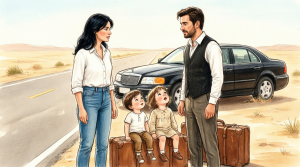
Isabella Moore had been standing beside the federal highway for so long that she no longer remembered when her legs had stopped trembling and started feeling numb. The road stretched endlessly in both directions, a ribbon of cracked asphalt cutting through dry land where the wind carried dust instead of promises. Each passing vehicle lifted clouds of dirt that settled slowly on her shoes, her coat, and the two children standing close to her, clinging to what little sense of safety remained.
At her feet rested two battered suitcases that had seen too many bus stations and too many hurried departures, along with a cloth bag filled with wrinkled clothes and a lunch container that had been empty since morning. Inside the pocket of her worn jeans, a few coins pressed against her thigh, their faint weight a cruel reminder that she had enough money for perhaps two bus tickets if a bus ever came, and not nearly enough to feed three hungry mouths.
Her son Samuel, who had just turned eight, shifted his weight and wiped sweat from his forehead with the sleeve of his shirt before looking up at her with eyes dulled by exhaustion.
“Mom, did they say when the bus would come back,” he asked quietly, trying to sound brave despite the dryness in his throat.
Her daughter Lily, only five, leaned against one of the suitcases and hugged her stomach, her small face twisted in discomfort.
“I am really hungry,” she murmured, no longer bothering to hide the weakness in her voice.
Isabella felt her chest tighten painfully, but she forced a smile because she had learned long ago that children drew strength from expressions, even when those expressions were lies meant to protect them.
“Soon, my loves,” she said softly. “We just need a little more patience.”
The truth, however, was far harsher than her words. The bus was not coming. It had not come yesterday, nor the day before that. The woman who ran the roadside guesthouse had assured her that buses always passed eventually, offering hope as casually as directions, but Isabella now understood that hope could be sold cheaply when the seller had nothing to lose.
Then a sound cut through the silence, different from the rattling engines of old vans and delivery trucks. This engine was smooth, controlled, and unmistakably expensive.
A black sedan slowed as it approached them, its tires crunching softly against gravel before stopping several feet away. Dust rose into the air, and Isabella instinctively stepped in front of Lily, shielding her with one arm. The driver side window lowered slowly, revealing a man whose expression was neither dismissive nor condescending, but alert, as though he had already noticed details others would have ignored.
“Have you been waiting here long,” he asked in a calm, steady voice.
Isabella tightened her grip on the suitcase handle and nodded politely without meeting his eyes.
“We are waiting for a bus,” she replied. “Thank you for stopping.”
The man glanced down the empty highway, then back at the children, and finally at the luggage resting on the ground.
“There has not been a bus on this route for several days,” he said carefully. “The company canceled the line after declaring bankruptcy.”
The words struck Isabella like a physical blow. Her breath caught as she stared at him, struggling to process what he had just said.
“That cannot be right,” she whispered. “No one told me.”
The man opened the door and stepped out, revealing his tall frame and the quiet authority that came from years of being listened to. He adjusted his jacket slightly before extending his hand.
“My name is Alexander Reed,” he said. “And I think you might need assistance.”
Isabella hesitated only a moment before shaking his hand.
“I am Isabella Moore,” she replied. “These are my children, Samuel and Lily.”
Alexander looked at the children again, and something in his expression softened in a way that surprised her.
“How long were you planning to wait here,” he asked gently.
Isabella swallowed hard. Pride rose in her chest, urging her to refuse help, but the sound of Lily’s stomach growling cut through that instinct with brutal clarity.
“Sir,” she said quietly, “I was hoping to find work nearby. Any kind of work. Cleaning, cooking, childcare. I am not afraid of learning.”
Alexander remained silent for several seconds, not because he was unsure, but because he was making a decision that would alter more than one life. When he finally spoke, his voice was measured and honest.
“There is a position available,” he said.
Isabella’s eyes widened slightly.
“What kind of position,” she asked.
Alexander met her gaze directly.
“I need someone willing to enter into a marriage of convenience,” he said plainly. “I need a wife.”
The world seemed to tilt around her as the words settled into her mind.
“I am sorry,” she said, certain she had misunderstood. “What did you say.”
Alexander raised one hand gently.
“I know how it sounds,” he replied. “Please allow me to explain. If you decide against it, I will personally take you to the nearest city and ensure you and your children are safe.”
Samuel pressed closer to his mother, and Lily stared at the car with wide, uncertain eyes.
“You have one minute,” Isabella said firmly. “That is all.”
Alexander nodded.
“My grandmother passed away recently,” he explained. “Her estate is tied to conditions that require me to be legally married and maintaining a stable household for a specific period. Without that inheritance, my company will collapse, and hundreds of people will lose their jobs.”
“That sounds like your problem,” Isabella said cautiously.
“It is,” Alexander agreed. “But it does not have to be only mine. I am not offering romance. I am offering security. Six months. A civil marriage. Separate bedrooms if you wish. In exchange, you and your children will have a home, medical care, schooling, and financial stability, all formalized and protected by contract.”
Samuel tugged at Isabella’s sleeve.
“Mom,” he whispered, “I feel dizzy.”
That single sentence shattered whatever resistance she had left.
“I need to see where we would live,” Isabella said slowly. “And I need time to speak with my children.”
“Of course,” Alexander replied. “But first, we eat. Decisions made on empty stomachs are rarely wise.”\

The small diner they visited smelled of soup and fresh bread, and Isabella watched her children eat with a focus that revealed just how hungry they had been. Alexander said very little, allowing the moment to remain theirs.
A week later, they stood inside a quiet courthouse, signing documents that felt unreal in their simplicity. Isabella wore a borrowed blue dress, and Alexander offered a respectful kiss to her cheek when the clerk declared them legally married.
What began as a contract slowly transformed into something neither of them had anticipated. Isabella found herself breathing easier in a house where her children slept without fear, and Alexander discovered that laughter at the dinner table softened the edges of a life once ruled solely by obligation.
When the past eventually resurfaced, carrying truths and consequences neither could avoid, it was honesty rather than wealth that held them together.
In the end, Isabella did not escape poverty through money alone, and Alexander did not find fulfillment through inheritance.
They built a family where none had existed before, and that was the only fortune that truly mattered.

