MY STEPMOM GRABBED THE MIC AT MY DAD’S RETIREMENT PARTY AND SAID, “SECURITY—REMOVE THIS USELESS WOMAN,” WHILE HE STOOD THREE FEET AWAY IN A TOM FORD TUX AND STARED AT THE FLOOR… SO I WALKED OUT WITHOUT A TEAR, GOT IN MY CAR, AND WITHIN 47 MINUTES I SHUT DOWN EVERY FAMILY-FUNDED ACCOUNT AND MOVED $17 MILLION INTO A TRUST SHE DIDN’T EVEN KNOW EXISTED—THEN I TURNED MY PHONE BACK ON TO 56 MISSED CALLS AND FOUND MY ENTIRE FAMILY ON MY DOORSTEP… NOT TO APOLOGIZE—BUT BECAUSE A LEGAL DOCUMENT THEY’D NEVER SEEN HAD JUST COLLAPSED 20 YEARS OF HER “PERFECT” PLAN…
“Security. Remove this useless woman.”
My stepmother said it into a microphone in front of two hundred guests—two hundred people dressed in black tie and diamonds, gathered under crystal chandeliers that threw light like glitter across the Whitmore Hotel ballroom.
And my father—Richard Paxton, the man everyone in that room had come to celebrate—stood three steps away in a custom Tom Ford tuxedo, looked down at the carpet, and said absolutely nothing.
No, “Diane, stop.”
No, “That’s my daughter.”
No, “Laura, come here.”
Nothing.
I didn’t run. I didn’t cry. I didn’t even blink fast, because the body does strange things when the humiliation is public and the betrayal is familiar. I stood there in the center aisle with my mother’s pearl earrings cooling against my skin, the velvet box in my hand, and I watched the room decide what I was.
Some people looked away immediately, as if shame could be avoided by turning the head. Others stared with a kind of hungry curiosity, the same expression you see on drivers slowing down for an accident.
The jazz quartet stopped mid-song. The bartender froze with a bottle tilted over a glass. Even the waiters in crisp black jackets paused like someone had hit a silent button on the night.
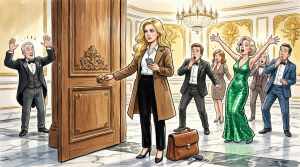
Two men in dark suits appeared beside me—so quickly it was clear they’d been waiting. One leaned toward my ear, voice low and practiced.
“Ma’am, we’ve been asked to escort you out.”
I looked at the stage. Diane stood there in cream silk, diamonds at her throat, her smile calm as a surgeon. Meredith—her daughter, my stepsister—had her phone raised, filming. That detail landed like a second humiliation. She wasn’t shocked. She was collecting content.
I turned to my father.
Richard Paxton’s hands were folded in front of him like a man waiting for someone else to finish speaking at a meeting. His eyes stayed on the floor.
I could have begged. I could have demanded. I could have thrown the velvet box like a grenade and watched it bounce across the marble.
Instead, I walked.
I set the box gently on the nearest table. Not tossed. Not slammed. Placed—as if it mattered that the last thing I did in that room was careful.
Then I said, not loudly, not with drama, just clearly enough for the cluster closest to hear, “I came for you, Dad. Not for her. But I see your choice.”
I turned toward the doors.
The guards walked with me—not gripping my arms, not yanking, because the Whitmore Hotel doesn’t do messy. They guided me the way you guide a disturbance out of a room full of polite people who want to pretend they’re not witnessing cruelty.
Behind me, Diane’s voice returned to the microphone with perfect composure.
“I’m so sorry about that, everyone,” she said, as if a spill had occurred. “Now—where were we?”
The jazz resumed before the doors even closed.
I stepped into the lobby, then out into October air sharp enough to feel like a slap. The cold hit my face and finally, finally, my lungs remembered how to breathe.
I stood on the front steps of the Whitmore Hotel, marble beneath my shoes, and listened to the muffled music bleeding through the walls—Cole Porter, laughter, glass clinking, a world continuing as if I hadn’t just been erased in front of two hundred people.
I gave myself sixty seconds.
Sixty seconds to feel everything I’d swallowed for twenty-three years rise up like a tide: the humiliation, the loneliness, the sick certainty of how easy it had been for them to do this. How prepared they were. How practiced.
Sixty seconds for every Christmas card I wasn’t in. Every Thanksgiving at the smaller table. Every time someone called me “difficult” because I had a pulse and a memory.
When the sixty seconds ended, I stood.
Because my mother did not teach me to sit on other people’s steps.
I pulled out my phone and made a call that would collapse an entire carefully built illusion.
“Rebecca Stone?” I said when she answered.
Her voice was crisp, professional. “Yes.”
“This is Laura Paxton,” I told her. “I’m ready to proceed with the segregated fund transfer. Tonight.”
There was a pause—brief, controlled, the pause of someone confirming identity and protocol. I had warned her this call might come. The only surprise would have been if it didn’t.
“I’ll need your digital signature and the authorization code from Mr. Aldridge,” she said. “If I receive both, I can execute within forty-five minutes.”
“You’ll have them in ten,” I said.
I hung up. My hands weren’t shaking. That’s the part people don’t understand. Rage doesn’t always look like screaming. Sometimes it looks like a woman sitting in her car with a laptop and a steady pulse, letting arithmetic deliver the justice other people refuse to offer.
Within forty-seven minutes, I had moved $17 million into a trust she didn’t know existed, and every family-funded account linked to that pool froze like a heart stopping mid-beat.
Then I turned off my phone.
When I turned it back on, there were fifty-six missed calls and my entire family was standing at my front door.
But they weren’t there to apologize.
They were there because a legal document they’d never seen had just collapsed twenty years of my stepmother’s careful planning.
My name is Laura Paxton. I’m thirty-four years old.
And this is the night I stopped being invisible.
But you can’t understand what happened in that ballroom—what it took for me to walk out without breaking—unless you understand the structure beneath it. The hidden beams and load-bearing walls of my family. The architecture of how a girl can be slowly moved from the center of her own life to the margins, one “kindness” at a time.
Let me take you back eleven months, to the day I received an email from a dead woman.
My mother, Catherine Hail, died when I was eleven.
Ovarian cancer. Eight months from diagnosis to funeral. Eight months of appointments and whispered phone calls, casseroles from neighbors, my father’s forced optimism curdling into exhaustion. Eight months of my mother growing thinner in ways that didn’t make sense to a child—how can a person disappear while they’re still standing in front of you?
What I remember most isn’t the hospital, or the day my father’s suit hung oddly on him at the funeral because grief had made him smaller. It’s the kitchen table.
Our kitchen table was maple wood scarred with years of family life—knife marks, water rings, a small burn from a candle my mother once forgot. It was where homework happened, where Christmas cookies cooled, where my mother and I sat the way other mothers and daughters might sit at a piano bench.
Except my mother didn’t teach me music.
She taught me structure.
She’d roll out craft paper—a big brown roll that smelled faintly of glue—and set drafting pencils beside it like tools in a surgeon’s tray. Then she’d draw.
Not doodles. Not childish sketches.
Floor plans.
She’d sketch the bones of a building, the load-bearing walls, the joists, the hidden geometry that held everything up, and she’d say, “See, Laura? Everything beautiful starts with structure.”
I didn’t know then she was an architect. No one ever used that word about her. I didn’t know she had her own firm, her own clients, her own name on documents. I just knew my mother understood buildings in a way that made them feel alive.
Sometimes she’d show me photos on her phone—old stone libraries, firehouses, schools—buildings with history in their walls. She’d tap the screen and tell me what the eye missed: where water damage started, how a foundation settles, why an arch holds.
“People look at a building and think it’s just what you see,” she’d say. “But what matters is the part you don’t see. The things holding it up.”
Then she’d look at me, and her voice would soften. “Same with people.”
During those eight months, she kept drawing with me even when her hands shook. Even when she had to pause to breathe. Even when she had to sit down with her head against the back of the chair as if the effort of being alive had become heavy.
When I was eleven, I believed my mother was unstoppable.
I also believed my father loved her enough to keep her name alive after she was gone.
I was wrong about one of those things.
Eight months after the funeral—eight—my father married Diane Hartwell.
People love to explain that kind of choice with grief. “He was lonely,” they say. “He needed support.” As if a child doesn’t count as support. As if the word “lonely” excuses replacing a woman’s presence like swapping a painting on a wall.
I remember the morning he told me.
I was sitting at the kitchen table drawing a floor plan of our house from memory, like my mother had taught me. I was trying to hold onto something familiar. The pencil scratched softly across paper. My father sat down across from me, hands clasped, face carefully arranged.
“You’re going to have a new mother, sweetheart,” he said.
I stared at him. The words made no sense. It felt like he’d told me we were getting a new sun.
I didn’t know how to say, I don’t want a new one. I don’t want an updated version. I want the one who taught me how to see.
So I said nothing.
That was the first time I chose silence.
It would not be the last.
Let me tell you about Diane.
Diane Hartwell was the kind of woman who could walk into a room and rearrange it without moving a single piece of furniture. She did it with tone, with timing, with the particular talent of making every suggestion sound like kindness and every command sound like a question.
She wore Chanel tweed the way other women wore denim—casually, constantly, as if it simply appeared on her body each morning. Her hair was always honey-blonde and blown out in the exact same style. Her nails were always perfect. I never once saw Diane Paxton look unprepared.
That should have been my first warning.
The first few months after the wedding, she played the role everyone applauds: the attentive stepmother, the woman who “took on” a grieving child. She brought me hot chocolate, asked about school, insisted on driving me to soccer practice.
But even as she smiled, she was building something.
Not a family.
A hierarchy.
Within a year, the Thanksgiving seating chart changed.
I went from sitting next to my father to sitting at the smaller table in the sunroom. Diane framed it like consideration.
“You’re so much more comfortable away from the crowd, aren’t you, Laura?” she said, her voice warm, her hand on my shoulder. Behind her, the main dining room filled with laughter and clinking glasses—adult conversation I wasn’t invited into.
I was twelve. I didn’t even know how to name what she was doing, only that it hurt. When my father looked toward the sunroom, I waited for him to say something.
He didn’t.
He smiled at Diane as if she’d solved a problem.
By year three, the family Christmas card featured Diane, my father, and Meredith—Diane’s daughter from her first marriage, born two years after me. Meredith stood between them in a red velvet dress, blonde hair curled, smiling as if she’d been born into that frame.
I was told the photographer ran out of time before my solo shots.
By year five, my bedroom became Diane’s yoga studio. My things were boxed and moved into the guest room.
“You’ll be leaving for college soon anyway,” Diane said breezily. “No point wasting space.”
Wasting space. That was the phrase.
As if I were furniture.
Diane introduced Meredith to people as “our daughter.” She introduced me as “Richard’s daughter from before.”
Before—like I was a rough draft my father had revised.
And my father let it happen, one eraser stroke at a time, because Diane’s tears were louder than my silence.
Richard Paxton was not a villain. That’s what made it worse.
A villain you can hate cleanly. A villain gives you clarity.
My father loved me. I know he did. I have evidence—small, scattered moments that still glow in my memory like embers.
When I was fourteen, he picked me up from school on a random Tuesday. No warning, no reason. He just showed up at the curb in his black sedan and nodded toward the passenger seat.
“Get in,” he said.
I climbed in, confused, and he drove west, past the grocery store and the high school football field, to the edge of town where an old stone building was being demolished. We sat in the car and watched the wrecking ball swing, each impact sending a shudder through the structure.
My father was quiet a long time. Then he said, softly, “Your mother would have fought to save that building.”
It was the last time he said her name.
After that, Catherine Hail Paxton became a ghost in her own house. Her photographs disappeared from the hallways. Her books were boxed. Her name was replaced by Diane’s in every sentence, every tradition, every toast. And my father—my loving, cowardly father—let it happen because it was easier to lose my mother again than to stand up to the woman who had replaced her.
I grew up learning the rules: don’t be too loud, don’t be too needy, don’t make Diane look bad in front of anyone. If Diane smiled, I smiled. If Diane wanted something, we did it. If Diane cried, my father folded like paper.
Silence became my survival skill.
When I left for college, I took a battered cardboard box with me.
My mother’s box.
It held her leather-bound notebook, a few drafting pencils, a photograph of her on a construction site with sawdust in her hair and the biggest grin I’d ever seen. It held old birthday cards and a small collection of things that smelled faintly like her—paper and cedar and that floral soap she used.
I carried the box from my Westchester bedroom to my dorm, to my first apartment, then to Brooklyn Heights—my third-floor walk-up brownstone with warped hardwood floors and ten-foot ceilings and morning light that came in like honey. I didn’t open the box often. Some grief you keep sealed because you’re afraid the air will change if you let it out.
I became a restoration architect.
If you don’t know what that means, you’re not alone. Most people don’t. My family certainly didn’t.
Restoration architecture is not glamorous. It’s not sleek Manhattan penthouses or Hamptons beach houses. It’s the buildings people have forgotten—crumbling libraries, nineteenth-century firehouses, schoolhouses with collapsed roofs. Structures that have been dismissed as worthless because it’s easier to demolish than to repair.
I loved them for that.
I loved how they required patience. How they forced you to listen. How you couldn’t fake the work. You couldn’t slap on a fresh coat of paint and call it done. You had to strip back the decay, find the original bones, and decide what could be saved.
Some days I crawled through attic spaces with a flashlight between my teeth, covered in plaster dust, smelling mold and old wood. Some days I stood in an abandoned building and ran my hands along cracked brick, imagining the hands that had laid it a century ago.
I earned $110,000 a year—perfectly good money, honest money. But in the Paxton world, where Meredith’s Instagram sponsorship deal could be worth $200,000 for posting photos of handbags, my career was a punchline.
At family dinners—when I was grudgingly invited—Diane would tilt her head and say, “And Laura, have you found anything more… stable yet?”
As if my work were a hobby I’d outgrow.
As if saving a century-old library from collapse were less real than unboxing a purse on camera.
My father would look at his plate. He always looked at his plate.
I drove home in my Subaru Outback—seven years old, paid off, 200,000 miles—and told myself it didn’t matter.
I became very good at telling myself it didn’t matter.
Last Christmas, Meredith patted the hood of my car in the driveway and said, “Cute car. Very you.”
She said it the way someone compliments a child’s drawing.
I didn’t answer.
What none of them knew was that six weeks earlier, the Historic Preservation Society had awarded me their highest honor for the Carnegie Library Project—a crumbling library in the Hudson Valley I had fought to restore when everyone else wanted to tear it down.
I didn’t tell them.
I’d stopped offering good news to people who only knew how to diminish it.
That library would change everything.
I just didn’t know it yet.
Eleven months before my father’s retirement party, on a gray afternoon in Brooklyn, I was kneeling on my apartment floor sorting through my mother’s box for the first time in years.
The brownstone creaked with its usual old-house sounds. A radiator hissed. Somewhere outside, a siren wailed and faded. Sunlight angled through the east-facing windows, catching dust motes like tiny floating stars.
I pulled out the notebook, the pencils, the photograph. I ran my thumb over my mother’s grin, felt the familiar ache in my chest.
Then, at the very bottom of the box, beneath a stack of old birthday cards, I found an envelope I had never noticed before.
Cream-colored. Heavy stock. The kind of paper you choose when you want the words to survive time.
On the front, in my mother’s handwriting—slanted, confident, unmistakable—it read:
For Laura, when she’s ready.
My hands shook as I opened it.
Inside was a single sheet of personal letterhead.
And the letterhead didn’t say “Catherine Paxton, homemaker” or any other softened version of my mother. It said:
Catherine Hail
AIA – Hail Architecture and Preservation
My breath stopped.
My mother had been a licensed architect. Not in the loose, “she liked drawing” way. In the official, “she built things that held” way.
No one had ever told me.
Not my father. Not Diane. Not a single person in twenty-three years.
Below the letterhead, in that same slanted hand, were words that felt like they reached through time and grabbed my wrist.
My darling girl,
There are things about our family’s money I need you to understand when you’re old enough. I’ve made arrangements to protect what’s yours.
Mr. Aldridge has everything. Find him.
Tucked behind the letter was a business card:
Thomas Aldridge, Esquire
Trusts and Estates
I sat on my apartment floor for a long time, the letter trembling in my hand. I felt like someone had slid open a hidden door in my life, revealing a corridor I’d never known existed.
Then I opened my laptop and searched his name.
Thomas Aldridge was sixty-seven and still practicing. His office was in Midtown Manhattan—twelve subway stops from my front door.
I wrote an email with my full name and a sentence that felt surreal:
“My mother was Catherine Hail Paxton. She left me a letter. She told me to find you.”
He responded within two hours.
The subject line read:
I’ve been waiting for this email for twenty-three years, Miss Paxton.
My stomach flipped.
He said he had a document I needed to see. He said it could only be discussed in person.
And he asked how soon I could come.
I went the next morning.
The subway ride felt like traveling through layers of my own life. Brooklyn Heights to Manhattan, the familiar tunnels, the smell of metal and damp concrete, strangers scrolling on phones, a man eating a bagel like it was the most important thing in the world.
I held my mother’s letter in my bag like a key.
Aldridge’s office was on the fourteenth floor of a pre-war building on Madison Avenue. The elevator was slow. The hallway was dim. The door was solid oak with a brass nameplate that looked like it hadn’t been updated since the nineties.
Inside, the office looked exactly like a trust attorney’s office should: floor-to-ceiling bookshelves filled with leather-bound volumes, a mahogany desk buried under neatly stacked files, the air smelling faintly of paper and old cologne.
And on the wall behind his chair—framed—was a photograph of my mother I had never seen.
She was young, wearing a hard hat, standing in front of a half-built building, smiling like she’d just been told the best joke in the world.
The sight of her—alive in a way my memory couldn’t fully reconstruct—hit me so hard I had to sit down before my knees gave out.
Thomas Aldridge was silver-haired and deliberate. He spoke the way careful lawyers speak: every sentence measured before it was released.
“Your mother retained me in 2003,” he said, “when she first learned about the cancer. She wanted to ensure that her assets—specifically the inheritance she brought into the marriage from the Hail family—would be protected for you.”
He placed a leather-bound document on the desk between us.
Forty pages. My mother’s signature in blue ink on the final page.
“The trust agreement of 2004,” he said.
He explained it in plain English, because my mother had asked him to, twenty-three years in advance.
Catherine Hail had entered the marriage with seventeen million dollars in inherited family wealth. That money had been placed into the Paxton family trust—but with a critical distinction.
It was designated as segregated funds. Walled off. Legally separate from the rest of the trust’s assets even if it sat in the same pool.
Then Aldridge slid a second document across the desk.
“Your mother signed an amendment in 2006,” he said, “six months before she passed.”
I stared at the paper. My mother’s handwriting in the margin: for my girl.
“It designates you, Laura Catherine Paxton, as the sole beneficiary of the segregated funds,” Aldridge continued. “Effective upon your thirtieth birthday. No co-signature required. No trustee approval needed.”
My throat tightened.
“Does my father know?” I asked.
Aldridge paused. It was the kind of pause that answers you before words arrive.
“Your father was present when the original trust was established,” he said quietly. “He has always known.”
The room seemed to tilt.
“And Diane?” I asked.
“Mrs. Paxton was never informed,” he said. “The trust agreement was never shared with her. She appears to believe the entire trust—approximately forty-two million at last valuation—belongs to the family generally.”
He folded his hands. “She’s been contacting my firm and the fiduciary manager—Rebecca Stone—requesting access to the trust provisions. Ms. Stone correctly declined.”
I sat back, my pulse loud in my ears.
Seventeen million dollars.
My mother had built a wall around it with paper and ink and foresight, and it had held for twenty-three years.
“What happens if I withdraw it?” I asked slowly.
Aldridge’s expression didn’t change. “The remaining trust assets,” he said, “will not cover the loans your stepmother has authorized using the full trust as collateral. The bank will issue a margin call.”
“Loans?” I echoed.
He nodded. “Your stepmother has leveraged the trust to secure debt. If the trust balance drops below the covenant threshold, the bank can freeze linked accounts and demand additional capital.”
I felt sick.
Not at the money. Money is abstract until it becomes power.
I felt sick at the shape of what Diane had been building without me ever seeing the blueprints.
I stared at the documents, my mother’s handwriting, her signature, her careful legal structure.
Then I said, “I’m not going to sign today.”
Aldridge raised an eyebrow.
“Give me until after my father’s retirement party,” I said. “I want to see if he chooses me.”
Aldridge’s gaze flicked to the photo of my mother on the wall, then back to me.
“Your mother,” he said softly, “would understand.”
I left his office with copies of both documents in a folder and something I hadn’t carried in years.
A choice.
Three weeks before the retirement party, I tried to give my father one last chance.
I called him and asked if we could meet for coffee—just us.
He said yes immediately, and for half a second something warm and unfamiliar flickered in my chest.
Then my phone rang ten minutes later.
Diane’s voice.
“Your father’s schedule is very full right now, Laura,” she said with smooth sweetness. “Maybe after the party.”
A week later, the invitation arrived.
Crane & Co. cardstock. Gold foil lettering.
Celebrating 35 years of excellence—Richard Paxton.
Hosted by Diane Paxton and Meredith Paxton.
My name was printed as Laura Paxton Hartwell.
Diane’s maiden name hyphenated onto mine like a brand.
I stared at it for a long time, then placed it on my kitchen counter and watched my cat step over it like it was litter.
Diane began building her stage.
I noticed the first move on a Monday. I texted the family group chat asking what time we were expected at the venue. The message sat there—delivered, unread—for three days.
On Thursday, I opened iMessage and realized the thread was dead. No new messages. No activity.
I texted Meredith separately. “Is the family chat broken?”
She replied four hours later. “Oh, mom made a new one. Must have been a glitch.”
There was no glitch.
There is never a glitch with Diane.
I called the event coordinator at the Whitmore Hotel—a woman named Janelle—and asked to confirm my RSVP.
There was a long pause on the line.
“I’m sorry,” she said carefully. “I don’t have Paxton—Laura—on the guest list. Could you be a plus one?”
The floor shifted beneath me—not surprise, but recognition.
I had seen this pattern before. The slow mechanical precision of being disappeared.
But this time the machinery was running faster.
I called Diane directly. She picked up on the second ring, because Diane never wanted to appear like she was avoiding you.
“Laura,” she said brightly. “What a surprise.”
“I called the hotel,” I said. “They don’t have me on the list.”
A beat of silence. Then Diane’s soft laugh, like a teacher indulging a confused student.
“Oh, darling,” she said. “I wasn’t sure you’d come, given everything.”
She let the pause hang there, inviting whatever rumors she’d planted to bloom.
“But of course,” she continued, “we’ll have someone add your name. And please—don’t wear one of your work outfits. This is black tie.”
I said I’d be there.
That evening, I checked the American Express Platinum card my father had set up for me when I turned eighteen—an “emergency” card linked to the family trust.
It was still active.
And for the first time, I looked deeper. I traced the account structure the way I’d trace a building’s hidden supports. Every card, every club membership, every insurance rider in the Paxton family was linked to the same trust. The same pool of money.
And I was starting to understand whose money it actually was.
Two weeks before the party, I drove to Westchester to give my father his retirement gift early.
I told myself it was because I wanted him to have it. But really, I wanted to see whether he could look at something made by my hands and still recognize his daughter.
I’d spent three months restoring an original architectural rendering of the first commercial property he ever purchased in 1989. I tracked down the blueprint in county archives, stabilized the paper, reframed it in reclaimed walnut, cleaned every line until it looked like it had been drawn yesterday.
The gift wasn’t expensive in the Paxton way.
It was expensive in time.
My father opened it in the living room. His eyes went soft. His fingers hovered over the glass like he was afraid to touch it.
For a moment, he was somewhere else—somewhere before Diane, before the gold foil invitations, before the image of his life became more important than the life itself.
“Laura,” he started.
Then Diane appeared in the doorway.
She glanced at the framed rendering the way you’d glance at a child’s finger painting.
“That’s sweet,” she said, “but we already have the walls full. Meredith commissioned a portrait of your father. Oil on canvas, by a real artist.”
My father set my gift down on a side table.
He didn’t fight for it.
He never fought for anything that was mine.
Diane guided him toward the kitchen, her hand light on his back like a steering wheel.
I stood alone in the living room and looked at the fireplace.
Above the mantle hung the portrait Meredith had commissioned: my father seated in a leather chair, Diane standing behind him with one hand on his shoulder, Meredith at his side smiling. The composition was complete. The lighting perfect. The frame gilded.
There was no empty space.
No room for anyone else.
As I turned to leave, I heard Diane’s voice from behind the kitchen door, low and fast.
“She’s going to make a scene at the party, Richard. You know how she is. She’ll bring up her mother and ruin everything. Maybe we should prepare security.”
My father’s reply was barely audible. “She’s my daughter, Diane.”
And Diane’s response was perfectly clear.
“Exactly. And daughters should know their place.”
I left without saying goodbye.
On my way out, I passed Diane’s study—and saw it on her desk: a manila folder with a law firm logo I didn’t recognize and the words Trust Amendment Draft printed across the tab.
I didn’t stop.
But I remembered.
The following Saturday, Meredith called me—not to check in, not to ask how I was. Meredith never called to check in.
She called because she wanted my opinion on her outfit for the party.
I said yes, because even at thirty-four I still sometimes said yes out of old reflex.
We met at Bergdorf Goodman on Fifth Avenue, eighth floor—the kind of place where the air itself smells expensive and sales associates remember your name if you spend enough.
They remembered Meredith’s.
She tried on seven dresses in ninety minutes: Oscar de la Renta, Valentino, Marchesa beading that looked like frozen starlight. Each one arrived on a velvet hanger carried by an associate named Clare who called her “Miss Paxton” and treated her like minor royalty.
The total hovered somewhere above twelve thousand dollars. Meredith didn’t blink.
She handed over a black card linked—like everything—to the family trust.
When I stepped to the counter to pay for a simple pair of shoes—two hundred dollars, from my own account—Clare looked at my card, then at me, and said, “And you are?”
Meredith laughed. Not cruelly. Worse—absently, as if the answer was obvious.
“She’s my half-sister,” Meredith said. “She restores old buildings. Like… physically. With her hands.”
The way she said with her hands made labor sound like a quaint hobby.
I smiled politely and paid for my shoes.
On the drive home, Meredith delivered the message Diane had clearly coached her to deliver.
“Laura,” she said, brushing lint from her dress bag, “mom thinks you shouldn’t give a speech at the party. It’s better if you just attend. Dad doesn’t like being emotional in public.”
I didn’t answer.
I just drove.
That’s what I’d always done. Driven and swallowed and driven.
One week before the party, I had lunch with Ellen Marsh.
Ellen had been my mother’s closest friend, one of the few people who still said Catherine’s name out loud as if she were a real person and not a footnote.
We met at a French bistro on the Upper East Side—the same one my mother used to take me to for Sunday brunch when I was small. White tablecloths. Copper pots on the walls. A waiter who still remembered that Catherine ordered a croque-madame every time.
I ordered the same.
Ellen was quieter than usual, rearranging her silverware like she was trying to build a sentence out of forks.
Finally, halfway through her second glass of Sancerre, she said, “Laura… is it true you were let go from your job?”
I put down my fork.
“Who told you that?” I asked.
Ellen winced. “Diane. At the garden club luncheon last week.”
My stomach tightened.
“She said you’ve been struggling,” Ellen continued, clearly uncomfortable. “No stable income. Relying on your father.”
I stared at her.
I had never relied on my father for a single dollar since the day I left for college.
“And,” Ellen added, voice dropping, “she said you have… mental health difficulties. That you push everyone away. That the family has been trying to help but you won’t accept it.”
I felt something cold spread through my chest.
“She called you,” Ellen whispered, “the frigid daughter.”
I sat very still, the restaurant sounds fading into a distant murmur.
Diane wasn’t just excluding me. She was building a story about me—seeding it into every circle that mattered so that when she humiliated me publicly, the crowd would already know what to believe.
Laura Paxton is unstable.
Uninvited.
Unwelcome.
So when security removed me, no one would question it. They’d nod and whisper, Poor thing. It was only a matter of time.
Ellen reached across the table and took my hand.
“I didn’t believe her,” she said fiercely. “Your mother was the strongest woman I knew. And you are her daughter.”
Something inside me that had been bending for a long time stopped bending.
It started to straighten.
That night, alone in my apartment, I looked at my mother’s photograph on the wall—Catherine Hail, thirty-one, laughing on a construction site with sawdust on her boots and a rolled blueprint under her arm.
I thought about not going to the party.
I could stay in my quiet life, in my restored brownstone, and let them have their champagne and their portrait and their narrative.
I could swallow this too.
I was good at swallowing.
But then I looked at my mother’s letter pinned above my desk.
Find him.
I had found him.
I had the documents now. I had the authority. I had Thomas Aldridge ready. I had Rebecca Stone prepared.
I hadn’t used any of it because I wanted to give my father one more chance.
If Richard Paxton stood next to me at that party—if he introduced me to his colleagues, if he said my name the way a father should—I would put the documents back in the drawer and never speak of them again.
It was the easiest test in the world.
Choose your daughter.
Just once.
I laid out my dress: midnight navy, clean lines, impeccable tailoring. Nothing flashy. Nothing begging to be noticed. I opened my jewelry box and took out my mother’s Mikimoto pearl earrings—the only thing of hers Diane hadn’t managed to claim.
I held them in my palm and felt their weight: cool, smooth, impossibly steady.
Then I picked up my phone and called Thomas Aldridge.
“If I need you tomorrow,” I asked, “can you execute within the hour?”
His voice was calm, precise.
“Everything has been ready for twenty-three years, Miss Paxton,” he said.
I set my alarm for seven.
I slept deeply, clearly—the way you sleep when you stop hoping and start deciding.
The Whitmore Hotel on a Saturday evening is the kind of place that makes you feel underdressed even when you’re wearing your best. Crystal chandeliers the size of small cars. Italian marble floors polished to mirror sheen. Waitstaff carrying silver trays of champagne that caught the light like liquid gold.
The ballroom had been transformed into a shrine to my father’s legacy: round tables draped in white linen, centerpieces of white hydrangeas and pale gold roses, a live jazz quartet playing with the kind of effortless precision money buys.
Two hundred guests milled beneath a banner that read:
Cheers to Richard Paxton—35 Years of Building Legacy.
Legacy. The word hung there like a joke.
I gave my name at the reception table. The young woman checked her list, scrolled, checked again. Her smile faltered.
“I’m sorry,” she said. “I don’t see—oh. Wait. Here. You were added yesterday.”
Yesterday.
Two hundred guests confirmed months in advance, and I was added yesterday, squeezed into the margin like a typo someone caught too late.
I thanked her and walked in.
It hit me in waves—the whispers, not loud enough to be challenged, quiet enough to slip through a room like a draft under a door.
“That’s the frigid daughter.”
“I heard she’s been out of work for months.”
“Diane says she just shows up and causes scenes.”
Diane’s seeds were blooming exactly on schedule.
I kept my back straight. I kept walking.
I scanned for my father and found him near the small stage standing between Diane and Meredith as a photographer arranged them into a family portrait.
Richard. Diane. Meredith.
Three people, perfectly composed.
No one looked for me. No one called my name.
And near the ballroom entrance, two men in dark suits stood with earpieces—security, already briefed. One of them glanced at Diane, then at me, and shifted his stance.
They were watching me.
They’d been told to watch me.
I crossed the ballroom. Every smile felt like a flinch. Every turned shoulder felt deliberate. I passed men I’d known since childhood—my father’s business partners—who didn’t even nod.
I reached my father’s circle.
Richard saw me first. His face flickered—warmth, then panic. He opened his mouth, and for half a second I thought he might say something real.
Then Diane’s hand landed on his arm, fingers pressing into his tuxedo like a leash pulled taut.
“Laura,” he said. “Glad you could make it.”
Five words. The words you say to a colleague you barely recognize.
Diane turned to me, radiant in cream silk. Her smile was the one she wore when she was about to draw blood.
“Laura,” she said, voice pitched just loud enough for the surrounding cluster to hear. “What a surprise. I wasn’t sure you’d come, given everything.”
She let the pause land, inviting everyone to fill it with rumor.
Then, softer, almost tender: “Just don’t make it about yourself, okay? Tonight is about family.”
Family. The word hit like a slap.
Meredith glanced at my dress with the smile of someone taking inventory.
“Love the dress,” she said. “Is that from last season?”
I didn’t answer. I looked at my father.
“Dad,” I said, “can I talk to you for a moment? Alone?”
I saw the instinct in him—a flicker of yes. His body leaned half an inch toward me.
Then Diane tightened her grip.
“Richard,” she said smoothly, “the Hendersons are waiting. You can talk to Laura later.”
My father looked at Diane, then at me.
And then he turned and walked away.
I stood alone in the middle of two hundred people who had been taught to see me as a problem.
That’s when the speeches began.
Diane took the microphone first, of course she did. She delivered a flawless speech—warm, charming, polished.
She thanked the guests, praised Richard’s career, called Meredith up for an embrace that drew collective “awws.” She spoke about loyalty, about family, about the people who truly make a house a home.
She did not say my name.
She did not look at me.
My mother’s name wasn’t mentioned once.
When the applause faded, I stood up.
I wasn’t going to give a speech. I wanted to do something smaller, quieter. I wanted to walk to the front and hand my father his gift—a brass compass I’d restored, the same one my mother had given him when they were young, engraved with her initials, C.H.
I was ten steps from the stage when Diane saw me coming.
Her expression didn’t change. That’s the part that still chills me—how controlled she was.
She leaned into the microphone and said, clear as a bell, “Security.”
A ripple moved through the ballroom. Heads turned.
Then she said, “Please remove this woman. She wasn’t invited, and she’s causing a disruption.”
Two hundred people went silent.
And my father looked at the floor.
Everything after that you already know: the guards, the velvet box, my voice steady as I said I saw his choice, my walk through the doors, the music starting again.
What you don’t know—what they didn’t know—was that while they kept dancing and clinking glasses and telling themselves the disruption had been handled, I was sitting in my Subaru in the hotel parking lot with my laptop open like a scalpel.
I had brought it the way a surgeon brings an instrument, hoping not to use it, prepared if I had to.
The car interior glowed pale blue from the screen. Outside, the parking lot was dark and empty. Inside the hotel, two hundred people were celebrating a man’s legacy.
Out here, it was just me, Wi-Fi, and twenty-three years of silence finally reaching its limit.
I dialed a conference call.
Thomas Aldridge picked up first.
Then Rebecca Stone.
“Authorization code,” Aldridge said calmly, as if reading a weather report. Twelve alphanumeric characters.
“This authorizes the transfer of segregated funds from the Paxton family trust to the Laura Paxton irrevocable trust per the trust agreement of 2004 and amendment of 2006,” he said.
Rebecca confirmed receipt. “Miss Paxton, I’m sending a DocuSign now. Please review and sign.”
My phone buzzed. I opened the email, read every line—because my mother taught me that everything beautiful starts with structure—and signed.
“Processing,” Rebecca said. “Estimated completion forty-five minutes.”
While I waited, I did the rest.
Three American Express Platinum cards. Authorized users. Country club membership. Insurance riders. Everything tethered to the trust’s collateral covenant.
I didn’t cancel anything out of spite.
I watched arithmetic do what arithmetic does.
At 9:47 p.m., Rebecca called back.
“Transfer complete,” she said. “Seventeen million, four hundred twenty-two thousand, three hundred sixteen dollars and seventy-eight cents. The funds are now in your trust.”
I closed my laptop.
I sat in the dark for a moment and listened to my own breathing.
Then I turned off my phone, started the engine, and drove home to Brooklyn.
When I turned my phone back on forty minutes later, there were twelve missed calls.
By the time I set it on my kitchen counter, there were twenty-nine.
By the time I finished making tea, fifty-six.
They hadn’t called me fifty-six times in the last twenty-three years combined.
The messages came in waves.
Meredith first, frantic: Laura, what did you do?
Then Diane, no longer velvet: You have no right. This is family money.
Then Meredith again: My cards aren’t working. Laura, this isn’t funny.
Then Richard: Laura, please call me. We need to talk.
Then Diane, sharp as broken glass: I’m calling our lawyer. You’ll regret this.
I watched the screen light up and go dark, light up and go dark like a heartbeat monitor.
I didn’t answer.
Instead, I ran a bath.
I took off my dress carefully and hung it on the bathroom door. I unclipped my mother’s pearl earrings and set them on the vanity. I stepped into the hot water and let the steam soften the edges of everything.
When I got out, I put on a sweater, made chamomile tea, and sat in my armchair—the one I’d found at an estate sale and restored over four weekends—staring at my mother’s photograph.
“I did what you asked,” I whispered to the empty room. “I found him. I found what you built.”
At 11:15 p.m., the intercom buzzed.
I looked at the screen.
There they were—my father in his tuxedo, tie loosened, face gray. Diane in her cream silk gown with mascara streaked down her cheeks, clutching her Hermès bag like a life raft. Meredith half a step behind, hugging her phone to her chest, eyes swollen.
For twenty-three years, I had gone to them—to their house, their dinners, their parties, their terms. I had rung their doorbell like a guest in my own family.
Now they were on my stoop.
I stood there a moment longer than necessary and let myself absorb the image: Diane Paxton, who had never visited my apartment in seven years, standing outside my door with panic in her posture.
Then I walked to my desk drawer and pulled out the folder: trust agreement, amendment, transfer confirmation—plus one more document I hadn’t shown anyone yet.
I tucked that last sheet into the back like a final nail in a coffin.
I checked my reflection in the hallway mirror. Cashmere sweater. Hair down. No makeup. Clean. Simple. Mine.
I pressed the intercom button.
“Come up,” I said.
I unlocked the front door and opened my apartment door before they reached the landing.
Diane climbed first, heels clicking on old wood, drawing breath for whatever speech she’d rehearsed.
She crossed my threshold and started, “How dare you—”
I raised one hand. Not dramatic. Just enough.
“You are at my door, Diane,” I said. “Lower your voice or leave.”
She stopped mid-word.
It was, I think, the first time in twenty-three years someone had said no to Diane Paxton on a doorstep.
I stepped aside. “Come in. But I’ll be the one talking tonight.”
They sat in my living room the way people sit in a doctor’s office when the news is already bad. Richard took the armchair by the window. He looked shrunken inside his tuxedo, a man built for conference rooms compressed into my small Brooklyn apartment that smelled like chamomile and old books.
Meredith perched on the edge of the sofa, arms crossed, eyes darting, not looking at anyone.
Diane remained standing. Standing was control, and she wasn’t ready to give it up.
She fired first.
“You stole from this family,” she said. “That money belongs to your father.”
I opened the folder on my coffee table.
I didn’t rush. I didn’t raise my voice.
I had spent my career uncovering original structures beneath decades of bad renovations. That was exactly what I was going to do now.
“That money,” I said, “never belonged to my father.”
I slid the trust agreement across the table. Forty pages. Leather-bound. My mother’s signature in blue ink.
“It belonged to my mother,” I continued. “Catherine Hail Paxton.”
Diane’s eyes locked on the document like it was a weapon.
“The trust agreement of 2004,” I said. “Drafted by Thomas Aldridge. Executed by my mother. It designates seventeen million dollars—her Hail family inheritance—as segregated funds. Legally separate. Mine.”
Diane’s voice went thin. “That’s fake. Richard, tell her.”
She turned to my father like he was her witness.
Richard stared at the document.
He didn’t deny it.
His silence was its own confession.
“You knew,” I said to him. Not a question. “Didn’t you?”
My father’s throat moved. His hands gripped the chair arms like he needed something solid to hold onto.
When he spoke, his voice sounded like something that hadn’t been used in years.
“Your mother… she set it up before she got sick,” he said. “I should have told you.”
Diane turned to him as if struck.
“You knew?” she whispered.
Richard didn’t answer.
But his silence answered for him.
I placed the second document on the table.
“Amendment of 2006,” I said. “Signed six months before my mother died. It names me sole beneficiary of the segregated funds effective on my thirtieth birthday. No co-signature. No trustee approval. I’m thirty-four. I exercised my legal right tonight.”
I sat back.
The papers lay between us like blueprints for a building Diane hadn’t known existed.
“I didn’t steal anything,” I said. “I reclaimed what was always mine.”
Diane grabbed the documents and read fast, eyes scanning for a crack, a loophole, a mistake.
She didn’t find one.
My mother had been meticulous. Aldridge had been meticulous. Twenty-three years of legal architecture built to hold.
When Diane looked up, she switched tactics instantly. Fury vanished, replaced by her most practiced performance—victim mode. Chin quiver. Eyes widening. Hand at her collarbone.
“Richard,” she breathed. “She’s tearing this family apart. After everything I’ve done—”
I cut her off, not with volume but with information.
“Speaking of what you’ve done,” I said, “I know about the trust amendment you’ve been drafting.”
Her hand dropped.
The mask cracked down the center.
Richard’s head lifted sharply. Meredith’s eyes snapped up.
“What?” Meredith said.
“Three weeks ago,” I said, “I was at the house. I saw the folder on your desk. Trust Amendment Draft. A draft designed to remove me as beneficiary of the segregated funds and transfer them to Meredith.”
Meredith turned toward her mother, stunned. “Mom—”
Diane’s mouth opened, then closed.
“I also confirmed,” I continued, “that you’ve been calling the fiduciary firm repeatedly requesting access to my mother’s trust provisions. Rebecca Stone refused because you have no legal standing.”
Diane’s tears evaporated.
What replaced them was raw anger stripped of all silk.
“So what?” she snapped. “That money’s been sitting there for twenty years doing nothing. Meredith deserves it more than you. At least she contributes to this family.”
“Mom, stop,” Meredith whispered, but Diane didn’t look at her.
I looked at Diane across my coffee table, across the documents, across twenty-three years.
“Meredith deserves what?” I asked. “Seventeen million dollars my mother earned, my mother’s parents built over generations—because she posts handbags online?”
Richard’s voice surfaced, weak. “Laura… that’s enough.”
I turned to him. I had been waiting for that word. Enough. His favorite escape hatch.
“No,” I said. “You don’t get to say enough tonight. You lost that right when you watched two security guards walk me out of a ballroom and said nothing.”
The silence after that was different. Not composed. Not controlled.
It was the silence of a man hearing, for the first time, the full cost of his cowardice.
I reached into the folder and pulled out the last document—the one I hadn’t mentioned.
A printed email from Diane’s personal account to her attorney, accidentally copied to Thomas Aldridge because his address was still on file as trustee of record.
I placed it on the table.
Then I read it out loud.
“We need to move quickly before Laura finds out about Catherine’s trust provisions. Richard doesn’t have the spine to stop us.”
The room went airless.
Richard picked up the page. Read it once. Then again.
Then he set it down and looked at his wife like he was seeing her for the first time.
“Diane,” he said, voice barely audible. “Is this real?”
She didn’t answer.
She didn’t have to.
Her face answered: the unmistakable expression of someone caught not in a lie, but in the truth.
“That’s not revenge,” I said quietly. “That’s arithmetic. And this”—I nodded at the email—“is who you are.”
What happened next was the sound of a structure failing.
Not dramatic collapse. Not exploding glass.
The slow kind—the kind I’d seen in my work, when a building has stood on compromised beams for decades and one support finally gives way.
Diane reached for the email as if removing it could undo the words.
Richard pulled it back.
Diane pivoted again, desperate—chin quiver, eyes wet, voice shaking.
“She’s manipulating you, Richard,” she said. “Just like Catherine always did.”
My father stood up.
In twenty-three years, I had never seen Richard Paxton stand up against Diane.
He had yielded. Deferred. Looked at his plate. Let silence do the work of agreement.
But something in that sentence—just like Catherine—hit a wall inside him that even he didn’t know was still standing.
“Don’t,” he said.
His voice shook, but the word was stone.
“Say her name.”
Diane stopped.
For the first time in her life, she had no prepared response.
Meredith rose slowly from the sofa. Her face was blotchy and wet, but her voice came out steadier than either of her parents.
“Laura,” she said. “I didn’t know about the trust. The amendment. Any of it.”
I looked at her—my half-sister, the golden child, the one who’d been handed everything I’d been denied.
Under the Tiffany necklace and expensive mascara, she looked like a twenty-six-year-old woman standing in the wreckage of the only story she’d ever been told.
“I believe you didn’t know about the trust,” I said. “But you knew what it felt like to watch me get erased. You knew what it meant when I sat at the smaller table every Thanksgiving.”
Meredith closed her eyes and nodded once, a tiny concession that cracked something open.
My father took a step toward me.
“Laura,” he said. “I’m sorry.”
I let the words settle. I didn’t rush to comfort him. I didn’t say it’s okay, because it wasn’t okay.
Not for twenty-three years.
“I know you are,” I said. “But sorry isn’t enough anymore. I need you to do something.”
He waited.
I laid it out clearly—four conditions, the way you lay out structural requirements before you rebuild anything.
“First,” I said, “the seventeen million stays in my trust. Not negotiable.”
Diane made a sound, but Richard held up a hand without looking at her.
“Second,” I continued, “the draft amendment is destroyed and voided. Notarized confirmation.”
“Third,” I said, “you retain your own attorney. Not Diane’s. Someone who will explain your real financial position without editing the numbers.”
“Fourth,” I said, and my voice softened only slightly, “I’m willing to rebuild a relationship with you. But it will be on equal terms, with clear boundaries, and it will not go through Diane.”
I paused.
“Those aren’t punishments,” I said. “They’re the minimum conditions for me to trust you again.”
Richard stared at the documents, at the email, at the life he’d let be remodeled without reading the plans.
Then he looked at me.
“Okay,” he said.
No negotiation.
Just one word.
Diane grabbed her bag.
“This isn’t over, Laura,” she hissed.
I met her eyes.
“For me, it is,” I said. “What happens next is between you and your choices.”
She left, heels clicking down my stairs, the front door closing hard enough to rattle the glass.
Meredith lingered a moment, looking like she wanted to say something and couldn’t find it.
Finally, she whispered, “I’m sorry,” and followed her mother.
My father stayed.
He sat back down in the olive chair and stared at his hands.
Neither of us spoke for a long time.
The radiator hummed. The brownstone settled. My mother’s photograph watched us from the wall.
The fallout arrived in waves over the next seventy-two hours, each one more precise than the last.
Monday morning, 9:00 a.m., the margin call came—a couriered letter in bold letterhead with an urgent stamp that made my hands cold just looking at it when my father showed it to me later.
The Paxton family trust was thirteen million dollars below the required collateral threshold. Richard had sixty days to inject capital or liquidate assets. Two commercial properties would need to be sold—an office complex in White Plains and a retail center in Stamford.
Richard hired his own attorney that afternoon—a woman named Patricia Hall from a midsize Manhattan firm Diane had never touched. Patricia pulled the full financial records of the trust. What she found was the second detonation.
Over fifteen years, Diane had authorized approximately 2.3 million dollars in withdrawals categorized as “family expenses.”
They weren’t.
Personal shopping. First-class travel. Spa retreats. Meredith’s lifestyle costs. A down payment on a vacation property in the Berkshires titled solely in Diane’s name.
None approved by trustee of record. None disclosed to Richard. All of it a breach of fiduciary duty.
Diane was given a choice: repay or face civil liability and removal as co-trustee.
The country club membership stayed frozen. Insurance riders lapsed. Meredith’s cards stayed dark.
Two days after the margin call, Meredith quietly deactivated her Instagram account. No announcement. No farewell. Just one story that read, “Taking some time offline.”
It was the first honest thing she’d posted in years.
One week after the party, my father called me—not through Diane, not through a secretary. He dialed himself.
“Would you have coffee with me?” he asked.
We met at the French bistro—the one with copper pots and white tablecloths, the one my mother had loved.
He was already seated when I arrived. He looked older, not in the gradual way aging usually works, but in the sudden way—as if a decade had landed on him in seven days.
His collar was loose. His eyes shadowed. His hands trembled faintly when he lifted his cup.
On the table in front of him sat the velvet box.
“I opened it,” he said.
He placed the brass compass in his palm.
I had restored it carefully—cleaned the patina, repaired the hinge, polished the case until the engraved initials were legible again: C.H.
He turned it over. The needle still worked, trembling, settling, pointing true.
“She was my compass,” he whispered. “Your mother.”
His eyes filled. He cried quietly the way men of his generation cry—jaw tight, eyes spilling, no sound.
“And I let someone else steer,” he said.
I didn’t say it’s okay.
But I said, “I’m glad you’re here, Dad. That’s a start.”
He told me he’d asked Diane to move out temporarily—not divorce yet, but separation. He needed space to understand what had happened to his life while he wasn’t paying attention.
We ordered coffee.
Then, without planning it, we both ordered a croque-madame—my mother’s standing brunch order.
Neither of us mentioned it.
We didn’t need to.
Two weeks after the party, Diane came to my door alone.
No mascara. No cream silk. No diamonds.
A gray cashmere coat. Simple black dress. Bare face mapped with exhaustion. The Cartier Love bracelet was gone from her wrist.
I learned later she’d sold it to begin repaying the 2.3 million.
She stood on my landing looking smaller than I’d ever seen her.
“You’ve ruined everything I built,” she said.
Not angry. Not performed. Flat. Honest.
I leaned against my doorframe.
“You built on someone else’s foundation,” I said. “My mother’s money. My mother’s husband. Even my mother’s daughter.”
She flinched—real flinch, not theatrical.
Then she said something I didn’t expect.
“I was terrified,” she whispered. “Every single day for twenty-three years, I was terrified that one day you’d show up and take it all away.”
Her voice cracked.
“And you did.”
I looked at her and understood the fear the way you understand rot behind a wall you’ve opened. It doesn’t excuse the damage, but you can see where it started.
“I didn’t take anything that was yours,” I said. “I took what was mine. You never understood there was a difference.”
Diane held my gaze a long moment.
No apology came.
I didn’t expect one.
She turned and walked down the stairs. Her footsteps were slower than I’d ever heard them—no click of designer heels this time, just the quiet pad of flats on old wood.
I closed the door and breathed until my chest stopped feeling tight.
Three months later, I stood on a stage again.
But this time no one called security.
The National Trust for Historic Preservation held its annual gala in Washington, D.C., in a restored Beaux-Arts ballroom—vaulted ceilings, ironwork, craftsmanship that makes you believe people once built things to last.
I was there as a guest of honor, invited to present the inaugural project of the Catherine Hail Foundation—a nonprofit I had established using a portion of the trust funds to restore endangered historic buildings in underserved communities.
My first project was a community center in Baltimore built in 1912, abandoned in 1987, condemned in 2014. We were bringing it back—load-bearing walls, original tile, the whole skeleton saved.
I wore an emerald-green dress, simple and well-cut. My mother’s Mikimoto pearl earrings cooled against my neck.
Behind me, on the screen, were letters six feet tall:
THE CATHERINE HAIL FOUNDATION
Preserving what matters.
I spoke about buildings that everyone walks past without seeing. About the ones condemned because it’s easier to demolish than to do the hard, slow, unglamorous work of discovering what’s still good underneath.
I spoke about my mother—an architect I never knew was an architect, who built things that held for decades because she understood that everything beautiful starts with structure.
When I finished, the room stood.
My father stood first.
Afterward, near the coat check, he handed me a flat rectangular package wrapped in brown paper.
I unwrapped it and went still.
It was the architectural rendering I’d given him before the retirement party—the blueprint of his first building, restored by my hands.
He’d had it framed in dark walnut with museum-quality glass and archival matting.
“It’s been on my wall since the day you gave it to me,” he said quietly. “I just never told Diane.”
I held the frame against my chest and looked at him—this flawed, frightened, trying man.
I didn’t say it’s okay.
I said, “Thank you, Dad. That means more than you know.”
We walked out into the cool D.C. night together, and for the first time in years I felt something in my father that wasn’t avoidance.
Presence.
Two weeks later, I received a handwritten letter in the mail.
No return address, but I recognized the stationery.
Meredith.
Three pages, front and back, careful handwriting.
An apology—not performative, not defended, not padded with excuses. Raw and stumbling and honest in the way a twenty-six-year-old writes when she’s seeing her life clearly for the first time.
I haven’t replied yet.
The letter sits on my desk next to my mother’s letter, next to the compass box.
Some things take time. Some buildings can’t be restored in a season.
But the foundation—the real one, the one my mother built quietly while she was dying—held.
I used to think strength meant enduring.
Showing up to every dinner. Sitting at the smaller table. Driving home in silence. Swallowing whatever was served and calling it family.
I thought if I was patient enough, quiet enough, good enough, someone would eventually see me.
No one was going to see me.
Not because I was invisible, but because the people around me had decided my invisibility was convenient.
And the only person who could change that was the one standing in the mirror.
My mother left me a letter. It said, Find him.
What I found wasn’t just a lawyer or a trust document or seventeen million dollars.
I found what she’d really been protecting all along.
My right to take up space.