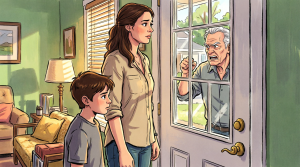
Mom texted, “We can’t make your son’s birthday. Tight month.” I replied, “No worries.” The next evening, I saw photos. Bounce house catering mountains of gifts for my sister’s kids. My son whispered, “They always have money for them.” I didn’t say a word. I just canled this. At 8:47 a.m., my dad was knocking so hard the windows shook.
The text came on a Thursday afternoon while I was standing in the grocery store checkout line, trying to decide whether to put the name-brand cereal back and grab the generic one instead.
“Elena, honey, we can’t make Mason’s birthday. Really tight month financially. I’m so sorry.”
I stared at the message longer than I should have.
Mason was turning seven.
Seven is old enough to count candles. Old enough to remember who showed up. Old enough to notice who didn’t.
I typed back the same thing I always typed.
“No worries, Mom. We understand.”
And that was the problem. We always understood.
For three years, I had been sending my parents eight hundred dollars every single month. Thirty-six months. Twenty-eight thousand eight hundred dollars. I knew the exact number because I’d done the math more than once, usually late at night when sleep wouldn’t come.
Jake thought I was being naive.
“They own their house outright,” he would say gently, not accusing, just practical. “Your dad has a pension. Your mom has Social Security. What are we actually covering?”
But they were my parents. They said Dad’s medication costs had gone up. They said utilities were higher than expected. They said retirement wasn’t stretching like they thought it would.
And I believed them.
Because daughters are conditioned to believe.
Mason’s party was simple. Twelve kids in our backyard. A homemade chocolate cake that leaned slightly to one side because I misjudged the frosting thickness. Dollar-store decorations I hung after the kids went to bed the night before.
He asked three times when Grandma and Grandpa were coming.
“They’re busy, buddy.”
He nodded every time, but his smile dimmed a little more each hour.
The party ended. Wrapping paper covered the grass. Kids left with goodie bags. Mason hugged me tight before bed and said, “It was the best day ever.”
I tried to hold onto that.
The next evening, I was on the couch scrolling through Facebook while Jake loaded the dishwasher. That’s when I saw Veronica’s post.
“Best auntie ever. Threw my babies the party of their dreams.”
There were twenty-three photos.
A massive bounce house.
Professional catering with a taco bar.
Designer decorations.
Balloon arches spelling out “Happy 5th Birthday” in rose gold.
Stacks of wrapped presents.
And in the middle of photo number seven—my mother, smiling wide, holding my niece. My father beside her, laughing like nothing in the world weighed on him.
The date stamp was the day after Mason’s party.
The day after they were too financially tight to attend.
My hands started shaking.
Mason walked in and climbed beside me.
He looked at the screen.
He didn’t say anything at first.
Then, quietly, like he was stating a fact he had already accepted:
“They always have money for them.”
It wasn’t angry. It wasn’t dramatic.
It was tired.
That’s what broke me.
I closed the laptop.
That night, I cried into my pillow like I hadn’t cried since Mason was born.
Jake held me and didn’t offer solutions. He just asked one question.
“What are you going to do?”
The next morning, I opened my banking app. The recurring transfer glowed calmly on the screen. $800. Scheduled for the first of every month.
Thirty-six completed transfers.
I tapped “cancel recurring transfer.”
The app asked if I was sure.
Yes.
I pressed confirm.
I expected guilt to flood in. Instead, something inside me felt strangely weightless.
For five days, nothing happened.
On the sixth morning, at 8:47 a.m., someone began pounding on our front door so hard the windows rattled.
I looked through the peephole.
Dad.
Red-faced.
Furious.
“Elena Marie Thompson!” he shouted.
Mason froze at the kitchen table mid-bite of pancake.
I opened the door.
“What the hell do you think you’re doing?” Dad demanded.
“Good morning, Dad.”
“Don’t you good morning me. Where’s the transfer?”
“It’s gone.”
Mom’s car screeched into the driveway. She rushed up, already crying.
“Elena, sweetheart, what’s happening? Are you in trouble?”
“I saw the photos,” I said.
They both stilled.
“What photos?” Mom asked, but she already knew.
“From Veronica’s party. The one you could afford to attend the day after you couldn’t afford Mason’s.”
Dad’s jaw tightened.
“That’s different.”
“How?”
“Veronica is going through a divorce. Those kids need stability.”
“And Mason doesn’t?”
He glanced past me and noticed Mason standing behind my leg.
“Elena, let’s talk privately.”
“No. Mason deserves to hear this. He’s the one you hurt.”
Mom sobbed louder.
“We love all our grandchildren equally.”
“Do you?”
Dad’s voice hardened. “It’s our money once you give it to us.”
And there it was. The truth.
“You’re right,” I said calmly. “It was.”
“You can’t cut us off,” Mom gasped.
“We depend on that money.”
“For what?” Jake’s voice came from the doorway. Calm. Steady. “The house you own free and clear?”
Silence.
Jake continued. “We checked property records. No mortgage. So what exactly requires $800 a month?”
Neither of them answered.
Mason’s small hand slipped into mine.
“I’m done,” I said quietly. “No more money.”
They left angry. Humiliated. And within hours, the extended family grapevine exploded.
How could you?
They’re your parents.
Family helps family.
I didn’t respond.
Two days later, my grandmother called.
“I heard what happened,” she said in her crisp voice. “About damn time.”
I sat down hard.
“What?”
“I’ve watched your father manipulate money for thirty years,” she continued. “He borrowed from me the same way. Crisis after crisis.”
“They don’t need your money,” she said firmly. “They like having it.”
Three weeks after I canceled the transfer, Dad showed up alone.
He looked smaller.
“I did the math,” he said.
He listed where my money went.
Veronica’s car payments.
Private preschool.
Divorce lawyer retainer.
Furniture.
Four separate birthday parties.
“None of it was for us,” he admitted.
“Why?” I whispered.
“Because she asked. Because she cried. Because I wanted to fix it.”
“And me?”
“You never cried,” he said. “You just paid.”
That hurt more than anything.
Then Veronica arrived, furious.
“You’re choosing her?” she demanded.
“I’m choosing what’s right,” Dad said.
And then she broke.
“I can’t keep pretending,” she sobbed. “I’m drowning.”
We went inside.
We talked.
She admitted she’d been compensating for her failing marriage with appearances. Big parties. Expensive things. Trying to look stable when she wasn’t.
Dad admitted enabling her.
But that wasn’t the end.
Three days later, Veronica called me panicked.
“I found something in Mom’s email.”
Emails referring to my transfers as “guilt money.”
Emails joking about how “easy” it was.
Emails discussing investments.
An Alaskan cruise.
Her money spends just fine.
My vision went white.
I drove to my parents’ house without knocking.
“Guilt money?” I asked.
Mom looked annoyed.
“You weren’t supposed to see that.”
No denial.
Just irritation at being caught.
Dad broke first. Real sobbing.
“We justified it,” he choked. “We thought you could afford it.”
Mom finally admitted, “It felt powerful.”
That was the moment I stopped seeing them as parents.
I saw them as people.
Flawed. Greedy. Small.
“I want you to tell everyone,” I said. “The truth.”
Two days later, Grandma Rose drove six hours and forced a confession at a family meeting.
They admitted everything.
The lies.
The emails.
The investments.
Three days after that, they showed up at my door with a carved wooden race car.
Dad knelt in front of Mason.
“I wasn’t a good grandpa.”
Mason asked, “Why didn’t you like me as much?”
“I did,” Dad said, voice breaking. “I just made terrible choices.”
Healing wasn’t instant.
It was awkward.
Fragile.
They came to Mason’s soccer game.
Cheered too loudly.
Dad made a sign.
Mom corrected herself when she almost compared him to his cousins.
Veronica downsized.
Sold the house.
Stopped pretending.
Money never returned.
Boundaries stayed.
Trust rebuilt slowly.
Mason no longer whispers that they always have money for them.
Now he says, “Grandpa’s actually funny.”
And sometimes, that’s enough.
The End.