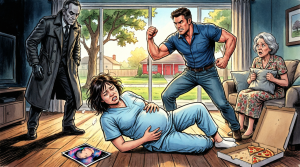
When I came home late from the hospital, my husband slapped me hard and screamed, “Do you know what time it is, you useless b!.tch? My mother and I are starving!” I tried to explain I’d been rushed to the ER—but the answer was more blows. Outside the door, my father stood frozen, watching it all. They never realized who he really was…
The heavy oak door creaked open. The smell of cheap pizza and the chaotic noise of a video game hit Maya like a physical blow.
Maya had just returned from the emergency room. She was wearing oversized hospital scrubs, her face pale as a ghost. Just hours ago, she had lost her unborn child, her body breaking under the exhaustion of scrubbing floors to meet her mother-in-law’s impossible standards.
Leo, her husband, was sprawled on the very sofa where she had collapsed in pain earlier. He didn’t even look up.
“It’s about time,” her mother-in-law, Helen, muttered, eyes glued to her iPad. “We had to order pizza. Where have you been all day? The house is a mess.”
Leo threw his game controller onto the table and spun around, his face flushed with annoyance. “Do you know what time it is? I worked all day, and I come home to a wet floor and no dinner! Do you think you’re a queen?”
Maya leaned against the wall to keep from collapsing. “I was at the ER, Leo. I texted you. I called you…”
“I was busy!” Leo shouted. “You’re always manufacturing drama to get out of chores!”
“I miscarried, Leo,” Maya stated flatly, looking directly into the eyes of the man she once loved. “The baby is gone. Because of the physical stress. The doctor said the placenta detached.”
The room went silent for a second. Maya waited for a flicker of regret, a shred of humanity.
Instead, Leo sneered. “Bullshit. You’re lying because you forgot to buy groceries. You’re pathetic. You can’t even carry a child right.”
Smack.
The back of his hand cracked across her face, sending Maya tumbling to the floor, blood tasting sharp in her mouth.
“Don’t lie to me!” Leo roared, fueled by his own toxic rage. He stepped forward, looming over his trembling wife. He raised his fist, preparing to deliver a devastating punch to her tear-streaked face.
“Get up! You are going to clean this mess right now!”
Leo drove his fist down with all his might.
But it never connected.
A massive hand, wrapped in a black leather driving glove, shot out from the shadows of the doorway. It caught Leo’s wrist in mid-air and squeezed.
The sound of snapping bone echoed through the room: Crack!
Leo shrieked, a high-pitched sound of absolute agony. He spun around, his face twisted in sh0ck.
Type “KITTY” if you want to read the next part and I’ll send it right away.👇
“Leo!” Helen screamed, finally dropping her iPad. She leaped up from the armchair, her face pale with horror. She rushed forward, her hands hovering uselessly over her son. “What are you doing to my son?! Are you crazy?! I’m calling the police! I’m pressing charges!”
Arthur slowly turned his head toward her. He didn’t raise his hands. He simply squared his massive shoulders and locked his dead eyes onto hers.
“SIT. DOWN.”
Arthur roared. The command didn’t just echo off the walls; it seemed to suck the oxygen out of the room. It was the “Command Voice”—a tone perfected over decades of breaking raw recruits and leading men into gunfire. It carried the absolute, unquestionable authority of a four-star General.
Helen froze mid-step. The sheer terror radiating from the man in front of her short-circuited her brain. The wealthy, entitled socialite vanished, replaced by primal fear. She collapsed back onto the sofa, her hands shaking, her mouth opening and closing without sound.
Arthur turned his attention back to the target.
He walked slowly, deliberately over the shattered glass, the shards crunching loudly under his heavy boots. Leo was writhing on the floor, clutching his broken wrist to his chest, wheezing pathetically as his lungs struggled to inflate.
Arthur stood over him. He slowly lifted his right leg and placed the thick, treaded sole of his combat boot squarely onto Leo’s throat.
He didn’t stomp. He simply pressed down, applying just enough precise pressure to cut off Leo’s airway, but not enough to crush the trachea instantly.
Leo’s hands flew to the boot, his perfectly manicured fingers clawing desperately at the thick leather. His face began to turn a deep, mottled purple. His eyes bulged, wide with absolute, primal panic. Tears of terror streamed down his face. The illusion of his dominance, his arrogance, his patriarchal control, was entirely erased. He was realizing, with horrifying clarity, that he was utterly powerless. He was an insect under the boot of a titan.
“I spent thirty years defending this country,” Arthur whispered, leaning down so his face was inches from Leo’s rapidly darkening one. The general’s voice was conversational, which made it infinitely more terrifying. “I have fought warlords. I have dismantled insurgencies. I have killed men who were ten times the man you pretend to be.”
—
1. The Weight of the House
The bucket of soapy water felt like it weighed fifty pounds. It sloshed against the pristine, gleaming baseboards of the living room, a stark contrast to the dark, bruising exhaustion settling deep into my bones.
I was six months pregnant. My lower back throbbed with a persistent, dull ache that had become my constant companion. Sweat beaded on my forehead, stinging my eyes, as I scrubbed the hardwood floor on my hands and knees. The smell of lemon pine cleaner was nauseating, mixing poorly with the subtle metallic tang I had been tasting in the back of my throat all morning.
“You missed a spot under the credenza, Maya,” my Mother-in-Law, Helen, sneered from the plush, cream-colored sofa. She didn’t look up from the glossy pages of her architectural magazine. She reached out blindly, her manicured fingers grazing the rim of a crystal glass filled with iced tea. Finding it empty, she rattled the ice cubes loudly. “And I need a refill. Honestly, Leo likes the house perfect when he gets home. Don’t be lazy. Pregnancy isn’t a disease.”
I swallowed the bile rising in my throat and forced a tight, obedient nod. “Yes, Helen. I’ll get it.”
My marriage to Leo had devolved into a masterclass in domestic servitude within a year of our wedding. Before the ring, Leo was charming, ambitious, and seemingly devoted. But the moment the ink dried on our marriage certificate, the mask slipped. When we found out I was pregnant, the mask was discarded entirely.
He moved his mother in “to help with the transition.” Instead of a grandmotherly presence, Helen became the warden, and Leo became her eager, cruel lieutenant. Every day was a grueling schedule of manual labor, complicated meals, and impossible standards. I was expected to manage the household like a Victorian scullery maid while carrying his child.
I pushed myself up from the floor, my knees aching against the hard wood. I reached for the heavy bucket, intending to carry it to the kitchen sink to refresh the water.
As I lifted, my body finally hit its breaking point.
A sharp, agonizing tearing sensation ripped through my lower abdomen. It wasn’t a dull ache or a Braxton Hicks contraction. It felt as though a hot knife had been dragged horizontally across my womb.
I gasped, a strangled, wet sound escaping my lips. My vision tunneled, the edges of the room turning fuzzy and dark. I dropped the bucket. The soapy water splashed violently across the immaculate floor, soaking the bottom of my maternity pants.
I collapsed against the side of the sofa, clutching my swollen stomach. The tearing sensation intensified, radiating down my thighs. And then, I felt it. A sudden, terrifying rush of warmth.
I looked down. Bright crimson blood was rapidly soaking through the light grey fabric of my pants, pooling on the hardwood I had just scrubbed.
“Oh God,” I whimpered, the reality of the horror crashing into my brain. “Oh my God.”
Helen finally looked up from her magazine. She didn’t jump up. She didn’t scream for help. Her eyes widened, not in concern for me or her grandchild, but in profound irritation.
“Maya! What are you doing?!” she snapped, pointing a trembling finger at the floor. “The water! The blood! You’re ruining the finish on the Brazilian cherry wood! Leo is going to be furious!”
I ignored her. Panic, cold and absolute, seized my chest. I fumbled blindly in the pocket of my cardigan with shaking, bloodstained fingers and pulled out my phone.
I dialed Leo’s number. My heart hammered against my ribs like a trapped bird. Please answer. Please, Leo.
The phone rang twice. Then, the automated voice clicked in. Call forwarded to voicemail.
He was ignoring me. He had told me that morning he was playing golf with a prospective client and didn’t want to be “bothered with domestic whining.”
I dialed again, my fingers slipping on the screen.
Call rejected. He had actively pressed the button to send me to voicemail.
The pain flared again, so intense it forced a scream from my throat. My vision blurred heavily. I was losing too much blood. I was losing my baby. The man who had put this child inside me was ignoring my calls because I was an inconvenience to his back nine.
With the last ounce of strength I possessed, my thumb hovered over my contacts. I scrolled past Leo. I scrolled past Helen. I found the only name in my phone that represented absolute, unwavering safety.
I pressed call.
He answered on the first ring. He always did.
“Maya,” the voice was deep, resonant, and clipped.
“Dad,” I sobbed, clutching my stomach, curling into a fetal position on the wet, bloody floor. “Dad, help me.”
There was no intake of breath. No panicked questions of “What’s wrong?” Arthur Vance, a retired Four-Star Military General who had spent thirty years commanding theaters of war, did not deal in panic. He dealt in logistics.
“Location,” Arthur’s voice barked through the phone, sharp and commanding, instantly shifting from father to commander.
“Home,” I gasped, the darkness creeping further into my vision. “I’m bleeding, Dad. So much blood. The baby…”
“Sitrep understood,” Arthur said. The sound of a heavy truck engine roaring to life echoed through the receiver. “I am ten minutes away. Apply pressure if you can. Breathe. Hold on, soldier.”
The line went dead.
I dropped the phone. The pain was becoming a distant, muted roar, replaced by a terrifying, cold numbness creeping up my limbs. Through the fading light of the living room, I could see Helen standing up, carefully stepping around the growing pool of my blood.
“I’m going to call a cleaning service,” she muttered, her face pinched in disgust. “This is going to stain.”
I closed my eyes, letting the darkness take me, praying that my father drove fast.
2. The Sterile Room
The steady, rhythmic beep of the heart monitor was the only sound in the sterile Emergency Room. The air smelled of iodine and bleach. The fluorescent lights overhead buzzed with a low, annoying frequency that seemed to vibrate directly inside my skull.
I was lying in a hospital bed, staring blankly at the acoustic tiles on the ceiling. I felt hollowed out. Physically, emotionally, spiritually empty.
To my left, the ultrasound machine had been pushed against the wall. Its screen was dark. A few hours ago, that screen had displayed the frantic, silent search of the ER doctor tracing the wand over my abdomen. I had watched the doctor’s face fall. I had watched the nurse avert her eyes.
“I’m so sorry, Maya,” the young doctor had whispered, placing a gentle hand on my knee. “There is no heartbeat.”
The words had triggered a silent, internal explosion.
“What happened?” a voice had demanded from the corner of the room.
I had turned my head slowly. My father, Arthur, stood near the door. He was a massive man, standing six-foot-four, with broad shoulders that still held the rigid posture of a military career. His hair was cropped close, entirely silver, and his face was a landscape of deep lines and old scars. He was wearing his usual attire—heavy denim jeans, a dark tactical sweater, and leather driving gloves he hadn’t bothered to take off.
The doctor had looked at the towering figure with visible intimidation. “Sir, it appears to be a severe placental abruption. Her blood pressure was dangerously high when she arrived, and her cortisol levels indicate extreme, prolonged physical stress. Her body was pushed far beyond its limits. The physical exhaustion… it triggered the separation. The baby is gone.”
Pushed far beyond its limits.
The words echoed in my head now, hours later, as I lay in the quiet room. Don’t be lazy, Maya. Scrub the floors, Maya. Carry the groceries, Maya. They had worked me until my body broke. They had killed my child.
Beside my bed, Arthur stood at attention. He hadn’t sat down since we arrived. He hadn’t paced. He stood perfectly still, a silent sentinel guarding a broken fortress. His jaw was clenched so hard the muscles jumped rhythmically under his skin.
I turned my head slightly. I saw something I had only seen once in my entire life—when my mother had passed away a decade ago.
A single, silent tear escaped the corner of the General’s eye, tracking slowly down his weathered cheek. He didn’t wipe it away. He reached out with a scarred, calloused hand and gently stroked my hair. The touch was impossibly light, a stark contrast to the immense power coiled within him.
“I’m sorry, Dad,” I whispered, my voice sounding like dry leaves. “I couldn’t hold on to it.”
Arthur’s eyes hardened, the sorrow instantly replaced by a cold, terrifying clarity. “This was not a failure of your body, Maya. This was a failure of your environment.”
I picked up my phone from the bedside table. My battery was at twelve percent. There were no missed calls. No frantic texts asking where I was.
I opened my messages to Leo.
Maya: I’m in the hospital. We lost the baby. Please call me.
I watched the screen. Beneath the text, the small gray word appeared. Read.
I waited. One minute. Two minutes. Five minutes.
No reply.