At My Housewarming, My Sister Claimed My $960,000 Home Was “Perfect For Her Kids,” And Mom Told Me To Pack. I Opened My Phone And Showed Them One Document That Changed EVERYTHING THEY FORGOT
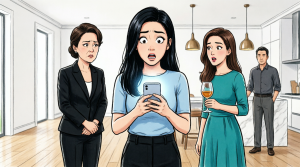
At my housewarming, my sister announced, “Your $960,000 house is perfect for my kids.” Then Mom said,
“Pack your bags.”
I smiled, took out my phone, and showed them the document that changed everything.
“Remember when you kicked me out at 18?” I said. “I bought this house with every night you told me I’d be fine on my own. And I remember the exact moment you made that true.”
The day of the party started the way big days always start for me: too early, with my mind already running a checklist before my eyes were fully open.
The sun had barely cleared the oak tree out back when I got up and padded across my own hardwood floors, barefoot, coffee in one hand, my phone in the other. I’d installed dimmers on nearly every switch in the house, so the morning light felt soft instead of harsh. It was the kind of detail people do when they aren’t used to living in a space they don’t have to apologize for.
There were a dozen little things left to do before sixty people would arrive. I needed to pick up the ice I’d ordered from the grocery store, put the flowers in vases, tuck the extra folding chairs into the hall closet, make sure the caterer could find the driveway, and, for reasons I couldn’t explain, check the locks on every door even though I’d checked them the night before.
It wasn’t paranoia. Not exactly.
It was my body doing what it’s always done—scanning for what might change in an instant.
I’d lived in too many places where stability was conditional. Where the roof wasn’t really yours. Where you slept lightly because you were always half-expecting someone to decide you didn’t belong.
I set my mug down on the marble countertop—white with gray veins that looked like lightning frozen mid-strike—and ran my fingers along the edge. A ridiculous thing to find comfort in, I know. Stone. Cold and indifferent.
But it was also real.
I remember the feeling of my own hand shaking as I stood in the foyer of my home for the first time as its legal owner. Not shaking from cold, not from exhaustion, though Lord knows I’d had plenty of that. My hands shook because, for fourteen years, I’d imagined this moment in about a thousand different versions. In most of them I cried. In some of them I screamed. In a few I called my mother and waited for the apology she’d never given.
None of those versions prepared me for how quietly enormous it would actually feel.
No orchestra. No fireworks. No cinematic swelling music.
Just me, alone in an empty house, pressing my palms flat to the wall like I needed the drywall to verify my name was on the deed.
The marble beneath my feet had felt like something I’d built out of thin air and sheer refusal to disappear.
The house cost $960,000.
I want you to sit with that number for a second. Not because I’m trying to impress you, but because I need you to understand what it represents.
Every single zero in that figure is a year of ramen dinners eaten alone in a studio apartment that smelled faintly of someone else’s cooking. It’s a rejected investor email I read at two in the morning and then deleted before it could take root in my chest. It’s a shift I picked up. A scholarship essay I rewrote eleven times. A night I slept in the backseat of a 2003 Honda Civic in a parking garage off Route 9 in Framingham, Massachusetts because I had nowhere else to go.
Every zero is a scar.
And I’ve learned that scars are really just receipts.
Proof that something cost you something. Proof that you survived the transaction.
My name is Hazel Matthews. I’m thirty-two years old. And the night of my housewarming party is the night everything finally came to a head.
If you’ve ever been to a party where you can feel two completely different atmospheres existing in the same room, you know exactly what that evening felt like.
On one side, there was warmth.
There were my colleagues from the tech world, two venture capital partners who’d believed in me early, my mentor Professor David Reynolds in a blazer that was slightly too large and completely perfect for him, and my business partner Stephanie Park, who kept refilling people’s wine glasses and laughing too loud at her own jokes in the most wonderful way.
The kind of gathering that feels like a living exhale.
We’d worked so hard for so long, and this house was the physical proof that it had been worth something.
On the other side—like a cold draft you can’t locate—there was the part of my life that didn’t care what I’d built.
There was the part that still thought I belonged to them.
It’s a strange thing, letting people into your home when you’ve spent most of your life guarding the edges of yourself.
I’d spent the week leading up to the party trying to convince my nervous system that it was safe. I did all the normal host things: sent the invites, confirmed the caterer, tested the speakers, picked up a case of wine that made me feel slightly ridiculous at the checkout.
But I also did things I didn’t mention to anyone.
I put my documents in a folder on my phone with a neutral name—Receipts—and made sure I knew exactly where it was.
I checked the television connection twice.
I told Stephanie, in my kitchen the night before, as she stood at the island eating a piece of cheese straight off the charcuterie board like she owned the place, that I’d invited my mother and Cassandra.
She froze mid-bite.
“Hazel,” she said carefully, like she was talking to a wild animal that might bolt. “Do you want them here?”
I stared at the sink, at the window over it, at the oak tree outside that had been minding its own business for a century. My throat tightened the way it always does when I try to tell the truth about them.
“I don’t know what I want,” I admitted. “I just know what I’ve always wanted.”
Stephanie set her wine down. She leaned her elbows on the marble.
“And what’s that?”
“For them to see me,” I said. “For real. Not as the extra kid who can handle it. Not as the one who’ll be fine. I want them to walk into this house and realize I’m not a footnote in their story.”
Stephanie’s eyes softened. Then, because she’s Stephanie, she got blunt.
“They might not,” she said.
“I know,” I said. “But I need to stop building my life around the possibility that they will.”
She nodded once, as if filing that away.
“Okay,” she said. “Then we plan for what happens if they don’t.”
That was always her gift. Not optimism. Not denial.
Planning.
The morning of the party, I showered and dressed slowly, like I was trying to keep my body from sprinting ahead of itself. I chose a black dress that made me look like the CEO I’d accidentally become—simple, sharp, the kind of thing that says you don’t need to announce your power because it’s already obvious.
My phone buzzed while I was pinning my hair.
A text from my mother.
Running a little late. Traffic.
No punctuation. No warmth.
I stared at it for a long moment, thumb hovering. There was an entire lifetime of possible replies. I chose none of them.
Instead, I set my phone down, exhaled, and checked the ice order.
At three o’clock, the caterer arrived. At four, Stephanie showed up with two bags of extra napkins and a bouquet of sunflowers that looked like they’d been ripped straight from a roadside stand.
“You don’t need more napkins,” I told her.
“Yes, you do,” she said, already tearing open a package. “Everyone needs more napkins. It’s America. We live and die by paper goods.”
I laughed despite myself.
Professor Reynolds arrived around five thirty, early, as he always is, carrying a bottle of cheap red wine and a small potted plant he’d probably bought at a hardware store on his way.
“For the windowsill,” he said.
“You didn’t have to—”
“I wanted to,” he cut in gently.
That’s the thing about him. He never makes you feel like you’re taking.
He just offers.
I took the plant and felt a sudden sting behind my eyes. The urge to cry at kindness is a side effect of growing up without it.
“Thank you,” I managed.
He patted my shoulder.
“You did it,” he said quietly.
And because he knew the full arc of my story, those three words meant more than congratulations.
They meant: I saw what it cost.
By seven, the house was alive.
String lights glowed warm over the backyard. People clustered around the kitchen island, laughing, passing plates, pointing out details of the space like they were touring a museum exhibit titled Hazel’s Life, Finally Visible.
Someone put on a playlist that was a little too upbeat, so Stephanie adjusted it and pretended it had been her plan all along.
My colleagues from the acquisition company arrived in a group, overdressed in the way finance people always are, and immediately asked about the neighborhood like they were considering buying homes around me.
One of the VCs, Mark Feldman, pulled me aside near the fireplace.
“This is the kind of thing I like to see,” he said, gesturing at the house. “You’re grounding. You’re not doing some weird penthouse thing in Manhattan. You’re… human.”
“Thank you?” I said.
He grinned.
“You know what I mean. It’s good. I’m proud of you.”
I nodded. Took it in. Didn’t deflect.
I’d been practicing that.
Then, just past seven thirty, I heard the door before I saw them.
Not because they knocked loudly.
Because something in me has always been wired to sense their arrival, the way you sense a shift in pressure before a storm.
I was mid-conversation with Professor Reynolds when I felt it—subtle tightening across my shoulders. The old familiar instinct to make myself smaller, quieter, easier to overlook.
I’d spent years unlearning that instinct.
I was still unlearning it.
My sister Cassandra walked in wearing a cream wrap dress that probably cost more than my first month’s rent had once been. She was beautiful. She always had been, in that particular way that comes with never having been told no about anything for too long.
She moved like the room already belonged to her.
Eric was behind her, taller than I remembered, with tired eyes and a polite half-smile that never quite reached his face. He looked like a man who spends his days staring at spreadsheets and his nights trying not to think about what he already knows.
My mother, Ellaner, came in last, smaller somehow than in my memory, wearing the same expression she’d worn at every significant moment of my life.
A look that said:
I see you succeeding, and I’m already calculating what it costs me.
I smiled. I crossed the room. I hugged them both because my body knows how to perform even when my mind wants to run.
“This is beautiful,” my mother said.
The way she said it made it sound like an accusation.
Cassandra said nothing at first. She just looked.
Her eyes moved over the open-plan living room, the high ceilings, the kitchen with the waterfall island I’d agonized over for three weeks before ordering. She looked the way people look at things they’re trying to appraise rather than appreciate.
And I recognized that look.
I’d seen it before.
The last time I’d seen it, I was eighteen years old, sitting at our kitchen table in Medford, Massachusetts, staring at a spreadsheet I wasn’t supposed to find.
Let me take you back.
Because this story doesn’t start at a housewarming party.
It starts in a house that never quite felt like home.
We grew up in a middle-of-the-road neighborhood outside Boston, my sister and I, the daughters of Dennis and Ellaner Matthews. Our father was a contractor who worked long hours and laughed easily, the kind of man who could fix a leaky sink and make you feel like the world wasn’t going to end.
Then one day, when I was nine and Cassandra was thirteen, he stopped doing both.
I don’t have a dramatic story about his departure.
There was no screaming. No breaking of dishes. No clear villain.
He just slowly withdrew the way a tide pulls back from a shore.
And eventually he was gone.
Living with a woman named Patricia in Quincy. Calling on birthdays with the kind of guilty cheerfulness that accomplishes absolutely nothing.
My mother handled it the way she handled most things: by choosing a focal point and pouring everything into it.
The focal point from that point forward was Cassandra.
I understand it now, intellectually, in the way you can understand something and still feel the weight of it pressing on your chest twenty years later.
Cassandra was older. Cassandra was louder. Cassandra was the kind of girl who could walk into a room and turn it into an audience.
She brought home art projects and friends and drama and energy.
My mother fed off that energy the way a plant turns toward sunlight.
I was quieter.
I read a lot. I liked school. I got good grades because I genuinely loved learning, not because I was performing for anyone.
But in a household that had just lost its center of gravity, quiet and self-sufficient reads as needing nothing.
So I got nothing.
Or rather, I got the assumption that I’d be fine.
Cassandra got a car at sixteen. Used, yes, but still.
She got a sweet sixteen party that my mother talked about for years afterward, as if throwing it had been a triumph she personally earned.
She got new clothes each fall. Trips to the mall. Dance classes she wanted and then abandoned after three months.
When she started dating boys, my mother helped her navigate it with the patience of a woman protecting something she considered precious and fragile.
When Cassandra got her heart broken for the first time, the whole house went into mourning.
My mother made casseroles. Bought magazines. Sat on Cassandra’s bed like she was holding vigil.
When my heart broke for the first time, I cried into a pillow and didn’t tell anyone.
Not because I didn’t want comfort.
Because I’d already learned it wasn’t a resource available to me.
By the time Cassandra graduated, there were photo albums dedicated to it.
By the time I graduated, my mother said, “Good job,” the way you say it when someone remembers to take out the trash.
I don’t say any of this to paint Cassandra as a monster.
She was my sister.
She and I had moments—late-night movies, shared secrets, the occasional night where she’d sneak into my room and talk to me like we were on the same team.
But even when she loved me, she didn’t protect me.
And that mattered.
Cassandra married at twenty-six to Eric Chambers, a financial analyst from a good family in Newton.
The wedding was extraordinary.
I’m not being sarcastic when I say that.
It was genuinely breathtakingly beautiful. A venue in the Berkshires. One hundred and twenty guests. Flowers that I learned afterward had cost eleven thousand dollars on their own.
My mother cried through the entire ceremony.
Cassandra was radiant.
Eric looked at her like she was the most extraordinary thing he’d ever seen.
And I stood in my bridesmaid dress and smiled and meant most of it because despite everything, she was my sister.
On that day, she looked genuinely happy.
I was not yet fully aware of what the wedding had cost.
Fifty thousand dollars.
That was the number.
Fifty thousand dollars my mother didn’t have.
Deployed on the theory that Cassandra deserved the day of her dreams.
And somehow, between the flower budget and the venue deposit and the catering bill, almost everything my mother had managed to save had been consumed.
Including, as I would later discover, what was supposed to be mine.
I was eighteen when I found the spreadsheet.
It was a Sunday afternoon in late July, the kind of heavy Boston summer day where everything feels slightly underwater.
My mother was out. Cassandra was at a bridal shower for someone I didn’t know.
I was using my mother’s laptop to print a college application essay I’d been working on for weeks. I’d rewritten it so many times the words felt like they belonged to someone else.
When I opened the file browser, I saw a folder labeled simply: finances.
I should have closed it.
I know that.
I’ve had fourteen years to examine that moment.
And I’m still not entirely sure whether opening it was instinct or premonition.
I think somewhere in me I already knew.
I think the body keeps a ledger even when the mind refuses to look at it.
The spreadsheet had several tabs.
One was labeled: Cassie house fund.
When I clicked it, I saw a number that made the room tilt slightly.
$22,000.
Earmarked. Tracked across deposits going back two years.
And beside it, in a second column, a source label I recognized immediately.
H College.
Hazel College.
Not Cassie.
Not Family.
Mine.
I sat at that kitchen table for a very long time.
The college fund my father had set up before he left. The one my grandmother had contributed to on my birthdays. The one my mother had assured me was safe and waiting when I was ready.
The one I’d built all my scholarship efforts around so it would stretch further and cover more.
It had been quietly redirected over two years in increments small enough that I never thought to check.
It had been moved into a fund for Cassandra’s house because Cassandra and Eric wanted to buy a home in Arlington and needed help with the down payment.
And my mother had decided that the most available resource was me.
She hadn’t asked.
She hadn’t told me.
She had simply decided.
I printed my essay.
Then I sat down with the spreadsheet open and waited for her to come home.
When she walked in, she took one look at my face and sighed like I’d spilled something on the floor.
“What now?” she asked.
I turned the laptop toward her.
“Can you explain this?” I said. My voice sounded too calm, like my body had stepped out of the situation to protect me from it.
She stared at the screen. Her mouth tightened.
“It’s not what you think,” she said.
I waited.
“It’s for Cassandra,” she said, as if that was the explanation. “They’re trying to buy. They need stability.”
I swallowed.
“That’s my college fund,” I said.
She waved her hand like she was brushing away a fly.
“Don’t be selfish,” she said.
The words landed with a physical thud.
“Selfish?” I repeated.
“Your sister needs a stable home for when they start a family,” she said. “You can go to community college. Plenty of people do. You’re smart enough to make it work.”
I stared at her.
I said, “We had a plan.” I said, “You promised.” I said, “I built my applications around that money being there.”
She didn’t flinch.
Then she said the thing I’ve carried in my body ever since—the thing that comes back at odd moments in airports and board meetings and quiet Sunday mornings when the coffee is too strong and the light hits wrong.
She said:
“Accept this or pack your bags.”
She didn’t say it cruelly.
That’s the part that still gets me.
She said it the way you say something you consider settled.
Matter-of-fact.
The decision had been made.
My role was to absorb it gracefully.
And if I was incapable of that, then maybe I needed to reconsider whether I belonged in the home she was managing.
Cassandra was there.
She said nothing.
She stared at the kitchen table like it might save her.
I looked at her, waiting—for anything. A glance. A flinch. A word.
She gave me nothing.
I went upstairs. I packed a bag.
I came back down, standing in the doorway with my backpack and my duffel like I was about to leave for college early.
My mother didn’t stand.
Cassandra didn’t move.
No one said, Please don’t.
So I walked out the front door.
Two weeks.
That’s how long I lived in my car.
Fourteen days in a parking garage in Framingham because I had a friend from school whose older brother managed the overnight shift and he let me stay as long as I was gone by six in the morning.
I learned the sound of the garage settling at night. The hum of the security lights. The way condensation forms on the inside of a windshield when you’re breathing in a sealed space.
I learned how to sleep curled on a backseat with my shoes on because you never know.
I learned how to wake up before dawn and brush my teeth in a public restroom without looking at your own eyes in the mirror because it’s too much.
I showered at the YMCA for seven dollars a day.
I ate what I could afford, which was not much.
I cried exactly twice.
Then I stopped.
Because crying in a Honda Civic in a parking garage at two in the morning does not actually solve anything.
And my body seemed to understand that and redirected the energy into planning.
I’d gotten into UMass Amherst—not my dream school, but a real university, a good one—with a financial aid package that would cover tuition if I supplemented it with work-study and a part-time job.
I reworked my numbers.
I made it work on paper.
On paper, I could survive anything.
In real life, I needed one thing I didn’t have.
A place to sleep.
One afternoon, sitting in the library where I’d gone to use the internet, I received an email from Professor David Reynolds.
He’d been my AP Economics teacher.
He was the first adult who ever looked at me like I was already someone.
His message was short.
He’d heard through a mutual connection that I’d had a difficult situation at home.
He asked if I was okay.
I wrote back one sentence.
I’m managing.
He replied within an hour.
“My spare room has a bed and a desk, and you’re welcome to it until September. No questions.”
I stared at the screen until the letters blurred.
Then I drove to his house that evening.
He opened the door like he’d been expecting me.
He didn’t ask for details.
He didn’t tell me what I should do.
He pointed me toward a room with clean sheets and a lamp and a stack of books on the nightstand.
“There’s coffee in the morning,” he said. “Real coffee. Not whatever people pretend is coffee at gas stations.”
I laughed, one sharp sound, like my body couldn’t decide whether to break or breathe.
For three months, I lived in his spare room.
He treated me like a fully formed human being.
It was the most radical thing anyone had done for me in a very long time.
In September, I moved into the dorms at UMass.
I had a scholarship.
A work-study position in the library.
A part-time job at a cafe off campus where the manager called everyone “kid” regardless of age.
And approximately nothing else.
I was the happiest I’d been in years.
Because for the first time, my survival belonged to me.
In my Introduction to Computer Science class, I met Stephanie Park.
Stephanie was from Los Angeles, loud in the best possible way and ruthlessly practical about money in a manner that came from growing up in a household where there was never quite enough.
She had a private suspicion that most financial tools were designed by people who had never actually been broke, which made them nearly useless for the people who needed them most.
We started talking the way you talk when you’re twenty and have no filter and haven’t yet learned that ideas are supposed to feel impossible before they feel inevitable.
One night, over coffee and the worst instant ramen I’ve ever tasted, she said:
“What if someone built an app that did for personal finance what a really good accountant does, but made it accessible to people who can’t afford a really good accountant?”
I thought about eighteen-year-old me in a parking garage with a spreadsheet I found by accident and a plan that had just been dismantled.
I thought about the way the world assumes you’ll figure it out when the world is also the thing making it impossible.
I looked at Stephanie.
“Let’s build it,” I said.
I will not pretend the next decade was a montage.
It wasn’t.
It was slow and frequently humiliating.
It was long stretches of doubt so deep it felt like walking through wet cement.
It was pitching to rooms full of people who smiled politely and then wrote us off with phrases like “too niche” and “not scalable” and “come back when you have traction,” as if traction appears by magic when you have rent due.
We bootstrapped for two years.
We got rejected by fourteen investors.
One of them—one I remember clearly because he said it with genuine kindness—told us the market we were targeting, young adults in financial distress, wasn’t a market worth targeting because people in financial distress don’t have money to spend on apps.
I thanked him for his time.
Then I went home and revised our pitch for the eleventh time.
We got a small grant from a Women in Tech foundation—eleven thousand dollars that felt like a million.
We hired our first contractor.
We launched a beta version that, in retrospect, was not very good.
But it solved a real problem in a way that people immediately recognized.
And so it grew.
Word of mouth.
Then a feature in a personal finance newsletter.
Then a partnership with a credit union.
Then a viral moment on social media when a twenty-three-year-old in Cincinnati posted a video of herself paying off her last credit card balance using a strategy our app built for her—crying and laughing at the same time.
It got four million views in three days.
After that, things moved differently.
By the time I was twenty-nine, we had eight hundred thousand users.
By thirty, we had a nine-figure acquisition offer from a fintech company that had been watching our growth for eighteen months.
Stephanie and I spent six weeks negotiating.
We brought in lawyers who were worth every cent.
Then we signed.
The exact number is not something I’ll share here.
But I will tell you it was enough.
Enough to buy a house.
Enough to never again check a bank balance with my hands shaking.
Enough to mean that the next time someone told me to pack my bags, I could look at them and smile because I had already unpacked in a place they could never take from me.
I found the property in April.
A Craftsman-style home in a quiet neighborhood outside Boston, close enough to the city that the commute was reasonable, far enough that the air felt like it belonged to trees instead of traffic.
Four bedrooms.
Original hardwood floors refinished to a warm honey color.
A kitchen with marble countertops.
A window over the sink that looked out onto a yard where an enormous oak tree had been minding its own business for at least a century.
The first time I toured it, the realtor talked about school districts and resale value and “good bones.”
I barely heard her.
I stood in the foyer and felt something in my chest go still.
Not excitement.
Recognition.
I made an offer.
It was accepted.
There were inspections and appraisals and a week where I slept badly because I was convinced something would go wrong.
On closing day in June, I sat at a conference room table with a stack of papers so thick it looked like a small book.
I signed my name until my wrist ached.
At one point, the attorney slid the deed across to me and said, “Congratulations.”
I nodded like a person who knew how to accept congratulations.
Then I got in my car, drove to the house alone, and stood in the empty foyer.
I pressed both palms flat against the wall.
Just to feel that it was real.
$960,000.
Every zero a receipt.
The housewarming was in September.
Sixty people.
Catered.
The kind of evening that was warm and slightly chaotic in all the right ways.
Stephanie gave a toast that made people laugh and then unexpectedly cry.
Professor Reynolds stood near the fireplace all evening, looking pleased in a quiet way that reminded me of how he’d looked when I’d graduated.
My colleagues from the acquisition were there—people I respected and liked, people who’d watched the app grow from a good idea into something real.
And my mother and my sister were there because I invited them.
Because despite everything, they were my family.
Because part of me—the part that never quite stops hoping—thought maybe this could be a moment where things were different.
I should have known better.
Hazel, I told myself, standing in the foyer and watching Cassandra’s eyes move across the room like a calculator.
You should have known better.
Cassandra spent the first hour touring.
There’s no other word for it.
She moved through the rooms with Eric slightly behind her and a look on her face I’d seen on HGTV—assessing and pricing and mentally rearranging.
She said things like:
“This is charming,” in a tone that made charming sound like a consolation prize.
“You’ve done well for yourself,” in a tone that made well sound temporary.
She ran her fingers along the marble countertops the way you handle something you’re considering purchasing.
My mother hovered near the food table and received updates from Cassandra in murmured exchanges when they thought I wasn’t watching.
At one point, my mother leaned toward me and said, almost conversationally:
“This must have cost a fortune.”
I waited for the follow-up—pride, wonder, anything.
What I got was:
“I hope you’re being responsible. Houses are a lot of upkeep.”
It took everything in me not to laugh.
As if I hadn’t been responsible since I was nine.
As if I hadn’t been maintaining myself like a house no one else wanted to fix.
Around eight, I tapped my glass with a spoon.
The room quieted.
I’d written a speech. Rehearsed it.
But when I stood there, looking at faces that had become my chosen life, the words that came out weren’t polished.
They were real.
I talked about the years of work.
I talked about Stephanie.
I thanked Professor Reynolds.
I said this house represented something I needed the room to understand—that nothing that costs you everything is wasted.
That survival is not a small thing.
That I was profoundly, unreservedly grateful to be standing in my own home among people who had seen me work for it.
The room applauded.
I felt something lift in my chest.
And then Cassandra stood up.
She did it without being asked, which should have been my first signal.
She picked up her wine glass and smiled at the room with the practiced ease of a woman who has always believed she is the most interesting person in it.
And she said, in a carrying voice:
“This house would be perfect for my kids.”
The room went a little quiet.
Not awkward silence.
A deeper kind.
The kind where people realize they’re about to witness something they weren’t invited to.
Cassandra kept going.
She had that look I remembered from childhood, the one that meant she had decided something and was now simply narrating it into existence.
“Three bedrooms,” she said. “They’d each have their own room for once. And that yard—”
She glanced toward the window.
“Dylan has been asking for a yard for two years.”
I looked at Eric.
His smile had slipped.
He looked at the floor like he wanted to disappear into it.
I looked at my mother.
My mother looked at me.
Her expression was not embarrassment.
It was something closer to agreement.
She stepped forward a little, as if she was aligning herself with Cassandra’s claim.
“Hazel,” she said, in the tone she’d always used when she was about to reframe something enormous as something minor.
“A condo would suit you better. Honestly, you’re single now. You don’t need all this space.”
There it was.
The same logic she’d used when I was eighteen.
You don’t need.
You can make it work.
You’ll be fine.
Cassandra had already moved into the hallway and was gesturing toward the staircase, explaining to Eric which bedroom would be for which child.
She was assigning rooms in my house at my housewarming party with sixty people watching in absolute silence.
I felt something settle in me.
Not rage.
I want to be precise about this.
It wasn’t rage.
It was clarity.
The particular crystalline calm that comes when you’ve been waiting for a moment for a very long time and it finally arrives and you understand exactly what to do.
I turned toward Cassandra.
“Cassandra,” I said.
She looked back, still smiling.
“Come back in here for a moment.”
Something in my voice made her pause.
She returned to the living room, wine glass still in hand.
Eric followed, a step behind.
My mother repositioned herself to observe, like she was settling in for entertainment.
The room had gone completely still.
Sixty people, not one of them moving.
I walked to my phone, which was connected to the television I’d set up in the living room for the evening.
My thumb hovered over the folder.
Receipts.
I opened the first document.
A scanned filing.
A date.
A stamped page.
I turned the screen toward them.
“When I was eighteen,” I said, voice steady, “two weeks after I was told to pack my bags and slept in my car, I filed paperwork to create a legal record of what happened.”
My mother’s mouth tightened.
Cassandra blinked.
I kept going.
“I never served it. I didn’t need to. I filed it because I needed the truth to exist somewhere outside of your memory.”
The room was so quiet I could hear the ice settling in someone’s glass.
I opened the second document.
A credit report.
I’d redacted the details that didn’t need to be public. I wasn’t there to expose private information.
I was there to expose a pattern.
“This,” I said, “is a credit report pulled in my name in 2012 when I was nineteen and in my first semester at UMass.”
I let the image sit on the screen.
There were two accounts listed that I did not open.
A credit card with a balance.
A personal loan.
A combined total.
In my name.
I heard someone in the crowd inhale.
Professor Reynolds didn’t move.
He just watched, his face unreadable in that calm teacher way that says: I’m here.
I paused.
“My middle name is Renee,” I said. “The signature on the loan application misspelled it.”
Eric made a sound—low, wordless, not quite a word.
I turned my gaze toward him.
“I spent three years cleaning up that debt,” I said. “I paid back money I didn’t borrow while working two jobs and finishing my degree. I didn’t report it at the time because I was nineteen and scared and still—against all evidence—thought there might be an explanation I was missing.”
I looked at Cassandra.
Her face had gone pale.
The kind of pale that happens when your body realizes the story you’ve been telling yourself is about to collapse.
“The accounts were traced to activity connected to your life, Cassandra,” I said, careful with my words because I was not there to give a lecture on crime.
I was there to tell the truth.
“The timing. The address. The signatures.”
Cassandra’s lips parted.
Nothing came out.
My mother stepped forward.
“Hazel,” she hissed, low enough that only I could hear. “Don’t do this here.”
I smiled.
Not kindly.
Not cruelly.
Just clearly.
“You mean don’t do it in front of witnesses,” I said.
The room shivered.
My mother’s eyes flashed.
I opened the third set of documents.
Financial records.
Not private details.
A pattern.
A timeline.
Numbers that meant something.
“And this,” I said, “is what happened after.”
I pointed to the screen.
“Between 2018 and 2022, Cassandra moved significant money into speculative ventures that failed.”
Eric’s head snapped up.
“What?” he said.
It was the first full word he’d spoken.
Cassandra’s hands began to shake. The wine in her glass trembled.
I didn’t gloat.
I didn’t raise my voice.
I let the facts do what facts do.
“The records show money leaving joint accounts in small amounts over time,” I said. “Enough to fund deals. Enough to build a quiet architecture of debt behind the appearance of comfort.”
Eric’s face changed in a way I can’t fully describe.
A man can look older in an instant.
He sat down.
He sat down on my couch in my house at my housewarming party and put his face in his hands.
My mother’s breath hitched.
“Cassandra,” she said, and for the first time in my life I heard that tone directed at my sister.
Not indulgent.
Not protective.
Alarmed.
“What have you done?”
Cassandra began to cry.
Not the pretty crying she used when she wanted sympathy.
This was raw.
Uncontrolled.
The kind of crying that happens when there is nowhere left to hide.
It wasn’t satisfying.
I want to be honest about that.
For years, I’d imagined this moment.
In most versions, I felt triumph.
In reality, what I felt was exhaustion.
A long, deep tiredness that came from carrying a truth alone for too long.
Eric looked up at Cassandra.
His voice was low.
“Is it true?” he asked.
Cassandra shook her head like she could shake the facts off her skin.
Then she whispered:
“It’s more complicated than that.”
A phrase that contains no actual information and communicates everything.
I waited.
I let the room hold the silence.
Then I said:
“I’m not selling this house.”
I looked at Cassandra.
“I’m not leaving this house.”
I looked at my mother.
“I’m not downsizing into a condo so you can move your kids into my bedroom.”
My mother opened her mouth.
I held up a hand.
“One more time,” I said, voice still steady, “I am not absorbing the consequences of choices made on my behalf without my consent.”
The hand lowered.
My mother’s mouth closed.
I continued.
“And because there are children in the middle of this,” I said, “I’ve already set up education accounts for Dylan, Maddie, and Owen.”
Cassandra’s head jerked up.
“What?” she choked.
“Three accounts,” I said. “Protected. Structured. They’ll be distributed directly to their schools when the time comes. Those are for them regardless of what happens between the adults in this room.”
I looked around at my guests.
Some of them I knew well.
Some I was meeting for the first time.
All of them had just witnessed something none of them had been invited to witness.
“I’m sorry for the disruption,” I said.
“The food is still warm. The wine is still open. And I would genuinely like to spend the rest of this evening celebrating with people I love. I hope you’ll stay.”
For a beat, no one moved.
Then Stephanie lifted her glass.
“To Hazel,” she said, loud enough for everyone to hear. “To building something no one can take.”
A few people echoed it.
Then more.
The room breathed again.
Most of them stayed.
My mother did not.
She walked out the front door without saying anything further.
I watched her go.
And I felt the particular grief of understanding that she might never fully reckon with what she’d done.
Some people don’t.
Some people protect themselves from that kind of reckoning their entire lives because the alternative is too costly.
I have made my peace with the fact that her peace may look completely different from mine.
Cassandra sat on my couch for a long time after most guests drifted back into conversation.
Eric sat beside her but not close.
They didn’t speak.
Professor Reynolds brought them both glasses of water because that is the kind of man he is.
Then he found me in the kitchen, set one hand briefly on my shoulder, and said nothing.
Nothing was required.
Stephanie kept the evening breathing.
She moved like a conductor, redirecting energy, making sure the music didn’t stop.
When the last guest left and the house finally went quiet, I stood alone in my living room surrounded by half-empty glasses and crumpled napkins and the aftermath of something that had been inevitable.
I walked to the front door.
I locked it.
Then I leaned my forehead against the wood and let myself feel, for the first time that night, how much it had cost to stay calm.
I didn’t cry.
Not because I couldn’t.
Because I didn’t need to.
The months that followed were not simple.
I won’t pretend they were.
Eric filed for divorce in November.
The proceedings revealed the full scope of what Cassandra had built and concealed—a financial parallel life running alongside their visible one.
The disclosure process was, by all accounts, devastating.
The house in Arlington went on the market in February.
Cassandra moved back to my mother’s house with the kids.
I say this without satisfaction.
I need you to understand there is nothing in me that is glad about three children being uprooted and confused and asked to absorb adult damage they had no part in creating.
I thought about Dylan, Maddie, and Owen more than I can say.
They were seven, nine, and eleven at the time.
Blameless.
And the education accounts I set up for them were real.
Structured.
Protected.
They would be there when they needed them.
Eric reached out to me in January.
He asked if we could talk.
We met for coffee in Cambridge, at a place with mismatched chairs and chalkboard menus and baristas who looked like they were writing poetry in their heads.
He arrived early.
He stood when he saw me.
“Thank you for meeting,” he said.
I sat.
He sat.
There was a long moment where he stared at his coffee cup like he was trying to find language in the foam.
Then he said:
“I’m sorry.”
I didn’t react.
Not because I wasn’t moved.
Because I’ve learned not to rush toward apologies like they are water in a desert.
“Not on her behalf,” he added quickly, like he understood the trap. “On mine. For the years I was present in a family system that treated you as expendable and I said nothing.”
He exhaled.
“I knew something was wrong,” he admitted. “I told myself it wasn’t my business.”
He looked up.
“It was my business.”
That honesty mattered.
More than I knew how to say.
We talked for an hour.
Not about numbers.
About patterns.
About the way families build scripts and hand them to you like your role is predetermined.
When we stood to leave, he hesitated.
“The kids…” he started.
“I know,” I said.
He nodded.
We have maintained a quiet, cautious connection for the sake of his children.
I see them occasionally.
They are adjusting in the resilient and heartbreaking way that children adjust.
Six months before the housewarming, I started therapy.
I want to say that clearly because it matters.
The clarity I had that night—the ability to act from steadiness rather than fury, the capacity to hold my ground without needing anyone in that room to understand or validate what I was doing—that didn’t come from nowhere.
It came from two years of weekly sessions with a woman named Dr. Patricia Osi, who has an office in Brooklyn and a talent for asking questions that make you realize you’ve had the answer for years and were just afraid to say it out loud.
In one of our early sessions, I told her about the spreadsheet.
About the car.
About my mother’s voice saying, Pack your bags.
Dr. Osi listened without flinching.
Then she asked:
“When you picture confronting them, what do you want?”
I stared at the rug in her office, the pattern too busy, the kind of thing meant to distract your eyes so your mind can loosen.
“I want them to admit it,” I said.
“And if they never do?” she asked.
My chest tightened.
“Then I don’t know how to stop feeling like I’m still eighteen,” I said.
She nodded slowly.
“Then we work on separating the truth from their acknowledgment of it,” she said.
“Because the truth doesn’t require permission.”
That sentence changed something in me.
Therapy taught me the difference between revenge and resolution.
They feel similar from the inside.
When you’re in pain, they pull in the same direction.
But one requires the other person to suffer.
The other requires only that you stop.
Stop absorbing.
Stop minimizing.
Stop extending grace beyond the point where grace becomes self-harm.
The documents I showed that night were not a weapon.
They were a record.
I kept them for years not because I planned to use them to destroy anyone, but because I learned at eighteen that without evidence, the truth is just a story the most powerful person in the room gets to revise.
I had the evidence.
And when the moment came, I used it.
Not to destroy.
To stop.
A year after the housewarming, I held a smaller gathering.
Twelve people.
Stephanie and her girlfriend.
Professor Reynolds.
Three colleagues I trust completely.
Two friends from my UMass years who had watched the whole arc of my life from a respectful distance.
No caterer.
Just food I made myself over the course of two days because cooking is what I do when I want to feel grounded.
It was a Saturday in September.
The weather had cooperated—warm enough to open the French doors onto the backyard, where the oak tree was just beginning to turn.
Dylan was there.
My nephew.
Eleven now, taller than he used to be, with a recent obsession with computers that I found both predictable and genuinely delightful.
He showed up with Eric, who stayed only long enough to hand him off and say hello.
Eric looked tired.
But there was steadiness in him now that hadn’t been there before.
“Thank you,” he said quietly.
I nodded.
Then he left, giving Dylan a small wave.
Dylan and I sat on the porch swing in the afternoon before everyone else arrived.
I pulled out my laptop.
“Okay,” I said. “You want to learn something useful?”
His eyes lit.
“Yes,” he said.
“We’ll start simple,” I told him.
I showed him how to write a tiny Python script that printed a message onto the screen.
He typed slowly, tongue sticking out in concentration.
When it ran, the screen displayed:
hello from Dylan
He stared at it like it was magic.
“It worked,” he whispered.
“It worked,” I confirmed.
We ran it fourteen times.
Because when you’re eleven, magic is worth repeating.
Cassandra came by briefly in the late afternoon before the evening guests arrived.
She stood in the doorway of the kitchen.
She looked smaller than she ever had.
Not thin.
Just quieter.
Like something that had been at high volume for years had finally been turned down.
She didn’t come all the way in.
She kept her hands clasped in front of her like she didn’t know what to do with them.
“I know I can’t undo it,” she said.
Her voice was flat.
Not theatrical.
Just tired.
Then she said:
“I’m sorry.”
She didn’t say sorry for anything specific.
I noticed that.
I held it.
And I decided the absence of specificity was probably all I was going to get.
For now, it was enough to have heard the word at all.
“Dylan’s good at this,” I said, nodding toward the laptop.
Cassandra’s eyes flicked to him.
Something softened in her face.
“He always was,” she murmured.
Then she looked back at me.
“I don’t know how you became…” She trailed off.
“Me?” I offered.
She swallowed.
“I didn’t think you would,” she admitted.
There it was.
Not cruelty.
Not even hatred.
Just the quiet assumption I’d carried for years—that my survival had always been treated like a fluke.
“I did,” I said.
Cassandra nodded once, like she was filing that away in whatever new version of herself she was trying to build.
Then she left.
My mother called the following week.
She talked for a long time about how difficult the past year had been.
How much she had lost.
How hard it was to watch Cassandra struggle.
She didn’t mention me.
She didn’t ask how I was.
At the end of the call, after a long pause, she said:
“I should have done things differently.”
Then she added, quickly, like she was afraid of the silence:
“It was the closest she’s ever come.”
I waited.
I could have said a dozen things.
I could have asked her to name it.
To say the words:
I took from you.
I failed you.
I harmed you.
But I knew my mother.
And I knew the limits of what she could bear.
So I said:
“Yes.”
She exhaled.
“I know,” she said.
Then we talked about the weather for two minutes.
And said goodbye.
I don’t expect more than that.
I’ve stopped expecting more than that.
The expectation, I’ve come to understand, was the thing that kept me tethered to the wound.
When you stop waiting for the apology to be complete, when you stop needing the other person to understand the full scale of what they did in order for you to be okay, something loosens.
Not everything.
There’s still a version of me that is eighteen and standing in a parking garage and crying into a jacket that smells like old upholstery.
She’ll always be there.
But she doesn’t have to live in the foyer of my house.
I hold the keys to this place.
I decide who walks through the door.
I want to leave you with something real because I think you came to this story looking for something real.
If you’ve ever been told that you were the sturdy one—the self-sufficient one, the one who could handle it—I want you to know that sturdy is not the same as fine.
Handling something is not the same as not being hurt by it.
And the fact that you survive something without falling apart does not mean the thing was okay.
Do not let the people who benefit from your resilience use your resilience as evidence that you didn’t need anything.
If you’ve ever had something taken from you by someone who should have protected it—your money, your time, your name, your story, your sense of what was real—I want to tell you that keeping records is not paranoid.
Documentation is not vindictive.
Knowing the truth of what happened to you, even when no one else will confirm it, is not crazy.
It is survival.
It is the thing that will matter fourteen years later when the moment comes.
And if you’ve ever been told to pack your bags by the person who is supposed to be the safest person in the world to you, I want you to know that the leaving—as excruciating as it is, as cold and alone and impossible as it feels in the parking garage at two in the morning—can sometimes be the thing that saves your life.
It saved mine.
The house I built is made of every night I drove away from a version of myself that didn’t know yet what she was capable of.
Every zero in that number is proof that the leaving was the right thing.
They told me to pack my bags, and I did.
And then I built something they could never take back.
Fourteen years ago, I walked out a door with nothing but a bag and a terrifying amount of uncertainty.
Today, I hold the keys.
And I decide who walks through mine.
If this story landed with you, you know what to do.