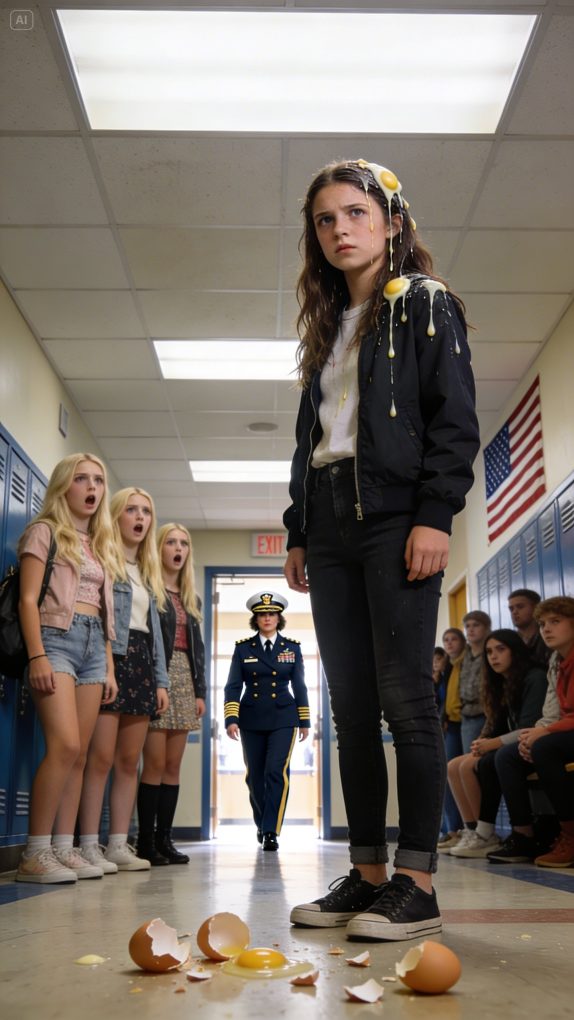
They cracked an egg over my head and laughed. “Maybe if you weren’t so poor, you’d fit in,” one of them whispered while everyone recorded it. I stood there, humiliated, trying not to cry. “You don’t even know who my mom is,” I said quietly. They laughed harder. What they don’t realize? My mother commands warships… and she’s already on her way to this school.
Part 1: The Hallway
My name is Lily Brooks, and until last Tuesday, I thought high school humiliation was something you survived quietly. I attend Jefferson Ridge High in Norfolk, Virginia, not far from the naval base where my mother serves. Most students know my mom works “in the Navy,” but I never talk about ranks or ships. I don’t mention that Commander Rachel Brooks oversees a destroyer squadron in the Atlantic Fleet. To me, she’s just Mom—strict, disciplined, always early. That morning started like any other. I wore the same faded sneakers I’ve had for two years and a thrift-store jacket that doesn’t quite match anything. I’ve heard the whispers before. “Discount girl.” “Trailer trash.” They think poor is contagious. I usually ignore it. But that day, Madison Carter decided ignoring me wasn’t enough. In the middle of the hallway between second and third period, she blocked my path with two of her friends. “You ever tried conditioner?” she smirked. Phones came out instantly. I tried to move around them. That’s when I felt it—cold, sticky, sudden. An egg cracked against the top of my head, dripping down my hair and onto my backpack. Laughter erupted like it was choreographed. Someone shouted, “That’s what farm girls are used to, right?” My face burned hotter than the humiliation. I wanted to disappear, but I refused to cry. “You don’t know who you’re messing with,” I said quietly. They laughed harder. “What? Your invisible dad?” Madison mocked. They didn’t know. They didn’t know that my mom commands sailors twice their parents’ age. They didn’t know discipline isn’t just a word in my house—it’s oxygen. I walked to the bathroom, cleaned what I could, and went straight to the principal’s office. He sighed like it was paperwork, not cruelty. “Teenage behavior,” he called it. I went home early that day. When my mom saw the dried egg in my hair, her expression didn’t explode. It hardened. She didn’t yell. She simply asked, “Who did it?” I told her everything. She nodded once, calm in a way that felt more dangerous than anger. “Get in the car,” she said. The next morning, a black Navy sedan pulled into the school parking lot. And my mother stepped out in full dress uniform.
Part 2: When Authority Walks In
The hallway that had echoed with laughter the day before fell into stunned silence when my mother entered through the main doors. Her white uniform was immaculate, medals aligned perfectly against the navy-blue fabric. The sound of her heels against the tile floor carried like a metronome of control. Students stopped mid-conversation. Teachers straightened instinctively. She didn’t raise her voice. She didn’t need to. “I’m Commander Rachel Brooks,” she announced at the front office desk, tone steady and precise. “I’m here regarding a harassment incident involving my daughter.” The principal’s smile faltered. Within minutes, Madison and her friends were pulled from class. I stood beside my mother in the conference room, feeling smaller than ever and yet strangely protected. Madison’s confidence from the day before had evaporated. Her mother, a local business owner, arrived flustered and defensive. “Kids make mistakes,” she insisted. My mom folded her hands calmly on the table. “Discipline is not optional in my profession,” she said evenly. “And it shouldn’t be optional here.” The school attempted to frame the egg incident as harmless teasing. That’s when my mom placed a printed screenshot on the table. A video clip. The humiliation had been recorded and uploaded. Thousands of views overnight. “Harmless doesn’t go viral,” my mother said quietly. Madison’s face turned pale. The assistant principal shifted in his seat. “We will handle this internally,” he began. My mom leaned forward slightly. “If this school cannot guarantee my daughter’s safety and dignity, I will escalate this beyond internal review.” There was no threat in her voice—only fact. The room felt smaller with every word. Madison finally looked at me. “It was just a joke,” she muttered. I met her eyes for the first time without fear. “Jokes don’t make people feel worthless,” I said. The school board was notified that afternoon. The video was taken down. Formal disciplinary hearings were scheduled. Word spread faster than the original clip. Students whispered about the “military mom” who showed up in full command presence. But what no one saw was how tightly my mom held my hand when we walked out of that building. And what Madison didn’t know was that the consequences were only beginning.
Part 3: Discipline and Dignity
The investigation lasted two weeks. The school district conducted interviews, reviewed hallway footage, and assessed the social media fallout. The outcome was decisive. Madison and the two girls involved received suspensions, mandatory counseling, and removal from extracurricular leadership positions. The school implemented an anti-bullying initiative that required digital conduct workshops for all students. But the real shift wasn’t in punishment—it was in awareness. When the district invited my mother to speak at a student assembly about respect and responsibility, she agreed. The auditorium was packed. Madison sat in the third row, eyes lowered. My mom stepped onto the stage not as an angry parent, but as a commander. “Leadership,” she began, “is defined by how you treat those with less power than you.” Her voice carried across the room with practiced authority. “In the Navy, humiliation weakens the unit. Respect strengthens it.” She didn’t mention me by name. She didn’t need to. Every student knew why she was there. She spoke about accountability, about the weight of public cruelty amplified by social media, about discipline as a form of protection—not punishment. When the assembly ended, there was no applause at first. Just silence. Then a slow, deliberate standing ovation from teachers, followed by students. Madison approached me later that week. “I didn’t think it would matter,” she said quietly. “It mattered,” I replied. For the first time, she looked ashamed instead of amused. Life at school didn’t become perfect overnight. But the whispers stopped. The phones lowered. And when people looked at me, they no longer saw someone alone. They saw someone defended. My mother returned to base the following Monday. Before she left, she hugged me tightly. “Strength isn’t loud,” she said softly. “It’s steady.” That hallway incident could have defined me as a victim. Instead, it redefined the school. Because the girls who thought no one would defend me forgot something important: when you attack the daughter of a warrior, you don’t just face anger. You face discipline. And discipline, when delivered properly, changes everything.

