The silence in the office became immediate and absolute.
It wasn’t flirtation in the cheap, easy way. It wasn’t a joke designed to score points. It was a flare fired from someone drowning who didn’t want anyone to notice the waterline at her throat.
I felt a distinct tightening at the base of my skull.
Not a spark. Not a flash.
Gravity.
An anchor dropping.
I didn’t smile back. I didn’t offer a compliment or a witty deflection. I simply held her gaze, expression neutral, while my mind processed the weight behind her words: exhaustion wearing a playful mask, stress disguised as banter.
Her knee bounced once under the desk, then stopped the moment she noticed it. Her nails clicked on the armrest in a tight, uneven rhythm. When Giovani’s name had come up earlier, her smile had held, but her breathing went shallow.
So she kept the room bright and fast to avoid letting it go quiet.
“She doesn’t exist,” I said plainly.
Then, more quietly: “Step away from the desk, Stella.”
Using her first name stripped away the corporate armor. It cut through her teasing like a key through a lock.
Her smile faltered, replaced by sudden clarity. She recognized the tone: the voice of someone who knew exactly what was wrong and was already implementing the fix.
She stood, smoothed her skirt once, and stepped aside.
I moved into the space she vacated.
The leather of the chair still held the heat of her body. I ignored it.
I didn’t sit. I leaned over the desk, hands hovering over the keyboard. I didn’t touch the mouse. I used command-line shortcuts, bringing up hidden directory trees with fast precision.
“What is it?” Stella asked.
Her voice dropped to a hush. She stood close to my shoulder, not close enough to touch, but close enough that I could sense her breathing go still.
“Someone is executing a localized packet capture on your machine,” I said, fingers moving in staccato bursts across the keys. “They are mirroring your personal directory to an external server. It’s a clumsy zero-day exploit piggybacking on the automated update service.”
“My personal directory,” she repeated, and her voice tightened.
“William, my drafts for the restructuring proposal are in there. My performance reviews of Giovani’s team.”
“I know,” I said.
That was why I was here.
I keyed in the command string and hit enter. The screen flashed black for a fraction of a second, then returned to her spreadsheet.
The outbound flow dropped to zero.
I exhaled a short controlled breath. The immediate hemorrhage was stopped, but the wound was still open.
“Did they get it?” she asked.
I pulled up system logs, parsing raw . “They got fragments. Encrypted blocks. It will take them hours to compile it into anything readable.”
Stella’s eyes flicked to the clock. She was calculating how many hours she had before morning, before a boardroom full of people who could end her career with one sentence.
I straightened and turned to face her.
“But the protocol constraint is strict,” I continued. “Now that I severed the connection manually, the localized network security policy initiates a hard lockdown on this terminal. You can’t leave and neither can I. We have to rebuild the encryption keys from scratch or the automated system will purge your drive at midnight.”
Stella stared at me as if I’d told her gravity was optional.
“You’re telling me we are locked out of the network unless we stay here and fix it.” Her voice was sharp, but there was no hysteria. “For how long?”
“Until it’s done.”
I looked at the clock again, because truth mattered more than comfort.
“Cancel your plans,” I said. “The date is off.”
If she resented me, she didn’t show it.
She didn’t throw a tantrum. She didn’t ask to speak to my supervisor, because she was my supervisor in every way that counted tonight.
She just nodded.
Her shoulders dropped a fraction of an inch as she accepted the new reality.
It was why I respected her.
She didn’t waste energy fighting physics or systems.
For the next three hours, we worked in a tense, grinding rhythm. I commandeered her secondary monitor, turned it vertically, and read cascading hex code until the lines started to blur. Stella sat on the small leather sofa in the corner, laptop open on her knees, working offline on speech notes for the morning.
The silence between us wasn’t awkward.
It was functional, like two people building a bridge in the dark. The only sounds were the rapid clack of my mechanical keyboard and the soft rustle of her shifting papers.
Around 9:30, the adrenaline began to drain away, leaving behind fatigue like a heavy coat.
I rubbed the back of my neck and felt knots of tension pulling at my spine. I hadn’t eaten since noon.
“You stopped typing,” Stella noted from the sofa without looking up.
“Running a decryption algorithm,” I replied. “Twelve minutes to brute force the hash. We wait.”
She closed her laptop and set it on the glass coffee table like she was placing down a weapon. Then she stood and stretched her arms above her head. The movement wasn’t performative. It was unself-conscious, betraying exhaustion in a way her boardroom self would never allow.
“I’m ordering food,” she said. “Thai or Greek. I don’t care. Whatever’s fast.”
“Thai,” I said automatically.
She glanced at me. A small smile tugged at one corner of her mouth as if she’d caught me forgetting to be invisible.
“Thai it is.”
While we waited, the room settled into a strange domestic quiet, like a storm had paused outside the windows and we were living in the eye of it.
I checked my phone.
A message from Christopher, my sole confidant and the guy who’d brokered my contract here.
Network stable?
I typed back one word.
Handled.
Then I placed the phone face down on the corner of the desk and pushed it a few inches away. It was a physical boundary. A signal to myself as much as to anyone else: I was here. I was nowhere else.
Stella watched the movement.
She walked over and leaned against the edge of the desk, arms crossed.
“You don’t talk much, do you, William?”
“I communicate when needs to be transferred,” I said. My tone was dry, but it lacked its usual bite.
She huffed a quiet laugh. “And what does the say about who did this?”
I turned my monitor toward her and pulled up the network schematic, because the truth was too intricate to live only in words.
“Look,” I said, pointing to the perimeter. “This is the outer boundary. The red vectors are the intrusion paths.”
Stella’s eyes tracked the lines.
“Notice how they bypass the external firewall,” I continued. “The attack didn’t come from outside. It launched from within. From a node authorized under Giovani Meyers’ credentials.”
The reality settled over her slowly, like a dark coat.
“He’s trying to find the restructuring drafts,” she said. “He knows I’m recommending his department be cut by thirty percent.”
“He found the drafts,” I corrected gently. “But they’re locked in an encrypted packet. I have the key. He doesn’t.”
The food arrived at 10:00.
We ate at a small conference table in the corner of her office. I unpacked containers and slid a box of pad thai toward her without asking.
I’d noticed two weeks ago in a break room interaction that she always chose peanut sauce over curry. I didn’t mention it. I just handed her a fork.
“Thank you,” she said quietly.
She took a bite, then set the fork down and stared at the grain of the wood as if it could tell her what tomorrow would bring.
The silence stretched, heavy with the board meeting looming like an execution date.
Then her voice cracked through.
“If he decrypts those files before tomorrow morning,” she said without looking at me, “my career here is over. It’s not just the restructuring. My personal notes are in there. My doubts about the CEO. My own… anxieties.”
She swallowed the last word like it tasted bitter.
“If he leaks that to the board, they won’t just deny my promotion. They’ll ask for my resignation.”
I stopped eating.
I didn’t offer empty reassurance. I didn’t say it’ll be fine. That sentence was a paper umbrella in a hurricane.
Instead, I analyzed variables and offered a concrete fact.
“He won’t decrypt them,” I said.
Stella looked up. Her eyes were bright with unshed stress.
“How can you be sure?”
“Because I’m better than the person he hired to build his script,” I said simply.
It wasn’t arrogance. It was measurement.
“His code is sloppy. Generic library dependencies. My encryption is bespoke. Built for this architecture. He’d need a quantum processor and ten years to break it.”
She held my gaze.
The panic hovering at the edges of her vision began to recede, replaced by profound stillness. It was visible, the way stability can transfer from one person to another like a slow exhale.
I watched the tremor in her hands stop.
She picked up her fork again.
“Okay,” she breathed.
One word, but it carried the weight of a surrendered burden.
By midnight, fatigue was physical in the room.
I was back at the terminal, eyes burning as I manually rebuilt registry keys, one line at a time, like stitching a wound with thread too small to see. Stella had fallen asleep on the leather sofa.
She curled on her side, suit jacket draped over her shoulders like a blanket. Her hair had slipped from its perfect arrangement. Stripped of corporate armor, she looked both fragile and unbreakable.
I paused typing for exactly five seconds to look at her.
I felt a sharp ache in my chest, a pull urging me to walk over and adjust the jacket to cover her arms.
I didn’t.
Restraint wasn’t punishment. It was discipline.
The best way to protect her wasn’t hovering over her while she slept. It was ensuring that when she woke up, her enemies had no weapons left to use against her.
At 2:00 a.m., the final progress bar hit 100%.
The system locked the new encryption keys, sealing her drive in an impenetrable digital vault. The leak wasn’t only contained. The stolen packets on Giovani’s server were rendered permanently inert.
I ran a secondary script to corrupt his logs without leaving a trace, turning his stolen files into dead ends and broken promises. Then I built the paper trail, because truth without receipts was just a bedtime story.
Firewall logs to an offline drive. Each file hashed and timestamped to the second. Intrusion path, credential misuse, corrupted packet captures. Printed, aligned, stapled, signed. Night security supervisor witnessed the timestamps. Sealed in a plain envelope.
No speeches.
Just evidence strong enough to survive a boardroom.
I sent a single line to the CEO’s assistant:
Security incident contained. Formal briefing 8:30. Evidence on hand.
Stella stirred.
She sat up slowly, rubbing her face, blinking against the monitor light. Her voice was rough with sleep and stress.
“Is it done?”
“It’s done,” I said.
I stood, stretched my back, felt joints pop in the silence. “Your drive is secure. The network is stabilized. The lockdown lifts at six.”
She looked at the clock, then back at me.
“You stayed awake the entire time.”
“That was the job.”
“No,” she said, and there was strength returning to her voice, executive authority tempered by something softer. “The job was to log the error and report it tomorrow. You bypassed protocol to fix it yourself. You stayed.”
I didn’t have a clean defense for that.
So I didn’t pretend I did.
I gathered my jacket from the chair.
“Get some sleep, Stella. You have a board meeting in six hours.”
Morning arrived like a blade.
The executive boardroom was charged with toxic anticipation, the kind that made the air feel slightly too thin. I sat in the back row in my gray shirt, a stark contrast to a sea of bespoke suits.
Technically I was there to provide a quarterly network health report.
In reality, I was there to watch the architecture of Giovani’s plan collapse.
Stella stood at the head of the long mahogany table, flawless. Whatever exhaustion had hunted her last night was erased, replaced by radiant competence. She began her presentation with surgical precision, outlining projections and strategy like she was laying down rails for a train that would not be stopped.
Giovani sat halfway down the table, hands folded, expression already rehearsed.
He waited.
When Stella brought up the proposed budget cuts, he struck.
“If I may, Stella,” Giovani interrupted, voice dripping faux concern. He opened a manila folder like a magician about to reveal a trick.
“I think the board should be aware,” he said, “that your judgment regarding these cuts may be compromised.”
A low murmur rippled through the room.
“I received an anonymous dump last night,” he continued. “It appears to be your personal files. Drafts indicating clear targeted bias against my department, along with some highly unprofessional remarks regarding the CEO’s leadership.”
The CEO at the far end frowned deeply.
Stella didn’t flinch.
She didn’t look at me.
She closed her clicker and placed it on the table like a chess piece.
“An anonymous dump, Giovani. That is a very serious allegation.”
“I have the files right here,” he said, pulling a flash drive from his pocket and sliding it across the polished wood. “I suggest IT decrypts this immediately for the board’s review.”
Stella’s gaze settled on the drive, then lifted calmly to the CEO.
“I welcome the review,” she said. “However, I believe William Santos, our independent security contractor, should handle the drive to ensure chain of custody.”
The CEO nodded once. “Proceed.”
I stood.
The room fell silent as I walked to the table and picked up the flash drive. It felt light, insignificant, like a bullet before it’s fired.
I plugged it into the presentation laptop and mirrored the screen to the projector.
A list of files appeared.
Giovani leaned back, smug smile settling like oil.
I clicked the first file.
The screen filled with chaotic alphanumeric nonsense.
Corrupted.
I clicked the next.
More corrupted.
I ran a diagnostic script and projected the results on the wall for everyone to see, because transparency was a weapon too.
“This drive contains nothing but shattered hash fragments,” I said, voice carrying cleanly.
“The is unreadable. Corrupted at the source.”
Giovani’s smile twitched, then stiffened.
I paused, then delivered the final blow with methodical precision.
“Furthermore, the meta indicates these fragments were illicitly scraped from an internal node using an unauthorized packet sniffer.”
I let the room absorb the shape of the accusation before I named it.
“A node registered to Giovani Meyers.”
Silence shifted from tense to lethal.
Giovani’s color drained. His mouth opened as if words could rewrite what was now projected in light.
“That’s… that’s impossible,” he stammered. “The script was flawless. Someone tampered with it.”
“Yes,” Stella said, voice sharp as a clean cut. “Someone did.”
She looked around the table, meeting eyes one by one, not pleading, not apologizing, simply claiming space that had been stolen from her for too long.
“I authorized William to perform a localized security audit last night after detecting your intrusion,” she continued. “You didn’t receive a whistleblower dump, Giovani. You executed corporate espionage against a fellow executive.”
Then she reached into her portfolio and pulled out a stack of paper.
“And to ensure complete transparency,” she said, placing it on the table, “here are hard copies of my actual restructuring proposal. The one based on metrics, not bias.”
Giovani looked around, searching for allies.
He found none.
Only the cold, unforgiving stare of the board and the CEO’s narrowed eyes.
The CEO pointed toward the door.
“My office, Giovani. Now.”
Giovani gathered his things with shaking hands. His ambition, so loud moments earlier, suddenly had nowhere to live. As he left, Stella didn’t gloat. She didn’t smile.
She just reclaimed the room.
She looked to the back row then, and for a fraction of a second her eyes met mine. The professional mask remained, but in the micro-softening of her mouth, the steady calm in her gaze, she spoke directly to me without words:
We survived.
I nodded once and walked out before congratulations could begin. Not because I didn’t care, but because my job was always to make the system stable, then disappear.
The aftermath was swift.
Giovani was terminated by noon. The board approved Stella’s restructuring plan and confirmed her promotion to Senior EVP. The corporate machine absorbed the drama and turned it into policy, the way it always did: pain into procedure, betrayal into training modules.
At 6:00 p.m., I was back in the server room packing my gear.
Contract complete. Temporary access badge set to expire in an hour. I zipped my heavy canvas duffel bag. The sound was loud in the quiet.
“Are you leaving?”
I turned.
Stella stood in the doorway of the server room.
She’d traded heels for sensible flats. The rigid posture was gone. She looked grounded, like someone who had finally set down a weight she’d been carrying for years.
“Contract is finished,” I said, hoisting the bag over my shoulder. “Network is secure.”
She stepped into the room.
It was the first time she’d come down into my domain. She looked at rows of blinking servers and tangled cables, at the cold utilitarian floor that didn’t care who she was.
“You didn’t stay for the celebration lunch,” she said.
“Not my scene.”
She stopped a few feet away.
“I need you to fix one more thing, William.”
I set the bag down.
“What’s broken?”
She reached into her pocket and pulled out a small heavy object.
A brushed-steel guest access card signed out from security, time-limited for twenty-four hours.
“My calendar,” she said, voice quiet, steady, completely stripped of corporate artifice. “It’s disorganized.”
She inhaled once, like she was about to step off a ledge she’d been staring at all day.
“I have a dinner reservation at eight,” she continued, “and no one to go with.”
I looked at the card in her hand.
It wasn’t just an invitation to dinner.
It was a public choice.
I didn’t take it immediately. I studied her face for signs of hesitation, fear, regret.
There was none.
She was choosing this with the same clarity she’d chosen to stand in that boardroom and tell the truth.
I reached out and took the card.
My fingers brushed hers for the briefest point of contact, but it was enough to transfer stability back and forth like a shared signal.
“I can fix a calendar,” I said.
She stepped closer until I could hear her breathing steady out.
Her fingers caught the hem of my sleeve, not tugging, just holding me in place as if confirming I was real.
“William,” she said softly, unambiguous.
No titles. No armor. Just a person who had spent years being steel and finally wanted to be human.
I didn’t pull her into anything frantic. I didn’t let adrenaline pretend to be intimacy.
I placed one hand at her waist, steady and respectful, and leaned down.
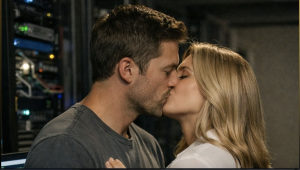
The kiss wasn’t an exploration.
It was an arrival.
A lock sliding into place, sealing a door against the storm outside.
When we parted, I felt tension bleed out of her shoulders under my hand. Her exhale steadied, like the moment she realized she didn’t have to carry everything alone.
“Eight,” she whispered, a small smile returning.
“I’ll be there,” I said.
I picked up my duffel bag, and the weight of it felt different now. Lighter.
Stella walked back toward the elevator, her steps steady, her posture relaxed. The server room fell quiet again, but it didn’t feel empty.
The guest card stayed in my pocket, not as a romantic promise, but as something rarer and more durable.
A plan.
Because the truest anchor when a system crashes isn’t the person who talks the loudest about loyalty.
It’s the one who stays, does the work, keeps receipts, and chooses truth in daylight.
And sometimes, when the crisis ends and the alarms stop, you realize you weren’t just patching a network.
You were rebuilding a life that had been running on emergency mode for too long.
In a world that treated people like replaceable hardware, Stella Ryan had chosen to be a person again.
And for the first time in a long time, so had I.
THE END