My Sister Crushed My 7-Year-Old Daughter’s Glasses Under Her Feet “TO TEACH HER SOME RESPECT,” She Said. Then She Forced My Daughter To Clean The Kitchen Again And Again Until Her Hands Bled What My Sister Didn’t Know Was… My Daughter Had Seen Something On Her Phone
Part 1
I smelled the lie before I even opened the door.
Not literally, though my parents’ house always carried the same cocktail of old upholstery, lemon air freshener, and whatever casserole had been reheated a little too long. I mean I felt it, the way you can feel a storm in your teeth. I’m an ER nurse. I’ve spent twelve-hour shifts watching people swear they’re fine while their vitals tell the truth. I know what tension looks like. I know what guilt sounds like when it tries to disguise itself as normal conversation.
I walked in straight from work, badge still clipped to my scrub pocket, hair in a messy knot that smelled faintly like antiseptic wipes. I’d texted that I was on my way. No one replied, which should’ve been my first clue.
The living room was too quiet.
My mother was at the kitchen counter, wiping it down with the determination of someone scrubbing away fingerprints. My father sat in his recliner, eyes locked on the TV like an insurance commercial was the most important story in the world. And my sister Jessica was on the couch scrolling through her phone with a kind of performative calm that might as well have been a neon sign flashing I DID SOMETHING.
Then I saw Maya.
My seven-year-old daughter was on the floor in the corner, hands folded tightly in her lap, shoulders rounded like she was trying to shrink into the carpet. Maya is not a quiet kid. She’s questions and giggles, a constant stream of thoughts, the kind of child who narrates her own life because she assumes everyone else wants to hear it.
Right now, she looked like she was waiting for permission to breathe.
And she wasn’t wearing her glasses.
Maya has worn glasses since she was four. Without them, her world is a watercolor smear. She can’t read the clock on the wall. She can’t make out faces across a room. She can’t safely navigate a stairwell without counting steps like a tiny mountaineer.
I stopped in the doorway.
“Hey, baby,” I said gently, softening my voice the way I do when patients are scared. “Where are your glasses?”
Maya flinched. Not a dramatic jump. Just a small, involuntary twitch inward, like my voice startled her because she hadn’t expected kindness.
Before she could speak, Jessica did.
“She dropped them,” Jessica said, still staring at her phone. Her tone was too smooth, like it had been rehearsed. “Kids, you know.”
I turned my head slowly toward her. “Dropped them where?”
Jessica shrugged. “I don’t know. Somewhere earlier.”
My mother chimed in without lifting her eyes from the counter. “It’s not a big deal, Sarah. Kids break things.”
That phrase, not a big deal, is a red flag in every context that involves a child. When adults say something is not a big deal, it usually means it is a big deal and they’re trying to convince you not to look at it too closely.
I walked across the room and crouched in front of Maya. Up close I could see she’d been crying, not fresh tears but the aftermath: slightly puffy eyelids, the sheen of dried salt on her cheek.
“Sweetheart,” I said, “can you tell me what happened?”
Maya stared at the floor like it held the correct answers. “I dropped them,” she whispered.
The words were flat. Too flat. She sounded like she was reciting something someone had fed her.
I reached for her hands. She pulled them back quickly, as if hands were a privilege that could be taken away.
“Maya,” I said, keeping my voice steady, “let me see.”
She hesitated, then slowly offered her hands.
Her knuckles were red, raw, and slightly swollen. Not bleeding, not bruised, but irritated in that unmistakable way that comes from scrubbing too long with the wrong soap. Her skin, usually soft, looked tight and angry, like it had been scoured.
My stomach tightened.
“What happened to your hands?”
Maya tucked them into her lap again. “Nothing.”
Jessica let out a short laugh. “She’s been dramatic today.”
I looked up at her. “Dramatic how.”
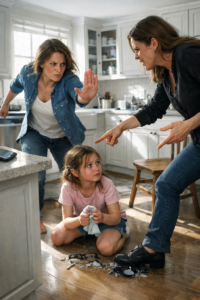
Jessica finally lifted her eyes from her phone. She didn’t look ashamed. She looked annoyed, like my question was the problem.
“Oh, you know,” she said, waving a hand. “Touching things she shouldn’t. Not listening. Acting entitled.”
Entitled came out sharp, like a word she’d been waiting to use on someone smaller than her.
My mother nodded as if this was a reasonable assessment. “Kids need boundaries, Sarah.”
My father turned a page of the newspaper he wasn’t reading.
Across the room, Jessica’s kids were at the dining table: Braden, nine, Emma, eight, and Chloe, five. They were whispering and giggling in that particular way kids do when they know something and no one has made them stop.
Braden made an exaggerated squinting face, scrunching up his features like he couldn’t see, and whispered something to Emma. They both laughed.
Maya didn’t look at them. She pulled her knees up and hugged them tight, making herself smaller.
Something inside me went still. Not anger yet. Clarity. The kind of clarity that drops over you like cold water.
I forced my voice to remain calm. “Can I see the glasses?”
Jessica sighed like I was exhausting. She stood, walked to a side table, and picked up a small pile of something. She dropped it into my hand.
Maya’s glasses.
The frames were bent. Both lenses were cracked. One had a spiderweb fracture across the center, the kind that doesn’t happen from a simple drop. The hinge was twisted like someone had stepped on it hard enough to grind it into the floor.
My mother glanced over and shrugged. “We’ll get them fixed.”
The cousins giggled again.
Maya didn’t move.
I looked down at the broken glasses, then at my daughter’s raw knuckles, and felt that icy clarity lock into place.
“We’re leaving,” I said.
My mother finally looked up. “Sarah, don’t be dramatic.”
“We’re leaving,” I repeated.
Jessica crossed her arms. “Seriously? You’re going to make this a whole thing?”
I didn’t answer her. I held my hand out to Maya.
Maya stood slowly, like any sudden movement might get her in trouble. She slipped her small hand into mine with a grip that felt too tight for a child.
We walked out.
In the car, Maya stared out the window and said nothing. I didn’t push. Not yet. I drove home, got her inside, and went straight to her dresser for her backup pair.
Because of course I have backups. I’m a single mom with a kid who needs to see. I have backups for everything: inhaler, chargers, snacks, spare clothes, spare comfort.
Maya put the backup glasses on and her shoulders dropped about half an inch, like her brain could finally stop straining.
I sat beside her on the couch. “Okay,” I said softly. “Tell me what really happened.”
Maya stared at her hands. “I did something bad.”
My chest tightened. “No,” I said firmly, “you did something that made someone mad. That’s not the same thing.”
Her lip trembled. “Aunt Jessica got really mad at me.”
“Why?”
Maya swallowed. “I… I looked at her phone.”
I kept my voice steady. “What were you looking at?”
“I thought she was watching a video,” Maya whispered. “So I looked just for a second. But it wasn’t a video. It was like… words. An email or something.”
My stomach dropped. “What did it say?”
Maya shrugged, eyes shiny. “I didn’t read it. I just saw a name. Uncle David’s name.”
Uncle David. My mother’s brother. He’d died six months ago. He’d been the only adult in my childhood who looked me in the eye and asked what I wanted, like my opinion mattered.
“And then what happened?” I asked quietly.
Maya’s voice got smaller. “Aunt Jessica grabbed my glasses and said I was disrespectful.”
My fingers went cold.
“She threw them on the floor,” Maya continued, tears spilling now. “And then she… she stepped on them.”
I didn’t speak. I couldn’t. I felt my pulse in my ears.
“And then she said I had to learn respect,” Maya whispered. “So she made me clean the kitchen. Over and over. She said it wasn’t good enough, so I had to do it again.”
I looked down at her raw knuckles. Rage rose in me, hot and fast, but I held it back so I wouldn’t frighten her.
“Braden and Emma and Chloe were laughing,” Maya said. “And Grandma just watched.”
“And Grandpa?” I asked, even though I already knew.
Maya shrugged. “He was there.”
Which meant he did nothing.
Maya looked up at me, face wet, desperate. “Mom,” she whispered, “am I bad?”
I pulled her into my arms so tight I thought I might crack. “No,” I said into her hair. “You are not bad. What happened to you was bad. That’s not the same thing.”
Maya cried quietly against my shoulder like she didn’t want to take up too much space even now.
And as I held my child, something inside me hardened into a decision.
After Maya fell asleep that night, I sat at my kitchen table and stared at the broken glasses.
Then I picked up my phone.
I didn’t call my mother. I didn’t call Jessica.
I called a lawyer.
Part 2
I knew the lawyer before I knew I needed her.
Rebecca Torres worked family law and estate disputes, and I’d met her at the hospital months earlier when her father came into the ER with chest pain that turned out to be anxiety. Rebecca had stood at his bedside, calm but fierce, asking questions no one else thought to ask, refusing to be soothed by vague answers.
When I called her, she didn’t waste time.
“Tell me what happened,” she said.
So I did. The tension in the living room. Maya’s missing glasses. The broken frames, the cracked lenses, the hinge twisted like it had been punished. The red knuckles. The forced cleaning. The word entitled like a blade. And the part that kept echoing in my head like a siren: Uncle David’s name on an email Jessica didn’t want Maya to see.
Rebecca was silent for a beat.
Then she asked one question that made my stomach flip. “Did your uncle leave a will?”
“I think so,” I said. “Why?”
“Because your sister’s reaction doesn’t sound like discipline,” Rebecca said. “It sounds like someone cornered.”
The next morning we met at a coffee shop near the hospital, one of those places that smelled like espresso and desperation. Rebecca arrived with a legal pad and a posture that suggested she’d already decided to take this personally.
I described everything again, slower this time. I told her what Maya said word-for-word, because kids rarely lie about things that make them feel ashamed. I told her about my parents’ faces, the way my mother wiped the counter like she was erasing a crime scene and my father disappeared behind the newspaper.
Rebecca didn’t interrupt. She listened the way an ER doc listens when a patient’s symptoms don’t match the story they’re trying to tell.
When I finished, she leaned back. “Okay,” she said. “I’m going to make a call.”
She stepped outside for privacy, and I watched her through the window, phone to her ear, expression unreadable. When she came back in, she slid into her chair and tapped her pen against the table.
“I want you to brace yourself,” she said.
I laughed once, humorless. “You mean more than I already am?”
Rebecca’s eyes were sharp. “I’m going to request the probate filings for your uncle’s estate. If there’s a trust, we’ll find it.”
The word trust landed heavy in my chest.
Uncle David had no children. He’d never married. He was the kind of man who tipped too much at diners and kept peppermint candy in his pocket for kids. He loved Maya. He used to kneel down to her eye level and ask about her drawings like she was the artist of the year.
If he left something for her…
Three days later, Rebecca called me while I was on break, sitting in the staff lounge with a granola bar I’d forgotten to eat.
“Sarah,” she said, voice tight. “We need to talk in person.”
I met her at her office that afternoon, heart pounding so hard I could feel it in my fingertips.
Rebecca didn’t waste time. She slid a folder across her desk.
“Your uncle David left a trust,” she said.
My mouth went dry. “Okay.”
“Your daughter Maya is listed as a beneficiary.”
The room tilted. “What?”
Rebecca’s gaze held mine. “One hundred eighty thousand dollars.”
I stared at her. My brain tried to reject the number like it was too large to be real. “That can’t be right.”
“It is,” Rebecca said. She flipped a page. “Held in trust for Maya to be managed by trustees until she turns eighteen.”
I swallowed hard. “Who are the trustees?”
Rebecca’s expression darkened. “Your parents.”
I felt like the air left the room. “What do you mean, my parents?”
Rebecca tapped the paper. “They were appointed as trustees. But here’s the problem. There is no record of the trust being disclosed to you. No distributions, no accounting, nothing. You should have been notified. You’re her mother. You should have been involved.”
My hands started shaking.
“So they just… kept it?” I whispered.
“It looks that way,” Rebecca said carefully. “I can’t say for certain until we demand an accounting. But the lack of disclosure is not normal. And your sister’s reaction to Maya seeing your uncle’s name suggests she’s afraid of you finding out.”
My mind raced. Images flooded in: Jessica calling Maya entitled. Jessica’s kids laughing. My mother’s too-bright smile. The casserole dish in my mother’s hands in my imagination, because that’s always how my mother tries to fix what she breaks. Food as apology. Food as distraction.
“What can I do?” I asked.
Rebecca leaned forward. “We can file a petition to remove your parents as trustees. We can demand a full accounting. We can recover funds and place them in a properly managed trust with an independent trustee.”
She paused, then added quietly, “And criminally, if funds were intentionally withheld or misused, you can file a police report for theft or fraud.”
The word theft made my stomach churn. These were my parents. The people who came to my apartment when I was sick as a kid. The people who taught me to tie my shoes.
But then I saw Maya’s hands in my mind, raw and red from scrubbing. I saw her flinch when I asked about her glasses. I heard her whisper, Am I bad?
My voice came out steady. “Do it.”
Rebecca moved fast. Within a week, official notices went out. Demand for accounting. Petition to remove trustees. Letters sent in language so formal it felt like a door slamming politely.
And yes, I filed a police report.
One hundred eighty thousand dollars doesn’t disappear by accident. And even if it hadn’t been spent, hiding it was its own kind of theft.
The calls started the same day.
My mother. My father. Jessica. Over and over. I ignored them all.
Then, three days later, there was a knock on my door.
I checked the peephole.
My mother stood there holding a casserole dish, like she’d been waiting her whole life for an excuse to carry one into my house. My father was behind her, hands shoved into his pockets, face gray. Jessica stood off to the side, arms crossed, jaw tight.
I opened the door but didn’t invite them in.
My mother smiled, strained. “Sarah, honey, can we talk?”
My eyes went to the casserole. “Interesting timing.”
Her smile faltered. “We don’t know what you mean.”
“Sure you don’t,” I said flatly.
Jessica stepped forward. “This is ridiculous. You’re blowing up the whole family over nothing.”
“Over nothing?” I repeated. “One hundred eighty thousand dollars is nothing?”
My mother’s face went pale.
My father stared at the ground.
I kept my voice calm. “Talk to Rebecca Torres,” I said. “She’s my attorney.”
My mother’s voice shook. “We’re family, Sarah.”
“I noticed,” I said. “That’s why this hurts.”
Jessica’s voice sharpened. “You don’t understand what you’re doing.”
“I understand perfectly,” I interrupted, and now the anger arrived, clear and controlled. “You destroyed my daughter’s glasses to hide the fact that you’ve been stealing from her.”
My mother gasped. “We didn’t steal!”
“Then where’s the money?” I asked.
Silence.
Jessica’s face flushed. “It’s not fair,” she hissed. “Maya’s an only child. She gets everything. Meanwhile, my kids…”
And there it was.
Not in court. Not under oath. Right on my doorstep.
A confession wrapped in jealousy.
My mother’s eyes went wide, realizing what Jessica had just admitted out loud.
My father finally looked up, and the shame on his face made something in me ache. Not enough to undo the damage. Just enough to remind me this betrayal had layers.
“Maya didn’t get everything,” I said quietly. “You took everything.”
Jessica opened her mouth, ready to argue, but I lifted a hand.
“Don’t,” I said. “Just don’t.”
I stepped back and closed the door.
Not a slam.
A quiet, decisive click.
And that click was the beginning of the end of the family I thought I had.
Part 3
The first week after I filed the petition, I slept like a person waiting for an alarm to go off.
Every creak in the hallway outside my apartment made me sit up. Every unknown number made my stomach twist. At work, I could handle trauma with steady hands, could intubate a teenager and speak calmly to frantic parents, could clean blood off my shoes without flinching.
At home, I jumped when the microwave beeped.
Maya hovered around me like she was trying to predict my mood, like she’d learned that adults can turn dangerous without warning. That broke my heart more than the money ever could.
So I did what I do when something is injured and I can’t fix it with a bandage: I brought in professionals.
I scheduled Maya with a child therapist who specialized in anxiety and family trauma. I bought thick, fragrance-free lotion for her hands and taught her how to rub it in slowly after washing, turning it into a ritual instead of a reminder. I ordered her new glasses immediately, the best frames our insurance would cover, and I paid extra for protective lenses because I didn’t trust the world with her sight.
I also documented everything.
Photos of her hands. The broken glasses. A written statement of what she told me, dated and signed, because Rebecca said the truth in court needs timestamps. I hated that. I hated that I had to turn my child’s pain into paperwork to be believed.
But I was done being polite.
My parents tried every strategy they knew.
At first it was denial. My mother left voicemails about misunderstandings and family stress. My father sent a text that said, Let’s talk like adults, as if adulthood meant quietly accepting betrayal.
Then it shifted to guilt.
My mother texted, Your father isn’t sleeping. This is hurting him.
I almost replied, Imagine how Maya’s hands felt. Imagine how her world looked without glasses.
Instead I deleted the message.
Then it turned to anger.
Jessica left a voicemail so loud it peaked the audio.
“You’re selfish,” she screamed. “You’ve always been selfish. You think you’re better than us because you’re a nurse and you have your little apartment and your one perfect kid. Mom and Dad did what they had to do. You don’t know what it’s like raising three kids!”
I listened to that voicemail twice, not because I needed to hear it, but because I wanted to remember that this wasn’t about a mistake. This was about entitlement. Jessica didn’t think the trust was wrongfully hidden. She thought it should belong to her children, by virtue of her having more of them.
Rebecca filed motions like she was building a wall brick by brick.
Demand for accounting. Request for bank records. Petition to remove trustees. Emergency hearing because the trust was for a minor and nondisclosure was a serious breach.
The police report moved slowly, as police reports often do, but it existed now, a record that could not be smoothed away with lemon cleaner.
The first hearing was on a rainy Tuesday. I took the day off work, dressed in plain slacks and a sweater, and held Maya’s hand as we walked into the courthouse. Maya wore her new glasses, and she kept adjusting them like she was checking that they were still real.
Rebecca met us at security. She looked sharp and calm, hair pulled back, a stack of folders under her arm.
My parents arrived ten minutes later.
My mother’s eyes went straight to Maya, and for a second I saw something like regret flash across her face. Then Jessica’s hand touched her elbow and her expression hardened, like regret was a luxury she couldn’t afford.
My father looked older than I remembered. His shoulders were slumped in a way that made him look smaller.
Jessica looked furious. Not scared. Furious.
In the courtroom, the judge listened while Rebecca laid out the facts: the trust existence, the trustee appointment, the complete lack of disclosure, the missing accounting, and the request to remove the current trustees and install an independent one.
My parents’ attorney tried to paint it as confusion.
“They didn’t understand the reporting requirements,” he said. “They believed they were protecting the funds.”
The judge’s eyebrows lifted. “Protecting them from whom?”
Jessica’s attorney, because of course she had one too, argued that the trust should be “reconsidered” to include other grandchildren.
Rebecca didn’t even blink. “That is not how trusts work,” she said. “The settlor made a decision. The trustees had a duty. They failed that duty.”
My mother cried. Real tears. She dabbed them with a tissue and looked at the judge like she was begging for sympathy.
I felt nothing soften inside me.
Because I could still see Maya in the corner of the living room, silent and small, hands folded like she was waiting for permission to exist.
The judge ordered my parents to produce a full accounting within thirty days and scheduled a follow-up hearing.
Outside the courtroom, my mother tried to speak to me.
“Sarah,” she said, reaching out like she wanted to touch my arm, like touch could rewind time. “Please. We love you. We love Maya.”
I stepped back. “Love doesn’t look like hiding money from a child.”
My father’s voice cracked. “We were trying to keep the family together.”
I looked at him. “At her expense.”
Jessica scoffed. “Oh my God, you are so dramatic.”
I turned to her, and my voice came out level. “You stepped on my daughter’s glasses.”
Jessica’s face flickered, just a tiny break in the armor. “She shouldn’t have looked at my phone.”
“She’s seven,” I said. “And you made her scrub until her hands were raw. That’s not discipline. That’s cruelty.”
Jessica’s nostrils flared. “You want to call me abusive? Fine. Go ahead. See how that works out for you.”
Rebecca stepped between us. “All communication goes through counsel,” she said, and her tone was the legal equivalent of a locked door.
On the drive home, Maya was quiet.
Then she asked, very softly, “Are Grandma and Grandpa mad at me?”
My grip tightened on the steering wheel.
“No,” I said carefully. “They’re mad because they got caught doing something wrong.”
Maya stared out the window. “But Aunt Jessica said I was disrespectful.”
I took a breath. “Looking at someone’s phone can be rude,” I said. “But the punishment has to make sense. And it can’t hurt you. What she did was wrong.”
Maya was silent for a long time.
Then she whispered, “I’m glad you came.”
That sentence hit me like a wave.
Because I realized how close I’d come to picking her up, believing the practiced story, and going home without looking deeper. How easy it would’ve been to accept not a big deal.
I reached over and squeezed her hand. “I will always come,” I said. “Always.”
That night, after Maya fell asleep, I sat on my couch and stared at the rain on the window.
My phone buzzed with another message from my mother.
Please don’t do this. We can fix it.
I didn’t reply.
Because they weren’t asking how to fix what they’d done to Maya.
They were asking how to fix the consequences for themselves.
And I was done fixing things for people who broke my child.
Part 4
The accounting arrived on day twenty-nine.
Rebecca called me while I was charting at work. “It’s in,” she said. “And it’s… worse than I expected.”
My stomach dropped. “How worse?”
“Come to my office,” she said. “Don’t read it alone.”
So after my shift, I drove to Rebecca’s office with my hands shaking on the steering wheel. The sky was pink with sunset, the kind of gentle color that felt offensive compared to what I was walking into.
Rebecca had the documents spread across a conference table like a crime scene.
She pointed to bank statements. Transfers. Withdrawals. A trail of money moving from trust accounts into places it never should have gone.
My parents had taken “administrative fees” that weren’t authorized. They’d reimbursed themselves for “expenses” with no receipts. They’d paid for Jessica’s kids’ summer camps. They’d covered home repairs. They’d written checks to Jessica labeled “family support.”
And then there were the cash withdrawals, large ones, spaced out like someone trying not to trigger suspicion.
Rebecca tapped one page. “This is the clearest breach,” she said. “They used trust funds for personal gain. That’s not confusion. That’s misuse.”
I stared at the numbers until they blurred. “How much is left?” I asked, afraid of the answer.
Rebecca took a breath. “Not zero. But not the full amount.”
My throat tightened. “So they spent her money.”
“Yes,” Rebecca said. “And the court can order recovery. But I need you prepared: recovery doesn’t always mean it comes back quickly. Sometimes it means liens. Payment plans. Asset seizures. It gets messy.”
I pressed my fingertips to my temples like I could hold my brain in place.
“And Jessica?” I asked.
Rebecca’s expression hardened. “We can seek to hold her accountable if she knowingly received misused funds. The criminal investigation will matter here.”
I swallowed. “Maya’s money paid for my sister’s kids’ camp.”
Rebecca nodded once. “Yes.”
I stared at the table and felt a strange mix of rage and grief.
Grief for the version of my parents I’d carried in my head. The version that would never steal from a child. The version that would never let jealousy turn into cruelty.
Rage because they’d looked at Maya, a little girl who can’t see without her glasses, and decided her future was negotiable.
Rebecca slid another paper toward me. “This is the proposed order we’ll request,” she said. “Remove trustees. Appoint independent trustee. Freeze accounts. Demand repayment. And yes, we’ll coordinate with law enforcement.”
My voice came out steady, surprising even me. “Do it.”
The next hearing felt heavier.
My parents showed up in their Sunday-best faces, as if appearances were armor. My mother clutched a tissue. My father looked like he hadn’t shaved in days. Jessica strutted in with a kind of angry confidence, chin lifted, like she dared the courtroom to judge her.
The judge reviewed the accounting in silence, flipping pages, eyes narrowing.
Then the judge looked up. “This is not a misunderstanding,” he said.
My mother began to cry louder.
The judge didn’t soften. “You had a fiduciary duty. You failed it. You took funds from a minor’s trust. You used them for personal expenses. You did not disclose the trust to the child’s parent. That is a serious breach.”
My father’s face went gray.
Jessica’s attorney attempted to argue that the money benefited “the family unit.”
Rebecca’s voice was sharp. “The beneficiary is not the family unit,” she said. “The beneficiary is Maya.”
The judge’s ruling came down like a gavel in my chest.
My parents were removed as trustees immediately.
An independent trustee was appointed, a professional who did not know my family, did not care about my family drama, and would follow the law because it was their job. The trust accounts were placed under stricter oversight. A repayment order was issued.
And the judge referred the matter directly to the district attorney for review, noting potential criminal conduct.
Outside the courtroom, my mother tried again.
She stepped toward me, eyes wet. “Sarah, please. We were trying to help Jessica. She has three kids. We thought…”
I cut her off, voice quiet. “You thought Maya wouldn’t notice.”
My mother’s mouth opened, then closed.
Jessica snapped, “Maya doesn’t need it right now. She’s seven. She doesn’t even know what money is.”
That was the moment something in me snapped into pure clarity.
“She knows what cruelty is,” I said. “You taught her.”
Jessica’s face reddened. “How dare you.”
“How dare I?” I repeated, and my voice stayed low, controlled, the way it does when I’m telling a family in the ER that their loved one didn’t make it. “You stepped on her glasses. You forced her to scrub until her hands were raw. You let your kids laugh at her. And you’re standing here acting like you’re the victim.”
Jessica surged forward like she wanted to yell closer to my face, but Rebecca stepped in immediately.
“Do not approach my client,” Rebecca said, calm but lethal.
Jessica pointed at me. “You’re going to regret this. You’re going to end up alone, Sarah. No one does this to family.”
I looked at her and felt nothing but certainty. “Family doesn’t do this to a child,” I said.
My father spoke for the first time in weeks. His voice was ragged. “Jessica,” he said, like he was finally hearing her. Like he was finally hearing himself. “Stop.”
Jessica turned on him. “Oh, now you want to be moral?”
My father flinched, and in that flinch I saw the truth: this had been Jessica’s gravity for years, pulling everyone into her orbit, demanding accommodation, demanding sacrifice.
Maya had been the latest sacrifice.
I turned away. “We’re done,” I said, to all of them, and I walked to my car.
At home, I found Maya coloring on the floor, tongue peeking out slightly in concentration. She looked up when I came in.
“Did Grandma and Grandpa get in trouble?” she asked.
I sat beside her. “Yes,” I said. “Because what they did was wrong.”
Maya’s brow furrowed. “Is it my fault?”
My throat tightened. “No,” I said firmly. “It’s not your fault. You didn’t do anything wrong. Adults made bad choices.”
Maya stared at her coloring book, then whispered, “Will they be mean to you?”
I exhaled slowly. “They might try,” I said. “But I can handle it.”
Maya reached out and touched my hand, gently, like she was checking I was real. “I’m glad you’re my mom,” she said.
I blinked hard.
Because in that moment, I realized the ending of this story wasn’t going to be the courtroom or the money.
The ending was going to be Maya learning, deep in her bones, that she deserved protection.
And me proving it, over and over, until she believed it.
Part 5
The criminal side moved like cold syrup.
It took interviews, subpoenas, more paperwork than I thought my brain could hold. A detective came to my apartment and asked careful questions about my uncle, the trust, the family dynamics. I watched him write notes as if he was cataloging not just financial misconduct but the kind of entitlement that makes people think a child’s future is theirs to borrow.
My parents hired a new lawyer for the criminal part. Jessica posted vague quotes on social media about betrayal and snakes. Extended family members I hadn’t spoken to in years suddenly had opinions.
Some messages were supportive.
Some were poisonous.
How could you do this to your parents?
Money isn’t everything.
Families fight. You’ll regret this when they’re gone.
I didn’t reply to any of them.
Because none of them had seen Maya’s hands.
None of them had heard her whisper, Am I bad?
The independent trustee moved faster than the criminal system. They reviewed accounts, froze what needed freezing, and started the process of recovering funds. It wasn’t instant. Recovery was a slow grind of legal orders and repayment schedules.
But it was happening.
And for the first time since my uncle died, I felt like I was honoring him the way he deserved.
Uncle David had left that trust for Maya for a reason.
Because he saw her. Because he saw me. Because he knew my family’s version of love came with conditions and silence.
He’d tried to protect my child even from the grave.
I didn’t take that lightly.
In the middle of all this, Maya’s therapist taught her a phrase that made me swallow tears the first time I heard it.
“You’re allowed to take up space,” Maya said one night, practicing the words like they were a new language.
I sat beside her on her bed. “Yes,” I said. “You are.”
Maya stared at her hands, now healed, skin soft again. “Aunt Jessica said I was entitled.”
I kept my voice gentle. “Entitled means you think you deserve things you didn’t earn,” I said. “But kids deserve safety. Kids deserve kindness. Kids deserve to see.”
Maya nodded slowly.
“Did I earn my glasses?” she asked.
I smiled, even though my throat ached. “You earned them by being a human with eyeballs,” I said. “That’s enough.”
Maya giggled, and that giggle felt like a tiny victory.
Three months after the first police report, the district attorney offered a deal.
No jail time, because white-collar family cases rarely end with handcuffs unless the money is in the millions or the public is watching. But there would be charges. Probation. Fines. Community service. Court-supervised repayment. And a permanent record.
Rebecca explained the options at her office, laying them out like a nurse explaining treatment plans.
“If you reject the deal, you could go to trial,” she said. “But trials are expensive and unpredictable. A plea ensures consequences.”
I thought about Maya’s future, not just the money but the lesson.
Consequences matter.
“I’ll accept it,” I said.
When my parents entered their plea, my mother cried again. My father looked like a man attending his own funeral. Jessica’s face was furious, and she kept shaking her head like the courtroom was wrong to demand accountability from her.
The judge was unimpressed.
“This court takes breaches of trust involving minors seriously,” he said. “These were not minor mistakes. These were choices.”
Probation. Fines. Community service. Repayment orders.
Not a TV drama.
But real consequences that would follow them.
Afterward, my mother attempted to approach me in the hallway. She held out her hands like she wanted to grab mine, to pull me back into the old family dance where she apologized with tears and I soothed her.
I didn’t let her.
“I’m sorry,” she said, voice shaking. “We didn’t think…”
“You didn’t think I’d find out,” I said.
My mother flinched.
My father whispered, “We were trying to keep peace.”
I looked at him. “Peace for who?”
He had no answer.
Jessica snapped, “You’re enjoying this.”
That accusation was almost funny.
“I’m grieving,” I said. “There’s a difference.”
I walked away.
After that, we went no contact.
Not as a punishment.
As a boundary.
I changed my phone number. I blocked social media accounts. I told Maya’s school that only I and my designated emergency contact, Rachel from work, were allowed to pick her up.
Maya asked about her grandparents at first. Not because she missed them deeply, but because kids like predictability and patterns.
I told her the truth in child-sized language.
“Grandma and Grandpa made bad choices,” I said. “And until they can be safe, we won’t see them.”
Maya accepted it with the weird resilience kids have when adults finally act like adults.
Over time, Maya stopped flinching when someone raised their voice on TV. She stopped apologizing when she asked for help with homework. She stopped looking at her hands like they were evidence of wrongdoing.
One night, months later, she looked up from her math worksheet and asked, “Mom, are we okay now?”
I thought about the broken glasses. The raw knuckles. The courtroom. The casserole dish on my porch like a bribe.
Then I looked at my daughter, safe in our living room, wearing glasses that let her see clearly.
“Yeah,” I said. “We’re okay.”
Because peace isn’t the absence of noise.
Sometimes it’s the sound of a door closing and staying closed.
And sometimes it’s a child learning she is not responsible for an adult’s cruelty.
That was worth everything.
Part 6
The year after the court case, my life looked ordinary from the outside.
I still worked the ER. I still bought groceries and folded laundry and paid bills. I still packed Maya’s lunches with a little note tucked inside because I wanted her to feel seen even when I wasn’t there.
But inside, everything had shifted.
I used to move through the world bracing for my family’s opinions like they were weather. I used to think I had to keep a certain version of myself intact: the dutiful daughter, the agreeable sister, the one who didn’t cause trouble.
Now I had a new job title in my own mind: Maya’s witness.
If something felt wrong, I looked at it. If someone tried to twist the narrative, I didn’t untangle myself to make them comfortable.
I saw what that did to Maya, too.
At school, she started raising her hand more. She joined an art club. She stopped shrinking when other kids teased her glasses, because I taught her a response that was both gentle and firm.
“These help me see,” Maya practiced saying. “I like seeing.”
One day she came home and announced, like it was the most obvious thing in the world, “My glasses make me look like a scientist.”
I laughed. “They do.”
“Good,” she said, and went back to drawing.
The trust recovery continued in the background. The independent trustee sent quarterly statements, detailed and boring in the best way. Repayments came in slowly. Some months my parents paid. Some months the trustee had to enforce.
I didn’t track it emotionally anymore. I let the system do what it was built to do.
On the anniversary of Uncle David’s death, I took Maya to the park he used to like. We brought peppermint candies, because he always had them, and we sat on a bench near the pond.
Maya asked, “Did Uncle David know Aunt Jessica was mean?”
I stared out at the water. “I don’t know,” I said honestly. “But I think he knew you deserved something good.”
Maya unwrapped a peppermint and held it up like a toast. “Thank you, Uncle David,” she whispered.
That simple moment cracked something open in me.
Because I realized my uncle’s gift wasn’t just money. It was a message.
You are worth protecting.
And that message was now part of Maya’s foundation.
In late spring, my mother tried to break no contact.
A letter arrived in my mailbox in her handwriting. I stared at it for a long time before opening it, as if the paper itself could bite.
It was short.
Sarah,
I think about Maya every day. I dream about her without her glasses and I wake up sick. I know you don’t owe us forgiveness. I don’t know if you’ll ever want to speak again. But I want you to know I am ashamed. I was afraid of Jessica. I was afraid of conflict. I was afraid of what people would say.
I chose wrong.
If you ever want to talk, I will listen.
Mom
I sat at my kitchen table and let the words settle.
I didn’t cry. Not because I felt nothing, but because I’d already spent my tears on the version of my mother who would have protected my child without needing a courtroom to teach her.
Still, the letter mattered.
It was the first time she’d admitted fear instead of blaming me for consequences.
I put the letter in a drawer. Not as a promise. As an option.
Two weeks later, my father texted from a new number.
I’m sorry.
Three words. No excuses. No guilt.
I didn’t reply.
Not yet.
Maya’s therapist told me something important during a parent session.
“Reconnection can be healing,” she said. “But only if it’s safe and only if it centers Maya’s wellbeing, not adult comfort.”
That sentence became a filter in my head.
Not adult comfort.
Maya’s wellbeing.
In July, I got a new job opportunity: a day-shift position in pediatric urgent care. Less adrenaline, more stability. I took it. I wanted to be home for dinner more often. I wanted to be present in the quiet moments that build kids.
When I told Maya, she smiled. “Does that mean you’ll tuck me in more?”
“Yes,” I said, and I meant it.
The first evening I tucked her in after the job change, she looked at me with that solemn little seriousness kids have when they’re about to say something big.
“Mom,” she said, “if someone is mean to me again, will you believe me?”
My throat tightened. “Yes,” I said. “Always.”
Maya nodded, as if she was filing that promise away like a treasure.
And in that moment, I realized that even if my parents never changed, even if Jessica never admitted what she’d done, Maya would still grow up with something I didn’t.
A mother who did not look away.
That was the future I was building, one ordinary day at a time.
Part 7
The next time I saw Jessica was not planned.
It was at a grocery store on a Saturday morning, the kind of place where people in my town pretend nothing is happening in each other’s lives because the produce section isn’t the right venue for accountability.
Maya was with me, sitting in the cart’s child seat even though she was technically too big, because she liked being pushed and I liked having her close.
We turned into the cereal aisle, and there Jessica was.
She looked thinner than I remembered. Tired. Not in a sympathetic way, but in a consequence way. She was staring at price tags like the numbers were personally insulting her.
Her kids weren’t with her.
She saw me and froze.
For a second, I thought she might turn and flee. Then her face tightened into that familiar expression, the one that says I will not be embarrassed, even if I’m wrong.
“Sarah,” she said, like my name tasted bitter.
Maya’s grip tightened on the cart handle. I felt it before I saw it. That old instinct in her body to make herself small.
I placed a hand on Maya’s shoulder. Gentle pressure. A silent message: You’re safe.
Jessica’s eyes flicked to Maya’s glasses. Something in her expression shifted, not remorse, but irritation, like the glasses were evidence she couldn’t erase.
“You really did it,” Jessica said.
I blinked. “Did what.”
“You took us to court. You called the cops. You destroyed Mom and Dad,” she hissed.
I kept my voice calm, which is always the most infuriating thing to people who want you emotional. “They destroyed themselves,” I said. “And you helped.”
Jessica’s jaw clenched. “You think you’re so righteous.”
I glanced at Maya. “Maya, do you want to go look at the snack aisle?” I asked.
Maya nodded quickly, relief in her eyes.
I pushed the cart toward the end of the aisle, stopped near an endcap, and said softly, “Pick something, okay? I’ll be right here.”
Maya hopped down, staying within arm’s reach. Good. She was learning.
Jessica waited until Maya was focused on snacks, then leaned in. “You don’t understand what it’s like,” she said. “You have one kid. One. You get to be the hero. Meanwhile I’m drowning.”
I stared at her. “So you drowned my child instead.”
Jessica flinched like I’d slapped her with words.
“She shouldn’t have looked at my phone,” Jessica snapped.
“She’s seven,” I said again, and this time my voice carried steel. “And you broke her glasses on purpose.”
Jessica’s eyes flashed. “It wasn’t on purpose.”
“The hinge was twisted,” I said. “The lenses were spiderwebbed. That’s not a drop.”
Jessica’s breathing quickened. For a moment, she looked like she might cry, and I almost expected her to pivot into victimhood again.
Instead she did something worse.
She shrugged.
“So what,” she said, low. “Kids need to learn.”
My body went cold.
I had dealt with violence in the ER. I had seen what happens when cruelty is normalized. The shrug is the scariest part, because it means someone has justified their own harm.
Maya walked back with a bag of pretzels and held it up. “Can we get these?”
“Yes,” I said, instantly softening for her. “Good choice.”
Maya glanced at Jessica, cautious. “Hi, Aunt Jessica.”
Jessica didn’t say hi back. She just stared, lips pressed tight.
Maya’s shoulders curled inward, and I felt anger flare.
I looked at Maya. “We’re going to check out,” I said. “Then we’re going to the park.”
Maya smiled, and that smile felt like sunlight cutting through something dark.
Jessica’s voice rose behind me. “You think you’ve won? You think you’re better than me? You’re going to regret cutting family off.”
I turned back, keeping my body between her and my child. “The only regret I have,” I said, clear and even, “is not protecting Maya sooner.”
Jessica’s face twisted. “Mom misses her.”
“Mom should have protected her,” I said.
Jessica’s eyes narrowed. “She’s still family.”
I felt something settle into finality. “Family is a job title,” I said. “It comes with responsibilities. You quit that job when you hurt my kid.”
Jessica opened her mouth, but no words came out. Because she had no argument that didn’t expose her.
I walked away.
At checkout, my hands shook slightly as I paid, not from fear, but from the aftershock of seeing Jessica’s lack of remorse up close. The courts could order repayment. Judges could assign probation. But no ruling could force empathy into someone who didn’t want it.
In the car, Maya asked, “Is Aunt Jessica mad at me?”
I took a breath. “Aunt Jessica is mad because she doesn’t like consequences,” I said. “But you didn’t do anything wrong.”
Maya stared out the window. “She didn’t say hi.”
I reached over and squeezed her hand. “Some people don’t know how to be kind,” I said. “That’s their problem. Not yours.”
Maya nodded slowly.
At the park, she ran toward the swings, hair bouncing, glasses catching sunlight. I sat on a bench and watched her pump her legs higher and higher, confident, loud, visible.
A thought hit me, sudden and sharp: Jessica had tried to shrink her.
But Maya was still here, still swinging, still taking up space.
That was the real victory.
That night, after Maya fell asleep, I opened the drawer where I’d placed my mother’s letter months earlier.
I reread it.
I considered what my therapist friend at work had told me: Sometimes people change when consequences finally remove their ability to lie to themselves.
Sometimes.
But I also considered Maya’s wellbeing, the way her body remembered tension. The way she’d gripped the cart handle when she saw Jessica.
I wrote a short reply to my mother on a clean sheet of paper.
Mom,
If you want a relationship with Maya, it will require accountability. That means you acknowledge what happened, you apologize directly to her without excuses, and you accept boundaries without arguing.
Any contact will be supervised at first. If you can’t do that, we won’t have contact.
Sarah
I didn’t send it yet.
I folded it and placed it back in the drawer.
Because I wasn’t offering a reunion.
I was offering a test.
And if my mother failed, I would close the drawer and move on.
Maya deserved adults who could pass basic safety.
I would not bargain with that again.
Part 8
My mother responded two weeks later.
Not with a call. Not with a surprise visit. With a letter.
That alone was progress. Letters require thought. They can’t interrupt you. They can’t corner you on a doorstep with food and tears.
Her handwriting looked shakier than I remembered.
Sarah,
I understand your conditions. I am scared, but I understand that my fear is not your responsibility.
I will apologize to Maya. I will not blame her. I will not excuse myself. I will accept supervision.
If you choose to never let me see her again, I will live with that. I earned it.
Mom
I stared at those words for a long time.
Earned it.
That phrase hit different than I’m sorry you feel hurt or we didn’t mean it or family is family. It was the first time my mother acknowledged that access to Maya was not a right.
It was earned.
I brought the letter to Maya’s therapist and asked her what she thought.
She read it, then looked up. “It’s a good start,” she said. “But the real test is in behavior, not paper.”
So I agreed to a supervised meeting at a public place: the community library, in a small reading room with glass walls. Neutral territory. Cameras in the hallway. A place where voices naturally stay lower.
Maya was nervous. She kept adjusting her glasses and asking if we could leave if she felt weird.
“Yes,” I told her. “Anytime.”
We arrived ten minutes early. Rachel came with me, not as a bodyguard but as a witness, another adult Maya trusted. Maya liked Rachel because Rachel always spoke to her like she mattered, not like a fragile object.
My mother arrived right on time. My father did not come. That was its own conversation, but not one I was willing to have in front of Maya.
My mother stepped into the reading room and stopped.
She looked at Maya like she was seeing her clearly for the first time in months.
Maya stood behind me, fingers curled into my sweater.
My mother swallowed. “Hi, Maya,” she said softly.
Maya didn’t reply.
I didn’t prompt her. Maya didn’t owe politeness to someone who had watched her suffer.
My mother turned to me, then back to Maya, and she did something I didn’t expect.
She sat down.
Not looming. Not hovering. She sat in a chair across the small table, hands folded in her lap, making herself smaller.
“Maya,” my mother said, voice trembling, “I am sorry.”
Maya’s eyes widened slightly behind her glasses.
My mother continued, words careful and plain. “I saw that your glasses were broken. I saw that your hands were hurt. And I didn’t protect you. I didn’t speak up. I didn’t stop it. That was wrong.”
Maya blinked rapidly.
My mother took a breath. “It was not your fault. You are not bad. You were a child, and the adults failed you. I failed you.”
Maya stared at my mother’s hands, then at mine, like she was comparing.
My mother’s eyes filled with tears, but she didn’t reach for Maya. She didn’t demand comfort. She just let the truth exist.
“I’m sorry,” my mother whispered again. “I know sorry doesn’t fix it. But I want you to know I see what happened now.”
Maya’s lip trembled. She looked at me.
I nodded slightly, not telling her what to do, just reminding her she was safe.
Maya took a shaky breath. “Why didn’t you stop her?” she asked, voice small.
My mother flinched like she’d been punched with the question, and good. That question deserved to land.
“Because I was afraid,” my mother admitted. “I was afraid of your aunt. I was afraid of conflict. I was afraid of what people would say. And I chose wrong.”
Maya’s brow furrowed. “You chose Aunt Jessica.”
My mother’s tears spilled. She wiped them quickly, not dramatic, just human. “I chose quiet,” she said. “And quiet hurt you. I will never choose that again.”
Maya was silent for a long time.
Then she asked, “Are you still going to let Aunt Jessica be mean to people?”
My mother’s face tightened, grief and shame mixing. “I can’t control your aunt,” she said. “But I can control myself. And I will not let her hurt you again. If I am ever in a room where someone is hurting you, I will stop it or I will leave with you.”
Maya considered that like a scientist evaluating data.
Finally, she whispered, “Okay.”
Not forgiveness. Not love. Just okay.
That was enough for a first step.
We kept the visit short. Thirty minutes. Then I told my mother we were leaving.
My mother nodded, accepting the boundary without complaint. “Thank you for letting me apologize,” she said quietly.
Outside the library, Maya exhaled like she’d been holding her breath the whole time. “I didn’t think Grandma would say it was her fault,” she said.
“I didn’t either,” I admitted.
Maya looked up at me. “Do we have to see her again?”
“No,” I said. “Only if you want to.”
Maya nodded slowly. “Maybe later,” she said. “Not now.”
“That’s perfect,” I told her.
Over the next months, my mother sent occasional letters to Maya. Short. No guilt. No requests. Just small updates and gentle reminders that Maya was loved. Maya didn’t always respond, and my mother didn’t push.
My father remained silent.
Jessica, meanwhile, grew louder. She posted online about toxic siblings and betrayal. She tried to recruit extended family into her narrative. She told anyone who would listen that I was greedy.
I didn’t respond.
Because the truth didn’t need my participation to keep being true.
One evening, a year after the glasses broke, Maya stood in front of the bathroom mirror and practiced brushing her teeth. She caught my reflection behind her.
“Mom,” she said, “I think I’m brave now.”
I smiled. “You always were brave.”
Maya shook her head. “No,” she said, serious. “I mean… I think I know I’m brave.”
That difference mattered.
That was the real recovery.
Not the money returning to the trust.
Not the court order.
Not the letters.
A child learning she was not defined by someone else’s cruelty.
A child learning she could trust her own worth.
I tucked Maya into bed that night, kissed her forehead, and turned off the light.
Then I stood in the hallway for a moment, listening to the quiet.
It wasn’t the tense quiet of secrets anymore.
It was the quiet of safety.
And I knew, with a certainty that felt like bone, that I would never trade this peace for anyone’s idea of family again.
Part 9
Two years later, Maya’s glasses were still intact.
That sounds like a small thing, but for us, it was a symbol.
Her glasses meant clarity. They meant the world wasn’t blurry. They meant she could read the board at school and see my face across a room and run without fear of missteps.
They meant no one had taken her sight from her as punishment again.
The trust was stable now, managed by the independent trustee with the boring regularity of quarterly statements and investment summaries. Maya didn’t care about any of that, not really. She cared that I didn’t tense up when the phone rang. She cared that home felt like a place where mistakes didn’t equal danger.
She cared that her mother believed her.
My mother had become a cautious presence in our lives, like someone learning to walk after a long injury. Supervised visits turned into occasional lunch dates with me present. Maya set the pace. Some days she asked to see Grandma. Some days she didn’t.
My mother didn’t argue anymore.
She’d started therapy, which she told me in a letter with no flourish, as if she didn’t want credit for doing the minimum required to become safe.
My father finally reached out the summer after the plea deal ended. He asked to meet alone, just me and him, at a diner Uncle David used to love.
I almost said no.
Then I thought about Maya’s future. Not a future where my parents were necessary, but a future where Maya might ask questions, where she might want to understand why her grandparents had failed her.
I agreed to one meeting.
My father looked older. Not just older in years, but older in spirit. He sat across from me in the diner booth, hands wrapped around a mug of coffee like he needed it to hold himself together.
“I should have stopped it,” he said without preamble.
I stared at him. “Yes,” I said.
He flinched, as if he’d expected me to soothe him.
“I thought keeping the peace was protecting the family,” he said, voice low. “But I was protecting Jessica. I was protecting my comfort. I wasn’t protecting you or Maya.”
I didn’t speak.
My father swallowed hard. “I’m ashamed.”
The word didn’t erase anything. But it mattered that he said it without adding but.
“I can’t undo it,” he continued. “I can only tell you… I see it now. I see what I did.”
I thought about that day at my parents’ house. My father staring at the insurance commercial like it was life or death, because looking at Maya would have required action.
“What changed?” I asked.
My father’s eyes were wet. “I lost you,” he said simply. “And it didn’t hurt in the way I expected. It hurt like… like I realized I’d traded something real for something empty.”
I nodded once. “You did.”
He exhaled shakily. “Does that mean I get to see Maya?”
There it was. The question that always comes too soon.
I kept my voice calm. “Maybe,” I said. “But not because you want it. Because she feels safe. Because you earn it.”
My father nodded like he understood.
I left the diner feeling oddly light, not because everything was fixed, but because the truth had been spoken aloud without anyone trying to scrub it away.
Jessica never apologized.
She moved to another town and told everyone she’d been “pushed out” by a vindictive sister. Her kids grew older, and occasionally I’d see them at school events if we crossed districts. They avoided my eyes.
Sometimes I wondered what story they’d been fed.
Sometimes I hoped they would grow up and question it.
But that was not my job anymore.
My job was Maya.
On Maya’s tenth birthday, she asked for a science-themed party. She wanted beakers of colored juice and a cake decorated like a galaxy. She wanted to wear a lab coat and safety goggles over her glasses, which made her look like the happiest little inventor alive.
As I watched her with her friends, loud and confident, I felt something in my chest loosen.
After the party, when the house was quiet and Maya was in bed, she called me into her room.
“Mom,” she said, serious, “I remember when Aunt Jessica broke my glasses.”
My stomach tightened.
Maya added quickly, “Not like it hurts. I just remember it.”
I sat on the edge of her bed. “Okay,” I said softly.
Maya stared at the ceiling. “I used to think it was because of me,” she said. “Like I was bad.”
I swallowed. “And now?”
Maya turned her head and looked at me through the dim light. “Now I think Aunt Jessica was scared you’d find out about the money,” she said. “And she tried to make me scared too.”
My breath caught.
Maya continued, voice steady. “But you didn’t get scared. You got… you got strong.”
I reached out and brushed hair from her forehead. “I was scared,” I admitted. “I just didn’t let fear decide.”
Maya nodded. “That’s what I want to do,” she said. “Not let fear decide.”
I smiled, throat tight. “You’re already doing it.”
Maya yawned, then whispered, “Are we okay?”
It was the same question she’d asked years ago, but it sounded different now. Less fragile. More curious.
I looked around her room: books stacked on a shelf, drawings taped to the wall, her glasses case on the nightstand like a trusted companion.
“Yes,” I said. “We’re okay.”
Maya’s eyes fluttered. “Good,” she murmured, and fell asleep.
I sat there a moment longer, listening to her breathing.
Peace, I realized, wasn’t a sudden arrival. It was built.
It was built when you believe your child.
It was built when you document what happened instead of swallowing it.
It was built when you choose boundaries over appearances.
It was built when you let consequences teach what kindness couldn’t.
My sister broke my daughter’s glasses and forced her to clean so much that Maya learned, too young, how quickly adults can fail you.
But it also led to something else.
It led to Maya learning she deserved protection.
It led to me learning I could be the protector without apology.
It led to a life where the truth didn’t have to hide behind a wiped counter and practiced smiles.
And the clearest ending I can give you is this:
Maya can see now.
Not just with her glasses.
With her whole self.
And I will never let anyone blur her world again.