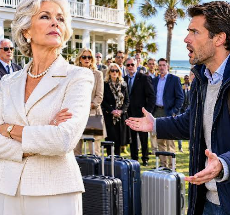
PART 5: THE LAST SECRET, THE BROKEN PROMISE, AND THE HOUSE THAT LOVE BUILT
The pounding on my front door grew louder.
“Mom! I know you’re in there! Open the damn door!”
I stood frozen in Nile’s workshop, holding the letter that had just shattered everything I believed about my husband’s death.
Fourteen years.
For fourteen years, I’d believed Nile had died of natural causes.
I’d buried him, mourned him, and spent countless nights wishing I could hear his voice just one more time.
Now my son was standing outside the house we’d built together, demanding entry because I’d discovered the secrets Nile had tried so desperately to protect.
Margaret immediately reached for her phone.
“Joanne, don’t open that door.”
I looked toward Noah.
My sixteen-year-old grandson was standing beside Rachel, his face pale with fear.
He had already learned more terrible things about his father in one afternoon than any child should have to hear.
And I refused to let him watch another confrontation become something worse.
“Rachel,” I whispered, “take Noah into the living room. Stay away from the windows.”
She nodded and gently guided him toward the hallway.
But Noah stopped.
“Grandma?”
I turned.
He looked directly into my eyes.
“Please don’t let him hurt you.”
Those words nearly broke me.
I walked toward him and placed my hands on his shoulders.
“Sweetheart, your grandfather taught me how to be stronger than I ever imagined. I’m going to be alright.”
Then I turned back to Margaret.
“Call the police.”
She nodded.
And I walked toward the front door.
Cullen was still pounding.
“Mom, this is ridiculous! Those papers belong to me!”
I stopped on the other side of the locked door.
“No, Cullen. They belonged to your father.”
Silence.
Then his voice lowered.
“Mom, please. We need to talk.”
“We’ve had seventy-one years of opportunities to talk, sweetheart. You’ve spent the last sixteen lying to me.”
“That isn’t fair!”
I almost laughed.
Fair.
My son wanted to talk about fairness while standing outside a house he’d tried to steal.
“Was it fair to hide my grandson from me?” I asked.
He didn’t answer.
“Was it fair to tell people I was dying?”
Nothing.
“Was it fair to forge my signature and use my home to obtain money?”
“Mom, you don’t understand!”
“Then explain it.”
His voice became desperate.
“Open the door first.”
“No.”
For the first time in my life, I heard something unfamiliar in Cullen’s voice.
Fear.
Not anger.
Not entitlement.
Real fear.
“Mom, Laurelai is going to destroy me.”
I frowned.
“What does Laurelai have to do with your father’s death?”
A long silence followed.
Then Cullen whispered, “Everything.”
My heart stopped.
Behind me, Margaret approached quietly.
She held up her phone, indicating that the police had been contacted.
I took a trembling breath.
“Tell me what happened that night, Cullen.”
He didn’t answer immediately.
When he finally spoke, his voice sounded twenty years younger.
“Dad found out about the money.”
I closed my eyes.
“The business money?”
“Yes.”
“He already knew about that.”
“No, Mom. Not that money.”
My stomach tightened.
“Then what money?”
Cullen began crying.
And I knew, before he said another word, that the truth was going to be worse than I imagined.
“Dad discovered Laurelai had been helping me move money through accounts connected to the old business.”
I pressed my palm against the door.
“But Laurelai said she met you only five years ago.”
“She lied.”
I felt my knees weaken.
Cullen continued.
“I met her through a property investment group. She was helping me find financing. At first, everything looked legitimate.”
“And then?”
“Then I borrowed money I couldn’t repay. Laurelai said she could fix everything if Dad agreed to use the beach house as security.”
I stared at the door.
My husband had spent six summers rebuilding that house.
He’d worked until his hands bled.
And my son had tried to gamble it away.
“What happened when Nile refused?”
Cullen’s breathing grew ragged.
“We argued.”
I felt my chest tighten.
“How badly?”
“Dad told me he was finished protecting me. He said he was going to tell you everything.”
I closed my eyes.
I could almost picture Nile standing in that workshop, his face filled with disappointment.
“And Laurelai?”
“She was there.”
My hand flew to my mouth.
So I hadn’t imagined her voice.
“She told Dad he was making a mistake,” Cullen continued. “She said if he exposed what we’d done, people would start asking questions about the business and the loans.”
“What did Nile say?”
“He told her to leave.”
A pause.
“Then he told me I had one last chance to tell you the truth myself.”
My eyes filled with tears.
Even after everything, Nile had given our son another chance.
One final opportunity to choose honesty.
“And what did you do, Cullen?”
Silence.
Then he whispered, “I grabbed the folder.”
My breath caught.
“Dad tried to stop me. We struggled over it. He reached for my arm, and his watch caught on the edge of the workbench.”
I remembered the broken clasp.
The one I’d found beneath that same bench.
Cullen began sobbing.
“I pulled away. Dad stumbled and grabbed his chest.”
I covered my mouth.
“He fell against the workbench. I thought he was just angry. I thought he’d get up.”
My entire body went cold.
“Did you call for help?”
“I… I didn’t know what to do.”
“Cullen.”
“I was scared, Mom!”
“DID YOU CALL FOR HELP?”
His answer came as barely a whisper.
“Not right away.”
I felt something inside me collapse.
“How long?”
He didn’t answer.
“HOW LONG, CULLEN?”
“About eight minutes.”
Eight minutes.
Eight minutes while my husband lay on the floor struggling to breathe.
Eight minutes while the man I’d loved for almost fifty years needed help.
And my son had been thinking about himself.
I leaned against the wall.
“Why?”
Cullen was crying openly now.
“Because Laurelai told me to get the documents first. She said we’d all go to prison if the police found them.”
I closed my eyes.
Nile had been dying.
And they had been collecting paperwork.
I had never imagined human selfishness could reach that depth.
Margaret gently took my arm.
“Joanne, you don’t need to hear any more right now.”
But I shook my head.
“No. I need the truth.”
I looked toward the door.
“Cullen, did you know your father called me?”
A long silence.
“Yes.”
My heart broke all over again.
“He wanted to tell me something.”
“I know.”
“He warned me about you.”
Cullen began crying harder.
“I know, Mom.”
Then he said something I’ll never forget.
“I thought if I could just get the house, everything would finally be alright.”
I stared at the door.
“And what about your father?”
No answer.
“What about me?”
Silence.
“What about Noah?”
Nothing.
I wiped my tears.
“You’ve spent your entire life believing money could erase consequences. But there are some things money can never buy.”
I paused.
“Like the eight minutes you took from your father.”
A broken sob came from the other side of the door.
Then Cullen whispered, “I’m sorry.”
For years, those two words would have been enough to make me open the door.
I would have hugged him.
Defended him.
Found another excuse.
But not this time.
“I’m sorry too, Cullen.”
He sounded hopeful.
“Mom?”
“I’m sorry I spent so many years protecting you from consequences you needed to face.”
Then I stepped away.
And when the police arrived six minutes later, I opened the front door.
Cullen was sitting on the porch steps.
His expensive honeymoon clothes were wrinkled.
His face was wet with tears.
He looked nothing like the confident man who had arrived twelve days earlier demanding the keys.
An officer approached him.
“Sir, we need to speak with you.”
Cullen looked at me.
“Mom, please.”
I stood in the doorway.
“I love you, Cullen.”
His eyes widened.
For one brief moment, hope returned to his face.
Then I continued.
“But loving you doesn’t mean I can keep protecting you from what you’ve done.”
The officers separated us and began taking statements.
Margaret provided the suspicious deed, the messages, and the documents from Nile’s cabinet.
I explained what I’d heard during Nile’s final phone call.
Rachel described the accounts opened using her identity.
Miles agreed to provide the financing records.
And Evelyn handed over the correspondence she’d kept for years.
Cullen was taken to the station for questioning.
I watched the police vehicle disappear down the driveway.
Then I closed the door.
And for the first time since Nile died, I allowed myself to cry without trying to be strong for anyone.
But the story wasn’t over.
Not even close.
Three days later, Laurelai disappeared.
Miles called Margaret in a panic.
His wife had emptied two investment accounts, packed a suitcase, and left their home before sunrise.
She’d also left behind a handwritten note.
I did what I had to do to protect this family.
Apparently, protecting her family had meant abandoning them.
But she hadn’t gone far.
Investigators traced the disputed financial transfers, and several days later, Laurelai was located in another state.
Over the following months, authorities investigated the financing scheme, the false property documents, and the circumstances surrounding Nile’s death.
The evidence surrounding the forged deed became central to the financial case.
The investigation into Nile’s death was more complicated.
Medical records confirmed he’d suffered a cardiac event, but the exact medical effect of the delay in calling for help could not be established with certainty.
Still, Cullen’s account of those eight minutes, together with the other evidence, became part of the official investigation.
I learned something important during those months.
The truth doesn’t always give you every answer.
Sometimes it simply forces you to stop believing the lies.
Cullen eventually entered guilty pleas to financial offenses connected to the fraudulent documents and loan scheme.
Laurelai also faced criminal charges for her role.
Neither the expensive wedding nor the family reputation she had guarded so fiercely could make those consequences disappear.
Blythe filed for divorce.
I wasn’t surprised.
But what happened afterward did surprise me.
One afternoon, Blythe appeared at my beach house.
She stood on the porch holding a small cardboard box.
“Mrs. Whitmore?”
I opened the door.
She looked exhausted.
Gone were the expensive designer clothes and perfect makeup.
She looked like a young woman who had been forced to grow up very quickly.
“I wanted to return something.”
She handed me the box.
Inside was the miniature replica of my beach house.
The one from their wedding cake.
The gray shingles.
The wraparound porch.
The little blue door Nile had painted.
I stared at it.
“Why are you giving me this?”
Blythe’s eyes filled with tears.
“Because it was never ours.”
I looked up.
She swallowed.
“I believed Cullen when he said you were too sick to attend our wedding. I believed him when he said you wanted us to have this house.”
Her voice broke.
“And I was so excited about being part of a wealthy family that I never stopped to ask whether any of it was true.”
For a moment, I saw something I hadn’t expected.
Genuine regret.
I stepped aside.
“Would you like some coffee?”
She looked surprised.
Then she nodded.
We sat at my kitchen table for almost two hours.
She told me about the messages she’d discovered.
About Laurelai’s obsession with social status.
About the crushing embarrassment of realizing her beautiful wedding had been built on deception.
And before she left, she said something I’ll always remember.
“Mrs. Whitmore, I thought marrying Cullen would give me the perfect life.”
I smiled sadly.
“A perfect life isn’t something another person can hand you, sweetheart.”
She nodded.
“I know that now.”
We never became close.
But we parted without bitterness.
And sometimes, that is enough.
Six months after the day Cullen demanded my keys, I drove to Willow Creek.
Evelyn, Rachel, and Noah came with me.
The farmhouse stood beneath a row of enormous oak trees.
Its white paint had faded.
The front steps needed repairing.
But the porch swing Nile had built was still hanging beside the front door.
Noah stepped out of the car.
“This was Grandpa’s house?”
I smiled.
“Yes, sweetheart. And one day, if the trust conditions are met, it will be yours.”
He looked toward the windows.
“Can we fix it up?”
I laughed through my tears.
“Oh, Noah. Your grandfather would have loved that question.”
Over the following months, we began restoring the farmhouse.
Not because it was valuable.
Not because it could make anyone wealthy.
But because it gave us something Cullen’s lies had stolen.
Time together.
Rachel painted the kitchen cabinets.
Evelyn planted roses beside the porch.
Noah repaired the old wooden fence with help from a local carpenter.
And I spent my afternoons telling him stories about the grandfather who had loved him quietly from the shadows.
Sometimes we laughed.
Sometimes we cried.
And sometimes Noah simply sat beside me on the porch while the sun disappeared behind the trees.
One evening, he asked me a question.
“Grandma, do you hate Dad?”
I looked at him.
It was the hardest question anyone had asked me.
“No, sweetheart.”
He frowned.
“Even after everything?”
I took his hand.
“Your father did terrible things. And he has to live with the consequences.”
I paused.
“But I don’t want hatred to take whatever years I have left.”
Noah looked down.
“Do you think he’ll ever change?”
I watched the evening light settle across the fields.
“I hope so.”
Then I added, “But changing is something he has to choose for himself.”
A year later, Cullen wrote me a letter.
It arrived in a plain white envelope.
No expensive stationery.
No demands.
No excuses.
Just four handwritten pages.
He admitted he’d spent years blaming everyone else for his failures.
He acknowledged what he’d done to Rachel, Noah, Blythe, and me.
And he wrote about his father’s final moments with a level of remorse I’d never heard from him before.
At the bottom, he’d written:
Mom, I know I don’t deserve your forgiveness. I won’t ask you for the house again. I won’t ask you to fix anything. I just want you to know that for the first time in my life, I understand what Dad meant when he said a man is measured by what he protects, not by what he owns.
I read that sentence three times.
Then I folded the letter.
I didn’t rush to answer.
Forgiveness isn’t a switch you flip because someone finally says the right words.
Trust takes time.
And some things can never return to the way they were.
But two weeks later, I wrote back.
Dear Cullen, I love you. I always will. But love does not erase responsibility. If you truly want to become a better man, begin by being honest with yourself. When you’re ready to build a life that doesn’t depend on taking from others, I hope we’ll be able to talk about the future.
Love, Mom.
I mailed it.
And I felt at peace.
Not because everything was fixed.
But because I had finally stopped trying to fix everything for him.
Then came the day that changed my life in a completely different way.
My seventy-second birthday.
I woke to the sound of laughter downstairs.
When I walked into the kitchen, I found Rachel making pancakes.
Evelyn arranging flowers.
And Noah standing beside the counter, holding a birthday cake.
“Surprise!” they shouted.
I pressed my hand against my chest.
On the cake was a small blue house.
Not the expensive replica from Cullen’s wedding.
This one was made from simple blue frosting.
A little crooked.
With uneven windows.
And a tiny wooden porch.
Noah grinned.
“I made it myself.”
I started crying.
He looked alarmed.
“Grandma, is it that bad?”
I laughed through my tears.
“No, sweetheart. It’s perfect.”
He hugged me.
And for a moment, I felt Nile standing beside us.
I could almost hear his voice.
That’s what a home is for, Joanne.
Later that afternoon, we gathered on the beach house porch.
The ocean stretched endlessly before us.
The same ocean Nile and I had watched for decades.
I had invited a few neighbors.
The people who’d stood beside me when my own family had tried to push me out.
There were no luxury cars.
No designer decorations.
No guests chosen for their status.
Just people who cared about one another.
As the sun began to set, I stood beside the railing and tapped my glass.
Everyone turned.
“I want to say something.”
Noah smiled.
“Oh, Grandma’s making a speech.”
I laughed.
“Yes, sweetheart. And you’re going to listen.”
Everyone chuckled.
I took a deep breath.
“A little over a year ago, I stood on this porch while my only son demanded the keys to my home.”
The laughter faded.
“I thought losing his love would be the worst thing that could happen to me.”
I looked toward Rachel and Noah.
“But I discovered something much worse.”
I paused.
“Losing myself while trying to keep someone else’s approval.”
Evelyn wiped her eyes.
“For years, I believed being a good mother meant sacrificing everything. My time. My money. My comfort. My peace.”
I shook my head.
“But love should never require you to surrender your dignity.”
I turned toward Noah.
“And sometimes, when life takes something away from you, it makes room for something you never knew you were missing.”
He stepped forward and wrapped his arms around me.
I kissed the top of his head.
“My grandson.”
My voice broke.
“Sixteen years late, but right on time.”
Everyone applauded.
Then Noah reached into his pocket.
“Grandma, I have something for you.”
He handed me a small envelope.
Inside was a photograph.
It showed Nile standing outside the old farmhouse, holding a little boy in his arms.
Noah.
He couldn’t have been more than two years old.
On the back, in Nile’s handwriting, were seven words.
“One day, Joanne will know this joy.”
I stared at those words until they blurred.
Then I pressed the photograph against my heart.
“Oh, Nile,” I whispered.
“You knew.”
I looked out toward the ocean.
For fourteen years, I’d wondered whether I’d failed my husband by not seeing the truth about Cullen.
Now I understood something.
Nile hadn’t left me a house to protect.
He’d left me a choice.
I could spend the rest of my life grieving everything I’d lost.
Or I could honor him by loving the people who were still here.
That evening, after everyone had gone home, Noah helped me carry the chairs inside.
We stopped beside the fireplace.
He looked at Nile’s photograph.
“Grandma?”
“Yes, sweetheart?”
“Do you think Grandpa would be proud of us?”
I smiled.
“I think he’d be very proud.”
Noah looked around the room.
“Do you ever wish you’d given Dad the house?”
I thought about that question.
The wedding.
The lies.
The forged deed.
The terrible secrets.
The years I’d lost with my grandson.
Then I looked at the little blue front door.
The one Nile had painted himself.
“No,” I said softly.
“Not anymore.”
Noah nodded.
Then he said something so simple, so beautiful, that I will carry it with me for the rest of my life.
“Good. Because I don’t want the house, Grandma. I just want more time with you.”
I pulled him into my arms.
And I cried.
Not tears of betrayal.
Not tears of grief.
But tears of gratitude.
Because my son had once believed a $1.94 million beach house was the greatest gift I could give him.
He’d lied, schemed, and nearly destroyed our family trying to get it.
But my grandson understood something his father had forgotten.
A house is worth what someone will pay for it.
A home is worth what people are willing to give to keep the love inside it alive.
The following morning, I met with Margaret.
Together, we updated my estate plan.
The beach house would remain mine for as long as I lived.
Afterward, it would pass into a carefully managed trust intended to preserve it for Noah’s future, with provisions ensuring he would never feel pressured to sacrifice his own dreams to keep it.
I also arranged support for a local program helping young families find stable housing.
Because after everything I’d experienced, I wanted this house to represent something greater than an inheritance.
I wanted it to represent second chances.
And before leaving Margaret’s office, I asked her to add one final instruction.
Nothing complicated.
Nothing extravagant.
Just a sentence I wanted Noah to remember.
“Never mistake the price of a property for the value of a family.”
Today, when I walk through my beach house, I no longer hear Cullen demanding his keys.
I hear Noah laughing in the kitchen.
I hear Rachel singing while she makes coffee.
I hear Evelyn complaining that the roses need more sunlight.
And sometimes, when the ocean breeze moves through the open windows, I imagine Nile’s laughter joining theirs.
My son excluded me from his wedding because he believed I wasn’t important enough.
He thought wealth created status.
He thought owning my home would make him successful.
But in the end, the greatest lesson of my life came from the grandson I never knew I had.
You can inherit a house without ever understanding what makes it a home.
And you can lose everything money can buy while discovering something far more precious.
Love.
Truth.
Family.
And the freedom to finally say no.
On the anniversary of Nile’s death, I stood alone on our porch and watched the sun rise over the water.
I held his photograph against my chest.
Then I whispered the words I’d spent fourteen years trying to find.
“Nile, I kept our promise. I protected our home. But more importantly, I finally learned how to protect myself.”
Behind me, the kitchen door opened.
Noah stepped onto the porch carrying two mugs of coffee.
“Morning, Grandma.”
I smiled.
“Morning, sweetheart.”
He handed me a mug and sat beside me.
And as we watched the waves roll toward the shore, I realized something that made me smile through my tears.
Twelve months earlier, thirty-four people had gathered on that very porch expecting to watch me surrender the keys.
But the real gift had never been behind the locked door.
It was sitting beside me.
My grandson.
My second chance.
My family.
And for the first time in years, I wasn’t afraid of what tomorrow might bring.
Because I finally understood the difference between being needed and being loved.
My son wanted the keys to my house. My grandson wanted a place in my heart.
Only one of them understood what it truly meant to come home.
THE END.