PART 1
My mother walked both of my sisters down the aisle.
Twice each, as it happens. Camilla has been married twice and Bronwyn has been married twice.
My mother did all four of those walks. A different hat each time. Beaming, with her chin up, the full length of the aisle — as though she were presenting a miracle dressed in lace to a room that had been waiting for one.
There are photographs of all four in the front room of that house. There are none of me anywhere in it and there never were.
On the morning of my own wedding she stood in the bridal suite, looked at me in the gown, and said:
“I refuse to walk my greatest regret to the altar.”
The room went completely silent. Four of us in it and not one sound for about three seconds.
My fingers shook a little around the veil.
I was holding it rather than wearing it, because the woman doing my hair had gone out for four minutes and had not come back, and I now know she was standing in a corridor having been told to give the family a moment.
Behind my mother, my two sisters traded a look.
Camilla was turning the diamond bracelet on her wrist — the one my mother mentions having helped buy, about four times a year, at tables.
And Bronwyn tipped her head and said, quietly enough to be deniable: “Don’t cry, Sabine. You’ll ruin the cheap mascara.”
I looked at myself in that mirror.
Twenty-nine years old. Face composed. Mouth steady. Four hundred dollars of hair.
And still, to those three people in that room, the same thing I had been at nine.
The one who got the attic. While my sisters had the two big rooms at the front with the bay windows, and a trip to Paris each for turning eighteen, and a car at twenty-one.
I got the attic in 2005 and I was told it was because I liked being on my own, which I did not, and which I then became.
My father was in the doorway in a grey tuxedo with his hands in his pockets.
Smiling slightly. The way that man has smiled since about 1998 whenever something is going badly for somebody who is not him, which in that house was always one of four people and was usually me.
“Your mother’s entitled to her feelings,” he said. “You’ve always been difficult.”
PART 2
Difficult.
Difficult meant asking, at nineteen, where my college fund had gone.
That question got answered once, in four words — there wasn’t one, Sabine — at a kitchen table, with my father reading something, and it was never answered again in ten years of asking it about eleven different ways.
Difficult meant asking why my grandfather’s letters had stopped coming when I was about fourteen.
I asked that four times. The answer was always that he was getting old and that I should not make him feel bad about it.
And difficult meant becoming a forensic accountant.
Instead of marrying somebody comfortable at twenty-four and being quietly grateful for the next forty years, which is what both of my sisters did and which is the only career either of them has ever been praised for.
My fiancé came forward. Ezra is extremely calm and I could see exactly how calm he was not, and I put two fingers on his sleeve.
“Don’t,” I said. “Not yet.”
My mother laughed. Once, through her nose, the way she does.
“Still dramatic. Even today.”
And then the door opened.
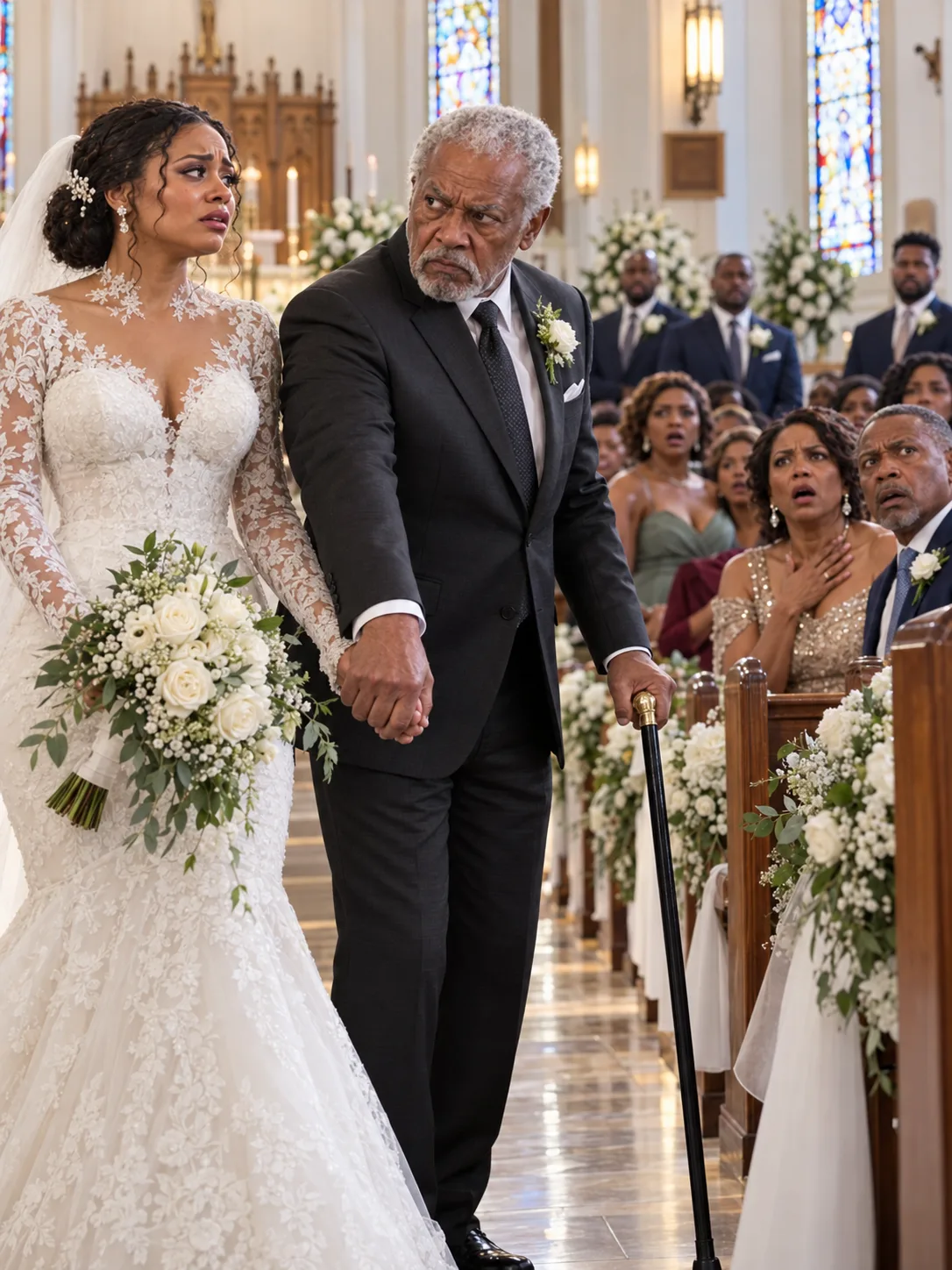
My grandfather came in at his own pace, on his black cane, the way he has come into every room since about 2019.
White hair combed flat with water. A navy suit older than either of my sisters’ marriages and in considerably better condition than my parents’ consciences.
He had shaved badly on one side, which I noticed from about four feet away and which told me he had done it in a hurry.
Eighty-one years old. Four inches shorter than he was.
And he still has the kind of eyes that stop a room doing whatever it happened to be doing, which I have watched work on about forty people over twenty-nine years and which has never once failed.
He looked straight at my mother.
“Rosalind. You said what?”
My mother’s face set. “This is family business.”
“I am family.”
My father moved towards him. “Barnaby. Don’t make a scene.”
Four words that man has used on about eleven different people in my hearing, and that have worked every single time.
My grandfather did not look at him.
Not once. Not in that room and not in that aisle and not for the whole of the rest of that day — about four separate occasions on which my father spoke directly to him and got nothing at all.
I noticed it at the time and did not understand it. I understand it completely now and it is in part five.
He turned to me and put out his hand.
“I’ll walk you.”
My throat closed. “Grandad —”
“You were never a regret, Sabine.”
His thumb pressed into my palm. Hard, twice, the way he has done at four funerals since 2011 when somebody needed to stop crying for ninety seconds.
“You’re the only one who came back for the truth.”
And my mother’s smile slipped.
A fraction of a second. Perhaps less.
But I saw it. And he saw it, and he saw me see it, and I have thought about that exchange about four hundred times since.
PART 3
Out in the hallway the organ started.
That church held about two hundred people.
Relatives. Business contacts. Neighbours of thirty years who have watched that family go in and out of a front door since 1996.
And four separate donors to my parents’ charitable foundation, two of whom had flown in, one of whom is eighty-four and had been driven four hours by his son.
All of them there on the understanding that the Harrow family is exactly what it looks like from the road.
My mother went out ahead of us and took her seat in the front pew on the left, with her chin up and her hat straight.
Four people have told me since how composed she looked. She was perfectly certain she had already won the morning — and she had every reason to be, because she had won every single one of these for twenty-nine years.
What she did not know is that I had spent the previous eighteen months tracing every dollar.
Every grant in. Every disbursement out.
Eleven years of filings. Four amended returns, all four amended in the same month. And a set of trustee minutes recording decisions on dates when the bank says the money had already moved.
I am good at this.
It is what I do for a living. I have done it to about forty companies and given evidence twice.
And I had been doing it to my own family, at night, after work, at a kitchen table in a flat, since the January before last — about four hundred evenings, in a notebook and then in a spreadsheet and then in something considerably more serious than either.
I had it in a folder. I had it on a drive.
And the drive was in the little white clutch bag hanging from my left wrist. Four inches from my own hand. On my wedding day, in a church, in a white dress.
I had a plan for it. A specific one, with a time on it.
I will come back to that, because it is the part of this that is mine and because there is no version of this account worth writing that leaves it out.
We got about eleven rows down that aisle. Perhaps forty feet. Slowly, because of the cane.
And then my grandfather stopped.
Not stumbled. I want that clear because two people have since told the story with a stumble in it.
He stopped. He planted that cane and turned his whole body round — slowly, in about four seconds, the way a man of eighty-one has to turn, one foot and then the other —
until he was facing the front pew on the left-hand side.
Two hundred people, mid-organ, half of them out of their seats, watching an old man with a cane turn round in the middle of an aisle.
It took him about four seconds and nobody in that building breathed through any of them.
He looked at my mother in that front pew.
And he said eight words.
“Rosalind. Show them the letter you wrote me.”
PART 4
The church did not go quiet.
It made a noise.
About two hundred people made the same small sound at exactly the same time, and then stopped making it, all within about two seconds.
The organist took four or five more seconds to work out that something had happened behind her, and then the music stopped halfway through a bar, which is a sound I will have for the rest of my life.
My father’s face changed.
He had been smiling in that pew for the whole of the procession. Two seats along from my mother, with his arm along the back of the wood.
It went off that man’s face in about one second and it did not come back for the rest of the day, and I have seen the photographs and there are four of him and it is not there in any of them.
And my mother leaned towards my grandfather and whispered something.
I did not hear it. I was about four feet away and I did not hear one word of it.
Four people in that pew did. I have been given three different versions since and two of them are clearly polite.
The one I believe, because two separate people gave it to me independently and neither of them likes me, is two words.
You promised.
And then my father came out of that pew into the aisle.
He took hold of my wrist.
My left wrist. The one with the bag on it.
I do not think that was deliberate. He had no idea what was in it and still does not. But I have thought about it about four hundred times since, because of what was four inches from his hand.
And he said, loudly enough for the whole church: “That’s enough. Sit down.”
Nobody moved. Not one of two hundred people.
Somebody four rows back dropped an order of service and it went off the pew and onto a stone floor and everybody heard it.
He did not let go. He leaned in and he said: “Not here.”
And my grandfather, who had his other hand flat on my arm the entire time, did not look at him then either.
He kept looking at my mother.
And with my father holding his granddaughter’s wrist in an aisle in front of two hundred people, my grandfather said the second thing.
Four words.
“She was thirteen, Rosalind.”
PART 5
There is a letter.
I had not known it existed. I want that on the page before anything else in this part, because I spent eighteen months on that family and I did not know about the single most important document in it.
It is dated the fourth of September, 2009.
Two pages. Handwritten, on the cream paper she used for everything until about 2014, from my mother to her own father.
The handwriting is completely steady. That is the thing I noticed first and it took me about four days to work out why it bothered me: she did not rush it and she did not cross anything out.
I was thirteen years old. I was in the third year at school. I had just been moved into the attic.
In it she asks her father to take me.
Not for a summer. Not for a term. Not until things settled down.
Permanently. To make me his — legally, on paper, at a desk, with everything that goes with that word.
The letter gives four reasons. I have read all four of them about a hundred times now and I am going to put down only the fourth, because the first three are about money and the fourth is not.
She wrote that she did not believe she was ever going to feel about me the way she felt about the other two.
That it was not going to change. That she had been waiting about eleven years for it to and had stopped expecting it.
And that she was tired of looking at me across a table and waiting.
That is, as far as I can tell, the only completely honest sentence my mother has written down in her life.
My grandfather said yes.
In four days. By return of post, more or less.
He was sixty-five years old. He had a four-bedroom house, a wife eleven months dead, and nothing whatsoever to do with his days.
He said yes inside four days, and then he went upstairs and started clearing the back bedroom, and he painted it, and I have seen the receipt for the paint because that man keeps everything.
And then she changed her mind.
About eleven days later, in four lines, by post.
Not because she loved me. I want to be exact about this because it would be very easy to go soft here and it would be false.
She changed her mind because accepting meant explaining it.
To her two sisters. To the church. To about four hundred people in a town where the Harrows have been the Harrows since her husband’s father, and where a woman does not simply hand her thirteen-year-old daughter over to her own father and go back to a four-bedroom house with two children in it instead of three.
There would have been a question. One question, asked four hundred times at the school gate, and she could not answer it.
She kept me because giving me away would have had to be accounted for.
And then she spent sixteen years punishing me for a letter I did not know existed.
Sixteen. From thirteen to twenty-nine. Through two of my sisters’ weddings and then two more.
Every single thing that woman has said to me since the autumn of 2009 has been said by somebody looking at a person who knows something about her — except that I did not, and could not, and never once worked out why I was being looked at like that.
That is what my greatest regret means.
It is not me. It has never been me.
The regret is two pages of her own handwriting in a drawer in her father’s house.
The one object on earth that says plainly what that woman is. In her own hand. Four hundred words of it, with her signature at the bottom and the date underneath.
She has spent sixteen years in the same room as a man who had it in a box upstairs, being pleasant to him at Christmas.
And then there are the letters.
My grandfather never stopped writing to me.
He wrote about once a month from 2010 until the autumn of 2016.
Birthdays. Four pages at Christmas every year without fail. And small ones in between with nothing in them at all except what he had been doing that fortnight.
They came to that house. Every one of them arrived; the post in that town has never failed in its life.
They were taken out of the pile on the hall table, in the four minutes between the postman and me coming down, and they did not reach the attic.
I used to come down at about eight and go through that pile. For six years. Looking.
There are about fifty of them. They are in a shoebox with a lid. He kept writing for six years into total silence, and then at some point in 2016 he worked out what was happening and he stopped —
and he did not stop because he gave up.
He stopped because he realised that every letter arriving was a reminder to her that the correspondence existed, and that one day somebody was going to ask about it, and he did not want her burning them.
That is a man of seventy-two doing document preservation on his own daughter.
In 2016. On his own, at a kitchen table, with a biro and a shoebox — having worked out, correctly, that the single most dangerous thing he could do to those letters was keep producing more of them.
Now my part, and there is no honest version of this without it.
I spent eighteen months on the money.
Eighteen months. About four hundred evenings. Bank statements, filings, trustee minutes, two separate sets of accounts for a foundation with eleven donors.
I built something extremely good. The woman I have now handed it to told me it was the cleanest unpaid work she had seen in four years.
And in eighteen months I never once asked my grandfather a question.
Not one question. Not one.
He was eleven feet away at four consecutive Christmases while I was doing it. I sat opposite that man and talked about the garden.
He has a landline. He answers it on the fourth ring, every time, because it takes him four rings to get across a room.
He had the whole of it — the letter, the fifty envelopes, the reason, the year, all of it in a box in a house forty minutes from mine.
And I did not ask him.
Because a file is a thing I can control. I can do a file at eleven at night with the door shut and nobody looking at me.
A conversation with an eighty-one-year-old man about why my mother does not love me is not a thing I can control, and it would have taken about forty minutes, and I would have had to sit there with my face doing whatever it was going to do.
I chose the version of the truth that could be done at a desk, on my own, with a spreadsheet, where nobody could look at my face.
And it goes further.
I almost did not invite him.
He was on the maybe list for about four months.
The reasons I gave myself were that he is eighty-one and the church has four steps at the front and no handrail on the left.
The real reason is this one, and I have written it down four times now and deleted it three:
I had decided, at some point in my twenties, that he had let it happen.
That he had known perfectly well what that house was, and had sent letters instead of doing something about it.
I had that opinion for about ten years. I never once tested it. I had assembled it out of absence, which is exactly the thing I am paid to tell other people not to do.
I was wrong by exactly one letter and six years of trying.
And it goes further still, and this is the one.
I had a plan.
The drive in that bag was not sentimental. I had scheduled it.
Four speeches at the reception. And then my father was going to stand up, because he had insisted on a fifth and had been writing it for about a fortnight.
And I had arranged — with the man running the AV, in advance, on the Thursday, in a car park, for four hundred dollars of my own money —
for a single page to come up on the screen behind him, about ninety seconds in, while he was talking about family.
That was it. That was what I had planned for my own wedding day.
Not a toast. A cue.
I was going to stand four feet away and let two hundred people watch my father’s face.
At a top table. In front of four donors and his own mother-in-law and about forty neighbours.
I had chosen which page. I had checked the font, at eleven o’clock at night, about a fortnight before — so that the numbers would be legible from the back of a room.
And my grandfather took it out of my hands eleven rows down the aisle by saying eight words, badly, in public, where it could not be managed.
He knew I had something.
He has told me since that he worked it out at the rehearsal, on the Friday, from about four minutes of watching me be pleasant to my mother.
You’ve never once been pleasant to that woman in your life, he said. You were pleasant for four minutes. I knew on the Friday.
And he went first on purpose.
Because he is a trustee.
His name is on that foundation. It has been since 2011.
He signed four of the documents I spent eighteen months reconstructing. Four. I found his signature on the first of them in about the eleventh week and I sat in my own kitchen for an hour.
He signed them because his daughter put them in front of him at a table with a pen and said they were for the hospice. And he did not read them, because she is his daughter, and because he was sixty-seven and his wife was dead.
He is eighty-one and he is in it. Not the worst of it, and his solicitor has used the phrase extremely unlikely about four times, and he is still in it.
He knew that. He has known it since 2016.
And he stood up in an aisle at eighty-one years old and opened the whole thing himself. Out loud. In a church. In front of two hundred people including every donor his daughter has.
So that when it came out — and he knew it was coming out, he had known since the Friday —
it would not come out of my mouth, at my own wedding, in front of my husband’s family.
It has been eleven weeks.
We did get married. That afternoon, in that church, about forty minutes late, with my father sitting down for the whole ceremony and my mother not there.
I am not going to pretend it was a nice wedding.
About a third of those guests had gone by the dinner. Four tables went entirely and we did not rearrange, so there were four empty round tables with full place settings on them all evening.
The AV man, who had four hundred dollars of mine in his pocket, did nothing at all. He found me afterwards and tried to give it back and I would not take it, and I have never been more grateful to a stranger in my life.
Ezra married a woman who had been planning an ambush and had not told him.
I told him on the second night.
That was considerably harder than anything that happened in that church. He sat at the end of a bed in a hotel for about four hours and was quiet.
And then he asked me one question. Not about my parents. About me.
He asked whether I had been going to tell him before or after.
I did not have an answer for him.
I still do not, eleven weeks later, and I have had four goes at one.
The foundation is with people whose job it is now. There are four names in it.
One of them is my grandfather’s. One of them belongs to a woman who has been on that board for eleven years and has never attended.
And one of them is not my father’s — which has surprised everybody, including me, including the people whose job it now is, and which is the loose end in all of this that I cannot make lie flat.
It will take about two years. There have been four meetings and three of them had nothing in them.
Nobody has been arrested and probably nobody will be, and what is actually coming is a number in an agreement that about eleven people will ever read.
My mother has not spoken to me in eleven weeks.
She has written once. Four pages, on the cream paper.
About three and a half of those four pages are about what I have done to her — the church, the donors, her sisters, the woman at the hall who has stopped ringing.
Half a page is about the letter. She says she was not well that year and that I would not understand, and that is the whole of it, and she does not say sorry anywhere on any of the four pages.
Camilla rang me in the ninth week.
We talked for about forty minutes, which is the longest real conversation I have had with that woman since we were about eleven and nine.
It was mostly her asking me what else was in the box. And then, at about minute thirty-four, it was not — and she asked me what the attic had been like in winter, which nobody in that family has ever asked me.
Bronwyn has not rung and I do not expect her to.
She has posted four times about family being everything and I have been shown all four by people who think they are helping.
I have the letters.
My grandfather gave me the box on the fourth day.
In his own front room, at about eleven in the morning, with a cup of tea in front of each of us and neither of us touching them.
About fifty envelopes. In order, oldest at the front. With a rubber band round them that had gone brittle and broke in my hand when I picked it up, which neither of us said anything about.
I have read eleven of them.
One a week. That is the rule and it is mine and Ezra has not argued with it.
He reads them with me on a Sunday morning. Each one takes about four minutes and then I have to go and do something else with my hands for an hour.
They are completely ordinary. That is what nobody warns you about. They are about the garden. About a man called Ralph who he plays dominoes with and who died in 2018 and who I have therefore met in eleven letters and never once in life.
About what he had for his lunch. About the weather four days running.
Eleven of fifty.
And the thing that has taken me apart is not anything inside any of them.
It is that there are fifty. That he sat down fifty times, over six years, and wrote four pages about nothing to a girl who never once wrote back —
and did not stop, and did not take offence, and never mentioned it to me at a single Christmas in the sixteen years since.
Here is the only thing I have.
Everybody wants this to be about a wicked mother and an old man stopping in an aisle, and about eight words in a church.
He did stop. He did say them. Two hundred people heard it and four of them have described it back to me and all four descriptions are wrong in the same direction, because they have made him braver than he was and more certain than he was.
He was frightened.
He has told me so, plainly, in his own kitchen, in the fourth week. He had worked out exactly what it was going to cost him. He had been awake since about four that morning and had shaved badly because of it.
He said he nearly did not. He said he got about eleven rows down that aisle still deciding.
But the thing that actually mattered in that building was not in his mouth.
It was in a box in his spare room, and it had been there for sixteen years, forty minutes’ drive from my flat.
I spent eighteen months, four hundred evenings and about eleven thousand dollars of my own time building a case against my parents.
And the whole of what I needed was with a man who answers his landline on the fourth ring and would have told me any single day of those eighteen months.
If you are building a file on somebody —
and some of you are; you know exactly who, and you have a folder, and it is beautifully organised —
stop for one evening and go and ask the oldest person who was in the room.
Not for evidence. They will not have evidence; evidence is what you have been building for eighteen months.
They will have one letter. A box. A date. And the four seconds of context that make every single thing in your folder mean something different.
Because a file is a thing you can do on your own, at a desk, where nobody can see your face, and that is precisely why you are doing it that way.
I chose a spreadsheet over an eighty-one-year-old man for eighteen months.
Four hundred evenings. He is eighty-one. I want somebody to sit with that arithmetic for a moment, because I have had to.

