He mistook the question for fear. His smile widened. “I’ll go easy on you.” “I wasn’t asking about me.” A few people laughed, but Grant stepped closer with his phone. “This is friendly,” he said. “One controlled round. Nothing serious.” “You arranged an audience and brought spare gloves.” “I thought you might want a fair opportunity to clear up what happened.”
“What happened is already clear.” “Not online.” There it was. This was not about Logan’s pride alone. Grant wanted a video that could replace the one story he could not control—the story of his son releasing a bicycle because a quiet woman had told him to. I stepped around the gloves. “No.” Logan moved into my path. People shifted in their chairs. Noah came forward, but I held one hand behind me, and he stopped.
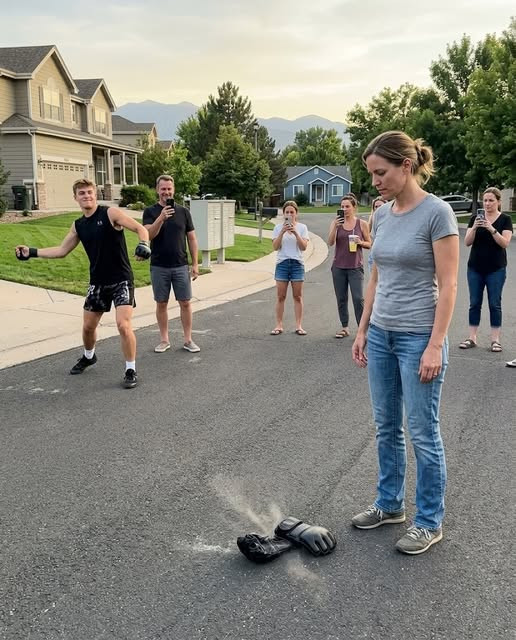 Logan looked past me at him. “Your mom always fight your battles?” “No,” Noah said. “She just finishes them.” Grant’s phone tilted slightly as he laughed. Logan did not. He reached down, picked up the gloves, and pressed them against my chest. “Put them on.” I looked at his hands, then at his father. Grant was smiling at his screen, watching the number of viewers climb. I finally understood that walking away would not end the performance.
They would follow us with the camera, edit my refusal into cowardice, and make Noah carry the cost at school while Logan’s father turned the humiliation into publicity. So I took the gloves. Noah whispered, “Mom.” I turned to him. “I’m not doing this because he challenged me.” “Then why?” “Because he thinks stopping is the same as losing.”
I pulled the gloves on and faced Logan. “One round,” I said. “No elbows, knees, head strikes, or attacks after either person says stop.” Logan shrugged. “Whatever makes you comfortable.” “Repeat the rules.” His eyes narrowed. Grant said, “They’re on video, Colonel.”
“I wasn’t asking you.” Logan repeated them. Then he raised his hands. He was faster than the neighbors expected and more skilled than his online critics would have admitted. His first step closed the distance cleanly, and his lead hand touched my shoulder before I moved outside his second strike.
The crowd reacted as though he had already won.
Grant shouted, “That’s it. Keep pressure on her.”
Logan advanced with disciplined combinations, cutting off the open side of the street and forcing me toward the curb.
I did not counter.
I watched his feet, breathing, and eyes.
Every few seconds, his gaze flicked toward his father’s phone.
Not long enough for anyone else to notice, but long enough to tell me whom he was truly fighting for.
He kicked toward my ribs.
I turned just enough to absorb it across my arm.
Pain traveled from my elbow to my shoulder, sharp and honest.
Logan heard the neighbors gasp and became less careful.
“Thought you commanded Rangers,” he said.
“I did.”
“Then do something.”
“I am.”
He lunged again.
This time, I changed levels, guided his arm past me, and used his forward momentum to take his balance.
His knee touched the pavement.
I released him before his other hand landed.
The entire exchange lasted less than two seconds.
Logan sprang up, embarrassed rather than hurt.
Grant lowered his phone just enough to say, “Don’t let her make you look stupid.”
Logan’s jaw tightened.
I saw the words enter him like a command.
Until that moment, I had believed Logan’s arrogance was the center of the problem.
Then I saw Grant’s expression.
He was not worried about his son’s safety, confidence, or judgment.
He was worried about the footage.
Logan attacked harder.
His technique began to unravel under the need to create a dramatic ending, and the more his father shouted, the more he abandoned the discipline that had earned him those three amateur victories.
I blocked a wide hook, stepped away from a kick, and said, “Slow down.”
He heard pity instead of instruction.
“Stop talking to me like I’m a kid.”
“Then stop fighting like one.”
He charged.
The heel of his rear foot slipped against a patch of loose gravel near the curb, but he was already committed to a turning strike.
His body rotated faster than his balance could follow.
For one instant, his head and shoulder were moving directly toward the concrete edge beside Grant’s SUV.
I could have stepped aside.
Instead, I moved in.
I caught his upper arm, braced across his torso, and redirected his fall away from the curb.
We hit the pavement together, but I controlled the descent and kept his head from striking the concrete.
Before he could recover, I trapped his wrist and shoulder in a position that made the next choice unmistakable.
He fought it for two seconds……