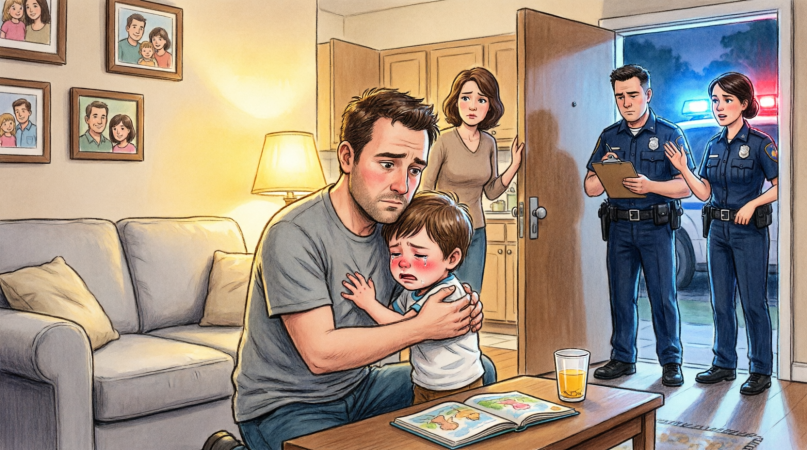
A police officer looked up.
“From the bathroom?” he asked.
Lorena nodded too quickly.
“Yes. He slipped. You know how kids are—they complain about everything.”
I felt a rage so deep it left me speechless.
My son was behind a door, trembling, and she was still using the same old words: “complaining,” “drama,” “too sensitive.”
The doctor came out twenty minutes later.
She didn’t look uncertain.
Her jaw was tight, and she held a folder against her chest.
“We need to transfer him to a pediatric hospital and activate protocol,” she said.
Lorena stepped forward.
“Doctor, I can take him. I’m his mother.”
The doctor didn’t even look at her.
“No. The child will remain under medical protection for now.”
Lorena turned pale.
“What are you implying?”
“I’m not implying anything. I’m documenting injuries.”
That word pierced straight through me.
Injuries.
Not a hit.
Not a fall.
Injuries.
Tomás came out on a stretcher, lying on his side with his face buried in a sheet. When he saw me, he stretched out his hand.
“Dad…”
I ran to him.
“I’m here, champ.”
“Is Mom coming?”
I looked at Lorena.
She tried to smile at him.
Tomás went stiff.
The social worker noticed.
“The lady will wait outside.”
Lorena let out a nervous laugh.
“This is absurd. My son is confused.”
The doctor closed the folder.
“Then we’ll make sure we hear him without pressure.”
They took us to the Pediatric Hospital in Coyoacán. The ambulance moved through half-empty streets, the siren echoing against the buildings. I sat beside Tomás holding his hand while he whispered over and over that he didn’t want to go back with Diego.
That night, the hospital stopped being just a name on a medical form and became the first place where someone saw my son as a child, not a problem.
“Who is Diego?” the paramedic asked gently.
Tomás closed his eyes.
“My mom’s boyfriend.”
I already knew.
But hearing it in my son’s broken voice made me hate myself.
Diego had shown up six months earlier carrying flowers for Lorena, wearing gym clothes, speaking with a friendly voice. He used to slap me on the back.
“Count on me for anything, buddy.”
I was never his buddy.
I was the father who got in his way.
In pediatric emergency care, they asked me to wait while specialists examined Tomás. I wanted to go in. I wanted to never let him go. I wanted to break every protocol with my bare hands.
A social worker stopped me.
“Mr. Andrés, I know this hurts, but we need to protect the evidence and the child. Even from you, even though you were the one who called.”
I wasn’t offended.
I felt ashamed.
Because I understood that real protection meant not blindly trusting any adult.
Not even me.
Lorena arrived fifteen minutes later with Diego.
He looked serious, wearing a black jacket, hair still wet, carrying that offended-man expression people practice in front of mirrors.
“Where’s my son?” Lorena asked.
“He’s being evaluated,” the nurse replied.
Diego stepped forward.
“I want to see him too. I live with him.”
The police officer moved in front of him.
“You’ll wait here.”
Diego smiled.
“Officer, don’t make this bigger than it is. The kid fell. Andrés is using this to take custody away from his mother.”
The examination room door opened.
Tomás screamed from inside.
It wasn’t a loud scream.
It was a scream of panic.
“Don’t let him in!”
Everyone froze.
Diego stopped smiling.
The doctor stepped out.
“That man is not to approach the child.”
Lorena tried to speak, but her voice cracked.
“Tomás is being manipulated.”
For the first time, the doctor looked directly at her.
“Ma’am, your son just asked us not to let him near him. We’re going to listen to him.”
That sentence felt like watching a door open inside a burning house.
At midnight, staff from the DIF arrived.
They explained that Mexico City’s DIF handles reports of child abuse within families through intervention by a multidisciplinary team and can begin comprehensive care for children after screening. I nodded, but inside I was trapped in a single image: Tomás asking me if he could sleep standing up.
The psychologist spoke to him using dolls.
She didn’t force him.
She didn’t pressure him.
She told him:
“You can point. You can write. You don’t have to say everything today.”
Tomás picked up a small doll and placed it behind a chair.
Then he picked up a bigger one.
He placed it in front of the door.
“This is Diego,” he whispered.
It felt like my skin was being ripped off.
The psychologist spoke softly.
“Did Diego hurt you?”
Tomás nodded.
“Did your mother see it?”
He didn’t answer.
Then his eyes filled with tears.
“She turned up the TV.”
Lorena was in the hallway when she heard him.
“Lies!” she screamed. “Andrés put those ideas in his head!”
The officer moved her back.
Diego started walking toward the exit.
“I’m calling my lawyer.”
“Do not leave,” the officer said.
“I’m not under arrest.”
“You are required to give a statement.”
Diego let out a humorless laugh.
“You have no idea who you’re messing with.”
I did.
A coward.
At two in the morning, a woman named Graciela arrived.
She was Lorena’s neighbor. She lived in the apartment downstairs. She always greeted me when I came for Tomás, but never said more than “good afternoon.”
That night she walked into the hospital carrying an old cellphone and a bag of sweet bread nobody was going to eat.
“I’m sorry,” she said, staring at the floor. “I heard things. I recorded some of them.”
Lorena went white.
“Graciela, stay out of this.”
The woman lifted her face.
“I should’ve gotten involved sooner.”
On the recording, a television was blaring loudly.
Underneath it, blows.
Then Tomás’s voice:
“No more, please.”
Then Diego:
“If you tell your dad, you’ll see what happens.”
And then Lorena, clear and tired, as if annoyed by the interruption:
“Make him shut up already. We’ll drop him off tomorrow.”
I folded over in the chair.
I didn’t cry.
Not because I was strong.
Because sometimes the body freezes so it won’t die.
Graciela was crying.
“I’m sorry. I was scared. Diego has friends. Lorena said you were crazy.”
I took her hand.
“Thank you for not deleting it.”
That was all I could say.
The next morning we were referred to a Women’s Justice Center. In Mexico City, those centers provide specialized and coordinated services for women, girls, and boys up to age twelve who are victims of family or gender violence. Tomás was eight, and for the first time his age wasn’t used to call him a liar, but to protect him.
That’s when the slow part began.
The real part.
The kind that never appears in movies.
Statements.
Photographs.
Evaluations.
Clothes sealed in bags.
Interviews with psychologists.
Copies.
Signatures.
Phone calls.
The same questions repeated carefully without breaking the child.
Tomás would fall asleep for moments in a chair leaning against my arm, waking every time a door slammed shut.
“Is Diego here?” he would ask.
“No.”
“Mom?”
“She’s outside.”
“Are you taking me back?”
“No.”
“Even if she says yes?”
“Even if she screams.”
He looked at me as if he wanted to believe me but didn’t know how anymore.
That was the hardest part.
Not winning temporary custody.
Not hearing Lorena accuse me.
Not watching Diego pretend to be innocent.
The hardest part was realizing my son no longer trusted the word of any adult.
Not even mine.
The first emergency hearing was three days later.
I hadn’t slept.
Tomás was with my sister under authorized supervision because they didn’t want to expose him to the courthouse hallways.
Lorena arrived dressed in white.
Like a victim.
Diego didn’t go inside, but he stood outside leaning against a truck.
She cried in front of the judge.
“My son is being manipulated by his father. Andrés never accepted the divorce.”………………………………………………