My husband left my father’s funeral to travel with his mistress.
But at 3 a.m.
I received a message from my father: “My daughter, it’s me.
Dad
Come to the cemetery immediately and very quietly.”
Even now, when I replay that night in my head, that is the sentence that still makes my skin go cold.
My father, Thomas Carter, died on a Thursday afternoon after years of heart failure.
|Not the dramatic kind people picture in movies.
His illness was slower, crueler, and somehow more exhausting.
It took his breath first, then his strength, then his ability to hide how frightened he really was.
By the time he died, every room in my parents’ house held some trace of the battle: pill organizers on the counter, oxygen tubing by his chair, hospital paperwork stacked in neat piles because my father hated mess even when he was sick.
I was his only daughter.
He used to call me Missy when I was little and Melissa whenever he wanted me to know he was being serious.
He was the one who taught me to change a tire, balance a checkbook, and spot the difference between confidence and charm.
Looking back, that last lesson might have saved me if I had remembered it sooner.
My husband, Andrew, had been all charm when we met.
He knew how to smile at waitresses, how to speak softly to strangers, how to make every selfish instinct sound like ambition.
For the first two years of our marriage, I mistook calculation for stability.
By the fourth year, I knew he was colder than he wanted the world to believe, but I kept explaining him away.
Stress from work.
Pressure.
Money worries.
The usual excuses women make when they are not ready to admit that the person beside them is not confused or damaged or temporarily distant.
He is simply showing you who he is.
My father saw Andrew more clearly than I did.
He never pushed me to leave him.
That wasn’t his style.
But during his last month in the hospital, when Andrew thought I was out getting coffee, my father took my hand and asked me a strange question.
Has he always watched people’s money the way he watches mine?
I laughed at the time because it sounded petty, almost paranoid.
Andrew had been handling some of the insurance calls, helping organize bills, talking to doctors with me.
I thought my father was embarrassed by needing help.
Now I know he was warning me in the only way he could without starting a war at his bedside.
At the funeral, Andrew’s mask slipped in a way I could never unsee.
My father had been buried less than half an hour when Andrew leaned down and murmured that he had business to handle.
He didn’t squeeze my hand.
He didn’t ask if I wanted him to stay.
He simply left.
That night my cousin Jenna called by accident while trying to reach someone else, and in the middle of apologizing she let something slip.
She had seen Andrew at the airport with a blonde woman in medical scrubs under a coat.
Not work clothes, she said.
More like someone trying to cover what she was wearing.
I asked her to describe the woman, and by
the time she mentioned the sharp bob haircut and the silver badge clip on her purse, I felt physically sick.
Kendra Walsh.
My father’s hospice nurse.
I didn’t even cry then.
I was too stunned.
I just sat on the edge of my childhood bed in my funeral dress, numb with a kind of humiliation so deep it seemed to hollow out my bones.
My father was gone.
My husband had left me hours after the burial.
And the woman he left with was one of the last people trusted to care for my father.
My mother, Elaine, finally cried herself to sleep in the next room.
I stayed awake under the old glow-in-the-dark stars that were still stuck to my ceiling from high school.
It was almost funny, in a bitter way.
I was thirty-four years old, grieving like a child, abandoned by my husband, and back in the room where my father once sat beside me after nightmares.
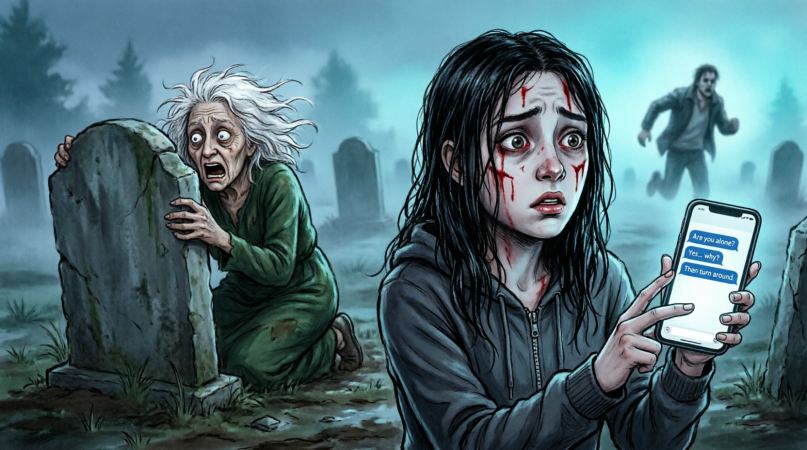
Then my phone buzzed at 3 a.m.
The message came from an unknown number.
My daughter, it’s me.
Don’t panic.
Come to the cemetery immediately and very quietly.
I need you.
It used my father’s voice so perfectly that it felt like someone had reached into my chest and squeezed.
Come very quietly was his phrase.
He had used it for private talks my entire life.
Only someone close to him would know that.
I left without waking my mother.
I did not call the police because I was not thinking like a careful person.
I was thinking like a daughter whose dead father had just spoken in the language only he used with her.
The cemetery was almost empty, washed in weak yellow light.
My father’s phone was propped against his gravestone, screen glowing.
Fresh footprints marked the wet soil.
Before I could decide whether to grab the phone or run, Walter Boone, the cemetery caretaker, stepped from the shadows and said my father had asked him to do this.
Boone handed me an envelope with my name written in my father’s handwriting.
My father, he explained, had visited the cemetery weeks earlier and left instructions.
If Andrew abandoned the funeral early, Boone was to place the phone on the grave after midnight and wait nearby in case I came alone.
Inside the envelope, my father had written: If Andrew leaves before the condolences are over, stop trusting what you think you know.
Start with the phone.
Then go to the red toolbox in my workshop.
Do not tell your mother yet.
The phone unlocked with my birthday.
One audio file was waiting.
My father’s voice was weak but steady.
He said Andrew was not only unfaithful.
He was lying about money, pressing him to sign documents, and showing far too much interest in his medications.
My father had changed his will on Monday.
Andrew found out.
That, my father said, was why Andrew had suddenly become desperate.
He told me there was a key and a memory card hidden in the red toolbox in the workshop and instructed me to get to First National Bank, box 214, as soon as it opened.
Then came the line that changed everything.
If the man in the next video is who I think it is, Andrew didn’t do this alone.
drove back to the house on autopilot, my pulse hammering so hard I could feel it behind my eyes.
In the workshop, exactly where my father said it would be, I found a brass key, a memory card, and another note: Watch the video before you trust anyone.
I put the memory card into my laptop.
The first file showed my father’s bedroom from a hidden angle near the bookshelf.
The timestamp was two nights before he died.
Andrew walked in, opened the medication drawer, and switched one pill bottle for another.
Then he called someone and said, We just need one more day.
After the funeral, we disappear.
The second file made my stomach drop.
Kendra walked in wearing scrubs.
She went straight to Andrew, took a set of papers from him, and said, He won’t sign anything if Melissa is here.
You said she’d be gone tonight.
Andrew answered, She was.
Her father called, and she ran back.
She always runs back for him.
Then he kissed her.
The third file was audio only, but I knew the male voice within seconds.
Victor Hale, my father’s attorney.
If Thomas changed the will, Victor said, we need the original before probate.
Once Andrew gets Melissa to sign, the house and the business can still be moved.
I remember staring at the dark laptop screen after the file ended, hearing my own breathing and nothing else.
My husband.
My father’s nurse.
My father’s attorney.
All working angles around a dying man.
Then headlights swept across the workshop window.
I nearly screamed, but it was only my mother’s friend Lorraine dropping off a casserole dish she had forgotten earlier.
I let her go without opening the door and locked every entrance in the house.
The fear had changed shape by then.
It was no longer the wild fear of the cemetery.
It was focused, intelligent fear.
The kind my father had meant when he wrote that it could point me toward the truth.
At 6 a.m., I finally woke my mother.
I did not show her everything at once.
I could barely hold myself together, and she had buried her husband the day before.
I only told her Andrew had lied about where he went and that Dad had left instructions for me because he suspected fraud.
She looked at me for a long, silent moment and then said something that still hurts to remember.
Your father told me last week that he was worried you were too loyal to a man who had not earned it.
She did not cry.
She only sat down, folded her hands, and said, Then let’s not waste his last good warning.
My father had anticipated that I would need one person I could trust, so tucked inside the toolbox note was a business card with a name written on the back: Elena Park.
Elena had been my father’s accountant for years.
More importantly, she had once been his student employee at the hardware store when she was in college.
She arrived at the house an hour later, still in sneakers, hair tied up, carrying a legal pad and a look on her face that told me Dad had already prepared her for the possibility that something ugly would surface.
He called me Monday night,
she said.
He told me if you contacted me before the bank opened, I was to go with you and not let you walk into that building alone.
At 9 a.m., Elena and I opened safe deposit box 214.
Inside was my father’s real will, stamped and witnessed.
There was also a thick envelope of documents: bank statements, screenshots, copies of forged signatures, property transfer drafts Andrew had prepared without my knowledge, and printed travel reservations for Andrew and Kendra to leave the country the morning after the funeral.
My father had even included a written affidavit explaining why he had secretly installed the camera in his bedroom.
He suspected Andrew and Kendra were manipulating medication times to keep him sedated, then presenting papers when he was confused or exhausted.
There was one more item in the box: a small digital recorder.
On it, my father had preserved a conversation with Victor Hale from three days before he died.
Victor urged him to sign an asset transfer while Andrew waited outside.
My father refused.
Victor’s voice, usually polished and warm, turned sharp.
He warned that delays would create complications for the family.
My father replied, very clearly, The only complication here is that my son-in-law thinks I’m too weak to notice he’s trying to steal from my daughter.
We took everything directly to Detective Sofia Ramos, who had handled elder fraud cases before.
She watched the bedroom footage twice, listened to the recordings, and called in two more officers.
By noon, the case had gone from family suspicion to formal investigation.
The hardest part was what Ramos could and could not promise.
The medical examiner had already certified my father’s death as heart failure.
Proving that medication tampering caused or hastened it would be complicated.
But tampering itself, fraud, conspiracy, and attempted theft were still serious.
Victor could lose everything.
Kendra could lose her license and face charges.
Andrew could face prison.
That should have felt like relief.
Instead I felt something colder.
I had married a man who had looked my father in the face while planning to profit from his decline.
Detective Ramos asked whether Andrew knew I had access to the bank box.
I shook my head.
Good, she said.
Then let’s keep it that way for a few more hours.
The plan was simple.
I would text Andrew and say I had found a key in Dad’s workshop and was confused by some paperwork in a bank envelope.
Nothing more.
If he was guilty, he would come back for the documents.
He responded in less than a minute.
Don’t do anything until I get there.
He was supposedly in Miami.
Two hours later, he was in my parents’ driveway.
That told me all I needed to know about how important whatever he wanted really was.
Detective Ramos and another officer waited in an unmarked car down the street.
Elena stayed in the kitchen with my mother.
I sat alone in the living room where my father used to watch baseball, the envelope of copied documents on the coffee table in front of me.
When Andrew walked in, he was dressed in the same suit from the funeral, but his tie was gone and his collar was open.
He looked tired, irritated, and strangely eager.
He tried
for concern first.
Melissa, I heard you were upset.
I came straight back.
You came straight back from your mistress? I asked.
He froze only for a second.
Then his face hardened.
This is not the time for drama.
I almost laughed.
My father had been buried the day before, and he was lecturing me about timing.
I picked up the brass key from the table.
Andrew’s eyes moved to it instantly.
Dad left this, I said.
And some papers.
I don’t understand why your name is on drafts transferring his store shares.
Andrew sat down slowly.
I could see him thinking, adjusting, calculating the lie that had the best chance of landing.
Thomas was confused near the end, he said.
He wanted help structuring things.
I was handling it for you.
For me?
Yes.
To protect you.
I slid a printed still frame from the camera footage across the table.
It showed him at my father’s medication drawer.
Protect me from what, Andrew?
The color left his face.
He looked toward the hallway, then back at me…
Where did you get that?
Another photo.
Him kissing Kendra in my father’s room.
Then a transcript of Victor’s audio.
His voice changed.
The soft husband tone disappeared, and something impatient and ugly rose up beneath it.
You don’t understand what you’re looking at.
Then explain it.
He stood so quickly the chair legs scraped the floor.
He pointed at the papers like they offended him.
Your father was dying anyway.
He kept delaying everything.
He said he wanted to review terms, then changed his mind, then changed the will.
Do you know what that did to the deal?
The deal.
That was what he called my father’s life.
I said, You switched his medication.
Andrew dragged both hands over his face.
And that was the moment he made the mistake that finally ended him.
I didn’t poison him, he snapped.
I lowered a dose so he’d be awake enough to sign when Victor came back.
Kendra said it wouldn’t hurt him.
He was already failing.
There are confessions that sound loud even when they are spoken in an ordinary voice.
That was one of them.
The front door opened behind him.
Detective Ramos stepped inside and said, Andrew Walker, don’t move.
He turned so fast I thought he might run, but there was nowhere to go.
Another officer entered from the back.
My mother stood at the kitchen doorway, one hand over her mouth, Elena beside her.
Andrew looked at me as if he still couldn’t believe I had done this.
You set me up, he said.
No, I answered.
My father did.
Kendra was arrested that evening at an airport hotel.
Victor Hale was taken from his office before sunset.
Over the next several weeks, investigators uncovered everything my father had suspected and more.
Andrew had opened credit lines using my information, moved money from a joint savings account into shell entities Victor helped create, and prepared fraudulent transfer documents tied to my father’s hardware store and the family home.
Kendra had altered medication logs and accessed my father’s medical chart without authorization.
Victor had drafted papers meant to survive just long enough to move assets before probate caught them.
The hardest truth was also the murkiest one.
The medical
examiner could not prove beyond doubt that the lowered dose caused my father’s death.
His heart had been weak for years.
But the state did not need a murder charge to bury Andrew’s future.
Fraud, conspiracy, elder exploitation, tampering with medication, attempted theft, identity-related charges, and professional misconduct were enough.
Victor was disbarred.
Kendra lost her license and faced criminal charges.
Andrew’s bail conditions included surrendering his passport.
The trip he had planned after my father’s funeral ended in a county holding cell.
I filed for divorce before the month ended.
Because my father had changed his will and moved key assets into a trust managed independently, Andrew got nothing
Not the house.
Not the store.
Not the investments he had spent months circling like a vulture waiting for the right moment to descend.
I wish I could say justice felt clean.
It didn’t.
It felt necessary.
My mother carried the guilt of not seeing it sooner.
I carried the guilt of bringing Andrew into our family at all.
Elena reminded us, more than once, that predators succeed because they study decency and wear it like a costume.
My father, even as sick as he was, had seen through the costume before either of us did.
A few weeks after the arrests, I went back to the cemetery alone in the early evening.
Walter Boone was trimming hedges near the gate.
He nodded when he saw me, then gave me privacy.
The grave still looked too new.
The grass had not settled.
The stone felt colder than the air.
I stood there with my hands in my coat pockets and thought about the last gift my father had given me.
Not money.
Not property.
Not even protection, though he gave me that too.
He gave me proof.
He gave me the truth when the lie around me was at its most convincing.
I read his final letter again, the one found in the bank box after the investigators took what they needed.
In it he wrote that love without honesty turns into a trap, and that the most dangerous people are often the ones who know exactly how much grace you are willing to extend.
He ended with a line that broke me all over again.
You were never too soft, Melissa.
You were simply loving in the presence of someone who treated love like an opening.
I cried then, finally and fully, the way I had not allowed myself to cry during the funeral or the night at the cemetery or the arrest.
When the tears passed, I touched the stone, whispered thank you, and stood there until the sky turned the color of old bruises.
People later asked me what the biggest red flag had been.
Andrew leaving the funeral.
The affair.
The money.
The fake concern.
The answer changed depending on the day.
But deep down I think the worst part was not the betrayal itself.
It was realizing how long I had been training myself to explain away the chill in him because admitting the truth would have shattered the life I thought I had.
My father’s death was the worst thing that ever happened to me.
But the truth he set in motion before he died saved what was left of my life.
And even
now, when I think about forgiveness, I do not wonder whether Andrew deserves it.
I wonder something harder: how many women mistake endurance for loyalty, and how many signs do they swallow before one terrible night forces them to see exactly who has been standing beside them all along?
The Woman Who Came After the Arrest
The first week after Andrew was arrested did not feel like justice.
It felt like living inside the wreckage after a storm.
Everyone kept telling me I was safe now.
Detective Ramos said it.
Elena said it.
My mother said it while holding both my hands across the kitchen table.
Even Walter Boone said it at the cemetery, standing near my father’s grave with his hat pressed against his chest.
But safety is not a light switch.
You do not go from terror to peace in one clean motion.
You carry the fear with you.
Into the grocery store.
Into the shower.
Into bed.
Into the silence after midnight when every small sound becomes a warning.
Andrew was in custody.
Kendra had been arrested at the airport hotel.
Victor Hale had been dragged out of his polished office before sunset.
My father’s evidence had worked exactly the way he planned.
But I still woke every night at 3 a.m.
The same time the message came.
The same time my dead father reached through the dark and pulled me toward the truth.
Sometimes I sat up in bed expecting another text.
Sometimes I checked the window.
Sometimes I walked down the hall to my mother’s room just to hear her breathing.
Grief had made me sad.
Betrayal had made me alert.
And the combination was exhausting.
My mother changed after the arrests.
Not loudly.
Not all at once.
But I saw it.
She stopped moving through the house like someone half-asleep.
She opened my father’s drawers.
She went through his coats.
She sat in his workshop for hours touching tools she had barely looked at when he was alive.
One afternoon I found her standing in front of the red toolbox.
The same toolbox where Dad had hidden the key and memory card.
She was not crying.
That frightened me more than tears.
“Mom?” I said softly.
She did not turn around.
“He knew he was dying,” she whispered.
“Yes.”
“And he still spent his last strength protecting us.”
My throat tightened.
“Yes.”
She touched the lid of the toolbox.
“I was sleeping beside him every night, and I still didn’t know how afraid he was.”
That sentence stayed with me.
Because it was true.
My father had protected us so quietly that even love could not hear him doing it.
The criminal case moved quickly at first.
That is what happens when there is video, audio, documents, and a recorded confession delivered by a man arrogant enough to believe grief made his wife stupid.
Andrew’s attorney tried to frame the medication issue as confusion.
He said Andrew had been “assisting with care.”
He said my father misunderstood.
He said I was emotionally unstable after the funeral.
That last part made Detective Ramos smile in a way that frightened even me.
Then she played the recording where Andrew said:
“I didn’t poison him.
I lowered a dose so he’d be awake enough to sign.”
After that, his attorney stopped using the word misunderstanding.
Kendra’s defense was uglier.
She claimed Andrew manipulated her.
She claimed she believed my father had consented to adjustments.
She claimed she was emotionally vulnerable because Andrew had promised to leave me and build a life with her.
I remember Elena reading that statement across from me at the kitchen table.
She stopped halfway through and said, “Do you want me to continue?”
I said yes.
Not because I wanted pain.
Because I was done protecting myself from truth in pieces.
Truth had to be taken whole now.
Kendra said she loved him.
Loved him.
That word sat in my mouth like ash.
Love had become the excuse everyone used after doing something unforgivable.
Andrew loved me but betrayed me.
Kendra loved Andrew but helped him circle my father’s estate.
Victor loved his reputation but sold his oath for money.
And I had loved Andrew long enough to make myself blind.
Three days later, I went back to the cemetery.
I had started going every morning.
Not because I believed my father was waiting there.
Because the cemetery was the last place where he had spoken to me clearly.
Walter Boone always saw me come through the gate.
He never hovered.
He never asked questions.
He just lifted one hand from a distance and let me have the silence.
That morning, the sky was low and gray.
The kind of sky that makes everything feel unfinished.
I knelt beside my father’s grave and brushed a few leaves from the fresh soil.
“I don’t know what to do with all of this,” I whispered.
The wind moved through the trees.
No answer came.
Of course it didn’t.
But for a second, I remembered his voice from the recording.
Fear is useful when it points you toward the truth.
I almost laughed through tears.
“Dad, I’m tired of truth.”
That was when I heard footsteps behind me.
Not Walter Boone’s slow careful steps.
Not my mother’s.
These were lighter.
Hesitant.
A woman’s steps.
I turned.
A stranger stood ten feet away near the path.
She was around my age, maybe a little older, wearing a dark green coat and holding a folder against her chest.
Her hair was pulled back tightly.
Her face was pale in a way that made her look as if she had not slept properly in days.
“Melissa Carter?” she asked.
I stood slowly.
“Yes.”
She looked at my father’s grave, then back at me.
“My name is Rachel Monroe.”
The name meant nothing to me.
Not then.
“I’m sorry to come here,” she said.
“I didn’t know where else to find you without going to the house.”
My body immediately tightened.
After what happened, unknown people no longer felt neutral.
They felt like possible threats.
“What do you want?”
She swallowed hard.
“I knew Kendra.”
That name cut through the air between us.
I looked toward the cemetery gate automatically.
“Are you here to defend her?”
Rachel’s face twisted with something like disgust.
“No.”
She stepped closer, then stopped when she saw my expression.
Smart woman.
“I worked with her at the hospice agency,” she said.
“I was assigned to another patient two streets from your father’s house.”
I said nothing.
Rachel gripped the folder tighter.
“I think your father wasn’t the only patient whose medication was tampered with.”
For a moment, all the sound seemed to leave the cemetery.
Even the birds.
Even the wind.
“What did you say?”
Rachel looked down at the folder.
“I didn’t have proof before.
Only suspicions.
Patients becoming unusually sedated before paperwork changes.
Family members suddenly signing transfers.
Certain nurses always assigned when assets were involved.”
My stomach turned cold.
Certain nurses.
“Kendra?” I asked.
Rachel nodded.
“Kendra was one of them.”
One of them.
The words opened a new hole beneath my feet.
I had thought Andrew, Kendra, and Victor formed a triangle of greed around my father.
But Rachel’s face told me the triangle might be part of something larger.
Something practiced.
Something that had happened before.
“Why didn’t you go to the police?” I asked.
“I tried.”
Her voice cracked slightly.
“Twice.”
“What happened?”
“The first time, my supervisor told me I was reading too much into stressful family situations.
The second time, I was reassigned and warned that making accusations without proof could cost me my license.”
She opened the folder and pulled out a printed sheet.
“My patient died two months before your father.
Her name was Ruth Ellison.
Her nephew inherited everything after she supposedly changed her documents during hospice care.”
She handed me a photo.
An elderly woman smiled from a hospital bed, frail but alert.
Beside her stood Kendra Walsh.
Same sharp bob.
Same pleasant professional smile.
Same calm face that had stood beside my husband while my father was dying.
My hand shook.
Rachel pulled out another page.
“Ruth had no children.
Her niece had been caring for her for years.
But the revised paperwork cut the niece out completely.”
I stared at the image.
“What does this have to do with Andrew?”
Rachel hesitated.
“That’s why I came.”
She pulled out one more paper.
A copied visitor log.
My father’s name was not on it.
This was from Ruth Ellison’s hospice file.
Several visitors had signed in during her final week.
One signature made my blood run cold.
Victor Hale.
My father’s attorney.
I looked up at Rachel.
“Victor was her attorney too?”
“No,” Rachel said quietly.
“That’s the thing.
He wasn’t.
Not officially.”
The cemetery seemed to tilt around me.
Victor Hale had not just drafted papers for my father.
He had appeared near another dying patient whose assets had changed hands suspiciously.
My father’s case was not isolated.
It was a pattern.
I heard myself ask, “How many?”
Rachel’s eyes filled…
“I don’t know.
But I think at least five.”
Five.
Five dying people.
Five families.
Five sets of documents.
Five possible crimes hidden under the respectable language of end-of-life planning.
I looked down at my father’s grave.
My grief had already been unbearable.
Now it sharpened into something else.
Purpose.
Not peace.
Not revenge.
Purpose.
Rachel said softly, “Your father had proof.
That’s why they rushed him.”
I turned back to her.
“What do you mean?”
She looked toward the path as if afraid someone might be listening.
“Thomas Carter called the hospice office the week before he died.
He asked for copies of every medication log from his last two months.
He also requested records of staff assignments.”
My chest tightened.
“He knew.”
“I think so.”
“And Kendra found out.”
Rachel nodded.
“I think someone told her.”
“Who?”
Rachel’s face went pale again.
“That’s the part I’m afraid of.”
She opened the folder one last time and handed me a staff directory from the hospice agency.
Several names were circled in red.
Kendra Walsh.
Marian Bell, hospice supervisor.
Dr. Paul Reeves, consulting physician.
And at the bottom, written by hand:
Victor Hale — legal contact?
Then Rachel pointed to one name.
Dr. Paul Reeves.
“He signed off on medication adjustments in three of the cases I’m worried about.”
I stared at the name.
“Was he my father’s doctor?”
“Not officially.”
My throat went dry.
“But he reviewed your father’s file.”
“When?”
Rachel looked me in the eyes.
“Two days before your father died.”
I nearly dropped the folder.
Two days before Dad died, Andrew had been switching medication bottles.
Kendra had been helping him.
Victor had been pushing papers.
And a doctor who was not officially my father’s doctor had reviewed his chart.
Suddenly, the investigation was no longer about my husband’s betrayal.
It was about a machine.
A quiet, professional machine built around vulnerable people, legal confusion, family greed, and death.
Rachel stepped back as if the weight of what she had given me frightened her too.
“I copied what I could before they locked me out of the system.”
“You were fired?”
“Suspended.”
Her mouth trembled.
“They said I violated confidentiality.”
“You were trying to report crimes.”
“They said I was unstable.”
Of course they did.
That was always the first defense.
Call the woman unstable.
Call the daughter grieving.
Call the nurse emotional.
Call the widow confused.
Anything but call the crime a crime.
I tucked the folder under my arm.
“Come with me.”
Rachel blinked.
“Where?”
“To Detective Ramos.”
Her eyes widened.
“I don’t know if they’ll believe me.”
I looked down at my father’s grave one more time.
Then back at her.
“They believed him.”
On the drive to the station, Rachel sat beside me with both hands clasped tightly in her lap.
She barely spoke.
I did not push her.
I knew what fear looked like when it was trying to remain useful.
Detective Sofia Ramos was already tired when we arrived.
She had circles under her eyes and half a sandwich untouched on her desk.
But when I put Rachel’s folder in front of her and said, “My father may not be the only victim,” every trace of exhaustion left her face.
She read the first page.
Then the second.
Then the visitor log.
Then the staff directory.
By the time she reached Dr. Paul Reeves’s name, her jaw had tightened.
“Where did you get this?” she asked Rachel.
Rachel’s voice shook, but she answered.
“From internal records before my access was suspended.”
Ramos leaned back slowly.
“Do you understand what you’re alleging?”
Rachel nodded.
“Yes.”
“Medication manipulation, elder exploitation, conspiracy, possible wrongful deaths, professional misconduct across medical and legal channels.”
“Yes.”
Ramos studied her carefully.
“And you came forward now because?”
Rachel looked at me.
“Because her father left proof.
And because I’m tired of wondering whether silence made me part of it.”
That sentence changed the room.
Detective Ramos closed the folder and stood.
“I need to make calls.”
She looked at me.
“Melissa, do not discuss this with anyone.
Not your mother yet.
Not Elena.
Not even by text.”
My stomach tightened.
“Why?”
“Because if this is organized, then we don’t know who’s connected.”
That was the first moment I truly understood danger had moved closer.
Not Andrew’s desperate danger.
Not Kendra’s selfish danger.
Something colder.
A network protecting itself.
When I stepped outside the station, my phone buzzed.
Unknown number.
For one horrible second, I thought of the cemetery message.
But this text was not from my father.
It was short.
Cruel.
And terrifying.
“You should have stopped when your husband was arrested.”
Underneath was a photo.
My mother sitting alone at our kitchen table.
Taken through the window.
I stopped walking.
Rachel nearly bumped into me.
“What is it?”
I showed her the screen.
Her face drained of color.
Then my phone buzzed again.
Second message.
“This is bigger than Thomas Carter.”
And in that moment, I understood something my father had tried to warn me from beyond the grave.
Andrew was only the doorway.
What waited behind him was much worse.
The Photograph Through the Window
I stared at the photo of my mother so long that my eyes stopped understanding what they were seeing.
At first it looked ordinary.
My mother sitting at the kitchen table.
Her coffee mug beside her.
Her cardigan draped around her shoulders.
The late afternoon light coming through the curtains.
Normal.
Completely normal.
Except someone had taken that picture from outside the house.
Without her knowing.
Without me knowing.
And they had sent it to me less than ten minutes after Detective Ramos said:
“We don’t know who’s connected.”
A cold pressure settled behind my ribs.
Not panic.
Panic is loud.
This was quieter.
More dangerous.
The feeling of suddenly understanding that the walls around your life are thinner than you believed.
Rachel touched my arm carefully.
“Melissa?”
I looked up.
“We need to get to my mother.”
We drove back to the house too fast.
Every red light felt personal.
Every slow driver felt unbearable.
I called my mother three times on the way.
No answer.
By the fourth call, my hands were shaking hard enough that I nearly dropped the phone.
Rachel kept looking behind us through the rear window.
“You think someone’s following us?”
“I think someone wants me afraid,” I said.
“And it’s working.”
When we turned onto my parents’ street, my stomach tightened so violently I thought I might be sick.
The house looked untouched.
The porch light was still off.
The curtains still half-open.
No broken windows.
No police cars.
No movement.
I parked crookedly in the driveway and ran to the front door.
“Mom!”
No answer.
I unlocked the door so fast the keys scraped the paint.
The house smelled like coffee and furniture polish and grief.
Still home.
Still normal.
Too normal.
“Mom?”
Then I heard her voice from the kitchen.
“Melissa, honestly, stop shouting like someone died twice.”
I nearly collapsed with relief.
She stood by the sink holding a dish towel, looking annoyed and confused.
I crossed the room in seconds and grabbed her so tightly she lost hold of the towel.
“Melissa?”
I didn’t answer immediately.
I just held her.
Because for ten full minutes on that drive, I had imagined walking into something irreversible.
She pulled back slowly.
“What happened?”
I showed her the messages.
Her expression changed instantly.
Not fear at first.
Recognition.
Then anger.
“Someone took this today?”
“Yes.”
She stared at the image again.
“That curtain was open after lunch.”
“You were alone?”
“Yes.”
“Did you hear anything?”
“No.”
She looked toward the window above the sink.
Then she whispered something that made my skin crawl.
“Your father heard noises outside three nights before he died.”
Rachel and I exchanged a look.
“What kind of noises?”
“He said someone was walking around near the workshop after midnight.”
“Why didn’t you tell me?”
“Because your father convinced me it was probably raccoons.”
She laughed bitterly.
“Apparently your father spent his final weeks trying to protect all of us without alarming anyone.”
I sat down slowly at the kitchen table.
The same table from the photograph.
The same angle.
Whoever sent that picture had stood in the backyard near the hydrangeas.
I knew because of the reflection in the glass.
I looked toward the back door.
Every shadow suddenly seemed intentional.
Every tree branch looked like cover.
Rachel spoke quietly.
“If this really connects multiple cases, then someone may be watching anyone involved.”
My mother turned sharply.
“Multiple cases?”
I realized then that I still had not told her everything.
Not about Rachel.
Not about the hospice patients.
Not about the doctor.
Not about Victor appearing around another dying woman’s estate.
I looked at her tired face and understood there was no safe way to tell her anymore.
Only necessary ways.
So I told her.
Everything.
I watched the color drain from her face piece by piece.
Not dramatic.
Not theatrical.
Just a woman slowly realizing her husband may have uncovered something monstrous while dying in his own bed.
When I finished, silence settled heavily over the kitchen.
Finally my mother whispered:
“Thomas knew.”
“Yes.”
“He knew these people were circling him.”
“Yes.”
“And he still acted normal every day.”
I swallowed hard.
“He was trying to buy time.”
She covered her mouth with one hand.
“Oh God.”
Then suddenly she stood up so quickly her chair scraped backward.
“The office.”
I blinked.
“What?”
“Your father’s office upstairs.”
She moved toward the hallway fast.
“He kept a second filing cabinet nobody was allowed to organize.”
I followed her upstairs while Rachel stayed in the kitchen watching the windows.
The office still smelled like Dad.
Leather.
Old paper.
Coffee.
The ghost of cedar aftershave.
My mother went straight to the far wall beside the bookshelf.
There was a narrow metal filing cabinet tucked partially behind an armchair.
“I thought it was tax paperwork,” she whispered.
She opened the bottom drawer.
Inside were folders.
Dozens of them.
Not labeled by finances.
By names.
People’s names.
I stared.
Ruth Ellison.
Margaret Dane.
Peter Holloway.
Luis Ortega.
Five folders.
Five possible victims.
My father had been investigating them.
My mother looked horrified.
“How long was he doing this?”
I pulled out the Ruth Ellison folder first.
Inside were copies of obituary notices, probate summaries, medication schedules, and handwritten notes from Dad.
One note read:
Family isolated before document changes.
Same hospice rotation involved.
Another:
Attorney connection possible.
Look at Reeves.
My pulse hammered harder with every page.
Dad had not simply suspected Andrew.
He had uncovered a pattern.
The Peter Holloway file contained a photo of an elderly man beside a younger nephew.
On the back my father had written:
Nephew suddenly inherited after medication increase.
Nurse present at signing.
I opened another folder.
Luis Ortega.
A handwritten note clipped to the front:
Daughter contested changes but withdrew suddenly.
Why?
Then there was Margaret Dane.
The folder was thicker than the others.
Inside was a photograph of Margaret beside—
I froze.
My mother leaned closer.
“No.”
It was Victor Hale.
Smiling beside another dying client.
Not legally representing her.
Just there.
Like he had been near Ruth Ellison.
Like he had been near my father.
A quiet parasite moving from vulnerable family to vulnerable family under the disguise of professionalism.
Rachel came upstairs suddenly.
“Melissa.”
Her face was pale.
“There’s someone outside.”
Every muscle in my body tightened.
We moved carefully toward the office window.
At the curb across the street sat a black sedan.
Engine running.
Lights off.
Watching the house.
My mother whispered:
“Do you recognize it?”
“No.”
The car remained still for several seconds.
Then slowly pulled away.
Not speeding.
Not hiding.
Almost worse.
Like they wanted us to know they had been there.
Rachel looked at me.
“You need police protection.”
I nodded immediately this time.
No arguing.
No pride.
This was beyond family betrayal now.
I called Detective Ramos.
She answered on the second ring.
Before I could speak she said:
“Do not leave the house.”
Ice slid through my chest.
“Why?”
“We just executed a search warrant at Dr. Reeves’s private office.”
Her voice sounded different
Tighter.
Controlled.
“We found patient files connected to three names from Rachel’s list.”
“Oh my God.”
“And Melissa?”
“Yes?”
“There’s more.”
I gripped the phone harder.
“We found your father’s name in a restricted folder.”
Everything inside me stopped.
“What kind of folder?”
Ramos exhaled slowly.
“One marked pending.”
The room tilted slightly around me.
Pending.
Not completed.
Not closed.
Pending.
As if my father had not been a victim of opportunity.
As if he had been selected.
Targeted.
Prepared.
I whispered:
“What does that mean?”
“It means your father may have been identified before Andrew ever entered the picture.”
My mother sank slowly into the chair behind her.
“No.”
Ramos continued carefully.
“We believe these people monitored vulnerable patients with significant assets.
Then they looked for access points.”
“Access points?”
“Family conflict.
Financial stress.
Caretakers.
Romantic relationships.
Anyone who could be manipulated.”
Andrew.
Not the mastermind.
The access point.
My stomach twisted violently.
Ramos lowered her voice.
“We also found something else.”
I braced myself.
“A payment ledger.”
“And?”
“Andrew’s name appears on it.”
I closed my eyes.
Of course it did.
“He wasn’t just stealing from my father,” I whispered.
“No.”
Ramos sounded grim.
“It looks like he may have been recruited.”
The office suddenly felt too small.
Too warm.
Too full of ghosts.
My father had been dying while people studied him like a financial opportunity.
Andrew had not simply betrayed me.
He had opened the door.
And now people connected to that network were photographing my mother through windows.
Rachel sat down heavily beside the filing cabinet.
“They’ll try to bury this.”
“Not this time,” I said.
But even as I spoke, my phone buzzed again.
Another unknown number.
Another message.
This one contained no photograph.
Only a sentence.
“You inherited your father’s curiosity.
That will kill you too.”
For the first time since the cemetery, real fear entered me completely.
Not fear for myself.
Fear that my father’s final warning had not been about Andrew at all.
It had been about what Andrew was connected to.
And somewhere out there, people who had already profited from the dying were now watching me read the truth my father left behind.
The Basement Ledger
I did not sleep that night.
None of us did.
My mother sat in the living room with every light on, clutching one of my father’s old sweaters in her lap like she could still pull warmth from it.
Rachel stayed in the guest room downstairs, though I heard her pacing most of the night.
And I sat in my father’s office with the folders spread across the floor around me, reading every note he left behind until dawn painted the windows gray.
The deeper I looked, the clearer the pattern became.
These were not random elderly patients.
Every victim had three things in common:
significant assets,
declining health,
and someone close enough to influence decisions near the end.
My father had written dates beside medication changes.
Notes beside legal amendments.
Names beside suspicious visitors.
He had connected details most people would never think to compare.
Because that was who Thomas Carter had always been.
Quiet.
Patient.
Observant.
The kind of man who noticed the missing screw before the bridge collapsed.
And once he noticed something wrong, he could not stop pulling at the thread until he saw what was underneath.
Even dying.
Even medicated.
Even exhausted.
He had kept digging.
At 4:17 a.m., I found the page that changed everything.
It was folded inside the Margaret Dane folder.
A single handwritten sentence:
“If anything happens to me suddenly, check the basement storage unit at Hale & Mercer Financial.”
My pulse jumped.
Hale & Mercer.
Victor Hale’s investment company.
I read the sentence again.
Then again.
There was no unit number.
No explanation.
Just that instruction.
I immediately called Detective Ramos.
She answered sounding half-awake but instantly alert when I mentioned the note.
“You’re sure that’s exactly what it says?”
“Yes.”
“Do not go there yourself.”
“I wasn’t planning to.”
That was a lie.
I absolutely was.
Ramos exhaled sharply.
“Melissa.”
“I know.”
“No, you don’t.
If your father uncovered evidence tied to financial exploitation across multiple estates, those records could destroy people with money and influence.”
“I know.”
“You are not hearing me.”
Her voice hardened.
“People panic when they think prison is coming.
Panicked people become dangerous.”
I stared at my father’s handwriting.
“I think they already are.”
There was silence for a second.
Then Ramos said:
“I’ll get a warrant request moving.
Meet me at the station in an hour.”
By sunrise the house felt transformed.
Not home anymore.
Command center.
Evidence archive.
Target.
My mother looked ten years older pouring coffee that morning.
Rachel sat beside her quietly twisting a tissue between her fingers.
I finally asked the question I had been avoiding.
“Why did you really come to me?”
Rachel looked up slowly.
“Because someone already died after trying to report this.”
The room went completely still.
“What?”
She swallowed hard.
“A nurse named Evelyn Porter.”
I had never heard the name.
“She filed internal complaints last year about medication discrepancies tied to Kendra and Dr. Reeves.”
“What happened to her?”
Rachel’s eyes filled.
“She supposedly fell asleep while driving home after a double shift.”
Something cold spread through my chest.
“Supposedly?”
“The police ruled it an accident.”
“But?”
Rachel looked at me directly.
“She told me two days before she died that someone had been following her.”
My mother whispered:
“Oh dear God.”
Rachel nodded weakly.
“I almost didn’t come to you because I thought the same thing would happen to me.”
I looked down at my father’s folders again.
How frightened had he been near the end?
How much had he hidden behind calm smiles so we would not panic?
Suddenly I remembered something.
Three weeks before he died, I found him sitting in the dark kitchen at 2 a.m.
I asked why he was awake.
He told me:
“Sometimes you realize too late that good manners keep dangerous people comfortable.”
At the time I thought the medication was making him philosophical.
Now I understood.
He already knew.
At 8:30 a.m., Detective Ramos arrived with two officers.
One remained outside by the patrol car.
The other walked through the house checking windows and doors while Ramos joined us in the office upstairs.
I handed her every folder.
She read quickly, efficiently, occasionally stopping to photograph pages with her phone.
When she reached the note about Hale & Mercer, her jaw tightened.
“That company has underground document storage downtown.”
“You know it?”
“I know Victor Hale invested heavily into secure archival systems after a data breach lawsuit six years ago.”
She closed the folder.
“If your father hid evidence there, he was smarter than I realized.”
My mother gave a humorless laugh.
“You have no idea.”
An hour later we drove downtown in silence.
Ramos insisted I ride with her.
Two unmarked police vehicles followed behind us.
The closer we got to the financial district, the more unreal everything felt.
Businessmen carrying coffee.
People rushing to meetings.
Normal life continuing while I sat surrounded by evidence of organized exploitation and possible murder.
Hale & Mercer occupied a sleek glass building near the river.
Victor’s name still gleamed beside the entrance despite his arrest.
I stared at it with disgust.
How many grieving families had trusted that name?
How many dying people had smiled politely at the man helping destroy them?
The building manager looked terrified when Ramos arrived with the warrant.
Within minutes we were escorted downstairs beneath the main offices.
The basement archive smelled like cold paper and recycled air.
Rows of secure storage cages stretched beneath fluorescent lights.
Ramos held my father’s note in one hand.
“No unit number,” she muttered.
Then suddenly she stopped walking.
At the far end of the corridor, one storage gate stood slightly open.
Not wide.
Just enough to notice.
Ramos signaled the officers immediately.
Everything changed at once.
Hands near holsters.
Voices lowered.
One officer moved ahead carefully.
My heartbeat became deafening.
The storage gate creaked open wider under the officer’s hand.
Inside sat dozens of archive boxes.
Most labeled with financial account numbers.
Estate files.
Tax records.
Nothing unusual.
Then I saw it.
One cardboard banker’s box sitting alone on the floor near the back wall.
Not archived.
Not labeled professionally.
Just handwritten black marker:
CARTER.
My father’s name.
Ramos moved toward it slowly.
The tape sealing the top had already been cut.
Someone had been here.
Recently.
She opened the box carefully.
Inside were copies of everything.
Medication schedules.
Wire transfers.
Patient files.
Emails.
Audio transcripts.
Photographs.
And beneath all of it—
a black leather ledger.
Ramos lifted it slowly.
The cover contained no title.
Only initials embossed faintly in gold.
P.R.
Paul Reeves.
The doctor.
She opened the first page.
Then immediately stopped turning.
Her face changed.
“What?”
She looked at me.
“This is a payment book.”
I felt sick instantly.
“What kind of payments?”
She turned the ledger toward me.
Names.
Dates.
Amounts.
Beside each patient’s name were coded percentages and notes.
Ruth Ellison.
Margaret Dane.
Peter Holloway.
Luis Ortega.
Thomas Carter.
My father’s name sat there in black ink beside a percentage figure and a single handwritten note:
Family leverage secured through spouse.
I stopped breathing for a second.
Spouse.
Andrew.
Not random betrayal.
Not sudden temptation.
He had been identified and used.
My knees nearly buckled.
Ramos caught my arm.
“Easy.”
I looked again at my father’s entry.
Underneath it was another line.
Contingency if resistance continues.
And beside that:
K.W.
Kendra Walsh.
I whispered:
“Oh my God.”
Rachel had been right.
This was organized.
Systematic.
Professional.
The officers began photographing everything immediately.
One of them opened another archive box nearby.
Inside were burner phones.
Cash envelopes.
Unsigned legal templates.
My stomach twisted harder with every second.
This was not one greedy husband and one affair.
This was an operation.
A machine built around death.
Then suddenly one officer shouted from the corridor:
“Detective!”
Ramos spun immediately.
“What?”
“Someone’s upstairs asking for access to the archive floor.”
“Who?”
The officer hesitated.
“He says he’s corporate legal counsel.”
Ramos’s expression darkened instantly.
“What’s his name?”
The officer checked his notes.
“Daniel Reeves.”
Reeves.
Same last name as the doctor.
The room went cold around me.
Ramos swore under her breath.
“Get everyone upstairs now.”
Everything exploded into motion.
Officers grabbing evidence.
Boxes sealed.
Photos rushed.
The tension in the archive shifted from investigation to escape.
As we moved toward the elevator, I glanced back once at the open storage cage.
My father had hidden the truth there knowing someone dangerous might eventually come looking for it.
And he had been right.
The elevator doors opened upstairs directly into chaos.
Two officers stood near reception.
A tall man in a navy coat argued sharply with security near the lobby desk.
Dark hair…
Sharp jaw.
Controlled anger.
He turned as we emerged.
And the moment his eyes landed on the black ledger in Ramos’s hands, something flashed across his face.
Not confusion.
Recognition.
Then calculation.
He recovered quickly.
Too quickly.
“Detective,” he said smoothly.
“I represent Hale & Mercer legal interests.
I’d like to know why restricted archives are being searched.”
Ramos stepped forward.
“I’d like to know why you were trying to access a sealed evidence floor.”
His eyes flicked toward me.
Just briefly.
But I felt it.
The same feeling I had when the unknown messages arrived.
Predatory attention disguised as professionalism.
Then he smiled.
And somehow that frightened me more.
“You must be Melissa Carter.”
Every nerve in my body tightened.
“How do you know me?”
His smile never moved.
“Your father was a very determined man.”
Ramos immediately stepped between us.
“You’re done speaking.”
But Daniel Reeves ignored her completely.
Still looking at me, he said:
“Thomas Carter should have accepted the offer when he had the chance.”
Silence slammed into the lobby.
My blood went ice cold.
Offer.
My father had been approached.
Maybe threatened.
Maybe bribed.
Maybe both.
Ramos’s voice sharpened instantly.
“Officer, detain him.”
But Daniel stepped backward calmly.
“You don’t understand what you found.”
Two officers moved toward him.
He raised both hands slightly.
“I’m not resisting.”
Yet even then he looked directly at me and said:
“Your father believed exposing this would save people.
He was wrong.”
I felt something ancient and terrible settle into my stomach.
Because he said it without fear.
Without panic.
Like a man who still believed he would survive this.
Then he smiled again.
And whispered:
“You inherited his stubbornness.
That means you inherited his danger too.”
The Offer They Gave My Father
The police interrogation room was too cold.
Not dramatically cold like in movies.
Just enough to make everyone uncomfortable and tired.
Daniel Reeves sat across from Detective Ramos wearing the same calm expression he had carried through the lobby at Hale & Mercer, like none of this truly applied to him.
Like arrest was an inconvenience.
Not a threat.
I watched through the observation glass beside Rachel and my mother while officers catalogued the evidence recovered from the basement archive downstairs.
The black ledger sat sealed in an evidence bag on the metal table.
Every few minutes I found myself staring at my father’s name inside my memory.
Thomas Carter.
Family leverage secured through spouse.
The cruelty of it hollowed me out.
My father had been dying while strangers reduced him to a strategy.
And Andrew—
Andrew had not simply betrayed me for lust or greed.
He had become part of a system that studied vulnerable families like investment opportunities.
Ramos entered the room slowly and sat across from Daniel.
He smiled politely.
“Am I being charged?”
“You’re being questioned.”
“That usually means you don’t have enough yet.”
Ramos slid the ledger onto the table between them.
“Funny thing about ledgers.
People always think coded language protects them.”
Daniel glanced at the book without concern.
“I’ve never seen that before.”
Ramos nodded casually.
“Good.
Then you won’t mind explaining why your fingerprints are all over it.”
That landed.
Just slightly.
Not panic.
Not fear.
But the first crack.
Daniel leaned back carefully.
“I’m legal counsel for Hale & Mercer.
I’ve handled archive materials for years.”
“Interesting.”
Ramos opened the ledger to a marked page.
“Then perhaps you can explain why your brother’s initials appear beside suspicious medication reviews connected to contested estates.”
Daniel’s expression hardened at the mention of his brother.
“There’s no evidence of wrongdoing.”
“You haven’t seen all the evidence yet.”
He smiled again.
Small.
Cold.
“You’re assuming these families were innocent.”
My mother inhaled sharply beside me behind the glass.
Rachel whispered:
“Oh my God.”
Ramos stayed perfectly still.
“Explain.”
Daniel folded his hands neatly.
“You’re investigating emotional end-of-life situations.
Money makes people ugly.
Families lie.
Children manipulate dying parents.
Relatives pressure the elderly constantly.”
“You’re describing motives for exploitation.”
“I’m describing reality.”
He leaned forward slightly.
“Your problem, Detective, is that you’re emotionally attached to a grieving daughter.”
My jaw tightened instantly.
Ramos didn’t blink.
“My problem is that elderly patients died after suspicious medication adjustments while legal documents changed hands.”
Daniel shrugged faintly.
“And yet people die every day in hospice care.”
That sentence made something inside me recoil.
The casualness.
The exhaustion in his tone.
As if death itself protected them because eventually every victim stopped speaking.
Ramos opened another file.
“This is Evelyn Porter.”
For the first time, Daniel’s eyes flickered.
Tiny.
But real.
The nurse.
Rachel stiffened beside me.
Ramos continued:
“She filed complaints before dying in what was ruled an accident.”
Daniel recovered quickly.
“Tragic.”
“You knew her.”
“No.”
Ramos slid a printed phone log across the table.
“Then why did she call you three times the week before her death?”
Silence.
Not long.
But enough.
Daniel finally said:
“People call attorneys all the time.”
“She wasn’t your client.”
“No.”
“Then why was she calling?”
He looked toward the observation mirror.
Not directly at me.
But close enough to feel deliberate.
“She was frightened.”
Rachel made a choking sound beside me.
Ramos leaned forward.
“Of what?”
Daniel smiled again.
“Of becoming difficult.”
The room seemed to shrink.
Difficult.
Not criminal.
Not dangerous.
Difficult.
Like Evelyn Porter’s death had been a workplace inconvenience.
I suddenly understood why my father hid evidence instead of confronting them openly.
These people did not think like normal human beings anymore.
They thought in risks.
Variables.
Containment.
Even morality sounded administrative in their mouths.
Ramos changed tactics abruptly.
“Tell me about Thomas Carter.”
That finally changed Daniel completely.
Not fear.
Recognition.
He sat back slowly.
“Your victim had persistence issues.”
Victim.
Not patient.
Not man.
Victim.
My stomach turned.
“What kind of issues?”
“He asked questions after signing timelines shifted.”
“So you monitored him?”
“No.”
“Did your brother?”
“No.”
“Did Andrew Hale?”
Daniel’s jaw tightened faintly.
“Andrew was useful.”
That sentence hit me harder than anything else so far.
Useful.
My marriage reduced to usefulness.
Ramos’s voice sharpened.
“How was he recruited?”
Daniel’s gaze drifted briefly downward.
The first avoidance.
“He had debts.”
I closed my eyes.
Of course he did.
Andrew always hid financial problems behind confidence.
Always smiling.
Always spending.
Always pretending success came easier than it did.
Ramos kept pressing.
“What kind of debts?”
“Personal.”
“Gambling?”
“No.”
“Affair-related?”
A pause.
Then:
“Lifestyle maintenance.”
Translation:
Andrew wanted the image more than the reality.
The expensive dinners.
The memberships.
The tailored suits.
The illusion of being important.
And someone like Daniel Reeves knew exactly how to weaponize that hunger.
Ramos tapped the ledger.
“So he approached Andrew?”
Daniel corrected her instantly.
“Andrew approached opportunity.”
The phrasing mattered.
It always mattered to people like him.
They never forced.
They enabled.
They simply left doors open for desperate or ambitious people to walk through willingly.
That way everyone shared blame.
Ramos’s expression remained unreadable.
“What was the offer made to Thomas Carter?”
For the first time since the questioning began, Daniel stopped smiling entirely.
I felt my heartbeat rise.
Because suddenly I knew.
This was the question.
The one that mattered most.
Daniel looked down at the table.
Then finally said:
“We offered discretion.”
My mother whispered:
“No…”
Ramos’s eyes narrowed.
“In exchange for?”
“Cooperation.”
“What kind?”
“Revised estate planning.”
My father.
Dying.
Being approached like a business obstacle.
Ramos’s voice lowered dangerously.
“You expected a terminally ill man to surrender his estate quietly?”
Daniel shrugged faintly.
“Most people prefer peace at the end.”
I couldn’t breathe for a second.
Peace.
That was the word they used for surrender.
Ramos leaned closer.
“And when Thomas Carter refused?”
Daniel met her eyes calmly.
“Things became complicated.”
That sentence terrified me more than a confession would have.
Because he still spoke like a consultant discussing logistics.
No remorse.
No shame.
Just inconvenience management.
Ramos opened another file.
“We recovered messages between Kendra Walsh and Andrew Hale.”
Daniel’s expression did not move.
“One message says: ‘He keeps writing things down. Reeves says the old man needs to stop digging.’”
Silence.
Then Daniel said softly:
“Thomas Carter should have let himself die peacefully.”
My mother burst into tears behind the glass.
Not loud.
Not dramatic.
Just one broken sound that escaped before she covered her mouth.
Inside the room, Daniel finally looked toward the observation window directly.
And smiled slightly.
He knew we were there.
He knew we were listening.
And he still wasn’t afraid.
That realization settled into me like poison.
Ramos stood abruptly.
“I think we’re done for now.”
Daniel remained seated.
“You don’t understand what you’re uncovering.”
Ramos ignored him.
But before officers entered the room, Daniel said one last thing:
“My brother is not the top of this structure.”
Every nerve in my body tightened.
Ramos stopped walking.
“What does that mean?”
Daniel tilted his head slightly.
“You think this begins with hospice care and forged signatures?”
He almost laughed.
Then:
“You’re investigating the visible edge of a much larger system.”
Ramos stared at him carefully.
“What system?”
But Daniel only leaned back again.
And smiled.
Outside the interrogation room, the hallway suddenly felt colder than before.
Rachel sat down hard against the wall looking sick.
My mother was still crying quietly into both hands.
I remained standing because I wasn’t sure my legs would support me if I tried to sit.
Ramos exited the room several minutes later.
“What did he mean?” I asked immediately.
She looked exhausted.
“I don’t know yet.”
“But you believe him.”
She hesitated.
That was enough.
“He’s protecting someone,” I whispered.
“Yes.”
“And he still thinks they can contain this.”
“Yes.”
I looked back through the observation glass.
Daniel sat alone at the table, calm as ever.
Like a man confident someone bigger would eventually clean up the mess around him.
Then suddenly Detective Ramos’s phone rang.
She answered immediately.
I watched her face change within seconds.
“What?”
Silence.
Then:
“When?”
More silence.
Then her eyes found mine.
And everything inside me went cold.
“What happened?” I asked.
Ramos lowered the phone slowly.
“There’s been a fire.”
My stomach dropped.
“Where?”
She held my gaze carefully.
“Your father’s workshop.”
For a moment the world stopped making sound.
The workshop.
The one behind the house.
The place Dad kept his tools.
His notes.
His backups.
His recordings.
His life.
“No.”
Ramos moved immediately.
“We need to go.”
The drive back felt endless.
Every second stretched thin with dread.
Smoke was already visible before we reached the neighborhood.
Dark gray against the afternoon sky.
Fire trucks blocked half the street.
Neighbors gathered in clusters on sidewalks whispering and staring.
And behind my parents’ house—
my father’s workshop burned.
Flames punched through the roof.
Glass shattered outward.
Water sprayed across black smoke and orange light while firefighters shouted over each other.
My mother made a sound I had never heard from another human being.
Not grief.
Not fear.
Something older.
The sound of watching the final physical pieces of someone you love disappear forever.
I jumped from the car before it fully stopped.
“Melissa!” Ramos shouted behind me.
But I was already running toward the backyard.
Heat slammed into me instantly.
The workshop roof groaned dangerously.
Firefighters held me back as sparks exploded upward into the gray sky.
“That building’s unstable!”
“There were files in there!” I screamed.
One firefighter looked at me grimly.
“There won’t be anymore.”
Then suddenly I froze.
Near the back fence.
Beyond the emergency vehicles.
A man stood watching the fire.
Dark coat.
Hands in pockets.
Perfectly still.
Too still.
He noticed me seeing him.
And even from that distance—
he smiled.
Then turned calmly and disappeared between the neighboring houses before I could move.
I stared after him, breathless.
Not because I recognized his face.
Because I recognized the message.
Someone had set that fire deliberately.
Someone knew my father kept evidence there.
And someone wanted us to understand that the investigation was no longer private.
It was war now.
The Things My Father Hid In The Walls
The fire burned for nearly three hours.
By midnight, all that remained of my father’s workshop was a blackened skeleton of beams collapsing inward under drifting smoke and hissing water.
The smell stayed everywhere.
Burned wood.
Melted plastic.
Wet ash.
And underneath it all, something metallic and bitter that clung to the back of my throat every time I breathed.
I stood in the backyard wrapped in a blanket one of the paramedics had forced onto my shoulders while firefighters moved through the ruins with flashlights.
My mother sat on the porch steps staring into nothing.
Rachel stayed beside her silently.
Nobody knew what to say anymore.
Some grief is too large for language.
Detective Ramos walked toward me holding a flashlight and a pair of gloves.
“Melissa,” she said carefully, “I need to ask you something.”
I nodded numbly.
“Did your father ever mention keeping duplicates somewhere besides the workshop?”
I thought about it.
Every memory suddenly felt important.
Every strange habit.
Every unfinished sentence.
Dad had become paranoid during the last year of his illness.
At the time I believed it was fear of dying.
Now I understood it was fear of being erased.
“He used to say something strange,” I whispered.
Ramos waited.
“He said real protection never stays in obvious places.”
Her expression sharpened immediately.
“Anything else?”
I closed my eyes trying to force my memory backward.
Then suddenly—
I remembered.
The kitchen.
Two months before he died.
Dad standing beside the old hallway wall tapping it twice with his knuckles while saying:
“People only search where they think value belongs.”
My eyes snapped open.
“The walls.”
Ramos frowned.
“What?”
“My father hid things inside walls.”
Without waiting, I ran toward the house.
The hallway still looked exactly the same.
Family photos.
Wood floors.
The grandfather clock ticking softly near the staircase.
A perfectly normal home hiding years of secrets beneath its surface.
I moved directly toward the narrow section beside the library doorway.
My father had remodeled that wall himself fifteen years earlier after a plumbing leak.
I remembered because he refused to hire contractors.
Said strangers asked too many questions.
I touched the paneling slowly.
Then knocked.
Most sections sounded solid.
One sounded hollow.
Ramos stepped closer instantly.
“You’re sure?”
“No.”
I swallowed hard.
“But neither was he until he checked.”
One officer brought tools from the fire crew.
Within minutes they carefully removed part of the decorative trim.
Behind it sat a small steel compartment embedded between the studs.
My mother gasped from the hallway behind us.
The compartment required a key.
And suddenly every person in the room looked at me.
Because my father’s key ring still sat in my purse.
The same keys I had carried mindlessly since his funeral.
My hands trembled as I sorted through them.
Old brass.
Garage key.
Mailbox.
Storage.
Then finally—
a tiny silver key with faded blue tape around the top.
Dad labeled everything with tape.
Always.
I inserted it carefully.
The lock clicked open.
Inside sat three things.
A flash drive.
A stack of sealed envelopes.
And a cassette recorder.
Real cassette tapes.
My father never trusted cloud storage.
“Jesus,” one officer whispered.
Ramos picked up the recorder carefully.
“There’s more.”
She pointed deeper inside the compartment.
Another folder rested flat beneath the others.
Thicker.
Heavier.
Stamped with a name that made my stomach turn instantly.
HALE & MERCER INTERNAL REVIEW
Rachel stepped forward slowly.
“No way.”
But there it was.
Real.
Physical.
Hidden inside the walls of my childhood home.
My father had known they might destroy the workshop.
So he hid the most important evidence inside the house itself.
My mother suddenly covered her mouth and began crying again.
Not broken crying this time.
Proud crying.
The kind that comes when grief collides with realization.
“He knew,” she whispered.
“He knew they’d come after him.”
I held the folder carefully.
My father’s handwriting marked the front:
IF SOMETHING HAPPENS TO ME — TRUST NO PRIVATE OFFER
My chest tightened painfully.
Even dying, he was still trying to protect me.
Ramos immediately secured the evidence.
Within twenty minutes the house transformed into an active investigation site.
More officers arrived.
Digital forensics.
Evidence technicians.
Photographs.
Chain-of-custody forms.
The quiet suburban home became something entirely different overnight.
A battlefield disguised as property.
Meanwhile, outside, the fire crews continued digging through the workshop ruins.
At 1:43 AM, one firefighter shouted for Detective Ramos.
We all ran outside.
Beneath collapsed shelving and burned tool cabinets, they found a partially melted lockbox.
Inside was another drive protected inside a fireproof pouch.
And beside it—
a handgun.
Registered to my father.
Unused.
Loaded.
Ramos stared at it silently.
“He expected them to come,” I whispered.
“No,” she corrected quietly.
“He expected to survive long enough to stop them.”
That sentence destroyed me more than anything else had so far.
Because suddenly I saw my father clearly.
Not weak.
Not frightened.
Fighting.
Even while dying.
Even while everyone around him believed cancer had already defeated him.
He had still been trying to protect us.
Hours later, near dawn, the forensic team finally accessed the first flash drive from the hidden wall compartment.
We gathered inside the dining room around a laptop while exhaustion hollowed everyone’s faces.
Ramos opened the directory carefully.
Video files.
Scanned contracts.
Audio recordings.
And one folder labeled:
PROJECT HARBOR
“What is that?” Rachel asked.
Ramos clicked it open.
Inside sat dozens of patient files tied to elder care facilities across three states.
Photographs.
Medical evaluations.
Estate projections.
Family vulnerability assessments.
Every document looked horrifyingly organized.
Like investment portfolios.
Except the investments were dying people.
One spreadsheet included categories:
NO CHILDREN
ESTRANGED FAMILY
COGNITIVE DECLINE
HIGH ASSET LIQUIDITY
“My God,” my mother whispered.
They weren’t simply exploiting random victims.
They were profiling them.
Systematically.
Strategically.
One recording file immediately caught Ramos’s attention.
The title read:
REEVES / A. HALE / PRIVATE
She clicked play.
Static crackled briefly.
Then Andrew’s voice filled the dining room.
My husband’s voice.
Smooth.
Nervous.
Trying too hard to sound confident.
“This stays between us.”
Daniel Reeves answered calmly:
“Only if you remain useful.”
I stopped breathing.
Andrew continued:
“Melissa’s father is getting suspicious.”
Daniel:
“Then redirect him.”
“How?”
“Family tension works best.”
A pause.
Then Andrew laughed weakly.
“Jesse already thinks Melissa manipulated the inheritance.”
My blood turned cold instantly.
My brother.
They used my brother.
Daniel spoke again:
“Good.
Encourage that.”
Rachel stared at me horrified.
The recording continued.
Andrew:
“What if Thomas changes the estate structure entirely?”
Daniel:
“Then we challenge competency.”
Silence filled the dining room.
Not ordinary silence.
The kind that changes people permanently.
My mother looked physically ill.
Ramos paused the recording.
“Your father was right,” she said softly.
“This goes far beyond financial fraud.”
No one answered.
Because we all understood now.
This wasn’t greed alone.
It was predation.
Organized.
Practiced.
Perfected.
Then another voice appeared unexpectedly from the laptop speakers.
Female.
Cold.
Controlled.
Leonor Hale.
Andrew’s mother.
“If Thomas Carter becomes emotional, we position Melissa as unstable and overwhelmed.”
Every hair rose on my arms.
My mother whispered:
“She knew.”
Ramos rewound slightly.
Leonor continued:
“Women under grief become unpredictable in court.
Especially daughters.”
I suddenly felt sick.
Not because they insulted me.
Because they had already prepared narratives about me before my father even died.
Andrew answered nervously:
“Melissa isn’t stupid.”
Leonor replied instantly:
“No.
But she’s sentimental.
That’s easier.”
Ramos stopped the recording completely.
Nobody moved for several seconds.
Finally Rachel whispered:
“They planned your entire collapse.”
Yes.
They had.
Every conversation.
Every pressure point.
Every emotional weakness.
Cataloged.
Weaponized.
Prepared.
And if my father had not hidden this evidence—
they probably would have succeeded.
At 6:12 AM, as dawn finally crept through the windows, another officer entered the dining room carrying a sealed evidence bag.
“We found this under the workshop foundation.”
Inside rested a charred photograph.
My father.
Standing beside another man.
Older.
Sharp-eyed.
Wearing a tailored coat.
The back of the photo held handwriting:
Elias knew first.
Ramos looked up immediately.
“Who’s Elias?”
I stared at the photograph.
Then suddenly recognized him.
Not from life.
From old stories.
My grandfather’s business partner decades earlier.
Elias Navarro.
A man my family claimed disappeared suddenly in the late 1990s after financial disagreements.
My mother’s face drained of color.
“No,” she whispered.
“What?” I asked.
She looked at me carefully.
“Elias Navarro didn’t disappear.”
Silence.
Then:
“He died in hospice care.”
Every person in the room froze.
Ramos stood immediately.
“When?”
“Twenty-three years ago.”
My mother’s voice shook.
“The family said it was natural complications.”
Ramos slowly looked toward the evidence spread across the dining room table.
Then toward the burned workshop outside.
Then back toward me.
And quietly said:
“I think your father spent twenty years trying to prove Elias Navarro was murdered.”
The room went completely still.
Because suddenly this wasn’t just about my father anymore.
Or Andrew.
Or inheritance fraud.
This thing stretched backward decades.
And somewhere beneath all of it—
someone powerful enough to survive twenty years of silence—
was still trying to erase the evidence.
The Man Who Never Died
Nobody slept after that.
How could we?
Morning light spread across the house while coffee went cold untouched beside stacks of evidence capable of destroying entire careers.
Outside, police tape fluttered around the burned workshop while neighbors gathered in quiet clusters pretending not to stare.
Inside, my entire understanding of my father’s life was collapsing and rebuilding itself simultaneously.
Twenty years.
Twenty years he had carried this alone.
Detective Ramos stood beside the dining room window reviewing files while officers moved constantly through the house.
The deeper they dug, the worse it became.
Hospice transfers connected to altered wills.
Families pressured into settlements.
Questionable medication increases near estate revisions.
Nondisclosure agreements disguised as grief counseling packages.
And threaded quietly through everything—
the Hale family name.
Not always visible.
Never directly.
But present.
Like fingerprints wiped badly from glass.
Rachel sat beside me scrolling through scanned documents on the laptop.
“There are hundreds of people in here.”
I nodded slowly.
“They industrialized grief.”
That was the horrifying part.
Not chaos.
Not emotional crimes of passion.
Systems.
Processes.
Language designed to sound compassionate while reducing vulnerable people into opportunities.
Ramos approached holding another folder.
“We identified six additional families already.”
“Alive?”
“Some.”
That answer hurt more than I expected.
Because it meant somewhere, right now, more families were still walking unknowingly toward the same trap mine barely escaped.
My mother suddenly stood from the table.
“I need to show you something.”
Her voice sounded distant.
Fragile.
She disappeared upstairs briefly before returning carrying an old cedar box I had not seen since childhood.
Dad kept family keepsakes inside.
Photographs.
Letters.
Military pins from my grandfather.
My mother placed the box carefully on the table and opened it.
At the bottom rested a yellowed newspaper clipping.
The headline read:
LOCAL INVESTOR ELIAS NAVARRO DIES AFTER EXTENDED ILLNESS
I leaned closer.
The photograph beside the article showed the same man from the burned picture.
Older.
Smiling.
Alive shortly before death.
My mother touched the clipping carefully.
“Your father never believed the official story.”
Ramos sat down immediately.
“Why?”
“Because Elias wasn’t sick.”
The room went silent again.
My mother swallowed hard.
“He had mild diabetes.
That was it.
Then suddenly he entered private hospice care under recommendation from a consulting legal group.”
“Hale & Mercer,” I whispered.
She nodded slowly.
“Three months later he was dead.
His estate transferred through emergency competency revisions while his son fought the paperwork.”
Rachel looked horrified.
“His son?”
My mother closed her eyes briefly.
“He disappeared after losing the case.”
Every detail felt worse than the last.
Because now a pattern emerged clearly enough to touch.
Find isolated wealth.
Create dependency.
Challenge competency.
Separate vulnerable people from protective relatives.
Control the legal narrative.
Profit.
And anyone who resisted—
became unstable.
Difficult.
Emotional.
Or dead.
Ramos suddenly stood.
“We need to find Elias Navarro’s son.”
One officer immediately began searching databases.
The room filled with keyboard sounds and urgent phone calls.
Meanwhile I sat frozen staring at the photograph.
Dad beside Elias.
Younger.
Laughing.
Unaware perhaps that he was standing at the beginning of a twenty-year war.
Then suddenly another realization hit me.
“Andrew knew.”
Rachel looked at me sadly.
“Yes.”
“No,” I whispered.
“He knew everything.”
Not fragments.
Not vague suspicions.
Everything.
The recordings proved it.
The discussions.
The estate manipulation
The planning around my father’s illness.
Andrew had not stumbled into corruption accidentally.
He had walked into it knowingly.
And married me anyway.
A sharp knock interrupted the room suddenly.
Every officer turned instantly.
Ramos signaled two deputies toward the door.
My pulse jumped violently.
For one irrational second I thought it might be Andrew.
Or Daniel.
Or whoever watched the workshop burn last night.
But when the door opened—
an elderly man stood outside holding a fedora in both hands.
Thin.
Gray-haired.
Nervous.
“I’m looking for Melissa Carter.”
“I’m Melissa.”
He looked at me carefully.
Then his eyes moved toward the burned workshop behind the house.
“They finally came for Thomas’s files.”
The room went dead silent.
Ramos stepped forward immediately.
“Who are you?”
The man swallowed hard.
“My name is Samuel Navarro.”
Every nerve in my body ignited.
Navarro.
Rachel whispered:
“Oh my God.”
The old man nodded slowly.
“I’m Elias Navarro’s son.”
Nobody spoke for several seconds.
Because suddenly a ghost story became flesh.
Samuel entered cautiously as if expecting someone to stop him.
He carried a worn leather folder against his chest with both hands.
“My father told me before he died that if anything ever happened to Thomas Carter… I should come.”
My mother covered her mouth.
“You knew my father?”
Samuel nodded.
“They were best friends.”
I stared at him.
“But everyone said you disappeared.”
A bitter laugh escaped him.
“No.
I was ruined.”
That sentence landed heavily.
Samuel sat slowly at the dining room table while Ramos recorded everything.
His hands trembled slightly.
Not weakness.
Age.
Exhaustion.
A lifetime of carrying fear too long.
“My father discovered irregularities in elder care legal processing back in 1999,” he explained quietly.
“He believed certain firms were coordinating with medical administrators to isolate wealthy patients from their families.”
“Hale & Mercer,” Ramos said.
Samuel nodded.
“At the time nobody would believe him.
The firm was powerful.
Connected.”
He looked directly at me then.
“Thomas believed him anyway.”
I suddenly understood why Dad never stopped.
This wasn’t curiosity anymore.
It was loyalty.
Samuel opened the leather folder carefully.
Inside rested dozens of old documents.
Bank transfers.
Letters.
Medical evaluations.
Photographs.
And one cassette tape labeled:
ELIAS — IF SOMETHING HAPPENS
Ramos stared at it intensely.
“You kept all this?”
Samuel smiled sadly.
“I kept breathing.
That was harder.”
The room stayed silent.
Then Samuel looked toward the burned workshop again.
“They threatened Thomas years ago.”
My blood went cold.
“What kind of threats?”
“The kind that arrive politely.”
He leaned back slowly.
“At first they offered money.
Then partnerships.
Then warnings disguised as concern.”
“Warnings?”
Samuel nodded.
“They said grief makes people obsessive.
That pursuing accusations could damage reputations.”
I thought about Daniel Reeves saying my father should have died peacefully.
The same language.
The same structure.
Control disguised as compassion.
Samuel continued quietly:
“Then Thomas found something bigger.”
Ramos leaned forward instantly.
“What?”
Samuel hesitated.
For the first time since arriving, real fear crossed his face.
“My father believed Hale & Mercer answered to another group entirely.”
The room tightened again.
Ramos exchanged glances with her officers.
“What group?”
Samuel looked toward the windows instinctively before answering.
“We never learned the official name.”
“Then how did Elias refer to them?”
Samuel swallowed.
“The Circle.”
Every officer in the room went completely still.
Because suddenly Daniel Reeves’s warning made sense.
This investigation was larger than hospice fraud.
Much larger.
Samuel opened the final section of the folder and removed a photograph.
I recognized one face instantly.
Leonor Hale.
Much younger.
Standing beside several men outside a private club.
One of them—
my stomach dropped immediately.
Senator William Ashcroft.
One of the most powerful political figures in Illinois twenty years ago.
Rachel whispered:
“No way.”
Samuel pointed carefully at another man in the photograph.
Silver-haired.
Elegant.
Unknown to me.
“My father believed that man controlled everything.”
“Who is he?”
Samuel answered softly:
“Victor Dane.”
The name meant nothing to me.
But Detective Ramos’s face changed immediately.
Fear.
Real fear.
“You know him,” I whispered.
Ramos looked at me carefully.
“Victor Dane owned one of the largest elder care investment networks in the Midwest.”
Samuel nodded slowly.
“Yes.
And every investigation connected to his facilities disappeared.”
A cold pressure settled over the entire room.
Not panic.
Not shock.
Something worse.
The realization that we were no longer dealing with ambitious lawyers exploiting loopholes.
We were touching something protected.
Organized.
Embedded.
Then suddenly one officer rushed into the dining room holding a tablet.
“Detective.”
Ramos turned sharply.
“What?”
The officer swallowed hard.
“You need to see this.”
He placed the tablet on the table.
News footage played silently first.
Then audio kicked in.
A reporter standing outside Hale & Mercer headquarters.
Headline:
CORPORATE ATTORNEY AND EXECUTIVES FOUND DEAD IN APPARENT MURDER-SUICIDE
My blood froze.
The screen showed Andrew’s photograph.
Camila’s.
And Daniel Reeves’s brother.
The reporter continued:
“Authorities believe the financial scandal uncovered last night may have led to a tragic internal breakdown involving multiple employees—”
“No,” Ramos whispered instantly.
Samuel closed his eyes.
“They’re cleaning house.”
The reporter continued speaking while my entire body went numb.
The official story already existed.
Prepared overnight.
Murder-suicide.
Internal collapse.
Scandal contained.
Loose ends erased.
Andrew was dead.
Or at least—
the world was being told he was.
And suddenly I understood the most terrifying thing yet.
If people powerful enough could rewrite entire deaths overnight—
then maybe Andrew wasn’t the only one who disappeared when things became inconvenient.
And somewhere out there—
the man called Victor Dane now knew exactly who we were.
The Funeral For A Man Who Wasn’t Dead
The official story spread across every major news station before noon.
“Murder-suicide.”
“Financial scandal.”
“Emotional collapse under pressure.”
The language was polished so quickly it felt rehearsed.
Three executives dead.
One surviving assistant hospitalized.
An isolated corporate tragedy.
Contained.
Explained.
Closed.
But nothing about it felt real.
Not to me.
Not to Detective Ramos.
And definitely not to Samuel Navarro, whose face had gone gray the moment the report aired.
“They’ve done this before,” he whispered.
The dining room fell silent.
Ramos muted the television immediately.
“What do you mean, before?”
Samuel rubbed his hands together slowly, like a man trying to warm himself beside a fire that no longer existed.
“My father used to say that when powerful people can’t control a narrative, they bury it under something uglier.”
Rachel crossed her arms tightly.
“You think Andrew is alive?”
Samuel looked at me carefully.
“I think powerful men rarely kill assets unless they absolutely have to.”
That sentence sat heavily in my chest.
Because despite everything Andrew had done to me, despite the lies, despite the betrayal, despite the recordings proving his involvement—
I knew something about him.
Andrew feared humiliation more than death.
And the news report humiliated him completely.
A man like Andrew would never willingly become the villain in a murder-suicide scandal.
Not unless someone else wrote the ending for him.
Detective Ramos stood abruptly.
“We need confirmation on the bodies.”
One of the officers hesitated.
“The scene is locked down by state investigators.”
“Then unlock it.”
Her tone cut through the room sharply.
“Now.”
Within thirty minutes Ramos was on the phone arguing with someone high enough in authority that even the officers nearby pretended not to listen.
Meanwhile I sat motionless at the dining room table staring at Andrew’s photograph on the television screen.
Dead.
Alive.
Victim.
Accomplice.
I no longer knew which possibility terrified me more.
My mother sat beside me quietly.
“You loved him once.”
It wasn’t a question.
I nodded slowly.
“Yes.”
“Do you still?”
I closed my eyes.
That answer hurt too much to touch directly.
Because betrayal doesn’t erase love instantly.
Sometimes it poisons it slowly instead.
You mourn while the person is still alive.
Then keep mourning after you discover they never truly existed the way you believed.
Rachel suddenly leaned forward over the laptop.
“Melissa.”
“What?”
“I found something strange.”
She rotated the screen toward us.
A timestamp discrepancy.
According to the public report, the deaths occurred around 3:00 AM.
But financial records showed activity from Andrew’s corporate credentials at 4:12 AM.
Ramos looked over immediately.
“What kind of activity?”
“Encrypted file access.”
My pulse quickened.
“Could someone else have used his credentials?”
Rachel nodded reluctantly.
“Yes.
But there’s more.”
She enlarged the screen.
The access originated from a private airport terminal outside Chicago.
The room went completely still.
Samuel whispered:
“He’s running.”
Ramos immediately grabbed her phone again.
“No.
Someone moved him.”
That possibility felt even worse.
Because if Andrew didn’t disappear voluntarily—
then he was now a liability under someone else’s control.
And liabilities inside organizations like this rarely survive long.
By late afternoon Ramos returned from the city morgue looking furious.
“The bodies were cremated.”
Every person in the room stared at her.
“What?”
“Immediate authorization from legal next of kin and emergency state clearance.”
“That fast?” Rachel asked.
Ramos nodded grimly.
“Too fast.”
Samuel leaned back heavily.
“They’re erasing evidence.”
I suddenly felt sick again.
No autopsy verification.
No independent confirmation.
No delay.
Just ashes.
Gone before questions could form.
Ramos threw a folder onto the table.
“I pulled security footage before they locked me out.”
She opened it.
Blurry still images from the airport terminal appeared.
Then my heart nearly stopped.
Andrew.
Alive.
Wearing a baseball cap and dark jacket.
Escorted by two men toward a private jet.
Timestamp: 4:31 AM.
Rachel whispered:
“Oh my God.”
I stared at the image unable to breathe properly.
Andrew looked terrified.
Not injured.
Not grieving.
Terrified.
One of the escorts caught my attention instantly.
Tall.
Broad shoulders.
Silver hair.
Samuel froze beside me.
“Victor Dane.”
The room dropped into complete silence.
There he was.
The ghost behind the entire machine.
Not hiding.
Not running.
Personally escorting my husband out of the country hours after the scandal broke.
Ramos pointed at the second escort.
“And that’s a federal marshal.”
Nobody moved.
Nobody spoke.
Because suddenly this thing grew even larger.
Protected at levels we hadn’t imagined yet.
My mother whispered shakily:
“They own law enforcement?”
“No,” Ramos corrected quietly.
“They own favors.”
That was somehow worse.
The realization that corruption didn’t always require evil everywhere.
Only enough leverage in enough places.
One compromised person at a time.
By evening the house felt like command central for a war nobody officially admitted existed.
Phones rang constantly.
Evidence was catalogued.
Ramos coordinated with a journalist she trusted from a federal corruption case years earlier.
Samuel reviewed old files beside Rachel.
And me—
I wandered into my father’s study alone for the first time since the fire.
The room smelled like him still.
Old books.
Coffee.
Wood polish.
I sat in his chair slowly and looked around at the walls covered in maps, notes, and handwritten timelines I never bothered understanding while he was alive.
Now every inch looked different.
Not obsession.
Investigation.
A man slowly assembling pieces while pretending to live a normal life.
Then I noticed something strange.
One photograph on the shelf sat slightly crooked.
I adjusted it automatically—
and heard a click.
A hidden drawer slid partially open beneath the desk.
My heart started pounding instantly.
Inside rested a single notebook wrapped carefully in cloth.
Dad’s handwriting marked the front:
IF MELISSA FINDS THIS, IT MEANS THEY ESCALATED
My hands shook opening it.
The first pages contained names.
Dozens of them.
Judges.
Doctors.
Administrators.
Law firms.
Politicians.
Beside some names Dad wrote:
BOUGHT
SCARED
COMPLICIT
UNKNOWN
I kept turning pages faster.
Then suddenly—
my breath caught.
Andrew’s name.
Below it Dad had written:
I THINK HE WANTS OUT
I stared at the sentence in disbelief.
Not fully loyal.
Not fully trapped.
Somewhere in between.
My chest tightened painfully.
Because now uncertainty returned.
Had Andrew truly become one of them?
Or had he gotten too deep and realized too late what he joined?
The next page answered part of that question.
Recorded conversation — June 18
Andrew asked if Melissa was safe.
Daniel warned him not to become emotional.
Andrew said:
“This wasn’t supposed to involve families.”
I covered my mouth immediately.
Tears finally burned behind my eyes.
Not forgiveness.
Not absolution.
Just tragedy.
Because maybe somewhere along the line Andrew crossed a line he thought he could uncross later.
And men like Victor Dane never allow exits.
At the back of the notebook, my father wrote one final message addressed directly to me:
Melissa,
If you are reading this, then events unfolded faster than I hoped.
Listen carefully.
Do not trust settlements.
Do not trust public apologies.
And never believe the first version of any death connected to these people.
The Circle survives by controlling stories.
They create villains.
They create accidents.
They create grief people are too exhausted to question.
If Andrew disappears, assume he became dangerous to them.
If I disappear, assume the same.
And if Victor Dane finally steps into the light himself—
run.
My entire body went cold.
Because downstairs, on the television still muted in the dining room—
Victor Dane’s face continued appearing beside the scandal coverage.
Not hiding anymore.
Watching openly.
As if he knew we were finally close enough to understand exactly how dangerous he truly was.
The Woman In The Red Coat
Three days after the fire, the first death arrived.
Not Andrew.
Not Victor Dane.
Detective Ramos’s journalist contact.
Her name was Claire Bennett.
And according to the official report, she died in a single-car accident at 2:14 AM while driving home from her office.
But Ramos knew before she even reached the scene that the report was false.
Because Claire had texted her twelve minutes earlier:
“They’re watching the house.”
I watched Ramos read the message standing in our kitchen.
Her face didn’t change.
That frightened me more than panic would have.
People only become that calm when fear has existed for too long already.
“She was supposed to publish tomorrow morning,” Ramos said quietly.
Rachel whispered:
“They killed her?”
Ramos didn’t answer directly.
“She never drinks.
The report says her blood alcohol level was triple the legal limit.”
Samuel closed his eyes heavily.
“The Circle again.”
Outside, rain hammered the windows hard enough to blur the trees.
The entire house felt hunted now.
Curtains stayed closed.
Lights remained off near windows.
Every unfamiliar car made us stop talking instantly.
This was no longer investigation.
This was survival.
Meanwhile national media continued swallowing the murder-suicide narrative whole.
Andrew’s face filled television screens constantly
Corporate greed.
Mental breakdown.
Tragic violence.
The public consumed it exactly the way powerful people depend on them to:
quickly.
Emotionally.
Without questions.
And Victor Dane?
Not one reporter mentioned him.
Not once.
Despite airport footage.
Despite corporate connections.
Despite his proximity to everything.
Invisible.
Protected.
Untouchable.
That afternoon Ramos received another call.
This time her expression changed instantly.
“What?”
Silence.
Then:
“When?”
She hung up slowly.
“What happened?” I asked.
“The federal marshal from the airport footage.”
My stomach tightened.
“What about him?”
“Dead.”
Rachel stood immediately.
“No.”
“Apartment fire.”
The room fell silent again.
Another fire.
Another sudden death.
Another witness erased.
Samuel whispered bitterly:
“They clean faster now.”
Yes.
Because now they knew the evidence survived the workshop fire.
And that made us dangerous.
Ramos turned toward me suddenly.
“Melissa, I need to ask something difficult.”
I nodded carefully.
“Would Andrew contact you?”
The question hit me harder than expected.
“Why would he?”
“Because if he’s alive and trying to escape Victor Dane, eventually he’ll need someone he still trusts emotionally.”
I almost laughed at the absurdity.
Trust.
After everything.
And yet…
a terrible part of me knew she might be right.
Not because Andrew deserved trust.
But because desperation rewrites human behavior quickly.
“He might,” I admitted quietly.
Ramos nodded.
“If he does, we control the communication completely.”
Samuel looked uneasy.
“That’s dangerous.”
“Yes,” Ramos agreed.
“But so is waiting for Victor Dane to decide the timing himself.”
By evening exhaustion settled over everyone like fog.
My mother finally slept upstairs after nearly seventy-two hours awake.
Rachel reviewed files in the living room.
Samuel rested silently in the armchair beside the cold fireplace.
And I sat alone on the back porch staring at the rain soaking the garden.
Dad’s roses drooped under the storm.
White petals scattered across wet grass like scraps of paper.
Then suddenly—
headlights appeared at the end of the driveway.
Every muscle in my body tightened instantly.
The car stopped without approaching fully.
Black sedan.
Engine running.
No movement.
I stood slowly.
Inside the house Ramos noticed immediately through the window and motioned officers silently into position.
Nobody opened the door.
Nobody announced themselves.
For nearly thirty seconds the car simply idled in the rain.
Then the rear passenger door opened.
A woman stepped out wearing a red coat.
Elegant.
Dark hair pinned neatly.
Tall heels sinking slightly into wet gravel.
My blood froze instantly.
Camila.
Alive.
Rachel appeared beside me at the porch window.
“No way.”
Camila walked calmly toward the house carrying a white umbrella.
No panic.
No rushing.
Like a woman arriving for dinner.
Ramos opened the front door halfway before Camila reached the porch.
“Stop there.”
Camila obeyed immediately.
Rain tapped softly against her umbrella while porch lights illuminated her face.
She looked exhausted.
Not glamorous anymore.
Not polished.
Terrified.
“I need to speak with Melissa.”
“You can speak with me,” Ramos replied.
Camila swallowed visibly.
“No.
I really can’t.”
Ramos didn’t lower her stance.
“You have thirty seconds.”
Camila’s eyes finally found mine behind the doorway.
Then she said words that shattered the remaining certainty in my chest:
“Andrew didn’t betray you voluntarily.”
The house went completely silent.
Ramos stepped aside carefully but kept one hand near her weapon.
Camila entered slowly dripping rainwater onto the hardwood floor.
Every officer watched her like a live grenade.
Rachel crossed her arms tightly.
“You’ve got nerve showing up here.”
Camila laughed weakly.
“You think I wanted to?”
She removed her soaked coat slowly.
Bruises covered part of her wrist.
Fresh.
Deep.
Ramos noticed instantly.
“Who did that?”
Camila looked directly at her.
“Victor Dane.”
No one moved.
She sat carefully at the dining room table where days earlier we uncovered the recordings.
Now she looked at the same evidence spread across the surface with hollow eyes.
“You don’t understand what this organization is,” she whispered.
Samuel answered quietly:
“We understand enough.”
“No.”
Her voice cracked sharply.
“You don’t.”
She looked toward me then.
“Andrew tried to pull you out quietly.”
I stared at her.
“What?”
Camila rubbed both hands together.
“The affair was real.
I won’t lie about that.
But it started because Victor wanted leverage over Andrew.”
Every word felt poisonous.
She continued anyway.
“Andrew discovered the estate operation eighteen months ago.
At first he thought it was aggressive legal restructuring.
Then he found the medical coordination files.”
I remembered Dad’s notebook.
This wasn’t supposed to involve families.
Camila nodded slowly as if reading my thoughts.
“He panicked.
Tried distancing himself.
Victor responded by bringing me in.”
Rachel looked disgusted.
“You expect us to believe you were forced?”
Camila closed her eyes briefly.
“No.
Not at first.”
Honesty.
Ugly and incomplete.
But honest.
“He offered promotions.
Money.
Access.
Then later… threats.”
She looked at me again.
“Andrew wanted to warn you after your father got sick.”
I felt physically ill.
“Then why didn’t he?”
Camila’s face crumpled slightly.
“Because Victor threatened Lily.”
The room froze completely.
My blood turned to ice.
“What?”
Camila nodded shakily.
“He knew about your daughter.
Your routines.
Your school.”
Ramos cursed quietly under her breath.
Camila continued:
“That’s why Andrew stayed compliant.
Every time he resisted, Victor reminded him how vulnerable families are.”
The room spun slightly around me.
Because suddenly all the pieces rearranged themselves into something even darker.
This wasn’t merely corruption anymore.
It was coercion.
Control through fear.
Control through children.
Control through love.
I whispered:
“Where is Andrew?”
Camila looked at me for several long seconds before answering.
Then finally:
“Running.
And dying.”
Nobody breathed.
“What do you mean dying?”
She reached into her purse slowly and removed a medical file.
Ramos snatched it first carefully.
Inside sat scans.
Reports.
Bloodwork.
Advanced pancreatic cancer.
My knees nearly gave out.
The same disease my father had.
Camila’s eyes filled with tears.
“Victor made sure Andrew understood exactly what happens to people who become problems.”
I stared at the scans unable to process reality anymore.
My father.
Andrew.
Cancer.
Fear.
Control.
Then Camila whispered the sentence that truly changed everything:
“Your father wasn’t the first person Victor Dane killed slowly.”
The room went utterly still.
Because now we finally understood the full shape of the monster we were fighting.
And somewhere out there—
Andrew Hawthorne was running from a man powerful enough to weaponize death itself.
The Island Where Powerful Men Go To Disappear
For a long time, nobody in the dining room spoke.
Rain battered the windows while Camila sat trembling at the table beneath the harsh overhead light.
Not glamorous anymore.
Not victorious.
Just tired.
The kind of tired that comes from surviving too long inside fear.
I stared at Andrew’s medical file spread open before me.
Pancreatic cancer.
Stage four.
The same disease that destroyed my father.
The same timeline.
The same terrifying speed.
Rachel whispered first.
“You’re saying Victor gave it to him?”
Camila shook her head immediately.
“No.
I’m saying Victor chooses people after they’re diagnosed.”
Detective Ramos narrowed her eyes.
“What does that mean?”
Camila swallowed hard.
“It means terminal illness becomes leverage.”
The room stayed silent.
Camila continued carefully, like someone stepping through broken glass.
“Victor targets people already collapsing.
Cancer.
Dementia.
Neurological disease.
He approaches them when they’re terrified and desperate.”
Samuel closed his eyes.
“My father.”
Camila nodded slowly.
“He offers protection.
Financial security for families.
Controlled estate management.
Quiet legal transitions.”
“And when they resist?” Ramos asked.
Camila looked directly at her.
“They become unstable.
Incompetent.
Paranoid.
Dangerous to themselves.”
Every word matched my father’s notebook.
Every word matched the recordings.
The Circle did not create illness.
They harvested it.
Weaponized it.
Monetized it.
I suddenly felt sick again.
Not because of Andrew anymore.
Because I finally understood how many families probably believed their loved ones simply deteriorated naturally while predators quietly surrounded them pretending to help.
Ramos leaned forward.
“Where is Victor now?”
Camila hesitated.
Fear crossed her face so visibly that even the officers noticed.
“I shouldn’t tell you.”
“That wasn’t a request.”
Camila looked toward me.
Then finally whispered:
“Lake Carrow.”
Samuel’s head snapped upward instantly.
“No.”
Rachel frowned.
“What is Lake Carrow?”
Samuel answered before Camila could.
“A private island.”
The room tightened immediately.
Samuel rubbed his forehead slowly.
“My father mentioned it once.”
Camila nodded.
“That’s where Victor takes people when situations become unstable.”
Ramos stared hard at her.
“You mean witnesses.”
Camila didn’t answer.
She didn’t need to.
I suddenly remembered something my father once said after returning from a business trip years ago.
Some places don’t exist on maps because powerful people pay to keep them invisible.
At the time I thought he meant politics.
Now I understood he meant survival.
Ramos stood immediately.
“We need coordinates.”
Camila shook her head.
“You don’t understand.
Victor owns local officials there.
Security.
Private transportation.
Communications.”
“Then how did you get away?”
For the first time, real grief crossed Camila’s face.
“Because Andrew stayed behind.”
The room went silent again.
My chest tightened painfully.
“What?”
“He told me to run.”
Camila’s voice cracked completely now.
“He knew Victor planned to disappear both of us after the airport.”
Samuel whispered:
“They clean loose ends.”
Camila nodded slowly.
“At the island Andrew overheard Victor discussing Melissa.”
Every nerve in my body ignited instantly.
“What about me?”
Camila looked straight at me.
“Victor said your father trained you too well.”
I felt cold all over.
Camila continued:
“He said if the evidence survived, eventually you would become more dangerous than Thomas.”
Rachel cursed softly under her breath.
“So what was his solution?”
Camila’s eyes filled with tears.
“To discredit her publicly first.
Then isolate her emotionally.
Then remove her quietly if necessary.”
The room went completely still.
Because suddenly every death, every narrative, every manipulation connected into one horrifying structure.
Not chaos.
Protocol.
Victor Dane didn’t improvise destruction.
He systematized it.
Ramos immediately ordered officers to prepare transport.
“You’re taking us there?” one deputy asked.
“No,” Ramos answered grimly.
“I’m taking federal evidence to people Victor Dane doesn’t own yet.”
Camila suddenly grabbed my wrist.
“You need to understand something before you go after him.”
I looked down at her trembling hand.
“He isn’t afraid of prison.”
“Then what is he afraid of?”
Camila answered softly:
“Exposure.”
That single word changed everything.
Because prison still allowed secrets.
Exposure destroyed empires.
Ramos spent the next six hours coordinating with federal corruption investigators outside Illinois jurisdiction.
Not local.
Not state.
People too distant from Victor’s network to silence easily.
Meanwhile Samuel and I reviewed every remaining document from my father’s files searching for anything tied to Lake Carrow.
At 3:17 AM we found it.
A ledger entry hidden beneath investment transfers.
Emergency transportation costs.
Medical relocation.
Private ferry access.
And beside one specific payment, my father wrote:
This is where they finish people.
My stomach twisted violently.
Because now we knew.
The island wasn’t merely a retreat.
It was the final stage.
The place where inconvenient people vanished cleanly.
By dawn, federal agents arrived quietly at the house.
Not uniforms.
Not flashing lights.
Just exhausted-looking investigators carrying sealed cases and nondisclosure agreements.
One older agent named Evelyn Pierce reviewed the evidence for nearly an hour without speaking.
Then finally she closed the final folder carefully.
“This is enough to destroy multiple careers.”
Ramos crossed her arms.
“If Victor doesn’t disappear first.”
Pierce nodded slowly.
“That’s why we move now.”
The operation began before sunrise.
Private helicopters.
Federal warrants.
Satellite tracking.
Financial freezes.
For the first time since my father died, I felt something shift slightly.
Not safety.
But momentum.
Victor Dane had spent decades controlling timing.
Now timing was turning against him.
At 7:42 AM one of the agents entered the dining room quickly.
“We located the island transport route.”
Pierce stood immediately.
“And?”
“The ferry left twelve hours ago.”
My chest tightened.
“Andrew?”
The agent hesitated.
“We believe he’s still there.”
Ramos looked at me carefully.
“You stay here.”
“No.”
“Melissa—”
“No.”
My voice surprised even me.
Cold.
Certain.
“He destroyed my family.
He manipulated my father.
He used my husband.
He threatened my daughter.”
I stood slowly.
“I’m finishing this.”
Nobody argued after that.
Because they all understood something finally:
this war started before me—
but it had reached me now.
And I was done surviving it quietly.
The island appeared through fog just after noon.
Lake Carrow looked peaceful from a distance.
Luxury docks.
Pine trees.
Modern glass houses overlooking still water.
The kind of place wealthy magazines describe as “exclusive.”
But underneath the beauty sat something rotten enough to poison generations.
Federal teams moved fast once we landed.
Properties secured.
Communications intercepted.
Private staff detained quietly.
Most residents claimed ignorance immediately.
Fear spread faster than resistance.
Then finally—
inside the largest estate overlooking the lake—
we found Victor Dane.
He stood beside massive windows calmly pouring himself tea while agents flooded the room around him.
Silver hair immaculate.
Tailored suit perfect.
No panic.
No denial.
Just annoyance.
Like a businessman interrupted during lunch.
His eyes found mine instantly.
And he smiled.
“You’re Thomas Carter’s daughter.”
Not a question.
I stepped forward slowly.
“You murdered him.”
Victor sighed softly.
“No.
Cancer murdered him.”
Rage exploded through my chest.
But beside me Agent Pierce touched my arm once lightly.
Steady.
Professional.
Victor watched the gesture carefully.
“Your father was intelligent,” he continued.
“He simply lacked perspective.”
“You preyed on dying people.”
Victor actually looked offended.
“I managed transitions.”
Samuel stepped forward shaking with fury.
“You stole from families.”
Victor looked at him calmly.
“I protected wealth from emotional incompetence.”
The sheer absence of humanity in his voice chilled the room more than shouting ever could.
Then I asked the question haunting me since the airport footage.
“Where is Andrew?”
Victor smiled faintly.
“Still trying to become a good man at the worst possible moment.”
Something in the way he said it terrified me.
Agent Pierce immediately ordered teams to search the property.
Minutes felt endless.
Then finally shouting echoed from downstairs.
Federal agents emerged carrying someone weak between them.
Andrew.
Alive.
Barely conscious.
Thinner than I remembered.
Gray-faced.
Breathing hard.
But alive.
My knees nearly gave out.
Andrew lifted his head slowly when he saw me.
Shame crossed his face instantly.
Not performance.
Real shame.
“I’m sorry,” he whispered.
Every emotion inside me collided painfully.
Love.
Anger.
Grief.
Betrayal.
Pity.
Nothing clean.
Nothing simple.
Victor Dane watched us silently.
Then finally said:
“See?
People always become sentimental in the end.”
Agent Pierce handcuffed him immediately.
For the first time all day, Victor’s expression shifted slightly.
Not fear.
Contempt.
“You think arrest changes anything?”
Pierce answered calmly:
“No.
Exposure does.”
And suddenly I realized something beautiful.
For the first time in decades—
Victor Dane was no longer controlling the story.
The Things That Survive
Victor Dane’s empire collapsed slowly and then all at once.
That is how powerful systems usually fall.
Not with one dramatic explosion.
With documents.
Testimony.
Victims finally believed.
People who stayed silent too long suddenly realizing silence no longer protected them.
Within weeks, federal investigations spread across four states.
Hospice administrators resigned.
Judges faced ethics reviews.
Financial accounts froze.
Families reopened estate cases they thought were buried forever.
The Circle didn’t disappear overnight.
Organizations like that never do.
But for the first time, they bled publicly.
And public wounds are hard to hide again.
The media called it one of the largest elder exploitation conspiracies in modern history.
I hated the headlines.
Not because they were inaccurate.
Because they were too clean.
Words like conspiracy and corruption sound clinical on television.
They don’t explain daughters watching fathers deteriorate while strangers quietly rearranged their lives around death
They don’t explain grief weaponized into paperwork.
They don’t explain the loneliness of realizing people sat at your dinner table already calculating your collapse.
Andrew entered federal protective medical custody after the island raid.
Stage four pancreatic cancer doesn’t pause for justice.
By the time investigators finished extracting information from him, he could barely stand without assistance.
I visited him only once.
The hospital room overlooked Lake Michigan.
Gray water.
Gray sky.
Machines humming softly.
He looked older than his years.
Not physically.
Spiritually.
Like guilt itself had weight.
When I entered, he tried sitting straighter automatically.
Old habits.
Old performances.
Then he stopped pretending.
“I never meant for this to happen.”
I stood near the window quietly.
“I know.”
That surprised him.
“You do?”
“Yes.”
And I did.
That was the tragedy.
Andrew wasn’t born monstrous.
He was weak.
Ambitious.
Afraid.
He walked into darkness believing he could benefit from it temporarily without becoming part of it permanently.
By the time he realized what Victor Dane truly was—
he was trapped.
That doesn’t excuse him.
But understanding evil and excusing it are not the same thing.
Andrew stared at the blanket covering his legs.
“I tried to protect you at the end.”
“You should’ve protected us at the beginning.”
His eyes filled instantly.
Not dramatic tears.
Broken ones.
The kind men cry when they finally stop defending themselves.
“I know.”
Silence settled between us.
Heavy.
Human.
Finally he whispered:
“Did your father hate me?”
I looked toward the lake.
“No.
I think that was what hurt him most.”
Andrew closed his eyes.
A few weeks later, he died quietly before dawn.
No cameras.
No dramatic final confessions.
Just a nurse holding his hand while machines slowed one by one.
I cried afterward.
Not because I forgot what he did.
Because mourning complicated people is one of the hardest things a heart can survive.
Victor Dane never saw freedom again.
The evidence proved too massive.
Too public.
Too interconnected.
Even his remaining allies abandoned him once the investigations threatened their own reputations.
That was the truth my father understood before anyone else:
people loyal to power are rarely loyal to each other.
During sentencing, dozens of families testified.
Some spoke through tears.
Others through rage.
One elderly woman held a photograph of her husband and said:
“They convinced him he was a burden before they convinced him to sign.”
That sentence haunted the courtroom.
Victor listened to every testimony without visible emotion.
Until Samuel Navarro stood.
The old man walked slowly to the podium carrying the same photograph recovered from my father’s burned workshop.
Elias and Thomas together.
Young.
Laughing.
Alive before fear consumed their lives.
Samuel placed the photograph directly in front of Victor.
“You spent decades teaching people that dying makes them weak,” he said quietly.
“But you were wrong.
It makes predators impatient.”
For the first time ever, Victor Dane looked away.
That mattered more than the sentence itself.
My father’s name was eventually cleared publicly.
Officially.
Not as a paranoid old man obsessed with conspiracies.
As the first person who tried to stop one.
The state awarded him posthumous recognition for exposing systematic financial abuse tied to elder care fraud.
I accepted it for him standing beside my mother and Rachel.
Flashbulbs exploded.
Reporters shouted questions.
But all I could think about was how much he would’ve hated the attention.
Dad never wanted fame.
He wanted truth to survive him.
And it did.
The house slowly became peaceful again after that.
The workshop was rebuilt six months later.
Not identical.
Some things shouldn’t be recreated exactly.
But close enough that when the wind moved through the trees at night, it still sounded like home.
My mother planted new white roses beside the old garden.
Rachel moved nearby permanently.
Samuel visited every Sunday for coffee.
Grief rearranged all of us.
But not always cruelly.
Sometimes surviving horror teaches people how to love each other more honestly afterward.
One evening near sunset, I found myself sitting alone in my father’s rebuilt workshop holding the notebook he left behind.
The final page remained unfinished.
Only one sentence written there:
If Melissa survives this…
Nothing after it.
Blank space.
At first that emptiness hurt me terribly.
Then eventually I understood.
He didn’t finish the sentence because the rest belonged to me.
Not him.
Not Victor Dane.
Not Andrew.
Me.
I closed the notebook gently and looked around the workshop.
Sunlight filtered through the windows.
Dust floated lazily in the air.
Outside, the roses moved softly in the wind.
And for the first time in years, I felt something unfamiliar settle inside my chest.
Not revenge.
Not triumph.
Peace.
The kind earned slowly after surviving things that should have destroyed you.
People always ask afterward what the lesson was.
As if suffering becomes easier when packaged neatly into wisdom.
But if there was one thing I learned from all of this, it was this:
evil rarely introduces itself looking monstrous.
Sometimes it arrives wearing tailored suits.
Sometimes it speaks gently.
Sometimes it offers help.
Sometimes it marries into your family.
And sometimes the people who save you are not the loudest or strongest in the room.
Sometimes they are dying men hiding evidence inside walls because they refuse to let truth disappear with them.
My father once told me roses survive winter by going quiet, not by dying.
I finally understand what he meant.
Survival is not loud most of the time.
It is patient.
Stubborn.
Hidden underground until the season changes.
And eventually—
if protected carefully enough—
it blooms again.