I was thirty-two, working as a real estate paralegal in Phoenix, and the legal owner of a modest but beautiful duplex I had purchased after six years of working weekends, skipping vacations, and saving every bonus check. One unit was mine. The other, I allowed my parents to live in rent-free after my father’s retirement “temporarily” stretched into nearly three years. I paid the property taxes, handled repairs, and even gave them my old Lexus when I upgraded, because my mother said it was humiliating to show up at church in their rusted sedan. I kept telling myself I was being a good daughter. In reality, I was being convenient.
My younger brother, Aaron, drifted through life with the confidence of someone who never paid the price of his mistakes. He quit jobs, burned through savings, and jumped from one “business idea” to the next. Every failure was labeled bad luck by my parents. Every success of mine was labeled responsibility. So when Aaron’s latest breakup left him “needing stability,” I should have known exactly where the conversation would land.
It happened over Sunday dinner in my unit, with my mother praising the curtains I had bought and my father criticizing the wine I had chosen. Aaron arrived late, unshaven and irritated, then announced he needed a place to “reset” for a few months. Before I could respond, my mother said, “He should take this apartment. It’s larger, closer to downtown, and better for a man trying to rebuild.” I laughed because I thought she was joking.
She wasn’t.
My father set down his fork and suggested I move into the smaller unit “for a while,” or find somewhere else entirely since I was single and “adaptable.” Aaron leaned back in my chair like the decision had already been made. I said no—calmly, clearly, once. Then my mother’s expression hardened, and she used the tone she always reserved for moments when guilt needed to replace logic. “You’re a very arrogant girl,” she said. “Everything makes you think you’re above your family.”
I told them ownership wasn’t arrogance. It was paperwork.
The room went cold. My father called me selfish. Aaron muttered that I had “forgotten where I came from.” I ended dinner and told them to leave my unit. They did, but not before my mother paused in the doorway and said, “You may own walls, Vanessa, but without family, a house becomes very empty.”
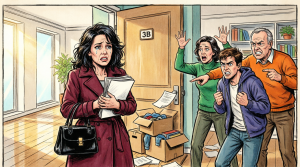
Three days later, I understood exactly what she meant.
A woman I had never seen before was unlocking the front gate using a code I had never given anyone. She had two suitcases and a text thread open on her phone. She smiled politely and said, “Hi, I’m here for the month. Mrs. Cole said the furnished apartment was ready.”
Mrs. Cole.
My mother had listed my apartment—my actual apartment—on a short-term rental platform while I was at work, using photos she had taken while “helping me decorate.” She had taken a deposit, promised immediate occupancy, and told a stranger she had authority over property that wasn’t hers.
I looked past the woman and saw my mother’s handwriting on a welcome note taped inside the door.
In that moment, watching a stranger arrive at the home my own family was trying to take from me piece by piece, I made a decision.
By the next morning, they would have no apartment, no Lexus, and no idea where I had gone.
I didn’t confront them that night.
That was the first thing I did differently.
The old version of me would have stormed into their unit, demanded explanations, let my mother cry, let my father shout, let Aaron call me dramatic until the truth somehow twisted into my fault. But years of being the responsible daughter had taught me something valuable: people who exploit you are often least prepared for silence paired with action.
So I smiled at the confused renter, apologized for the situation, refunded her deposit immediately through the app, and explained that the listing was unauthorized. She was frustrated, understandably, but not unkind. When I showed her the deed on my phone and the account used for the listing, she shook her head and said, “Wow. Your family is bold.” That word stayed with me. Bold. Not loving. Not complicated. Bold.
After she left, I went inside and made a list.
First, I changed every lock code on both units and the garage. Then I contacted the rental platform, reported the fraudulent listing, submitted proof of ownership, and had the account frozen pending investigation. When the representative asked if I wanted the case escalated as financial misrepresentation, I said yes—calmly, almost pleasantly.
Then I opened the file cabinet where I kept property records and vehicle documents. The Lexus title had never been transferred. I had added my parents to the insurance for convenience, but legally, the car was still mine. I stared at that title for a long time, remembering the day I handed over the keys because my mother cried and said no daughter of hers should let her parents “feel lesser” in retirement. I remembered how grateful they looked. Funny how gratitude tends to expire the moment entitlement arrives.
Around midnight, I called my friend Celeste, a broker who had been telling me for months that I was underpricing the duplex because I was emotionally attached. “How fast can we move if I want out?” I asked. She paused, then asked the only question that mattered. “What happened?” I told her enough. She said, “Give me until morning.”
By 8 a.m., I had done three things my family never expected.
I served my parents formal notice to vacate the unit they occupied under a month-to-month arrangement, drafted by my attorney, Mr. Harlan, based on their unauthorized commercial use of the property.
I arranged for the Lexus to be repossessed from the church parking lot after confirming the title and insurance exposure.
And I accepted a job offer in Denver from a law firm I had interviewed with two months earlier but hesitated to join because “my family needed me nearby.”
By noon, Celeste had a private investor touring the duplex. Phoenix was moving fast, and the numbers were strong. He made a clean offer for the furnished property with rapid possession. It wasn’t sentimental. It wasn’t rushed. It was exactly what freedom looked like.
I signed.
My parents learned everything in pieces, which made it worse.
First came the Lexus. My mother called from the church parking lot, screaming that her car had been stolen. I told her the owner had retrieved it. She hung up.
Then came the platform notice. My father stormed into my unit with a printed email accusing him of fraudulent listing activity and demanding repayment. He actually asked why I was humiliating them. I told him renting out property you don’t own is usually what causes humiliation. He called me cold. I told him cold is what a person becomes after being treated like an unlimited resource.
Then came the eviction notice and sale disclosure.
Aaron showed up just as my father was reading the documents, and I watched realization settle across all three of them at different speeds. My mother reached for outrage first. “You would sell your family’s home?” she cried.
“It was never the family’s home,” I said. “It was mine. You just got comfortable pretending otherwise.”
Aaron cursed, demanded to know where he was supposed to go, said I was ruining his life over “a misunderstanding.” That word almost impressed me. A misunderstanding is forgetting an appointment. Secretly listing someone else’s home and trying to push them out is a plan.
I packed that night without drama. Two suitcases, important documents, jewelry from my grandmother, my laptop, and the framed law degree my parents once proudly displayed when it benefited them. I left the rest behind.
Before dawn, I was on a flight to Denver.
By the time my family woke up and realized the duplex was under contract, the car was gone, my number had changed, and I was already in another state.
That’s when they panicked.
The next day, they called everyone.
My aunt in Tucson. My old roommate. Former coworkers. Even Celeste, who professionally informed them I was not available for emotional trespassing. They sent emails from new accounts after my number stopped working. My mother wrote that she was “sick with worry.” My father demanded I “act like an adult and discuss this face-to-face.” Aaron asked if I planned to send him money until he got “back on his feet.”
I didn’t respond.
That silence wasn’t revenge. It was recovery.
People raised in families like mine are taught that access equals love. If they can reach you, pressure you, guilt you, wear you down, then the relationship still exists. The first real boundary feels cruel—not because it is wrong, but because you were taught your exhaustion was proof of loyalty. Denver gave me something I had never had: distance that couldn’t be crossed with a knock on the door.
The law firm was smaller than my Phoenix office but sharper, leaner, and refreshingly uninterested in my family drama. I rented a one-bedroom near Wash Park with terrible natural light and excellent locks. I bought a secondhand table, two plants I nearly killed, and a cheap coffee maker that hissed like it hated mornings. Every decision felt radical because it belonged entirely to me. No one asked for keys. No one borrowed my things. No one suggested my success should be redistributed to whoever had failed most recently.
The duplex sale closed in under four weeks.
Because my parents had no legal claim, their outrage meant nothing. My attorney arranged cash-for-keys terms tied to a fast move-out. They resisted until they realized the buyer wasn’t me and couldn’t be manipulated. Aaron bounced between a motel, a friend’s couch, and whatever chaos he found next. My parents downsized into a small rental. I’m sure, in their version, I abandoned them after all they sacrificed. Families like this don’t tolerate accurate storytelling.
What mattered to me was simple: the pattern ended.
Months later, I finally read the long email my mother kept resending from different addresses. It was full of familiar lines. After everything we did for you. Family shouldn’t keep score. You could have handled this with compassion. Not one sentence acknowledged the listing. Not one admitted they tried to give my home to Aaron. Not one apology. That’s another thing distance teaches you: when people call your boundaries cruel, what they usually mean is that your boundaries disrupted their convenience.
My father wrote once, more bluntly. He said I embarrassed him in front of church, neighbors, extended family. There it was. Not grief. Not regret. Reputation. I almost appreciated the honesty. My mother wanted access. My father wanted image. Aaron wanted resources. When I stopped supplying all three, they called it betrayal.
Do I still think about them? Of course. Distance isn’t erasure. Some nights I remember my mother brushing my hair before school, my father teaching me to parallel park, Aaron as a kid following me around with scraped knees and endless questions. That’s what makes estrangement so painful—love can exist alongside exploitation. Memory doesn’t become false just because clarity arrives. But clarity matters more than nostalgia when nostalgia is used to keep you trapped.
A year after I moved, I bought myself a different car. Not to replace the Lexus—that lesson stayed—but as a quiet marker of the life I built without permission. One Saturday, I drove into the mountains with the windows down, and somewhere along that road it hit me: no one knew where I was, no one could demand I come back, and no one could turn my kindness into a contract. I pulled over just to breathe.
Freedom is quiet when it comes. Not dramatic. Not cinematic. Sometimes it sounds like your own thoughts finally finishing.
The lesson I taught my family was never about punishment. I didn’t ruin them. I removed myself as the structure they leaned on while criticizing it. That’s why their panic came so quickly. They mistook my presence for permanence. They thought I would always stay, always explain, always absorb. They never imagined I would sell everything, reclaim what was legally mine, and leave for a better life before breakfast.
But I did.
And if I’m honest, the hardest part wasn’t leaving.
It was accepting that leaving was the healthiest choice I had ever made.

