The first time my daughter said she felt unwell, I believed her instantly. A mother senses when something is wrong long before it can be explained with words.
That morning, Emma Carter stood in our kitchen, one hand gripping the edge of the counter for support. Her skin looked pale in a way that sleep couldn’t fix, and her lips were pressed tightly together as if she were trying to hold back the fear she couldn’t yet describe.
She told me her stomach felt strange — tight and heavy, like something was pulling downward inside her. The nausea came in waves that made it hard for her to focus at school or even finish a simple meal.
When David Carter, my husband, heard her explanation, he laughed.
Not kindly. Not sympathetically. It was the cold, dismissive kind of laugh that shuts down concern before it can even begin.
“She’s exaggerating,” he said, swirling the ice in his drink as if the conversation meant nothing. “Teenagers do that when they want attention. Don’t waste time or money on doctors.”
From the outside, the Carter family looked perfect.
Our home in a peaceful suburb of Charlotte, North Carolina was the kind neighbors admired during evening walks — a neat two-story brick house with white trim, spotless windows, and flower beds that always looked carefully maintained.
Everything about it suggested stability and success.
For more than ten years I had worked as a school counselor, listening to children describe problems adults refused to see. Yet somehow, in my own home, I was being told to ignore the voice inside me that said something wasn’t right.
David was influential and respected — a successful real-estate investor whose name carried weight in business meetings and charity events. When he spoke, people tended to believe him.
Including me.
At least, that used to be true.
Emma hadn’t changed overnight. It had happened slowly.
First her grades slipped. Then her laughter faded. Eventually the walls of her bedroom lost their cheerful photos and decorations as she withdrew further into herself.
When I knocked on her door that evening, it took a long moment before she answered. When she did, she moved slowly, as if standing up required more strength than she had.
“The pain won’t stop,” she whispered. “It gets worse when I eat. Something feels… wrong.”
David stood in the doorway behind me with his arms crossed, his presence heavy and intimidating.
“She wants attention,” he said impatiently. “If you keep treating her like a fragile child, she’ll never learn to handle real life.”
Emma turned toward the wall, her shoulders tightening as if she were trying to disappear.
At that moment, something inside me quietly broke.
A few days later David left for a three-day business trip. The house became eerily quiet, and that silence allowed my fear to grow louder.
The next morning I confided in Laura, my closest friend at work.
For the first time, I said the truth out loud without filtering it through my husband’s disbelief.
“She isn’t pretending,” I told her, my voice shaking despite years of professional composure. “I know something’s wrong.”
Laura didn’t hesitate.
“She needs a doctor,” she said firmly. “You don’t need anyone’s permission for that.”
That afternoon, I signed Emma out of school early.
Instead of driving to our usual hospital where people might recognize us, I took her to a medical center across town. I didn’t want anyone informing David before I understood what was happening.
My hands trembled when I handed the receptionist my insurance card.
Emma asked if she could speak privately with the doctor. I agreed, though sitting alone in the waiting room felt unbearable. The lights seemed too bright, every minute stretching into an eternity filled with terrible possibilities.
When Dr. Patel returned, her expression had changed.
The calm professionalism was still there, but something else sat behind it — caution.
She ordered blood tests and an ultrasound and told us to return the following day for the results.
That night, Emma cried in the car on the way home. She admitted she was scared.
I promised her I would protect her, even though I wasn’t sure how.
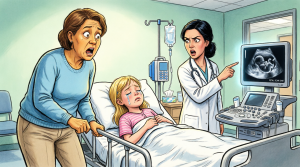
The next afternoon we sat across from Dr. Patel while she studied the scan for an unusually long time. Her fingers hovered near the screen as if she were choosing her next words carefully.
Finally she looked up.
Her voice dropped almost to a whisper.
“There’s something inside your daughter’s abdomen,” she said slowly, “that shouldn’t be there.”
My lungs froze.
She turned the screen slightly toward us. The image was blurry to my untrained eyes, but it was obvious that something wasn’t right.
The room seemed to spin.
Before I could stop myself, I screamed.
Dr. Patel spoke calmly, but the weight of her words pressed down harder than any shouting could.
The scan showed a foreign mass lodged deep in Emma’s abdomen — something solid, something that clearly didn’t belong there. She explained that further tests were necessary before confirming what it might be.
My phone vibrated in my purse.
David’s name appeared on the screen.
Seeing it made my stomach twist.
Apparently his trip had been cut short. Even from a distance, his control seemed to reach into every corner of our lives.
Dr. Patel leaned closer and lowered her voice even further.
“Whatever we’re seeing,” she said quietly, “didn’t appear overnight. It suggests something has been wrong for quite some time.”
I looked at Emma again and truly saw her — the fear beneath her exhaustion, the confusion mixed with shame, as though she believed the pain was somehow her fault.
I took her hand. It felt cold and fragile.
Outside the office, footsteps echoed down the hallway. Hospital life continued normally, as if my world hadn’t just been torn apart.
Then Dr. Patel added one more sentence, something she hadn’t yet written in the medical chart.
“There are indications,” she whispered carefully, “that this may not have happened naturally.”
My heart stopped.
Before I could ask what she meant, the door suddenly opened.
A nurse stepped inside holding a clipboard.
“My apologies,” she said softly. “Your husband just arrived.”
David was here.
And in that moment I realized the greatest danger might not only be what was inside my daughter.
It might be the man who had been standing beside us all along.

