The sound was not loud in the theatrical way people later imagine when they tell a story they were never truly inside. It was not a clap of thunder, not a cinematic report that splits a room in two and gives everyone the dignity of knowing, instantly and together, that evil has entered. It was smaller than that, cleaner, almost intimate—a hard crack with a little wetness beneath it, the noise of skin meeting skin with enough force to rearrange trust. It sounded, absurdly, like a board snapping in a cold garage. It sounded like something domestic breaking. And perhaps that was why it was worse.
Lily’s head jerked so sharply to the side that her braid swung out like a rope cut loose from a post. Her chair legs scraped backward on the tile, screamed for less than a second, and then her body slid off the seat as though gravity itself had been waiting all evening for permission. She hit the floor first with her shoulder and then with the side of her head, the dull little thud of bone and tile so intimate and final that my own body reacted before my mind did. My hand closed around my fork so hard I thought the tines might bend.
For one strange, stretched second the room did not move.
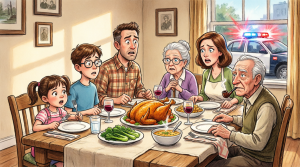
It hung there in a grotesque tableau of holiday prettiness and moral cowardice. My sister-in-law’s hand hovered in midair over the sweet potatoes, the serving spoon dripping orange glaze onto a linen runner embroidered with tiny acorns. Someone’s wineglass hung inches from their mouth, a crescent of deep red lipstick staining the bowl. Candles, vanilla and cinnamon, breathed out their warm, bakery sweetness as if the air had not just turned metallic. Outside the big bay window, November had pressed its face to the glass in the form of darkness and skeletal tree branches. Inside, under pendant lights and polished silver, my ten-year-old daughter lay on the tile with blood threading from her lower lip.
There are moments when a parent sees two realities at once. In one, your child is still the person you tucked into pajamas the night before, the one with freckles across the bridge of her nose and a habit of saying please to the dog when she wanted him to move off the couch. In the other, she is suddenly only a small animal in danger, all your tenderness stripped down to instinct. The first reality makes your heart split. The second tells you exactly how quickly a grown man can kill another grown man with the objects already on a dinner table.
Lily blinked up at the ceiling as if the room had somehow tilted and she was waiting for it to set itself right again. Blood brightened her chin in a line so red it looked painted. Her eyes were wide, but not yet crying. That was the part that destroyed me most. She was still in the stage of shock where children think they might somehow be the ones who made violence happen.
Jared stood over her with his hand still half-raised.
He was a thick-necked man in his late thirties with the softened muscularity of someone who had once been handsome and had since confused size with authority. He always smelled like expensive cologne poured over cheaper things—bourbon, stale sweat, old resentment. He looked at his own palm for the tiniest fraction of a second, not with horror, not with shame, but with offended disbelief, as though his body had acted out an opinion and now the room was rudely forcing him to witness it. Then his face resettled into that expression I had come to know over the years and hate more deeply every time I saw it: the petulant indignation of a man who believes every limit placed on him is a personal insult.
At the head of the table, Aunt Claudia smiled.
Not broadly. That would have been easier to condemn. It was worse than that—a small, satisfied tightening at the corners of her mouth while she dabbed her lips with a monogrammed napkin, as though she had just seen a difficult recipe turn out correctly.
“That’s what brats deserve,” she said.
Her voice was level, almost conversational. It moved through the room like perfume—expensive, clinging, impossible to ignore once detected. If Jared was the kind of man who mistook force for manhood, Claudia was the kind of woman who mistook cruelty for order. She was silver-haired and beautifully preserved in the manner of women who believe discipline is a virtue when applied to the body, the table, the curtains, the children, the truth. At sixty-eight she still hosted dinners as if they were liturgical acts. Candles placed with military symmetry. Napkins folded into impossible little fans. Turkey carved at the table. Gravy from a boat older than my mortgage. And beneath all that elegance, a rank little religion of power.
My wife, Sarah, stared at her plate.
Not at Lily. Not at Jared. Not at me. At the mashed potatoes, as though they had become the most complicated thing in the room. Her face had gone pale in the particular way faces do when the soul has stepped back from the body for its own protection. To someone who did not know her, she might have looked indifferent. I knew better, though not well enough—not then. I knew she had a stillness that appeared under pressure, a terrible and unnatural stillness, as if her whole system had learned long ago that the safest response to danger was to become furniture.
Her two brothers, Daniel and Mark, performed their own versions of disappearance. Daniel examined the turkey platter with scholarly concentration. Mark stared at his phone, thumb frozen halfway down the screen. Neither one got up. Neither one bent toward my child. Neither one said what any decent man ought to have said before Lily even hit the floor.
What the hell is wrong with you?
My whole body surged white-hot with the urge to move.
The crystal water pitcher near Jared’s elbow caught the candlelight and flashed once, sharply, and in the same instant I had a complete, almost serene vision of standing, grabbing it by the handle, and bringing it across his face with enough force to rearrange the architecture. I saw myself vaulting the corner of the table, heard in my mind the gratifying crack of bone, felt the room explode at last into honest chaos.
But rage, if it is to be useful, cannot be allowed to write the scene alone.
Lily was on the floor bleeding. Claudia was already gathering her version of events behind her smile. Jared would become, within minutes, a man who had merely “tried to correct” a “mouthy child.” I would become unstable, aggressive, dangerous. They had practiced that alchemy before. Turn the victim into the cause. Turn the witness into the threat. Turn violence into family culture and anyone who objects into an outsider who doesn’t understand how things are done.
So I did not lunge.
I did not even speak right away.
Instead I let my left hand slide beneath the tablecloth, into my pocket, around my phone. Earlier in the evening, when Jared’s voice had begun to take on that thick-edged meanness I’d learned to recognize after two bourbons, I had started recording. I did that sometimes around him. It was an old habit from construction disputes and contract meetings and job sites full of men who lied more confidently than they breathed. When someone has a history of revising reality in his own favor, documentation becomes less paranoia than hygiene.
Now my thumb found one name and pressed call.
The room above the table still looked frozen in its ugly little pageant. Lily had rolled halfway to one side and was pushing herself up with one small hand. Sarah still stared at her plate. Claudia still wore that poised satisfaction. Jared had already started settling back into his chair, as though the matter had concluded.
The phone rang once.
“Ramirez,” came the voice on the line, roughened by age and late hour.
I kept my own voice flat, almost bored. That was important. Men like Alex knew how to hear urgency when it arrived disguised.
“Alex,” I said. “It’s Ryan Carter. I need you at 1294 Oak Haven Lane.”
There was a pause just long enough to tell me he had heard what sat under the words.
“What happened?”
I watched Lily finally look at me, confusion blooming into hurt as she searched my face for the shape of the world she still believed in.
“Bring cuffs,” I said.
Another beat.
“You sure?”
I looked up at Jared.
He picked up his glass of bourbon and took a sip.
At the head of the table, Claudia folded her napkin in her lap with small, efficient fingers.
My daughter touched her lip, looked at the blood, and went very quiet.
“Yes,” I said. “I’m sure.”
Then I ended the call, slid the phone screen-down onto my thigh beneath the table, and rose at last to pick up my child.
When people remember moments like that, they tend to remember the dramatic edges and not the quiet center. They remember police lights eventually flashing through curtains, or handcuffs, or shouting, or the sentence that finally split the family into before and after. What I remember most clearly is kneeling on cold tile and seeing Lily try to apologize.
That was the first thing she did when I crouched beside her.
“I’m okay,” she whispered, though blood touched her teeth when she spoke. “I’m sorry.”
It was such a child’s instinct and such an indictment of every adult in that room that for a moment I could not answer. Her left elbow was reddening where she had struck the floor. Her braid had come loose, and one little curl had stuck damply to her cheek. I put a hand against the back of her head and moved it gently, checking for swelling. Nothing obvious yet. Her pupils looked equal, thank God. Her lower lip, though, had split on the inside.
“You didn’t do anything wrong,” I said.
Jared gave a short laugh from across the table.
“Oh, for God’s sake, Ryan, don’t start with the performance.”
I looked at him then, not quickly, not with the satisfaction I would have preferred, but with a long enough stare that his smirk flickered. Men like Jared are brave only inside systems that support their version of manhood. The presence of a bleeding child did not shame him. My stillness did.
“She was mouthing off,” he said, trying to recover his swagger. “Someone had to put a stop to it.”
Lily shifted against me.
That tiny motion told me something crucial. She wasn’t just hurt. She was listening, already trying to understand whether this room agreed with him. Whether what had happened to her was going to be treated as violence or as a consequence.
I slid one arm around her shoulders and helped her into a sitting position.
“Can you stand, peanut?”
She nodded immediately, because children always want to make things easier for the adult they trust most. I took that nod for what it was worth and still lifted her carefully myself, setting her back in the chair beside mine rather than the one she had fallen from. I pulled a clean cloth napkin from the table, folded it twice, and pressed it gently to her mouth.
Aunt Claudia clicked her tongue.
“Oh, honestly,” she said. “You’d think she’d been shot.”
It is a strange thing, discovering exactly how much hatred the body can hold without trembling. I had always assumed hatred was loud. Red-faced. Shaking. Teeth bared. But mine sat down very quietly inside me and began arranging itself.
Sarah still had not moved.
I could feel her without looking at her, the way one feels someone on the edge of a bed in the dark. Her body had gone so still it felt absent. If I had reached across the table and touched her wrist, I think I might have found no pulse at all, only the rigid shell of her.
“Sarah,” I said.
Her eyes lifted, but only to my shoulder, not my face. “Maybe,” she said faintly, “maybe we should all just calm down.”
Jared spread his hands as if that settled it.
“See? Even Sarah gets it.”
No, I thought. You do not get to use my wife’s paralysis as consensus.
Lily leaned closer into my side and whispered, “Daddy, am I in trouble?”
That question did what the slap itself had not yet done. It introduced a kind of pain rage cannot adequately answer. Children learn the moral weather of a room from the first adult response to their suffering. If the response is confusion, excuse, embarrassment, minimization—those become the climate they carry for years. I knew that much from the men I had grown up around and the sites I had later supervised, where broken boys had simply become large, badly disguised versions of the same question.
“No,” I said, more softly than before. “No, baby. Not even a little.”
Daniel shifted in his chair.
My wife’s older brother was the kind of man who had built a life entirely out of appearing harmless. Beige sweaters. Practical sedans. A CPA’s careful hair. He had spent thirty-nine years standing near uglier men and mistaking his inaction for innocence. Now, finally, he cleared his throat.
“Jared,” he said weakly, “maybe you should apologize.”
Jared turned toward him with such open contempt that Daniel visibly shrank.
“For what?” Jared asked. “For not letting your niece turn into one of those kids who think they can mouth off to adults?”
“She asked you not to call her stupid,” I said.
He shrugged.
“Then she should learn not to act stupid.”
Across from him, Mark—Sarah’s younger brother—let out a brittle, humorless laugh, the kind people produce when terror is trying to disguise itself as social ease. “Can we not do this tonight?”
Not do what? I wanted to ask. Not acknowledge the child bleeding in front of us? Not disturb the pie? Not interrupt the old and holy family tradition of pretending the ugliest thing in the room is the person who names it?
Instead I kept one hand on Lily’s shoulder and glanced at the clock on the wall.
Nine minutes, maybe less.
“Ryan,” Claudia said, and now her tone had shifted into something maternal and dangerous. “You are overreacting. You didn’t grow up in this family, so perhaps you don’t understand that children here are taught respect.”
There it was, the word every abusive system eventually uses to perfume its violence. Respect. By which they mean silence. Submission. No witness contradicting the ruling mood. No child’s feelings interrupting the comfort of power.
I turned my head and met her eyes fully for the first time that night.
“You’re right,” I said. “I didn’t grow up in this family.”
Her smile sharpened. She thought I was conceding something.
I went on. “Which is probably why I can still tell the difference between respect and assault.”
The room changed. Not dramatically. Not all at once. But I felt it—like barometric pressure dropping before a storm. Claudia’s fingers tightened once on the stem of her wineglass. Jared leaned forward. Daniel stared into his plate. Mark’s knee began to bounce under the table. Sarah closed her eyes for one single second, opened them, and looked at Lily at last.
Something like pain crossed her face then. Not fresh pain. Old pain, risen too quickly to be hidden.
Before anyone could answer, the doorbell rang.
No one moved.
It rang again, longer, more insistently.
Claudia frowned, affronted by interruption. “Who on earth—”
“I’ll get it,” I said.
The hallway felt colder than the dining room. My heart had been beating in that disciplined, deliberate way it does when a situation is on the edge of violence and you’ve made the conscious decision not to be the first one to step over. At the front door I paused only long enough to exhale once, then opened it.
Alex Ramirez stood on the porch in a navy windbreaker over plain clothes, his expression already gone grave before he had spoken a word. Behind him were two uniformed officers, one male, one female, both alert in the quiet, respectful way good cops get when they realize they are entering a domestic scene involving a child. The street behind them pulsed blue and red in slow revolving sweeps that washed the neighboring houses in scandal.
Alex looked past my shoulder into the house and then back at my face.
“Where is he?” he asked.
“Dining room.”
He nodded once.
Alex and I had been friends long before either of us chose professions that made people careful around us. We’d played football together in high school, though he had been better at discipline and I had been better at improvising under impact. He’d gone into law enforcement through the sheriff’s department and eventually into the county detective unit, carrying with him that rare ability to look at a room and see, almost immediately, not the loudest person but the actual center of danger. He knew my voice well enough that if I said bring cuffs, he understood I had already made every effort not to deserve the request.
He stepped inside. The officers followed.
The dining room went still again, but this time the silence had a different quality. Before, it had been complicity. Now it was fear adjusting its posture.
Jared stood up too quickly and knocked his chair backward.
“What the hell is this?”
Claudia made a sharp little sound in the back of her throat, halfway between gasp and outrage. “Police? Ryan, what have you done?”
Alex did not answer either of them.
He crossed the room as though Jared and Claudia were furniture and crouched directly in front of Lily. The female officer, Hernandez, hung back just enough to give him space while already taking in the split lip, the redness at Lily’s elbow, the cloth napkin stained pink where I had held it.
“Hey there,” Alex said, voice lowered at once into the gentleness reserved for frightened children and wounded animals. “I’m Alex. Can you tell me what happened to your mouth?”
Lily looked at me.
I nodded.
Her voice came out so quietly that everyone at the table had to lean toward it, and perhaps that was fitting. Let them strain to hear the truth they had refused to speak.
“Uncle Jared hit me.”
No one moved. Even Jared didn’t, not for a heartbeat.
Then everything broke.
Jared’s first instinct was not denial. It was offense.
He threw his hands wide and barked a laugh so brittle it sounded like something thin cracking under weight. “You’ve got to be kidding me. This is insane. I was disciplining her.”
“Sit down,” Alex said.
Not loudly. Not theatrically. But authority, when genuinely possessed, does not need volume to enter a room. Jared looked as though he might push it anyway, might try to puff himself larger in front of the uniforms and the women and the child he had just knocked to the floor. For a half second I think he imagined he still could. Then Officer Hernandez took one deliberate step closer, and his courage remembered its dependencies.
“It was a slap,” he said, lowering himself back into the chair but only halfway, perched on the edge like a man ready to argue his way back into innocence. “One slap. She was being disrespectful.”
“Not your child,” Alex replied.
Claudia rose then, napkin still in hand.
Her face had changed more than anyone else’s. The smug composure was gone, replaced by the high, righteous fury of a woman whose favorite role—matriarch, arbiter, keeper of the family narrative—had just been publicly interrupted. “This is appalling,” she said. “Ryan, have you lost your mind? You call the police on your own family because a child was corrected at the dinner table?”
“She was assaulted,” I said.
“Oh, don’t use that word in my house.”
The room sharpened around that sentence.
My house.
Not our family gathering. Not what happened here. Not this child. Possession first. Always possession. Houses, rooms, stories, loyalties. Claudia had built her entire moral universe out of possession.
Officer Hernandez took out her notebook and stepped toward Lily. “Honey, I’m going to ask you a few questions, okay? You’re not in trouble.”
The words were nearly identical to mine from minutes before, but coming from a stranger in uniform, they seemed to help Lily believe them. She nodded. Her hand, still in mine under the table, trembled but did not let go.
Across the room, Jared’s color started to drain.
He had not expected consequence. That much became obvious with every second. Men like him rarely do. Violence, for them, is not an act but a privilege—a gesture granted by blood, by hierarchy, by the collusion of everyone nearby. It is only when another system enters the room, one wearing a badge or carrying a warrant or simply naming what everyone else had agreed to euphemize, that they begin to look not dangerous but startled.
Alex stood slowly and turned toward him.
“Mr. Whitman,” he said, “did you strike this child?”
Jared opened his mouth. Closed it. Looked toward Claudia.
That hesitation mattered more than a denial would have. Guilty people do that tiny piece of arithmetic in real time. They calculate which lie is likeliest to hold.
“It wasn’t like that,” he said finally.
Alex’s expression did not change. “That wasn’t my question.”
Jared licked his lips. “I—she was acting out.”
“Did you strike her?”
Claudia cut in again. “This is harassment.”
Alex did not even turn his head. “Ma’am, if you interrupt again, I’ll have you removed from the room.”
That, more than anything so far, seemed to land. Claudia took one step back, stunned in the way tyrants always are when someone they cannot immediately control refuses to recognize their local rank.
Jared inhaled sharply through his nose. “Yes,” he snapped, as if anger could restore dignity. “I slapped her. Once. My God. You’d think I killed someone.”
No one said anything for a moment.
Then I reached down, picked up my phone from my lap, and pressed stop on the recording.
The tiny electronic sound seemed monstrously loud.
Jared’s eyes flicked to it. He understood before anyone else did.
“What is that?” Claudia demanded.
“Insurance,” I said.
I held the phone up. Hit play.
Jared’s voice filled the room first, thickened by drink and contempt.
“Sit down before I make you.”
Then Lily’s: small, frightened, still trying to be polite. “I didn’t do anything—”
Then the crack.
Then the scrape of chair legs.
Then her body hitting the floor.
The recording ended in the silence that follows certain truths when every other sentence in the room has suddenly been exposed as an accessory.
Alex looked at Jared.
“Stand up.”
Jared obeyed this time without argument.
Officer Bennett moved behind him. The handcuffs came out with a soft metallic whisper that made Lily stiffen against me. I leaned down immediately.
“It’s okay,” I murmured. “You’re safe.”
Jared turned half around as Bennett took his wrists.
“You really want to do this?” he spat at me. “You really want to humiliate the family over one moment?”
I looked at him and felt, in that instant, something stranger than triumph.
Pity.
Not for what was happening to him. For how genuinely he seemed not to understand that he had arrived at this moment over years, not seconds. The slap was not an accident. It was merely the first time his entitlement had encountered a room that refused to kneel.
“No,” I said quietly. “You humiliated yourself. I’m just the first one here who won’t lie about it.”
The cuffs clicked shut.
Claudia made a sound so shrill it seemed to lift the candle flames. “This is unbelievable. Ryan, you self-righteous bastard. You have no idea what you’ve done.”
I turned to her then, slowly enough that my chair scraped the tile and made everyone flinch.
“Yes,” I said. “I do.”
Her eyes narrowed. For a brief moment, the mask slipped and something feral showed through—not grief for Jared, not fear for the family, but naked hatred that the old rules had failed her when she invoked them. I saw then, more clearly than ever, that Claudia did not love order. She loved immunity.
Sarah finally stood.
The movement was small and unsteady, but it changed the center of gravity of the room at once because Sarah had been absent in spirit for so long it almost felt supernatural to watch her re-enter. Her face was pale, her hands trembling, but she crossed the tile and came not to me first, not to her aunt, not to her brothers.
To Lily.
She knelt beside our daughter and touched the back of her hair with a hand that shook hard enough for Lily to notice.
“Baby,” she whispered.
Lily looked at her mother, and for one terrible second I thought she might pull away. Instead she began to cry.
Not loud, not theatrically, not in a way that relieved the room of responsibility. She simply folded inward, put her face against Sarah’s shoulder, and cried like children do when they have finally received permission to understand they were hurt. Sarah wrapped both arms around her and made a sound I had not heard from her in years, maybe ever—a low, cracked animal sound, grief and horror braided together.
That was when I understood the silence at the table had not been emptiness.
It had been memory.
I did not know its full shape yet. Only that it had one.
Alex glanced at me, then at Sarah, then back at the officers. “Take him.”
Bennett guided Jared toward the front door. Jared dug in his heels once, then thought better of it under Bennett’s hand. As he passed Lily, he turned his head slightly.
“I barely touched her,” he muttered.
Sarah rose so fast her chair toppled.
“Don’t you look at her.”
The entire room stopped.
Sarah’s voice was not loud. But it had changed. All the softness had burned out of it, leaving behind something stripped, bright, and dangerous. Jared stared at her, genuinely stunned.
Claudia whispered, “Sarah—”
But Sarah was already moving. She stepped between Jared and Lily with such absolute instinct that for a second she looked like someone I had never met—not frozen, not retreating, not apologizing for taking up space. Just a mother standing where violence had decided to return and finding the doorway occupied.
“If you ever say her name again,” she said, “I will testify to everything.”
Jared’s expression altered. Fear, real fear, passed over his face and vanished so quickly I almost thought I’d imagined it.
Everything.
The word sat in the room like a dropped knife.
Claudia recovered first. “Testify to what?”
Sarah turned to her aunt.
And the look on her face then told me this dinner was no isolated event. We were not standing inside a single ugly family story. We were standing at the mouth of something older, rotting beneath the boards for years while everyone served pie on top of it.
“To all of it,” Sarah said.
Jared was taken out. Claudia began shouting only once the front door had closed behind him, once the blue lights washed the entryway, once the neighbors’ curtains had almost certainly started twitching.
Daniel stood up and then immediately sat back down, the physical embodiment of a man who had spent forty years rehearsing dissent only in private. Mark muttered, “Jesus Christ,” but whether in shock at the arrest or dread of whatever Sarah meant by everything, I couldn’t tell.
Alex asked if Lily needed an ambulance. I said no, but we were going to urgent care right now. Hernandez asked Sarah if she wanted to make a statement. Sarah looked as though someone had asked her to walk into freezing water.
“Not tonight,” she said.
Alex nodded. “Tomorrow, then.”
When the police finally left, the house was full of that ugly aftermath energy unique to family catastrophe: candles still burning, food congealing on plates, gravy skinning over in its boat, napkins abandoned in laps, and under all of it the animal realization that whatever had just happened could not be swept into coffee and pie and one more holiday photo.
I got Lily’s coat. Sarah got hers with fumbling fingers.
At the front door, Claudia spoke one last time.
“If you leave now,” she said, voice low and poisonous, “don’t bother coming back.”
Sarah paused.
She looked over her shoulder at the woman who had fed her every holiday meal of her childhood, helped button school dresses, chosen funeral flowers for Sarah’s father when she was fifteen, hosted birthdays, corrected grammar, enforced table manners, and apparently built an altar to cruelty under all of it.
Then Sarah said, “I should have stopped coming back years ago.”
We drove to urgent care in silence.
Lily sat in the back with an ice pack against her lip and my old flannel blanket around her shoulders. Sarah kept turning slightly in her seat to look at her, as though making sure she still existed. I gripped the steering wheel and watched the dark road unspool in the headlights while pieces of the evening tried to reorder themselves in my head.
At a red light, Lily said, “Mom?”
Sarah twisted around instantly. “Yes, sweetheart?”
“Why didn’t anybody help me?”
There are questions that enter a car and change its shape.
Sarah’s face collapsed. Not dramatically. Just enough. Enough that I knew the truthful answer would hurt her almost as badly as the slap had hurt Lily. Enough that I also knew the lie would do a quieter, longer kind of damage.
Sarah reached back and took Lily’s hand.
“I should have,” she said, her voice raw. “I’m so sorry. I should have moved faster.”
Lily nodded in the solemn way children do when they are trying not to burden the adults already failing them.
At urgent care the doctor said the cut didn’t need stitches, but Lily had a mild concussion and should be watched through the night. While the nurse cleaned the blood from her chin, Sarah stood in the corner of the room and wept soundlessly, one hand over her mouth.
I signed discharge papers with one hand and texted Alex with the other.
What did she mean by everything?
His reply came several minutes later, after I had buckled Lily into the car.
You need to ask your wife. And when she tells you, listen before you get angry.
That answer did not calm me.
It widened the night.
Lily fell asleep in our bed sometime after midnight, curled against the wall with the plastic hospital bracelet still around her wrist and one of my T-shirts bunched under her cheek because she liked the smell of it. Concussions make children strangely solemn. She had accepted water, pain medicine, and two saltines with a gravity no ten-year-old should have to perform. Before sleep took her, she had asked me if police cars always looked so blue. Then she had closed her eyes as if her body had simply run out of room for the day.
Sarah sat in the kitchen long after the house went quiet.
I could see her from the hallway. She was at the table with all the lights off except the over-stove lamp, which turned the room into a dim little stage of wood grain and shadow. Her coat was still on. She had not loosened her hair. One hand was wrapped around a mug of tea gone cold an hour earlier. The other lay flat on the table, fingers spread, as if she needed proof of a surface beneath her.
I stood in the doorway for a minute before speaking because I no longer trusted the instinct to go charging toward pain and call it love.
“Can I sit?”
She laughed once without humor. “It’s your kitchen.”
I pulled out the chair across from her and sat down.
For a while neither of us said anything. The refrigerator hummed. Somewhere upstairs, floorboards settled under the weight of old wood and November air. The clock over the microwave clicked from 12:13 to 12:14 with an obscenity that belonged to ordinary nights, not this one.
Then I said, carefully, “What did you mean?”
She closed her eyes.
“I knew you’d ask that before you asked anything else.”
“Should I have asked something else first?”
“No.” She looked at me then, and what I saw in her face was not accusation. It was exhaustion so old it had started using other names for itself. “No, Ryan. You should ask.”
I waited.
Her throat moved once. Twice. Then she said, “Do you remember the first Thanksgiving you ever spent with my family?”
I frowned, thrown by the question. “Of course.”
“You said Aunt Claudia’s dining room felt like a museum where people were afraid to breathe wrong.”
I almost smiled despite everything. “That sounds like me.”
“You noticed how everyone sat in the same chairs every year.” A pause. “You noticed Jared always got mean after his second drink.”
“Yes.”
“You noticed Mark never looked Claudia in the eye. Daniel laughed too loudly at things that weren’t funny. My mother—before she died—never spoke if Jared was standing.” She swallowed. “You noticed a lot.”
“I didn’t notice enough.”
“No,” she said softly. “You did. You just didn’t know what you were noticing.”
She reached into her coat pocket and took out a key ring I hadn’t seen in years. On it hung a tiny silver ballerina charm, one leg broken off at the ankle.
“My cousin Emily had one of these,” Sarah said. “She was eleven.”
The room seemed to tilt a little.
“Aunt Claudia’s daughter?”
Sarah nodded.
I had met Emily exactly twice in old photographs. Brown hair. Gap-toothed grin. Died, as the family always said, of a seizure in the bathtub when she was twelve. An awful tragedy. So sudden. Claudia wore her mourning like church silk for years.
“What about her?”
Sarah looked down at the broken charm in her palm.
“She didn’t drown,” she said.
The sentence entered me slowly, then all at once.
Sarah’s fingers closed over the charm so tightly her knuckles whitened.
“She spilled a glass of juice at Christmas dinner,” she said. “Jared was nineteen. I was fourteen. Emily laughed because it got all over Claudia’s fancy table runner and she thought the way Aunt Claudia looked at the stain was funny. Jared stood up and slapped her so hard she hit the china cabinet.”
Every part of me went still.
“No one called it a slap,” Sarah continued. “No one called it violence. Claudia said Emily was getting wild and needed to learn respect. She had a seizure later that night, in the bathroom. That’s the story they told everyone. But she didn’t have a seizure first. She hit her head. She was dizzy. She threw up. My aunt put her to bed and said she was being dramatic.”
The kitchen light above the stove seemed suddenly too bright.
“She died before morning,” Sarah said.
I leaned back in the chair as if distance could improve what I was hearing.
“Sarah—”
“She died because they didn’t take her to the hospital. And after she died, they all agreed on the story. Even my brothers. Even my mother. The doctor was one of Claudia’s friends from church. A seizure, they said. Tragic, tragic, tragic.” Her mouth twisted around the word. “Do you know what Claudia said to me when I cried at the funeral?”
I did not answer.
Sarah looked at me with eyes that had moved beyond tears into something harder.
“She said, ‘That’s what brats deserve when they make scenes.’”
The phrase from the dinner table seemed to echo backward through time until it hit another child on another floor.
My hand, resting on the table, curled slowly into a fist.
Sarah saw it and shook her head before I could speak.
“That’s not even the twist,” she said. “Not really.”
I stared at her.
“There’s more?”
A short, broken laugh. “There’s always more.”
She stood abruptly and went to the hall closet. For one terrible second I thought she might be leaving the conversation entirely, that I had asked too much and too late. Instead she came back with a battered accordion file, the kind teachers and accountants use. It was thick, overstuffed, edges worn from being opened and shut in secret.
She set it on the table between us.
“I’ve been collecting things for three years,” she said.
Inside were photographs, copies of medical reports, printouts of emails, journal pages, therapist notes, and children’s drawings. There were pictures of bruises on a little boy’s upper arm I recognized after a second as Rebecca’s son, Oliver. Screenshots of texts from Jared calling Rebecca weak, useless, hysterical. Notes from school counselors about “behavioral shifts” in Oliver after weekends with his father. A photocopy of Emily’s old death certificate. A newspaper clipping from twelve years ago about an “accidental fall” at a family lake house involving Jared’s college roommate. A typed statement unsigned but detailed, from one of Claudia’s former housekeepers, describing “discipline” administered in locked rooms.
I looked up slowly.
“You were building a case.”
Sarah nodded.
“Alex knows?”
“Yes.”
The answer hit harder than I expected.
Not because she had involved Alex. Because she had not involved me.
She saw it in my face immediately.
“There it is,” she said quietly. “That part.”
“What part?”
“The part where you think I didn’t trust you.”
I opened my mouth, then closed it. Honesty, stripped of vanity, is an ugly thing to reach for sometimes.
“I’m trying not to,” I said.
“But you do.”
“Yes.”
She sat back down and folded her hands around the dead mug as if warming them over something long extinguished.
“I didn’t tell you because I did trust you,” she said. “I trusted you enough to know exactly what you’d do.”
“That’s not trust, Sarah. That’s fear.”
“Yes,” she said, and there was no softness in it now. “It was fear. Of losing you.”
The kitchen went silent again.
She pressed on before I could make her responsible for my reaction.
“When you’re calm, Ryan, you are the most decent man I know. You’re patient with Lily. You fix things before anyone asks. You never use your size to make a room smaller for other people. You make tea when I can’t sleep. You call my mother’s grave on holidays because you know I still talk to her there.” Her voice shook. “But when someone hurts the people you love, something else comes online. I’ve seen it, even if you think I haven’t.”
I said nothing.
“The man you became tonight?” she whispered. “I knew he would protect her. I also knew he might destroy himself doing it. So I kept building the file. I kept waiting for enough evidence, enough witnesses, enough leverage to do this through the courts.” She looked upstairs, toward our sleeping child. “But then he hit her in front of everyone, and I froze because I was fourteen and Emily was on the floor again, and by the time I could breathe, you had already called Alex.”
The twist, when it arrived, was not one thing. It was a whole rearrangement of the architecture.
I had spent the evening silently judging Sarah’s stillness as absence, perhaps even as failure. What it actually was had been a trapdoor into old terror. I had thought of myself as the first real adult in the room, the only one unwilling to kneel to the family script. But Sarah had been resisting that script for years, quietly, methodically, in a language I had not respected because it did not sound like confrontation. She had not been passive. She had been strategic. Terrified, yes. Conditioned, yes. But also working. Building. Enduring the daily humiliation of appearing weaker than she was because premature exposure would have gotten the whole thing buried again.
And worst of all—she had been protecting me from myself.
Not from my anger, which she knew I could feel. From my competence inside anger. From the part of me that, once justified, might stop distinguishing between justice and annihilation.
I looked at the file again. Three years. Dates. Notes. Cross-references.
“Why tonight?” I asked finally.
Sarah’s expression shifted, and now I saw the answer had been sitting in the room with us all along.
“Lily found Emily’s ballerina charm in the old sideboard drawer,” she said. “She asked about it at dinner.”
I closed my eyes.
“She said Emily sounded nice,” Sarah continued. “She said maybe she and Emily would have been friends. Claudia went still. Jared laughed and said dead girls make bad playmates. Lily told him not to say that. She said it was mean.” Sarah’s fingers trembled once on the file. “That’s when his voice changed. That’s when you started recording, I think.”
Yes. Exactly then.
“She wasn’t mouthing off,” Sarah said. “She was defending a dead child no one in that family has ever been allowed to tell the truth about.”
A long, terrible quiet followed.
Then I asked the question that had been sitting like a shard under everything.
“If you had enough for Alex… why didn’t he move sooner?”
Sarah’s mouth hardened.
“Because Oliver’s mother kept recanting. Because Claudia knows judges and pastors and school board members. Because there was never one perfect event with a neutral room full of witnesses and an unambiguous child victim outside the family unit. Until tonight.” Her eyes met mine. “Lily changed the case the moment Jared hit someone he didn’t own.”
The words hollowed me out.
Because now even my righteous fury had to make room for something more complex and much harder to bear: the knowledge that Lily’s suffering had not merely exposed a monster. It had detonated an entire protected history.
And in that history, my wife was not the woman who had failed to move. She was the child who had never been allowed to.
Upstairs, a floorboard creaked.
Sarah stood so fast her chair legs squealed.
We both turned, but it was only Lily, small and pale in the doorway, one hand on the frame, eyes huge in the hall light.
“How long was Mom scared?” she asked.
Neither of us had heard her come down.
Sarah made a sound that was almost a gasp.
Lily looked from her to me to the open file on the table.
“Was she scared when she was little too?”
There are moments when the truth becomes gentler than protection because the child already feels its shape.
Sarah crossed the room slowly, as though approaching a skittish animal, and knelt in front of Lily.
“Yes,” she said. “I was.”
Lily frowned, thinking hard. “So when you looked at your plate… you weren’t not helping me.”
Sarah’s face broke.
“No, baby. I was trying to come back to you. I just came back too late.”
Lily considered that in the solemn way only children can, with no interest in euphemism and no talent for social mercy.
Then she stepped into her mother’s arms.
And Sarah, who had spent twenty years being a witness to silence, finally cried loudly enough for the whole house to hear.
What followed was not the clean moral arc people imagine when they hear that someone was arrested at a family dinner and “justice was served.” Justice, in actual houses, arrives padded with paperwork and gossip and panic attacks and casseroles from neighbors who want access to your grief more than they want to relieve it. Justice requires forms. Statements. Child interviews in softly painted rooms with stuffed animals meant to signal safety. It requires repeating the ugliest moment of your child’s life to strangers trained to keep their faces neutral. It requires your daughter drawing the dining room table in marker while a forensic interviewer asks where everyone was sitting and whether Uncle Jared used his left hand or his right.
It also requires survival to keep doing ordinary things.
Packing lunches. Brushing out hair around the swelling. Remembering to buy milk. Answering Lily when she asks whether she still has to go to math club because her lip hurts and she doesn’t want anyone looking at her. Marriage, too, insists on ordinariness, even after revelation. Sarah and I still had to move around each other in the kitchen. Still had to share the bathroom sink. Still had to decide whether Lily should sleep with one of us or between us or in her own bed with both hallway lights on.
Jared made bond in less than twenty-four hours.
That, somehow, shocked Lily more than the arrest.
“He got to go home?” she asked when Alex called to warn us before the local station posted it online.
I knelt beside her on the couch.
“Not because they think it was okay,” I said. “Because that’s how the process works sometimes.”
She looked down at her hands. “That seems dumb.”
“It is,” I said.
She nodded once, accepting the answer not because it satisfied her but because children recognize powerlessness when they hear it named.
The harder part came after. Claudia began calling relatives before breakfast the next morning. By noon three cousins I hadn’t seen in years had texted Sarah versions of the same poisonous hymn: Family should stay private. You know how Jared gets when he drinks. Aunt Claudia is devastated. Lily shouldn’t have talked back. Try not to ruin everyone’s lives over one mistake.
That last one made Sarah physically sick.
She threw up in the downstairs bathroom while Lily watched cartoons in the den and pretended not to hear. When I found her, she was on the floor beside the toilet with one hand braced against the tile, breath coming in sharp little cuts.
“I knew it would happen,” she said before I could touch her. “I knew the moment it left that dining room, they’d all rush to save the adults and bury the child.”
I crouched beside her. “Then let them rush.”
Her laugh was brief and miserable. “You say that because you haven’t spent your whole life being told exile is worse than injury.”
I sat with that.
The old instinct would have been to argue, to promise that my love was enough, that Lily and I were enough, that the family she lost was rotten and therefore the loss ought to feel cleaner than it did. But grief does not care whether the thing lost deserved mourning. The body mourns structures as much as people. Rituals. Holidays. Illusions. The childish hope that one day the room will become safe because the adults finally will.
So instead I asked, “What do you need?”
She leaned her head back against the vanity and closed her eyes. “For once?” A pause. “Not to have to be the brave one because you assume I am.”
That landed in me deeper than any accusation so far.
Because it was true. I had always admired Sarah’s composure, her ability to absorb tension without theatrics, her quiet intelligence in bad rooms. I had called it strength because that was the most flattering name for the burden she carried. I had not understood how often composure is simply fear wearing a cardigan.
The case widened quickly after Sarah gave her formal statement.
Alex found a way to reopen Emily’s death, not as a homicide initially but as a negligent concealment with probable abuse. Old records surfaced. A retired nurse remembered the bruising. The housekeeper signed her statement. Oliver’s school counselor, finally free of ambiguity, documented enough to bring in child protective services. Rebecca, Jared’s wife and Sarah’s cousin, recanted her recantation and arrived at our house one afternoon with sunglasses on indoors and Oliver asleep in the backseat. She stood on our porch with one overstuffed tote bag and said, in a voice that had clearly not been used for requests before, “Can I stay here two nights?”
She stayed three weeks.
That, too, altered the story.
Suddenly our house was not just a recovery site but a refuge. Lily and Oliver built blanket forts in the living room while adults sat in the kitchen talking low about restraining orders, trauma therapy, asset freezes, which judge might be reachable without passing through Claudia’s social orbit. Rebecca cried at the sink while rinsing coffee cups because she had never once, in twelve years of marriage, poured a drink without bracing for Jared’s mood afterward. Sarah sat with her through every tremor, and in doing so seemed to discover, almost unwillingly, the shape of her own rage.
Not dramatic rage. Not mine.
The kind that clarifies.
Two weeks after the dinner, Claudia came to the house.
She did not call first. Of course she didn’t. People like Claudia do not request entry into the spaces they believe history entitles them to occupy. I saw her car from the front window—silver sedan, spotless, gliding into the driveway with the confidence of a woman who had spent six decades being accommodated by the architecture of everyone else’s discomfort.
Sarah saw it too.
Her face went pale, but she did not freeze.
“Take the kids upstairs,” she said.
I opened my mouth to object. She shook her head.
“No. Ryan. Please.”
I looked at her then and understood what she was asking—not protection from the confrontation, but ownership of it.
So I took Lily and Oliver to the playroom. We shut the door. We put on a movie. Lily, who missed almost nothing, looked at me once and asked, “Is that the aunt who likes napkins too much?”
“Yes.”
She grimaced. “Okay.”
Downstairs, the front door opened.
I could not hear every word through the floor, but I heard enough. Claudia began in the register of pained dignity.
“I came alone.”
Sarah said something too low to catch.
Then Claudia again, sharper. “I am trying to save what can still be saved.”
Longer silence.
Then Sarah’s voice, clearer this time. “Emily wasn’t saved.”
I stood very still in the playroom.
What followed came in waves. Claudia insisting memory is unreliable. Sarah asking whether memory was unreliable before or after the death certificate. Claudia claiming women in the family had always been too emotional. Sarah asking whether emotion was what she called brain swelling in an eleven-year-old. Claudia crying then—not with grief, I suspected, but with the fury of a woman discovering tears no longer purchased surrender.
At one point I heard Claudia say, “Do you have any idea what your little performance has done to this family?”
And Sarah answered, “Yes. I ended its favorite tradition.”
When Sarah came upstairs afterward, she was shaking so hard she had to grip the banister with both hands. But her face had changed in a way I will never forget. Something had left it. Some old obedience, perhaps. Some parasite of inherited fear. She looked exhausted and wrecked and newly her own.
“Did you tell her to leave?” I asked.
Sarah let out a strange little laugh. “No.”
“What did you do?”
“I told her if she ever came near Lily again, I’d tell the grand jury what happened in the bathroom the night Emily died.”
I stared at her.
“There’s more?” I said, though by then I should have stopped asking the question like a man surprised by rot under rotten boards.
Sarah sat on the edge of the bed and pressed her palms to her eyes. “There is always more.”
The trial never fully happened.
Jared pled out before jury selection. Child assault. Endangerment. Witness intimidation attached from messages he sent Rebecca after his arrest. There were no cinematic closing arguments, no public breakdowns, no moment where he finally looked across a courtroom and understood the exact proportion of the life he had squandered. Real cowards almost always plea. It is their final bid for control—to choose the smaller humiliation and call it strategy.
Claudia was not charged for Emily, not directly. Too much time. Too many dead witnesses. Too many official records already lacquered into place. But the reopened inquiry destroyed what remained of her social standing. She resigned from two boards before she could be asked. Her church requested a “period of private reflection,” which is what respectable institutions say when they want a scandal to stop dripping onto the carpet. For a woman like Claudia, exile from admiration was probably the nearest approximation of punishment the world could arrange.
And yet none of it restored what the dinner table had broken.
Lily changed in ways both subtle and brutal.
She still said please to furniture. She still left notes in the dog’s bowl with hearts drawn over the i’s. But now loud male laughter made her flinch before she could hide it. She asked, more than once, whether she had done the right thing by telling the police. She wanted to know if grown-ups got arrested because of children or because of what they had already been. It took months before she would sit in a chair at the edge of a table without first touching the legs to make sure they were steady.
Sarah changed too.
Healing did not make her softer. It made her more visible. She stopped attending family events entirely, which sounds simple until you understand how women like her are trained to confuse attendance with duty. She started trauma therapy twice a week and came home from it wrung out and furious, sometimes at Claudia, sometimes at Jared, sometimes at herself, sometimes at me for not asking harder questions earlier, sometimes at the whole architecture of American family life that teaches girls to identify danger and then smile through appetizers.
I learned not to defend myself too quickly.
That may sound like a small skill. It is not.
There were nights she woke gasping, convinced Lily had fallen. Nights I woke gasping, convinced I had, in some essential way, failed them both by believing decency would be obvious enough to protect them in a room full of adults. Marriage after revelation is not romance. It is repeated truth-telling under unflattering light.
One evening, months later, after Jared had been sentenced and Rebecca had moved into a condo across town with Oliver and two rescued houseplants she kept forgetting to water, the three of us sat at our own dining table eating takeout because nobody felt like cooking. The light over the table was low and warm. The table itself was plain maple, scarred already from homework pencils and one ill-advised glitter project. No candles. No linen. No ghosts invited for ambiance.
Lily set down her fork and asked, “Are we still a family if we don’t have the big family anymore?”
Sarah and I looked at each other.
I said, “Yes.”
Sarah said, at the same time, “More than before.”
Lily thought about that while chewing.
Then she asked the question that has stayed with me longer than the slap, longer than the arrest, longer even than Sarah’s revelation in the kitchen.
“If people love you,” she said, “why do they wait so long to stop bad things?”
Neither of us answered immediately.
Because the child had not asked about Jared.
She had asked about all of us.
About Daniel and Mark staring at plates. About Rebecca recanting. About Sarah freezing. About me not seeing the deeper history sooner. About every adult who had once decided that the preservation of a system mattered more than the interruption of harm.
Love, I wanted to say, is often weak where fear is organized. Love gets trained badly. Love mistakes endurance for virtue. Love thinks it has more time than harm will allow.
But none of those answers were enough for a ten-year-old girl with a scar just inside her lower lip and a new understanding that adults are not morally promoted by age alone.
So Sarah reached across the table and took Lily’s hand.
“Because sometimes,” she said carefully, “people are taught the wrong thing so many times they forget stopping is possible.”
Lily frowned. “Did you forget?”
Sarah swallowed.
“For a little while,” she said. “Then I remembered.”
Lily nodded, accepting that not because it solved the question, but because children can live beside difficult truths longer than adults think, as long as no one insults them with lies.
Later that night, after Lily was asleep and the dishwasher was running, I stood alone in the kitchen and looked at our reflection in the dark window over the sink—the room behind me doubled over the black yard outside. Our house was quiet. A good quiet this time. The kind built from ordinary things: homework folders stacked on the counter, Sarah’s mug by the coffeemaker, the dog twitching in dreams near the back door, one of Lily’s barrettes forgotten under a chair.
I thought of the dinner table at Claudia’s house.
Of how easy it would have been, that first white-hot second, to pick up the crystal pitcher and become the story she was already preparing to tell.
I had believed, in the immediate aftermath, that my restraint had been the victory. And perhaps in a narrow sense it had. But standing there months later, older in a way no calendar records, I understood that restraint alone had not saved my daughter. Recording had helped. Calling Alex had helped. But what had truly broken the cycle was something harder and slower: Sarah telling the truth she had been trained to bury, Rebecca refusing one more recantation, Lily speaking in her small clear voice, and all of us deciding that family was not a room you stayed in when harm had claimed the head of the table.
The dishwasher clicked into its drying cycle.
Upstairs, I heard Sarah moving around Lily’s room, probably checking the nightlight, tucking the blanket back over one foot, kissing a forehead she still sometimes watched too long while our daughter slept.
I went up a minute later and found them both in the half-dark.
Lily was asleep, one arm flung across her pillow, hair spread out in a copper fan. Sarah sat on the edge of the bed, not crying, not smiling, just watching with the still attention of someone who had learned how quickly a room can change and who no longer intends to miss the chance to guard it.
When she looked up at me, there was no need for either of us to speak.
We both knew the ending was not neat.
Lily would remember.
Sarah would remember.
I would remember not only the slap, but the second before it, the long terrible second in which a room full of adults had already begun choosing silence.
That is what stays, in the end. Not only the violence itself, but the waiting around it. The pause in which everyone reveals who they are willing to be if no one else moves first.
I crossed the room, put my hand on Sarah’s shoulder, and together we looked down at our sleeping daughter—safe, for tonight, and still somehow soft in a world that had already tried to harden her.
Outside, wind moved through the maple branches with a sound like distant applause or distant warning.
I could not tell which.

