I used to believe I could take anything life threw at me and keep moving—keep grading, keep teaching, keep paying the bills, keep smiling for my daughter, keep swallowing whatever hurt I didn’t have time to feel. At thirty-eight, I’d become an expert at stacking responsibilities like books on a desk: a single mother with one hand on the steering wheel and the other on the future, a high school English teacher in the Boston suburbs who lived on lesson plans, coffee, and stubborn determination.
I thought I’d mastered the balancing act.
Then, on Christmas Eve, my phone rang and the sound of it changed everything.
It was late afternoon, the kind of winter afternoon where the sky gets dark too early and the streetlights blink on like tired eyes. The building was nearly empty—students gone for break, the halls quiet enough that my footsteps echoed. I was in my classroom with a red pen in my hand, trying to keep my promise to a colleague who’d rushed out earlier that day with tears on her face. Her husband had been taken to urgent care, and she’d needed someone to cover her grading so she could sit beside him. I’d said yes without thinking. I’d always said yes to emergencies. I knew what it was like to have no one.
Stacks of essays covered my desk like snowdrifts—arguments about symbolism in The Great Gatsby, personal narratives about first heartbreaks, poems that were more confession than assignment. I’d been working for hours, my shoulders aching, my eyes burning, Christmas music drifting faintly from a forgotten radio in the teacher’s lounge down the hall.
My phone buzzed on the desk. McKenzie.
My first thought was that she’d arrived at my parents’ house safely. My second thought—because mothers live with second thoughts the way lungs live with air—was that something was wrong. My daughter didn’t call during work unless it mattered.
I picked up on the first ring. “Hey, sweetheart. You there?”
A pause. A sound that wasn’t a word, like breath caught in a throat that didn’t know whether to scream or keep pretending everything was fine.
Then McKenzie’s voice came through, small and broken. “Mom.”
Everything in me tightened. I stood so fast my chair scraped the floor. “What happened? Are you okay? Where are you?”
“I’m… I’m driving.” Her voice trembled, and underneath it I heard something else: the soft, relentless hiss of rain against a windshield, the rhythmic thump of wipers, the low hum of tires on wet pavement. “I’m coming home.”
My hand closed around the phone like I could squeeze sense out of it. “Why are you driving home? You just got there. Did something happen with Grandpa? Did Cody—”
“She said it.” McKenzie swallowed, and the sound of it made my chest ache. “Grandma said it.”
There are moments when your brain refuses to accept the words coming in, as if denial can build a wall against reality. I forced my voice to stay steady. “Said what, baby?”
McKenzie’s breathing hitched. “She looked at me like… like I was a stranger. Like I’d walked into the wrong house.” A wet sound, a sniff she tried to hold back. “And she said, ‘You’re not my granddaughter. Get out.’”
For a second I didn’t breathe.
The hallway outside my classroom was empty, but I still felt exposed, like the world could see the way my face went hot and my vision sharpened into something dangerous. “What?” I managed, and my voice didn’t sound like mine.
“I didn’t even… I didn’t even know what to do.” McKenzie’s words came out in pieces, as if her mind was still replaying the moment and her mouth couldn’t keep up. “I thought maybe I misheard her. I thought maybe she was joking. But she wasn’t. She didn’t smile. She just… she just stared. And Grandpa didn’t say anything.”
My throat tightened so hard it hurt. “Where were you? At the door?”
“Yeah. I had the pie and the gifts. I made the apple pie like you taught me. I brought the scarf for her. I—” Her voice cracked. “I stood there like an idiot holding everything, and she said it again. Louder this time. Like she wanted everyone to hear. Taylor was in the living room and she looked up and just… didn’t do anything.”
My blood turned to fire.
I walked into the empty hallway because I couldn’t stay in the classroom. I needed space to contain what was erupting inside me. The fluorescent lights hummed overhead. Somewhere far away, a janitor’s cart squeaked.
“Sweetheart,” I said, forcing gentleness into my voice because McKenzie was driving in the dark in the rain, and anger couldn’t be the only thing she heard. “Listen to me. You did nothing wrong. Nothing. Do you understand?”
Silence, then a whisper: “What did I do wrong, Mom?”
That question was an old wound. I’d asked it once too, years ago, when I’d stood in my parents’ kitchen with a positive pregnancy test in my trembling hand. I’d asked it in a different way when I’d watched my sister be celebrated and myself be overlooked. I’d asked it a thousand times in private, in quiet moments when I wondered what kind of daughter I’d been that could be cut off so easily.
Hearing it now from my child—my bright, kind, hardworking child—was like being stabbed in the chest.
“You didn’t do anything wrong,” I repeated. “You hear me? This is not about you. It’s about them.”
McKenzie didn’t answer right away. I pictured her on the road, hands tight on the steering wheel, rain blurring the world into streaks of light. Her red sweater dress, the one she’d picked out because she wanted to look festive and grown up. Her hair probably still curled at the ends like she’d styled it earlier, hoping someone would notice and say she looked beautiful.
My stomach churned.
“I’m coming home,” she said again, like she needed to anchor herself to a plan. “I’m almost there.”
“Okay,” I said. “Okay. Stay on the line with me if you can. If not, just drive safe. I’m leaving now. I’ll be home before you get there.”
“No,” she protested faintly. “You have work. You—”
“I’m leaving,” I said, and my voice left no room for argument. It wasn’t a request. It was a vow.
I ended the call only after I heard her turn signal click and she said she was pulling into our neighborhood. Then I went back into my classroom and stared at the stacks of papers as if they belonged to someone else’s life.
My hands were steady as I shoved essays into my bag. My mind was anything but.
I didn’t say goodbye to anyone. There was no one to say goodbye to. I walked through the empty building, out into the cold, and the air hit my face like a slap. Holiday lights blinked in the parking lot. My car was dusted with a thin layer of snow that had started to melt into slush from the rain.
As I drove, the world outside blurred—red and green lights, wet asphalt, wreaths on doors, inflatable Santas swaying in the wind like cheerful lies. My heart pounded so hard it felt like it was trying to break out of my ribcage. Every time I hit a red light, my foot tapped the brake and my fingers tightened on the wheel until my knuckles went pale.
I had spent years telling myself I could handle my parents. That I could absorb their coldness, their subtle cruelty, their favoritism, because I was grown and I didn’t need them. I had endured for McKenzie’s sake, telling myself a half-hearted family was better than none.
But there are lines you don’t cross.
By the time I pulled into our small driveway, my rage had crystallized into something sharper than anger. Something clean and hard.
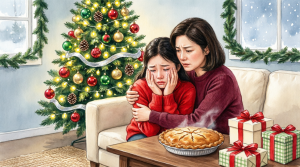
Our apartment was quiet when I stepped inside, the kind of quiet that doesn’t soothe but alarms. The Christmas tree in the corner glowed softly, lights reflecting off ornaments McKenzie and I had collected over the years—cheap plastic stars, handmade paper snowflakes from her elementary school days, a tiny ceramic book ornament a student had given me last year.
McKenzie was on the couch, curled up like a child even though she was almost an adult, knees tucked to her chest. She was still wearing that red sweater dress. Her shoes lay kicked off near the coffee table. Her eyes were swollen and glassy, her cheeks streaked with dried tears.
On the sideboard, her homemade apple pie sat untouched. Next to it were the gifts—neatly wrapped boxes with perfect bows. She’d brought them back. She’d brought everything back. Like she couldn’t bear to leave even an inch of herself behind in that house.
The sight of her broke something in me. I crossed the room and dropped to my knees beside the couch, pulling her into my arms.
She clung to me with a force that told me she’d been holding herself together by sheer will until the moment she saw me. Then she shook, silent at first, then sobbing—raw, shocked sounds that seemed to come from somewhere deep.
I held her tight, pressing my cheek to her hair. “I’m here,” I whispered. “I’ve got you. I’m here.”
“I don’t understand,” she choked out. “I tried, Mom. I tried so hard. I was polite. I brought the pie. I brought gifts. I smiled. I didn’t say anything wrong. I swear I didn’t.”
“I know,” I said fiercely. “I know you didn’t.”
She pulled back just enough to look at me. Her hazel eyes—my eyes—were full of pain and confusion. “Why would she say that?”
Because she could, my mind answered. Because she’d been saying it in a thousand quiet ways for years and tonight she finally used the words.
But I didn’t say that to McKenzie. Not yet. She didn’t need the full weight of my history in this moment. She needed certainty.
“She said it because something is wrong with her, not with you,” I said. “Do you hear me? You are my daughter. You are family. You are loved. You belong.”
McKenzie’s lips trembled. She nodded, but I could see the damage already taking root—the kind of damage that comes from rejection, from being told you don’t have a place in a room you thought you’d earned.
I kissed her forehead and pulled her close again. “Go upstairs and take a shower,” I said gently after a while. “Put on something comfortable. I’m going to make hot chocolate, okay?”
She hesitated like she didn’t want to leave me. Then she nodded and stood, moving like someone underwater.
As she climbed the stairs, I stared at the gifts, at the pie, at the tree, and something inside me snapped—not into brokenness, but into steel.
I took out my phone and opened my contacts. Jordan Pierce.
Jordan and I had met years ago in a way that felt almost like fate. She’d been a young lawyer volunteering at a community center where I tutored kids after school, the same community center I’d once volunteered at as a teenager when I’d first realized I wanted to teach. She’d helped a mother file for a restraining order against an abusive ex, and I’d seen how calm and fierce she was—how she could speak softly while moving mountains.
When McKenzie was three, Jordan had helped me with a messy legal situation involving child support from a man who had long since vanished. Jordan had done it partly as a friend, partly because she hated injustice. She’d become one of the few people I trusted completely.
I typed a message with steady fingers: Handle them all.
Then, before I could second-guess myself, I sent it.
The phone rang minutes later. Jordan. I answered on the first ring.
“Kayla,” she said, and I could hear the question in her tone. “What happened?”
I told her. I didn’t sugarcoat it. I didn’t try to make it sound less cruel than it was. I described McKenzie at the door with gifts, my mother’s sneer, that sentence that should never be said to any child.
When I finished, there was a pause.
Then Jordan’s voice turned sharp. “Do you want to cut contact?”
“Yes,” I said. “I want to make sure they can’t touch us. Not financially, not legally, not emotionally. I want everything documented. I want every boundary in place.”
“Okay,” Jordan said. “I’m on it. I’ll send you what you need tonight. And Kayla?”
“Yeah?”
“You’re doing the right thing.”
I ended the call and stood in the kitchen staring at the counter where McKenzie had rolled out pie crust just the night before, humming Christmas songs. The cinnamon scent still lingered faintly, but now it felt like a ghost.
My phone buzzed again.
Mom.
One missed call. Then another. Then another. The screen lit up over and over until I turned it face down on the counter.
I made hot chocolate with extra marshmallows, the way McKenzie liked it. I carried a mug upstairs and found her in her pajamas, hair damp from the shower, sitting on her bed with her knees drawn up.
She took the mug with both hands like it was something to hold onto. “Are you mad at me?” she asked suddenly, so quietly it might have been swallowed by the hum of the heater.
My heart clenched. I sat beside her and took her hand. “Never,” I said. “Not in a million years.”
She stared at the mug, watching the marshmallows melt. “I keep thinking maybe I should’ve stayed. Maybe I should’ve said something. Maybe I should’ve—”
“You did exactly what you needed to do,” I interrupted. “You left a place that wasn’t safe for you. That’s strength, McKenzie. Don’t ever apologize for protecting yourself.”
She swallowed, and a tear slid down her cheek. I wiped it away with my thumb.
Downstairs, my phone began buzzing again.
Over the next hour, thirty-eight missed calls came in from my mother. Voicemails stacked up like a desperate tower. I didn’t listen to them. I didn’t need her words to muddy what was clear.
At midnight, when McKenzie finally fell asleep, I sat at the kitchen table with my laptop open and the Christmas tree lights reflecting in the screen.
I opened my email.
And there it was again—the message from two months ago that I’d archived and tried not to think about: an offer from a headhunter representing a growing school district in Austin, Texas. Assistant principal position, with a strong chance of becoming principal within a year. Better pay. Better hours. A chance to lead a curriculum program focusing on creative writing—my passion, the thing I’d spent years nurturing in students like seeds.
When I’d first read the email, my instinct had been to delete it. My life was here. McKenzie’s life was here. And despite everything, part of me still clung to the illusion that I could make Boston work. That I could carve out peace in the shadow of my parents’ house.
But now?
Now Boston felt poisoned.
I clicked the email open and reread it slowly. The words felt like a door cracking open.
I thought of McKenzie’s face when she’d said, “What did I do wrong?” I thought of her sitting alone with a plate on her lap while others laughed at a table set for everyone but her. I thought of how many times I had forced her to show up, to smile, to hope, because I didn’t want her to feel the emptiness I’d felt.
I was done offering her up to be hurt.
By morning, the decision had settled into me like something inevitable.
When McKenzie came downstairs, she looked exhausted, but there was a steadiness in her eyes that hadn’t been there the night before. She poured herself a glass of water and stood by the kitchen counter, staring out at the gray winter sky.
“What happens now?” she asked.
I turned my laptop toward her so she could see the email. “We start over,” I said. “If you’re willing.”
She read, her eyes moving across the screen. “Austin,” she murmured.
“Yeah,” I said. “It’s a big move. But it’s also… a chance. A real chance. New school. New community. No Sunday dinners where you have to shrink yourself to fit into their narrative.”
McKenzie was quiet for a long time. Then she looked up at me and something like relief flickered across her face. “I’m tired, Mom,” she said. “I’m tired of trying to make them want me.”
My throat tightened. “Me too.”
She nodded once, decisively. “Then let’s go.”
We spent the next hours doing what I always did when my world threatened to collapse: we made lists. Practicality is a lifeline when emotions are a storm.
I called the district in Austin and asked for a formal interview. They offered me a time slot within the week. I emailed back with careful professionalism, as if my heart wasn’t still bruised and burning. I started researching neighborhoods, school rankings, moving companies.
McKenzie made her own list—colleges she’d already applied to, scholarship offers she’d received, clubs she wanted to join wherever we went. She tried to sound casual about it, but I could hear excitement woven through her voice like gold thread.
That afternoon, while she sat on the couch with her laptop open, I drafted an email. Then I erased it. Then I drafted it again.
When it finally felt true, I handed it to McKenzie. “Read this,” I said. “Tell me if it sounds right.”
She read silently. When she finished, she looked up at me with tears in her eyes again, but these were different tears. “It’s right,” she whispered. “It’s honest.”
So we sent it.
Not just an email—we printed it, too, and sent it certified mail, because I wanted a paper trail they couldn’t twist into “Kayla overreacted” or “Kayla misunderstood.” I wanted proof.
The letter was simple, stripped of unnecessary emotion because I’d learned long ago that my parents used emotion like ammunition.
It said that on Christmas Eve, while I worked to help a colleague whose family was in crisis, my seventeen-year-old daughter arrived at their home with gifts and a homemade pie. It said that my mother told her she was not her granddaughter and ordered her to leave. It said that this was not an isolated incident but the culmination of years of neglect and favoritism.
It said that we were moving to Austin at the end of January.
It said we did not want contact.
It said: If you ever want a relationship with us again, it will require accountability, therapy, and consistent proof of change.
Then it said goodbye.
Within hours, the backlash began.
My phone lit up with their calls. My mother’s name over and over. My father’s gruff voicemail notifications. Taylor’s email full of indignation.
I didn’t answer.
I listened to one voicemail from my mother only because I needed to know what she was going to claim, what narrative she would try to spread.
Her voice came through, shaky and desperate. “Kayla, please. Please don’t do this. It was… it was a misunderstanding. I didn’t mean it like that. McKenzie is sensitive, and you know how she takes things. We were just… we were caught off guard. Call me. Please.”
I stopped it halfway through and deleted it.
Caught off guard. As if my daughter hadn’t been going to Sunday dinners for years. As if McKenzie’s existence wasn’t known. As if cruelty could be dismissed as surprise.
That night my father left his own voicemail, voice low and furious. “After everything we’ve done, you’re going to tear this family apart? You’re selfish, Kayla. You always have been. Think about what you’re doing.”
The words hit old bruises. For a moment, my hands shook. Because there was a part of me—small, deeply conditioned—that still craved my father’s approval. That part of me had been trained from childhood to believe love was earned through obedience.
But then I looked at McKenzie, who was sitting on the floor wrapping a gift for her best friend with careful precision, and I remembered what mattered.
Taylor’s email came after midnight.
Subject line: THIS IS INSANE.
Her message was a long, furious spiral of blame. She accused me of “punishing everyone” for “a tiny comment.” She insisted my mother hadn’t meant it, that my daughter was “dramatic,” that I was “still bitter” about “that pregnancy mess” from years ago. She said moving to Texas would ruin McKenzie’s senior year. She implied I was using my daughter as a weapon.
I read it once. Then I replied with three words:
Decision is final.
Then I blocked her.
Ten days later, they came to my door.
It was late afternoon again, the sky dim with winter. The doorbell rang once, then again, sharp and insistent.
McKenzie was at the kitchen table working on an essay—college applications, personal statements, the kind of writing that reveals who you are when the world asks you to define yourself. She looked up, startled.
I went to the window and pulled back the curtain just enough to see.
There they were on the porch: my mother in her coat and scarf, her face tight with anxiety; my father standing beside her like a wall, jaw clenched; and Taylor behind them, arms folded, expression hard.
McKenzie’s breath caught. “It’s them,” she whispered.
I turned to her. “You don’t have to do this,” I said quickly. “You can go upstairs.”
McKenzie’s eyes flicked to the stairs, then back to me. Something in her expression sharpened. “No,” she said. “I want to hear them say it. I want to hear what they think they can justify.”
My heart swelled with pride and fear all at once. I squeezed her hand. “Okay,” I said. “Stay close.”
I opened the door, but I didn’t step aside. I stood in the doorway like a boundary made flesh.
Cold air rushed in, bringing with it the scent of my father’s aftershave, my mother’s perfume—scents that used to mean home when I was a child, now sharp as reminders.
My father spoke first. He held a printed copy of our letter in his hand like evidence in a trial. “What the hell is this?” he demanded. “You can’t just cut us off because your daughter got her feelings hurt.”
McKenzie’s hand tightened in mine.
I kept my voice calm. “She didn’t ‘get her feelings hurt.’ She was told she wasn’t family.”
My mother stepped forward, eyes shining with tears. “Kayla, please,” she said, voice trembling. “I didn’t mean it. I didn’t. I was upset and—”
“You were upset about what?” McKenzie interrupted quietly.
My mother froze, as if she hadn’t expected McKenzie to speak.
Taylor scoffed. “Oh my God,” she muttered. “This is so dramatic.”
My father’s gaze snapped to McKenzie, then back to me. “You’re taking her away,” he said, voice thick with anger. “Across the country. Over one night.”
“One night doesn’t erase seventeen years,” I said.
My mother’s eyes flashed. “Seventeen years?” she repeated, offended. “We’ve tried. We’ve had you over. We’ve invited you to dinners—”
“You set the table for everyone but me,” McKenzie said, her voice shaking but strong. “You told me to eat in the living room. You ignored me when I talked. You forgot my birthday. You never asked about my writing. You never cared unless it was convenient.”
Taylor’s mouth opened, then shut, as if for a moment she couldn’t find words.
My father’s face darkened. “That’s not true,” he growled. “We care about you.”
“Then why did you say it?” McKenzie asked, and the question landed like a stone.
My mother’s shoulders trembled. She looked away, then back, as if searching for a version of reality where she could be the victim. “I…” she started.
Taylor jumped in. “She didn’t mean it literally,” she snapped. “She was just… frustrated. You know how Mom is. She says things.”
“She said I’m not her granddaughter,” McKenzie repeated, and her voice broke on the word granddaughter. “What does that mean if not literal?”
My father stepped forward, anger swelling. “Enough,” he said. “We’re not doing this. Kayla, you’ve always held grudges. This is you punishing us because you still can’t get over what happened when you were young. You made choices. We did what we had to do.”
There it was. The old justification. The old verdict.
“You kicked me out when I was pregnant,” I said, voice steady. “You told me I’d ruined your reputation. You cut me off. I survived anyway. I didn’t come crawling back for money or pity. I came back because my daughter deserved a chance at family. And you proved, again, that you don’t know how to love without conditions.”
My mother’s tears spilled over. “We were scared,” she whispered. “You were throwing your life away.”
“I built a life,” I said. “And you weren’t part of it because you chose not to be.”
Taylor shifted, annoyance rising. “This is unbelievable,” she said. “You’re acting like we’re monsters. We’re not. We have a family. We have traditions. And you’re… you’re ripping it apart.”
My laughter was quiet and bitter. “What family?” I asked. “The one where my daughter eats alone?”
Taylor’s cheeks flushed. “Cody loves McKenzie,” she said quickly. “He asks about her. You’re hurting him, too.”
McKenzie’s gaze turned sharp. “When was the last time you let me see him without you hovering?” she asked. “When was the last time you brought him to my school play? When was the last time you asked me to babysit? You don’t get to use him as an excuse now.”
My father looked like he wanted to shout, but my mother grabbed his arm. “Kayla,” she pleaded. “Please. Don’t do this. Don’t leave. Don’t take her away. We can fix it.”
“Fix it how?” I asked. “By pretending it didn’t happen?”
My mother’s mouth trembled. “We can… we can start over.”
I shook my head. “We’re already starting over,” I said. “Just without you.”
My father’s eyes narrowed. “If you walk away,” he said, voice low, “don’t expect us to come running back. Don’t expect help. Don’t expect inheritance. Don’t expect—”
I interrupted him, calm as ice. “We’ve never expected anything from you,” I said. “That’s the point.”
For a moment, there was silence except for the faint sound of a neighbor’s dog barking down the street.
Then my mother whispered, “Blood is blood.”
I met her gaze. “Blood isn’t love,” I said. “Love is love. And you’ve shown us exactly how much you’re willing to give.”
I took a breath, felt McKenzie’s hand in mine, warm and steady. “You need to go,” I said.
My father’s jaw clenched. Taylor rolled her eyes. My mother looked like she might collapse.
But they didn’t argue again. Maybe because something in my voice finally made them understand there was no more negotiation, no more guilt, no more pleading that could change my mind.
They turned and walked down the steps.
My mother looked back once, tears streaking her face. “Kayla,” she whispered.
I didn’t answer. I closed the door softly, but firmly, and locked it.
McKenzie exhaled like she’d been holding her breath for years. She leaned against the wall, eyes shining. “We did it,” she whispered.
I pulled her into my arms again. “Yeah,” I said. “We did.”
That night, as snow began falling again outside our windows, I sat alone after McKenzie went to bed and let myself remember everything I’d tried not to think about.
Seventeen years earlier, my life had shattered for good—and the sound of it had been my father’s fist slamming on the kitchen table.
I’d grown up in a tidy split-level house outside Boston, the kind with a white picket fence and trimmed hedges that made neighbors nod approvingly when they drove by. From the outside, it looked like a postcard version of family: two parents, two daughters, a golden retriever when we were younger, Christmas wreaths in the windows, backyard barbecues.
Inside, the reality was quieter and sharper.
Taylor, my older sister by four years, was the sun in my parents’ universe. She was the kind of child who seemed designed to impress: perfect grades, athletic trophies, a smile that photographers loved. My father used to call her “my girl” in a voice full of pride.
When Taylor scored a goal at a soccer game, my mother baked her special chocolate chip cookies that same night, the house smelling of butter and sugar and celebration. My father would tell the story to anyone who would listen—neighbors, coworkers, strangers at the grocery store—his chest swelling as if Taylor’s achievements were his own.
And me?
I was the shadow. The afterthought. The kid who quietly did well but not spectacularly enough to compete with Taylor’s shining orbit.
I wasn’t a failure, exactly. I got good grades. I stayed out of trouble. I volunteered at the local community center helping younger kids learn to read, because something in me loved watching a child’s face light up when words began to make sense.
That was where I first felt certain about who I wanted to be. I wanted to teach. I wanted to give kids the kind of attention and belief I rarely felt at home.
But when I mentioned studying education in college, my father waved it off like a fly. “Teaching is fine,” he said, “but it’s not a real career. You need something practical.”
Taylor was already being groomed for business school—my father’s path. He worked in finance and spoke about numbers like they were scripture. He wanted Taylor to follow in his footsteps.
My mother nodded along, eyes barely lifting from whatever recipe she was reading. “Teaching can be a hobby,” she said lightly. “But you’ll want something that actually pays.”
Taylor smirked, sprawled on the couch like she owned the world. “Yeah, Kayla,” she said. “Not everyone’s cut out for the real world.”
I pretended it didn’t hurt. I learned early how to swallow hurt like a pill.
I pushed through anyway. I applied for scholarships. I worked part-time jobs in high school. I got into State University and moved into a dorm room that smelled like laundry detergent and hope. For the first time in my life, I felt like I could be myself without constantly measuring my worth against Taylor’s reflection.
Freshman year flew by in late-night study sessions, cheap coffee, the thrill of being surrounded by people who didn’t already have a role written for me. I made friends. I joined a literature club. I sat in lectures about child development and teaching methods and felt something settle inside me—this quiet certainty that I was where I belonged.
Then sophomore fall, at a campus mixer, I met him.
He was charming in that effortless way some people have, like he’d never had to question whether he belonged in a room. He laughed easily, and when he looked at me, he made me feel seen in a way I wasn’t used to. He told me I was funny. He told me I was smart. He called me beautiful like it was obvious.
We dated fast—too fast. I see that now, with the clarity time gives. But back then, I was hungry for affection, for attention, for someone who chose me. I mistook intensity for love.
By winter break, I was staring at two pink lines on a drugstore pregnancy test, hands trembling in a cramped bathroom stall.
I still remember the way my stomach dropped, the way my ears rang, the way the fluorescent lights made everything look sickly pale. I sat on the closed toilet lid and pressed my palm to my belly as if I could smooth the fear away.
When I told him, he went quiet. He said he needed time. He said we’d talk later.
Then he vanished.
No goodbye. No explanation. No call. No text. One day he was there, and the next he was gone like smoke. I tried calling him until my phone battery died. I left messages that went unanswered. I asked his friends, who shrugged awkwardly and avoided my eyes.
I learned, in the coldest way possible, that some people leave without looking back.
I drove home to tell my parents because I didn’t know what else to do. Part of me—still that girl who wanted her father to be proud—believed they would help. That they would at least hold me while I cried, tell me we’d figure it out.
The second the words left my mouth, my father’s face hardened like stone.
“You’re irresponsible,” he barked, voice loud enough that it felt like it hit the walls and bounced back. “You’re throwing your life away.”
He slammed his fist on the kitchen table so hard the salt shaker jumped.
My mother’s hand flew to her mouth, eyes already tearing. “What will the neighbors think?” she whispered. “Kayla, do you understand what you’ve done? We have a reputation.”
Taylor leaned against the doorway, arms crossed, smugness slicing through me. “I always knew you’d mess up big,” she said, voice dripping with satisfaction.
My father started listing options like a judge handing down a sentence. “You end it,” he said. “Or you give it up. Those are your choices.”
My mother nodded, tears falling. “We can help you move on,” she said, as if the baby inside me was a mistake to erase.
I remember standing there with my hands shaking, my heart pounding, and something inside me—small but fierce—rose up.
“No,” I said. My voice trembled, but it didn’t break. “I’m keeping my baby.”
My father’s eyes narrowed. “Then you’re on your own,” he said. “You think you can do this without us? You can’t. You’ll ruin everything.”
My mother’s shoulders stiffened. She turned away like she couldn’t bear to look at me. “Pack your things,” she said. “You can’t stay here.”
Just like that. A door slammed shut in my life.
That night, I stuffed clothes into a duffel bag with shaking hands, grabbed my textbooks and my scholarship paperwork, and walked out into the cold December air. The door clicked shut behind me like a final judgment.
I didn’t cry until I was in my car.
I cried so hard I couldn’t see the road at first. Then I wiped my face, gripped the steering wheel, and drove back to campus because there was nowhere else to go.
The months that followed were survival. A cramped studio apartment off campus that smelled like old carpet. Financial aid that barely covered tuition. Cafeteria shifts that left my feet aching. Part-time tutoring gigs that paid in crumpled bills. Night classes where I sat with my belly growing under my sweater, trying to focus while my mind churned with worry.
I learned what it meant to be hungry. Not just for food, but for security. For kindness.
When labor hit in July, it started at dawn, sharp pain rolling through my body like waves. I drove myself to the hospital with my hands trembling on the wheel, stopping to breathe through contractions at red lights.
The hospital room smelled of antiseptic and sweat. Nurses moved efficiently, kind but busy. There were no family members waiting in the hall. No father pacing. No mother holding my hand. No sister bringing flowers.
It was just me.
When McKenzie’s first cry filled the room, piercing and fierce, it felt like a promise.
I held her tiny hand, her fingers curling around mine instinctively, and I whispered, “We’ve got this, kiddo. It’s you and me.”
And it was.
The first years blurred into a grind of diapers, late-night feedings, homework, and exhaustion so deep it felt like it lived in my bones. I studied for my teaching certification at night with McKenzie sleeping beside me in a borrowed bassinet. I worked any job I could—tutoring, babysitting, summer programs. Some months I had exactly two hundred dollars left after rent and bills. Some months I had less.
McKenzie grew in the spaces between my struggles. She learned to walk in that tiny studio, her little feet slapping against the worn floor. She learned words early, pointing at my flashcards with chubby fingers and repeating them with determination. She would babble while I graded papers, her voice like music in the quiet.
My parents sent one card on her first birthday. No signature. No message. Just a generic printed “Happy Birthday” as if even that sentiment was too intimate to attach their names to.
Taylor visited once when McKenzie was a toddler. She looked around my peeling wallpaper and cheap furniture with a wrinkled nose. “You’re doing okay, I guess,” she said, as if she were evaluating a stranger’s effort.
She didn’t hug me. She didn’t hold McKenzie.
Then she left.
Holidays were the hardest. When other families gathered, when Christmas lights glowed and laughter spilled out of houses, it was just McKenzie and me in our little apartment with takeout Chinese food or a cheap frozen pizza I tried to dress up with extra toppings.
When McKenzie was five, she asked me why she didn’t have grandparents like her friends.
“Where are Grandma and Grandpa?” she asked one December night, her eyes wide and innocent. “Do they live far away?”
I had swallowed hard and said the simplest truth I could manage. “They’re… complicated,” I said. “But you have me. And I have you.”
She nodded, but I could see questions forming like clouds behind her eyes.
As she grew older, those questions sharpened. At twelve, one evening over mac and cheese, she looked up at me and asked softly, “Mom, what’s Grandpa like? Do we have family stories?”
There was a tenderness in her voice, a longing that made my heart twist.
I had spent years shielding her from the full ugliness of my parents’ rejection. I didn’t want her to feel unwanted. I didn’t want her to carry my pain.
But how long could I keep painting them as distant and vague? How long could I keep my daughter from something she clearly craved: roots, connection, a sense of belonging beyond just the two of us?
I wrestled with it for weeks. Every instinct in me wanted to protect her by keeping the door closed. But love sometimes means risking hurt to give someone a chance at something meaningful.
So I caved.
“They’re complicated,” I told her again. “But… we can try.”
That was how the monthly Sunday dinners began.
The first time we drove to my parents’ colonial house in the suburbs, my stomach churned so hard I thought I might be sick. The driveway was lined with Taylor’s SUV, shiny and expensive. My mother’s wreath hung on the door like a symbol of perfect holiday cheer, even though it wasn’t the holidays.
McKenzie clutched a drawing she’d made—a simple sketch of our little family, just her and me holding hands under a bright sun. “Do you think Grandma will like it?” she asked.
“I’m sure she will,” I lied, because hope is a thing mothers sometimes hand their children even when they’re not sure it will survive.
When my mother opened the door, she smiled—tight and practiced. “Well,” she said, eyes flicking over McKenzie like she was assessing how much she resembled me. “Hello.”
My father stood behind her, arms crossed, face unreadable. After a moment, he cleared his throat and said, “Come in.”
It wasn’t warmth. It was tolerance. But it was a beginning.
McKenzie, for her part, was radiant with effort. She said “please” and “thank you” and complimented my mother’s cooking. She asked my father questions about his garden. She tried.
And for a while, it almost worked.
My father would ruffle her hair sometimes, awkward but not cruel. My mother would give her extra mashed potatoes, her way of showing affection without saying it. There were moments—small and fleeting—when McKenzie laughed at something my father said and my mother’s eyes softened, and I thought maybe, just maybe, things could heal.
But cracks showed quickly.
Taylor came to most dinners with her husband, Dylan Walsh, both of them polished and comfortable in my parents’ house like it belonged to them. Taylor took up space the way she always had—loud stories, confident opinions, casual superiority. Dylan was friendly enough, but he followed Taylor’s lead.
McKenzie tried to tell them about school, about a story she’d written, about a book she loved. They nodded vaguely and moved on.
At first, I told myself it was just adjustment. That it would take time.
Then, when McKenzie was fifteen, Taylor announced she was pregnant.
The entire atmosphere in my parents’ house shifted as if the air itself had been electrified. My mother squealed and cried. My father looked like someone had handed him a second chance at joy.
When Cody Ellis arrived—a screaming bundle in a hospital room decorated with blue balloons—my father held him like a treasure. “Look at him,” he whispered, eyes shining. “Strong grip already.”
From that moment, Cody became the center of everything.
My parents remade their world around him. They started a college fund immediately, my father proudly announcing he’d deposited five thousand dollars “just to start.” My mother converted the guest room into a nursery extension, buying a crib that cost more than my monthly rent had once been, hanging tiny baseball posters on the walls, stocking drawers with clothes Cody would outgrow in weeks.
They visited Taylor constantly. They babysat. They posted pictures on social media with captions like “Blessed beyond words.” My mother joined parenting groups again as if she were raising Cody herself.
McKenzie faded in their attention like a candle in daylight.
Her birthdays became afterthoughts. When she turned thirteen, we celebrated in our apartment with a homemade cake I baked from scratch. We sang. We laughed. But when she checked her phone afterward and saw no messages from my parents, no calls, no card in the mail, her shoulders drooped.
“They must have forgotten,” she said quietly, hugging her knees on the couch.
The scent of vanilla filled the room, sweet and painful. I wanted to drive to my parents’ house and scream. Instead, I wrapped my arms around her and said, “They’re busy. It’s not about you.”
But even as I said it, I knew it wasn’t true.
By sixteen, the Sunday dinners turned into ritualistic torture.
The table was always set for six: my mother and father at the ends, Taylor and Dylan on either side, Cody’s high chair placed prominently like a throne. My chair sat empty unless I was there. McKenzie’s place was never clearly defined. Sometimes a folding chair would appear near the wall, like an afterthought. Sometimes she would end up balancing her plate on her lap in the living room because no one rearranged anything to make space.
“Pass the rolls, please,” she would murmur politely, reaching across awkwardly.
My father barely glanced her way, too busy spooning peas for Cody. “Eat up, champ,” he’d say, voice warm. “This’ll make you big and strong.”
My mother cooed over Cody’s babbling and laughed at every sound he made like it was genius.
McKenzie, meanwhile, would mention—softly, carefully—that she’d won an essay contest. That she’d placed first in a regional writing award with a story she’d titled Family Secrets, a story that had made me cry when I read it because it was full of longing and quiet resilience.
“That’s nice, dear,” my mother said once, not looking up from her plate.
Then she launched into a video on her phone of Cody taking his first steps.
Taylor nodded along, distracted by emails. “He’s a natural athlete,” she said proudly. “Just like Dylan.”
No one asked about McKenzie’s writing. No one said they were proud. No one even seemed curious.
I watched my daughter’s face carefully during those dinners. I saw how her smile became more practiced, how her eyes grew guarded. I saw her learn the same lesson I’d learned: don’t expect warmth where there isn’t any.
Still, she kept trying.
Because McKenzie was kind to a fault. Because she believed effort could earn love. Because she wanted to belong.
And I let her keep trying because part of me still hoped. Part of me still wanted my parents to change, to see what they were doing, to fix it.
That was my mistake.
Three weeks before Christmas, my colleague—Lena—burst into the staff room with her eyes red and her hands shaking. “My husband,” she whispered. “They found something serious. I need to be with him. I can’t— I can’t do the holiday coverage.”
The stack of grading she was responsible for sat on the table like a threat.
Without thinking, I said, “I’ll take it.”
Lena stared at me like I’d thrown her a lifeline. “Kayla, you don’t have to—”
“I do,” I said. “Go. Be with him. I’ve got this.”
Because I knew what it was to be alone in a crisis. Because my instinct had always been to fill gaps. Because being needed felt like purpose.
That decision meant Christmas Eve would be complicated. I’d promised my parents we’d be there for dinner. McKenzie had been talking about it for weeks, about bringing her apple pie, about giving everyone gifts.
The night I told her I’d be working late, we sat on our worn couch while the tree lights blinked softly.
“Sweetie,” I said, “I’ve got extra grading over the holidays. Lena’s family emergency. I need to cover.”
McKenzie’s face flickered with disappointment, but she immediately smoothed it into understanding. “Of course,” she said. “She needs you.”
I watched her carefully. “Would you be okay going to Grandma and Grandpa’s without me? I’ll join after. Around ten, maybe.”
McKenzie nodded slowly. “I can do that,” she said, fiddling with her bracelet. “I’ll drive myself.”
“You sure?” I pressed. “Things get… awkward sometimes.”
She gave me a small smile that made my heart ache. “I’ll manage,” she said. “Maybe this year will be better. I have news, Mom.”
“What kind of news?” I asked, though I already suspected.
Her eyes lit with a spark. “Scholarships,” she said softly. “I’ve got three offers already. Full rides. I wanted to tell them. I wanted… I don’t know. I wanted them to be happy.”
The hope in her voice made me want to cry.
I hugged her tight and inhaled the scent of her hair. “I’m proud of you,” I whispered. “Always.”
In the days leading up to Christmas Eve, McKenzie threw herself into preparation like it was a mission. She tweaked her pie recipe late into the night, the apartment filled with cinnamon and apples. She wrapped gifts with crisp paper and perfectly tied bows. She knitted a scarf for my mother, fingers moving rhythmically while she watched holiday movies.
“Do you think she’ll like it?” she asked, holding up the scarf, the yarn soft and pale blue.
“She’d have to be made of stone not to,” I said, forcing confidence.
Christmas Eve morning, I kissed McKenzie’s forehead before leaving for school. “Text me when you get there,” I said. “Call if anything feels off.”
McKenzie waved from the kitchen, pie cooling on the rack, red sweater dress already on. She looked beautiful—grown, hopeful, eager.
“Go conquer your papers,” she said. “See you tonight.”
The day at school dragged. The halls were quiet, decorated with leftover tinsel and paper snowmen. I graded essays until my wrist cramped. Around six-thirty, my phone pinged.
Made it. Pie’s a hit with Uncle Dylan.
Relief washed through me. I texted back a heart emoji. For a moment, I let myself breathe.
Then, at seven-forty-five, my phone vibrated again—insistent. Two missed calls. Then a text:
Can you talk now?
The dread that hit me was physical, cold in my stomach.
When I called her back and heard her voice breaking, something inside me knew: the fragile bridge I’d built had collapsed.
Later, when McKenzie finally told me everything in more detail—when the shaking stopped enough for her to speak—I could see the night like a movie in my mind.
She arrived at my parents’ house with the pie warm in her hands, gifts stacked neatly in her arms. She rang the bell with a practiced smile, reminding herself to be confident, to be gracious.
My mother opened the door, took one look at her, and her lips twisted.
McKenzie said, “Merry Christmas, Grandma.”
My mother’s eyes were cold. “What are you doing here?” she asked.
McKenzie blinked, startled. “I… I’m here for dinner. Mom said she’d be late, but I—”
My mother’s gaze dropped to the pie, to the gifts, to McKenzie’s eager face. Something hard flickered across her expression.
“You’re not my granddaughter,” she said, voice sharp enough to cut. “Get out.”
McKenzie froze.
For a second, she truly believed she’d misheard. Because who says that? Who looks at a child—nearly grown, still a child in the ways that matter—and erases her with a sentence?
McKenzie’s mouth opened, but no sound came out. She stood there holding love in her arms—pie, gifts, hope—and it suddenly weighed like stones.
My father appeared behind my mother, his face unreadable. He didn’t contradict her. He didn’t step forward. He didn’t say, “What are you talking about?”
He just stood there.
Taylor’s voice drifted from the living room, laughing about something Cody had done. Cody’s toy cars buzzed across the floor.
McKenzie’s throat tightened. “Grandma…” she whispered. “Why would you—”
My mother’s face hardened further, as if softness would make her lose control. “I said get out,” she snapped, louder. “Don’t make a scene on Christmas.”
A scene. As if McKenzie was the problem.
Taylor looked over from the living room then, her eyes flicking toward the doorway. She saw McKenzie frozen there, saw my mother’s expression, and instead of intervening she rolled her eyes like she was bored.
“Mom,” Taylor called lightly, “Cody’s juice is spilling.”
My mother glanced back and forth as if choosing what mattered. Cody mattered. Reputation mattered. Control mattered.
McKenzie didn’t.
My mother stepped aside—not to welcome McKenzie in, but to close the door. “Leave,” she said.
McKenzie stumbled backward like she’d been physically pushed. She turned toward her car with her arms still full. She fumbled to set the pie down carefully in the passenger seat, fingers trembling. Gifts slid, ribbons crumpling. Her vision blurred with tears.
She started the engine and drove away in the rain, her chest aching so hard she thought she might throw up.
And as she drove, she called me, because I was the only person who had ever truly been home.
When she finished recounting it all, she looked at me with haunted eyes and whispered, “I feel stupid.”
“You’re not stupid,” I said fiercely. “You were brave.”
She shook her head. “I wanted them to want me,” she admitted, voice breaking. “I wanted… I don’t know. I wanted to feel like I belonged somewhere bigger than just us.”
My heart cracked and swelled at the same time. “You do belong,” I said. “You belong with me. And we’re going to build something bigger. Something real.”
In the days that followed, we packed our lives into boxes.
It was surreal, moving through our apartment wrapping dishes in newspaper, folding clothes, labeling cardboard with black marker. It felt like preparing for an earthquake that had already happened.
McKenzie was quiet at first, moving with a focused determination. She didn’t cry much after that first night. She was too busy doing what she always did: adapting, surviving, making herself useful.
But sometimes, late at night, I’d hear her moving around upstairs, and I’d find her sitting on her bed staring at the ceiling.
“Do you think they’ll ever realize?” she asked me once, voice barely above a whisper.
I sat beside her and smoothed her hair back. “Maybe,” I said honestly. “But that’s not our job. Our job is to live.”
McKenzie swallowed. “I don’t want to hate them,” she said.
“You don’t have to,” I told her. “You just have to stop letting them hurt you.”
The interview with Austin went better than I’d dared to hope. The superintendent was impressed with my curriculum ideas, my leadership experience, my commitment to creative writing programs. They offered me the position within a week.
When I told McKenzie, she smiled—a real smile that reached her eyes for the first time since Christmas Eve. “Texas,” she whispered, tasting the word like possibility.
We left Boston at the end of January.
The day we drove to the airport, snow piled in gray heaps along the roads. The city looked like it always had—historic, stubborn, beautiful in a cold way. I wondered if I would miss it.
Then I remembered my parents’ house, my daughter’s trembling voice, and I knew I wouldn’t.
On the plane, McKenzie sat by the window. As we took off, she watched the white landscape shrink beneath us.
“Goodbye,” she murmured, not to the city, but to something else—an old version of hope.
Austin greeted us with mild drizzle and air that didn’t bite. The sky felt wider. The streets were lined with greenery even in winter. Our rental apartment overlooked rolling hills, and the first time we stepped onto the balcony, McKenzie inhaled deeply like she was breathing for the first time.
“It smells different,” she said, half-smiling.
“It smells like a new start,” I replied.
The weeks that followed were a blur of adjustment. New school for McKenzie. New job for me. New routines. New people.
McKenzie’s new high school counselor reviewed her transcripts and scholarship offers and practically glowed. “You’re an incredible applicant,” she told McKenzie. “We’ll make sure you have everything you need.”
Teachers welcomed her into clubs and activities. The literary magazine editor asked to read her writing. Debate team recruits approached her at lunch. For the first time in years, McKenzie wasn’t invisible.
At my new school, staff members introduced themselves with genuine warmth. They invited me to coffee, to barbecues, to informal gatherings where laughter felt easy. They didn’t know my history, and for once that felt like freedom.
Jordan flew down in March to help finalize legal documents. We sat in my kitchen with takeout containers and paperwork spread out like a map.
“It’s clean,” she said, tapping the finalized documents with satisfaction. “No loose ends. They can’t claim anything. You’re protected.”
I exhaled, tension releasing from my shoulders in a way I hadn’t realized I’d been holding. “Thank you,” I said, voice thick.
Jordan smirked. “You did the hard part,” she said. “You chose yourself. You chose McKenzie.”
As spring warmed Austin, our life began to bloom in ways I hadn’t anticipated. We found a community of people who didn’t require us to beg for a seat at the table.
Neighbors brought over food when they learned we were new. Fellow teachers included us in holiday potlucks. McKenzie made friends quickly—kids who admired her writing, who laughed at her dry jokes, who asked her opinions and actually listened to the answers.
The ache of my parents’ rejection didn’t vanish overnight. Trauma doesn’t evaporate because you change zip codes. But distance softened its grip. It became an echo instead of a daily bruise.
McKenzie graduated high school in Austin, not Boston.
She walked across a stage in a cap and gown under a bright Texas sky, her smile radiant. I sat in the audience clutching a program, tears streaming down my face. When her name was called, I screamed louder than anyone, because I had spent seventeen years fighting for her to have this moment.
After the ceremony, she hugged me tight. “We did it,” she whispered into my hair.
“Yes,” I said, laughing through tears. “We did.”
She accepted a full scholarship to the University of Texas for creative writing. The first time she walked onto campus, eyes wide, she looked like she was stepping into the future she’d always deserved.
“Mom,” she said, turning to me with excitement bubbling. “This is it. This is my place.”
And it was.
Three years after that Christmas Eve, McKenzie was thriving. She lived in a dorm decorated with posters and fairy lights, her desk covered in notebooks filled with stories. She worked on the literary journal and eventually earned a leadership role, her writing praised by professors who saw her brilliance.
I was promoted too, stepping fully into a principal position, leading curriculum changes, building programs that made space for kids whose voices were often ignored. There was a quiet irony in it—me, the afterthought daughter, creating a world where no child had to feel like an afterthought.
Occasionally, news from Boston trickled down through extended family or old acquaintances. My father’s health began to decline—heart issues, hospital stays. My mother’s social circle shrank as whispers spread. Taylor’s marriage cracked under strain and eventually shattered into divorce. She struggled financially, the comfortable life she’d always assumed she deserved slipping away.
People expected me to feel satisfaction. Revenge is a story the world loves—watch the cruel fall, watch the rejected rise.
But what I felt wasn’t triumph.
It was distance.
I didn’t wish them harm. I didn’t obsess over their downfall. I simply didn’t let their lives shape mine anymore.
On Thanksgiving in Austin, our dining table was crowded with people who had become family—Jordan when she could visit, colleagues, neighbors, McKenzie’s friends, their laughter filling the air like music. Plates passed hand to hand. Stories flowed easily. No one was forced to eat alone. No one had to fight for attention.
And every year, McKenzie baked her apple pie.
The first time she served it at our new table, someone took a bite and moaned dramatically. “This is criminal,” they declared, and everyone laughed. McKenzie’s cheeks flushed with pride.
I watched her in that moment—my daughter, glowing in warmth, surrounded by people who cherished her—and something deep inside me finally loosened.
Family, I realized, isn’t a chain you inherit.
It’s a circle you choose.
Boundaries aren’t cruelty. They’re doors you lock when someone keeps barging in to break what’s precious.
On the anniversary of that Christmas Eve, McKenzie called me from campus. “Mom,” she said, voice bright, “I got accepted to a summer writing program. Fully funded.”
I leaned back in my office chair, staring out at the hills beyond the window. “Of course you did,” I said, smiling. “That’s my girl.”
She laughed softly. Then her voice softened too. “Do you ever think about them?” she asked.
I paused.
“I think about who we used to be,” I said honestly. “And I’m grateful we’re not there anymore.”
McKenzie was quiet for a beat. Then she said, “Me too.”
After we hung up, I sat for a moment longer, letting the quiet settle.
Some people never learn how to love without control. Some people never learn how to apologize in a way that actually repairs. Some people cling so tightly to their version of family that they’d rather break it than bend.
But I had learned something else.
I had learned that my daughter’s heart was worth protecting, even from blood. I had learned that leaving isn’t always abandonment—sometimes leaving is survival. Sometimes leaving is the bravest kind of love.
And I had learned that the brightest Christmas lights don’t hang on a perfect suburban house with a white picket fence.
They glow in the places where you are welcomed, where you are seen, where no one ever has to ask, “What did I do wrong?” just to earn a seat at the table.
THE END.